Optical
second-harmonic
generation
from
magnetized
surfaces
Ru-Pin Pan
Department ofElectrophysics, National Chiao Tung Uniuersity, Hsinchu, Taiwan 30049,Republic ofChina
H.
D.
WeiInstitute ofElectronics, National Chiao Tung Uniuersity, Hsinchu, Taiwan 30049,Republic
of
ChinaY.
R.
ShenDepartment
of
Physics, University ofCalifornia, Berkeley, California 94720 (Received 7July 1988)We propose optical second-harmonic generation as ameans to probe surface magnetization. It is shown that surface magnetization can induce a number ofnonlinear susceptibility elements that
would vanish otherwise. They are presented for the (001), (110),and (111)surfaces ofafcc cen-trosymmetric crystal. An order-of-magnitude estimate, using the microscopic expression of the nonlinear susceptibility, suggests that these induced elements are detectable by optical second-harmonic generation with appropriate polarization combinations. The second-harmonic signals
from magnetized and nonmagnetized surfaces should exhibit characteristically different rotational anisotropy.
I.
INTRODUCTIONThe controversy over the observation
of
magnetically"dead"
layers by Liebermann etal.
' almost two decades ago has sparked continuting intensive studies in the fieldof
surface magnetism. ' From the basic research pointof
view, the fact that the surface and the bulkof
the same material can have very different magnetic properties is certainly most interesting and intriguing. '"
Improvedunderstanding
of
the roleof
surfaces in magnetic phase transitions will also help shed light on other physical phe-nomena such as surface melting. From the application pointof
view, the fact that magnetic memory devices could be affected by surface magnetization naturally callsfor a better understanding
of
surface magnetism. Thesurface magnetic properties
of
transition metals arealso-of
pivotal importance for catalysis and metallurgy.Experimental studies in this field have, however, been impeded by the limited number
of
analytical tools avail-able. Techniques such as electron-capture spectroscopy,inverse photoelectron spectroscopy, Hall-effect measure-ment, ' and angle-resolved photoelectron spectroscopy'
have been used. Most
of
these methods require placingthe probe along with the sample in an environment
of
ul-trahigh vacuum. Recently, optical second-harmonic gen-eration (SHG) has been proven to be a versatile probe forsurface studies. '
lt
has the advantagesof
being highly surface sensitive, capableof
remote sensing and in situ measurement, and applicable to any interface accessible by 1ight. Gne may question whether the technique can also be used to probe surface magnetization. Recently,Pan and Shen drew attention to this possibility by show-ing that the nonlinear optical susceptibility tensor for SHG for the (001)surface
of
a cubic crystal possesses a groupof
nonvanishing elements induced by the presenceof
afinite magnetization,M,
parallel to the (100) axis.'In this paper, we show in more detail the experimental feasibility
of
probing magnetized surface by opticalsecond-harmonic generation. The nonlinear optical sus-ceptibility tensors for SHG from magnetized (100),
(110),
and(111)
surfacesof
a fcc centrosymmetric crystal are derived and tabulated inSec.
II.
The input-outputpolar-ization combinations needed for detecting the nonlinear susceptibility elements induced by surface magnetization
are suggested in
Sec.
III.
The SH signals from magnet-ized and nonmagnetmagnet-ized surfaces can exhibit differentro-tational symmetries. Section IV shows a first-order
mi-croscopic expression
of
the magnetization-inducedsur-face nonlinear susceptibility, taking into account
spin-orbit interaction
of
the conduction electrons. Anorder-of-magnitude estimate ispresented, using nickel as an
ex-ample.
II.
SYMMETRY CONSIDERATIONSIn a centrosymmetric medium, the electric dipole
con-tribution to the second-order optical nonlinearity is iden-tically zero. At the surface, the inversion symmetry is broken, resulting in the high surface sensitivity
of SHG.
The magnetization
of
a material will not break the inver-sion symmetryof
the bulk material, but can lower the surface symmetry, and hence modify the formof
the non-linear susceptibility tensors for surfaceSHG.
The surface nonlinear optical polarization at
2'
can be written asP,
(2co)=y'
'(M):E(co)E(to),
where the surface nonlinear susceptibility third-rank
ten-sor g' ' is a function
of
the surface magnetization M ingeneral and E(co)is the fundamental field. The symmetry
of
g''(M)
is dictated by the symmetryof
the particularsurface under consideration. The nonzero elements
of
1230 RU-PIN PAN, H.D.WEI, AND
Y.
R.
SHEN 39 TABLEI.
Independent nonvanishing elements ofg', 'for(001), (110),and (111)surfaces offcc crys-tals without surface magnetization. (Surface is inthe x-y plane.)
Surfaces (001) (110) (111) Symmetry classes 4m mm2
3'
Independent nonvanishing elements
xzx =xxz=yzy =yyz, zxx =zyy, zzz
xzx =xxz, yzy =yyz, zxx, zyy, zzz
xxx
=
—
xyy= —
yxy= —
yyx, xzx=xxz
=yzy =yyz, zxx =zyy, zzzX'
'(M)
can be obtained from invarianceof
X''(M)
under symmetry operations:(2)
J~=T,
—
(2),-.T)).
~kg;)k,
i,
z,k=x,
y, z (2) whereT
is the transformation matrix for each symmetry operation, and summation over repeated indices is im-plied. The time-reversal propertiesof
X''(M),
neglecting dissipation, requires that the real partof
X''(M)
is an even functionof
M, while the imaginary partof
X''(M)
is an odd function
of M.
The latter group, nonvanishing only in the presenceof
afinite M, can be useful for prob-ing surface magnetization.We consider the (100),
(110),
and(111)
surfacesof fcc
centrosymmetric crystals. In the absenceof
surface mag-netization, the (001)and (110)faces areof
4mm and mm2 symmetries, respectively, while the(111)
surface isof
class 3m when more than two monolayersof
the surfaceare considered. Nonvanishing elements
of
X''(0)
forthese symmetries can be found in numerous works, e.g., the recent paper by Guyot-Sionnest et al.' These are reproduced in Table
I
for later comparison. With surface magnetization, the symmetries are changed. We summa-rize our derivation for the non vanishing surface-susceptibility tensor elements in the following. Thecoor-dinate system chosen forall cases isto have the surface in the x-y plane and the surface normal along
z.
First we consider a magnetized (001) surface: With M
parallel to the
[100]
direction (x),the fourfold symmetryof
the surface about the surface normal is broken. Thetwo independent symmetry operations are (i) reflection about the x-z mirror plane,
x
~x,
y~
—
y, andM~
—
M,
and (ii) reflection about the y-z mirror plane,x
~
—
x,
y~y,
andM~M.
Using Eq. (2), one can show that there are ten independent nonvanishing elements:(2) (2) (2)
—
(2) (2) (2) (2)(Xxxz Xxzx~ Xyyz Xyzy~ Xzxx~ Xzyy~ Xzzz Xyl,
'),
X(y)=X(2y)) are odd inM.
If
the surfacemagnetiza-tion M is parallel to the
[110]
direction, allof
the 27 ele-ments are nonzero, tenof
which are independent. Actu-ally, the latter can be obtained from the former caseof
M~~[100] by a coordinate transformation with x'~~x+yand y'~~x
—
y.If
the surface magnetization, M, is parallelto the surface normal, i.e., the
[001]
direction, thefour-fold symmetry
of
the surface is preserved. The symmetry operations are (x~x,
y~
—
y, and M~
—
M) and(x
~
—
x,
y~y,
and M~
—
M)
for reflections about the x-zand y-z planes, respectively, yielding five independent nonvanishing elements. Threeof
them are even in M and the others odd inM.
TableII
lists all the nonvanishing susceptibility elements forthe above cases.Similarly, we can find the nonvanishing
g
' elements for a magnetized (110)surface as shown in TableIII.
Wechoose the x and y axes to be along the
[110]
and[001]
directions, respectively.For
M~~[001]~~y, there are ten independent nonvanishing elements; fiveof
them are even and the other five odd inM. For
the caseof
M~~[110]~~z, there are eight independent nonzero elements; fiveof
them are even and the other three odd inM.
Note that the symmetryof
X''(M)
for the (110)surface is identicaltothat forthe (001)surface.
Finally, our results for a magnetized
(111)
surface are given in Table IV. The[21
1]
and[Ol1]
directions areTABLE
II.
Independent nonvanishing elements of g,' '(M)for the (001) surface offcccrystals with
surface magnetization M parallel to the [100],[110],and [001]directions. (x is along the [001]direction
and the surface is in the x-y plane.)
Direction of M
Independent nonvanishing elements
Even parity Odd parity
[100] xzx =xyz, yzy =yyz,
zxx, zyy, zzz
xyx =xxy, yxx, yyy, yzz, zyz =zzy
[110] xyz =xzy =yzx =yxz,
xzx
=xxz
=yzy =yyz, zxx=zyy, zzz, zxy =zyxxxx
= —
yyy, xyy= —
yxx,xzz
—
yzz,xxy =xyx
= —
yxy=
—
yyx, zxz =zzx= —
zyz=
—
zzy[001] xzx
=xxz
=yzy =yyz,zxx =zyy, zzz
xyz =xzy =yzx =yxz,
TABLE
III.
Independent nonvanishing elements of g,' '(M)for the (110)surface offcccrystals with surface magnetization M parallel to [001]and [110]directions. (y is along the [001] direction and the surface is in the x-y plane.)
Direction of M
Independent nonvanishing elements Even parity Odd parity
C Y' =X' [001] xzx =xxz, yzy =yyz, zxx, zyy, zzz xxx, xyy, xzz, yxy =yyx, zxz=zzx 2 uJ
[110] xzx =xxz, yzy =yyz, xyz =xzy, yzx =yxz, Medium Z
zxx, zyy, zzz zxy =zyx
Medium
Z=O
chosen to be the xand y axes. The cases for
M~~[211]
~xand M~~[111]~~zhave been studied. Eighteen and seven independent nonvanishing elements are found, respective-ly. The parities
of
these elements with respect to M are indicated in the table.Ep
III.
SECOND-HARMONIC GENERATIONASA PROBE FORSURFACE MAGNETISM Y'
Y
AI
We have shown that certain surface nonlinear suscepti-bility tensor elements are nonvanishing only in the pres-ence
of
a finiteM.
With appropriate combinationsof
in-put and outin-put beam polarizations, different elementsof
y
(M)
can be selectively measured by surfaceSHG.
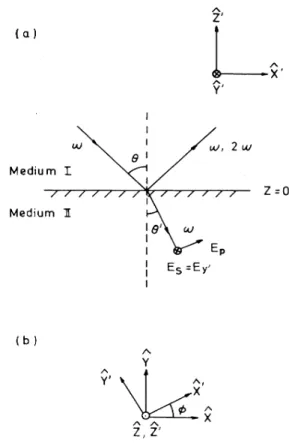
In the following discussion, we shall use the experimental geometry shown inFig. 1.
The interfaceof
mediumI
(airor vacuum) and medium
II
(which can be magnetized) is in the x-y plane, with the surface normal being the z axis. The laser beam is incident at an angle 0 with respect to the z axis, whereas L9' is the refraction angle in mediumII.
The x' and y' axes in the x-y plane are chosen to be parallel and perpendicular to the planeof
incidence, re-spectively, and Pisthe angle between x andx'.
The nota-tion (s,p) denotes that the incident fundamental beam is p polarized while the SH output is s polarized, and so on. The SH signal reflected from a centrosymmetric medium actually consistsof
not only a surface contribution but also a bulk contribution. The latter, however, tends to be weaker than the former in the caseof
metals. ' TheA A
Z, Z'
FIG.
1. (a) Geometry of second-harmonic generation inreflection from an interface between two media. (b)Beam coor-dinates x',y', and z' relative to crystal coordinates x,y, and z.
effective surface nonlinear polarization can be written as
P,
tr=P,
(M)+
P„,
where
P,
(M),
defined inEq.
(1),is the surface contribu-tion toP,
~andP„
is the equivalent surface polarization due to the bulk quadrupole. ''
We shall assume that only the surface layer is magnetized.A. (001)surface
For
a normally incident beam with the (s,s) polariza-tion combinapolariza-tion, the reflected SH signal vanishes forTABLE IV. Independent nonvanishing elements of
g,
' '(M) for the (111)surface offcccrystals withsurface magnetization Mparallel to the [211],and [111]directions. (xis along the [211]direction and
the surface is in the x-y plane.)
Direction of M
[2
11]
xxx,xyy, xzz,xzx =xxz, yzy =yyz,
yxy =yyx, zxx, zyy,
zzz, zxz
=
zzxxyx =xzy, xxy =xyx,
yxx, yyy, yzz,
xzx =yxz, zyz =zzy,zxy =zyx
Independent nonvanishing elements
Even parity Odd parity
xxx
= —
xyy=
—
yxy= —
yyx, xzx=xxz
=yyz =yzy, zxx, zyy, zzzxyz =xzy
= —
yzx= —
yxz, xxy =xyx =yxx= —
yyy1232 RU-PIN PAN, H.D.WEI, AND Y.
R.
SHEN 39P
(M)
yyy(M)E
E
Applying Eq.(2),we get
P,
,(M)
=
{[2y'~)(M)+y'
'(M)]sin
PcosP+y'
'(M)cos
P]E E
~~
C&cosp+C2cos(3$),
(4) M=0.
In the presenceof
amagnetized surface, M~~[100]
or
[110],
they'
componentof
the surface nonlinear polar-ization iswhere k (co) is the
x'
componentof
the wave vectorof
the pump field. g is a phenomenological constant describing the anisotropic contribution to P&.
'For
anormally incident s-polarized laser beam,
k„,
(co)=0,
the reflected SH signal is generated byP,
only.If
the in-cidence angle is nonzero, the contributionof
the surface magnetization to the nonlinear polarization can still be identified by inspecting the P dependenceof
the reflected SH signal.With M~~[110],one can show that, for the (s,p) polar-ization combination,
where
C,
and Cz are linear combinationsof
the nonlinear susceptibility tensor elements and the pump fields.It
is seen thatP,
~ has two components with onefold andthreefold rotational symmetries, respectively, about the surface normal ~ The equivalent surface nonlinear
polar-ization due tothe bulk quadrupole for an incident angle 0 1S]8
and
P,
,
=
[[yy,,
'(M)
—
y",
(M)]sin(2$)
+
[gy„,(M)+g',
'(M)]cos(2P)+
[yy„'(M)
—
y„',
)(M)]]E
.E,
.P), ~o:[=,
'k
(co)E' '(9)
Pb ~ccsin(4P)sinO .
Therefore, for a normally incident beam, P& ~ is zero.
Thus,
P,
f[y=P».
We note that even &ft9&0, Pby has adiff'erent rotational symmetry than
P„
If
M is parallel to z~~[001],
the SH signal with the (s,s)combination vanishes. With the (s,
p)
combination, we findp,
,(M) =y)2),
,(M)E2
+2y'
„', (M)E„E,
+yy,
',
(M)E,
=
—
y'„2,)(M)E
sin(2)9'),
(6)with the constant term arising from the magnetized
sur-face. Thus from the rotational anisotropy, the contribu-tion
of
the magnetized (001) surface can be uniquely determined.For M=O,
the SH intensity,I(2'),
ispro-portional to sin
(4P)
and exhibits an eightfold symmetry.For
M&0,
I(2')
assumes a fourfold symmetry and its minima no longer vanish.B.
(110)surfaceFor
the caseof
M~~[001], the (s,s) polarizationcom-bination yields
P,
~=
[(2gyy
(M)
—
y''(M)]sing
—
[y'
„(M)+2y'
'(M)
—
y„'
( M)]sin(3$))
E
~,
where
E
isthe electric field amplitude and g„'y,(M)
is an odd functionof M.
As one would expect physically,P„
is rotationally isotropic with respect toz.
The quadru-pole contribution from the bulk is again given byEq.
(5). The total SH field as a functionof
P isE,
(2') =
Ci+
C2sin(4$),
—
k2,.(co)E.E,
.+
k .E,
]g sin(2$)—
k (co)E
~/sin(4$),
(10)where k2,(co) is the z component
of
the wave vectorof
the refracted light in the magnetic material. In the ab-senceof
surface magnetization,y',
)=y„' ',&0,
while,
=0.
As a result,P,
~=0.
The re~ecte(2) (2) yyz xxz
signal is contributed solely by the bulk.
For
M&0,
it is possible to identify unambiguously the SH signal due tothe magnetized surface by employing geometries with
/=0
orP=a.
/2, at which Pb=0,
according to Eqs. (9) and (10), whileP,
=y'„,
)(M)E
sin(28') for/=0,
andP,
=
—
y',
)(M)E
sin(28') for P=m./2.
C. (111)surface
and
Pb ~
~ gE sin(3$)
.
Examining Eqs
(11)
and (12), we fndP,
y =Xy(2yy)(M )Ey2while Pb ~
=0
for/=0.
Both the surface and bulkcon-tributions to the nonlinear polarization are identically zero in the absence
of
surface magnetization for tt)=0,
but the former isnonvanishing for
M&0.
For
Malong the[111]
axis, the (s,s) polarizationcom-bination gives
Let us consider the (s,s)polarization combination.
For
M~~[2 1
1],
i.e.
,M in the mirror plane, we haveP,
=[
—
y„',' (M)sinP
—
y''(M)singcos
P—
2y' „'(M)sing cosP+2y'„~
(M)sin P+y',
' (M)sinP
cosP+y'
(M)cos
P]E
~(7) which is nonvanishing only for
M&0.
The equivalent surface nonlinear polarization due tothe bulk quadrupole1s
P,
y=[y'
'(M)sin(3$)+y
(M)cos(3$)]E
~ Pb ~~k2,
.(co)gEsin(3$)
. (13) (14)symme-try about
[111].
The former, induced by M, can be unambiguously determined by choosing/=0.
IV. THK MAGNETIZATION-INDUCED y'
'(M)
In the previous section we have suggested several ex-perimental geometries to probe the surface
magnetiza-tion.
It
is, however, important to know whether the magnetization-induced componentsof
y''(M)
are large enough to give detectable SH signals. In this section we will estimate these components to the linear order inM.
Consider Ni(001) as an example. We estimatey' '
(M)/y'
«(0)
=0.
1 since it should beof
the sameor-der as the ratio
of
the linear optical susceptibilitycom-ponents
y„' (M)/g('„'(0),
which isabout0.
1.'It
was first pointed out by Kittel in anorder-of-magnitude estimate that it isthe change
of
the electronic wave functions, rather than the shiftof
energy eigenval-ues due to spin-orbit coupling, which is responsible forthe magnetization-induced
y,
'"(M)
in a ferromagnetic material. In the calculation fory„'"(M) of
Ni andFe,
Ar-gyres ' showed that this theory does give reasonable
pre-dictions. Here, we apply the same method to estimate
y„"y(M)/y"„',
(0).
In the electric dipole approximation, the nonlinear sus-ceptibility for
SHG
(Ref.22)is+5
similar termsf,
(k),
(15)where k denotes the electron wave vector; v,c, c' are band
indices forthe valance and conduction bands;
f,
(k)
istheFermi distribution function forthe state ~v,k
);
(»,)
„,
isamatrix element for the ith component
of
the electronicdisplacement vector for the transition c
~v;
and(v„=
(E,
E,
)/fi.—
The Hamiltonian for amagnetized system is
(k,
r)
withm&n,
i.e.
,y„(k,
r)=
g
b„P
(k,
r)
.m (~n)
(20)
From Eqs. (18)and (19),the expression for y',~& in
Eq.
(15)can be rewritten as
(M=O)+y'
'(M)
(21) where e+ +
(» ) (»
i vcj
)cc'(»
k &c'c ))I'„.
..
(2(v—
~v„)(cv—
(v,„)
+
5 similar termsf,
(k)
(22) and&»;)„(»,&„(»„&,
,'„'(M)=
g g
g+b,
*+35
similar termsf,
(k,
(r) . (23)Here, cr is a spin index, and the
+
signs correspond tospin up and down, respectively.
If
both spin statesof
~v,
k)
are filled, their contributions inEq.
(23) arecan-celed exactly. Thus only the partially filled spin states contribute in the summation.
Calculating the tensor elements in
Eq.
(22) andEq.
(23) would require detailed information on the wavefunc-tions. Instead, we will calculate only the ratio
of
the magnetization-induced element y(& (M)
to
themagnetization-independent nonvanishing element y,',j,
(0).
We assume all nonvanishing y',k)(0) are alike and all
(M)
are alike. From Eqs. (22) and (23),we findH
=H0+H.
.
p«(M)/y,
',q(0)
=
u(,g
6b„ (24} where and 1 p+
V(r)
2m c (16) A cl11 '(E
E
) (25) where ub is the numberof
Bohr magnetons per surfaceatom.
We take the approximation by Argyres, '
H,
,
=
1[VV(r)Xp].
S .2m c
Treating the spin-orbit coupling Hamiltonian as a
pertur-bation, we find that the electron wave functions with spin functions
a(+1)
are 'P&
+,
=
[g„(k,r)+y„(k,
r)
]a(+1)
and the corresponding eigenenergies are
eg .(-i
=E
(k)+5
(18)
(19)
where )t
„
is the unperturbed eigenfunction withHQQ„=E„g„and y„(k,
r)
is a linear combinationof
y' p«(M)/y',
Jk(0)=0
07i . . (26) This is in excellent agreement with our early estimate based on the known ratioof
X(yi)(M)/X(„l.)(0).
Knowing that for a metal surface y',
"k(0}
—
10 ' esu,' we should expect y(&
(M)
—
10' esu. This iscertainly detectable, considering that the detection limit
of
surfaceSHG isy' '
(
10 ' esu.'and consider only the m band just above or below the v
band in the summation, over m.
For
Ni, we take A=
1.
0 X 10 ' erg, ' the average nearest band separa-tionof
4eV=6. 4X10
' erg, ' andub=0.
68 for a free surface, we get1234 RU-PIN PAN, H.D.WEI, AND
Y.
R.
SHEN 39 V. SUMMARYWe have shown that surface magnetism can lower the surface symmetry and make several elements
of
thesur-face nonlinear susceptibility tensor for surface SHG no longer vanishing. These elements are derived and tabu-lated for (001),
(110),
and(111)
surfacesof
fcc centrosym-metric crystals. They areof
the orderof
10 ' esu fornickel, as estimated from the microscopic derivation.
Based on this estimate, it is believed that optical SHG
can be used to probe surface magnetization. Suitable input-output polarization combinations are suggested for
the probing
of
the (001), (110),and(111)
surfaces with various directionsof M.
It
is also predicted that SHGsignals from the magnetized and nonmagnetized surfaces
in certain experimental geometries will exhibit
character-istically different rotational anisotropy. ACKNOWLEDGMENTS
This work was initiated when Ru-Pin Pan was on leave
at University
of
California at Berkeley, supported by a grant from the National Science Council, Republicof
China. She would also like to thank members
of
the Physics Departmentof
the Universityof
California atBerkeley for their hospitality.
Y.R.
S.
was supported by the Director, Officeof
Energy Research, Officeof
BasicEnergy Sciences, Materials Science Division
of
the U.S.
Departmentof
Energy under Contract No.DE-AC03-76SF-00098.
~L. Liebermann,
J.
Clinton, D. M. Edwards, andJ.
Mathon, Phys. Rev.Lett. 25, 323(1970).M.Campagna,
J.
Vac. Sci.Tehnol. A3,1491(1985).J.
Terso6'and L.M.Falicov, Phys. Rev.B36, 6186 (1982). 4R. H. Victora, L.M. Falicov, and S.Ishida, Phys. Rev. B 30,3896(1984).
5A.
J.
Freeman and C. L.Fu,J.
Appl. Phys. 61, 3356 (1987). C.L.Fuand A.J.
Freeman, Phys. Rev.B35,925(1987). 7C.L.Fu, A.J.
Freeman, and O. Oguchi, Phys. Rev. Lett. 54,2700(1985).
C.Rau and S.Eichner, Phys. Rev.Lett. 47,939 (1981);C.Rau
and H.Kuffner,
J.
Magn. Magn. Mater. 54-57, 767(1986).J.
Unguris, A.Seiler, R.J.
Celatta, D. T.Pierce, P. D.Johnson,and N. V.Smith, Phys. Rev. Lett. 49,1047(1982).
G.Bergmann, Phys. Rev. Lett.41,264(1978).
D.Weller, S.
F.
Alvarado, and M. Campagna, Physica BRC130,72(1985).
E.
W. Plummer and W. Eberhardt, Phys. Rev. B 20, 1444(1979).
' R.Droste, G.Stern, and
J.
C.Walker,J.
Magn. Magn. Mater.54-57, 763(1986).
' Y. R.Shen, Annu. Rev. Mater. Sci. 16, 69 (1986).
'5Ru-Pin Pan and Y.R.Shen, Chin.
J.
Phys, 25, 175(1987). P.Guyot-Sionnest, W.Chen, and Y.R.Shen, Phys. Rev. B 33,8254(1986).
' H. W.
K.
Tom, Ph.D.Thesis, University ofCalifornia,Berke-ley, 1984.
'
J.
E.Sipe, D.J.
Moss, and H. M.van Driel, Phys. Rev. B 35,1129 (1987).
G.S.Krinchik and G.M.Nurmukhamedov, Zh. Eksp. Teor. Fiz. 48,34 (1965) [Sov. Phys.
—
JETP21,22(1965)].C. Kittel, Phys. Rev. 83,A208 (1951).
P.Argyres, Phys. Rev.97, 334 (1955).
22Y. R. Shen, The Principles ofNonlinear Optics (Wiley, New