Effect of Intermolecular Hydrogen Bonding on Low-Surface-Energy Material of
Poly(vinylphenol)
Han-Ching Lin,† Chih-Feng Wang,‡Shiao-Wei Kuo,† Pao-Hsiang Tung,† Chih-Feng Huang,† Chun-Hung Lin,§and Feng-Chih Chang*,†
Institute of Applied Chemistry, National Chiao Tung UniVersity, 30050 Hsinchu, Department of Materials Science and Engineering, I-Shou UniVersity, 84041 Kaohsiung, and National Nano DeVice Laboratories, 30050 Hsinchu, Taiwan
ReceiVed: NoVember 29, 2006; In Final Form: February 13, 2007
We discovered that poly(vinylphenol) (PVPh) possesses an extremely low surface energy (15.7 mJ/m2) after
a simple thermal treatment procedure, even lower than that of poly(tetrafluoroethylene) (22.0 mJ/m2) calculated
on the basis of the two-liquid geometric method. Infrared analyses indicate that the intermolecular hydrogen bonding of PVPh decreases by converting the hydroxyl group into a free hydroxyl and increasing intramolecular hydrogen bonding after thermal treatment. PVPh results in a lower surface energy because of the decrease of intermolecular hydrogen bonding between hydroxyl groups. In addition, we also compared surface energies of PVPh-co-PS (polystyrene) copolymers (random and block) and their corresponding blends. Again, these random copolymers possess a lower fraction of intermolecular hydrogen bonding and surface energy than the corresponding block copolymers or blends after similar thermal treatment. This finding provides a unique and easy method to prepare a low-surface-energy material through a simple thermal treatment procedure without using fluoro polymers or silicones.
Introduction
The performance of polymeric materials is often dictated by surface properties, such as wettability, friction, and adhesion. In particular, hydrophobicity and oleophobicity have attracted tremendous interest due to their wide range of applications.1-4
Both poly(dimethylsiloxane) (PDMS) and poly(tetrafluoroeth-ylene) (PTFE) are two well-known examples possessing low surface energies.5-8PTFE may be regarded as the benchmark
lower surface energy material, displaying water repellency9in
combination with other desirable properties.10The small size
of the fluorine atom with high electronegativity, low polariz-ability, and strong fluorine-fluorine repulsion11results in weak
intermolecular forces of fluorinated polymer chains and thus relatively lower surface energies. However, PTFE and many fluorinated polymers have some application limitations such as high cost and poor processibility. Many efforts have been attempted to search for low-surface-free-energy polymeric materials with low cost, easy processibility, and good film-forming characteristics.12-14
The amorphous comblike polymers possessing a flexible linear backbone on the side chain with low intermolecular interaction generally exhibit a low surface energy.15We have
found that the intermolecular hydrogen bonding between the hydroxyl groups increases their surface energies in the poly-benzoxazine system.12 Chung et al.16 have reported that the
presence of amide groups in the main-chain-fluorinated liquid-crystalline polymer system tends to induce strong intermolecular hydrogen bonding and results in a higher surface energy and hydrophilicity. The nature of the pendent chain has a most
profound effect in determining the surface energy of the material; therefore, a low-surface-free-energy material can be obtained by decreasing the intermolecular interaction from the comblike polymer with a flexible linear backbone.17 In this
study, the relationships between the hydrogen-bonding strength and the surface energy of poly(vinylphenol) (PVPh) before and after thermal treatment were investigated on the basis of infrared spectroscopy and contact angle measurements. It is well-known that high-temperature thermal treatment tends to disrupt hydro-gen bonds and the hydrohydro-gen bonds are re-formed in a different distribution (inter- and intramolecular) after fast cooling to ambient temperature relative to that before thermal annealing. Besides, the free hydroxyl content is also changed. To our surprise, we discovered that PVPh, a fluorine- and silicone-free polymer, can possess an extremely low surface energy (15.7 mJ/m2) after a simple thermal treatment procedure which is even
lower than that of PTFE (22.0 mJ/m2) calculated on the basis
of the two-liquid geometric method. To the best of our knowledge, this is the first reported thermoplastic to achieve a low surface energy by weakening the intermolecular hydrogen-bonding interaction. Furthermore, we use PVPh/PS (polystyrene) random and block copolymers and their respective blends to investigate the importance of the hydrogen-bonding strength in the resulting surface energy.
Experimental Part
Preparation of PVPh/PS Random and Block Copolymers and Blends. The detailed synthesis procedures of PVPh-r-PS
and PVPh-b-PS copolymers have been reported previously.18,19
Table 1 lists the characterizations of PVPh, PS, and PVPh/PS random and block copolymers. Various binary PVPh/PS blend compositions were prepared by solution-casting. A THF solution containing 5 wt % polymer was stirred for 6-8 h and then cast onto a Teflon dish. The solution was left to evaporate at room
* To whom correspondence should be addressed. E-mail: changfc@ mail.nctu.edu.tw. Phone/fax: 886-3-5131512.
†National Chiao Tung University. ‡I-Shou University.
§National Nano Device Laboratories.
10.1021/jp067909+ CCC: $37.00 © 2007 American Chemical Society Published on Web 03/09/2007
temperature for 1 day and dried in vacuum at room temperature for 2 days. The thermal treatment was carried out by placing the as-prepared polymer film in a vacuum oven at 120 or 180°C for 24 h and then quenching to ambient temperature.
Characterizations. 1H NMR spectra were recorded on a
Varian Unity Inova 500 FT NMR spectrometer operated at 500 MHz; deuterated chloroform was used as the solvent. Thermal analyses were performed using a DuPont DSC-9000 differential scanning calorimeter operated at a scan rate of 20°C/min within a temperature range from 30 to 220°C. Thermal stabilities of the cured samples were investigated using a DuPont 2050 TGA instrument operated at a rate of 10°C/min from 30 to 700°C under a nitrogen flow. Infrared spectroscopic measurements were conducted on a Nicolet Avatar 320 FTIR spectrophotom-eter; 32 scans were collected with a spectral resolution of 1 cm-1. All sample preparations were under continuous nitrogen flow to ensure minimal sample oxidation or degradation. Surface roughness profiles of film structures were acquired using a Digital Instruments DI5000 scanning probe microscope in the tapping mode. The values of root-mean-square (rms) roughness were calculated over scan areas of 5µm× 5 µm. For contact
angle measurements, deionized water and diiodomethane (DIM) were chosen as testing liquids because significant amounts of data are available for these liquids. The advancing contact angle measurement of a polymer sample was determined at 25 °C after injection of a liquid drop (5µL) onto the surface, and a
Kru¨ss GH-100 goniometer interfaced to image-capture software was employed to perform the measurement. A two-liquid geometric method was employed to determine the surface energy.20 XPS was performed using a VG Microlab 310F
spectrometer equipped with an Al KR X-ray source (1486.6 eV).
Results and Discussion
Formulations and thermal properties of these synthesized copolymers are summarized in Table 1. It is well-known that a high temperature above Tgtends to partially disrupt hydrogen
bond formation, and this is why we chose 180°C as the thermal treatment temperature. Thermal treatment at 120°C was chosen because it is between the Tgvalues of PS and PVPh.
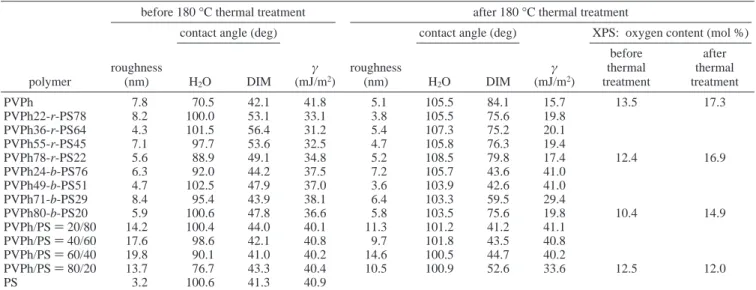
Further-more, 120 and 180°C are both far lower than the decomposition temperature (Table 1), and the thermal treatment should not damage the polymer structure. Table 2 lists the surface rough-ness, advancing contact angles, and surface free energies of all specimens, before and after thermal treatment. The surface roughnesses of all specimens are lower than 20 nm; therefore, the influence of topography on the surface free energy is
negligible. The advancing contact angle is relatively less sensitive to surface roughness and heterogeneity than the receding angle; thus, the advancing contact angle data are commonly used to calculate the components of surface and interfacial tension.21,22In the pure PVPh system, the advancing
contact angles of water and diiodomethane increase substantially after thermal treatment, resulting in a significant decrease in surface free energy (from 41.8 to 15.7 mJ/m2). Compared with
the surface free energy of PTFE (22.0 mJ/m2) by using the same
testing liquids and calculated method,23surprisingly, the surface
free energy of this fluorine- and silicone-free PVPh (15.7 mJ/ m2) is significantly lower than that of the pure PTFE after the
simple thermal treatment procedure.
It has been reported that increasing the intermolecular hydrogen bonding of a polymeric material tends to increase its surface energy.12,16We speculate that the decrease of surface
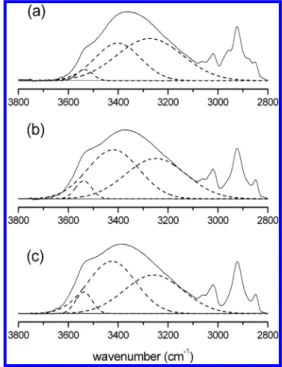
energy in the present case is due to the decrease of the intermolecular hydrogen-bonding interaction. Figure 1 shows the FTIR spectra and the curve-fitting result of the pure PVPh at room temperature and after 120 and 180°C thermal treatment for 1 day. For clarity, the spectra only display the hydroxyl stretching region between 2800 and 3800 cm-1. According to a recent study,24the -OH band can be fitted by three Gaussian
functions: a narrower shoulder band at 3525 cm-1 represents the free hydroxyl group, the peak atν Z 3280 cm-1corresponds to the hydroxyl groups involved in intermolecular hydrogen bonding, and the peak at ν Z 3420 cm-1 corresponds to the hydroxyl groups involved in intramolecular hydrogen bonding. Scheme 1 displays the schematic representation of free hydroxyl and inter- and intramolecular hydrogen bonding in poly-(vinylphenol). During the process of fast cooling, it is more favorable to re-form hydrogen bonds from neighboring hydroxyl groups or those in the vicinity (most likely from the same chain, defined as an intramolecular hydrogen bond). This is probably the reason for the decrease in the number of intermolecular hydrogen bond (longer distance between hydroxyls, mostly from different chains) content. Table 3 lists results of curve-fitting data for PVPh before and after the thermal treatment. Combining our analyses of the FTIR spectra and the corresponding
curve-TABLE 1: Formulations and Thermal Properties of PVPh-co-PS Copolymers and Corresponding Blends
copolymer phenol ratioa (mol %) Mnb Mw/Mnb Tg (°C) Td (°C) PS 0 11000 1.21 100 371 PVPh22-r-PS78 21.5 24000 2.05 104 368 PVPh36-r-PS64 36.0 17400 2.05 118 365 PVPh55-r-PS45 55.2 23200 2.10 154 359 PVPh78-r-PS22 77.8 24400 2.34 162 353 PVPh24-b-PS76 24.2 12400 1.13 101, 172 370 PVPh49-b-PS51 49.0 17400 1.09 98, 175 363 PVPh71-b-PS29 71.0 30200 1.08 99, 177 356 PVPh80-b-PS20 80.7 20900 1.13 99, 176 354 PVPh/PS ) 20/80 20.0 98, 178 364 PVPh/PS ) 60/40 60.0 101, 180 360 PVPh/PS ) 80/20 80.0 99, 182 353 PVPh 100 20000 1.07 175 352
aObtained from 1H NMR measurement.bObtained from GPC
analysis.
Figure 1. FTIR spectra and curve-fitting result of pure PVPh (a) at room temperature and after (b) 120°C and (c) 180°C thermal treatment procedures.
fitting results (Figure 1 and Table 3) and the variations in the surface energies (Table 2), it is clear that decreasing the fraction of intermolecular hydrogen bonding leads to a decrease in the
surface free energy. This observation is in good agreement with the result of our previous study on the surface-free-energy effect.12
TABLE 2: Root-Mean-Square Surface Roughness, Advancing Contact Angle for Water and Diiodomethane, Surface Free Energy, and XPS Analysis of PVPh/PS Copolymers (Standard Deviations in the Range 0.3-2.4)
before 180°C thermal treatment after 180°C thermal treatment
contact angle (deg) contact angle (deg) XPS: oxygen content (mol %)
polymer roughness (nm) H2O DIM γ (mJ/m2) roughness (nm) H2O DIM γ (mJ/m2) before thermal treatment after thermal treatment PVPh 7.8 70.5 42.1 41.8 5.1 105.5 84.1 15.7 13.5 17.3 PVPh22-r-PS78 8.2 100.0 53.1 33.1 3.8 105.5 75.6 19.8 PVPh36-r-PS64 4.3 101.5 56.4 31.2 5.4 107.3 75.2 20.1 PVPh55-r-PS45 7.1 97.7 53.6 32.5 4.7 105.8 76.3 19.4 PVPh78-r-PS22 5.6 88.9 49.1 34.8 5.2 108.5 79.8 17.4 12.4 16.9 PVPh24-b-PS76 6.3 92.0 44.2 37.5 7.2 105.7 43.6 41.0 PVPh49-b-PS51 4.7 102.5 47.9 37.0 3.6 103.9 42.6 41.0 PVPh71-b-PS29 8.4 95.4 43.9 38.1 6.4 103.3 59.5 29.4 PVPh80-b-PS20 5.9 100.6 47.8 36.6 5.8 103.5 75.6 19.8 10.4 14.9 PVPh/PS ) 20/80 14.2 100.4 44.0 40.1 11.3 101.2 41.2 41.1 PVPh/PS ) 40/60 17.6 98.6 42.1 40.8 9.7 101.8 43.5 40.8 PVPh/PS ) 60/40 19.8 90.1 41.0 40.2 14.6 100.5 44.7 40.2 PVPh/PS ) 80/20 13.7 76.7 43.3 40.4 10.5 100.9 52.6 33.6 12.5 12.0 PS 3.2 100.6 41.3 40.9
SCHEME 1: Schematic Representation of Inter- and Intramolecular Hydrogen Bonding and Free Hydroxyl in Poly(vinylphenol)
TABLE 3: Results of Curve-Fitting the Data for PVPh, PVPh-co-PS, and PVPh/PS Blends before and after the Thermal Treatment
before 180°C thermal treatment after 180°C thermal treatment
intermolecular O-H intramolecular O-H free O-H intermolecular O-H intramolecular O-H free O-H polymer ν (cm-1) Ab (%) ν (cm-1) Ab (%) ν (cm-1) Ab (%) ν (cm-1) Ab (%) ν (cm-1) Ab (%) ν (cm-1) Ab (%) PVPh 3276 62 3400 35 3534 3 3279 48 3421 44 3538 8 PVPh22-r-PS78 3289 53 3422 36 3546 11 3308 30 3445 49 3547 21 PVPh36-r-PS64 3280 55 3414 39 3545 6 3303 37 3442 47 3545 16 PVPh55-r-PS45 3279 56 3409 39 3541 5 3290 41 3438 46 3542 13 PVPh78-r-PS22 3278 56 3404 39 3541 5 3282 46 3433 45 3538 9 PVPh24-b-PS76 3280 59 3412 35 3435 6 3285 55 3415 35 3536 10 PVPh71-b-PS29 3280 58 3416 37 3536 5 3284 50 3416 41 3535 9 PVPh80-b-PS20 3285 57 3418 38 3539 5 3285 49 3417 43 3535 8 PVPh/PS ) 20/80 3282 58 3413 36 3534 6 3285 56 3416 34 3437 10 PVPh/PS ) 60/40 3283 59 3415 36 3535 5 3286 55 3418 37 3435 8 PVPh/PS ) 80/20 3281 59 3416 37 3536 4 3285 52 3419 40 3434 8
To further investigate the importance of decreasing the fraction of intermolecular hydrogen bonding or increasing the fraction of free hydroxyl groups in lowering the surface free energy, a series of PVPh/PS random and block copolymers and their corresponding blends were prepared. Their surface energies were measured through the same method as that for the pure PVPh, and the results are summarized in Table 2. Clearly, the contact angles and resulting γ of PVPh/PS blends show no
significant change before or after 180°C thermal treatment. The
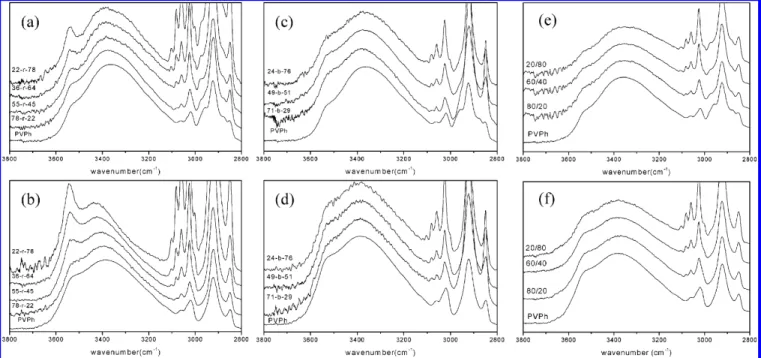
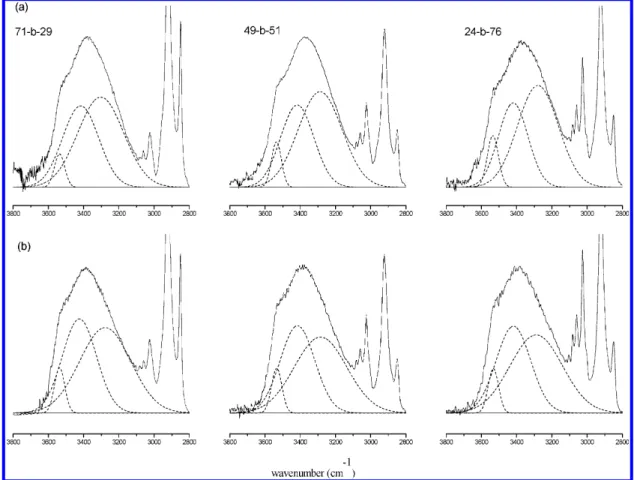
PVPh-r-PS copolymers possess the most drastic reduction in surface energy after the thermal treatment in comparison with corresponding block copolymers and blends under comparable compositions. Figure 2 summarizes FTIR data at the hydroxyl stretching region of PVPh/PS random and block copolymers and blends before and after 180°C thermal treatment for 1 day. Figures 3-5 display their respective FTIR spectra and curve-fitting results before and after the thermal treatment. Table 3 also lists results of curve-fitting data for PVPh-co-PS and PVPh/ Figure 2. FTIR spectra of PVPh/PS random and block copolymers and blends (a, c, e) before and (b, d, f) after the thermal treatment.
Figure 3. FTIR spectra and curve-fitting result of PVPh-r-PS copolymers (a) at room temperature and (b) after the 180°C thermal treatment procedure.
PS blends before and after the thermal treatment. The fractions of free and inter- and intramolecularly hydrogen-bonded
hy-droxyl bands do not show a significant change before and after thermal treatment in the block copolymer, which is similar to Figure 4. FTIR spectra and curve-fitting result of PVPh-b-PS copolymers (a) at room temperature and (b) after the 180°C thermal treatment procedure.
the blend system in surface energy. On the contrary, the fraction of the free hydroxyl absorption (3525 cm-1) increases signifi-cantly. The peak position of the intermolecular hydroxyl band shifts to higher wavenumber, and its peak area decreases in pure PVPh and PVPh-r-PS copolymers after thermal treatment, implying a decrease of the intermolecular hydrogen-bonding fraction. The styrene moiety can act as an “inert” (non-hydrogen-bonding) diluent to space the vinylphenol segment. In our previous work,18we have studied the effect of an inert diluent
segment on the miscibility behavior of PVPh-r-PS copolymers and found that the incorporation of a styrene moiety into the PVPh polymer chain can dilute and decrease the strong self-association in the PVPh component. The spacing of these vinylphenol groups tends to decrease the average hydroxyl-hydroxyl distance and increase the fraction of free hydroxyl-hydroxyl in PVPh/PS random copolymers and provides a positive effect to lower the surface energy of the polymer. On the other hand, the interference of the styrene segment tends to prevent the vinylphenol segment from migrating to the surface, which can be regarded as a negative effect, i.e., an increase in the surface energy of the material.
Previous studies25,26 suggested that the surface energy of a
random copolymer usually follows the linear relationγ ) x1γ1 + x2γ2. This behavior was observed by Rastogi et al.27 in
random copolymers of ethylene oxide and propylene oxide. It is well-known that backbone lengths of each component have to be taken into account when dealing with copolymers. A greater length in block copolymers or polymer blends is more favorable to induce micro- or macrophase separation and enhances migration of the lower surface free energy component to the surface. When the backbone length of the block is decreased and randomly distributed, as in random copolymers, the preferential accumulation of the low-energy segments at the surface decreases due to conformational restrictions of the polymer chains.
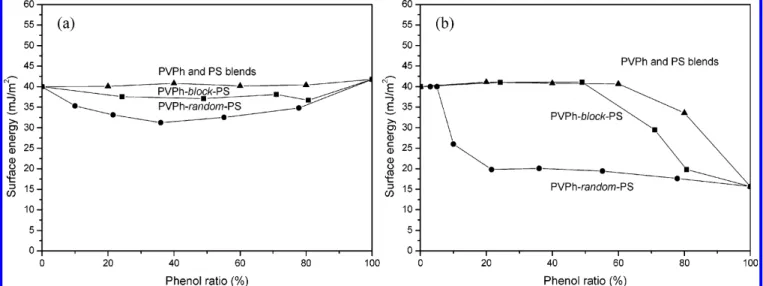
It is interesting to note that, before and after thermal treatment, the above relationship between sequential distribution and surface energy does not exist in the PVPh/PS copolymer system. Figure 6 summarizes the surface energies of PVPh/PS random and block copolymers and blends before and after thermal treatment. After thermal treatment, the surface energies of the random copolymers decrease to 19.8 mJ/m2; even the PVPh
content is only 22 mol %. The surface energy of block copolymers starts to decrease at a relatively higher PVPh content (>50 mol %), while the surface energies of blends do not change
significantly over the whole composition range. For both block copolymers and blends, the intermolecular hydrogen-bonding fractions do not decrease by incorporation of an inert diluent component (polystyrene) because of phase separation, on the basis of DSC results. In addition, the aggregation of the homopolymer segment tends to prevent the vinylphenol segment from migrating to the surface. XPS results (Table 2) show that the atomic fraction of oxygen, an indication of the vinylphenol segment content on the surface, increases drastically after thermal treatment, except for the PVPh/PS blend, which is in good agreement with the measured surface energy in this system. As a result, the combination of infrared spectra, contact angle measurements, and XPS results indicates that the decrease of intermolecular hydrogen-bonding interaction or increase of the fraction of free hydroxyl groups tends to lower the surface free energy of the polymer.
Conclusions
The decrease of the intermolecular hydrogen-bonding fraction between hydroxyl groups of PVPh through a simple thermal treatment procedure tends to decrease the surface energy. The lowest surface energy after thermal treatment for the pure PVPh is 15.7 mJ/m2, even lower than that of PTFE (22.0 mJ/m2). The
sequence distribution of the vinylphenol group in PVPh-co-PS copolymers plays an important role in dictating the final surface energy after thermal treatment. This finding provides a pos-sibility to prepare a new class of low-surface-energy materials through simple thermal treatment by decreasing the intermo-lecular interaction of polymers.
Acknowledgment. This research was supported financially
by the National Science Council, Taiwan, Republic of China, under Contract No. NSC-95-2221-E-009-166-MY3 and Ministry of Education “Aim for the Top University” (MOEATU) program.
References and Notes
(1) Li, H.; Wang, X.; Song, Y.; Liu, Y.; Li, Q.; Jiang, L.; Zhu, D. Angew. Chem. Int., Ed. 2001, 40, 1743.
(2) Aussillous, P.; Quere, D. Nature 2001, 411, 924.
(3) Shirtcliffe, N. J.; McHale, G.; Newton, M. I.; Perry, C. C. Langmuir 2005, 21, 937.
(4) Wang, S.; Feng, L.; Liu, H.; Sun, T.; Zhang, X.; Jiang, L.; Zhu, D. ChemPhysChem 2005, 6, 1475.
(5) Coulson, S. R.; Woodward, I.; Badyal, J. P. S.; Brewer, S. A.; Willis, C. J. Phys. Chem. B 2000, 104, 8836.
(6) Jin, M.; Feng, X.; Xi, J.; Zhai, J.; Cho, K.; Feng, L.; Jiang, L. Macromol. Rapid Commun. 2005, 26, 1805.
(7) Feng, L.; Zhang, Z.; Mai, Z.; Ma, Y.; Liu, B.; Jiang, L.; Zhu, D. Angew. Chem., Int. Ed. 2004, 43, 2012.
(8) Hillborg, H.; Tomczak, N.; Olah, A.; Schonherr, H.; Vancso, G. J. Langmuir 2004, 20, 785.
(9) Wu, S. Polymer Interface and Adhesion; Marcel Dekker: New York, 1982.
(10) Feiring, A. E.; Imbalzano, J. F.; Kerbow, D. L. AdV. Fluoroplast. Plast. Eng. 1994, 27.
(11) Carlson, D. P.; Schmiegel, W. Ullmann’s Encyclopedia of Industrial Chemistry; VCH Verlagsgesellschaft: Weinheim, Germany, 1988; p 393. (12) Wang, C. F.; Su, Y. C.; Kuo, S. W.; Huang, C. F.; Sheen, Y. C.; Chang, F. C. Angew. Chem., Int. Ed. 2006, 45, 2248.
(13) Kobayashi, H.; Owen, M. J. Trends Polym. Sci. 1995, 3, 5. (14) Schmidt, D. L.; Coburn, C. E.; DeKoven, B. M.; Potter, G. E.; Meyers, G. F.; Fischer, D. A. Nature 1994, 368, 41.
(15) Owen, M. J. Comments Inorg. Chem. 1988, 7, 195. (16) Ma, K. X.; Chung, T. S. J. Phys. Chem. B 2001, 105, 4145. (17) Tsibouklis, J.; Graham, P.; Eaton, P. J.; Smith, J. R.; Nevell, T, G.; Smart, J. D.; Ewen, R. J. Macromolecules 2000, 33, 8460.
(18) Kuo, S. W.; Chang, F. C. J. Polym. Sci., Part B: Polym. Phys. 2002, 40, 1661.
(19) Tung, P. H.; Huang, C. F.; Chen, S. C.; Hsu, C. H.; Chang, F. C. Desalination 2006, 200, 55.
(20) Fowkes, F. W. In Adhesion and Adsorption of Polymers, Polymer Science and Technology; Lee, L. H., Ed.; Plenum Press: New York, 1980; Vol. 12A, p 43.
(21) Drelich, J.; Miller, J. D.; Good, R. J. J. Colloid Interface Sci. 1996, 179, 37.
(22) Good, R. J.; van Oss, C. J. In Modern Approaches to Wettability: Theory and Applications; Schrader, M. E., Loeb, G., Eds.; Plenum Press: New York, 1992; pp 1-27.
(23) Yoshimasa, U.; Takashi, N. Langmuir 2005, 21, 2614.
(24) Yuan, F.; Wang, W.; Yang, M.; Zhang, X.; Li, J.; Li, H.; He, B. Minch, B.; Lieser, G.; Wegner, G. Macromolecules 2006, 39, 3982.
(25) Helfand, M. A.; Mazzanti, J. B.; Foue, M.; Reamey, R. H. Langmuir 1996, 12, 1269.
(26) Teraya, T.; Takahara, A.; Kajiyama, T. Polymer 1990, 31, 1149. (27) Rastogi, A. K.; St. Pierre, L. E. J. Colloid Interface Sci. 1969, 31, 168.