A Web-enabled Talking Head System
Based on a Single Face Image
Cheng-Sheng Hung, Chien-Feng Huang, Guo-Shi Lee, I-Chen Lin, Ming Ouhyoung Communication and Multimedia Laboratory,
Dept. of Computer Science and Information Engineering, National Taiwan University, Taipei 106, Taiwan
Abstract
In this paper, a lifelike talking head system is pro-posed. The talking head, which is driven by speaker independent speech recognition, requires only one single face image to synthesize lifelike facial expres-sion.
The proposed system uses speech recognition engines to get utterances and corresponding time stamps in the speech data. Associated facial expressions can be fetched from an expression pool and the synthetic facial expression can then be synchronized with speech.
When applied to Internet, our talking head system can be a vivid web-site introducer, and only requires 100 K bytes/minute with an additional face image (about 40Kbytes in CIF format, 24 bit-color, JPEG compression). The system can synthesize facial ani-mation more than 30 frames/sec on a Pentium II 266 MHz PC.
1. Introduction
Compared with the rapid growth of the Internet usage, the bandwidth of Internet does not grow as much, and so can easily get congested. Besides, users are not satisfied with static information such as homepages with only static images and text; hence communications with video and audio will be the fu-ture trend. Therefore, developing very-low bit-rate but high-resolution communication tools become more and more necessary. Using synthetic faces and talking heads instead of current frame-based videos appears to be a good way to reduce the bit-rate of communication dramatically, because a remote
com-puter can reconstruct the animation by some key pa-rameters. In the international standard MPEG-4 [1][2], synthetic heads are also included; the controls of synthetic face expressions are defined as a set of FAPs (Face Animation Parameters).
A video using synthetic face can be very enter-taining. A user can choose not only the model of the user himself, but also whichever model he (or she) wants to use in the synthetic video, such as a movie star, a statesman, or even an animal. A user can also let the talking head make amusing facial expressions to entertain other people.
In previous researches, most approaches try to synthesize one's facial expressions with a 3D model. Waters [3] proposed to use physical and anatomical models such as bones and muscles to synthesize fa-cial expressions. Most researches use a generic 3D model with texture mapping from a set of images. Using 3D model is suitable when the taking head acts with big motions and rotations, but it must take a lot of efforts to fit the 3D model for the set of images. Pighin et al. [4] proposed a delicate method to recon-struct one's 3D head model from a set of images, and developed a method to generate new facial expres-sions. However, the whole process is considered complex for general users. Furthermore, the hair is not considered.
2D image warping or morphing has proved to be a powerful tool for visual effects [5][6][7]. Syn-thetic taking heads with this technique can look quite real when the talking head moves with only small-scale translation and rotation. Some researches are proposed to synthesize talking heads by combin-ing individual parts of face features extracted from video clips of a talking person [8][15].
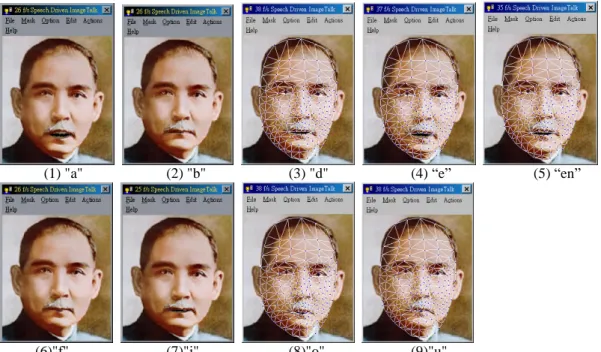
(1) "a" (2) "b" (3) "d" (4) “e” (5) “en”
(6)"f" (7)"j" (8)"o" (9)"u"
Figure 1. Basic expression (1) ~ (9). The original image is the founding father of modern China (R.O.C), Dr. Sun Yet-Sen.
expressions using the 2D image warping technique. This system is the second generation of our Chinese text-to-speech talking head system, the Image Talk [9]. It first applies a generic Talking Mask to a given image. Then the character in the image can blink eyes, move its head, and even talk in Mandarin Chinese (see Figure 1). Facial expressions of this photo-realistic talking head can be synchronized with and driven by speech from a wave file, or from a mi-crophone. Speech recognition techniques are used to conjecture the phonemes in the speech and then fetch the associated facial expression.
In Section 2, we describe the head model of our proposed talking head system. How to generate facial expressions are described in section 3. Section 4 shows how speech recognition techniques are used to synchronize facial expressions with the speech. The result and applications of our system is in section 5 and 6.
2. Head Model
Since our talking head is supposed not to have much head rotation and translation, our proposed talking head models a human head by applying a two-dimensional mesh model, and uses real time
view dependent mesh warping for animations. Be-cause it is simple but with good visual effect, it can run on common Pentium II PCs in real-time.
A neutral face is the frontal face image without specific facial expressions. The color information of an input neutral face provides a base image for the system. By warping the input image, we can morph the neutral face into various expressions. If the pic-ture taken is not from a neutral face, the furrows caused by squeezing the muscles while smiling or frowning will sometimes make the synthesized expression unnatural.
How to warp the input image into various ex-pressions? A set of interesting spots are marked as control vertices. These vertices were placed around the contour of specific features on the face such as eyes, nose, mouth, and chin. These control vertices were then connected into convex polygons, such as triangles. Then the problem of warping a whole im-age can be simplified to a set of polygon texture mapping problems.
For real time processing, the less the number of the vertices is, the better is the performance. In our work, less then 200 control vertices were marked on the facial area, and the final two-dimensional mesh model comprises less than 350 triangles; still the
synthetic faces look natural.
2.1 Mouth shape generation
At this moment, our system is developed for Mandarin Chinese, and can be extended to other lan-guages. In general, there are a total of 408 Chinese utterances without tone variation [10], and 1333 Chi-nese utterances with tone variation. Many mouth shapes of these utterances are quite similar to each other, and all mouth shapes of these utterances can be simulated by combining basic mouth shapes. In our system, 9 basic mouth shapes are adopted, as shown in Figure 1 [9].
2.2 Face Mesh Fitting
The first stage to use the talking head system is to fit a generic two-dimensional face mesh to a user’s face image. We provide user-friendly tools for users to go through this process. As shown in Figure 2, af-ter a user inputs a new frontal facial image, a generic
2D mesh is applied to the face image. A boundary box is used to approximate the head size in the image, and a user can manually adjust control points to fit with feature points, for example, eyes, nose and lips on the image. Most efforts are on the adjustment of eyelids and lips, which takes about one to three min-utes to adjust the mask for an experienced user al-ready using the system for more than two times.
3. Synthesizing Facial Expressions
3.1 Key Frames Specification
As mentioned above, various facial expressions can be synthesized by mapping parts of the original texture to certain polygons defined by control vertices. Putting the texture mapped mesh model and the background together, the scene now looks just like the original face with certain facial expressions.
The first step to animate facial expressions is to define the key frames. The neutral face without any facial expressions can be thought as a key frame that contains a neutral facial expression. Key frames in this proposed system are from our previous system: the Image Talk[9].
The actual content of key frames saved in our system library are the vector differences of each con-trol vertex from the neutral face, and normalized ac-cording to the size of the generic mask. In summary, a synthetic face can be represented as weighted com-binations of the neutral facial mask (from the generic one adjusted to match the input image) and the ex-pression mask.
3.2 Generating Intermediate Expressions by In-terpolation
In order to generate the animation of a face giv-ing a talk, our proposed system has to generate in-termediate frames or expressions between two key frames. Since the key frames are saved as normalized vectors according to the size of the generic mask, the intermediate expressions can be generated by time-driven interpolation.
To make our talking head’s mouth actions look more realistic, the problem of co-articulation, which means the current mouth shape is not depend only on the current pronunciation but the one coming before and after, must be taken into account.
(a) The original image.
(b) A generic mesh mask (c) The modified mesh mask Figure 2. Adjustment of a
mesh mask for a new face.
Figure 4. The speech data shape of a Chinese sen-tence pronounced as “ni hau ma” which means as “How are you?” in English. The vertical lines in the picture are marked to separate three different utterances (words) “ni”, “hau”, “ma”.
There are 408 possible combinations of pho-nemes in a Mandarin Chinese word. In our previous system [9], we only use linear interpolation to gener-ate intermedigener-ate expression; in the current system, we try to use an exponential decay model [21] to make the animation of mouth shape look more natural.
3.3 Small-scale Head Motion
In addition to our previous algorithm developed for head motion [9], a 3D-projection method is also tried to make the head motion more realistic. In this way, the 2D mesh of the talking head is acquired from the projection of a 3D head model. To perform head motion, the 3D head model is rotated first, and then projected on the 2D mesh. After moving the ver-tices of the 2D mesh to the new projection location, the image of the talking head is morphed to perform the head motion.
3.4 Generic Teeth Model
Because the input image is only a static neutral face, there is no image information inside the talking head’s mouth. We propose a generic teeth model to simulate teeth inside the mouth. The teeth model is separated into two parts: the upper teeth and the low-er ones. The upplow-er teeth model is moved according to the control vertex at the philtrum, and the lower one is moved according to the control vertex at the chin. This generic teeth model can resize according to the mouth size in the neutral face.
In addition, there is a basic assumption that the larger one’s mouth is opened, the more light his teeth can be illuminated. Our proposed system adjusts
col-ors of the generic teeth model according to the long-est distance between the upper lip and the lower one. The smaller the distance is, the darker the teeth are (see Figure 3).
4. Speech Driven Face Synthesis
After the 2D face mesh is adjusted, it can be used to animate facial expressions driven by speech. To synthesize animations of facial expressions synchronized with speech data, we must know which utterances appear in the input wave data. In addition, the start and stop time of a certain utterance should be obtained to synchronize the mouth shapes with wave data.
For example, in Figure 4, it is the PCM data of a Chinese sentence “ni hau ma” spoken by the first au-thor. After getting this wave file, our system invokes a speech recognition engine and finds that from StartTime to TimeA is silence; TimeA to TimeB should be “ni”; TimeB to TimeC should be “hau”; TimeC to EndTime should be “ma”. Our system then translate these results into “neutral (from 0 to TimeA), ni (from TimeA to TimeB), hau (from TimeB to TimeC), ma (from TimeC to EndTime) and appropriate key frames are fetched from the expression pool.
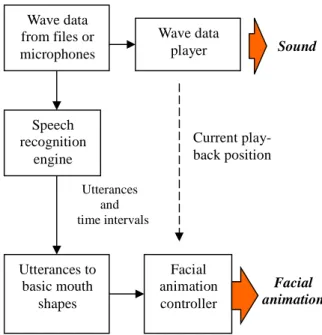
Figure 5 is the flow diagram of our proposed system. First, wave data from a speech file or a mi-crophone are fed to a speech recognition engine that helps us to conjecture the phonemes of the speech. The engine compares the input wave data with its own database; then reports the most possible utter-ance and the time stamps of each utterutter-ance in the
se-(a) without teeth (b) with teeth Figure3. a generic teeth model inside the mouth
quence. A table of mapping from utterances to pho-netic notations is used to get basic facial expressions. Thus, we can get a sequence of basic facial expres-sions according to the input speech data. With this information, facial animation synchronized with the input wave data by techniques mentioned above can be generated. For example, Mandarin Chinese word “good” pronounced as /hau/ is converted to be /h/+/au/, and the corresponding mouth shape is from “h” then gradually morphed to ”au”.
Since our purpose is to synthesize facial expres-sions according to speech data and many mouth shapes of Chinese utterances are quite similar to each other, the recognized results don’t need to have high recognition rate. Currently an efficient speech recog-nition engine can be used to generate facial animation in near real time.
In general, the recognition rate for a speaker in-dependent recognition engine is only around 60%. Since many different pronunciations have similar mouth shapes; that is, the real difference is inside the mouth that is not visible, the overall “recognition rate” for this talking head system is higher than 90%. Actually, the visual effect is so strong that most
peo-ple can not see the difference. The details of how speech recognition engines are applied for two kinds of speech data sources are described in the following.
4.1 Generating facial animation driven by speech data from files
Since speech signals saved as files can be play-ed repetitively, this kind of wave sources is proper for preprocessing computation. We will to preprocess the input speech file and save the recognition results as an index file.
When users want to see facial expressions driven by a speech wave file, our system checks whether there is an index file associated with it first. If there is one, the system plays back the speech file and the talking head makes facial expressions ac-cording to the information in that index file. If there is no index file, a speech recognition engine is in-voked to recognize the speech data, and an index file can then be generated.
At this moment, we can invoke two kinds of speech recognition engines. The first group are those speech recognition engines that support Microsoft DirectSpeechRecognition API from Microsoft SAPI 4.0[11] (Microsoft Speech Application Interface ver-sion 4.0); the other one is the speech recognition en-gine from Applied Speech Technologies [12].
For first-time users with MS Di-rectSpeechRecognition API, they are encouraged to have a training session to increase the recognition rate by reading some specified texts for 10 minutes. The main parts we need are the functions of wave indexing. Wave indexing is a way to index each seg-ment of wave data from files with an appropriate ut-terance or a word by parsing wave data segments with a given CFG (context free grammar). We have defined a CFG describing the basic 408 Mandarin Chinese utterances [10] for the API, and the most matched utterances can therefore be reported.
The speech recognition engine we use from Ap-plied Speech Technologies is a simplified version without parsing grammar and therefore can recognize Chinese utterances directly. It can index speech data from files or from input devices such as microphones.
4.2 Near real time speech driven facial animations by dual recognition engines
Figure 5. the flow diagram of the speech-driven talking head system. Wave data from files or microphones Speech recognition engine Utterances and time intervals Utterances to basic mouth shapes Facial animation controller Wave data player Current play-back position Sound Facial animation
To apply our speech driven talking head to vis-ual communication, a real-time system is required. However, the required time for speech recognition techniques to look ahead is usually more than one second, and so we should reduce the response time as much as possible. The preprocessing actions for the input speech in previous sections are not practicable for real-time applications.
Since the speech recognition library from Ap-plied Speech Technologies is a simplified version and focussed just on Chinese utterances, the recognition time of this engine can be less than the playback time of input on an Intel Pentium II 266 MHz PC. To dis-play facial animation driven by speech from a mi-crophone with the shortest response time, the concept of double buffers in graphics is applied in our system. Because of constraints of wave I/O control in the recognition library we used, a pipeline structure does not work. We use dual recognition engines to recog-nize input speech data blocks alternately.
We make 2 second long speech data a block, and so the input data sequences consist of a sequence of blocks. Two recognition engines are opened at the same time but work alternately. Engine A is in charge of odd blocks; Engine B is in charge of even ones. While Engine A is recognizing data in block N, En-gine B receives the wave data of block N+1 from a microphone. While Engine B is recognizing data in block N+1, Engine A receives the wave data of block N+2 from the microphone. These processes are de-monstrated in Figure 6.
5. Results
The current performance of the proposed talking head system without real-time speech recognition is
about 30 frame/sec in CIF format on a Pentium II 266MHz PC. The speech recognition is processed off-line using Microsoft’s DirectSpeechRecognition API in Speech SDK 4.0 or the speech recognition library from Applied Speech Technologies.
For facial animations driven by live speech with limited response time, an initial delay is about 4 sec-onds, because the speech recognition module needs to accumulate a certain length of signals to begin the recognition process. However, there are two practical problems. The first one is the wave data possible discontinuity (less than 0.3 sec) when two recognition engines “swap”. The second problem is that display frame rate sometimes can not keep at 20 frames per second. On a Pentium III 500MHz PC, the perform-ance is about 15-24 frames per second with image size 120x150. This is caused by the fact that the rec-ognition engines share the CPU with the display en-gine.
To make our speech-driven talking head with large-scale motion, we also develop a talking head system constructed by 3D models [13].
6. Applications
One immediate application of the talking head system is a web-site introducer. Speech data about the web or products and the corresponding index file, which is generated by an off-line process, are put on the web-site, and the talking head animator is packed as a plug-in packet for users to download. After in-stalled the packet, when users click icons of our talk-ing head on the homepage, speech data and the index file are sent to the client side, and then the talking head can give a vivid speech to introduce the web-site.
…………. Engine A
Engine B
time N time N+1 time N+ 2 Time Figure6. Dual Speech Recognition engines approach.
Receive Block N Recognize Block N-1 Recognize Block N Receive Block N+1 Receive Block N+2 Recognize Block N+1 ………….. …………..
Compared to frame-based video such as H.263 etc., which requires about 400Kbytes to 4Mbytes per minute depending on the video quality, the proposed system will only need 100Kbytes/minute (voice is compressed using GSM610) with an additional face image (about 40Kbytes compressed using JPEG). Another application is the idea of “VR-talk” that can be applied to Internet chat rooms. Since the proce-dures of adjusting our generic mask to fit to a new face image are simple, users can easily use new face images such as movie stars or even animals to repre-sent themselves in chatrooms. This feature appears to satisfy people’s intension of concealing and disguis-ing themselves on the Internet for fun or for other
purposes, and this can also make Internet chat rooms more fun.
The proposed web-enabled talking head system for Netscape Navigator is available now, and the web-page is at http: // www.cmlab.csie.ntu.edu.tw/ ~ichen.
7. Future Works
A speech-driven talking head with real-time re-sponse is our goal. As mentioned in subsection 4.2, the practical problems should be solved. Similar to our generic teeth model, an eyeball model can be de-veloped to change the viewing direction of eyes.
(a) 2D mesh mask (b) a neutral face (c) pronouncing “u” (d) pronouncing “en” Figure 7. Three examples of pronouncing a Chinese syllable “wen” (u+en).
Speaker-independent speech recognition engines also need improvement.
Acknowledgement
We would like to thank Applied Speech Tech-nologies, since it provides its speech recognition li-brary and helps our research.
Reference:
[1] MPEG4 Systems Group, “Text for ISO/IEC FCD 14498-1 Systems,” ISO/IEC JTC1/SC29/WG11 N2201, 15 May 1998.
[2] J. Ostermann, “Animation of Synthetic Faces in MPEG-4”, Proc. of Computer Animation, pp.49-51, Philadelphia, Pennsylvania, USA, June 8-10, 1998.
[3] Demetri Terzopoulos, Keith Waters, “Analysis and synthesis of Facial Image Sequences using Physical and Anatomical Models,” IEEE Tran. On Pattern and Machine Intelligence,15(6), Jun.1993, pp.569-579.
[4] Frédéric Pighin, Jamie Hecker, Dani Lischinski, Pichard Szeliski, David H. Salesin, “Synthesizeng Realistic Facial Epressions from Photographs,” Proceedings of ACM Computer Graphics (SIG-GRAPH 98),pp. 75-84 Aug-1998.
[5] Thaddeus Beier, Shawn Neely “Feature-Based Image Metamorphosis”, Proc.of SIGGRAPH 92. In Computer Graphics, pp 35- 42
[6] Steven M.Seitz, Charles R. Dyer, “View Morphing”, Proc. SIGGRAPH 96, pp. 21-30. [7] Nur Arad, Nira Dyn, Daniel Resfeld, Yehezkel
Yeshurun, “Image Warping by Radial Basis Func-tions: Application to Facial Expressions”, CVGIP: Graphical Models and Image Processing”, Vol 56, No.2, pp.161-172, 1994.
[8] Eric Cosatto, Hans Peter Graf, “Sample-Based Synthesis of Photo-Realistic Talking Heads”, Proc. of Computer Animation 98, pp. 103-110, Phila-delphia, Pennsylvania, June 8-10, 1998..
[9] Woei-Luen Perng, Yungkang Wu, Ming Ouhy-oung, “Image Talk: A Real Time Synthetic Talking Head Using One Single Image with Chinese Text-To-Speech Capability” Proc. of PacificGraphics 98, pp 140-148, Singapore, Oct 1998.
[10] Lin-Shan Lee, Chiu-Yu Tseng, Ming Ouhyoung,
“The Synthesis Rules in a Chinese Text-to-Speech System”, IEEE Trans. On Acoustics, Speech and Signal Processing. Pp.1309-1320. Vol.37, No.9, 1989.
[11] Microsoft Speech Technology SAPI 4.0 SDK,
http://www.microsoft.com/iit/sapisdk.htm
[12] Applied Speech Technologies Corporation.
http://www.speech.com.tw
[13] Tzong-Jer Yang, I-Chen Lin, Cheng-Sheng Hung, Chien-Feng Huang and Ming Ouhyoung, “Speech Driven Facial Animation”, accepted by Proc. of CAS’99.
[14] M.Esoher and N.M. Thalmann, “Automatic 3D Cloning and Real-Time Animation of a Human Face”, Proc. Computer Animation 97, pp.58-66, 1997.
[15] C. Bregler, M.Covell, M.Slaney, “Video Rewrite: Driving Visual Speech with Audio”, Proc. SIG-GRAPH’97, pp.353-360, 1997.
[16] B. Guenter, c. grimm, D. Wood, H. Malvar, F. Pighin, “Making Face”, Proc. of Computer Graphics (SIGGRAPH ’98), pp. 55-66, Aug,1998.
[17] D. Decaolo, D. Metaxas, M. Stone, “An Antro-pometric Face Model Using Variational Tech-niques”, Proc. Computer Graphics (SIGGRAPH ’98), pp. 67-74, Aug,1998.
[18] T. DeRose, M. Kass, T. Truong, “Subdivision Surfaces in Character Animation”, Proc. of Com-puter Graphics (SIGGRAPH’98), pp85-94, Aug,1998.
[19] P.E Kmon, W.Fresen, “Facial Action Coding System: A Technique for the Measurement of Fa-cial Movement”, Consulting Psychologists Press, Palo Alto, CA, 1978.
[20] S. Morishima, H.Harashima, “A Media Conver-sion from Speech to Facial Image for Intelligent Man-Machine Interface”, IEEE J. Selected Areas in communications, 9, pp. 594-600, 1991.
[21] M.M. Cohen and D.W. Massaro. “Modeling co-articulation in synthetic visual speech”. In N.M. Thalmann and D. Thalmann, editors, Models and Techniques in Computer Animation. Springer-Verlag, 1993.