
The Effect of OVSF Code Assignment on PAR
5
0
0
全文
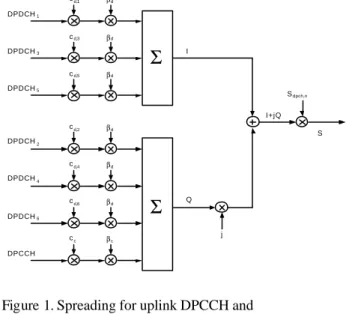
(2) characteristics of a W-CDMA signal, particularly. can’t be used if the mother code is already being. the PAR or the complementary cumulative. used.. distribution function (CCDF) of the envelope, varies significantly with OVSF code assignment. Generally, consecutive codes generate more severe PAR than the codes that are evenly distributed in the OVSF code space. In addition,. c d,1. βd. c d,3. βd. DPDCH 1. Σ. DPDCH 3. I. βd. c d,5 DPDCH 5. S dpch,n. low data rate channels produce more severe PAR I+jQ. than high data rate channels. In this paper, the purpose is to study the OVSF codes assignment’s effort on PAR,. c d,4. βd. c d,6. βd. cc. βc. S. Σ. DPDCH 6. be introduced. Moreover, the PAR definition will be explained, and PAR’s effect on 3GPP’s. βd. DPDCH 4. especially for the 3GPP model. In Section 2, the channelization codes of 3GPP specification will. c d,2 DPDCH 2. Q. j. DPCCH. specification will be described. Then the suggested OVSF codes assignment will be. Figure 1. Spreading for uplink DPCCH and. introduced. In Section 3, the simulation for the. DPDCHs. OVSF codes assignment’s effect on PAR will be shown. This simulation focuses on the test models. of. 3GPP. specification. [5].. The. simulation results will indicate the suggested. I. S → P. Any downlink physical channel except SCH. method is a proper way to assign OVSF codes. S dl,n I+jQ C ch,SF,m Q. based on reducing PAR. In Section 5, some conclusions will be made about OVSF code. j. assignment. Figure 2. Spreading for all downlink physical II.. The relationship between OVSF code and PAR. channels except SCH Cc h , 4 , 0 =(1,1,1,1) Cc h , 2 , 0 = (1,1). A. Channelization Code in 3GPP Specification The channelization codes adopted in figure. Cc h , 4 , 1 = (1,1,-1,-1) C. ch,1,0. = (1) Cc h , 4 , 2 = (1,-1,1,-1). 1 and figure 2 are OVSF codes that preserve the orthogonality. between. different. Cc h , 2 , 1 = (1,-1). physical. Cc h , 4 , 3 = (1,-1,-1,1). channels. The OVSF codes can be defined using the code tree of figure 3 [7].. SF = 1. SF = 2. SF = 4. In figure 3, the channelization codes are uniquely described as Cch,SF,k , where spreading. Figure 3. Code-tree for generation of orthogonal. factor (SF) is the spreading factor of the code. variable spreading factor (OVSF). and k is the code number, 0 ≤ k ≤ SF-1. Each. codes. level in the code tree defines channelization codes of length SF, corresponding to a spreading factor of SF in figure 3. The total number of. B. PAR's definition and effect The PAR is the ratio of peak power to. possible OVSF codes is equal to SF, but not all. average power, and the peak value of a signal x(t). of the OVSF codes can be used. In the 3GPP. is obtained by the maximum value of its. specification, any daughter code in the code tree. envelope |x(t)| in amplitude.. PAR is a. S.
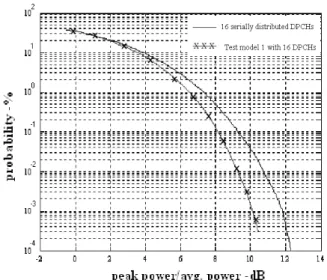
(3) significant parameter for the linear amp lifier.. There are many methods to assign OVSF. Operating a power amplifier in its linear range. codes for different purposes. The method. will avoid chipping and hence spectral regrowth.. introduced here is to reduce PAR, and to limit. Therefore PAR is a significant issue for. adjacent-channel leakage.. basestation design. In order to reduce the required PA linear dynamic range, a low PAR is desirable. PAR is typically shown graphically through the signal’s CCDF. The CCDF plot is a histogram that graphs the PAR and is a statistical. High PAR causes. serious problem. Signal will be dis torted if PA’s dynamic range is not wide enough. Using the OVSF code assignment is an alternative method to reduce PAR. The spirit of the proposed. method to indicate the peak power properties of. method is the concept of “even distribution” and. the signal versus probability. There is a. these channels should be evenly distributed in. parameter called crest factor and it is the. code domain.. maximum. the. orthogonal channel noise simulator (OCNS) is. observation window is significantly large. In. defined, and it is the mechanism used to simulate. other words, the crest factor is the maximum. the users or control signals on the other. PAR value that occurs at any probability point. orthogonal channels of the downlink. It is also. PAR. value. obtainable. if. on the CCDF curve. In order to amplify the signal linearly, the PA has to be operated in the dynamic range that is greater than or equal to the crest factor. Figure 4 shows the CCDF curves for. In the 3GPP specification, the. proposed that the 16 dedicated channels of the OCNS signal should be evenly distributed to optimize it. The method opposite to even. two W-CDMA downlink signals with different. distribution is to distribute channels serially and. channel configurations: a signal with 16 serially. the PAR is larger. In addition, the PAR of. distributed DPCHs and a signal configured as. W-CDMA signals will increase with the number. test model 1 with 16 DPCHs. For a probability. of code channels. Simulation of these conditions. of 0.01 percent, the signal with 16 serially. will be described in Section III.. distributed DPCHs has a higher PAR than the signal configured as test model 1[6].. III.. Performance simulation. In this section, the simulation shows that even assignment of OVSF codes results in smaller PARs than serial assignment of OVSF codes. Moreover, a view of the PAR for W-CDMA signals increasing with the number of code channels is shown. These simulations are based on the OCNS models in 3GPP specification. The two models can support 16, 32 DPCH channels whose SF = 128. and. 256. for. variant. basestation. implementations. Because baseband data can impact PAR significantly, test models have been Figure 4. A typical CCDF plot of PAR for 16 W-CDMA downlink channels with SF = 128 C. Proposed OVSF codes assignment scheme. defined with random data and time offsets [5]. The diagram is shown in figure 5 and these parameters for simulations are shown in Table 1 and Table 2..
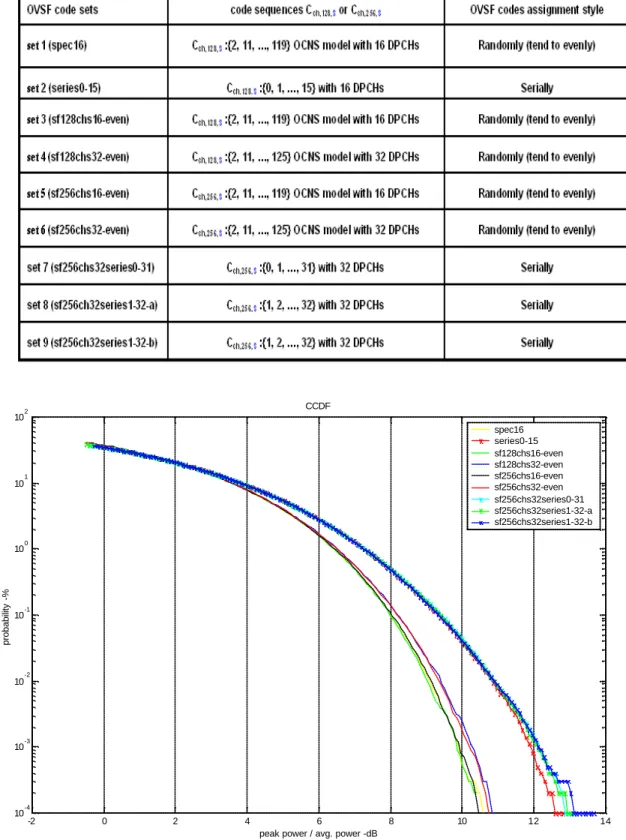
(4) The simulation result is shown in figure 6 and the even assignment of OVSF codes has about 2. IEEE VTC’2000, pp. 2188-2192, 2000. [2] Thit Minn and Kai -Yeung Siu, “Dynamic. dB improvement in CCDF at the point of 0.001. Assignment. percent. Moreover, it is shown that PAR for. Spreading-Factor Codes in W-CDMA,”. WCDMA signals increases with the number of code channels for the evenly distributed style. IV.. Conclusion. of. Orthogonal. Variable-. IEEE J. Select. Areas Commun., Vol. 18, No. 8, Aug. 2000. [3] V.K.N.Lau, “Peak-to-average ratio (PAR) reduction by Walsh-code selection for IS-95 and CDMA2000 systems,” IEE Proc. Commun., Vol. 147, No 6, Dec. 2000.. In this paper, the relationship between PAR. [4] Nikhil Eeshpande, Steven Stanton, and. and OVSF codes assignment is discussed.. Michael Hurst, “ACPR Specs Place. Assigning OVSF codes evenly is the suggested. Demands. method because of its good performance and. Amplifiers,” Wireless System Design, Aug.. simple implementation. It has about 2dB. 1999.. improvement in CCDF at the point of 0.001 percent when compared with the method of assigning OVSF codes serially. Besides, it is found that the value of PAR increases with the number of channels.. On. WCDMA. Based-Station. [5] 3GPP 25.141, “Base station conference testing (FDD)”, Mar. 2001. [6] Paul Stadnik, “Baseband Clipping Can Lead To Improved WCDMA Signal Quality,” Wireless System Design, Sep. 2000. [7] 3GPP 25.213, “Spreading and modulation. REFERENCE. (FDD)”, Mar. 2001.. [1] RaySGuang Cheng and Phone Lin, “OVSF Code Channel Assignment for IMT-2000,”. Figure 5. The simulation architecture for OVSF codes allocation Table 1. The basic parameters for simulations. Chip rate (chip/frame) Scrambling model Scrambling seed (x0, … , x17). 38400 Downlink scrambling 1, 0, 0, … , 0.
(5) Table 2. The parameters for OVSF codes assignment. 10. 10. probability -%. 10. 10. 10. 10. 10. CCDF. 2. spec16 series0-15 sf128chs16-even sf128chs32-even sf256chs16-even sf256chs32-even sf256chs32series0-31 sf256chs32series1-32-a sf256chs32series1-32-b. 1. 0. -1. -2. -3. -4. -2. 0. 2. 4. 6 peak power / avg. power -dB. Figure 6. The PAR vs. OVSF codes assignment for SF=128. 8. 10. 12. 14.
(6)
數據

相關文件
An additional senior teacher post, to be offset by a post in the rank of CM or Assistant Primary School Master/Mistress (APSM) as appropriate, is provided to each primary
An additional senior teacher post, to be offset by a post in the rank of CM or Assistant Primary School Master/Mistress (APSM) as appropriate, is provided to each primary
An additional senior teacher post, to be offset by a post in the rank of Certificated Master/Mistress or Assistant Primary School Master/Mistress as appropriate, is provided to
An additional senior teacher post, to be offset by a post in the rank of APSM, is provided to each primary special school/special school with primary section that operates six or
(b) The Incorporated Management Committee may approve leave of various kinds to teaching and non-teaching staff employed under the Salaries Grant, paid or no-pay, in
(ii) “The dismissal of any teacher who is employed in the school – (a) to occupy a teacher post in the establishment of staff provided for in the code of aid for primary
which can be used (i) to test specific assumptions about the distribution of speed and accuracy in a population of test takers and (ii) to iteratively build a structural
Let us suppose that the source information is in the form of strings of length k, over the input alphabet I of size r and that the r-ary block code C consist of codewords of
