
Robust Spatial-Domain Watermarking Methods Based on a Weighting Table with Fine-Tune Technique
7
0
0
全文
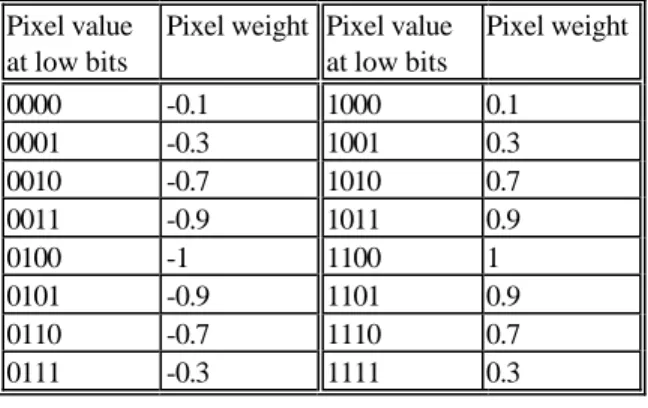
(2) Pixel value at low bits 0000 0001 0010 0011 0100 0101 0110 0111. Pixel weight Pixel value at low bits -0.1 1000 -0.3 1001 -0.7 1010 -0.9 1011 -1 1100 -0.9 1101 -0.7 1110 -0.3 1111. Pixel weight 0.1 0.3 0.7 0.9 1 0.9 0.7 0.3. Table 1: The weighting table corresponds to higher probability. For example, a pixel value of 11000000 with four LSBs of 0000 is mapped to the weighting of –0.1 while another pixel value 11000001 with the same four MSBs but with different four LSBs of 0001 is mapped to the weighting of -0.3. The difference of the magnitudes of these two pixels is only 1, which means that it is very likely that the first pixel value of 11000000 is changed to the second pixel value of 11000001 under some kind of processing. The idea of embedding watermark information in this paper is to gradually change the pixel value until the corresponding weighting achieves a predefined threshold value. The process of changing the pixel values is called finetune process whose objective is to have as small pixel magnitude change as possible while still maintaining the robustness of the watermarking scheme.. 2.1 Basic Watermark embedding scheme In order to increase the robustness, we consider adding one watermark bit for a group of pixels, say four pixels for each watermark bit as will be shown shortly. Assume that the size of the original gray-level image is N×N and the watermark bits are from a binary image of M × M with pixel values ∈{1, −1} . The watermark embedding procedure is listed below and illustrated in Fig. 1. E-(1): Divide the original image into four regions (A,B, C, D) of the same size. E-(2): Partition each region into blocks of size 8 × 8 . E-(3): Calculate the variance of all the 8 × 8 blocks and select the M2 /64 blocks with the largest variances for watermark embedding. Number the blocks according to the order of their variance. If we want to reduce the computation complexity, this step of block variance calculation can be skipped by selecting randomly M2 /64 blocks in each region instead. However, embedding watermark bits into image blocks of large variance will reduce the influence on image quality since human visual system is less sensitive to the pixel value changes of image blocks with large variance. E-(4): Denote the pixel value at the j-th position of the i-th 8 × 8 block in region A, B, C, D as Ai,j ,Bi,j ,C i,j ,Di,j respectively where 1 ≤ i ≤ M 2 / 64 , 1 ≤ j ≤ 64 .. E-(5): Map a group of four pixels Ai,j ,Bi,j ,C i,j ,Di,j into their corresponding weightings using Tab. 1. ′ ′ ′ ′ Ai, j , Bi, j , Ci, j , Di, j E-(6): Based on the k-th binary watermark bit Wk ∈ {1, −1} , calculate if the following inequality (1) is satisfied (1) ( Ai′, j ,+Bi′, j + C′i, j ,+Di′, j ) ×Wk ≥ T1 where T1 is the prescribed threshold that is a function of the number of pixels in each group. Note that the selection of this threshold affects the image quality and the robustness performance of the watermarking scheme. In our experiment, T1 is set to be 2.5 for group size of 4. If inequality (1) is satisfied, the watermark bit Wk has been already added to the group of four pixels Ai,j ,Bi,j ,C i,j ,Di,j. Then continue the embedding steps E-(5) and E-(6) for another group of four pixels. If not, proceed to the following fine-tune process. E-(7): Based on the sign of the watermark bit Wk , change the magnitudes of Ai,j ,Bi,j ,C i,j ,Di,j to their neighboring pixels ~Ai, j , B~i , j , C~i, j , D~i, j with the weightings closer to the value Wk . Then continue steps E-(5) and E-(6). The following exemplifies our watermark embedding procedure. Assume that we want to add a watermark bit Wk = -1 into the group of four pixels with values Ai , j = 10111111 , Bi, j = 11000000 , C i, j = 00100111, Di , j = 00110011. According to the pixel weighing in Tab. 1, we have the corresponding weightings A′i, j = 0 .3, B′i, j = −0 .1, C′i, j = −0 .3,. D′i, j = −0 .9. The sum of the above four weightings is –1 and inequality (1) is not satisfied. Thus, we change the four pixels to their neighboring pixels with weightings closer to Wk = -1, i.e., ~ Ai , j = Ai, j + 1 = 11000000 , ~ Ci, j = Ci, j − 1 = 00100110 ,. ~ Bi, j = Bi, j + 1 = 11000001 , ~ Di, j = Di, j + 1 = 00110100. The corresponding weightings of the above fine-tuned pixels are ~ Ai′, j = − 0. 1,. ~ Bi′, j = −0 .3,. ~ Ci′, j = −0 .7 ,. ~ D i′, j = −1. The sum of the above four weighting values does not satisfy inequality (1) either, and thus we continue another ~ ~ ~ ~ fine-tune process by replacing A i , j , B i, j , Ci , j , Di , j with their neighboring pixels..
(3) A B. calculate variance of each block. C D Original Image. select M 2 / 64 blocks with largest variance. partition into four regions and divide each region into 8 x 8 blocks. M. M. W watermark image. 8. (1) satisfied?. no. reference pixel?. 8. 1. 2. 3. 4. 5. 9. 10. 11 2. 12. 13. M yes. yes no. 1 9 fine-tune 8. all pixels processed?. 2. 6. 7. 8. •••. / 64 blocks at one region of the original image 8 •• 8 • •• •. • • •. next pixel no. 64. ye s. one 8*8 pixel block. finish. Fig. 1: The watermark embedding procedure.. ~ Aˆi , j = Ai, j + 1 = 11000001 , ~ Cˆi, j = Ci , j − 1 = 00100101 ,. ~ Bˆi , j = Bi , j + 1 = 11000010 , ~ Dˆi , j = Di, j = 00110100. The corresponding weightings are Aˆi′, j = − 0. 3,. Bˆi′, j = −0. 7,. Cˆi′, j = −0 .9,. Dˆ′i, j = −1. in other blocks have small changes. We can use the reference pixels to calculate the degree of changes under a specific signal processing. In this case, each 8 x 8 block should be assigned a factor indicating reliability (fidelity) of this block. Using the same mapping table of Tab. 1, we obtain the weightings of the 16 reference pixels in the 8 x 8 block of Fig. 2 and denote them as Rk′ , k = 1,2, Λ ,16 . Let. The above weighting satisfies inequality (1) and thus the fine-tune process terminates.. P=. 16. ∑ Rk′ (−1) k. (2). k =1. 2.2 Improved Watermark Method with Reference Pixels We can increase the robustness and security of the above watermarking method by dividing the pixels in each 8 x 8 block into two categories: reference pixels and embedding pixels. For example, the pixels in the 8 x 8 block of Fig. 2 are divided into 48 embedding pixels and 16 reference pixels where the reference pixels are located in three diagonals. The watermark information is added into the embedding pixels while the reference pixels are used to detect the reliability of this 8 x 8 block. Indeed, after some geometric distortion, pixel values in some blocks might be changed significantly while pixel values. The same fine-tune method as in Sec. 2.1 is used for the 16 reference pixels so that inequality P ≥ T2 is satisfied. The threshold valueT2, affecting the reliability, is selected to be 10 in our experiment. The watermark embedding method for other embedding pixels is the same as discussed before in Sec. 2.1. Later in Sec. 4, we will see that such a watermark embedding method with reference pixels has better performance. Since only 48, instead of 64, watermark bits are added for each 8 x 8 block, the number of blocks selected for watermark embedding in each region should be M2 /48.
(4) If ( Pi (a ) Ai′, j + Pi (b ) B i′, j + Pi (c )C i′′, j + Pi (d ) Di′, j ) ≥ 0 then Wk′ = 1; else Wk′ = 0. 8 1. 2 3. 4 5. 8. Reference Pixel 6. 7 9. 8. Embedding Pixel. 10 11. 14 15. Pi(a), P i(b) , P i(c) ,P i(d) are respectively the reliability metrics of the four i-th 8 × 8 blocks where the four pixels with weightings A ′i′, j , Bi′′, j , C i′′, j , D i′′, j are located. The four reliability metrics, calculated using Eqn. (2), are used as the scaling factors to determine the confidence of the four weightings A ′i′, j , Bi′′, j , C i′′, j , D i′′, j if the pixel values in. 12 13. (4). 16. Fig. 2: Embedding pixels and reference pixels in an 8 x 8 block. instead of M2 /64. Although the positions of the reference pixels in each block are fixed in Fig. 2, it is possible to arbitrarily select the positions of these reference pixels in order to increase the security of the watermark method. For example, the location of the reference pixels may come from a pseudo random sequence generator.. 3. WATERMARK EXTRACTION AND DETECTION The watermark decoding process contains two stages. The first stage is to extract watermark sequence from the received image, which might undergo any kind of signal processing or attack. The second stage is to detect whether the received image contains the desired watermark based on the extracted sequence and the original watermark sequence. We will discuss these two stages in the following.. some part of the image encounter significant changes due to geometric distortion, common signal processing, or other subterfuge attacks. Recall that in the watermark embedding process mentioned in Sec. 2, the reliability metric of an 8 × 8 block is fine-tuned to be greater than or equal to a threshold value T2 (T2 = 10 in our experiments). Thus, if any one of Pi(a), P (b) , P i(c) ,P i(d) is greater than 10, we limit it to 10 while if some i of Pi(a), P i(b) , P i(c) ,P i(d) are smaller than 1 (due to the serious attacks), we assign the value of 1 for them. If the four values are in between, i.e., 8 ×8 1 ≦ Pi(a), P i(b) , P i(c) ,P i(d) ≦ 10, their values are used as the scaling factors for inequality (4) during the watermark extraction. Inequality (3) is in fact a special case when the scaling factors Pi(a), P i(b) , P i(c) ,P i(d) of the i-th block are all one. Shortly, we will see that the watermark scheme with referencepoint has better performance.. 3.2 Watermark Detection After extracting watermark bit sequence the normalized correlation of random sequence. Wk′ , we calculate. Wk′ with the original pseudo. Wk in order to determine whether the. extracted sequence is the correct watermark bit sequence. The normalized correlation of the two sequences are defined as. 3.1 Extraction of Watermark Sequence Our proposed watermark extraction method does not require the access of the original image data. The extraction process is quite simple. Assuming that Ai′, j , Bi′′, j , C′i′, j , Di′′, j are the. Corr(W , W ′) =. corresponding weighting values of the four pixels from the same position of the four regions in the received image, we can determine the corresponding watermark bit Wk′ as. where IP( A , B ) is the inner product o f two sequences. follows:. larger than a threshold value, i.e.,. If ( Ai′′, j + Bi′′, j + Ci′, j + Di′′, j ) ≥ 0, then Wk′ = 1 else Wk′ = 0. (3). In other words, the sign of the summation of the corresponding four weighting values determines the embedded watermark bit. If the reference-pixel method proposed in Sec. 2 is adopted to enhance the robustness, the above watermark extraction is modified as follows:. IP(W , W ′) IP (W , W ) × IP(W ′, W ′). Ak , Bk . If the normalized correlation of the two sequences is Corr(W ,W ′) ≥ T3. (5). the extracted watermark sequence is determined to be the same as the original embedded sequence. The selection of the threshold value T3 affects the false detection rate or false pass rate. In the following, we give a systematic method to choose this threshold value..
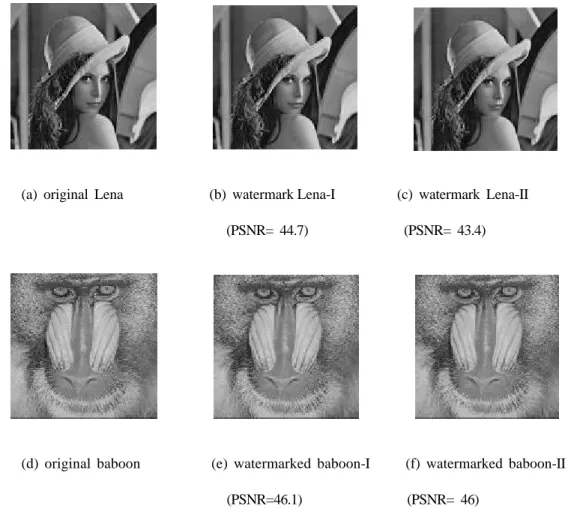
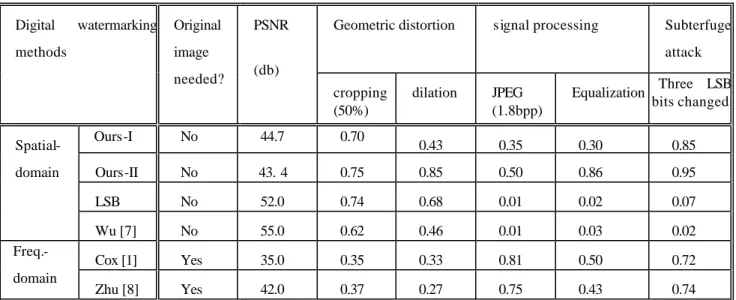
(5) (a) original Lena. (b) watermark Lena-I. (c) watermark Lena-II. (PSNR= 44.7). (d) original baboon. (PSNR= 43.4). (e) watermarked baboon-I (PSNR=46.1). (f) watermarked baboon-II (PSNR= 46). Fig. 3: The original images of Lena (a) and baboon (d) and those after embedding watermark bits using our proposed methods without (b)(e) and with (c)(f) reference pixels.. 4. EXPERIMENT RESULTS. According to the central limit theorem, the normalized The test images we use in this experiment are Lena and correlation X = Corr (W , W ′) of the extracted watermark baboon of size 256 x 256 with gray levels of 8 bits for each sequence and all the other pseudo random sequences can be pixel. The embedded binary watermark bit sequence with approximated as a random variable with Gaussian distribution. length of 32*32 is the 200th sequence among the 1000 pseudoX − µ with sample mean µ and sample randomly generated sequences. For convenience, our Thus, Z = proposed watermark methods without and with reference σ pixels are noted respectively as method-I and method-II. We variance σ 2 is a normalized Gaussian distribution Q(z) first examine the invisibility of our proposed watermark with zero mean and standard deviation of one methods by calculating the peak-signal-to-noise-ratio (PSNR) for the two watermark images. It is almost imperceptible as can 2 x be observed Fig. 3. z − 1 2 Next, we compare the performance of our proposed Q( z ) = e dx watermark methods with other approaches under a variety of − ∞ 2π signal processing or attacks as shown in Tab. 2 for Lena image. . Let the threshold is selected as T3 = ασ , the probability Two types of geometric distortion (cropping and dilation), two of false watermark detection is types of common signal processing (JPEG and equalization) and the subterfuge attack of the last three LSB bits are considered. The values in Tab. 2 are the normalized correlation Pr ob{ X > T3 } ≤ Q(α ) . (6) of the extracted watermark sequence with the original sequence. Based on the analysis in Sec. 3, the threshold of the In other words, the probability of detecting the watermark correlation is set to be 0.1 with the probability of false sequence for non-watermark images is less than Q (α) . Thus, detection smaller than 10 −4 . In other words, watermark we can select the threshold value T2 depending on this sequences with correlation smaller than 0.1 is determined to be probability which might vary from applications to applications. undetectable since they are not significantly larger than. ∫.
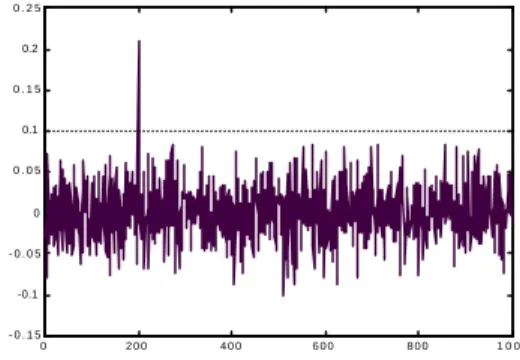
(6) 0.25. (6) Our proposed spatial-domain watermarking methods have better overall performance and they do not need the original image during watermark extraction. Furthermore, the methods are simple and easy to realize using either hardware or software.. 0.2. 0.15. Corr. 0.1. 0.05. 0. -0.05. -0.1. -0.15 0. 200. 400. 600. 800. 1000. Fig. 4: The normalized correlation of the extracted watermark sequence with all the 1000 pseudo random sequences (our proposed method under JPEG processing). the correlation with other no-watermark sequence. Since the embedded watermark bits are from the 200th sequence, the correlation of the extracted watermark sequences with the 200th sequence should be much larger than the correlation with all the other 999 random sequences, as indicated in Fig. 4. From Tab. 2, we have the following observations: (1) Most of the digital watermark methods have high PSNR (greater than 40) except for the method proposed by Cox [1]. As can be seen from Fig. 3, images with PSNR greater than 40 are almost indistinguishable with the original images. (2) Most of the frequency-domain methods require the original image during watermark extraction. Thus, their applications are limited and a large memory space is needed to store the original images before watermark extraction. (3) Compared with frequency-domain approaches, the spatialdomain watermarking methods usually have better performance under geometric distortion but have poor performance under common signal processing and subterfuge attacks. For example, the normalized correlation values for the listed two frequency-domain methods under 50% cropping are around 0.3-0.4 compared to those of 0.7-0.8 using spatial-domain methods. On the other hand, the correlation values of the frequencydomain methods under JPEG processing with 1.8 bit-perpixel (bpp) are 0.7-0.8, much higher than those using spatial-domain methods. (4) Most spatial-domain methods are vulnerable to common signal processing such as JPEG and filtering. For example, the correlation values using the LSB method and the method proposed in [8] are smaller than the threshold value of 0.1. Hence, the embedded watermark information is lost. However, our proposed methods are robust to this kind of signal processing or filtering. (5) Our proposed method with reference pixels have better robustness performance than without using reference points at the cost of slightly lower PSNR (but still greater than 40). For example, the correlation value is increased from 0.43 to 0.85 for the watermark image with dilation.. We also tested three benchmark images (Lena, baboon and F-16) using our proposed watermark methods with and with reference pixels. The experimental results are shown in Tab. 3 where ours-I is the method without reference pixels while oursII is that with reference pixels. The watermark embedding method with reference pixels is in general has better performance.. 5. CONCLUSIONS We proposed two spatial-domain watermarking methods based on a pixel-weighting table and the fine-tune process. The methods, although simple, have better robustness performance compared to other spatial-domain or frequencydomain methods. Furthermore, our methods do not require the original image during watermark extraction, make them favorable for most watermark applications.. References [1] I. J. Cox, J. Kilian, T. Leighton and T. Shamoon, ”Secure Spread Spectrum Watermarking for Multimedia”, IEEE Trans. On Image Processing, Vol. 6, No12, pp.1673-1687, Dec. 1997. [2] M. D. Swanson, M. Kobayashi, and A. H. Tewfik, “Multimedia Data-Embedding and Watermarking Technologies”, Proc. of IEEE, Vol. 86, No.6, pp.1064-1087, June 1998. [3] C.-T. Hsu and J.-L. Wu, “Hidden Digital Watermark in Image”, IEEE Transactions on Image Processing, Volume: 8 1, pp 58 –68, Jan. 1999. [4] W. Tang and Y. Aoki, “A DCT-based Coding of Images in Watermarking”, Information, Communications and Signal Processing., Proc. ICICS, Volume: 1 , pp 510 -512, 1997. [5] I. J. Cox, Jean-Paul M. G. Linnartz, “Some General Methods for Tampering with Watermarks”, , IEEE Journal on Selected Areas in Communications, Volume: 16 4 , pp 587 -593 , May 1998. [6] R. B. Wolfgang and E. J. Delp, “A Watermark for Digital Image”, Proc. IEEE Intl. Conf. on Image Processing, Volume: 3 ,pp 219 -222, 1996 . [7] M. Wu, and B. Liu, “Watermarking for image authentication”, Proc IEEE Intl. Conf. on Image Processing, vol. 2, pp. 437-441, 1998. [8] W. Zhu, and Z. Xiong and Y. Q. Zhang, “Multi-resolution watermarking for images and video”, IEEE Transactions on Circuits and Systems for Video Technology, vol. 9, no. 4, pp. 545-550, Jun. 1999..
(7) Digital. watermarking. methods. Original. PSNR. Geometric distortion. signal processing. Subterfuge. image needed?. attack (db) cropping (50%). Spatial-. Ours-I. No. 44.7. 0.70. Ours-II. No. 43. 4. LSB. No. Wu [7]. domain. Freq.domain. dilation. JPEG (1.8bpp). Equalization. Three LSB bits changed. 0.43. 0.35. 0.30. 0.85. 0.75. 0.85. 0.50. 0.86. 0.95. 52.0. 0.74. 0.68. 0.01. 0.02. 0.07. No. 55.0. 0.62. 0.46. 0.01. 0.03. 0.02. Cox [1]. Yes. 35.0. 0.35. 0.33. 0.81. 0.50. 0.72. Zhu [8]. Yes. 42.0. 0.37. 0.27. 0.75. 0.43. 0.74. Tab. 2: Comparison of robustness of different watermarking methods under a wide variety of signal processing.. Three test images. Lena. baboon. F16. PSNR. Geometric distortion. signal processing. cropping. dilation. JPEG. Equalization. Ours-I. 44.7. 0.70. 0.43. 0.35. 0.30. Ours-II. 43.4. 0.75. 0.85. 0.5. 0.86. Ours-I. 46.1. 0.78. 0.43. 0.20. 0.10. Ours-II. 46. 0.78. 0.74. 0.10. 0.10. Ours-I. 44.8. 0.86. 0.21. 0.32. 0.18. Ours-II. 43. 0.69. 0.94. 0.49. 0.90. Tab. 3: Performance comparison of our proposed watermark methods for different benchmark images..
(8)
數據
相關文件
BAL 1000 Brown almost-linear func, nonconvex, dense Hessian.. BT 1000 Broyden tridiagonal func, nonconvex,
Then they work in groups of four to design a questionnaire on diets and eating habits based on the information they have collected from the internet and in Part A, and with
"Extensions to the k-Means Algorithm for Clustering Large Data Sets with Categorical Values," Data Mining and Knowledge Discovery, Vol. “Density-Based Clustering in
Particularly, combining the numerical results of the two papers, we may obtain such a conclusion that the merit function method based on ϕ p has a better a global convergence and
Table 3 Numerical results for Cadzow, FIHT, PGD, DRI and our proposed pMAP on the noisy signal recovery experiment, including iterations (Iter), CPU time in seconds (Time), root of
Lin, A smoothing Newton method based on the generalized Fischer-Burmeister function for MCPs, Nonlinear Analysis: Theory, Methods and Applications, 72(2010), 3739-3758..
• Use table to create a table for column-oriented or tabular data that is often stored as columns in a spreadsheet.. • Use detectImportOptions to create import options based on
SG is simple and effective, but sometimes not robust (e.g., selecting the learning rate may be difficult) Is it possible to consider other methods.. In this work, we investigate
