Magnetotransport properties, electronic structure, and microstructure of La
0.7Sn
0.3MnO
3thin films
T. Y. Cheng,1,*C. W. Lin,2 L. Chang,2C. H. Hsu,3J. M. Lee,3 J. M. Chen,3J.-Y. Lin,4K. H. Wu,1T. M. Uen,1Y. S. Gou,1 and J. Y. Juang1
1Department of Electrophysics, National Chiao Tung University, Hsinchu 30050, Taiwan
2Department of Materials Science and Engineering, National Chiao Tung University, Hsinchu 30050, Taiwan 3National Synchrotron Radiation Research Center, Hsinchu 30076, Taiwan
4Institute of Physics, National Chiao Tung University, Hsinchu 30050, Taiwan
共Received 27 February 2006; revised manuscript received 25 August 2006; published 30 October 2006兲
Single-phase La0.7Sn0.3MnO3共LSnMO兲 thin films were fabricated on LaAlO3共LAO兲 substrates by pulsed
laser deposition 共PLD兲. The as-deposited films, though showed insulating characteristics with no sign of insulator-metal transition 共IMT兲 down to very low temperatures, did display a paramagnetic-ferromagnetic transition共PFT兲 around 180 K. The x-ray absorption spectroscopy 共XAS兲 of the as-deposited LSnMO films shows signature of Mn3+/ Mn2+mixed valence indicating that tetravalent Sn ions may have resulted in electron
doping into the egband of Mn. The transmission electron microscopy共TEM兲 analyses on the as-deposited
LSnMO films further confirmed that the films are epitaxial with uniform composition distributions. It is suggestive that the doping level of x = 0.3 in La1−xSnxMnO3can be achieved without disrupting the perovskite
structure or any composition inhomogeneity. On the other hand, ex situ annealing in oxygen as well as in argon atmosphere, though both drive the films to display IMT and a marked enhancement in the transition tempera-ture, the preservation of LSnMO phase is somewhat doubtful. In the oxygen-annealing case, the evidence from the XAS measurements on Sn ions though showed the existence of tetravalent characteristics, the Hall mea-surements indicated that the obtained LSnMO films are p type in nature. Furthermore, the TEM analyses also revealed the emergence of the Sn compounds, which may ultimately drive the obtained films into La-deficient La1−xMnO3phases.
DOI:10.1103/PhysRevB.74.134428 PACS number共s兲: 75.70.Ak, 75.50.Lk, 81.40.Rs
I. INTRODUCTION
The perovskite manganites, being a representative family of strong-correlated electron system, have been subject of extensive researches.1,2 In particular, in various hole-doped manganites, the colossal magnetoresistance 共CMR兲 effect, manifested by a paramagnetic-ferromagnetic transition at the Curie temperature共Tc兲 accompanied by a dramatic decrease in resistivity around a similar temperature 共TIM兲, has been ubiquitously observed and attributed to the charge-spin inter-action of mixed-valence Mn3+/ Mn4+ ions via Zener’s semi-nal double-exchange 共DE兲 mechanism.3 However, it has been pointed out that DE alone might be inadequate to ex-plain the observed CMR effect in La1−xSrxMnO3 and the
incorporation of polaron effect induced by electron-phonon interactions arising from the Jahn-Teller splitting of the Mn d levels could be essential.4 On the other hand, despite the extensive success in obtaining the hole-doped manganites over wide range of compositions, efforts in trying to substi-tute La ion with tetravalent ions and hence make the manga-nites electron doped have been rather inconclusive. Joseph Joly et al.5 argued that, due to the ion size constraints, it is almost impossible to replace the trivalent La3+ ion by
tet-ravalent ions in polycrystalline manganite bulks prepared by solid state reaction. Indeed, early attempts of preparing Ce-doped RMnO3 共R=La,Pr,Nd兲 manganites by Das and
Mandal6 all showed signatures of mixed phases and hence blurred the interpretation of the obtained results. In particu-lar, the replacement of tetravalent ions to La3+ often led to
the self-doped La1−xMnO3−␦with localized multiphase
com-pounds, which might give rise to very similar magnetotrans-port properties to those of the hole-doped manganites and jeopardize the genuine electron-doped characteristics.7,8
Recently, single-phase tetravalent-ion-doped La0.7Ce0.3MnO3 共LCeMO兲 thin films were successfully
fab-ricated by pulsed laser deposition共PLD兲.9–12It appeared that ionic constraints and stoichiometry conservation could be compromised provided proper growth conditions were cho-sen. On the other hand, Kawai et al.13showed that, in their preparation scheme, while the as-grown LCeMO films all displayed ferromagnetic-insulator behavior, the typical metal-insulator transition are recovered only after post an-nealed under the atmosphere of oxygen and/or argon. The existence of the nanoclustering cerium oxides within the films revealed by the transmission electron microscopy 共TEM兲 analyses has led the authors to conclude that cation deficiencies are responsible for the emergence of the ferromagnetic-metal characteristics, albeit the phase regions identified appeared to be rather minor. On the other hand, Zhang et al.14 reported that the x-ray photoemission spec-troscopy共XPS兲 of the La0.9Te0.1MnO3prepared by PLD and
followed by annealing in the flowing oxygen revealed the signature of 4+ valence states for Te ions. They regarded it as the evidence of electron-doping for the La0.9Te0.1MnO3
films. Chen et al.15 reported that the as-prepared La1−xPrxMnO3共LPMO兲 bulks with different compositions do
not show discernable metal-insulator transition behavior. However, the metal-insulator transition and associated CMR effect were obtained after annealing the samples in argon flow atmosphere. The XPS results of the Pr ions in their
samples featured the characteristics of Pr3+and Pr4+mixture,
indicating that the LPMO ceramic might be an electron-doped CMR compound. Compared to the potentially electron-doped CMR materials mentioned above, obtaining single-phase LaxSn1−xMnO3 共LSnMO兲 represents an even
more severe challenge because of an even larger ionic size difference between La3+and Sn4+. Nevertheless, CMR effect
has been observed in LSnMO,16–18 albeit the single-phase samples were hardly obtainable by the solid-state reaction technique and only limited doping 共x=0.1–0.2兲 has been achieved in thin film form. Since most manganites display optimum CMR effects around 30% doping and the promi-nent roles played by lattice degree of freedom in giving rise to both CMR19effect and phase-coexistence20phenomena, it is desirable to perform systematic studies on the LSnMO system with higher doping. In addition to the experimental facts briefly described above, there are some points notewor-thy of mentioning. First, all attempts to substitute the tetra-valence ion共Ce, Sn, Te, Pr兲 into the La ion site frequently result in ferromagnetic-insulator CMR, suggesting either the lack of itinerant carriers or the exchange mechanism may be fundamentally different in the electron-doped regime. Sec-ond, post annealing under oxygen or argon environment has been a usual practice in fabricating the electron-doped man-ganites. However, samples prepared under these two anneal-ing schemes can display markedly different transport and magnetic behaviors. Finally, it is not clear that the electronic states of the doped ions indeed directly reflect the doping states of the CMR materials. In this paper, we present results obtained from the magnetotransport, electronic, and micro-structure analyses of the La0.7Sn0.3MnO3共LSnMO兲 that evi-dently clarify some of the outstanding issues mentioned above.
II. EXPERIMTAL
Sintered LSnMO target was prepared by conventional solid-state reaction technique. LSnMO films were deposited on single crystalline LaAlO3共100兲 substrates using a 248 nm
KrF excimer laser operating at energy density of 2 – 3 J / cm2. The details of the processing conditions can be found elsewhere.21 The as-deposited films, though displayed usual paramagnetic-ferromagnetic transitions, the typical CMR be-haviors of the accompanying insulator-metal transition was, however, absent. Thus, in some cases, subsequent ex situ annealing was carried out at 800 ° C for 4 h in 250 Torr of oxygen or argon. The temperature dependences of magneti-zation 关M共T兲兴 and magnetotransport properties were mea-sured using a Quantum Design® PPMS system with a maxi-mum applied field strength of 8 Tesla. The crystalline structure of the films was examined by x-ray diffraction 共XRD兲 共-2 scan兲 and x-ray scattering measurements. For the electronic structure and valence state of Mn and Sn ions, the x-ray absorption near edge spectroscopy 共XANES兲 ex-periments were performed at the National Synchrotron Ra-diation Research Center of Taiwan. In order to probe the microstructure, interface between film and substrate, as well as the element distributions of the LSnMO films, cross-section transmission electron microscopy 共TEM兲 and
elec-tron energy loss spectroscopy 共EELS兲 mapping were per-formed.
III. RESULTS AND DISCUSSION A. Transport and magnetic behaviors
Figure 1 shows the field-cooled and zero-field-cooled temperature-dependent magnetizations M共T兲 measured at ap-plied field of 0.1 T and 0.01 T together with the zero-field temperature dependence of resistivity 共T兲 for 共a兲 the as-deposited 共AD兲 and 共b兲 the oxygen-annealed 共PA兲 LSnMO
FIG. 1. The field-cooled and zero-field-cooled temperature-dependent magnetizations关M共T兲兴 measured at 0.1 T and 0.01 T for 共a兲 the as-deposited 共AD兲 and 共b兲 the oxygen-annealed 共PA兲 films. 共c兲 Similar M共T兲 measurement for the argon-annealed 共ArPA兲 film at 0.1 T. The typical spin-glass behavior is observed in all films, indicating either the structure disorder or the magnetic disorder is ubiquitously existent in this manganite. The zero-field temperature dependence of resistivity for both films is also displayed. Notice the drastic difference exhibited.
films as well as for共c兲 the argon-annealed 共ArPA兲 LSnMO film measured at 0.1 T, respectively. We note that in the paramagnetic 共PM兲 state the resistivity of the AD film is larger than that of the PA films by nearly two orders of mag-nitude. While this may originate from the charge localization effects associated with lattice distortion,22,23the absence of a temperature-induced TIMin the AD film can be more subtle
and complicated. De Teresa et al.24 argued that it might be related to the absence of long range FM order signified with a manifestation of spin-glasslike behavior at lower tempera-tures. This would imply that the large epitaxial strain origi-nally existent in the AD film not only induces enormous charge localization effect but also hinders the formation of long range FM ordering. If this argument is true, one expects to see the opposites for the PA films. At first glance, it seems to explain the over 200% enhancement in magnetization and dramatic increase in TIM rather consistently. However, as
shown in Fig.1, significant spin-glasslike behavior, charac-terized by the pronounced irreversibility between the field-cooled共FC兲 and zero-field-cooled 共ZFC兲 M共T兲 curves, is evi-dent for both cases. This implies that the insulator-metal transition and spin-glass state are not necessary mutually ex-clusive. Furthermore, we note that the results shown in Fig.1 also reveal some features deviating from that reported for low-doping LSnMO.18 In that progressive suppression of spin-glasslike behavior with increasing Sn doping was ob-served. It has been interpreted as a result of increasing Mn4+
ions driven by Sn doping-induced La vacancies, and the low-doping LSnMO’s were essentially regarded as hole-doped manganites. However, according to the XAS results to be presented below, the features of Mn2+/ Mn3+mixed valences
indicate that the present AD films might have effectively doped some electrons to the egband of Mn-3d orbitals. Fur-thermore, we note that, in our case共x=0.3兲 the spin-glasslike transition not only emerges at much higher temperature共Tg ⬇150 K兲 than that reported in Ref. 14共75 K→20 K for x = 0.04→0.18兲 but also is very sensitive to the applied field. Thus, we suspect that the Sn-doping-induced La-vacancies scenario may not apply to our case. The spin-glasslike be-havior and CMR effect observed in the annealed LSnMO here is probably not arising from the divalent doping-enhanced ferromagnetic interaction and magnetic homogene-ity but maybe related to the strain relaxation in a subtler manner. The other feature to be noted is the dramatic sup-pression of the low temperature magnetization for the AD film when measured at 0.01 T. Since the basic ingredients for spin glass to occur are disorder as well as the magnetic interaction randomness, anisotropy and frustrations,19we be-lieve that these factors also account for the dramatic suppres-sion of magnetization in the lower measuring fields for the AD films. Finally, we note that very recent observations by Valencia et al.25 have indicated that, in La
2/3Ca1/3MnO3
films, the formation of Mn2+ ions due to the instability of Mn3+ subjected to prolonged air exposure might also lead to
charge localization and, hence, the increasing resistivity and reducing magnetization. However, the relevance of this non-ferromagnetic order originated from divalent Mn component to the observed spin-glasslike behaviors discussed above re-mains to be clarified.
On the other hand, since post annealing by argon is a common practice for preparing the tetravalent-doped CMR
materials, it is important to clarify the effect of argon anneal-ing on LSnMO films. The idea behind this practice was that the excessive oxygen may induce hole doping, and thus, may counteract the expected effect of electron-doped CMR mate-rials. Therefore, annealing in the argon environment may avoid the introduction of holes induced by excess oxygen and could turn out to be a practical method of fabricating electron-doped CMR materials. As illustrated in Fig. 1共c兲, the M-T of the argon-annealed LSnMO共ArPA LSnMO兲 film does display a comparable magnetization to that of the PA-LSnMO film. Nonetheless, the zero-field temperature depen-dent resistivity,共T兲, is about three times larger than that of the PA-LSnMO film. Since, in contrast to the AD films, both PA- and ArPA-LSnMO films exhibit signatures of typical paramagnetic-insulator 共PI兲 to ferromagnetic-metal 共FM兲 transition, annealing appears to have effects on driving the material from a ferromagnetic insulator to a ferromagnetic metal. However, there exist some differences in the detailed behaviors between the PA and ArPA films, as well.
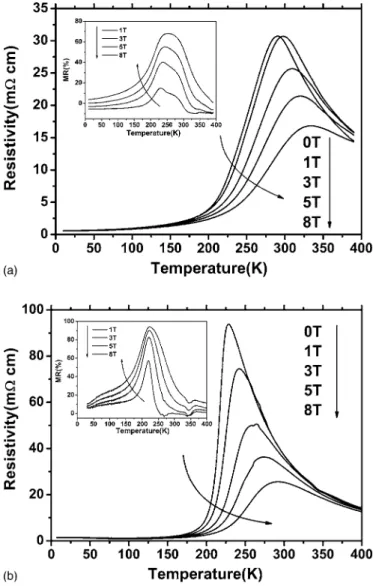
Figure2 shows共T兲 as a function of applied field for the PA film and ArPA film, respectively. The resistivity was
mea-FIG. 2.共T兲 as a function of applied field for the 共a兲 PA and 共b兲 ArPA LSnMO film, respectively. The inset illustrates the field de-pendence of the MR ratio.
sured with the field applied parallel to the film surface. For the AD film, although there exists a typical PM-FM transi-tion with Tc⬇190 K, the 共T兲 increases steeply with
de-creasing temperature关Fig.1共a兲兴 and has no sign of metallic transition for applied field up to 8 Tesla. On the contrary, for the PA film, in addition to having nearly two orders of mag-nitude reduction in resistivity as compared to the AD film in the PM state, it also displays the typical CMR behavior with
TIM⬃300 K at zero field. The maximum magnetoresistance
共MR兲 ratio, defined as ⌬/=关共0兲-共H兲兴/共0兲 with 共0兲 and 共H兲 being the resistivity at zero field and at field H, appears around 250 K and reaches about 70% at a field of 8 Tesla. Together with the M共T兲 results shown in Fig.1, the results demonstrate that annealing not only significantly en-hances the low-temperature magnetization by more than 200% but also changes the magnetotransport properties of the LSnMO films dramatically. Guo et al.,17 by varying the film thickness in their La0.9Sn0.1MnO3+␦ films, have found
similar enhancement in raising TIM with increasing film thickness. However, there was no noticeable change in Tc and low temperature magnetization with film thickness varia-tions, which led them to conclude that the enhancement of
TIMwas due to strain relaxation instead of formation of new phases introduced by oxygen or La deficiency.7,8,20,25–28 Similarly, Thomas et al.29have attributed the improved mag-netotransport properties observed in their high temperature 共900 °C兲 annealed La0.7Ca0.3MnO3 films to the massive
stress relaxation and improved film crystallinity accompa-nied with grain growth. However, they did not report how magnetization and Tc were affected by post annealing. In comparison, for the ArPA films, although it also displays the typical CMR behavior, the TIM= 230 K at zero field is
some-what lower than that of the PA films. The maximum MR ratio appears around 220 K and reaches nearly about 95% at a field of 8 Tesla. These results are, in fact, very similar to that of some La-deficient CMR materials.20,24It appears that, from the magnetotransport properties alone, one cannot dis-cern whether the typical CMR behaviors displayed by post-annealed films are indeed the genuine characteristics of electron-doped manganites or they are just manifestations of La-deficient manganites induced by post annealing.11In ad-dition, whether the lack of insulating-metallic transition in AD-LSnMO films is correlated to the lattice disorder or to other mechanisms共such as composition change兲 remains to be clarified. In order to give some further accounts on these issues, we performed further investigations on the electronic structures of the corresponding films by XAS measurements.
B. Electronic structure
Figure 3共a兲 shows the XAS results of Mn-L2,3 for the
AD-, PA-, and ArPA-films together with that of several “standard” powder samples. The results demonstrate that, while the AD-film indeed displays qualitative mixed-valence state characteristics of Mn2+/ Mn3+, the valence state of Mn
in the PA- and ArPA-films appears to be closer to that of the Mn3+/ Mn4+mixed state. The manifestation of Mn2+
charac-teristic revealed in the XAS of the AD-film indicates that the PLD process, though may simultaneously introduce
signifi-cant structural disorders, does help in retaining the Sn ions in the lattice. On the other hand, both the PA and ArPA pro-cesses appear to drive the LSnMO toward the hole-doped regime, except that there is signature of Mn2+ 共the pre-edge
peak around 640 eV兲 appearing for the latter. In order to further delineate the possible difference between the elec-tronic structure of PA and ArPA films implied in the
magne-FIG. 3. The x-ray absorption spectra of 共a兲 Mn-L2,3 and 共b兲 Sn-M3for LSnMO film, respectively. Spectra for various standard
totransport results described above, we show, in Fig. 3共b兲, the XAS of Sn together with that obtained from the standard samples of SnO2 and SnS powder. We first note that the
results essentially dismiss the existence of Sn2+ ions in the
LSnMO films, despite it has been anticipated that the ionic size of Sn2+共0.96 Å兲 seems to be more favorable than that of
Sn4+ 共0.81 Å兲 in substituting the La3+ 共1.13 Å兲 ions in the
perovkite structure.30The XAS data of Sn in the PA-LSnMO 共oxygen annealed兲 films qualitatively demonstrate the fea-tures obtained from the standard SnO2 samples, indicating
that the majority of Sn ions are in the valence state of Sn4+.
In comparison, the XAS of Sn in the AD film displays a smeared characteristic of Sn4+around the same energy range.
This is indicative that the Sn ions are residing on the La-site and are either affected by the size-mismatch-induced strain or even participating the hybridization between Mn-3d and O-2p orbitals, as in this case most of Sn ions are retained in the La-Sn-Mn-O films共vide infra兲. On the contrary, the XAS data of Sn in the Ar-annealed film do not show the signature of either Sn2+ or Sn4+, suggesting that the doped Sn in the
initial target material may have been largely missing in the ArPA LSnMO film, at least within the depth probed by the XAS. We, thus, suspect that the magnetotransport properties demonstrated previously might be the manifestations of some La-deficient manganite derived from the argon-annealed process. Besides, the unambiguous Sn4+feature
ob-served in the PA-LSnMO films suggests that either the
va-lence of Sn in LSnMO is really 4+ or there is some SnO2or
other tin compounds formed in the LSnMO sample during the oxygen annealing process. Although the high Tcand high
TIMexhibited by these films have indicated that the latter is
more likely the case, direct evidence is desirable to clarify this issue.
C. Microstructure and constituents distribution analysis Figure4共a兲compares the – 2 scan of x-ray diffraction 共XRD兲 results for AD, ArPA, and PA LSnMO films. As is evident from the results, all the films are c-axis oriented with no observable impurity phases. The slight split of the共00ᐉ兲 peaks between the ArPA and PA films and the substrates, however, indicates that significant strain relaxation may have occurred after prolonged annealing. To further delineate the possible subtle changes in the film microstructure due to an-nealing, L-scan and-scan measurements were performed. The typical results are illustrated in Figs.4共b兲–4共d兲, respec-tively. In Fig.4共b兲, it is evident that, in addition to the sharp Bragg peak from the LAO substrate, well-resolved 共003兲-reflection peaks of the LSnMO films were observed for the AD, ArPA, and PA samples with the correspondent c-axis lattice constant being 3.908 Å, 3.893 Å, and 3.878 Å, re-spectively. Since the LSnMO film on LAO substrate is ex-pected to experience an in-plane compressive stress due to the smaller substrate lattice constants, the progressive
short-FIG. 4.共a兲 XRD results for the as-deposited, Ar-annealed and post-annealed LSnMO films grown on LAO substrates at Ts= 780 ° C.共b兲
L scan of AD, ArPA, and PA films across共003兲 Bragg peak. 共c兲 The scans for the LAO 共103兲 and AD LSnMO 共103兲 Bragg peaks,
respectively.共d兲 The scans for the LAO 共103兲 and PA LSnMO 共103兲 Bragg peaks, respectively. The results clearly show the high degree of epitaxy between the film and substrate. Significant strain resulted from this kind of coherency is expected.
ening of the c-axis lattice constant exhibited in the ArPA and PA films is indicative of the occurrence of annealing-induced strain relaxation, which in turn drives the film toward its bulk characteristics. 共The pseudocubic lattice parameter of La1−xMnO3 ranges from 0.3866 nm– 0.3880 nm for x
= 0 – 0.33.25,28兲. We note that the in-plane lattice parameters also exhibited noticeable shrinkage upon annealing with a = 3.913 Å, 3.907 Å, and 3.900 Å for AD, ArPA, and PA films, respectively. Valencia et al.32 pointed out, in their study of LCMO/STO films, that the existence of oxygen va-cancies compensates the excessive elastic energy in coher-ently strained films. Thus, the shrinkage of the unit cell vol-ume may reflect the elimination of oxygen vacancies and associated strain energy. The full width at half maximum 共FWHM兲 of the 共0–13兲 peak of AD-LSnMO is about 4.4°, which is much larger than that of LAO共103兲 共0.1°兲. This can be either due to the strain or fine grain size effects. The in-plane grain size estimated from the linewidth of K scan across the LSnMO 共0 −1 3兲 reflection is approximately 100 Å. On the other hand, for the PA film, the FWHM of LSnMO共103兲 is about 1.9°, which, though still much larger than that of LAO共103兲 共⬃0.036°兲, is significantly smaller than that observed in AD film. The in-plane grain size as estimated from the linewidth of the H scan across the LSnMO共103兲 reflection is approximately 135 Å. This differ-ence strongly suggests the crystallinity of LSnMO films was significantly improved upon annealing while the in-plane ep-itaxial relations remain largely intact. The scans were taken along the共0 −1 3兲 Bragg peak of the LAO substrate and LSnMO films. As is evident from Figs.4共c兲and 4共d兲, both AD- and PA-LSnMO films display well-aligned
ab-plane epitaxy with the LAO substrate. Again, the FWHM
of the diffraction peaks for the AD film is larger than that of the PA film consistent with the arguments aforementioned for the XRD results.
To further delineate the evolving film/substrate relations due to annealing, Fig. 5共a兲–5共c兲 compares the reciprocal space maps of AD-, ArPA- and PA-LSnMO films. The de-creasing peak position offset in q储 between LAO and
LSnMO in the reciprocal space maps clearly shows the oc-currence of strain relaxation effect after the annealing pro-cess. It is also evident that the lattice constants of LSnMO are significantly larger than that of LAO, consistent with the above mentioned results. For comparison, we show, in Fig. 5共d兲, the similar plot obtained for the PA LSnMO/STO共001兲. Since the lattice constant of LSnMO falls between STO and LAO and is closer to that of STO, LSnMO grown epitaxially on STO and LAO would experience a tensile/compressive average in-plane strain, respectively. In the case of LSnMO/ STO, the films are fully coherent to the substrate, as indi-cated by the nearly perfect alignment between the center of the STO共113兲 and LSnMO共113兲 peak contours. Nevertheless, in both bases, we observe shrinkage of both the c-axis lattice constant and unit cell volume of LSnMO upon post-annealing; in LSnMO/STO case, a-b remains invariant but in the case of LSnMO/LAO, a-b also decreases slightly. It ap-pears that some of the strain, originally compensated by oxy-gen vacancy incorporation,32was released through the reduc-tion of average unit cell volume. Alternatively, it is also possible that the change of average lattice parameters upon
PA is coupled with change of composition, or even second-phase segregations. In any case, the lattice constant change associated relaxation of the strain in the films, though might originate from very different mechanisms, do intimately cor-relate to the enhanced CMR properties in a consistent man-ner. Unfortunately, the x-ray analyses seemed inadequate to precisely answer the question about the role played by Sn.
In order to further examine the distribution of Sn and the possibly formed Sn-compounds that are not discernable by using x-ray diffraction alone, we performed the cross-sectional transmission electron microscopy共X-TEM兲 analy-ses to reveal the microstructure and the element distribution of the LSnMO films. Figures6共a兲and6共b兲Show the bright-field TEM images and selective area diffraction共SAD兲 pat-tern of AD LSnMO共001兲 film grown on LAO共001兲 substrate. As can be seen from Fig. 6共a兲, the film microstructure ap-pears to be rather homogeneous and there is no trace of any additional compound existing within the interface of film and substrate. In addition, the absence of extra diffraction spots in Fig. 6共b兲 indicates that the AD-LSnMO film grown on LAO substrate is indeed single phase with well-organized epitaxial relations. The rodlike diffraction spots and the streaky patterns appeared in the columnar grains of the LSnMO phase suggest that there exists a significant amount of strain in the film. We believe that both the slight lattice mismatch between the film and substrate and the large ionic size difference between La3+ and Sn4+ may contribute. For
the PA-LSnMO film, however, the results are quite different. The bright field image shown in Fig.6共c兲apparently displays two somewhat separated regions. The grains in the near sur-face upper region appear to be more “equiaxial” with much less strain-induced streaky patterns, suggesting significant re-crystallization may have occurred due to annealing. In the “lower” region 共region close to the substrate interface兲 the features are more like that observed in the AD film. Although it is still not obvious to conclude whether or not the recrys-tallized upper region containing any newly formed phases from the SAD results, it is, nevertheless, interesting to find that the oxygen annealing affects only the upper part of the film. With the about 4 h of annealing time and 100 nm of the affected depth, the estimated oxygen diffusion rate at 800 ° C is about 25 nm/ hr.
From the above discussion, the strain relaxation effect is consistent with what observed in x-ray diffraction analyses and hence account for part of the magnetotransport proper-ties obtained. The XAS results, however, remain to be clari-fied. In order to delineate the effect of annealing on the com-position distribution of the doped element in the LSnMO film, the electron energy loss spectroscopy共EELS兲 mapping was performed on the TEM samples. Fig.7共a兲show the zero-loss image of the AD-LSnMO film and the elemental maps of La, Sn, Mn, O, respectively. As revealed by the series of the images, the four constituents distribute uniformly over the entire AD-LSnMO film, indicating that they are presum-ably situated within the parent perovskite structure. The re-sults are largely consistent with the data discussed above. Nevertheless, the elemental maps of the four constituent el-ements in the PA-LSnMO film display rather different re-sults. As illustrated in Figs.7共b兲 there are clear evidence of local segregation of Sn and O in the “upper” region of the
PA-LSnMO film 关Figs. 7共b兲兴. More interestingly, in these Sn-O segregated areas, both La and Mn are absent 关Fig. 7共b兲兴, indicating that the clusters formed are some kind of Sn-O compound.共From the previous XAS results it should be SnO2.兲 This strongly implies that the oxygen annealing
affected regions may indeed induce the formation of the La-deficient manganite, which, in turn, accounts for the marked enhancement in Tc and TIM for the PA-LSnMO films
de-scribed above.
In the following, we try to put the experimental observa-tions presented above together to see if it can be reconciled to the outstanding issues about the CMR effects on Sn-doped manganites that we set forth to resolve at the beginning. The very first question to be answered is whether or not Sn ions can substitute La sites? The results obtained from the as-deposited films indicated that the substitution of the tetrava-lent Sn into the La site does prevail and result in a ferromagnetic-insulating manganite. The unexpected
insulat-FIG. 5. 共a兲, 共b兲, and 共c兲 are reciprocal space maps of AD, ArPA, and PA LSnMO films grown on LAO substrates, respectively. 共d兲 Reciprocal space map of PA LSnMO film grown on STO substrate.
ing behavior thus suggests either the lack of itinerant carriers or a fundamentally different exchange mechanism in the electron-doped regime. In the former scenario, similar double-exchange mechanism as in the hole-doped mangan-ites gives rise to the paramagnetic-ferromagnetic transition and the existence of Mn2+ due to tetravalent doping of Sn4+
should result in enhancement of saturation magnetization be-low Tcowing to contributions from extra egelectrons. How-ever, due to the charge localization effects associated with strain-induced lattice distortion, the lack of itinerant elec-trons not only has hindered effective transport but also is responsible for the absence of long range FM order as mani-fested in the dramatic reduction of saturation magnetization and marked spin-glasslike behavior displayed in Fig.1. The large epitaxial strain originally existent in the AD-film as revealed by the x-ray and X-TEM analyses seemed to give consistent support. On the other hand, the existence of Mn2+
in as-deposited and prolonged air exposure LCMO films was found to yield charge localization, and hence increasing re-sistivity and reducing magnetization, as well.25However, the effects of Mn2+-induced charge localization seemed too
mod-est to drive it into ferromagnetic insulator. Another possibil-ity for explaining why our AD LSnMO films present as a ferromagnetic insulator is that the doping level共x=0.3兲 is too low to drive the LSnMO into n-type manganite. Chang et
al.12indicated that the one of the main effects of doping Ce 共up to x=0.3兲 into LaMnO3 was to dramatically shrink the
hole pockets near the Fermi level, instead of providing itin-erant electrons and driving LCeMO into a n-type manganite. We believe that, from the evidence exhibited by XAS
共espe-FIG. 7. 共a兲 The electron energy loss spectroscopy of the zero-loss image共a1兲 and the elemental maps of La 共a2兲, Sn 共a3兲, Mn 共a4兲, and O 共a5兲 of the AD LSnMO film. 共b兲 The electron energy loss spectroscopy of the zero-loss image 共b1兲 and the elemental maps of La共b2兲, Sn 共b3兲, Mn 共b4兲, and O 共b5兲 of the PA LSnMO film.
FIG. 6. 共a兲 The bright-field TEM image and 共b兲 the electron diffraction pattern for the AD LSnMO共001兲 film. 共c兲 The bright-field TEM image and共d兲 the electron diffraction pattern for the PA LSnMO共001兲 film. Notice that the near-surface upper part of the PA LSnMO film displays apparent recrystallization signature upon prolonged annealing.
cially on Sn ion兲 and EELS of XTEM analyses, for AD-LSnMO films, effective doping is obtained. However, the tetravalent—doping-induced hole-pocket shrinkage effects similar to that observed in Ce-doped manganites12 may also happen in the present AD-LSnMO films. Together with the influences of the coherent strain and, possibly larger ion-size effect, thus resulted in the ferromagnetic insulating as well as spin-glasslike behaviors displayed by the AD-LSnMO films. On the other hand, although post annealing under oxygen or argon is usually practiced in the fabrication of the “electron-doped” manganites, our experimental results dem-onstrate that it may not work as expected. According the XAS of Sn, we are tempted to rule out the existence of Sn2+ ions in the LSnMO films. The XAS of Sn for the PA-LSnMO film evidently shows the characteristics of Sn4+valence. On the contrary, the same spectrum for the Ar-annealed film does not show the characteristics of either Sn2+or Sn4+, sug-gesting that the doped Sn in the initial target material may have been largely missing in the ArPA-LSnMO film. The question is how do these spectrum results correlated to the magnetotransport properties displayed by the respective films? The TEM microstructure analyses and the EELS el-emental map of PA-LSnMO film evidently showed that there is some kind of Sn-O compound formed during the post annealing. The unambiguous Sn4+ feature of XAS results strongly implies that within the oxygen annealing affected regions it may have indeed induced the formation of the La-deficient manganite with SnO2 clusters. The significant improvement of the CMR effects, including high Tc, TIM,
low resistivity and relatively large magnetization at low tem-peratures, is naturally explained within the context of this scenario. Finally, for the ArPA-LSnMO films, although also exhibit transitions from paramagnetic insulator to ferromag-netic metal albeit at a significantly lower temperature with higher resistivity, the detailed mechanism may be fundamen-tally different from the oxygen-annealed PA-LSnMO films. In particular, the XAS of Sn for this film showed most of the Sn was missing after annealing. Thus, although the reduced average unit-cell volume for the ArPA- and PA-LSnMO films is indicative of strain relaxation, it is doubtful to attribute it as the sole reason for the obtained enhancement on the mag-netotransport properties. It is quite possible that the change of average lattice parameters upon annealing is also coupled with change of composition, or even segregation of second phases. In this scenario, the excessive oxygen presumably present in the PA-LSnMO films would provide more itiner-ant carriers and Mn4+ content,32 and is responsible for the improvement of electrical transport and magnetic properties. While Ar-annealing, though may induce the loss of Sn and hence result in La-deficient manganite, it may also provoke the formation of nonferromagnetic Mn2+ component and
give rise to charge localization-induced increase in resistivity and reduction in saturated magnetization.25
Finally, we make a brief comparison between LSnMO and LCeMO, the two representative “electron-doped” mangan-ites. The primary distinction of these two materials is the ionic size difference of Sn4+ 共0.81 Å兲 and Ce4+ 共0.97 Å兲.31 One of the instant effects resulted from this was the low
temperature saturation magnetization obtained from the as-deposited films with MLCeMO⬃1.4B/ Mn-site13 and
MLSnMO⬃0.4B/ Mn-site measured under T = 10 K, H
= 100 Oe. This may be easily attributed to more severe struc-ture disorder originated from the larger ionic size difference between Sn4+and La3+共0.32 Å兲 than that between Ce4+and
La3+ 共0.16 Å兲. However, as the films were annealed under
oxygen environment, both LSnMO and LCeMO exhibit similar magnetotransport properties. The existence of SnO2
or CeO2共Ref.13兲 seemed to indicate that both films tend to
turn into La-deficient manganites after annealing. However, for as-deposited PLD LCeMO films, there are still some dis-crepancies on the magnetotransport properties reported in the literature remained to be clarified.9–13
IV. CONCLUSIONS
In summary, we have presented systematic investigations on one of the highly anticipated electron-doped CMR mate-rials. Single-phase La0.7Sn0.3MnO3共LSnMO兲 thin films were grown on LaAlO3substrates by pulsed laser deposition. The
as-deposited LSnMO films are ferromagnetic insulators with typical Curie temperature around 150 K. Both the electronic structure revealed by the x-ray absorption spectra共XAS兲 and the detailed TEM analyses indicate that in this case the doped Sn-element is indeed acting as the tetravalent ion uni-formly distributed in the LaMnO3 parent compound. The
large internal strain originated from the marked ion size dif-ference between the doped Sn4+ and substituted La3+ ions,
however, is believed to hinder the long-range itinerancy of the carriers, hence preventing it from becoming metallic. Un-fortunately, due to the insulating nature of these as-deposited LSnMO films, it is not clear whether it is indeed “n-type” electron-doped manganite. Ex situ annealing in oxygen and argon both drive the films to exhibit insulator-metal transi-tion with hole-doped characteristics when becoming ferro-magnetic. The transition temperatures, however, are different for films annealed in different environments, presumably due to the final phase and compositions obtained. From the re-sults of magnetoresistance measurements and XAS, it is sug-gestive that LSnMO films annealed in argon causes the sig-nificant loss of Sn and results in La-deficient phase. Whereas those annealed in oxygen appeared to form some kind of Sn-O compound, turning the films into La-deficient manga-nite, albeit with some excessive oxygen. We emphasize that the existence of tetravalent Sn from x-ray absorption spec-troscopy共XAS兲 should not be taken as the sole evidence of achieving electron-doped manganite. As being clearly dem-onstrated in this study, it may just reveal the emergence of SnO2.
ACKNOWLEDGMENTS
This work is supported by the National Science Council of Taiwan, R.O.C. through Grant No.NSC94-2112-M009-007.
*Corresponding author. Email address: [email protected]
1Y. Tokura and N. Nagaosa, Science 288, 462共2000兲, and
refer-ences therein.
2E. Dagotto, “Nanoscale Phase Separation and Colossal Magne-toresistance”共Springer, 2003兲, and references therein.
3C. Zener, Phys. Rev. 82, 403共1951兲.
4A. J. Millis, P. B. Littlewood, and B. I. Shraiman, Phys. Rev. Lett. 74, 5144共1995兲.
5V. L. Joseph Joly, P. A. Joy, and S. K. Date, J. Magn. Magn.
Mater. 247, 316共2002兲.
6S. Das and P. Mandal, Z. Phys. B: Condens. Matter 104, 7
共1997兲; P. Mandal and S. Das, Phys. Rev. B 56, 15073 共1997兲.
7A. Gupta, T. R. McGuire, P. R. Duncombe, M. Rupp, J. Z. Sun,
W. J. Gallagher, and Gang Xiao, Appl. Phys. Lett. 67, 3494 共1995兲.
8S. Pingard, H. Vincent, J. P. Senateur, J. Pierre, and A. Abrutis, J.
Appl. Phys. 82, 4445共1997兲.
9C. Mitra, P. Raychaudhuri, J. John, S. K. Dhar, A. K. Nigam, and
R. Pinto, J. Appl. Phys. 89, 524共2001兲.
10W. J. Chang, C. C. Hsieh, J. Y. Juang, K. H. Wu, T. M. Uen, Y. S.
Gou, C. H. Hsu, and J.-Y. Lin, J. Appl. Phys. 96, 4357共2004兲.
11T. Yanagida, T. Kanki, B. Vilquin, H. Tanaka, and T. Kawai, Solid
State Commun. 129, 785共2004兲.
12W. J. Chang, J. Y. Tsai, H.-T. Jeng, J.-Y. Lin, Kenneth Y.-J.
Zhang, H. L. Liu, J. M. Lee, J. M. Chen, K. H. Wu, T. M. Uen, Y. S. Gou, and J. Y. Juang, Phys. Rev. B 72, 132410共2005兲.
13Takeshi Yanagida, Teruo Kanki, Bertrand Vilquin, Hidekazu
Tanaka, and Tomoji Kawai, Phys. Rev. B 70, 184437共2004兲.
14Guotai Tan, X. Zhang, and Zhenghao Chen, J. Appl. Phys. 95,
6322共2004兲.
15Ping Duan, Zhenghao Chen, Shouyu Dai, Yueliang Zhou, Huibin
Lu, Kuijuan Jin, and Bolin Cheng, Appl. Phys. Lett. 84, 4741 共2004兲.
16J. Gao, S. Y. Dai, and T. K. Li, Phys. Rev. B 67, 153403共2003兲.
17X. Guo, S. Dai, Y. Zhou, G. Yang, and Z. Chen, Appl. Phys. Lett. 75, 3378共1999兲.
18X. Guo, Z. Chen, S. Dai, Y. Zhou, R. Li, H. Zhang, B. Shen, and
H. Cheng, J. Appl. Phys. 88, 4758共2000兲.
19J. A. Mydosh, Spin Galsses: An Experimental Introduction
共Tay-lor & Francis, London, 1993兲.
20S. de Brion, F. Ciorcas, G. Chouteau, P. Lejay, P. Radaelli, and C.
Chaillout, Phys. Rev. B 59, 1304共1999兲.
21T. Y. Cheng, C. C. Hsieh, J. Y. Juang, J.-Y. Lin, K. H. Wu, T. M.
Uen, Y. S. Gou, and C. H. Hsu, Physica B 365, 141共2005兲.
22M. R. Ibarra, P. A. Algarabel, C. Marquina, J. Blasco, and J.
García, Phys. Rev. Lett. 75, 3541共1995兲.
23P. G. Radaelli, D. E. Cox, M. Marezio, S.-W. Cheong, P. E.
Schiffer, and A. P. Ramirez, Phys. Rev. Lett. 75, 4488共1995兲.
24J. M. De Teresa, M. R. Ibarra, J. García, J. Blasco, C. Ritter, P. A.
Algarabel, C. Marquina, and A. del Moral, Phys. Rev. Lett. 76, 3392共1996兲.
25S. Valencia, A. Gaupp, W. Gudat, Ll. Abad, Ll. Balcells, A.
Cav-allaro, B. Martínez, and F. J. Palomares, Phys. Rev. B 73, 104402共2006兲.
26S. J. Kim, C. S. Kim, S. I. Park, and B. W. Lee, J. Appl. Phys. 89,
7416共2001兲.
27B. C. Hauback, H. Fjellvag, and N. Sakai, J. Solid State Chem. 124, 43共1996兲.
28G. J. Chen, Y. H. Chang, and H. W. Hsu, J. Magn. Magn. Mater. 219, 317共2000兲.
29R. Suryanarayanan, J. Berthon, I. Zelenay, B. Martínez, X.
Obra-dors, S. Uma, and E. Gemelin, J. Appl. Phys. 83, 5264共1998兲.
30K. A. Thomas, P. S. I. P. N. de Silva, L. F. Cohen, A. Hossain, M.
Rajeswari, T. Venkateson, R. Hiskes, and J. L. MacManus-Driscoll, J. Appl. Phys. 84, 3939共1998兲.
31R. D. Shannon, Acta Crystallogr. 32, 752共1976兲.
32S. Valencia, Ll. Balcells, J. Fontcuberta, and B. Martínez, Appl.