行政院國家科學委員會專題研究計畫成果報告
計畫名稱:COMT 抑制劑 entacapone 對於巴金森氏病患者的血清 catecholamine 濃度及 心臟血管系統的影響
Effect of entacapone, a COMT inhibitor, on the plasma concentration of catecholamine, and cardiovascular responses in patients with Parkinson’s disease
計畫類別:▓ 個別型計畫 □ 整合型計畫 計畫編號:NSC90-2314-B-002-246-執行期限:20010801~20020731 執行期限:90 年 8 月 1 日至 91 年 7 月 31 日 主持人:吳瑞美﹔執行機構及單位名稱:國立臺灣大學醫學院神經科, E-MAIL: [email protected] 共同主持人:何蘊芳﹔執行機構及單位名稱:國立臺灣大學醫學院藥學研究所 計畫參與人員:余怡文﹔執行機構及單位名稱:國立台灣大學醫學院藥學研究所 本成果報告包括以下應繳交之附件: □赴國外出差或研習心得報告一份 □赴大陸地區出差或研習心得報告一份 □出席國際學術會議心得報告及發表之論文各一份 □國際合作研究計畫國外研究報告書一份 執行單位:國立臺灣大學醫學院神經科 中 華 民 國 92 年 12 月 17 日
一、中文摘要
COMT 抑制劑代表一種新的抗巴病藥物種類。Entacapone 是一個有效的、選擇 性的、可逆性的、口服的及作用在週邊系統的新一代 COMT 抑制劑。此藥已經在臨 床上被證明能夠改善巴病患者藥效減弱的現象,增加血中左多巴的有效濃度面積及下 降 3-OMD 的 含 量 。 由 於 體 內 的 catecholamines , 如 norepinephrine(NE) 及 epinephrine(EP)也是經由 COMT 來代謝,理論上服用 COMT 抑制劑後也可能增加血 中 NE 及 EP 的濃度進而影響心跳、血壓及其他相關的心臟血管系統的反應,尤其是 在巴病患者原本就經常合併交感神經系統異常的情況下,更需留意服用 entacapone 後這一方面的副作用。除此之外,我們先前的研究發現 COMT 酵素的基因多形性會 影響巴病患者對另一類 COMT 抑制劑 tolcapone 的藥效反應,具有野生形高活性 (COMT H/H)的基因形態的病人服用 tolcapone 6 週後停電期(off time)較 COMT H/L或
COMT L/L基因形減少許多。因此在本研究,我們探討 COMT 基因多形性是否會影響
巴病患者服用 entacapone 後血中 catecholamine 之變化及臨床上心臟血管功能的改 變。我們的研究結果發現,COMT 抑制劑的服用對受試者之心跳、血壓及血中 catecholamine 的濃度變化,並無顯著的影響。
Abstr act
This study is an open label, and single-arm study that will evaluate the changes in the plasma concentrations of norepinephrine and epinephrine after the co-administration of single dose of entacapone and L-dopa/AADC inhibitor in PD patients. On the first day of pharmacokinetic evaluation, patients took only their individual, standard dose of levodopa(Sinemet or Madopar); On the second day, a single dose of entacapone 200 mg was coadministered with levodopa. Venous blood samples were taken immediately before test dose and at different time points thereafter within two days. Plasma concentration of plasma concentration of catecholamine were measured by reverse-phase high-performance liquid chromatography with electrochemical detector. Moreover, blood pressure and heart rate were measured to evaluate the safety of entacapone. In the present study, we did not see a significant change in the heart rate, blood pressure and plasma concentration of catecolamine after the administration of entacapne, suggesting a well toleration in the hemodynamic system.
Key wor ds: Parkinson’s disease, entacapone, plasma catecholamine, hemodynamics 二、緣由與目的 J USTIFICATION AND OBJ ECTIVES
Entacapone is a potent, selective, peripheral, reversible, orally active catechol-O-methyltransferase (COMT) inhibitor.1 It inhibits COMT and reduces the conversion of levodopa to 3-OMD. When co-administered with levodopa/decarboxylase inhibitor, entacapone increases the area under the concentration-time curve (AUC) of plasma
epinephrine and norepinephrine are primarily metabolically inactivated by COMT, inhibition of COMT may lead to increases in plasma levels of these catecholamines and potentially cause changes in the hemodynamic systems and the cardiovascular response to adrenergic stimuli, especially in PD patients who have been shown to have autonomic dysfunction. Thus, it is important to know the effect of entacapone on the plasma concentrations of catecholamine and the simultaneous changes in the blood pressure and heart rates in PD patients after a single dose administration of entacapone 200 mg
The level of COMT enzyme activity is genetically polymorphic. The low COMT activity allele (COMTL) is common in Caucasians, with an allelic frequency of 40-50%, but less common in Taiwanese,5-8 with the COMTL allele frequency of 22.5%. This increased COMT activity results in larger amounts of 3-O-methyldopa being produced, and probably explains
the substantially low doses of levodopa used in Orientals compared with Caucasians and the more frequent development of dyskinesia. Our recent study showed that PD patients encoded with COMTL/L gene had less favorable response to tolcapone (an analog of entacapone) than those with COMTL/H or COMTH/H.
Thus, the aims of the present study are: 1)To investigate the effect of entacapone on the plasma concentrations of catecholamine and the simultaneous changes in the blood pressure and heart rates in PD patients with a single dose administration of entacapone 200 mg ; 2)The effect of COMT polymorphism on the catechaolamine plasma levels and adverse effects of cardiovascular response in PD patients receiving L-dopa and entacapone.
RESULTS AND DISCUSSION9
1. Demographic data of patients with entacapone therap
表 1. 不同 COMT 基因型之巴金森氏病患基本資料比較表 項目/組別 Aa B+Ca p 值 人數 6 9 性別(男/女) 4/2 8/1 年齡(平均數 ±標準差,歲) 58.8±8.5 64±7.8 0.25 (範圍) (42-65) (49-76) 體重(平均數 ±標準差,公斤) 63.7±8.4 59.7±10.6 0.38 (範圍) (51-75) (36-75) Levodopa 之單一劑量 (中位數,毫克)(範圍) 100(100-200) 150(50-250) 0.68 Levodopa 之劑型 Madopar/ Sinemet 疾病分級 2/4 7/2
(平均數 ±標準差) 2.1±0.9 2.2±0.6 0.83 Creatinine 排除率 (平均數 ±標準差,毫升/分) (範圍) 58.5±14.8 53.7±9.3 0.49 (48.8-80.5) (41-68.3) a. A:野生型;B+C:異型合子加突變型。 2. 血液動力學方面:心跳、血壓之變化
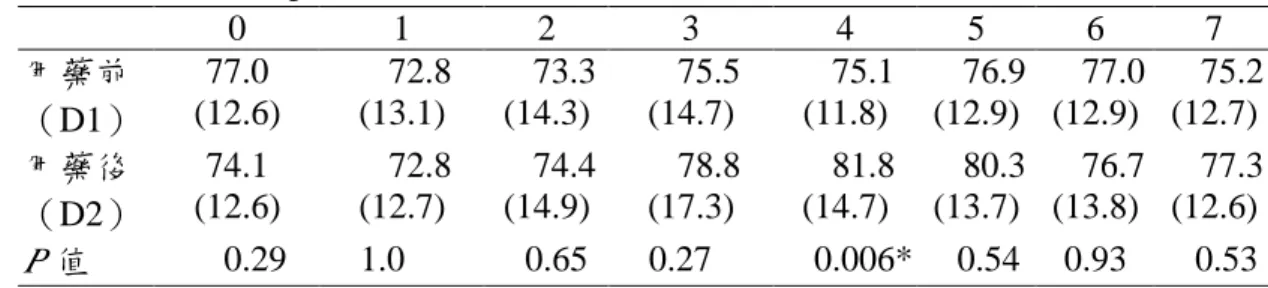
表 2 為服用 entacapone 前後,血壓及心跳的平均值(標準差),以 paired t-test 作檢定。在 收縮壓及舒張壓方面,從表中可得知在使用 entacapone 後,相較於使用前並無增加之趨 勢;但在心跳方面,服用 entacapone 後 4 小時的心跳較未使用時,有顯著地增加(p= 0.006)。 表 2.投予 Entacapone 藥物前後的心跳平均值(標準差) 0 1 2 3 4 5 6 7 用藥前 (D1) 77.0 (12.6) 72.8 (13.1) 73.3 (14.3) 75.5 (14.7) 75.1 (11.8) 76.9 (12.9) 77.0 (12.9) 75.2 (12.7) 用藥後 (D2) 74.1 (12.6) 72.8 (12.7) 74.4 (14.9) 78.8 (17.3) 81.8 (14.7) 80.3 (13.7) 76.7 (13.8) 77.3 (12.6) P 值 0.29 1.0 0.65 0.27 0.006* 0.54 0.93 0.53 *:有統計上顯著差異。
2. Noradrenaline、Adrenaline 之血中濃度變化
試驗進行的兩天,監測血中之正腎上腺素、腎上腺素濃度變化,如圖 1, 2 所示。由圖中 可看出兩天正腎上腺素、腎上腺素濃度的起伏主要在投藥後 2-4 小時之間,但 entacapone 的服用似乎並未顯著的影響 noradrenaline、adrenaline 之血中濃度。Fig 1. Plasma epinephrine concentrations pre-and post-entacapone administration Fig 2. Noradrenaline plasma concentration after levodopa with and without entacapone
Fig 1. Fig 2. Levodopa Levodopa+Entacapone Time(hrs) 0 2 4 6 8 10 No ra d re n a lin e c o n c e n tra ti o n (n g /m l) -1000 -500 0 500 1000 1500 Time(hrs) 0 2 4 6 8 10 A dr enali n e co ncen tr at ion( ng/m l) -2000 -1000 0 1000 2000 3000
五、參考文獻
1. Holm KJ, Spencer MC. Entacapone: a review of its use in parkinson’s disease. Drugs 1999; 58: 159-177.
2. Ruottienen HM, Rinne UK. Effect of one month’s treatment with peripherally acting catechol-o-methyltransferase inhibitor, entacapone, on pharmacokinetics and motor response to levodopa in advanced parkinsonian patients. Clin Neuropharmacol 1996;19:222-33.
3. Rinne UK, Larsen JP, Siden A, Worm-Petersen J and the Nomecomt Study Group. Entacapone enhances the response to levodopa in parkinsonian patients with motor fluctuations. Neurology 1998;51:1309-14
4. Kaakkola S, Teravainen K, Ahtila S, Rita K and Gordin A. Effect of entacapone, a COMT inhibitor, on clinical disability and levodopa metabolism in parkinsonian patients. Neurology 1994;44:77-80.
5. McLeod HL, Syvanen AC, Githang’a J, and et al. Ethnic differences in catechol-O-methyltransferase pharmacogenetic: frequence of the codon 108/158 low activity allele is lower in Kenyan than Caucasian or Soutth-west Asian individuals. Pharmacogenetics 1998; 8:195-9.
6. Reilly DK, Rivera-Calimlim L and Dyke DV. Catechol-O-methyltransferase activity: A determinant of levodopa response. Clin Pharmacol Ther 1980;28:278-86.
7. Wu RM, Cheng CW, Chen KH, Lu SL, Shan DE, Ho YF and Chern HD. The COMT L
allele Modifies the Association between MAOB Polymorphism and PD in Taiwanese. Neurology 2001, 56, 375-382.
8. Tai CH and Wu RM. Catechol-O-methyltransferase and Parkinson's Disease. Acta
Medica Okayama, 2002:56, 1-6.
9. 于怡文, 藥學研究所醫院藥學組, 碩士論文 (2001) 巴金森氏病患之 COMT 基因多 形性對 Levodopa 及 Entacapone 藥物動力學的影響; 指導老師:吳瑞美、何蘊芳、 陳恆德