Effect of Solvent-Assisted Thermal Treatment on the
Performance of Polyfluorene-Based Polymer Light Emitting
Diodes
Mei-Ying Chang,a,
*
,zHsu-Bin Yen,aChian-Yi Hung,a Yi-Fan Chen,a,**
Shih-Chin Lin,a,**
Wen-Yao Huang,a,*
and Yu-Kai Hanb,*
a
Department of Photonics and Institute of Electro-Optical Engineering, National Sun Yat-Sen University, Kaohsiung 804, Taiwan
b
Department of Chemical and Materials Engineering, National Kaohsiung University of Applied Sciences, Kaohsiung 807, Taiwan
Solvent-assisted thermal annealing plays an important role in controlling the morphology of polymers; indeed, it affects the performance of polymer light emitting diodes共PLEDs兲. Using a polyfluorene derivative, poly共9,9-di-2-adamantylhexyl fluorene-2,7-diyl兲 共PDAHF兲, possessing bulky rigid side groups as the emitting material and suitable thermal annealing conditions, we observed improved carrier injection and no photoluminescence quenching. The boiling point of the solvent and the glass transition temperature of the polymer also played important roles. Blue PLED devices having the configuration indium tin oxide共1300 Å兲/poly共3,4-ethylenedioxythiophene兲:poly共styrene sulfonate兲 共800 Å兲/1 wt % PDAHF 共650 Å兲/LiF 共10 Å兲/Ca 共100 Å兲/Al 共2000 Å兲 were prepared using o-xylene or toluene as the solvent. Thermal annealing at 130°C共o-xylene兲 or 115°C 共toluene兲 resulted in devices exhibiting blue emissions, with maximum luminances at 12.5 V of 8593 cd/m2共o-xylene兲 and 8732 cd/m2共toluene兲 as a result of improved carrier injection, which increased the degree of charge recombination. The current efficiencies were 4.0 cd/A 共o-xylene兲 and 4.4 cd/A 共toluene兲 at 100 mA/cm2. The Commission Internationale de l’Eclairage coordinates were good at共0.14, 0.17兲. These results indicate that searching for a suitable solvent combined with appropriate thermal annealing conditions is a promising approach toward achieving high-efficiency PLEDs.
© 2010 The Electrochemical Society. 关DOI: 10.1149/1.3298906兴 All rights reserved.
Manuscript submitted October 1, 2009; revised manuscript received December 14, 2009. Published February 25, 2010.
Although polymer light emitting diodes共PLEDs兲1based on con-jugated polymers are being used widely in flat-panel displays be-cause of their superior brightness, contrast, viewing angle, response time, and production cost, the low efficiency of blue PLEDs has limited the development of polymer full-color displays. Many ap-proaches have been examined to improve the performance of blue PLED devices,2-9including the modification of the molecular struc-ture of the emitting layers and the device strucstruc-ture of the PLEDs. Because thermal annealing plays an important role in controlling the morphologies of the polymers, it can affect the performance of PLEDs.9-13The optical and electrical properties of PLEDs usually depend on intrachain and interchain interactions of their component conjugated polymers. These interactions are determined by the mor-phologies of the polymers films.
Liu et al.9found that thermal annealing provides a trade-off be-tween the hole-injection efficiency and the photoluminescence共PL兲 efficiency. Lee and Park10noted that thermal annealing could result in a maximum optical output but a lower PL quantum yield. Both groups noted, however, that annealing at a temperature close to the glass transition temperature共Tg兲 could improve the efficiency of the hole injection at the expense of the PL efficiency, and vice versa. Presumably, when polymer films are subjected to thermal annealing, the polymer chains tend to relax, thereby increasing the frequency and strength of the interchain interactions; such enhanced packing improves the carrier injection and carrier transport and results in enhanced electrical properties, but it also induces aggregation and excimer formation, which result in PL quenching and, sometimes, cause spectral redshifts.
To reduce the aggregation effects caused by thermal annealing and resulting in PL quenching, one solution is to employ emitting materials that possess bulky rigid side groups on their conjugated backbones. In this study, we used poly共9,9-di-2-adamantylhexyl fluorene-2,7-diyl兲 共PDAHF兲, a polyalkylfluorene 共PF兲 derivative featuring bulky rigid side groups on the conjugated backbone, as the blue-emitting material for thermal annealing studies toward the fab-rication of PLEDs. Our reasons for choosing PDAHF were twofold: 共i兲 Of the known blue-emitting materials, PFs are among the most
promising emitting materials for PLEDs,11,13,14and 共ii兲 bulky rigid side groups separate the conjugated backbones and decrease the fre-quency and strength of the interchain interactions. Because of the lack of interchain interactions, we expected the effects of annealing to not only improve carrier injection but also maintain the PL effi-ciency as a result of enhanced packing.
In some instances during the fabrication of emitting layers, evaporation of the solvent creates empty spaces within the film,9,12 thereby facilitating the motion of the chains. Therefore, the solvent plays an important role in affecting the morphology of the polymer. In this study, we examined the effect of solvent-assisted thermal treatment using solvents having boiling points共Tb兲 higher or lower than the value of Tgof PDAHF. We measured the PL spectra and the surface roughnesses of the annealed PDAHF materials and the op-tical and electronic properties of PLED devices featuring PDAHF as the emitting material; we fabricated these devices after spin-coating solutions of PDAHF in solvents having relatively high and low val-ues of Tband then subjecting these films to thermal annealing under various conditions.
Experimental
Figure1apresents the chemical structure and the synthesis route of PDAHF, which was synthesized through Pd共0兲-catalyzed Suzuki coupling polymerization.15,16A detailed synthetic procedure for the preparation of PDAHF will be reported elsewhere.17 Differential scanning calorimetry revealed that the Tg of the polymer was 120°C. PDAHF is readily soluble in common organic solvents, in-cluding tetrahydrofuran, toluene, and xylenes. The solvents used in this study, o-xylene and toluene, have values of Tb of 145 and 110°C, respectively, i.e., higher and lower, respectively, than the value of the Tg of PDAHF. The polymer films were prepared by spin-coating 1 wt % PDAHF in o-xylene共or toluene兲 solutions onto glass substrates and then subjecting the system to thermal annealing at 100, 115, 130, 145, and 160°C for the PDAHF/o-xylene films and 85, 100, 115, 130, and 145°C for the PDAHF/toluene films.
The devices were fabricated on glass substrates layered with 1300 Å thick indium tin oxide共ITO兲 having a sheet resistance of ca. 13 ⍀/䊐. The substrates were cleaned through ultrasonication in isopropyl alcohol and deionized water, followed by treatment with O2 plasma. An 800 Å thick poly共3,4-ethylenedioxythiophene兲: poly共styrene sulfonate兲 共PEDOT:PSS; Baytron AI4083兲 film was
*Electrochemical Society Active Member.
**Electrochemical Society Student Member.
z
E-mail: [email protected]
Journal of The Electrochemical Society, 157共4兲 J116-J119 共2010兲
0013-4651/2010/157共4兲/J116/4/$28.00 © The Electrochemical Society J116
emitting polymer;9-11the quantum efficiency decreases if these de-vices are annealed at temperatures higher than Tg. In our case, the best performance of the PLEDs occurred when the annealing tem-perature was higher than the value of Tgof PDAHF but below the Tb of the solvent. We suspect that when the value of Tbis higher than the value of Tg, the residual solvent also contributes to the relaxation of the polymer chain at temperatures higher than Tgbut below the Tb of the solvent, resulting in better packing.
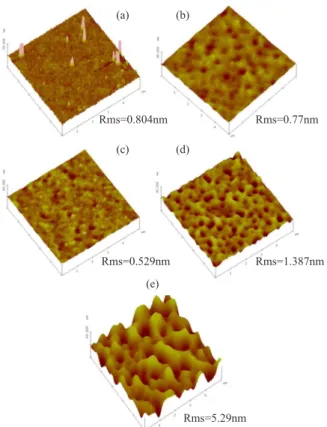
To confirm this solvent-assisted thermal annealing effect, we re-peated the experiment using toluene as the solvent; its value of Tbis 110°C, which is lower than the value of Tg of PDAHF. Figure6 displays the surface morphologies of the PDAHF/toluene films after thermal annealing at 85, 100, 115, 130, and 145°C. A smoother surface was obtained when the annealing temperature increased from 85 to 115°C presumably because of the increased chain move-ment near the value of Tg. When the thermal annealing temperature was 130°C, the surface roughness increased. Figure7displays plots of共i兲 the power efficiency at 100 mA/cm2for PLEDs having the configuration ITO共1300 Å兲/PEDOT:PSS 共800 Å兲/1 wt % PDAHF in toluene共650 Å兲/LiF 共10 Å兲/Ca 共100 Å兲/Al 共2000 Å兲 and 共ii兲 the surface roughness of PDAHF/toluene films, both with respect to the thermal annealing temperature. When the annealing temperature was 115°C, i.e., near the value of Tgof the polymers, the surface was the smoothest and the power efficiency reached its maximum. A device having the configuration ITO共1300 Å兲/PEDOT:PSS 共800 Å兲/1 wt % PDAHF共650 Å兲/LiF 共10 Å兲/Ca 共100 Å兲/Al 共2000 Å兲, prepared with toluene as the solvent and subjected to thermal annealing at 115°C, exhibited a blue emission having a maximum luminance at 12.5 V of 8732 cd/m2. The current and power efficiencies were 4.4 cd/A and 1.6 lm/W, respectively, at 100 mA/cm2, with good CIE coordi-nates of共0.14, 0.17兲.
Conclusions
We prepared blue PLEDs incorporating a polyfluorene deriva-tive, PDAHF, presenting rigid bulky side groups as the emitting
layer, which we fabricated by spin-coating a solution of PDAHF in toluene or o-xylene and then by thermally annealing the samples at various temperatures. The optimal thermal conditions depended on both the value of Tgof the emitting polymer and the value of Tbof the solvent. When the value of Tbwas lower than the value of Tg, the best-performing devices were obtained when the annealing tem-perature was close to the value of Tg; when the value of Tb was higher than the value of Tg, the best-performing devices were ob-tained at an annealing temperature higher than Tgbut lower than Tb. Using the optimized thermal annealing conditions, we obtained high brightness, high efficiency PLEDs as a result of improved carrier injection, which increased the degree of charge recombination.
Acknowledgment
We thank the National Science Council, Taiwan共grant no. NSC 97-2113-M-110-004兲 for financial support.
Institute of Electro-Optical Engineering assisted in meeting the publica-tion costs of this article.
References
1. J. H. Burroughes, D. D. C. Bradley, A. R. Brown, R. N. Marks, K. Mackay, R. H. Friend, P. L. Burns, and A. B. Homes, Nature (London), 347, 539共1990兲. 2. J. Kim, R. H. Friend, I. Grizzi, and J. H. Burroughes, Appl. Phys. Lett., 87, 023506
共2005兲.
3. D. Sainova, T. Miteva, H. G. Nothofer, U. Scherf, I. Glowacki, J. Ulanski, H. Fujikawa, and D. Neherb, Appl. Phys. Lett., 76, 1810共2000兲.
4. M. C. Suh, B. D. Chin, M. H. Kim, T. M. Kang, and S. T. Lee, Adv. Mater., 15, 1254共2003兲.
5. D. B. Romero, M. Schaer, L. Zuppiroli, B. Cesar, and B. Francois, Appl. Phys.
Lett., 67, 1659共1995兲.
6. W. Zhao and J. M. White, Appl. Phys. Lett., 87, 103503共2005兲. 7. J. Huang, G. Li, E. Wu, Q. Xu, and Y. Yang, Adv. Mater., 18, 114共2006兲. 8. X. Gong, S. Wang, D. Moses, G. C. Bazan, and A. J. Heeger, Adv. Mater., 17, 2053
共2005兲.
9. J. Liu, T. F. Guo, and Y. Yang, J. Appl. Phys., 91, 1595共2002兲. 10. T. W. Lee and O. O. Park, Adv. Mater., 12, 801共2000兲. 11. Y. H. Niu, Q. Hou, and Y. Cao, Appl. Phys. Lett., 81, 634共2002兲.
12. J. Kim, J. Lee, C. W. Han, N. Y. Lee, and I. J. Chung, Appl. Phys. Lett., 82, 4238 共2003兲.
13. B. D. Chin, L. Duan, M. H. Kim, S. T. Lee, and H. K. Chung, Appl. Phys. Lett., 85, 4496共2004兲.
14. C. E. Halkyard, M. E. Rampey, L. Kloppenburg, S. L. Studer-Martinez, and U. H. F. Bunz, Macromolecules, 31, 8655共1998兲.
15. E. P. Woo, M. T. Bernius, M. Inbasekaran, and W. W. Wu, U.S. Pat. 6169163 共2001兲.
16. M. Inbasekaran, W. W. Wu, and E. P. Woo, U.S. Pat. 5777070共1998兲. 17. W. Y. Huang and M. Y. Chang, Unpublished work.
18. W. Y. Huang, P. T. Huang, Y. K. Han, C. C. Lee, T. L. Hsieh, and M. Y. Chang,
Macromolecules, 41, 7485共2008兲. Rms=5.29nm Rms=0.529nm Rms=0.77nm (e) (b) (c) (d) (a) Rms=0.804nm Rms=1.387nm
Figure 6.共Color online兲 AFM images of PDAHF/toluene films subjected to
thermal annealing at共a兲 85, 共b兲 100, 共c兲 115, 共d兲 130, and 共e兲 145°C.
80 90 100 110 120 130 140 150 0 1 2 3 4 5 6
Thermal Annealing Temperature (oC)
Surface Roughness (nm) 0.0 0.5 1.0 1.5 2.0 Power E fficiency (lm /w )
Figure 7. 共Color online兲 Plot of power efficiency with respect to thermal
annealing temperature for devices having the configuration ITO共1300 Å兲/ PEDOT:PSS共800 Å兲/1 wt % PDAHF in toluene 共650 Å兲/LiF 共10 Å兲/Ca 共100 Å兲/Al 共2000 Å兲; plot of surface roughness with respect to thermal annealing temperature for PDAHF/toluene films.
J119
Journal of The Electrochemical Society, 157共4兲 J116-J119 共2010兲 J119