行政院國家科學委員會專題研究計畫 成果報告
蜂巢式類神經網路於震測圖型識別之研究
計畫類別: 個別型計畫 計畫編號: NSC93-2213-E-009-067- 執行期間: 93 年 08 月 01 日至 94 年 07 月 31 日 執行單位: 國立交通大學資訊科學學系(所) 計畫主持人: 黃國源 報告類型: 精簡報告 報告附件: 出席國際會議研究心得報告及發表論文 處理方式: 本計畫可公開查詢中 華 民 國 94 年 10 月 21 日
行政院國家科學委員會專題研究計畫成果報告
蜂巢式類神經網路於震測圖型識別之研究
The Study of Cellular Neural Network for Seismic Pattern Recognition
計畫編號:NSC 93-2213-E-009-067
執行期限:93 年 8 月 1 日至 94 年 7 月 31 日
主持人:黃國源 交大資訊科學系
[email protected]
一、中文摘要 本 研 究 運用蜂巢式類神經網路於震 測圖型識別,我們依據儲存圖樣將蜂巢式 類神經網路設計成聯想記憶體,完成網路 的訓練,然後我們利用這聯想記憶體來辨 識震測圖型。震測圖型識別將有助於震測 資料之探油分析及解釋。 關鍵詞:蜂巢式類神經網路、圖型識別、 震測圖型。 AbstractCellular neural network is adopted for seismic pattern recognition. We design cellular neural network to behave as associative memory according to the stored patterns, and finish the process of network training. Then we use this associative memory to recognize seismic patterns. Seismic pattern recognition can help the analysis and interpretation of seismic data.
Keywords: Cellular neural network, pattern
recognition, seismic patterns.
二、緣由與目的
Seismic pattern recognition can help us to analyze and interpret seismic data. We use associative memories to store seismic patterns and recognize noisy seismic patterns. Cellular neural network (CNN) is used for associative memory. Each memory pattern corresponds to a unique globally asymptotically stable equilibrium point of the network.
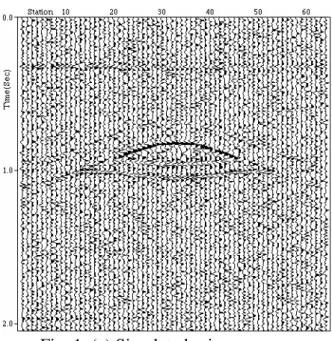
Fig. 1(a) shows a simulated seismogram. A seismogram consists of
many seismic traces. Each trace contains many peaks (wavelets). We can extract peak data from seismogram. Then we transform peak data to bipolar data. The seismogram passes through preprocessing to extract peak data. Fig. 1(b) shows the result of preprocessing of Fig. 1(a), the value of pixel “1” is for peak point and “0” is for background. Fig. 2 shows the preprocessing steps of seismogram. It contains enveloping, thresholding, peaking, thinning, and compression in the time direction. Fig. 3 shows the seismic pattern recognition system using CNN. The process of seismic pattern recognition is composed by two parts. In the training part, the training patterns can construct the associative memory using cellular neural network. In the recognition part, associative memory can recognize the input test pattern.
The process of CNN network training is summarized in the following. Given m bipolar training patterns as input vectors
i
u and output vectors y , i = 1, 2, …, m, for i
each u , there is only one equilibrium point i
i
x satisfying the equation of motion: e
Bu Ay
xi = i + i + , i = 1, 2, …, m (1) The equation (1) can be expressed as compact matrix form:
X = AY + BU + J (2) whereX=[x1 x2 L xm], ] [y1 y2 ym Y= L , ]U=[u1 u2 L um , and J=[e e L e].
Equation (2) can be rewritten as equation (3):
BU + J = X–AY (3)
matrix. The eigenvalues of A can be derived as follows:
∑
− = − = r r h n hq j e h a n q S(2π / ) ( ) 2π / , q = 0, 1, 2, …, n-1. (4) Discrete time CNN with circulant matrix Aare globally asymptotically stable if and only if 1 ) / 2 ( q n < S π , q = 0, 1, 2, . . . , n-1 (5)
Notice that equation (3) must be solved for B and J. The steps are as follows. Let all
training patterns be u and i y . Then we i
can get matrices U and Y. Choose a
sequence
{
a(−r) L a(−1) a(0) a(1) L a(r)}
for which the stability criterion (5) holds. Then design matrix A as a circulant matrix.
Let X =αY with α>1. B and J in equation (3) can be computed using pseudo-inversion techniques.
Algorithm 1: Design a cellular neural network to behave as an associative memory in the training part.
Input: m bipolar patterns u , i = 1,……, m i
Output: B and e
Methods:
(1) Calculate matrix U from training
patterns u . i ] [u1 u2 um U= L
(2) Establish matrix Y = matrix U. Y = U
(3) Design matrix A as the circulant matrix
which satisfies globally asymptotically stable condition.
(4) Set the value of α ( α > 1), and calculate X = αY.
(5) From BU + J = X – AY, using
pseudo-inverse technique to calculate B
and J. And from J, select one column of J as e.
After training, the process of recognition is summarized in the following. Input
the test pattern as u and A, B, e to the
equation of motion, x(t+1) = Ay + Bu + e. After getting the state value x(t+1) at
the next time, we use output function to calculate the output y(t+1) at the next
time. We calculate the state value and the output until all output values are not changed anymore, then final output is the classification of the test pattern.
Algorithm 2: Use associative memory to recognize the test pattern
Input: Test pattern u and A, B, e in the
equation of motion
Output: Classification of the test pattern u
Methods:
(1) Set up initial output vector y, its
element values are all in [-1, 1] interval. (2) Input test pattern u and A, B, e into the
equation of motion to get x(t+1) x(t + 1) = Ay(t) + B u + e
(3) Input x(t + 1) into activation function,
get new output y(t + 1).
For activation function:
⎪ ⎩ ⎪ ⎨ ⎧ − = − < = ≤ ≤ − = > 1 then , 1 then , 1 1 1 then , 1 y x x y x y x
(4) Compare new output y(t + 1) and y(t).
Check whether they are the same. If they are the same, then stop, otherwise input new output y(t + 1) into equation
of motion again. Repeat (2) to (4) until output y is not changed.
三、結果與討論
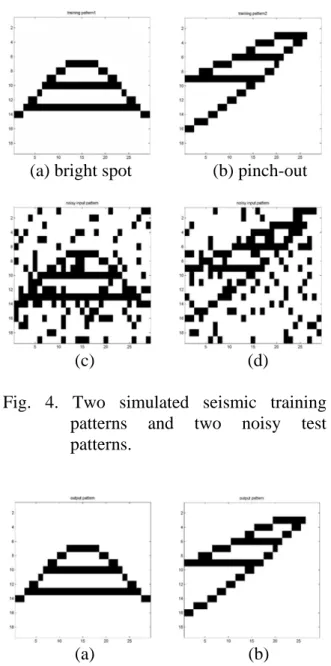
The two simulated peak data of bright spot pattern and pinch-out pattern is shown in Fig. 4(a) and 4(b). The size of input data is 19x29. We use these two patterns as the training patterns. Fig. 4(c) is the first noisy test pattern. Fig. 4(d) is the second noisy test pattern. We set α= 3 and neighborhood radius r = 3. The recognition results are
shown in Fig. 5.
The value of α and matrix A do not
affect the network performance. The network performance strongly depends on the number of patterns to be stored.
四、成果自評 研究內容與原計畫相符程度: 100% 達成預期目標情況: 100% 研究成果的學術或應用價值: 建立蜂巢式 類神經網路震測圖型識別系統 是否適合在學術期刊發表: 是 主要發現或其他有關價值: 可用於其他有 關圖型識別的應用 五、參考文獻
L. O. Chua and Lin Yang, “Cellular Neural Networks: Theory,” IEEE Trans. on CAS, vol. 35 no. 10, pp.1257-1272, 1988. L. O. Chua and Lin Yang, “Cellular Neural
Networks: Applications,” IEEE Trans. on CAS, vol.35, no.10, pp. 1273-1290, 1988. Leon O. Chua, CNN:A PARADIGM FOR
COMPLEXITY. World Scientific, 1998. H. Harrer and J. A. Nossek, “Discrete-time
Cellular Neural Networks,” International Journal of Circuit Theory and Applications, Vol. 20, pp. 453-468, 1992. G. Grassi, “A new approach to design
cellular neural networks for associative memories,” IEEE Trans. Circuits Syst. I, vol. 44, pp. 835–838, Sept. 1997.
G. Grassi, “On discrete-time cellular neural networks for associative memories,” IEEE Trans. Circuits Syst. I, vol. 48, pp. 107–111, Jan. 2001.
R. Perfetti, “Frequency domain stability criteria for cellular neural networks,” Int. J. Circuit Theory Appl., vol. 25, no. 1, pp. 55–68, 1997.
Fig. 1. (a) Simulated seismogram.
000000000000000000000000000000000000000000000000000000000000 000000000000000000000000000000000000000000000000000000000000 011111111111111111111111111111111111111111111111111111111110 000000000000000000000000000000000000000000000000000000000000 000000000000000000000000000000000000000000000000000000000000 000000000000000000000000000000000000000000000000000000000000 000000000000000000000000000000000000000000000000000000000000 000000000000000000000000000000000000000000000000000000000000 000000000000000000000000000000000000000000000000000000000000 000000000000000000000000000000000000000000000000000000000000 000000000000000000000000000000000000000000000000000000000000 000000000000000000000000000000000000000000000000000000000000 000000000000000000000000000000000000000000000000000000000000 000000000000000000000000111111111111000000000000000000000000 000000000000000000001111000000000000111100000000000000000000 000000000000000001110000000000000000000011100000000000000000 000000000000000110000000000000000000000000011000000000000000 000000000000111000000000000011100000000000000111000000000000 000000000011000000000011111100011111100000000000110000000000 000000011100000000001100000000000000001110000000001110000000 000111100000000111110000000000000000010001110000000001111100 001000000000001000001111111111111111100000001110000000000011 000000000001110000000000000000000000000000000001100000000000 000000001110001111111000000000000000000111111110011100000000 000000110000000000000111111111111111111000000000000011100000 001111000000000000000000000000000000000000000000000000011100 110000000000000000000000000000000000000000000000000000000011 000000000000000000000000000000000000000000000000000000000000
Fig. 1. (b) Preprocessing from Fig. 1(a).
Input Envelope Thresholding Peaks of seismogram Compress data in time direction seismogram Fig. 2. Preprocessing steps of seismogram.
Cellular Neural Network Autoassociative Memory Training: Training pattern Testing pattern Recognition: Recovered pattern Autoassociative Memory Fig. 3. Seismic pattern recognition system
using cellular neural network.
(a) bright spot (b) pinch-out
(c) (d)
Fig. 4. Two simulated seismic training patterns and two noisy test patterns.
(a) (b)