E L S E V I E R
Polymer Vol. 37 No. 9, pp. 1513 1518, 1996 Copyright © 1996 Elsevier Science Ltd Printed in Great Britain. All rights reserved 0032-3861/96/$15.00 + 0.00
Characteristics of an e l e c t r o p o l y m e r i z e d
PPV and its l i g h t - e m i t t i n g diode
Win-Pin Chang, Wha-Tzong Whang* and Ping-Way Lin
Institute of Materials Science and Engineering, National Chiao Tung University, Hsinchu 30049, Taiwan, Republic of China
(Received 25 July 1995; revised 5 September 1995)
Poly(phenylene vinylene) (PPV) has been prepared successfully from p-xylylenebis(triphenylphosphonium bromide) in acetonitrile solution via an electroreduction polymerization, p-Xylylenebis(triphenylphos- phonium bromide) also acted as an electrolyte in the solution. The resultant electropolymerized PPV film was transparent and dense, and had considerable adhesion to an indium tin oxide (ITO) electrode. The electropolymerized PPV showed a blue shift both in the ultraviolet-visible absorption spectrum and photoluminescence, compared with the PPV prepared from a p-xylylenebis(tetrahydrothiophenium chloride) precursor route, indicating that it has a shorter 7r-conjugated chain length. The infra-red absorption spectra showed a stable P - C bond on the electropolymerized PPV chain. The Al/electro- polymerized PPV/ITO light-emitting diode emitted green light with an emission maximum at 530nm. Annealing the electroluminescence device in a high vacuum oven at 160°C for 3 h significantly enhanced the electroluminescence performance as a result of improvement of the interfacial contact between PPV and the A1 metal electrode. Copyright © 1996 Elsevier Science Ltd.
(Keywords: electropolymerization; poly(p-phenylene vinylene); electroluminescence)
I N T R O D U C T I O N
Conjugated polymers have attractive potential appli- cations in electronics and optoelectronics devices, with poly(p-phenylene vinylene) (PPV) being one of the promising candidates. The sulfonium precursor route 1, the m o s t p o p u l a r m e t h o d to prepare PPV, is a base-induced polymerization o f arylsulfonium salt m o n o m e r in aqueous solution. The polymerization reaction is terminated with dilute H C I aqueous solution and the solution is then dialysed against deionized water for several days. PPV film can be obtained f r o m the PPV precursor after coating the solution and eliminating the sulfonium groups. Electronic and optoelectronic char- acteristics o f the PPV film have been reported in the literature 2 5. In addition to chemical polymerization electrochemical polymerization has also been reported
6
for PPV preparation. In 1987 Nishihara et al. reported a new m e t h o d to synthesize PPV f r o m c~,c~,c~',c~'-tetra- bromo-p-xylene in t e t r a h y d r o f u r a n solution containing n-Bu4NBF4 electrolyte. The electropolymerized PPV film was recently fabricated into a p o l y m e r diode by this group 7. However, the different synthetic methods m a y result in PPV with different 7r-conjugated chain lengths and chain configurations. These factors m a y affect the electronic and optoelectronic properties o f the PPV.
In our early study 8 we reported the p r e p a r a t i o n of electropolymerized PPV f r o m p-xylylenebis(tetrahydro- thiophenium chloride). The resultant PPV diode is a good Schottky diode with a rectification ratio o f 100, but
* To w h o m correspondence should be addressed
it does not show electroluminescence. In this study, PPV is prepared in the u n d o p e d state via a simple and convenient electrochemical polymerization reaction from p-xylylenebis(triphenylphosphonium bromide) in acetonitrile solution. The resultant PPV is deposited on a cathodic ( i n d i u m - t i n oxide) (ITO) conductive glass electrode, on which the ionic m o n o m e r , p-xylylenebis- (triphenylphosphonium bromide), undergoes an elec- troreduction polymerization. The ionic m o n o m e r p- xylylenebis(triphenylphosphonium bromide) also acts as an electrolyte in this process. The resultant PPV film is transparent and suitable for electronic as well as optoelectronic applications. The characteristics of the electropolymerized PPV film and its electroluminescence device will be discussed in this paper.
E X P E R I M E N T A L
Sulfonium precursor route for preparing chemically polymerized PP V
PPV precursor was prepared by the addition of 20 ml o f 0.22 M N a O H aqueous solution into 2 0 m l of 0.2 M p-xylylenebis(tetrahydrothiophenium chloride) aqueous solution with 80ml pentane. Both solutions were first cooled to 0 - 5 ° C in an ice bath. The reaction proceeded for 1 h and then was terminated by the addition of 0.1 M HC1 aqueous solution to neutralize the reaction solution. After the pentane was decanted off, the PPV precursor aqueous solution was dialysed against deionized water for several days. Chemically polymerized PPV film was obtained by spin-coating the PPV precursor solution on an I T O glass electrode and then heating in a v a c u u m oven at 220°C for 2 h.
Electropolymerized PPV and its LED: W. -P. Chang et al.
Preparation of electropolymerized PP V
The solution for the electropolymerization was obtained by dissolving 0.05g p-xylylenebis(triphenyl- phosphonium bromide) in 50ml acetonitrile. A pre- cleaned T N grade ITO (area 3.5 x 2.5 cm 2) conductive glass was used as a working electrode at the cathode, and a platinum plate (area 5.0 x 4.0cm 2) was employed as a counter electrode at the anode. The two electrodes were separated by 2 cm. The electropolymerization reaction was carried out by a current with a fixed voltage level under ambient conditions. After the electropolymeriza- tion reaction, transparent PPV was obtained by heating the electropolymerized film in a high vacuum oven at 220°C for 2 h.
Preparation of PP V ligh t-emitting diode
Both PPV films, i.e. chemically polymerized PPV (2000,~) and electropolymerized PPV (2500A), on the ITO glass were coated with A1 metal (2000 Ad area 7 mm 2) by thermal evaporation in vacuum (4 x 10 torr) to give A1/PPV/ITO sandwich devices. Some o f AI/PPV/ITO sandwich devices were annealed in a high vacuum oven at 160°C for 3 h.
Characterization
The thickness of the PPV film was measured with a Dektak 3030 surface profilometer. The morphologies o f the electropolymerized PPV films were obtained using a Hitachi S-2500 scanning electron microscope, after coating the surfaces with a thin gold film. The cross- section profile o f AI/PPV/ITO sandwich devices was characterized using a Hitachi S-4000 scanning electron microscope. Infra-red (i.r.) absorption spectra o f the PPV were taken using a Bio-Rad FTS-165 F T - I R spectrometer. Ultraviolet-visible (u.v.-vis.) absorption of the PPV was measured using a Beckman 7400 spectrometer. A Jasco FR-770 spectrometer was employed to obtain both the photoluminescence spectra o f PPVs with a xenon lamp at a wavelength of 365 nm and the electroluminescence spectra o f A1/PPV/ ITO light-emitting diodes. The I ( c u r r e n t ) - V (voltage) curves o f the PPV sandwich devices were measured with a programmable Keithley 237 electrometer under ambient conditions. The electroluminescence intensities of A1/PPV/ITO sandwich devices were recorded using a photodiode detector connected with a Newport (model
1815-C) power meter.
R E S U L T S A N D D I S C U S S I O N
In this study, PPV was prepared via a new electro- reduction polymerization from p-xylylenebis(triphenyl- phosphonium bromide) in acetonitrile solution. The electropolymerization was performed at a constant voltage level o f 5.5V; the current between the two electrodes typically changed from 6 mA at the beginning o f the reaction to 2 mA at the end. The electropolymer- ized PPV was obtained by reducing the p-xylylenebis- (triphenylphosphonium bromide) monomer. This ionic m o n o m e r showed a considerable ionization in the solution: no additional electrolytes were added in this electropolymerization reaction, thereby preventing doping o f the resultant PPV by such electrolytes. The resultant PPV film in the undoped state was transparent,
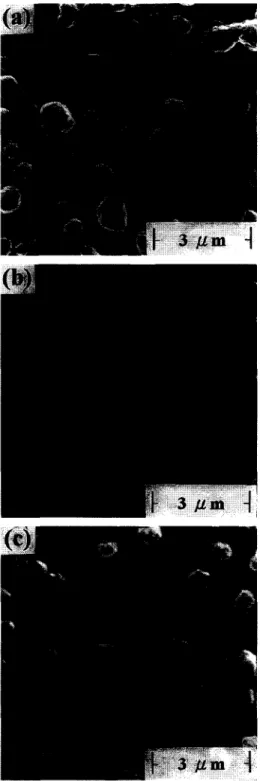
Figure 1 Scanning electron micrographs showing the growth of electropolymerized PPV on ITO glass after (a) 30 min, (b) 60 min and (c) 90 min of the electropolymerization reaction
insoluble as well as infusible, and the film showed good adhesion to the ITO glass.
The dynamic growth behaviour of the electropolymer- ized PPV on the ITO glass was examined, and the surface morphologies are shown in Figure 1. As seen in Figure la, in the initial 30rain of the electropolymerization, isolated sphere-like PPV granules were formed on the ITO glass surface. As the etectropolymerization reaction continued, Figures lb and c, more PPV granules were formed which became connected with their neighbours, eventually forming a continuous dense PPV film on the ITO glass surface.
Electropolymerized PPV and its LED." W.-P. Chang et al.
8
Figure 2I
(a)
0 p ~i
A
V a ~J
"ql" O0i
g
71
U'- , |N
I I I I I ! I4 0 0 0
3 5 0 0
3 0 0 0
2 5 0 0
2 0 0 0
1 5 0 0
1 0 0 0
5 0 0
Wavenumbers (cm
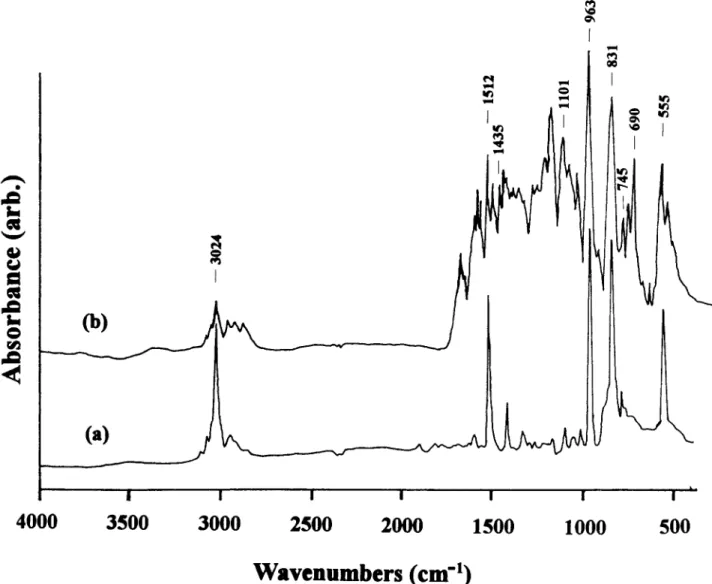
I.r. a b s o r p t i o n spectra o f the PPV p r e p a r e d f r o m (a) the s u l f o n i u m p r e c u r s o r route and (b) electrochemical polymerization
~s 1 - qD ¢d m U ~s ,¢ (b) (a) I I I I 3 ~ 4 ~ 5 ~ 6 ~ 7 ~ 800 Wavelength (rim)
Figure 3 U.v.-vis. absorption spectra of the PPV prepared from (a) the sulfonium precursor route and (b) electrochemical polymerization
The chemical structures o f the P P V prepared f r o m the sulfonium route and the electropolymerized PPV were examined by i.r. spectroscopy, as shown in Figures 2a and b respectively. The absorption b a n d near 963 cm -1, resulting f r o m C - H out-of-plane bending, is character- istic of the trans configuration of the vinylene group. The absorption b a n d near 3024cm -1 was due to the trans- vinylene C - H stretching mode. The bands near 831 and
1
1 5 1 2 c m - were assigned to para-phenylene ring C - H out-of-plane bending and C - C ring stretching, respec- tively. The b a n d near 555cm - l was attributed to the phenylene out-of-plane ring bending mode. These i.r. absorption bands were seen b o t h in Figure 2a and Figure 2b. However, in Figure 2b, a b a n d due to an a r o m a t i c ring in-plane stretching m o d e was seen at 1435 cm - l for a P - A r bond. Besides, the band near 745cm -1 was assigned to P - C stretching o f P - C H 2 - A r bonding. The appearance o f bands near 1101 and 6 9 0 c m - l was attributed to P - P h stretching modes. W h e n the electro- polymerized PPV was further heated at 250°C for 8 h, its i.r. absorption spectrum was similar to that o f the original material prepared at 220°C for 2h. This indicates that the p h o s p h o r u s - c a r b o n bonds were retained in the p o l y m e r chains. Such bonds were stable even at higher temperature and under high vacuum, and
Electropolymerized PPV and its LED. W.-P. Chang et al.
t . .
I Ir i I I
4 0 0 5 0 0 6 0 0 700
Wavelength (rim)
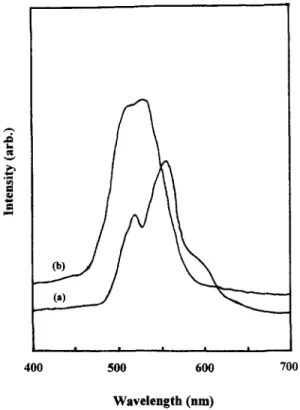
Figure 4 Photoluminescence spectra of the PPV prepared from (a) the sulfonium precursor route and (b) electrochemical polymerization
6.40
3.20
~ ) 1 . 6 0 0.00 0 5 10 15 20 25 V o l t a g e ( V ) F i g u r e 5 I V c u r v e o f u n a n n e a l e d A 1 / P P V / I T O L E D devicethus were not due to unreacted m o n o m e r or low- molecular-weight triphenylphosphorus.
The u.v.-vis, absorption spectra of the two types o f PPV are depicted in Figure 3. The onset of u.v.-vis. absorption for the chemically polymerized PPV and the electropolymerized PPV was around 530nm (Eg = 2.34eV) and 5 1 5 n m (Eg = 2.41 eV), respectively. The blue shift in the u.v.-vis, absorption of the electro- polymerized PPV indicated the f o r m a t i o n of a short conjugated chain length.
The photoluminescence (PL) spectra o f these two types of PPV are illustrated in Figure 4, where it can be seen that the electropolymerized PPV emitted a shorter wavelength (green) light than did chemically polymerized PPV (green-yellow). A Stokes shift between absorption and emission spectra was also observed in these systems, meaning that the p h o t o n energy of the emitted light is lower than that absorbed.
The steady-state I - V characteristics of the A1/electro- polymerized P P V / I T O light-emitting diodes (LEDs) are
L L) 30 20 10 i _.
__..,~e eeeeee
. _ . - - . 5 l0 15 V o l t a g e ( V ) F i g u r e 6 I - V c u r v e o f a n n e a l e d A I / P P V / I T O L E D device o~al1.50
1.00
0.50
0 . 0 0
0
2
4
/
it
.J
1~ ,-, . . . .6
8
10
V o l t a g e (V)
F i g u r e 7 L u m i n e s c e n c e i n t e n s i t y - v o l t a g e c u r v e o f a n n e a l e d A I / P P V / I T O L E D deviceshown in Figures 5 and 6. In these L E D sandwich devices, A1 and I T O were used as the cathode (electron- injecting electrode) and as the anode (hole-injecting electrode), respectively. In Figure 5 the threshold voltage of the unannealed A1/electropolymerized P P V / I T O L E D started at 13V, corresponding to an applied
,'~ X 5 - 1
electric strength of 5.2 10 V c m . In comparison, the threshold voltage o f the annealed A1/electropolymer- ized P P V / I T O L E D occurred at 8 V, corresponding to an
5 1
applied electric strength o f ~ 3 . 2 x 10 V c m , as seen in Figure 6. The dependence of the electroluminescence (EL) intensity on the applied bias voltage for the annealed sandwich device is illustrated in Figure 7. When the applied bias exceeded the threshold voltage, the luminescence intensity was linearly proportional to the applied voltage, and the emitted light could be easily observed under normal r o o m light. Figure 8 showed the EL intensity of the annealed device as a function of applied current. The EL intensity of the L E D device had a linear dependence on the applied current. In the PPV L E D device the electrons f r o m the metal electrode were injected into one side o f the PPV layer to form negative polarons and the holes f r o m the I T O electrode were injected into the opposite side of the PPV layer to f o r m
Electropolymerized PPV and its LED." W. -P. Chang et al. em
0 . 5 0
0 . 2 5
0 . 0 0
0
10
20
30
Current (mA)
Figure 8 Luminescence i n t e n s i t y - c u r r e n t curve o f annealed AI/PPV/ I T O L E D device --7-- AI t o p s u r f a c e --4-- AI layer -+- P P V layer _.A.. -1--- AI layer P P V layer -.1.- + - Interface • -- I n t e r f a c e
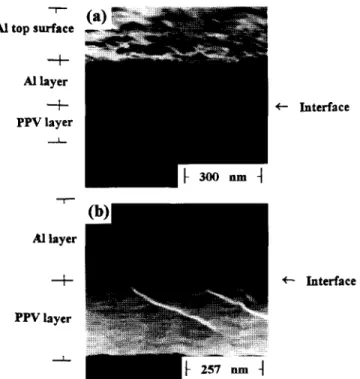
Figure 9 Scanning electron micrographs o f the cross-section profile o f (a) u n a n n e a l e d and (b) annealed A1/PPV/ITO sandwich devices
positive polarons 9. Both negative polarons and positive polarons migrated under the influence of the applied electric field and combined on segments of the polymer chain to form the same singlet exciton which then could decay radiatively 9. Therefore, the higher the applied current, the more the light was emitted.
When the EL characteristics of both unannealed and annealed electropolymerized PPV LED sandwich devices were examined, some significant improvements were observed in the performance of the annealed LED sandwich device. The initial light-emitting active area of the unannealed sandwich device was ~50%, and obviously increased to the full active area after
annealing. Concurrently, the light emission intensity became more homogeneous. The failure of the unan- nealed sandwich device due to spike sparks was elimi- nated by the annealing process. Moreover, the annealing process reduced the threshold voltage of the polymer LED from 13 to 8 V, increased the light emission intensity and increased the long-term stability. Annealing of the A1/chemically polymerized PPV/ITO LED also resulted in a similar, remarkable improvement in performance.
The significant improvement in the performance of the annealed sandwich device could be explained by examination of scanning electron micrographs taken of the interface. As illustrated in
Figure 9a,
some gaps were present at the interface between PPV and the thermally evaporated A1 metal prior to annealing. The interfacial gap between AI and PPV may be due to the formation of A1 clusters on the PPV, such cluster formation having been reported in A1/polyimide and Au/polyimide sys- tems 1°,11. The non-uniform formation of the A1 film generated some interfacial gaps and reduced the effective contact area between A1 and the polymer. The interfacial gap lowered the effective applied electric field strength on the device and consequently raised its operation voltage. The coarse A1 metal may also have resulted in small spikes on the interface after thermal evaporation. These spikes caused the device to fail easily upon application of a voltage. In addition, the incomplete contact between PPV and A1 metal reduced the active emission area and emission intensity. However, as seen inFigure 9b,
after annealing the interface between PPV and A1 metal exhibited good contact; thus annealing the A1/PPV/ITO sandwich device at 160°C for 3 h significantly improved the contact between PPV and A1 metal. Therefore, the annealed device displayed a marked improvement in performance.
The EL spectra of both types of A1/PPV/ITO sandwich devices,
Figure 10,
were similar to their PL spectra. With a maximum emission at 530 nm, the EL of the electropolymerized PPV LED also showed a blue shift compared with that of the chemically polymerized PPV LED.CONCLUSIONS
In this paper we have explored a new approach to prepare PPV and its electroluminescence device. The PPV was obtained successfully from p-xylylenebis- (triphenylphosphonium bromide) in acetonitrile solution by electropolymerization. The electropolymerization was a reduction reaction with the ITO glass as a working electrode at the cathode. The resultant electropolym- erized PPV deposited on ITO glass was a transparent and dense film suitable for electronic and optoelectronic applications.
The i.r. spectrum of the electropolymerized PPV revealed that it contained phosphorus-carbon bonds in the polymer chains. Experimental results indicated that the phosphorus-carbon bonds were stable and did not disappear even at higher temperature under high vacuum
8
(<10 tort), thus the phosphorus-carbon bonds were not due to unreacted monomers or low-molecular-weight triphenylphosphorus. The u.v.-vis, absorption spectrum of the electropolymerized PPV showed a blue shift compared with the spectrum of PPV prepared from the precursor route, showing that the electropolymerized
Electropolymerized PPV and its LED. W. -P. Chang et al. t _
/
(a) I I I I I 400 500 600 700 Wavelength (nm)Figure 10 Electroluminescence spectra of (a) Al/chemically polym-
erized PPV/ITO and (b) A1/electropolymerized PPV/ITO LED devices
P P V h a d a s h o r t e r 7r-conjugated c h a i n length. T h e P L s p e c t r u m o f e l e c t r o p o l y m e r i z e d P P V was s i m i l a r to the m e a s u r e d E L s p e c t r u m , w h e r e a green light was e m i t t e d w i t h the e m i s s i o n m a x i m u m at 530 nm. B o t h the E L a n d P L s p e c t r a o f the e l e c t r o p o l y m e r i z e d P P V also s h o w e d a b l u e shift, c o n f i r m i n g a s h o r t 7r-conjugated c h a i n l e n g t h in the P P V m a i n c h a i n p o s s i b l y as a r e s u l t o f the f o r m a t i o n o f P - C b o n d s . A n n e a l i n g o f the p o l y m e r L E D i m p r o v e d the c o n t a c t b e t w e e n P P V a n d A1 m e t a l , r e d u c i n g the d r i v i n g v o l t a g e a n d i n c r e a s i n g the e m i t t e d light intensity. A C K N O W L E D G E M E N T T h e a u t h o r s w o u l d like to e x p r e s s their a p p r e c i a t i o n to the N a t i o n a l Science C o u n c i l o f the R e p u b l i c o f C h i n a for the financial s u p p o r t o f this s t u d y u n d e r g r a n t N S C - 8 4 - 0 4 0 5 - E - 0 0 9 - 0 0 4 ,
R E F E R E N C E S
1 Garay, R. and Lenz, R. W. Makromol. Chem. 1989, 15, 1
2 Burroughes, J. H., Bradley, D. D. C., Brown, A. R., Marks,
R. N., Mackay, K., Friend, R. H., Burn, P. L. and Holmes,
A. B. Nature 1990, 347, 539
3 Brown, A. R., Bradley, D. D. C., Burroughes, J. H., Friend,
R. H., Greenham, N. C., Burn, P. L., Holmes, A. B. and Kraft,
A. Appl. Phys. Lett. 1992, 61, 2793
4 Karg, S., Riess, W., Meier, M. and Schwoever, M. Synth. Met.
1993, 55-57, 4186
5 Wung, C. J., Wijekoon, W. M. K. P. and Prasad, P. N. Polymer
1993, 34, 1174
6 Nishihara, H., Tateishi, M., Aramaki, K., Ohsawa, T. and
Kimura, O. Chem. Lett. 1987, 539
7 Nishihara, H., Akasaka, M., Tateishi, M. and Aramaki, K.
Chem. Lett. 1992, 2061
8 Chang, W.-P., Whang, W.-T. and Lin, P.-W. J. Appl. Polym.
Sci. submitted.
9 Holmes, A. B., Bradley, D. D. C., Brown, A. R., Burn, P. L.,
Burroughes, J. H., Friend, R. H., Greenham, N. C., Gymer, R. W., Halliday, D. A., Jackson, R. W., Kraft, A., Martens,
J. H. F., Pichler, K. and Samuel, I. D. W. Synth. Met. 1993,
55-57, 4031
10 Atanasoska, L., Anderson, S. G., Meyer III, H. M., Lin, Z. and
Weaver, J. H. J. Vac. Sci. Technol. A 1987, 5(6), 3325
11 Meyer III, H. M., Anderson, S. G., Atanasoska, L. and Weaver,