Reducing exciton-longitudinal-optical phonon interaction with shrinking ZnO quantum
dots
Wei-Tse Hsu, Kuo-Feng Lin, and Wen-Feng Hsieh
Citation: Applied Physics Letters 91, 181913 (2007); doi: 10.1063/1.2805192
View online: http://dx.doi.org/10.1063/1.2805192
View Table of Contents: http://scitation.aip.org/content/aip/journal/apl/91/18?ver=pdfcov Published by the AIP Publishing
Articles you may be interested in
Enhanced exciton-phonon interactions in photoluminescence of ZnO nanopencils Appl. Phys. Lett. 94, 261904 (2009); 10.1063/1.3159829
Reducing exciton–longitudinal optical phonon coupling with increasing Mg incorporation in MgZnO powders J. Appl. Phys. 102, 123504 (2007); 10.1063/1.2820100
Analytical study on exciton-longitudinal-optical-phonon coupling and comparison with experiment for ZnO quantum wells
J. Appl. Phys. 97, 106111 (2005); 10.1063/1.1900294
Longitudinal-optical-phonon-assisted energy relaxation in self-assembled CdS quantum dots embedded in ZnSe J. Appl. Phys. 92, 3573 (2002); 10.1063/1.1504161
Phonons and exciton recombination in CdSe/ZnSe self-assembled quantum dots Appl. Phys. Lett. 77, 1813 (2000); 10.1063/1.1311393
This article is copyrighted as indicated in the article. Reuse of AIP content is subject to the terms at: http://scitation.aip.org/termsconditions. Downloaded to IP: 140.113.38.11 On: Thu, 01 May 2014 00:05:01
Reducing exciton-longitudinal-optical phonon interaction with shrinking
ZnO quantum dots
Wei-Tse Hsu, Kuo-Feng Lin, and Wen-Feng Hsieha兲
Department of Photonics, National Chiao Tung University, 1001 Tahsueh Rd., Hsinchu 30050, Taiwan, Republic of China and Institute of Electro-Optical Engineering, National Chiao Tung University, 1001 Tahsueh Rd., Hsinchu 30050, Taiwan, Republic of China
共Received 11 September 2007; accepted 12 October 2007; published online 1 November 2007兲 The exciton-longitudinal-optical-phonon 共LO-phonon兲 interaction was observed to decrease with reducing ZnO particle size to its exciton Bohr radius共aB兲. The unapparent LO-phonon replicas of
free exciton 共FX兲 emission and the smaller FX energy difference between 13 and 300 K reveal decreasing weighting of exciton-LO phonon coupling strength. The diminished Fröhlich interaction mainly results from the reducing aBwith size due to the quantum confinement effect that makes the
exciton less polar. © 2007 American Institute of Physics.关DOI:10.1063/1.2805192兴
During the last decade, zinc oxide 共ZnO兲 has received much attention because of its wide band gap and large bind-ing energy 共Eb⬃60 meV兲.1 Optical and physical properties
of semiconductor quantum dots 共QDs兲 have also devoted considerable efforts to study due to their potential applica-tions to light-emitting diodes,2optically pumped lasers,3and other electronic devices.4 Although a large number of re-searches on II-VI QDs and III-V QDs have been published,5,6the properties of ZnO QDs have not been stud-ied as completely as other materials.
The interaction between exciton and longitudinal-optical 共LO兲 phonon has a great influence on the optical properties of polar semiconductors. Ramvall et al.7reported a diminish-ing temperature-dependent shift of the photoluminescence 共PL兲 energy with decreasing GaN QD size caused by a re-duction of the LO-phonon coupling. In our previous work,8 the resonant Raman scattering 共RRS兲 of various ZnO QD sizes reveals that decrease of I2LO/ I1LO with decreasing
par-ticle sizes gives an evidence for the reduction of exciton-LO phonon interaction with decreasing QD size. Chang and Lin
9
theoretically reported that the exciton LO-phonon interac-tion energy兩Eex-ph兩 is evaluated as functions of electric field strength and the size of the quantum dots. The field enhanced by reducing the separation between electron and hole would increase 兩Eex-ph兩; whereas, the decrease of dot size leads to delocalize the wave functions of both electron and hole, in turn, decreases 兩Eex-ph兩. However, the size dependence of
exciton-LO-phonon coupling is a complicated problem to be investigated.
In this letter, we qualitatively compared the PL spectra of various ZnO particle sizes and quantitatively deduced the weighting of exciton-LO-phonon coupling strength. We fi-nally obtained the reduction of exciton-LO phonon interac-tion with decreasing ZnO particle sizes.
ZnO QDs and powders were synthesized by sol-gel method, which was published previously.10,11Stoichiometric zinc acetate dihydrate 关99.5% Zn共OAc兲2· 2H2O, Riedel–
deHaen兴 was dissolved into diethylene glycol 共99.5% DEG cethylenediamine-tetra-aceticacid兲. The resultant solution
was centrifuged at 3000 rpm for 30 min and a transparent solution was then obtained containing dispersed single crys-talline ZnO QDs. Finally, the supernatant was dropped on a Si共001兲 substrate with native oxide and dried at 150 °C. The samples of 5.3, 7.4, and 12 nm in diameter were obtained for further studies. ZnO micrometer size powders were synthe-sized by Zn共OAc兲2· 2H2O and methanol. The concentration
of Zn2+was 0.35 mol/ l. The sol was annealed in a furnace at
900 ° C under air atmosphere for 1 h, and then slowly cooled to room temperature. The PL measurement was made using a 40 mW He–Cd laser at a wavelength of 325 nm and the emission light was dispersed by a TRIAX-320 spectrometer and detected by an UV-sensitive photomultiplier tube. A closed cycle refrigerator was used to set the temperature any-where between 13 and 300 K.
Figure 1共a兲 shows the PL spectrum of different ZnO sizes at 13 K. The spectrum of ZnO powders consists of the free exciton共FX兲 and the donor-bound exciton 共D0X兲 emis-sion peaks along with three obvious LO-phonon replicas.11 The FX emission of ZnO powders is 3.377 eV which be-haves as ZnO bulk. The energy shift 共dash line兲 from 3.377 to 3.475 eV due to quantum confinement effect can be observed. The full width at half maximum which increases as the dot size decreases may be caused by the contribution of surface-optical phonon,12 surface-bound acceptor exciton complexes,13and size distribution. Accordingly, we observed that LO-phonon replicas are obvious in ZnO powders but are unapparent in other QD samples. Duke and Mahan inter-preted that the intensities of LO-phonon replicas depend strongly on their exciton-phonon coupling strengths.14
Figure 1共b兲 displays the temperature-dependent PL of 7.4 nm QDs; it reveals only a single band for T = 13 ⬃300 K. Due to small binding energy of D0X, it will be
ionized as T⬎100 K, so we can easily attribute the single band to the FX emission. We also find that the peak energy difference of FX between 13 and 300 K is⬃25 meV, which is smaller than 65 meV of the ZnO powders. It is known that the main contribution to the energy shift is the Fröhlich interaction,15 a result of Coulomb interaction. From the temperature-dependent PL, we can obtain the exciton bind-ing energy共Eb兲 from the following relation:
16 a兲Author to whom the correspondence should be addressed. Tel.:
⫹886-3-5712121 ext. 56316. FAX: ⫹886-3-5716631. Electronic mail: [email protected]
APPLIED PHYSICS LETTERS 91, 181913共2007兲
0003-6951/2007/91共18兲/181913/3/$23.00 91, 181913-1 © 2007 American Institute of Physics This article is copyrighted as indicated in the article. Reuse of AIP content is subject to the terms at: http://scitation.aip.org/termsconditions. Downloaded to IP:
I共T兲 = I共0兲
1 + A exp共− Eb/kBT兲
, 共1兲
where I共T兲 is the integrated intensity of the peak at a specific temperature, I共0兲 is the integrated intensity at absolute zero,
A is a constant, and kB is Boltzmann’s constant. The fitting
results are shown in Fig. 2; Eb of the ZnO powder is
60 meV, which is close to that of ZnO Bulk. We obtained
Eb= 67, 87, and 132 meV, respectively, for 12, 7.4, and
5.3 nm QDs. The decreasing particle size would raise the electron-hole interaction as a result of the compressing boundary to cause increasing Coulomb energy. Therefore, the binding energy increases as the particle size decreases.
In order to quantitatively investigate the relation be-tween the quantum confinement size and the exciton-LO phonon interaction, we introduced the temperature-dependent exciton energy17
Eex共T兲 = Eex共0兲 −
兺
i␣0i
exp共ប/kBT兲 − 1
, 共2兲
where Eex共T兲 is the exciton energy at a specific temperature
T, Eex共0兲 is the exciton energy at 0 K, and␣0irepresents the coupling strength of the optical phonon with energyបi. As
our previous RRS共Ref. 8兲 and PL results, the most
promis-ing LO phonon involve in RRS and PL is the one havpromis-ing
energy of 71– 72 meV. We therefore take only one of the summation terms withប= 72 meV into account to discuss the exciton-LO phonon coupling. Then the␣0represents the
weighting of exciton-LO-phonon coupling. Although the LO-phonon energy depends on the size of QD, from our fitting result even for 5.3 nm QD, the phonon energy shift is less than 1 meV, it is insufficient共⬍44%兲 to change␣0. We
plotted the fitting results ␣0= 0.59, 0.40, 0.21, and 0.19 for
powders, 12 nm, 7.4 nm, and 5.3 nm QDs, respectively, in Fig.3. These results are consistent with the observations of PL spectra, weakening coupling strength of exciton-LO pho-non as decreasing the particle sizes.
The increasing Eb gives an indication for reduction of
exciton-LO phonon interaction. The enhancement of Eb or
Coulomb potential indicates a reduction of aB. It makes the
exciton less polar capable for efficiently interacting with LO-phonon through the Fröhlich interaction.18 To find out the relation between aB and ␣0, we calculated aB from our PL
spectra including the FX emission energy and Eb for
differ-ent dot sizes based on the weak confinemdiffer-ent model as follows:19 Eg共R兲 ⬇ Eg+ 2ប2 2eR2*− 1.8e2 40R , 共3兲 and aB 2
=ប2/共2*Eb兲,20 where Eg共R兲 is the measured FX
emission energy plus Eb, Eg= 3.43 eV is the band gap energy
FIG. 1. 共a兲 PL spectra of different ZnO particle sizes at 13 K. The dashed line indicates the FX peak energy shift.共b兲 Temperature-dependent PL spec-tra of 7.4 nm of ZnO QDs in the range of 13– 300 K. The dashed lines marked the peak energies of 13 and 300 K. Their energy difference is 25 meV.
FIG. 2. The FX integral intensity as a function of the inverse temperature from 13 to 300 K for different ZnO particle sizes. Squares represent experi-mental data, while solid lines are the theoretical fitting.
FIG. 3. Experimental and calculated共solid line兲 exciton energies plotted against inverse temperature for different ZnO particle sizes.
181913-2 Hsu, Lin, and Hsieh Appl. Phys. Lett. 91, 181913共2007兲
This article is copyrighted as indicated in the article. Reuse of AIP content is subject to the terms at: http://scitation.aip.org/termsconditions. Downloaded to IP: 140.113.38.11 On: Thu, 01 May 2014 00:05:01
of bulk ZnO, e is the charge of electron,ប is Planck’s con-stant divided by 2, R is the particle radius, * is the re-duced mass of exciton,=3.7 is the relative permittivity,21 and0is the permittivity of free space. The calculated
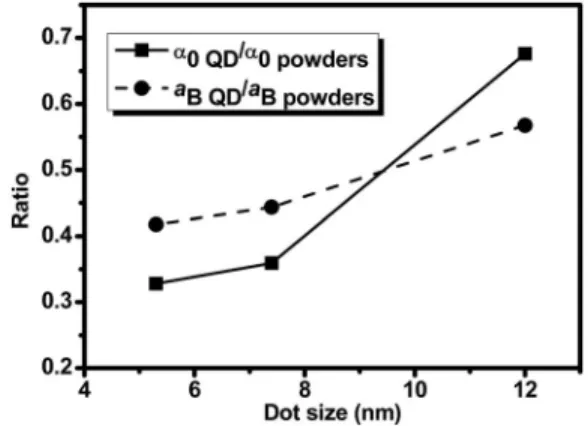
exci-ton Bohr radii aB QDfor 5.3, 7.4, and 12 nm QDs are 0.977, 1.038, and 1.328 nm. The ratios of aB QDto the exciton Bohr
radius for bulk ZnO of aB bulk= 2.34 nm are 0.42, 0.46, and 0.57, respectively, which agree well with 0.42, 0.49, and 0.59 obtained by Senger and Bajaj.22
Figure 4 shows similar trends of ␣0 QD/␣0 powders and
aB QD/ aB bulkagainst the dot size. It shows that the exciton
formation is attained by Coulomb interaction; as the particle sizes decrease, the quantum confinement effect causes in-crease of Eband decrease of aB. The electric dipole, which is
proportional to the distance of electron-hole pair, is then re-duced. The exciton formation thus becomes less polar, reduc-ing the couplreduc-ing strength with the polar lattice via the Fröhlich interaction.18 Consequently, we demonstrated that the reduction of exciton-LO phonon interaction occurs in ZnO-QD system.
We presented temperature-dependent PL of different sizes of ZnO particles. The unobvious LO-phonon replicas of FX were observed when the ZnO particle sizes were under 12 nm in diameter. The FX emission energy difference of 13– 300 K decreases as the particle size decreases. The in-creasing exciton Ebwith the decreasing quantum dot size can
be obtained from temperature-dependent PL. From the
temperature-dependent change of FX emission energy, the exciton-LO phonon coupling strength reduces as the particle size decreases. This is consistent with reducing LO-phonon replica in PL spectra and our previous RRS results.8 The reduced aB with particle size obtained from Eband PL
spec-trum confirms that the exciton becomes less polar, in turn, reducing the Fröhlich interaction; and the exciton-LO pho-non interaction is reduced with decreasing ZnO QDs.
This work was partially supported by the National Science Council Taiwan under Contract No. NSC 96-2628-M-009-001-MY3.
1C. R. Ding, S. W. Li, and H. Z. Wang, Appl. Phys. Lett. 90, 241918 共2007兲.
2C. Y. Lee, Y. T. Huang, W. F. Su, and C. F. Lin, Appl. Phys. Lett. 89, 231116共2006兲.
3K. Tachibana, T. Someya, Y. Arakawa, R. Werner, and A. Forchel, Appl. Phys. Lett. 75, 2605共2005兲.
4G. Yusa and H. Sakaki, Superlattices Microstruct. 25, 247共1999兲. 5A. Murayama, T. Furuta, K. Hyomi, I. Souma, Y. Oka, D. Dagnelund, I. A.
Buyanova, and W. M. Chen, Phys. Rev. B 75, 195308共2007兲.
6Y. H. Cho, H. S. Kwack, B. J. Kwon, J. Barjon, J. Brault, B. Daudin, and L. S. Dang, Appl. Phys. Lett. 89, 251914共2006兲.
7P. Ramvall, P. Riblet, S. Nomura, and Y. Aoyagi, J. Appl. Phys. 87, 3883 共2000兲.
8H. M. Cheng, K. F. Lin, H. C. Hsu, and W. F. Hsieh, Appl. Phys. Lett. 88, 261909共2006兲.
9R. Chang and S. H. Lin, Phys. Rev. B 68, 045326共2003兲.
10K. F. Lin, H. M. Cheng, H. C. Hsu, and W. F. Hsieh, Appl. Phys. Lett. 88, 263117共2006兲.
11C. J. Pan, K. F. Lin, W. T. Hsu, and W. F. Hsieh, Appl. Phys. Lett. 91, 111907共2007兲.
12Z. D. Fu, Y. S. Cui, S. Y. Zhang, J. Chen, D. P. Yu, S. L. Zhang, L. Niu, and J. Z. Jiang, Appl. Phys. Lett. 90, 263113共2007兲.
13V. A. Fonoberov and A. A. Balandin, Appl. Phys. Lett. 85, 5971共2004兲. 14C. B. Duke and G. D. Mahan, Phys. Rev. 139, 1965共1965兲.
15S. J. Sheih, K. T. Tsen, D. K. Ferry, A. Botchkarev, B. Sverdlov, A. Salvador, and H. Morkoc, Appl. Phys. Lett. 67, 1757共1995兲.
16D. S. Jiang, H. Jung, and K. Ploog, J. Appl. Phys. 64, 1371共1988兲. 17L. Viña, S. Logothetidis, and M. Cardona, Phys. Rev. B 30, 1979共1984兲. 18J. J. Shiang, S. H. Risbud, and A. P. Alivisatos, J. Chem. Phys. 98, 8432
共1993兲.
19L. E. Brus, J. Chem. Phys. 80, 4403共1984兲.
20N. Zettili, Quantum Mechanics, Concepts and Applications共John Wiley & Sons, England, 2004兲, Vol. 1, p. 31.
21S. A. Studenikin, N. Golego, and M. Cocivera, J. Appl. Phys. 84, 2287 共1998兲.
22R. T. Senger and K. K. Bajaj, Phys. Rev. B 68, 045313共2003兲. FIG. 4. The relation of␣0 QD/␣0 powdersand aB QD/ aB powderswith different
dot sizes.
181913-3 Hsu, Lin, and Hsieh Appl. Phys. Lett. 91, 181913共2007兲
This article is copyrighted as indicated in the article. Reuse of AIP content is subject to the terms at: http://scitation.aip.org/termsconditions. Downloaded to IP: 140.113.38.11 On: Thu, 01 May 2014 00:05:01