A Commitment-based Model Exploring Online Social Networks:
Prospects and Problems
Author: Timothy MacKay Advisor: Dr. Benjamin Y.C. Yuan
Institute of Management of Technology National Chiao Tung University
Abstract
Web 2.0 applications have begun to shift online habits and have even altered the way people communicate. This has resulted in an increase in user participation and thus a change in online web service technology. This has in turn driven the opening of new opportunities for businesses.
This study first discusses the metamorphosis Web 2.0 in the World Wide Web and then argues the reasons that the new web services are different from the previous ones. A Web 2.0 standout has been Social Network Sites (SNS). These websites have shown to be user-driven and participatory. This study argues why SNS is successful and will likely remain so and shows some of the critical success factors of the websites.
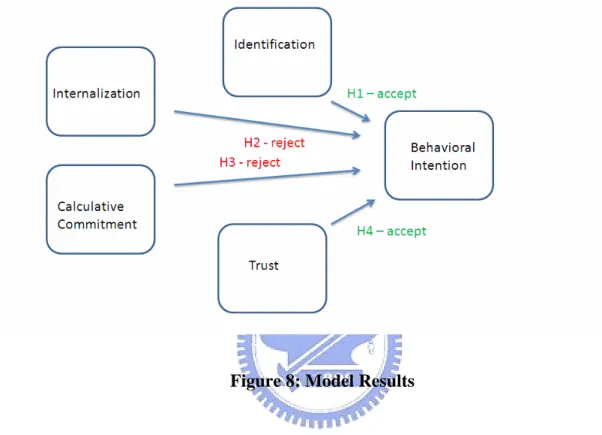
Empirical research showing the benefits of using a commitment-based model is shown in this study. The model tested internalization and identification influences as well as calculative commitment and trust using a commitment-based model. The model was successful while both internalization influence and trust were shown with significance to be related to behavioral intention.
Aknowledgement
The completion of the Master’s degree and of the Master’s thesis was not done by without the support of others. I needed guidance, ideas, challenges and encouragement of many to be successful. I was lucky enough to receive this kind of aid from many sources. First, I appreciate all the input that I received from my classmates. I leaned on and learned a lot from everyone that I worked with during the program. Those experiences enriched my life. I will try to take knowledge and the friendships with me wherever I go. I want to thank the staff and teachers at National Chiao Tung University, especially those who helped me on the journey toward the completion of my thesis. I would like to single out, Dr. Charles Trappey who gave me a basic road map, Dr. Grace Lin who provided me with some great advice about my experiment and Dr. James Chen who helped me iron out many details and who was always willing to help in any way he could. Of course, I thank my advisor, Dr. Benjamin Yuan who showed me again that encouragement and small pushes can be fantastic motivating tools.
Heartfelt thanks goes to my family in Canada, who have always supported my goals and ambitions no matter what the size.
This paper and this degree would not have been possible without the constant support and selflessness of my wife, Yi-ching. She was the one who had to put up with the late nights, the sleep deprived and (sometimes) grouchy husband and the myriad of other annoyances. It is a journey that I feel lucky to have taken together with her. And finally, I acknowledge Jaren who had to share his dad with a school that he never even heard about. Thank you.
Contents
LIST OF FIGURES AND TABLES ...V
1. INTRODUCTION ... 1 1.1MOTIVATION... 1 1.2CONTRIBUTION... 3 1.3AIM FOR THESIS... 4 1.4METHODOLOGY... 5 2. BACKGROUND... 7 2.1WEB 0.1 ... 7 2.2WEB 1.0 ... 9 2.3WEB 2.0 ... 12 2.4FIRST WEB 2.0 APPLICATIONS... 15 2.5THE BIG IDEAS OF WEB 2.0... 16 2.6FACEBOOK... 18
2.6.1 How Facebook Works... 19
2.7MYSPACE... 21
2.7.1 How MySpace Works... 21
2.8BABYHOME... 22
2.8.1 How BabyHome Works... 22
3. LITERATURE REVIEW ... 24
3.1INTRODUCTION TO SOCIAL NETWORK SITES... 24
3.2DESCRIPTION OF SNS... 25
3.3EXAMPLES OF POPULAR SNS... 27
3.4SOCIAL NETWORK SITES AS WEB 2.0APPLICATIONS... 30
3.5SOCIAL NETWORK SITES IMPACT... 31
3.6GEOGRAPHIC DISTRIBUTION OF SNS... 32 3.7DEMOGRAPHIC DISTRIBUTION... 34 3.8BUSINESS MODELS... 35 3.9CATEGORIZING SNS... 38 3.10STRATEGIC ADVANTAGES OF SNS... 39 3.10.1 Trust in SNS... 39
3.10.2 Building Social Capital... 42
3.10.3 The Long Tail... 43
3.10.4 Network Externalities... 45
3.10.5 Network Based Marketing... 47
3.10.6 Critical Success Factors for SNS... 50
4. RESEARCH MODEL ... 52
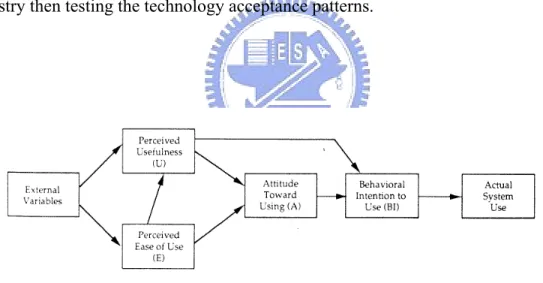
4.1THEORETICAL BACKGROUND... 52
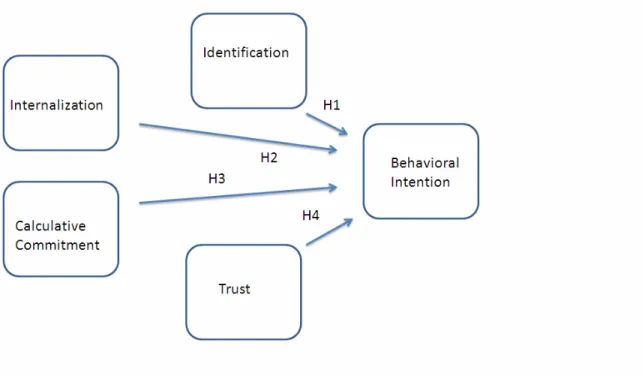
4.2RESEARCH MODEL AND HYPOTHESES... 55
4.3IDENTIFICATION AND INTERNALIZATION INFLUENCES... 56
4.4CALCULATIVE COMMITMENT... 57
4.5TRUST... 58
4.6METHOD... 59
4.6.1 Instrument Used for Data Collection... 60
4.7RESULTS AND DATA ANALYSIS... 61
5. CONCLUSIONS AND FURTHER STUDY ... 66
5.1CONCLUSIONS... 66
5.2IMPLICATIONS AND FUTURE RESEARCH... 66
REFERENCES... 69
JOURNAL REFERENCES... 69
OTHER SOURCES... 72
APPENDIX 1: SURVEY... 77
APPENDIX 2: GEOGRAPHICAL DISTRIBUTION ... 78
List of Figures and Tables
Figure 1: Web 1.0 ... 12
Figure 2: Web 2.0 ... 15
Figure 3: Launch Dates of Major SNS ... 29
Figure 4: Banner Ads ... 37
Figure 5: Premium Accounts ... 37
Figure 6: Technology Acceptance Model... 52
Figure 7: Commitment-based Behavioral Model (Research structure) ... 56
Figure 8: Model Results... 65
Table 1: ANOVA (b) ... 62
Table 2: Model Summary... 62
Table 3: Coefficients (a) ... 63
1. Introduction
1.1 Motivation
As membership in Social Network Sites (SNS) become more regionalized and set (boyd & Ellison, 2008), what companies will survive (if any)? And what will be the critical success factors for those who survive?
Clearly, individuals’ Internet use has changed since the introduction of the World Wide Web and it has even evolved since the dot com bubble burst early this decade. More now than ever the web is becoming a place where individuals make connections, interact, and share information irrespective of geography. This paper will examine the role of SNS1 in the “new World Wide Web.”
The idea for this thesis was fostered out of a paper (MacKay, 2008) written for a prior class about Facebook. The main focus of that research was on the changing nature of trust in online sources with SNS in general and Facebook in specific playing major roles as actors in this shift.
For that paper, the working hypotheses involved the lowering of the trust barriers to Internet interactions because of SNS. Especially initially on the Internet, there had been low trust thresholds of the medium for consumers (Siao & Shen, 2003). With the advent of SNS, a shift might have occurred in the trust felt between the social actors. Luo (2002) suggested that connections that occur between like-minded people create another trust tie
1 For the purpose of this paper I have decided to use SNS (Social Network (web)Sites). This term and
acronym has been used by prominent scholars (Dwyer et al. 2007; Beer 2008; boyd and Ellison 2008; Hargittai 2008) and others. Some scholars have other terms specifying the web relationship such as “web-based” or “online”.
and a feeling of shared binding. Social Network Sites tend to be websites where like-minded people interact. For example, MySpace is a site where members share their music likes and dislikes. Cyworld is a site where Koreans can share elements of their culture and make ilchons (discussed later in paper). Maybe this meant that there was a higher trust level in the SNS.
The experiment for that project was unsuccessful but something else happened just as I was completing that essay. My wife, who is an English teacher and owns a language school in Hsinchu, Taiwan, was participating in her own unofficial SNS experiment. Over the last several years, she has been running her small English language learning school out of her parents’ home and has been interested in increasing her class sizes and adding a number of classes. Although she had gotten some new students through word of mouth, she was looking to add more students. She had advertised in a variety of manners but her advertising was met with skepticism maybe because she did not have a name brand. She had not been able to recruit any students from her advertisement using locally hung posters or by handing out flyers at local elementary schools.
Also, she had been an active member of a SNS in Taiwan called BabyHome. So she had the idea of advertising her classes on this SNS. She posted a note on an open forum listing her class openings. So members could read this forum and then check her individual site out before replying to this appeal. Before long she had a number of inquiries and a number of students signed up almost immediately. Why had she been successful in this virtual space where she had been unsuccessful in person? My original hypothesis from the Facebook paper had again looked correct. SNS could be responsible for lowering trust barriers (MacKay, 2008).
1.2 Contribution
This area of research is relatively new as SNS have been part of popular culture for less than ten years now. It is scholarship that is in its early stages (Beer, 2008) and for that reason it is crucial to map the development and to set the definitions for what exactly is SNS.
Web 2.0 is also an important new area of scholarship. SNS have been linked to Web 2.0 applications on many occasions (O’Reilly, 2005; Skiba et al., 2006; Anderson, 2007; Parise & Guinan, 2008). This paper will answer the question whether the group SNS truly a subset of the group Web 2.0. The research will examine the trends in Web 2.0 and determine whether they apply to SNS.
This is an important link as there are questions about the viability of all Web 2.0 applications and this group of applications is garnering much interest from scholars, entrepreneurs, investors and the general public. If this connection is a false one, it would be important to note the differences and if it is a correct one, how do SNS fit in with the other Web 2.0 applications?
This paper will discuss the varying geographic locations of differing services. This paper will also develop experimental quantitative research depicting the reasons that customers stick with specific SNS in some cases despite access to deemed superior websites. There are a number of studies specifically dealing with technology adoption especially concerning websites. Interestingly, there are not as many dealing with the continuous use of websites and retaining customers (Li et al., 2006). This paper will show that this market is getting pretty mature so retaining customers is becoming more important. So
keeping that in mind, the experimental research will investigate areas of focus in order to enhance customer retention.
All of these topics were deemed worthy of further study by the preeminent SNS researchers boyd and Ellison (2008). Also, “the feedback loop” of information will be discussed. This idea implies that there are some marketing opportunities seemingly built into SNS as users share important feedback within the system (Beer, 2008).
As this thesis has been a relatively exhaustive in the study of SNS and has turned up little in the way of sorting SNS, this study will also aim to classify SNS and to list popular business models.
1.3 Aim for Thesis
The aim for this thesis is to report findings about the shifts in computing user habits, especially regarding trust and SNS. The scholarship in this field is relatively new so in order to contribute meaningfully to the existing body of work some effort will be made to summarize the research and to make clarifications or modifications where necessary. There are three important areas of discussion that are addressed in this paper: social psychology, business and technology. All three of these sections are linked and significant and all three of these areas are addressed in some manner in this paper. There has been a shift in the way that people are using the Internet. This shift in technology use is documented in the discussion of Web 2.0 and the advent of SNS. This shift in how users interact on the web has in turn had an effect on the way they interact with other
individuals thru the Internet. In this paper, social interaction in SNS is investigated and an experiment is conducted to try to better understand behavior patterns and customer retention on SNS. Because there has been a shift in how people interact with each other in this changing medium, businesses should look at the technology to see how they can benefit from it. This paper attempts to shed some light on where the technology may be leading us. It also discusses the strengths of the technology and possible future use especially with regard to network marketing.
1.4 Methodology
This current and rapidly evolving topic will be reported by canvassing a variety of current sources. Also, this is an article on the changing nature of the Internet so the research will take an extensive online approach. First, the literature review will examine the trends in the web media especially since the dot.com bubble burst early this decade. Appropriate sources for this literature review would be journals, web articles and even weblogs. Also used to inform this research is a survey using the web service surveymonkey.com will be sent to respondents by email. The statistical research concerns maintaining customer satisfaction with SNS.
The format of this thesis has been partially borrowed from the thesis of Ilana Davidi (2006) from the Sloan School of Business at MIT who did her research on wiki sites. Similar to that study, this one will look at a Web 2.0 application. Also, the studies conducted by Li et al. (2006) concerning technology retention and Mahotra and Galletta
(1999) adapting the Technology Acceptance Model (TAM) were instrumental in the development of the research model used.
2.
Background
2.1 Web 0.1
2Netscape Navigator and ‘browsers’ introduced the Internet community to browsing the web. Prior to the introduction of these applications, the Internet and the World Wide Web remained an unexplored world for most.
Although relatively young (less than 20 years), the Internet age has been a turbulent one. At first, it was met with great enthusiasm and vigor. As a high school student in the early 1990’s, I remember hearing about this coming “age”. I didn’t know what it was going to be, but I understood that it might be important. Even though most of us had never used the Internet and really had no idea how to “surf the World Wide Web” many understood that it might bring about a revolutionary change.
In the fall of 1994, my World History teacher from high school, Mr. Penton made the suggestion to our class that the Internet would be as important a technology as the telephone or the TV. He even went so far as to say that it would be as important a technological breakthrough as there had been since Gutenberg’s printing press. This was difficult for me to comprehend at the time, and it was a bold statement. Today it looks as if the statement could be considered prophetic. This is a debatable issue, but the Internet and the World Wide Web has had a profound impact especially in the developed world. In fact just a little more than 10 years after that bold statement, in 2005, it was noted that there were at least 600 billion pages of web text. This equates to about 100 pages for
2 I have not taken the term Web 0.1 from any specific source. I chose this term to clearly show a difference
between the Web (browsing in particular) as it was used prior to the introduction of Browsers such as Netscape Navigator.
every person (Kelly, 2005). Since we are 3 years removed from 2005, it stands to reason that there are many more web pages in existence today. Also by 2007, the Internet was being accessed by 20% of the world’s population according to Internetworldstats.com (“Internet Usage Statisitics”, 2007).
Now, while Mr. Penton had anticipated a profound change in information output methods, almost no one could have predicted what the Internet and the World Wide Web would look like 15 years after its inception. In fact, it is even more surprising to me looking back at this history teacher as at the time he likely never “searched the net”, let alone “surfed the web”. More likely, in 1994, the most that he was using the Internet for was for exchanging emails with colleagues across the office from him. By 1995, many people had heard the term “information super highway” but few had an idea about what that highway would look like and exactly what kind of cars would be driving along this highway. It would have even been hard to fathom who would make those cars. However, people started to get a clearer understanding about the Web and started to use the Internet en masse after the introduction of Netscape Navigator in 1995.
People who really had hope for business on the Internet really started to imagine its commercial potential in 1995. In May of that year, the National Science Foundation (NSF), who had been safeguarding the World Wide Web for research purposes, finally opened the Web for commerce and 3 months after that Netscape had their famous IPO that sent shockwaves through business sectors and the rush was on to make some money from the Internet (Kelly, 2005).
So Netscape had indelible effect for a number of reasons, first its IPO created such a buzz and an excitement in the business sector for commerce to be created online. Second, the Navigator introduced the web browser concept (teamed with search sites) that made it relatively easy for a user to find information.
2.2 Web 1.0
3The browser introduced the world to the Web and the Internet as it aided people in navigating the net. It also signaled the start of a new era in computing. The fierce competition between Microsoft and Netscape in the browser business not only led the industry to understand the some of the potential of the net, it also foreshadowed future winner take all battles throughout the industry. So while these two early entrants were battling to get on desktops and laptops around the world, consumers and entrepreneurs were imagining the infinite possibilities and opportunities that the web had to offer. With the huge success of Netscape’s initial public offering (IPO) came dreams of riches for many entrepreneurs who wanted a piece of the action. Many thought of Internet applications as the one stop solution center. Many businesses opened up with the anticipation of reaching their gold mine IPO without being able to offer a useful product or service at an affordable cost for customers. In fact, many web companies found that with the Internet, customers could demand lower prices than existed prior to the
3 Similarly to Web 0.1 that I described earlier, I have seen this term used in a few articles discussing Web
1.0 but of course no one used this term to describe applications or programs in the late 1990’s. This term has been used here to label applications that preceded those under the banner of “Web 2.0.”
introduction of this technology. This was the result of customers having greater access to competition from around the world.
Two types of companies participated in the initial web industries. The first type of industry that participated here was traditional “Bricks and Mortar” companies. According to Weill and Vitale (2001), these were established companies that were looking to get into this new Internet industry. Of course, they got taken in on the hype of the web and because they were scared of the threat of new entrants or because they saw a great opportunity to gain new business in the age of the Internet. They joined this race to be connected. The first problem for these companies had been that they were moving out of the element that had made them successful. Many felt that they simply had to be online. In a way they were being forced to invest in a technology in which they had no understanding about how to recuperate that investment.
The second group that joined were newcomers to industry altogether. They were the so called “virtual companies” that started with an idea and some computers. These companies faced some immediate problems chief amongst them was getting customers to pay for anything they produced. Online retailers and service sellers faced a significant barrier to accomplishing anything because customers did not trust them. This meant that they would not be willing to pay for services online.
This problem encountered may have been in the technology itself. Even when the variable element of the product had been removed, online retailers had a more difficult time being trusted. Online businesses had not been trusted because consumers lacked the social information necessary to trust the system. Consumers’ trust (or lack of it) in
commerce may have been a reason for the reluctance to purchase products online. Social Exchange Theory (SET) suggested that members involved in an economic exchange evaluated relationships in a behavioral context. These selling and purchasing partners look beyond the short-term and concentrate on the satisfaction of long-term goals as well (Luo, 2001). There was no guarantee of long-term contact with their customers, so the customers were reluctant to share their money with these new businesses.
Since customers were so unwilling to pay for anything over the web, it was difficult for companies in this unexplored land to find reasonable sources of revenue. To solve this problem, Internet developers hearkened back to a revenue stream that had been popular on other forms of entertainment such as radio and television: ads. The most common form of these new web ads were banner ads and “pop ups”. Banner ads are like streamers of information found along the borders of web pages or even sandwiched by text. Pop-up ads are web pages that entered the browser displaying advertisements on a new web page. While these two types of ads may have injected some cash into the industry, they were found to be intrusive and inefficient (O’Reilly, 2005).
In this first phase of electronic commerce, businesses were at the center of the action. This meant that servers would operate from the business and interactions were mediated through a central location. While businesses remained in control of the interactions, this inefficient exchange was probably not how Tim Berners-Lee (2001) envisioned the Web. He envisioned the web to be an entity that was as decentralized as possible.
Not only were interactions centralized, information was also centralized and monitored by those under the employ of business. Tim Berners-Lee would say that the Internet
bubble burst for good reason: because of Internet companies trying to control the information flowing through their website. As the designer of the World Wide Web, he knew that this kind of action went against the very architecture of the web. Only when the websites ceded control of each site would the web really take off (Berners-Lee, 2007).
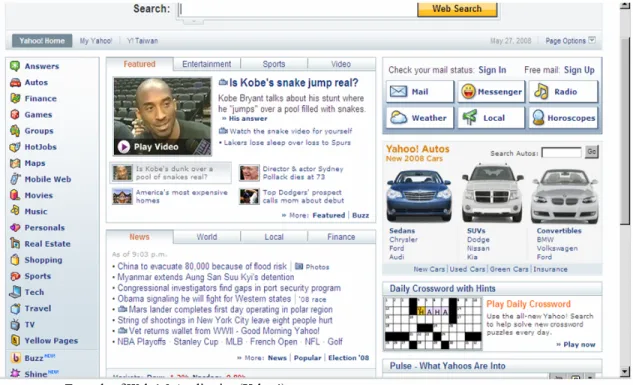
Figure 1: Web 1.0
2.3 Web 2.0
4Because of the success of businesses such as eBay, Craigslist, Napster and Amazon coupled with the failures of websites such as Pets.com, Cdnow.com and others, businesses really started to see a trend to the success stories of the Internet. This trend
4 Tim O’Reilly is frequently referred to as the one who coined the phrase Web 2.0 (O’Reilly 2005;
Anderson 2007).
showed an increase in customer participation. Internet companies had not been the cash cows that people had envisioned. After the Internet bubble burst in 2000, investors started to look at important numbers again: costs and revenue.
What eBay and Craigslist have been able to do is to set up a database that is more or contributed to by members. On these sites, content is managed rather than created by the websites. One of the lessons of Web 1.0 was that content was the expensive ingredient and customers were mostly unwilling to pay for it.
A revelation that shocked the industry was that people were willing to contribute and in a sense create content. Blogging, for instance, is basically a person just writing for fun. Industry insiders were blown away that this could be such a popular pastime (Kelly, 2005). Being an English teacher, I am surprised by this idea as well. I have to encourage my students to write. It the rare exception that writes ‘for fun’. “Web 1.0 tended to be
about publishing, while Web 2.0 is about participation … that they have embraced the
power of the web to harness collective intelligence” (O’Reilly, 2005).
Many successful new websites are participation oriented with an enormous amount of contributors and a huge number of people that want to be remunerated for their efforts. Ads remain an important agent for funding the web now in its second phase. Popup ads have been replace by unimposing text ads such as Google’s AdSense and Yahoo!’s Search Marketing. These services have reached out to the Long Tail (discussed later) and encouraged an unprecedented number of businesses and individuals (hundreds of thousands) to get a piece of the action. In some way or form many are getting compensation for their efforts (O’Reilly, 2005).
While data and information had always been the most import assets that existed on the net, web companies finally realized that data management was to be the most important capability of the Web 2.0 age. For example, Wikipedia, the web dictionary that is user created, does not have to worry as much about content creation; their users are doing for them. They do have to ensure that this data is being stored and becomes easily accessible for their members and searchers.
While much of Web 1.0 was built on purchased proprietary software, much of Web 2.0 success has been built not only around user-generated content, but also on free open source software. In fact, it is argued that open source software has been a driver of Web 2.0 applications (Beer, 2008). This cheap access to software (free!) has in turn lowered the barriers for entry for entrepreneurs who may have lost many opportunities because of the downturn in the first Internet bubble. This coupled with the lowering of costs of data storage has encouraged entrepreneurs to return to the former site of the famous crash from earlier this decade.
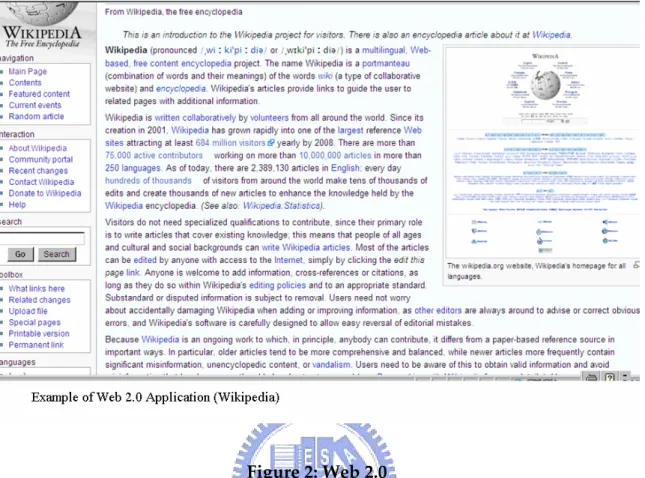
Figure 2: Web 2.0
2.4 First Web 2.0 applications
The first Web 2.0 applications and two of the most successful e-commerce applications are eBay and Amazon. EBay is an auction site that serves customers almost like a global flea market. It handles 1.4 billion auctions annually and it is more or less run and policed by its users. Users make 3 billion comments about other buyers and sellers on the site each year (Kelly, 2005). Amazon started out as an online catalogue for book sales and changed into a company that enables customers to interact (and make transactions) with small business and other individuals through their site. These two sites let users become active participants and maybe because of that survived.
When examining the success stories of Web 1.0, it is clear that they are few and far between relative to the hype and excitement of the mid to late 1990s. EBay and Amazon.com are unquestionably two of the brightest stars from the first wave of e-businesses and they happen to be Web 2.0 applications.
2.5 The Big Ideas of Web 2.0
In his research for the Joint Information Systems Committee, a technology research group in the UK, Paul Anderson succinctly summarized the key ideas of Web 2.0. He noted that there were six guiding principles for Web 2.0 and successes of it (Anderson, 2007). First, it must be individually produced and encourage user generated content. This low cost solution to creating content also gives the user a stake in the web site or service. With an affordable cost, it ensures the businesses that even when the revenues are relatively low, the costs of business can still be covered.
The second big idea of Web 2.0 is to ‘harness the power of the crowd.’ This idea refers to the concept that among a large group of people ‘Truth’ may be able to filter away from purely opinions or ideas of a few. In this way of thinking, when crowds of people are sifting through the information or data on the net, eventually a “best answer” will emerge. The example that both Anderson and O’Reilly give for this idea is the spam filter, Cloudmark. This system is a spam filter application that aggregates the individual decisions of email users rather than analyzing the messages the way that traditional spam
filters had done. Cloudmark was noted to do a more thorough job than the traditional method because of the “wisdom of crowds.”
As mentioned earlier, sharing data is becoming the key element to Web 2.0 applications. Users are creating an unprecedented amount of data so web services must learn to deal carefully and consciously with this data. Those who preach the future being the Semantic Web also agree that content and data in particular is the key to the next step in computing (Berners-Lee, Hendler & Lassila, 2001).
The fourth big idea that Web 2.0 successes tend to have is “architecture of participation.” This once again sounds similar to the idea of user-generated content. The difference is subtle but important. Examining this idea, we must look at each term equally. Not only should there be the important concept of user generated ideas but the architecture must be such that it actually encourages this and it is even better if the architecture improves as participation increases. BitTorrent is the perfect example of this concept. BitTorrent is a software sharing system that extracts “bits and pieces” of data from other users in a decentralized fashion. As more users get involved, the sharing capability actually becomes stronger.
The fifth big idea of Web 2.0 according to Anderson is the power of network externalities or network effects. This idea comes from the economic term that describes the increased value of a service for the existing users when more users commit to that service. This network effect often hearkens back to the day of competing local telecommunication companies. The more members that each company gained, existing members would benefit. Being built on the backbone of telecommunications services, it is easy to draw
the parallel with Internet services. However it works in a slightly different way on the Web because other services remain available to users even if they are committed to one service. Through personal observation, I am more willing to stick with a service that I have gotten used to using. Also, it is common to stick with a service that friends or family are using for a variety of reasons from convenience to maintenance of social stature. In addition to the network effects, Anderson noted that Web 2.0 does not reside only at the center of the web where there is lots of traffic. He notes by referencing “The Long Tail” that there is an enormously important set of sub-groups that exist on the fringes of the web that can be accessed by Web 2.0 applications.
The last idea that Anderson noted in his key ideas for Web 2.0 is “Openness.”This idea refers to a couple of different things. First, being at least mildly transparent is important. Much of Web 2.0 was written using open source code so there is also kind of an unwritten rule that code should also remain available for those who need it. As Web 2.0 concerns itself with collecting, managing and storing data and information, there is expected to be openness about sharing the collected intelligence.
2.6 Facebook
A Harvard dropout named Mark Zuckerberg designed Facebook as a social networking site for college students to interact with each other in 2003. Originally, it was an online program available only to Harvard students. Later, as word spread about the program, students at other colleges joined. And then, in 2005 it was opened to high school students. With the success opening the program to high school students, late in 2006, Facebook
was opened up to all Internet users. Although there is some debate as to how many active members Facebook has and how fast they have been growing, there is no question that it has grown exponentially. It is one of the most popular websites on the Internet (Lampe et al., 2006). Facebook claims to have 50 million active users (Facebook, 2007). Of course the user demographics have changed, too, especially since they opened the site to everyone in the fall of 2006. Originally, American college students dominated the site, but now it hosts members from all over the world (so far only in English) and many age demographics.
Facebook has also introduced the “platform.” This enables aspiring programmers and product developers a chance to create software within Facebook that can be used and shared among members. This has been very popular and may have also encouraged growth. However, it is safe to say that many Facebook users do not develop software for the website. Instead many actively participate in the activities available, chat or just observe others’ interactions.
2.6.1 How Facebook Works
Facebook is, at its basic form, a directory of names with attached portrait pictures. Typically, an existing member recruits new members to the website by email-based invitations. Once signed up, the new member can create a self-profile. This includes his name, email address and a few optional personal identification criteria such as age, workplace and hobbies. He can also join an existing network (such as a college or hometown) or he can create his own network.
There are three main ways to find and recruit friends to a personal site. Any member can 19
search for other active members through the search application. New members can send invitations to contacts from the member’s existing email list and a new member can also look at the friends’ lists of his current Facebook friends and send messages to those members.
Only friends and members of the same network can see individuals’ larger profiles, but everyone can see names with the attached pictures. In order to become “Facebook friends,” one must make a request and get confirmation from that friend. Friends are then linked together in crossing networks. Whether a friend or not, the network link can be searched at the basic level which is faces and names within friend networks.
“Groups” are also an important part of Facebook membership. Members create and join groups on a variety of subject matters where they can post messages or take part in dialogues with others.
An important aspect of Facebook is the so called “news feed.” This shows what activities community members have been doing. Whether a member is active or not, the member can still keep track of discussions or postings by other friends. An example of this would be if John were a friend of Bob and Linda. John sends a photo to Linda. Even though Bob is not involved in this transaction, he is notified of the interaction in his “news feed” because he is a friend of John. So members can keep track of friends’ social interactions whether or not they participate in those interactions. Marketers may find this a useful tool of implicit advocacy to spread product information.
Already one of the questions raised has been answered fairly assuredly. Marketers can reasonably be expected to benefit from the participatory nature of social network sites. Boyd Thomas et al. (2007) have already seen evidence of this at MySpace. And Walsh
(2006) tells us that SNS have actually been driving sales.
2.7 MySpace
Chris DeWolfe and Tom Anderson created MySpace in 2003. They had been using Friendster and saw an opportunity to create something better (Lapinski, 2006). While MySpace is currently the most popular SNS in America (Alexa.com), MySpace grew quickly by appealing to a younger demographic (Snyder et al., 2006) by encouraging users to share personal experiences, files, hobbies and cultural preferences such as music. Most of all, MySpace exists to interact with others and to make new friends. As they say on their website, “MySpace is an online community that lets you meet friends’ friends.” (MySpace) Media magnate Rupert Murdoch purchased MySpace in 2005 for over US$580 million (Barsky & Purdon, 2006). While these spaces are created to be personal spaces, they are also in the public domain. This is one of the key purposes of MySpace and has also been one of their most difficult problems. They have had privacy issues and security issues as well (Snyder et al., 2006). An example of this may be to consider a student who shares his not for public ideas with his friends on MySpace. Later, when he tries to get a job, he may have a problem with employment based on his views expressed in his public profile.
2.
7.1How MySpace Works
Users are encouraged to sign up and to create a profile on the site. Then, they invite friends to join the personal network created and/or search for friends currently using the
site. Then, users create connections between other users and finally contribute to the site by linking your contacts with each other (MySpace).
The researcher will canvas MySpace users as part of the experiment discussed later. MySpace was chosen as it is a large US-based company that is incredibly popular and influential (Snyder et al., 2006).
2.8 BabyHome
BabyHome is a website that was developed in Taiwan and is mostly used by Taiwanese consumers in 2002. They claim to be the biggest website featuring babies in the world (Yeh, 2007). Although it was set up as a base site for members to develop their own web pages, it works much like a SNS. It is directed at parents and their kids.
BabyHome offers three different types of accounts: a basic (free account), a premium membership and a premium plus membership. The latter two have incremental memory space available and are offered more services, but require yearly fees (Yeh, 2007).
2.8.1 How BabyHome Works
Originally, two fathers wanted to put pictures of their kids on a website however, they were unable to find suitable sites to use. So they decided to use their own web ideas to create sites. Soon friends inquired about their websites and asked for their help setting up their own. The two fathers decided that they should design a template that would allow parents to set up sites of their own (Yeh,2007).
On the site, users are able to quickly set up pages and customize them as they view fit. These customizations include adding pictures, short movies and sound files on to the personalized site. Discussion boards are open and encourage members to meet each other. Ideas and information are shared among parents with similar needs.
They use an advertising medium but they do not just allow any companies to advertise on their site. They ask advertisers to offer special discounts and bonuses to members. Also the site sets up group purchasing pages that will encourage parents to get together to purchase expensive sets of books, for example. This type of facilitation benefits both the buyer and the seller (Yeh,2007).
3. Literature Review
3.1 Introduction to Social Network Sites
When defining this term, it is important to look at the research and also make clear the cases where there may be discrepancies. As it is the defining new research into this topic noted Beer (2008), this study will aim to integrate boyd and Ellison’s definition of social network sites.
Boyd and Ellison’s paper defines social network sites as
‘Web-based services that allow individuals to (1) construct a public or semi-public profile within a bounded system, (2) articulate a list of other users with whom they share a connection, and (3) view and traverse their list of connections and those made by others within the system.’
(boyd and Ellison, 2008: p. 2)
While this is a useful definition, to expand upon it a little further and to clarify it, Golbeck (2005: p. 13) offers an addition: “The system must have explicit built-in support for users making these connections.” While this last point may sound obvious, it is important to note because one of the keys that sets this kind of site apart from email is the ability to make connections and maintain these open connections.
Using these two examples for the purposes of this paper, we can define social network sites as being online services where members can develop a public registry within a bounded service. It must have a built-in service to aid customers to find others with
whom they want to have a connection with. They must be able to traverse their list of connections and in some way traverse a list of others made within the system.
It is also important to note what SNS is not (at least for the sake of this paper.) Virtual communities are noted to be “a community in which the primary mode of interaction is electronic (online/virtual) and not face-to-face.” (Hinds 2008, p.2) While SNS is a subset of this group, virtual communities as Hinds describes them, are a much larger group consisting of communities of people who play games together such as groups associated with playing massively multiplayer online role playing games. Or groups that are mostly concerned with sharing content such as video files or music files that use YouTube or Kazaa.
Activism communities are mostly concerned with social activism. Knowledge sharing communities are the likes found on Wikipedia and other wikis, while development communities work on open source software and other software. Hinds (2008) also mentions exchange communities such as eBay as a virtual community.
While a subset of virtual communities, SNS differ from the other ones in that larger group in terms of motivation. The motivation for people joining SNS is singularly for the purpose of interacting socially with other like-minded people.
3.2 Description of SNS
SNS users join a site by signing up with that service and sharing some basic personal information. Name, age, country of residence and preferred language are usually the
fields that are required in order to join. Other requested information includes, but is not limited to gender, birth date, profile picture, work information, schools attended, hobbies and interests. Most of this information is optional but users are encouraged to fill in as much as possible.
Once the user completes the terms of service requirements and has filled in a profile, the user is then free to use the service. The social network site will give an opportunity for the new user to add to or edit his or her profile at any time. As this is an SNS, the most important activity is communication with others. To find others, members can browse listings of other members or search for other members within the site. Also, they can input email addresses of friends, family and acquaintances to send a request to others to join this group. Most of these sites are exclusive so if you are signed up in one service, you cannot communicate with someone who is using a competing service. Upon inputting acquaintances’ addresses, the service provider will send email to those people inviting them to join the site.
Once contact is made with a friend within the site and a friend link is developed, members can communicate through this closed system with each other. These friend links are important as friends can be granted access to certain parts of others sites. They can also browse their friends’ profiles, share files or chat. Each friend connection not only opens that friend’s site but also opens the friend’s directory of acquaintances.
Facebook offers a good example of this concept. As a Facebook user, I can use it as a directory. If I want to get in touch with an old friend from high school, I do not need to look in the yellow pages or search for him online. I could do that but there may be many
people who share his name. To narrow the search down I can scour the directory of a high school friend of mine who is a contact on Facebook. I can even search a friend of my friend’s directory and so on.
Groups for like-minded individuals may also be created on these sites to further increase opportunities to share information or ideas, to chat or to meet new people. As mentioned earlier, most of these sites offer storage for a variety of types of media files. As Lampe et al. describe SNS, “they allow users to create in-depth profiles describing themselves, and then to establish explicit links with other users, who are described as ‘friends’ by the system.” (Lampe et al., 2007: p. 435)
SNS are incredibly versatile. It is likely that we are just scratching the surface of their potential. Nonetheless, people use SNS for many different types of activities. In conversations with my friends, they have told me that they use SNS to set up group activities, to chat with friends and they use it to view activities of friends and family. They use it to help plan their social calendar. Some use it instead of email because it’s more direct and gets quicker responses. One friend insists that he will never give up his SNS because he has invested time in uploading many files and pictures to his site. So it is a new tool for communicating with as yet unexplored potential.
3.3 Examples of Popular SNS
There are countless SNS today and they have been popping up since early this decade. Friendster has been noted as being one of the key companies that started this big movement toward SNS when they started out in California in 2002 (Chafkin, 2007). As
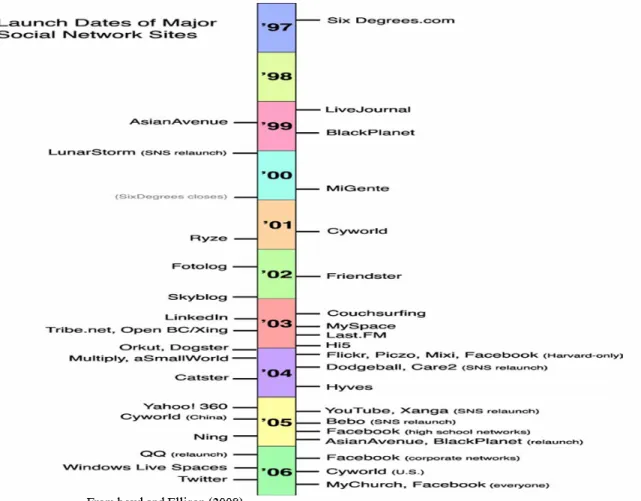
there are too many to introduce, here is an outline of some of the major SNS launches since 1997.
In their exhaustive introduction to social network sites, boyd and Ellison (2008) list the launch dates of key SNS. They include, SixDegrees.com which was one of the first SNS and it was launched in 1997. This site tries to find connections between members. LiveJournal, another SNS pioneer was launched in 1999. The hugely popular Korean site Cyworld was launched in 2001.
Friendster was the first big hit as a SNS in the US. It was launched in 2002 and immediately found success. LinkedIn was launched in 2003. This uses a different idea than purely social networking. The idea with this site is that users not only make connections with friends but importantly make connections with business associates to aid in commercial transactions and to network (in the business sense of the word). Later in 2003, MySpace was launched and found very quick success in the US. (There is more about MySpace later in the paper.) Hi5, which has found success in Latin America, was also launched in 2003.
Orkut launched in the beginning of 2004 and found a market in Brazil almost immediately. The photo sharing/tagging, Flickr was launched in 2004 as was Facebook. Facebook was originally only launched to Harvard students. Later it would incorporate other Ivy League schools and then other colleges. Today it is open for anyone to use. It has reach across the globe, but is strongest in North America. Dodgeball, a mobile phone based SNS was launched in 2004 and later purchased by Google.
YouTube was launched in 2005 and had almost immediate success. In some ways this site acts as a SNS although it does not fully fit into the category of SNS as per the definition from the previous section. YouTube videos have been integrated into several SNS. In 2005, Yahoo! jumped on the SNS bandwagon with Yahoo! 360. Microsoft followed shortly after in 2006 with Windows Live Spaces. Cyworld (China), QQ and Xanga all launched in 2005 or 2006 with the expressed interest in capturing the huge and growing Chinese market (boyd & Ellison, 2008).
Figure 3: Launch Dates of Major SNS
3.4 Social Network Sites as Web 2.0 Applications
To answer this question of whether or not SNS are truly Web 2.0 applications, we must check to make sure that the six key ideas discussed earlier from Anderson line up with the definition of SNS described in the prior section.
So first, do SNS encourage active contributions from users and individual production of content? SNS definitely encourage user-generated content. Do SNS harness the power of the crowd? Yes, they do but in a slightly different manner. Through the network effects, they encourage more participation of the members. Most SNS store data including files, pictures, and even video for free so the third issue about managing data is true as well. Participation is in the backbone of SNS. Without participation, most of these sites are but merely shells. So they fall within the boundaries of the fourth key idea from Web 2.0 as well. As mentioned earlier, network effects definitely matter for SNS. Many SNS encourage members to keep their profiles as open as possible and in a move that has heretofore been unprecedented; members are often leaving their information open to whomever (MacKay, 2008). Often SNS use open source code for their base code. So the last two conditions are also met.
So with the conditions for being a Web 2.0 application met, we can assuredly consider SNS a Web 2.0 application.
3.5 Social Network Sites Impact
SNS are growing at a rapid rate all around the world. It is not unusual for members to log into accounts several times during the (boyd, 2007). They are unquestionably important communication tools for those who are using them.
There has been much discussion about SNS and participation from youth. They participate more often than older people and even teenagers spend as much time as they are afforded on SNS. 55% of online teens aged 12-17 have created profiles on social network sites with 64% of teens 15-17 (boyd, 2007). As these sites are popular with younger participators and it becomes habit-forming, we can hypothesize that participation overall will increase over time.
While SNS have had an undisputed impact on communications, the business community remains a bit skeptical about the future. Churchill and Halverson (2005) note that SNS encourages a surge in communication not only between friends but also with people that individuals normally would never meet. Researching social network communication on computers affords a great opportunity to study types of communication and many intricacies of social interactions.
Partly because of its current lack of financial strength, scholars and experts warn that SNS could be here today and gone tomorrow. Friendster seemed to be a perfect example of this. It became popular almost overnight in 2003 and quickly grew to 20 million registered users. It dipped down to a million as they had technology problems and MySpace became more popular in 2005 (“MySpace, Facebook and Other Social Networking Sites: Hot Today, Gone Tomorrow?” 2006). Some scholars argue that if this
is possible for one company, maybe it is possible for the whole industry to be replaced by better services.
But as SNS become ubiquitous are they replacing current methods of communication or are they creating new ones? Just because one SNS suffered a setback will others suffer the similar fate or will the whole industry succumb? Another question centers on how SNS are going to fund themselves to ensure that they make a profit or at least break even. This question about funding no charge services is reasonable. In the first web development period, many companies ignored the problem related to gaining revenue and in turn they folded. Some entrepreneurs see the potential in social network sites. Mankof et al. (2007) noted that, “SNS facilitated by Internet technologies, is a popular and potentially powerful medium for educating consumers and motivating change… virtual social networks membership can be used to motivate personal change, by enhancing actionable suggestions presented to consumers frequently in an integrated fashion.” (Mankof et al., 2007, p.1) So in order to maintain that impact, SNS will have to figure out a way to obtain profits. One way to do this is to take advantage of the marketing potential.
3.6 Geographic Distribution of SNS
There is no one globally dominant SNS. While eBay may be the top auction site for many countries; and Google and Yahoo dominate search especially in the Western world, there is no shortage of SNS. Many have strong holds in specific geographic regions. For example, MySpace is the top SNS in the US, but Facebook is the top SNS in America’s
neighbor Canada and ranks second in the US (Alexa.com, 2008). For the geographic distribution of dominant SNS, refer to the chart in the appendix.
The reasons for these strong geographic ties may be several-fold. First there can be cultural ties built in to the website. For example, Cyworld, a website developed and deployed in South Korea is by far the most popular SNS in that Asian country. Kim and Yun (2001) argue that there are a number of cultural reasons why Koreans prefer this site to others. First, the name itself “cy” relates to a Korean word that means relationship, which easily gives Koreans a clue about the nature of the site. This site is built similar to other Korean websites and requires a Korean identification number. While this may sound like a disadvantage, actually it could be a source of trust for users of the site as users can be reasonably sure that other users can be traced (and traced to Korea).
Cyworld also uses societal cues such as the idea of “ilchon”. This term describes non-kin relationships. Cyworld’s setup encourages users to develop their ilchon networks in a way that is particularly Korean (Kim & Yun, 2007).
In countries with very similar cultures such as Canada and the US, there is perhaps a different reason why different SNS are stronger than others. Network effects may explain these differences. A social network site which has the aim of interaction may not be too enjoyable if there is only one member or even if there are a few. For an SNS, more members give the site real strength. Because of this, users encourage others to join. At some point, the network effect may become so strong that it makes the option of joining another SNS less appealing. So MySpace reached a critical number of members in
America that gave it such a strong pull that even a strong competitor such as Facebook could not crack that lead.
Even though Orkut is owned and run by an American company, Google, it has a strong base in Brazil rather than in America. Its relative strength in Brazil is so much that competitors are reduced to a mere fraction of the online social networking pie in the country. Once again, the penetration of Orkut into the Brazilian market was so strong that the network effect made using an alternative unacceptable.
The discrepancies between Canada (which favors Facebook) and the US (which favors MySpace) could be related to network effects and the strong market penetration by Facebook into Canada and by MySpace in the US. (A more detailed description of network externalities is given later in the paper.)
3.7 Demographic Distribution
The demographic information for SNS is incomplete. However Hargittai (2008) has noted that members of the similar demographics tend to use the same SNS. This also suggests that members are joining SNS in order to communicate with friends and family. It reinforces the idea that strong network effect forces propel like-minded people to use certain SNS that correspond with the most popular site in that geographic area.
In her study of teen use of SNS in America, danah boyd (2007) found that in terms of race or ethnicity, participation went across the board. The only important distinctions
came from two sources: those with no Internet access and those from various backgrounds who were conscious objectors (to SNS or the Internet).
Some websites have features that are more attractive to certain age demographics. For example, MySpace offers users the ability to upload videos to their personal space. This has encouraged many young people to share videos of their favorite bands and it has encouraged young performers to upload their own videos to try to entice an audience. Other sites have included a genealogy feature, which may be a more attractive feature for older people.
3.8 Business Models
Few SNS sell memberships to their sites. This is likely because it is a new service that people have to get used to before they are willing to pay for it. However, with the number of SNS running, it is unlikely that many companies could afford to start charging registration fees.
Later in this paper, there is a thorough discussion of network externalities. There will be tests to the network effects at some point. As with many new website service, the question as to how the customers pay for the service is always a good one. Sites must consider whether to charge user fees or not. Or maybe they would tier the service with “premium service” given to those paying for the service. LinkedIn offers “Premium Service”. This service promised more business connections. Businesses are willing to pay this fee to get access to the LinkedIn databases. Individuals may not be.
Now, if LinkedIn had eliminated the free service or cut back severely on the service to free subscribers, it would seriously test the network effects. It could be that some or many members switch allegiances to a competing SNS.
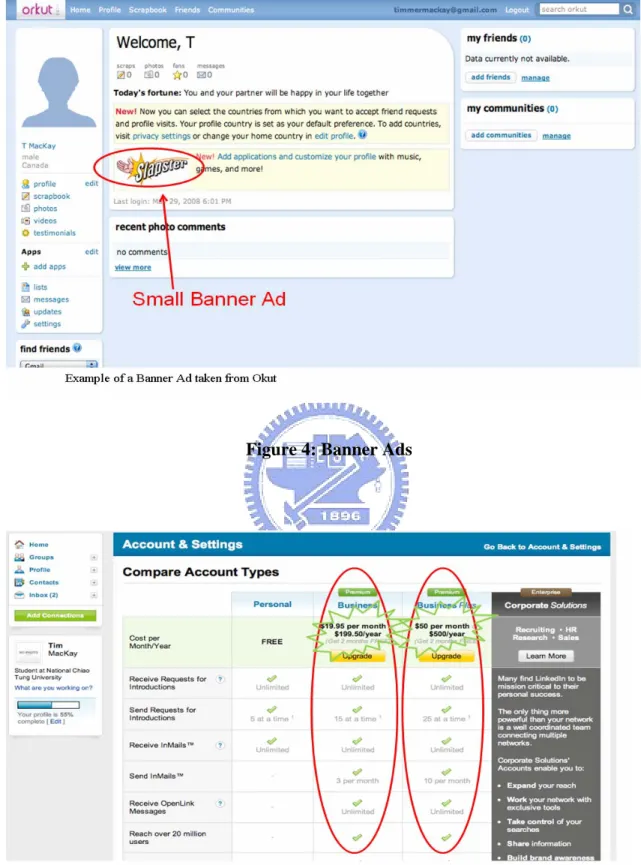
While a few sites take membership fees, most of the SNS are using some type of advertising model to collect revenues. That is to say that either banner ads or text ads or both appear on the main page, on members’ profile pages and on group pages. This type of model can have real power on this type of website as users tend to really segment themselves by listing geographical location, age, job, likes and dislikes and so on. SNS is able to place content-based ads that more or less directly targets audiences demographically.
Facebook also acts as a merchant by selling digital images to members for a nominal fee. Others such as LinkedIn sell information to businesses.
Figure 4: Banner Ads
Figure 5: Premium Accounts
3.9 Categorizing SNS
SNS is an evolving technology so there is some difficulty to pigeonhole different services. O’Murchu, Breslin and Decker (2004) from the Digital Enterprise Research Institute at the National University of Ireland developed a list of classifications that are suitable to most of these sites. It is incomplete as the list was made when SNS were just starting and these sites have made significant advances since then. So here is the list with some modifications.
The first classification mentioned is registration versus connection. Some sites require that current members invite new members. Others are open to the public. While most major SNS are open to the public, there is a good possibility that more sites will open that will aim to connect those in closed groups such as in businesses.
The next classification deals with purpose for joining the site. Some SNS are mostly built for social purposes: to keep in touch with friends and family, to set social calendars or to share content. Examples in this first category are MySpace and Facebook. Others have clear business goals such as connecting with business partners or recruiting employees. An example of this is LinkedIn.
Another classification that comes from personal observation is homepage personalization. Some sites allow members to personalize the look of their space while others keep the background and the content standard. MySpace allows users to change many aspects of their pages so each page has a unique feel, whereas Orkut and Facebook pages while containing different content have the same look for all users.
Future use of websites may be affected by another classification. In response to Facebook Apps, Google introduced an app development tool called OpenSocial (Wolfe, 2008). This tool enables users to develop (and gain ad revenue from) their own applications. It is also available across services so it can be used in a number of SNS. It also serves as linking mechanism between services. So the classification is two-part. First, can users develop their own applications on the SNS? And can it link to other services outside of its own umbrella?
There are also some social network sites that are meant for niche audiences. For example, BabyHome is such a site in Taiwan. It caters to new mothers who especially want to store picture files, but also want to get to know other members. They share ideas and experiences about childbirth. Many of the larger sites try to cater to many different groups. So this classification is based on whether the service attracts the general population or a niche market. As the general population looks to be served by some powerful companies, niche markets are likely to be a growth area in SNS.
3.10 Strategic Advantages of SNS
3.10.1 Trust in SNS
The exchange of money for goods or services demands a certain amount of trust (Hogg & Adamic, 2004). In fact, Luo (2002) suggests that trust is the most precious asset that a company can possess and it is the bedrock on which businesses are built. Trust and privacy issues have long plagued the commerce on the Web. As Wang and Emurian (2004) point out, “To build online trust, however, is a formidable task. Because trust is a
complex and abstract concept, it is difficult to define trust and to identify the elements that construct it.” Overcoming this enormous hurdle has been a focus of both businesspeople and scholars. For SNS, some trust barriers have been lowered as users are interacting with other users (often known) rather than with faceless e-commerce companies.
As mentioned earlier in the discussion of Web 0.1 because of the Social Exchange Theory, Internet commerce was more stagnant than expected. This happened because people were unwilling to take the risk of dealing with someone who had little to lose by cheating the other. If the seller never had to deal with the buyer again either socially or in business, he would have less motivation to provide satisfactory service or product. Similarly, if a buyer had the same information, he may be more willing to cheat the seller as well. Of course both parties knew this and it created a standoff where the safest decision would be to have no commercial exchange.
Some websites were able to solve this dilemma by creating trust systems. EBay uses a ratings system for both buyers and sellers so those who participated in transactions would have their transactions monitored and rated. A low rating would not only result in never being involved in another commercial relationship with the person you cheated, but also it may result in losing the opportunity to participate in this forum at all. Books.com.tw is an online book ordering business based in Taiwan. It uses bricks and mortar stores to lower the inhibitions of its customers. So customers can order books online that will be delivered to the nearest 7/11 retail stores. When it arrives, the customer proceeds to the convenience store to purchase it.
SNS does not have the trust problems associated with normal web applications for a number of reasons. First, many of the people that are using SNS often have known each other prior to being “friends” online (Gabay, 2006; Lampe et al., 2006; Beer, 2008). These groups of people already have social ties (friendship or kinship) with each other and a therefore high level of trust.
Because of the network of links, there is another social tie. Through a network of friendship or kinship links, the social tie that may be a weak tie through one person becomes stronger by multiple relations to that person (Hogg & Adamic, 2004). The example of this may be Jane knows person Sue as a high school acquaintance. This is not a strong tie (a weak tie). Jane also knows Debbie, who is a co-worker. This is a strong tie as Jane and Debbie are also best friends. Debbie knows Sue very well from a yoga class that they share. All three of them are connected through SNS. Through connection, Jane knows Sue from high school and through a friend, Debbie. The high school acquaintance is a weak tie but it gets a little stronger because of Debbie’s so it is a more trustworthy connection. This is also visible through the SNS interactions.
This eliminates a problem that exists on sites like eBay. This problem is one where a member may invent an alias for the purpose of Internet communications. While there is no stopping someone from inventing an alias, the real person is traceable through his or her friend network. So a problem that exists on eBay or Amazon would not exist on SNS.
3.10.2 Building Social Capital
After joining Facebook, the first thing that I noticed was that some of my friends were connected to old acquaintances of mine from high school or from my days in my undergrad. Being about 15 years removed from high school and about 10 years removed from college and living on the other side of the world (I went to school in Eastern Canada and live in Taiwan), I was eager to get in touch with some of these old faces. And I did. In fact, I made a habit of chatting with some of my old friends. This would have never happened prior to these sites gaining popularity (and many joining). While getting in touch with my old friends, it brought back some happy memories and made me feel part of a community again that I had left long ago. There was also a sense of satisfaction and even relief at being able to communicate with these people that I had known at a different point in my life. It was a positive experience. The social implications suggested here could be widely studied, but for this paper, only social capital will be touched upon here. Sociologists have been studying connections made between people and the total effects that it has. They note that there are intangible benefits of these relationships that they label “social capital” (Ellison et al., 2007).
This type of connection that I made online with old (former) friends is one that Hampton and Wellman (2003) noted when they wired a suburb of Toronto with fast Internet connections and installed a discussion forum. They would have labeled the connection I had with these old classmates “a weak tie.” They found that weak ties communicate much more often when a convenient communication forum facilitates it. This type of communication increases social capital. In their recent tests, Ellison et al., also discovered the connection between SNS (in their case, Facebook) and social capital. They found that
there was a positive relationship between the two especially when considering “weak tie” relationships.
An increase in social capital is postulated to increase psychological wellbeing and production from individuals (Helliwell & Putnam, 2004). As SNS users are engaged almost wholly in communicating with or otherwise interacting with other members, it is important to note the impact on social capital. If they are creating social capital through these networks, then these networks must be pretty strong and important for the user.
3.10.3 The Long Tail
Chris Anderson of Wired magazine discussed a change in the shape of the marketplace as brought about by the Internet age. He told us that the in the Internet age, the “big hits” are not the only success stories. In his model, products and services that exist in the “Long Tail” have more of a chance than ever because digital technology has made storing inventory incredibly cheap. It has also allowed these products and services in the long tail to be available to a wider variety of customers (Anderson, 2006).
There are several examples of how the Long Tail affects SNS. The first example recalls that most of these websites are using an advertising-based business model. While this model is nothing new to the entertainment and leisure industry, it can be used in unique ways on SNS because of the nature of these sites. As these sites collect rich user information, they have great opportunities to generate specific and specialized context-based ads. These specific advertising should be available and useful for advertisers located further down the Long Tail.
For an illustration of this idea, compare a famous case of an advertising-based model: television. In America, the best position for an advertiser to be is where the most eyeballs are watching. For a beer company, the best television advertising space may be during the Super Bowl. This space guarantees many eyeballs of which many are beer drinkers. Unfortunately, this space is prohibitively expensive. Also, there are many eyeballs of people who do not drink beer at all which create somewhat of a waste.
With the rich content generated by users in their profile, information or data can be used by SNS in a variety of ways. One way would be to sell content-based advertising. So the same beer company can target its preferred demographic through SNS. As well, these types of advertising can be made available to smaller businesses and markets, for example a small local brewery could advertise their product and target a demographic (such as males aged 25 to 40) in a certain neighborhood or city. So SNS should be able to enable more transactions in the Long Tail and more opportunities.
The second way that the Long Tail can help SNS exists because of the ease of production and minor expense of these sites. Because it is cheap to store data and these sites exist almost entirely on user-generated product, there are many openings for these types of sites. There has already been some segmentation and fragmentation into smaller demographically segregated groups recently. In May 2008, Wikipedia listed 126 SNS. Some sites were dedicated to activities as diverse as knitting, dance clubs in the UK and genealogy (“List of social network sites,” 2008). Just doing simple searches will unearth many more that are not included in this record.