This article was downloaded by: [National Chiao Tung University 國立交通大學] On: 28 April 2014, At: 01:28
Publisher: Taylor & Francis
Informa Ltd Registered in England and Wales Registered Number: 1072954 Registered office: Mortimer House, 37-41 Mortimer Street, London W1T 3JH, UK
Liquid Crystals
Publication details, including instructions for authors and subscription information:
http://www.tandfonline.com/loi/tlct20
Synthesis of laterally substituted bistolane
liquid crystals
C. S. Hsu , K. F. Shyu , Y. Y. Chuang & Shin-Tson Wu Published online: 06 Aug 2010.
To cite this article: C. S. Hsu , K. F. Shyu , Y. Y. Chuang & Shin-Tson Wu (2000) Synthesis of laterally substituted bistolane liquid crystals, Liquid Crystals, 27:2, 283-287, DOI: 10.1080/026782900203100
To link to this article: http://dx.doi.org/10.1080/026782900203100
PLEASE SCROLL DOWN FOR ARTICLE
Taylor & Francis makes every effort to ensure the accuracy of all the information (the “Content”) contained in the publications on our platform. However, Taylor & Francis, our agents, and our licensors make no representations or warranties whatsoever as to the accuracy, completeness, or suitability for any purpose of the Content. Any opinions and views expressed in this publication are the opinions and views of the authors, and are not the views of or endorsed by Taylor & Francis. The accuracy of the Content should not be relied upon and should be independently verified with primary sources of information. Taylor and Francis shall not be liable for any losses, actions, claims, proceedings, demands, costs, expenses, damages, and other liabilities whatsoever or howsoever caused arising directly or indirectly in connection with, in relation to or arising out of the use of the Content.
This article may be used for research, teaching, and private study purposes. Any substantial or systematic reproduction, redistribution, reselling, loan, sub-licensing, systematic supply, or distribution in any form to anyone is expressly forbidden. Terms & Conditions of access and use can be found at http://www.tandfonline.com/page/terms-and-conditions
Synthesis of laterally substituted bistolane liquid crystals
C. S. HSU*, K. F. SHYU, Y. Y. CHUANGDepartment of Applied Chemistry, National Chiao Tung University, Hsinchu, Taiwan 30050, ROC
and SHIN-TSON WU
HRL Laboratories, 3011 Malibu Canyon Road, Malibu, CA 90265, USA (Received 31 May 1999; in nal form 3 August 1999; accepted 31 August 1999) Methods for synthesizing bistolane liquid crystal materials with lateral methyl and ethyl substituents are presented. Some of the bistolanes are nematic at room temperature. These highly conjugated mesogens exhibit wide nematic ranges, small enthalpies of fusion, high birefringence and modest viscosity. Their potential applications for at panel displays employing light scattering or Bragg re ection and for infrared optically phased arrays are foreseeable.
1. Introduction Here, R is a methyl or ethyl group and n and m are limited to 1~6 for low viscosity consideration. The High birefringence (Dn) liquid crystals (LCs) are
attractive for display devices involving light scattering synthesis schemes are described in § 2. The structure– property relationships for these compounds are discussed [1] or Bragg re ection [2], and for beam steering devices
employing voltage-contro lled phase gratings [3, 4]. From in § 3. the single band model, [5 ] the Dn of a LC is mainly
2. Experimental determined by its molecular conjugation, di erential
2.1. Characterization techniques oscillator strength and order parameter. A more linearly
1H NMR spectra (30 MHz) were recorded on a Varian
conjugated LC should, in principle, have a larger
VXR-300 spectrometer. Thermal transitions and thermo-birefringence. A major technical challenge in high Dn
dynamic parameters were determined by using a Seiko LC studies is however to reduce melting temperatures.
SSC/5200 di erential scanning calorimeter equipped with Asymmetric diphenyl-diacetylene LCs possess a high
a liquid nitrogen cooling accessory. Heating and cooling birefringence, low viscosity and low melting point, [6–9]
rates were 10ß C minÕ 1. Transition temperatures reported
but, they are sensitive to UV radiation. Some symmetric
here were collected during the second heating and cool-bistolanes have been reported in the literature [10–13],
ing scans. A Carl-Zeiss Axiphot optical polarizing micro-but their melting points are extraordinaril y high (>200ß C).
scope equipped with a Mettler FP 82 hot stage and a Recently, we discovered that lateral alkyl substitution in
FP 80 central processor was used to observe the thermal the middle phenyl ring signi cantly lowers the melting
transitions and analyse the anisotropic mixtures. temperatures of bistolane LCs. Some bistolanes remain
liquid at room temperature and their clearing point
2.2. Synthesis of laterally substituted bistolanes exceeds 100ß C. These bistolanes are chemically stable
The scheme illustrates the procedures used to synthesize and will nd useful applications.
the laterally substituted bistolane compounds. In this paper, we report the synthesis processes and
physical properties of two series of bistolane LCs
con-2.2.1. Synthesis of 4-iodo-2-methylaniline (1a) and taining a lateral alkyl substituent. The general bistolane
4-iodo-4-ethylanilin e (2a) structures that we have studied are:
Compounds 1a and 2a were prepared by analogous methods. The synthesis of compound 1a is described below.
o-Toluidine (20 g, 0.187 mol), iodine (47.5 g, 0.187 mol) and calcium carbonate (23.3 g, 0.233 mol) were dissolved * Author for correspondence.
L iquid Crystals ISSN 0267-829 2 print/ISSN 1366-585 5 online © 2000 Taylor & Francis Ltd
http://www.tandf.co.uk/journals/tf/02678292.html
284 C. S. Hsuet al.
saturated ammonium chloride solution. The product was extracted into ethyl ether. The ether solution was washed with water, saturated sodium chloride solution, and dried over anhydrous MgSO4. After the ether was
removed, the crude product was puri ed by column chromatograph y (silica gel, ethylacetate/n-hexane=1/4 as eluent) to yield 8.51 g (95%) of brown crystals; m.p.=40.0ßC.
1H NMR, d=0.92 (t, 3H, –CH
3), 1.61 (m, 2H, –CH2–),
2.10 (s, 3H, Ph–CH3), 2.56 (t, 2H, Ph–CH2–), 3.71
( br, 2H, –NH2–), 6.55–7.41 (m, 7 aromatic protons) .
2.2.3. Synthesis of 4-n-alkyl-3¾-methyl-4¾-iodotolanes (5a–5f) and 4-n-alkyl-3¾-ethyl-4¾-iodotolanes (6a–6e)
Compounds 5a–5f and 6a–6k were prepared by the same method. The synthesis of compound 5c is described below.
Compound 3c (7.25 g, 29.0 mmol ) was dissolved in THF (15 ml ) and cooled to 0ß C. A mixture of conc. HCl (16 ml) and 40 wt % aqueous sodium nitrite (17.5 ml ) was added to the THF solution. The solution was stirred at 0ßC for 30 min and then treated with 6M aqueous KI (50 ml ). The mixture was stirred at 0ßC for 3 h, treated with saturated aqueous sodium thiosulfate (50 ml ) and shaken with n-hexane. The n-hexane solution was Scheme. Synthesis of laterally substituted bistolane compounds. washed with water and saturated brine, and dried over anhydrous MgSO4. After the solvent was removed, the
crude product was puri ed by column chromatograph y in 100 ml of water. The solution was stirred at room
(silica gel, n-hexane as eluent) to yield 6.29 g (60%) of temperature for 1 h and heated to 65ß C for 5 min. After
yellowish crystals; m.p.=50.2ßC. cooling to room temperature, the solution was added to 1
H NMR, d=0.93 (t, 3H, –CH3), 1.63 (m, 2H, –CH2–),
100 ml of water and then shaken with ethyl ether. The
2.40 (s, 3H, Ph–CH3), 2.58 (t, 2H, Ph–CH2–), 6.98–7.60
ether extract was dried with anhydrous MgSO4 and the
(m, 7 aromatic protons) . solvent removed in a rotary evaporator. The crude
product was recrystallized from 50% aqueous ethanol 2.2.4. Synthesis of bistolanes with either a lateral methyl to yield 36.2 g (83%) of brown crystals; m.p.=86.0ßC. (7a–7r) or ethyl (8a–8k) substituent
1H NMR, d=2.09 (s, 3H, –CH
3), 3.59 (br, 2H, –NH2), Compounds 7a–7r and 8a–8k were prepared by
6.41–7.32 (m, 3 aromatic protons) . Cadiot–Chodkiewicz coupling [14] of a 4-n-alkylphenyl-acetylene with compounds 5a–5f and 6a–6e, respectively, 2.2.2. Synthesis of 4-n-alkyl-3¾-methyl-4¾-aminotolanes according to similar synthetic procedures to those given (3a–3f) and 4-n-alkyl-3¾-ethyl-4¾-aminotolanes for compound 3c. All the compounds were puri ed
(4a–4e) several times by column chromatograph y (silica gel,
4-n-Alkylphenylacetylenes were prepared as pre- n-hexane as eluent) until their purities were higher than viously described [9]. Both 1a and 2a were coupled with 98%. The elemental analysis and purity data for some 4-n-alkylphenylacetylene s to form compounds 3a–3f and representative compounds are listed in table 1.
4a–4e. The synthesis of compound 3c is described below. 1H NMR of compound 7a: d=1.23 (t, 3H, –CH
2–CH3),
4-Iodo-2-methyl aniline (8.38 g, 36.0 mmol), 4-n-propyl- 2.35 (s, 3H, lateral Ph–CH3), 2.67 (q, 2H, Ph–CH2–), phenylacetylen e (6.48 g, 45.0 mmol), triphenylphosph ine 7.12–7.45 (m, 11 aromatic protons) .
(0.7 g, 2.7 mmol), bis(triphenylphosphine ) palladium
chloride (0.25 g, 0.36 mmol), and cuprous iodide (0.25 g, 2.2.5. Synthesis 4-[2-(4-ethylpheny l)-1-ethynyl]- 4¾ -1.3 mmol ) were dissolved in 100 ml of triethylamine. The hexyltolane (9a)
solution was heated at re ux for 24 h, then cooled to Compound 9a, without a lateral substituent, was syn-room temperature. The solvent was removed in a rotary thesized by two step Cadiot–Chodkiewicz couplings of the 4-n-alkylphenylacety lene with 1-bromo-4-iodo benzene. evaporator and the crude product was treated with
Table 1. Purity and elemental analysis data for some representative bistolanes.
Elemental analysis, found (calc.)/%
Compound R n m Purity/% C H 7a CH3 1 2 99.1 93.51 (93.37) 6.49 (6.63) 7b CH3 1 3 98.3 93.45 (93.06) 6.55 (6.94) 7f CH3 2 1 99.0 93.63 (93.37) 6.37 (6.63) 7g CH3 2 2 98.5 92.70 (93.06) 7.30 (6.94) 7j CH3 3 2 99.1 92.99 (92.77) 7.01 (7.23) 7k CH3 3 3 99.0 92.89 (92.50) 7.11 (7.50) 7o CH3 4 2 98.3 92.33 (92.50) 7.67 (7.50) 7p CH3 5 2 98.4 92.01 (92.26) 7.99 (7.74) 7q CH3 6 2 99.0 92.32 (92.03) 7.68 (7.97) 8a C2H5 2 3 98.6 92.81 (92.50) 7.19 (7.50) 8c C2H5 3 2 99.0 92.30 (92.50) 7.70 (7.50) 8f C2H5 4 2 99.3 92.07 (92.26) 7.93 (7.97) 8h C2H5 5 2 98.4 92.22 (92.03) 7.78 (7.97) 8i C2H5 6 2 99.0 92.03 (91.81) 7.97 (8.19)
3. Results and discussion 3.1. E ect of terminal alkyl chain length
The phase transitions and corresponding enthalpy changes for compounds 7a–7r with a lateral methyl substituent are listed in table 2. All the compounds give an enantiotropi c nematic phase.
Compounds 7a–7r possess the same mesogenic core. The only di erence amongst them is the length of the terminal alkyl groups at each end. In general, this series of compounds gives very high clear temperatures ranging from 160 to 200ß C. Each compound also gives a very wide temperature range nematic phase (>45ß C). The phase transition temperatures are strongly a ected by
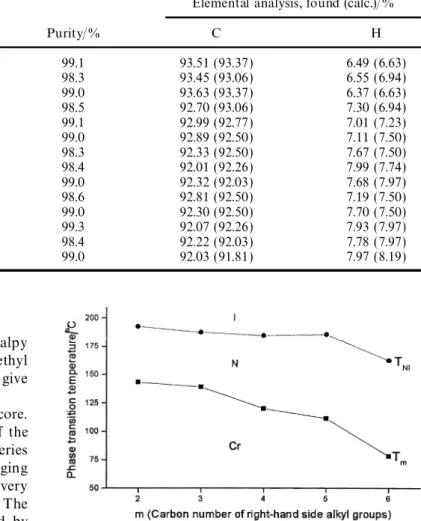
Figure 1. Melting (Tm,+ ) and isotropization (TN I,E )
temper-the lengths of temper-the terminal alkyl groups. From table 2,
atures of the lateral methyl substituted bistolanes as a we nd several interesting phase transition phenomena:
function of the carbon number (m) of the right-hand side alkyl group.
(i) On going from 7a to 7e, the terminal alkyl chain length on the right-hand side increases from methyl to hexyl. Figure 1 shows the plot of the phase transition temperatures versus the carbon number (m) of the right-hand alkyl group and demonstrate s that both melting and clearing temperatures decrease gradually with increasing carbon number of the terminal alkyl group. For the other two groups of compounds, i.e. 7f–7i and 7j–7n, the phase transition temperatures follow the same trend as that for compounds 7a–7e.
(ii) For the other groups of compounds that contain the same ethyl group on the right-hand side and a di erent alkyl group on the left, phase transition temperatures are plotted against the carbon number (n) of the left-hand alkyl group in gure 2.
Figure 2. Melting (Tm,+ ) and isotropization (TN I,E )
temper-This also demonstrate s that both melting and atures of the lateral methyl substituted bistolanes as a clearing temperatures decrease with increasing function of the carbon number (n) of the left-hand side
alkyl group. carbon number of the terminal alkyl group.
286 C. S. Hsuet al.
Table 2. Phase transition temperatures and enthalpy changes for bistolanes with a lateral methyl (7a–7r) or ethyl (8a–8j) substituent and for the unsubstituted compound (9a).
T/ßC (H/kJ mol) Compound R n m Cr N I 7a CH3 1 2 E 143.2 (30.8) E 192.4 (0.90) E 7b CH3 1 3 E 139.1 (27.8) E 187.4 (0.73) E 7c CH3 1 4 E 120.2 (22.3) E 184.6 (0.90) E 7d CH3 1 5 E 111.3 (22.5) E 185.7 (1.05) E 7e CH3 1 6 E 78.1 (21.2) E 162.7 (0.97) E 7f CH3 2 1 E 136.5 (29.8) E 189.6 (0.74) E 7g CH3 2 2 E 144.5 (26.4) E 186.4 (0.45) E 7h CH3 2 5 E 97.8 (18.9) E 179.9 (0.97) E 7i CH3 2 6 E 73.9 (21.6) E 166.5 (1.01) E 7j CH3 3 2 E 115.3 (22.5) E 190.0 (1.01) E 7k CH3 3 3 E 123.4 (21.0) E 200.4 (1.05) E 7l CH3 3 4 E 98.5 (22.0) E 191.2 (1.40) E 7m CH3 3 5 E 86.2 (15.1) E 182.8 (1.45) E 7n CH3 3 6 E 77.9 (15.7) E 170.0 (1.17) E 7o CH3 4 2 E 72.2 (17.5) E 177.4 (0.98) E 7p CH3 5 2 E 61.6 (14.8) E 173.5 (0.94) E 7q CH3 6 2 E 56.8 (14.4) E 160.1 (0.85) E 7r CH3 6 3 E 57.3 (13.7) E 168.7 (1.17) E 8a C2H5 2 3 E 73.9 (14.0) E 141.5 (0.94) E 8b C2H5 2 5 E 58.4 (11.9) E 124.6 (1.09) E 8c C2H5 3 2 E 37.2 (13.3) E 136.0 (0.83) E 8d C2H5 3 5 E 56.1 (12.5) E 134.9 (1.26) E 8e C2H5 3 6 E 56.9 (12.7) E 120.4 (1.08) E 8f C2H5 4 2 E 69.6 (27.0) E 123.8 (0.98) E 8g C2H5 4 3 E 35.9 (18.6) E 126.7 (1.25) E 8h C2H5 5 2 E 29.4 (13.6) E 128.0 (1.11) E 8i C2H5 6 2 E 31.0 (13.3) E 106.8 (0.75) E 8j C2H5 6 3 E 20.0 (14.7) E 107.8 (1.16) E 9a H 6 2 E 133.6 (15.1) E 191.1 (1.05) E
(iii) An asymmetric bistolane generally shows a much compounds 8a–8j that contain a lateral ethyl group. lower melting point (Tm) than the symmetric Compound 9a without a lateral alkyl group in the
one. For example, the Tm of compound 7k is middle phenyl ring is also included for comparison. All
123.4ßC. Keeping the total carbon number of the compounds exhibit an enantiotropi c nematic phase, both terminal alkyl groups unchanged except for and their phase transition temperatures follow the same breaking the symmetry leads to a much lower Tm. trend as that for the previously discussed series of
For instance, the Tmof compound 7o is reduced to compounds 7a–7r. The compounds with longer terminal
72.2ßC. However, if one side has too short an alkyl alkyl chains show much lower T
m values. This series of
chain, as in compound 7d, then the advantage is compounds reveals much lower melting and clearing not obvious. The Tm of compound 7d remains as temperatures than those of the laterally methyl
sub-high as 111.3ßC. stituted series of compounds. This means that the size
(iv) Since the lateral methyl group protrudes from the of the lateral alkyl group plays a very important role in 3-position of the middle phenyl ring, it is more
lowering the melting point. For example, the Tm of
favourable to have a longer alkyl chain on the
compound 9a is 133.6ßC and the Tm of compound 7q is
left-hand side than on the right. This is
demon-56.8ßC, while the Tm of compound 8i is as low as 31ß C.
strated in the cases of the 7h/7p and 7i/7q pairs.
This is because the lateral ethyl group increases the The Tm values of the 7p and 7q homologues are
width of the molecule and so decreases the packing 36 and 13ßC lower than those of the 7h and 7i
density of the LC molecules. As a result, the required homologues, respectively.
temperatures to melt the crystals and to clear the LC phase are much lower.
3.2. E ect of the size of the lateral alkyl group
Some homologues (e.g. compounds 8h–8j) exhibit par-Table 2 summarizes also the phase transition
tem-peratures and corresponding enthalpy changes for ticularly low melting points (<31ßC) and small enthalpies
(<15 kJ molÕ 1). Compound 8j has a surprisingly low in polymer dispersed LC displays, re ective displays
employing cholesteric liquid crystals and laser beam melting point. We had to cool nematic samples to
Õ 170ß C and run the di erential scanning calorimeter steering employing liquid crystal optically phased arrays. very slowly (at 1ßC minÕ 1) in order to resolve the melting
point peak. In the cooling process, the solidi cation The authors are grateful to the National Science temperature was found to be below Õ 50ßC. This large Council of the Republic of China for nancial support supercooling phenomenon is very useful for formulating of this work.
eutectic mixtures with a wide nematic range.
References
[1] Fergason, J. L., 1985,SID T ech. Dig., 16, 68.
3.3. Physical properties [2] Yang, D. K., Doane, J. W., Yaniv, Z., and Glasser, J., 1994, Appl. Phys. L ett., 64, 1905.
Two compounds, 7r and 8j, were selected for dielectric
[3] Dorchner, T. A., Friedman, L., Holz, M., anisotropy and birefringence measurements [15, 16].
Resler, D. P., Sharp, R. C., and Smith, I. W., 1996, in The bistolane compounds are non-polar so that the
Proceedings of IEEE International Symposium on dielectric anisotropy (De) measured was around 1. The Phase-array Systems and Technology, Boston, USA, birefringence of compound 7r was measured by a p. 119.
[4] Sutherland, R., Tondiglia, V. P., Natarajan, L. V., guest–host method [17]. The refractive indices of E63
Bunning, T. J., and Adams, W. W., 1994, Appl. Phys. (Merck UK) and three mixtures containing E63 and 10,
L ett., 64, 1074. 20 and 30 wt % of compound 7r were measured using a
[5] Wu, S. T., 1986, Phys. Rev. A, 30, 1270.
Jelly–Leitz refractometer. The extrapolated refractive [6] Wu, S. T., Margerum, J. D., Meng, B. H., indices of pure compound 7r are: ne=1.889, no=1.507, Dalton, L. R., Hsu, C. S., and Lung, S. H., 1992,Appl.
Phys. L ett., 61, 630. or Dn=0.382 at a wavelength of 589 nm and T=22ßC.
[7] Wu, S. T., Hsu, C. S., Chen, Y. N., and Wang, S. R., The birefringence dispersion of compound 8j was also
1992, Appl. Phys. L ett., 61, 2275. measured at room temperature (T=22ßC) using a
homo-[8] Wu, S. T., Hsu, C. S., Chen, Y. N., Wang, S. R., and geneous aligned cell. The birefringence (Dn) of 8j exceeds Lung, S. H., 1993,Opt. Eng., 32, 1792.
0.4 in the blue and green regions. As the wavelength [9] Juang, T. M, Chen, Y. N., Lung, S. H., Lu, Y. H., Hsu, C. S., and Wu, S. T., 1993, L iq. Cryst., 15, 529. increases, Dn decreases gradually and saturates in the
[10 ] Viney, C., Brown, D. J., Dannels, C. M., and near infrared region.
Twieg, R. J., 1993,L iq. Cryst., 13, 95.
[11 ] Xu, Y., Hu, Y., Chen, Q., and Wen, J., 1995,J. mater. Chem., 5, 219.
4. Conclusion [12 ] Twieg, R. J., Chu, V., Nguyen, C., Dannels, C. M., and Viney, C., 1996, L iq. Cryst., 20, 287.
Two series of laterally substituted bistolane LCs were
[13 ] Leroux, N., and Chien, L. C., 1996,L iq. Cryst., 21, 189. synthesized and characterized. All the bistolanes display
[14 ] Eglington, G., and McCrae, W., 1963, Advances in enantiotropi c nematic phases. The terminal alkyl groups
Organic Chemistry, Vol. 4, edited by R. A. Raogael, have a profound e ect on the phase transition temper- E. C. Taylor and H Wynberg (Interscience), Chap. 3, ature of the bistolanes; both melting and clearing tem- p. 225.
[15 ] Wu, S. T., Hsu, C. S., and Shyu, K. F., 1999, Appl. peratures decrease as the alkyl chain length increases.
Phys. L ett., 74, 344. The lateral methyl or ethyl group plays an important
[16 ] Wu, S. T., Hsu, C. S., and Chuang, Y. Y., 1999, Jpn. role in lowering the melting temperature. Some
homo-J. appl. Phys., 38, L286.
logues possess a high birefringence, low melting points [17 ] Khoo, I. C., and Wu, S. T., 1993,Optics and Nonlinear and high clearing temperatures, and small enthalpies of Optics of L iquid Crystals (World Scienti c), Chap. 2,
p. 174. fusion. These bistolane LCs could nd useful application s