Tunable single- and
dual-wavelength fiber
ring lasers using an
Er-Yb doped
waveguide amplifier
Peng-Chun Peng
National Chiao-Tung University Institute of Electro-Optical Engineering Hsinchu, Taiwan 300
Sien Chi
National Chiao-Tung University Institute of Electro-Optical Engineering Hsinchu, Taiwan 300
and
Yuan Ze University
Department of Electrical Engineering Chungli, Taiwan 320
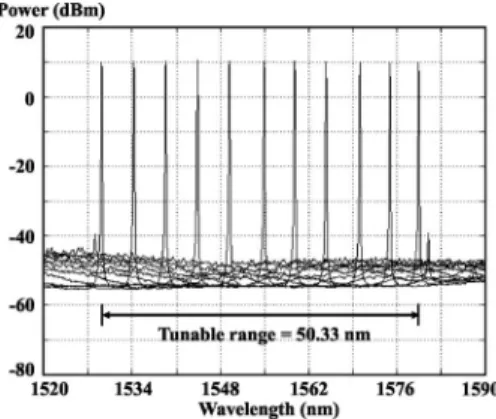
Abstract. We demonstrate tunable single- and dual-wavelength fiber ring lasers using a compact Er-Yb doped waveguide amplifier. In the single-wavelength operation, a signal-to-noise ratio higher than 63 dB and an output power maintaining around 11 dBm in the operation range over 50 nm (from 1529.1 to 1579.43 nm) are achieved. In the dual-wavelength operation, lasing wavelengths with wavelength separation from 51.73 to 6.2 nm are demon-strated. ©2005 Society of Photo-Optical Instrumentation Engineers. [DOI: 10.1117/1.1927487]
Subject terms: fiber ring laser; dual-wavelength laser; tunable laser; Er-Yb doped waveguide amplifier.
Paper L040316R received May 26, 2004; revised manuscript received Mar. 10, 2005; accepted for publication Apr. 13, 2005; appeared online Apr. 18, 2005; published online Jun. 20, 2005.
1 Introduction
Great efforts have been made on the development of the Er-Yb doped waveguide amplifier共EYDWA兲 using ion ex-change technology in planar glass integrated optics.1 This device might become a key component in wavelength-division-multiplexing共WDM兲 systems because of its com-pactness and excellent compatibility with optical fibers.2– 4 Recently, it has been proposed to combine the EYDWA and fiber Bragg gratings to realize single- and multi-wavelength laser sources.5,6
Tunable fiber lasers are applicable to loss measurements of optical components, optical sensing systems,7 and tun-able transmitters in WDM systems. In this paper, we ex-perimentally investigate and demonstrate tunable single-and dual-wavelength fiber ring lasers using a compact EYDWA. These fiber lasers are of small size, have a wide tunable range, and deliver high output power. The perfor-mances of tunable range, output power, and signal-to-noise ratio共SNR兲 are studied.
2 Experiments and Results
Figure 1 shows the experimental setup for the tunable single-wavelength fiber ring laser using a EYDWA. This configuration is constructed by a 1⫻2 optical coupler with coupling ratio 50:50 共C1兲, a fiber Fabry-Perot filter 共FFP filter兲, and a EYDWA. The EYDWA with a saturated output power 16.5 dBm is manufactured by Teem Photonics via a two-step ion exchange process. The FFP filter is an all-fiber device with a wide tunable range, low insertion loss, and low polarization dependence. For these reasons, we choose the FFP filter for the intracavity filter. The central wave-length of the FFP filter is tuned by the voltage applied to the piezoelectric transducer. The free spectral range 共FSR兲 and 3-dB bandwidth of the FFP filter are 51.73 nm and 0.53 nm. The insertion loss of the FFP filter is 1.9 dB. An optical spectrum analyzer 共OSA兲 and a power meter are used to measure the output spectra and powers of the fiber laser. Figure 2 shows the optical spectra of the tunable single-wavelength fiber laser while the various voltages are ap-plied on the FFP filter. The lasing wavelength tuning over 50 nm共from 1529.1 to 1579.43 nm兲 is observed. The out-put power is maintained around 11 dBm, and the SNR can be kept higher than 63 dB in a wide tuning range. The cavity length and longitudinal mode spacing are about 24 m and 8.3 MHz, respectively.
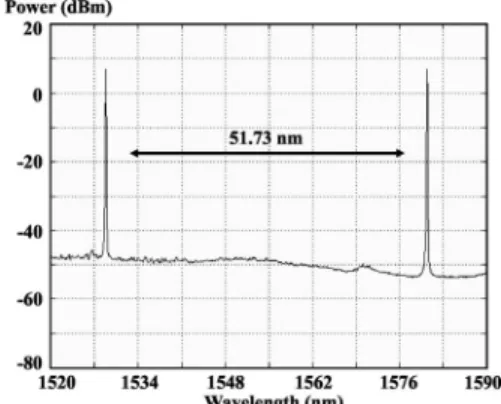
Because the FSR of the FFP filter is 51.73 nm, the dual-wavelength lasing is observed when the FFP filter is tuned to 1580.48 nm, as shown in Fig. 3. This result shows the
0091-3286/2005/$22.00 © 2005 SPIE
Fig. 1 Experimental setup of the tunable single-wavelength fiber laser. (C1: 1⫻2 coupler with coupling ratio 50:50, WDM: 980/ 1550-nm WDM coupler, FFP-filter: fiber Fabry-Perot filter, OSA: op-tical spectrum analyzer).
Fig. 2 Output spectra of the tunable single-wavelength fiber laser with various voltages applied on the FFP filter.
O
E
L
E
T
T
E
R
S
060507-1Optical Engineering June 2005/Vol. 44(6)
potentially tunable dual- or multi-wavelength lasing in the whole range of 1528.75 to 1580.48 nm. However, one of the major problems in the tunable dual- or multi-wavelength fiber laser using a EYDWA at room tempera-ture is correctly adjusting the cavity losses on each lasing wavelength.
We set up an experiment for the tunable dual-wavelength fiber laser using a EYDWA, as shown in Fig. 4. In our experiment, the tunable dual-wavelength fiber laser consists of a EYDWA, two FFP filters, two variable attenu-ators共VA兲, a 2⫻2 optical coupler 共C2兲, and a 1⫻2 optical coupler共C3兲. Due to the homogeneous gain broadening of the EYDWA, individual loss control for different wave-lengths is required. To solve this problem, the variable at-tenuators are used to adjust the losses at different lasing wavelengths. Furthermore, the variable attenuators can be adjusted to equalize the power level of the lasing wave-lengths. Figures 5共a兲–共d兲 shows the output spectra of the tunable dual-wavelength laser when the FFP filters are tuned at different wavelengths. The wavelength separations of the two lasing wavelengths are 42.5, 30, 18, and 6.2 nm, and the differences in loss between the two cavities are 1.6, 3.2, 3.7, and 2.1 dB, respectively. Moreover, we continu-ously monitor the two wavelengths for 10 min. Power variation of both lasing wavelengths is less than 1.5 dB.
These experiments show potentially multi-wavelength las-ing in the whole range of 1528.75 to 1580.48 nm.
3 Conclusion
In summary, tunable single- and dual-wavelength fiber ring lasers based on a compact EYDWA have been experimen-tally investigated and demonstrated. In the single-wavelength operation, a SNR higher than 63 dB and an output power maintaining around 11 dBm in the operation range over 50 nm共from 1529.1 to 1579.43 nm兲 have been achieved. In the dual-wavelength operation, the lasing wavelengths with wavelength separation from 51.73 to 6.2 nm are demonstrated. These results show that tunable lasers using EYDWA are potentially acceptable for WDM applications.
Acknowledgment
This work was supported in part by the MediaTek Fellow-ship and in part by the National Science Council of the Republic of China under Contract NSC 93-2752-E-009-009-PAE and Contract NSC 93-2215-E-155-005.
References
1. D. Barbier, J. M. P. Delavaux, and A. Kevorkian, ‘‘Yb/Er integrated optics amplifiers on phosphate glass in single and double pass con-figuration,’’ Optical Fiber Communication Conference ’95, San Di-ego, CA, postdeadline paper PD3-1共1995兲.
2. D. R. Zimmerman and L. H. Spiekman, ‘‘Amplifiers for the masses: EDFA, EDWA, and SOA amplets for metro and access applications,’’ J. Lightwave Technol. 22共1兲, 63–70 共2004兲.
3. S. Blaize, L. Bastard, C. Cassagnetes, and J. E. Broquin, ‘‘Multiwave-lengths DFB waveguide laser arrays in Yb-Er codoped phosphate glass substrate,’’ IEEE Photonics Technol. Lett. 15共4兲, 516–518 共2003兲.
4. K. C. Reichmann, P. P. Iannone, M. Birk, N. J. Frigo, D. Barbier, C. Cassagnettes, T. Garret, A. Verlucco, S. Perrier, and J. Philipsen, ‘‘An eight-wavelength 160-km transparent metro WDM ring network fea-turing cascaded erbium-doped waveguide amplifiers,’’ IEEE Photon-ics Technol. Lett. 13共10兲, 1130–1132 共2001兲.
5. G. Sorbello, S. Taccheo, P. Laporta, O. Svelto, E. Cianci, V. Foglietti, S. Jiang, and N. Peyghambarian, ‘‘Singlemode Er:Yb waveguide laser array at 1.5m,’’ Electron. Lett. 37共16兲, 1014–1015 共2001兲. 6. G. Jose, S. Taccheo, G. Sorbello, D. Migliorati, V. Foglietti, E. Cianci,
S. Jiang, N. Peyghambarian, and P. Laporta, ‘‘Multiwavelength wave-guide laser array in C-band,’’ Electron. Lett. 38共21兲, 1275–1276 共2002兲.
7. P. C. Peng, H. Y. Tseng, and S. Chi, ‘‘A novel fiber-laser-based sensor network with self-healing function,’’ IEEE Photonics Technol. Lett. 15共2兲, 275–277 共2003兲.
Fig. 3 Output spectrum of the fiber laser when the central wave-length of the FFP filter is tuned to 1580.48 nm.
Fig. 4 Experimental setup of the tunable dual-wavelength fiber la-ser. (C2: 2⫻2 coupler with coupling ratio 50:50, C3: 1⫻2 coupler with coupling ratio 50:50, VA: variable attenuator).
Fig. 5 Output spectra of the dual-wavelength fiber laser with vari-ous wavelength separations: (a) 42.5 nm, (b) 30 nm, (c) 18 nm, and (d) 6.2 nm.
O
E
L
E
T
T
E
R
S
Peng and Chi: Tunable single- and dual-wavelength fiber ring lasers . . .
060507-2
Optical Engineering June 2005/Vol. 44(6)