
A Novel Handoff Algorithm Of Wireless Communication For Multi-tier IP-based Network
16
0
0
全文
(2) frequency has been decreased and 8% of. connecting. using rates of resource has been increased.. network anywhere, the multi-tier IP-based. Keyword: handoff, multi-tier IP-based. network that presented by ITU is imperative.. network, multi-tier, mobile host (MH) ,. The multi-tier IP-based network is the. new-tier, old-tier. combination system of covering different. 1. Introduction. region and supporting different transmitted. In the recent year, the number of mobile users has increased much faster than anticipated. According to the Universal Mobile Telecommunication System (UMTS) Forum, there will be around 1800 million mobile users worldwide in the year 2010. [1] Under the situation that limited resources and. more. and. more. users,. handoff. algorithm becomes very important for mobile users remove seamlessly of wireless. There are many communication systems brought up to provide mobile users with the best services. For example, cellular IP is for. communication. speed of network. In this paper, a handoff algorithm is addressed for multi-tier IP-based network. We hope to decrease the time of handoff, increase the use of resource and make users always in the best state. The paper is structured in following statement. In section 2, some background information will be introduced. In section 3, the algorithm will be described by using flow-chat. In section 4, simulations and. communication.. suitable. wireless. indoor. or. pedestrian. environment; Mobile IP is suitable for. analysis. will. be. revealed,. and. the. conclusion is listed in section 5.. 2. Background Mobile IP The Internet Engineering Task Force. satellites. (IETF) was formed at Columbia. communication system is suitable for boat. University. John Ioannidis and Gerald. or plane environment. To aid users in. Maguire Jr. originally organize the. vehicle. environment. and.
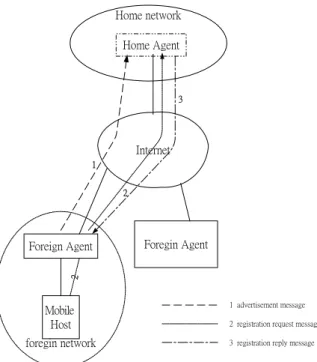
(3) team and proposed Mobile IP, which. If a MH were in home. defined two substantive, home agent. network, it would register at home. (HA) and foreign agent (FA), to. agent. If this MH came to a foreign. manage MHs in the internet in June of. network,. 1992. [2]. advertisement message to HA to. Proper noun [3]. FA. would. send. an. check the existence of MH. If the. i. Home agent (HA) : A base. MH existed in HA, MH would. station (BS) that there are data. send a registration request message. for register for the MH in his. to the HA through the FA. The HA. database.. will reply a registration reply. ii. Home network : The network which includes the HA is call. message to the FA. Figure 1 shows the register in mobile IP system. Home network. home network.. Home Agent. iii. Home address : To show the 3. place of the MH and to be Internet. distributed by the HA.. 1. iv. Foreign agent (FA) : A BS which is not HA.. address shows the temporary MH. distributed by the FA. Register [4][5][6][7]. 2 registration request message. foregin network. vi. Care-of address : A care-of. the. 1 advertisement message. Mobile Host. which includes the FA.. of. Foregin Agent. 2. Foreign Agent. v. Foreign network:The network. place. 2. and. is. 3 registration reply message. Figure 1: register in Mobile IP. Data transmission If data packets were send to MH that is in home network, the packets would transmit it to home.
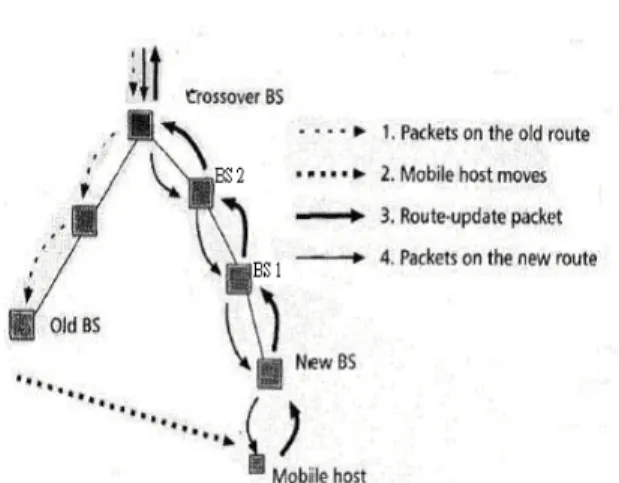
(4) address directly. If data packets. BS 1,and crossover BS keep record of. were send to MH that is in foreign. MH is in BS 2. Then, the crossover BS. network,. would. notifies the record of about the MH has. transmit it to HA first. HA. changed the position. Data packets will. transmits the packets to FA by the. be transmitted to BS 2, after crossover. care-of address, and then the FA. BS keep the record of the MH is in BS. transmits the packets to the MH.. 2.. the. packets. If MH had data to transmit for the other MH, they would transmit by the home address directly. Cellular IP Mobile IP is not suitable for fast mobility, because MH must register continuously to a possible long-distanced HA continuously after a local migration. Cellular IP provides fast and smooth handoff for local migration. Figure 2 shows the handoff in cellular IP. MH needs to request handoff when MH moves from old BS to new BS. It will send routed-updatemessage to the crossover BS and without registration to HA again. Then, BS 1 keep the record of MH is in new BS, BS 2 keep the record of MH is in. Figure 2:data transaction of Cellular IP. Before handoff succeeded, if data packets were sent to MH, the packets would be send to old BS. The data packets would not lost, because of the cell overlaps. MH still can receive the data packets from the old cell. [8][9][10][11]. Satellite system [12] The. commercial. use. of. satellites for mobile communications began with the COMSAT/MARISAT.
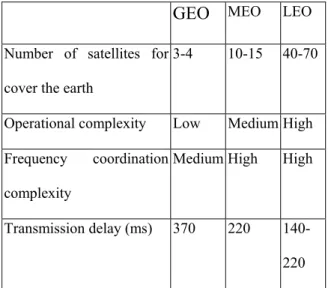
(5) system in1976. Satellites are sorted to. The first generation satellite. different class. They are geostationary. communication system began from. orbit (GEO) and medium earth orbit. 1998 because there are two large. (MEO) and low earth orbit (LEO).. improvements. One is the minimal of. Table 1 shows the comparison of them.. terminal size and the other one is frequency reused. Table 2 shows the. GEO Number of satellites for 3-4. MEO. LEO. several. 10-15. 40-70. communication system in the first. cover the earth. of. satellite. generation.. Operational complexity Frequency. systems. Low. Medium High. coordination Medium High. High. complexity. Parameter Iridium Globalstar ICO. Aires. Number of 66. 48. 10. 46. 8. 5. 5 in each. satellite. Transmission delay (ms). 370. 220. 140220. Satellites per. Table 1: Comparison of orbits for satellite. 11. inclined. orbit. orbit. plane. communication system. The. system. 11. should. be. equatorial. without being delayed because realtime data is very important for the third generation ( 3G ). wireless. orbit Voice. bit 4.8. 1-9. 4.8. 2.4. rate Multiple. TDMA- CDMA-. TDMA- CDMA-. access. FDMA FDMA. FDMA FDMA. satellite is very expensive. In order to. Nominal. 1100. 4500. cover the earth, numbers of LEO. capacity. satellite is necessary. How to keep the. per. communication. However producing. balance?. Thus. many. satellite. in. 2400. ?. satellite Table 2:several system of satellite communication. communication systems were proposed.. system.
(6) Multi-tier. Users of indoor or pedestrian or in. The. International. Telecommunication. (ITU). micro-cell, and they will use the. proposes the concept of multi-tier, to. cellular IP system and the speed of. combine all manners of wireless. data transmission is in 2MB/s. Users of. communication and provide a standard. vehicle or in high-speed users are in. in. wireless. macro-cell, and they will use the. communication. The multi-tier will be. Mobile IP system and the speed of data. used in third generation wireless. transmission is in 384KB/s. Users of. communication.. boat or plane or in higher speed are in. different. systems. Unit. low-speed users are in pico-cell or. of. A multi-tier cell contains four. satellite cell, and they will use the. stratum and bigger cell covers smaller. satellite communication system and the. cell. (See figure 3) There is a connect. speed of data transmission is in. switch subsystem (CSS) in each cell.. 4.8KB/s.. CSS is to play the role of bridge, to connect with every cell. It means the switch of data packets and data of recognition are delivered by CSS.. 3. Handoff Algorithm Of Multitier To classify stratum According to the state of MHs, MHs be divided into the four kinds of cell. Table 3 shows the parameter of a multitier cell.. Figure 3: Framework of multi-tier network.
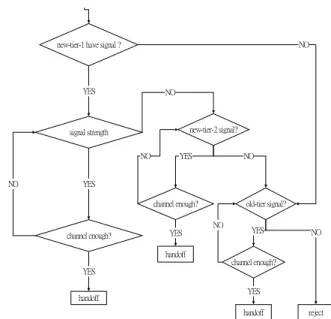
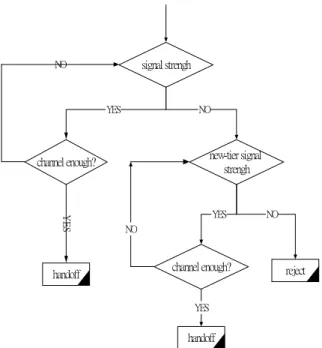
(7) Cell. Speed of data Radius transmission. of. MH, the stratum should be changed.. speed. The algorithm will be active working,. of Range. cover. it’s. (km/hr) Pico-cell <5M/S. 5M. <5. Micro-. 1KM. 5 ~30. <2M/S. the workable process of algorithm is called new-tier priority algorithm. If the stratum won’t be changed, it work. cell Macro-. <384KB/S. 35KM. algorithm, which is called old-tier. 30 ~200. cell. priority algorithm. Combining the two. Satellite- <4.8KB/S. 100~500KM >200. algorithms to one, that is our multi-tier. cell. handoff algorithm.. Table 3: to classify stratum. Algorithm MH will request a handoff, as it will go out the range of BS’s signal. In this paper,. mobile. controlled. handoff. (MCHO)[13] and soft-handoff are the main framework of research. Traditional handoff. algorithm. is. modified. to. achieve the request of handoff. In this paper, when a mobile host (MH) requests a handoff, MH is allotted different stratum dynamically according to the speed of MH and the request of resource. The algorithm will determine to change the stratum or not when the MH requests the handoff. If the speed or resources isn’t suitable the. i.. New-tier Priority Algorithm MH checks the signal from the newtier BSs when it determines to change the stratum. To permute the strength of signal from new-tier-1’s BSs from the strong stage to the weak stage, and then to ask for resource from the strongest signal BS. It will handoff, if the BS has enough resource for the MH. If not, MH will ask resource for the second stronger signal BS. Moving in circles until handoff succeeds. If all of BSs have not enough resource, MH checks the signal from new-tier-2’s BS from the strong stage to the weak stage. New-tier-2 means that higher than new-.
(8) tier-1. Example one, Pico-cell is old-tier of. the MH. So MH just has new-tier-2. The. the MH A. New-tier-1 is micro-cell of MH. flow-chart of algorithm shows as figure 4.. A, if MH A increase the speed. And then, new-tier-1 have signal ?. new-tier-2 is macro-cell of MH A. Example two; old-tier is macro-cell of the. YES. MH B. New-tier-1 is micro-cell of MH B,. signal strength. NO. NO. new-tier-2 signal? NO. if MH decreases the speed. And then, new-. NO. YES. NO. YES channel enough?. tier-2 is Pico-cell of MH B. Example three;. handoff. old-tier is macro-cell of the MH C. New-. new-tier-2 of MH C. MH asks for resource from new-tier-2’s BS, when the new-tier-1 doesn’t satisfy the MH. Moving in the same circle in the new-tier-1, until handoff succeeds. If all BS of new-tier-2 didn’t have enough resource for MH, MH would request resource from old-tier’s BS and move the same circle in the new-tier-1, until handoff succeeds. If all BS of old-tier didn’t have enough resource, the request of handoff from the MH would be rejected. It just has four stratums in each multi-tier cell. It will not be suitable for the MH, if we across too much stratum for. YES. NO. channel enough?. YES YES. handoff. tier-1 is satellite cell of MH C, if MH C increases the speed. And then, there is no. NO. YES. channel enough?. old-tier signal?. handoff. reject. Figure 4: new-tier priority algorithm. ii. Old-tier Priority Algorithm It. works. the. old-tier. priority. algorithm and checks the signal strength from the same tier when it doesn’t to change stratum. To permute the signal strength of BSs from the strong stage to the weak stage, and then ask for the resource from the strongest signal BS. It will handoff if the BS has enough resource. If not, MH asks for resource from the second stronger signal BS. Moving in circles until handoff succeeds. If all of BSs have not enough resource, MH checks the signal from newtier’s BS from the strong stage to the weak.
(9) stage. New-tier means that speed of MH A. There are some assumptions for. is closer to old-tier based on the range of. simulation of algorithm. The first, the. speed. For example, speed of MH A is in 32. cell is infinite. The maximum cell is. km/hr. Macro-cell is old-tier of the MH A.. satellite cell, which deliver data by. Micro-cell is New-tier of MH A. MH. satellite. The assumption is reasonable. requests resource from new-tier’s BS, when. because only three GEO satellite can. the old-tier can’t satisfy the MH. Moving. cover all the earth. The second, each. the same circle in the new-tier, until handoff. cell has 5M resources. It means that a. succeeded. If all BS of new-tier didn’t have. multi-tier cell has 20M resources. Table. enough resource for MH, the request of. 4 shows that each cell transports data in. handoff from the MH would be rejected.. a limited speed and limited cover range.. The reason is the same as above. The flow-. According to pico-cell, each cell is. chart of algorithm shows as figure 5.. assumed that each cell has 5M resources. The third, MH requests a handoff when it’s moving distance more than the cell’s. signal strengh. NO. diameter. In face, MH can move in any NO. YES. passage. Diameter is an average of new-tier signal strengh. channel enough?. YES. handoff. YES. move trajectory. The fourth, the top of speed is in 1000km/hr, because the. NO. NO. channel enough?. YES. handoff. reject. speed. of. an. aircraft. is. between. 1000km/hr and 2500km/hr. It is too large of the range of specimen, if the. Figure 5 :old-tier priority algorithm. range of speed is between 0km/hr and 2500km/hr. The fifth, the number of 4.. Simulation Simulate Circumstances. user in micro and macro-cell are more.
(10) than the number of users in pico-cell. in micro-cell if S [i] lower than 30km/hr.. and satellite cell. So MHs’s speeds in. And i moves in the speed S [i] during. macro and micro-cell have larger weight.. time T [i]. After the time T [i], the MH. Then, the rate of user in pico-cell is. moves on distance D [i]. MH ask for a. 15% and in micro-cell is 37.5% and in. handoff when D [i] over the distance of. macro-cell is 42.5% and in satellite cell. diameter and add one to handoff. is 5%. The simulation will more. variable H. MH i get a new time T [i]’. conformable to fact the reality.. after T [i]. Moving in circles for one. Cell. Top. of Distance Range of Rate of user. transport. for. speed. speed. handoff. (km/hr). Pico-cell 5M/S. 10M. <5. 15%. Micro-. 2KM. 5 ~30. 37.5%. 2M/S. hour and to record the times of handoff of forty MHs. Time continued to count two, three …until ten hours and record them. There are some differences between the two programs for handoff. cell Macro-. 384KB/S 70KM. 30~200. 42.5%. cell. simulation. One of the two programs is for the experimentation and the other is. Satellite- 4.8KB/S. 200KM. cell. 200. 5%. for the comparison. After handoff, MH i. ~1000 Table 4: compares of multi-tier. We have four programs in C++ to. change in comparison. Working the two. I. Simulation for handoff There are forty MHs in multi-tier network. The system gives random time T [i] and random speed S [i] for each MH’s. stratum. [i]’ in experimentation. After the first stratum allocation, the stratum will not. simulate the algorithms.. MH.. will change its stratum in new speed S. is. allocated. according S [i]. It means that MH i will. programs ten times. The number will be deleted when it has much difference with the others. The average of the rest numbers is the result..
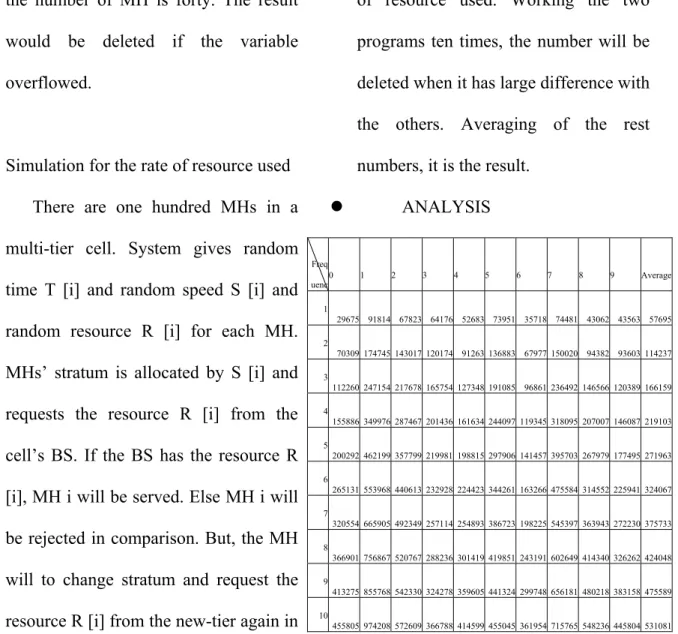
(11) Why the number of MH is forty?. show the used of resources, will be. If the number of the MH is large than. added R [i]. Until one hundred MHs. forty, the variable of times accumulation. achieve the request of resource and then. in handoff will overflow. During ten. recording the rate of resource used.. times of working program it just has. Increasing the number of MH to. two times overflowed in 40 MHs. So,. 200,300…1000 and then record its rate. the number of MH is forty. The result. of resource used. Working the two. would be deleted if the variable. programs ten times, the number will be. overflowed.. deleted when it has large difference with the others. Averaging of the rest. II. Simulation for the rate of resource used. numbers, it is the result.. There are one hundred MHs in a. ANALYSIS. multi-tier cell. System gives random Freq. time T [i] and random speed S [i] and. uenc. 0. 1. 2. 3. 4. 5. 6. 7. 8. 9. Average. 1. random resource R [i] for each MH.. 29675 91814 67823 64176 52683 73951 35718 74481 43062 43563 57695 2 70309 174745 143017 120174 91263 136883 67977 150020 94382 93603 114237. MHs’ stratum is allocated by S [i] and. 3 112260 247154 217678 165754 127348 191085 96861 236492 146566 120389 166159. requests the resource R [i] from the cell’s BS. If the BS has the resource R. 4 155886 349976 287467 201436 161634 244097 119345 318095 207007 146087 219103 5 200292 462199 357799 219981 198815 297906 141457 395703 267979 177495 271963 6 265131 553968 440613 232928 224423 344261 163266 475584 314552 225941 324067. [i], MH i will be served. Else MH i will 7. be rejected in comparison. But, the MH. 320554 665905 492349 257114 254893 386723 198225 545397 363943 272230 375733 8 366901 756867 520767 288236 301419 419851 243191 602649 414340 326262 424048. will to change stratum and request the resource R [i] from the new-tier again in. 9 413275 855768 542330 324278 359605 441324 299748 656181 480218 383158 475589 10 455805 974208 572609 366788 414599 455045 361954 715765 548236 445804 531081. Table 5: Frequency of handoff in experimentation. experimentation, according to the oldtier priority algorithm. When handoff succeeded, the variable u[i], which is.
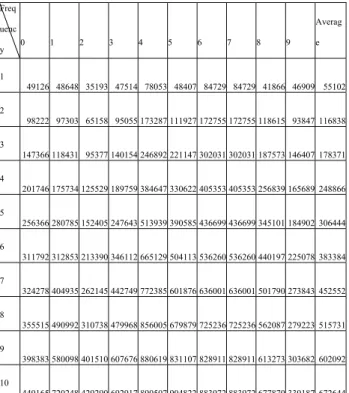
(12) Freq Averag. uenc y. 0. 1. 2. 3. 4. 5. 6. 7. 8. 9. e. random. time. in. experimentation. and. comparison. It can be found that the time is. 1 49126 48648 35193 47514 78053 48407 84729 84729 41866 46909 55102 2. longer than one or two hours. It means that. 98222 97303 65158 95055 173287 111927 172755 172755 118615 93847 116838. the MH in the best state in the first random. 3 147366 118431 95377 140154 246892 221147 302031 302031 187573 146407 178371 4 201746 175734 125529 189759 384647 330622 405353 405353 256839 165689 248866 5 256366 280785 152405 247643 513939 390585 436699 436699 345101 184902 306444 6 311792 312853 213390 346112 665129 504113 536260 536260 440197 225078 383384. time in comparison, because they are distributed in the best state in the first time. According to the table 5 and table 6. 7 324278 404935 262145 442749 772385 601876 636001 636001 501790 273843 452552 8. the new-tier priority algorithm throughput. 355515 490992 310738 479968 856005 679879 725236 725236 562087 279223 515731. performance is 11.99%, it is better than the. 9 398383 580098 401510 607676 880619 831107 828911 828911 613273 303682 602092 10 449165 720248 429290 692917 890507 904822 883972 883972 677870 339187 672644. traditional algorithm. It means that the new-. Table 6:Frequency of handoff in comparison. tier priority algorithm can reduce 11.99. Frequency. Handoff 800000 600000 400000 200000 0. times for per 100 handoffs. Figure 6 shows o_handoff n_handoff. comparison. The X axle shows the times of. 1 2 3 4 5 6 7 8 9 1 Time(HR). handoff and Y axle shows the hours for. Figure 6:diagram of curves for comparatively for handoff. Table 5 shows the number of handoff in experimentation. Table 6 shows the number of handoff in comparison. To permute the data in table 5 and table 6 increasingly, it can be find that the result in the first two hours in comparison is better than. in. experimentation,. a diagram of curves of an average for. sometimes.. Observing the time of MHs in the first. handoff..
(13) MH. Rate. #Rate 0 Rate 1 2. Averag. Table 7 shows the rate of use in. Rate 3 Rate 4 Rate 5 Rate 6 Rate 7 Rate 8 Rate 9 e. 100 98.33 94.89 98.42 96.27 93.65 96.61 98.055 98.87 97.865 98.005 96.979 200 99.68 98.67 98.75 99.52 99.595 98.6. 98.405 99.4. 99.37 98.87 98.993. 300 99.68 99.74 99.61 99.67 99.855 99.175 99.565 99.845 99.45 99.62 99.588 400 99.78 99.74 99.78 99.88 99.9. 99.805 99.685 99.985 99.72 99.77 99.773. 500 99.95 99.88 99.90 99.88 99.92 99.805 99.895 99.985 99.76 99.85 99.871 600 99.97 99.88 99.90 99.88 99.945 99.895 99.905 99.985 99.76 99.93 99.899 700 99.97 99.89 99.90 99.88 99.965 99.905 99.905 99.985 99.76 99.965 99.908 800 99.98 99.89 99.93 99.88 99.965 99.905 99.96 99.985 99.845 99.975 99.932 900 99.98 99.89 99.93 99.88 99.965 99.91 99.96 99.985 99.94 99.995 99.947 100099.98 99.89 99.93 99.92 99.965 99.93 99.975 99.985 99.94 99.995 99.951. Table 7:rate of resource used in experiment MH#Rate 0 Rate 1 Rate 2 Rate 3 Rate 4 Rate 5 Rate 6 Rate 7 Rate 8 Rate9 Average 100 86.88566.62581.13 74.10569.41 72.47598.36585.71568.89 54.83 73.245 200 88.94582.51581.41 97.33574.65 72.47598.61 88.24 69.08 72.54 78.732. resource in experiment and Table 8 shows in comparison. The rate doesn’t change as the MH’s number are between 400 to 900 in the fourth executing of program (rate 3) in comparison. It is special condition, so we delete the result. The result that the eighth execute of program (rate 7) in comparison and the fourth execute of program (rate 3) in experiment, we have deleted them in the same reason. The rate in the seventh execute of program (rate 6) for one hundred. 300 89.48 88.06587.84599.24575.81594.83598.65 89.02572.33583.94585.168 400 89.48 91.91587.91 99.42 92.50595.66 99.03 89.02593.76 96.75592.126 500 94.78 91.91597.65599.46592.58597.11 99.18592.34598.36 97.46595.277 600 98.95 94.89599.11 99.46592.6. 97.11 99.5. 700 98.96 98.52 99.11 99.47592.6. 97.11 99.59598.81598.61 99.54597.909. 900 99.08598.55 99.15599.47595.60597.96 99.70599.47 98.76 99.77 98.544 1000 99.08598.55 99.15599.47596.79597.96 99.74 99.59598.76 99.77 98.709. Table 8: rate of resource used in comparison used rate of resource. 100. N_RATE O_RATE. 50. 90 0. 70 0. 50 0. 0 30 0. delete the result. According to the table 7 and table 8 it can be found that the new algorithm throughput performance is 8% better than the old algorithm. It means that the new. 150. 10 0. experiment. It is special condition, so we. 95.07598.41 98.83596.873. 800 99.08598.52 99.15599.47595.60597.11 99.61599.29598.61 99.58598.371. rate (%). MHs is too large than any other results in. algorithm increase the use of resources. Figure 7 shows a diagram of curves of an average for comparison. The X axle shows. MH#. Figure 7: diagram of curves in comparatively for the rates of used of resource. the number of MHs and Y axle shows the rates of resources. When the numbers of MH over seven hundred, there is only little.
(14) improvement of the algorithm. The rate of. for wireless communication. The algorithm. used resources get to 98% in comparison.. is divided into new-tier priority and old-tier. But it promotes 99% in experiment. No. priority. matter how much the number of MH, it can. Making the programs for simulating and. keep in high rate of used resource in our. make sure that the algorithm is workable.. algorithm. But it will have high rate of used. The. resource in comparative unless there are. decreasing of 11.99% frequency in handoff. over six hundred of MHs.. and increasing 8% using rates of resource. handoff. results. of. algorithm. simulation. two. show. parts.. the. In the future, resource reservation 5.. CONCLUSION. protocol (RSVP) will be used in multi-tier.. Sometimes, the MHs changes state. Dynamical resource disposed for multi-tier. when MH ask for a handoff. For example,. is a very good issue. They will heighten the. the increasing of speed in MH and the. quality of service (QoS) for multi-tier IP-. stratum is no more suitable for the MH. In. based network.. this paper, the MH can change the stratum anywhere and any time to suitable for the MHs’ speed in multi-tier IP-based network. It will reduce times of handoff. Sometimes, MH will be rejected because it does not have enough of resource. It can change the stratum to get resources. So the rate of used resource will increase, too. For this reason, the QoS is raised. In this paper, a handoff algorithm of Multi-tier IP-based network is brought up.
(15) [5] Robert L. Geiger, James D. Solomon,. Reference. Kenneth J. Crisler, Motorola Inc,. [1] Martin Haardt and Werner Mohr, Siemens. Ag,. Solution. for. Wireless Modes. Complete. “Wireless Network Extension Using. Third-Generation. Mobile IP”, Nov., 1997 Page(s): 63-. “The. Communications: on. Air,. Strategy”,. One. IEEE. 68. Two. [6] Richard R. Parry, “Mobility and the. Winning. Internet”,. personal. IEEE. Potentials. 1998. Page(s): 8-10. Communications, December 2000,. [7] Garg, V.K.; Tejwani, H., “Mobile. Page(s):18-24. IP. [2] Lionel Robert, Niki Pissinou, Sam. for. 3G. wireless. networks”,. Makki, “Third Generation Wireless. Personal Wireless Communications,. Network: The Integration of GSM. 2000 IEEE International Conference. and. on, 2000, Page(s): 240 -244. Mobile. IP”,. Wireless. [8] Campbell, A.T.; Gomez, J.; Kim, S.;. Communications and Networking Confernce,. 2000.. WCNC.. IEEE,. 2000. Valko,. 2000. Turanyi,. cellular. [3] Mobile IP by Internet research lab. at Taiwan. Chieh-Yih Z.R.. Wan;. ”Design,. Implementation, and Evaluation of. Page(s): 1291 -1296 vol.3. Nation. A.G.;. IP,”. IEEE. Personal. Communications, Volume: 7 Issue: 4,. University. Aug.2000 Page(s): 42-49.. http://mmnet1.ee.ntu.edu.tw/mobileI. [9] Campbell, A.T.; Gomez, J.; Valko,. P/mip.htm. A.G. “An Overview of Cellular IP,”. [4] Charles E. Perkins, Sun Microsystem, “Mobile IP”, IEEE Communication. Wireless. Magazine, May, 1997 Page(s): 84-99.. Networking. 15. Communications Conference,. and 1999..
(16) WCNC.1999 IEEE, 1999 Page(s): 606-610 vol.2. [10] Andras G.Valko.” Cellular IP: A New Approach to Internet Host Mobility”. [11] RAmjee, R.; La Porta, T.F.; Salgarelli, L.; Thuel, S.; Varadhan, K.; Li, L.”IP-based Access Network Infrastructure for Next-generation wireless. Data. Networks,”. IEEE. Personal Communications, Volume: 7 Issue: 4, Aug. 2000 Page(s): 34-41. [12] J.V. EVANS, ”Satellite Systems for Personal. Communications”,. proceedings of the IEEE, VOL.86, NO.7, July 1998 [13] Personal Communication System Group at Department Computer Science & Information Engineer National Chiao Tung Univercity, Hsinchu, Taiwan, Yi-Bing Lin, “Mobile Telephone & Network Management”, Aug. 1999. 16.
(17)
數據

+6

相關文件
Huang, A nonmonotone smoothing-type algorithm for solv- ing a system of equalities and inequalities, Journal of Computational and Applied Mathematics, vol. Hao, A new
In this paper, we develop a novel volumetric stretch energy minimization algorithm for volume-preserving parameterizations of simply connected 3-manifolds with a single boundary
Gu, Smoothing Newton algorithm based on a regularized one-parametric class of smoothing functions for generalized complementarity problems over symmetric cones, Journal of
Wi-Fi Supported Network Environment and Cloud-based Technology to Enhance Collaborative Learning.. Centre for Learning Sciences and Technologies (CLST) The Chinese University of
Overview of NGN Based on Softswitch Network Architectures of Softswitch- Involved Wireless Networks.. A Typical Call Scenario in Softswitch- Involved
[23] Tiantong You, Hossam Hassanein and Chi-Hsiang Yeh, “PIDC - Towards an Ideal MAC Protocol for Multi-hop Wireless LANs,” Proceedings of the IEEE International Conference
Kuo, R.J., Chen, C.H., Hwang, Y.C., 2001, “An intelligent stock trading decision support system through integration of genetic algorithm based fuzzy neural network and
The GCA scheduling algorithm employs task prioritizing technique based on CA algorithm and introduces a new processor selection scheme by considering heterogeneous communication
![[102-2] WNFA lab4 - A Tiny Wireless Sensor Network](data:image/gif;base64,R0lGODlhAQABAIAAAP///wAAACH5BAEAAAAALAAAAAABAAEAAAICRAEAOw==)