行政院國家科學委員會專題研究計畫成果報告
以UV/O
3氧化洗滌法處理排氣中揮發性有機物之研究(III)
Scrubbing and UV/O3 oxidation of volatile organic compounds (VOCs) in
air streams (III)
計畫編號:NSC 94-2211-E-110-011- 執行期限:94年8月1日至95年7月31日 主持人:周明顯(國立中山大學環境工程研究所) 研究助理:張耿崚(博士班研究生)
中文摘要
本研究以10 L液相批次反應器探討 2,2,3,3-tetra-fluoro-propanol (TFP)為UV/O3氧 化之反應行為,反應條件為初始TFP濃度 772-887 mg/L,pH分酸性、鹼性及未控制,溫 度23-60 oC,使用185及254 nm之UV光。實驗 結果顯示UV光波長對反應速率之影響不顯 著;臭氧充分供應時,TFP分解速率與其濃度 無關(零次反應);高溫對反應速率之影響不顯 著;鹼性狀況利於TFP分解。 關鍵詞:UV/Ozone、揮發性有機物(VOC)、空 氣污染防治、2,2,3,3-tetra-fluoro-propanol (TFP)Abstract
2,2,3,3-tetra-fluoro-propanol (TFP) has been extensively used in CD-R and DVD-R manufacture and a large amount of wastewater containing the chemical is being discharged. This investigation evaluates the feasibility and effectiveness of the use of UV, O3 and UV/O3 todegrade aqueous TFP. TFP oxidation tests were performed with initial TFP concentrations of 772-887 mg/L with various solution pH values (acidic, alkaline, uncontrolled), solution temperatures (26, 37, 48 and 60 oC), and UV wavelengths (254nm and 185nm). Results demonstrated that alkaline conditions favor the TFP degradation and increase the mass of TFP decomposition per unit mass of ozone
consumption, in both UV254nm/O3 and
UV185nm/O3 processes. There was no
significant difference in the rate of TFP degradation when using either UV254nm or
UV185nm. TFP exhibited zero-order degradation
kinetics when sufficient ozone was supplied. A higher oxidation temperature was found to be no help for the UV/O3 oxidation of TFP in the tested
concentration and temperature ranges.
Keywords: UV/Ozone; UV/O3;
2,2,3,3-tetra-fluoro-propanol; air pollution control
Introduction
The CD-ROM (Compact Disc-Read Only Memory) is an excellent storage medium and it develops very rapidly due to its long life, large capacity, good portability and relatively low cost. CD-R (Compact Disc-Recordable) and DVD-R (Digital Versatile Disc-Recordable) are
especially popular for their ability to write new data to the disc. In the manufacture of CD-R and DVD-R, some organic dyes are coated on the substrate as a recording layer. The
recording layer would absorb infra red and cause a surface distortion which results a hollow-type ‘defect’ for data coding. Spin coating of the organic dyes for the manufacture of CD-R and DVD-R is accompanied with a discharge of solvents for the dyes [1-3].
2, 2, 3, 3-tetra-fluoro-propanol (TFP) has been extensively utilized in CD-R and DVD-R manufacture owing to its ability to dissolve the
organic dyes. A large amount of
TFP-containing wastewater is being discharged from the spin coating process. Accordingly, handling the wastewater economically and effectively is a significant issue for the environmental protection.
Recent researches have suggested some processes for treating TFP-containing wastewater, including O3/H2O2 [4], Fenton [5], Fered-Fenton
[6], pervaporation with a hybrid process [7], supercritical fluid fractionation (SFF) [8], reverse osmosis (RO) [9] and air stripping [9]. However, to the knowledge of the authors, the degradation of aqueous TFP by UV254nm/O3 or
UV185nm/O3 has not been investigated.
The process, consisting of a combination of UV and ozone, is based on the production of highly reactive free radicals, mainly hydroxyl radicals, in aqueous solution. The hydroxyl radicals can then react non-selectively with aqueous organic pollutants at high rates. A lot of applications have recently been reported [10-24]. In recent years, advances in
ozone-generating technologies have made the application of ozone in wastewater treatment much more economic and effective [25]. In this work, three approaches (UV185nm,
UV254nm/O3 and UV185nm/O3) to the degradation
of aqueous TFP were compared and effects of pH and temperature investigated.
Experimental
Chemicals
99.7% TFP was obtained from Seedchem Co., Ltd. Potassium indigo trisulfonate, used to measure aqueous ozone concentration, was obtained from Acros Organics, Inc. All of these chemicals were analytical grade and used
without further purification.
Equipment
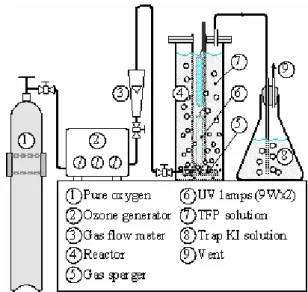
Figure 1 schematically depicts the experimental system employed in this investigation. The reactor was made entirely of acrylic plastic with an effective volume of 10 liters. All
experimental solutions were prepared with deionized water to prevent any interference from impurities. Test solutions were buffered by adding a borate buffer, and H3PO4 or NaOH was
used to yield the desired pH. 8.0 L solution was used in each experiment and the total sampling volume was within 5% of the initial amount. Ozone was generated by an ozone generator (KIA-03-2A, Three Oxygen, Co., Taiwan) using pure oxygen from a commercial cylinder. The ozone concentration was
controlled by the number of switch-on electrode tubes in the ozone generator with a constant volumetric oxygen feed rate of 3 L/min. Each reaction was conducted with the liquid in a batch mode and ozone-rich oxygen was introduced to the liquid bottom via a gas sparger. The liquid was heated by a 450-W electrical heater and kept at temperatures of 26, 37, 48, and 60±2 oC,
respectively, by a controller with a Teflon-coated K-type thermocouple. A quartz sleeve with an outside diameter of 5.0 cm was set along the axis of the reactor and two low-pressure mercury UV lamps were inserted (HNS 10 W/U OZ or OFR, Osram Co., Italy). The photon flux of UV used to irradiate the reacting liquid was estimated to be 2.50 W/L.
Procedure and analysis
Blank tests were conducted with liquids without the addition of any TFP to determine whether self-decomposition of ozone would occur in the aqueous solution in the presence or absence of UV. Each blank test was conducted by filling with 8 L deionized water and adjusting the solution to the desired initial pH by adding a borate solution, and HCl or NaOH. In the course of each experiment, liquid samples were periodically withdrawn from the reactor to analyze the dissolved ozone concentration in the reacting liquid. At approximately the same time, ozone in the sample of the influent gas to or the exhaust gas from the liquid surface was trapped in a KI solution and its concentration determined iodometrically.
filled with 8 L of aqueous TFP solution of the desired initial concentration and the reaction began with UV lamps turned on. The initial pH of the TFP solution for each experiment was adjusted to the desired one in the same way as in the blank experiment. Similarly, samples were extracted at regular intervals to analyze TFP and ozone concentrations. The UV/O3
decomposition of aqueous TFP was initiated with introducing ozone-rich oxygen and turning on both UV lamps. A constant solution temperature was kept during the reaction time.
TFP concentration in the aqueous samples were measured by gas chromatography (GC-14A, Shimadzu Co., Japan) using a capillary column (50mL×0.53 mm i.d., SGE A4) and a flame ionization detector, with an injection volume of 1 µL. Calibration curves were prepared for quantitative determination. Aqueous ozone concentration was measured by the indigo method. A spectrophotometer (Model Genesys 20, Thermo Co. Ltd., USA) was employed to measure absorbance. Solution pH values were measured using a pH meter (Model MP 220, Mettler Toledo Inc., USA).
Results and Discussion
Either nitrogen or oxygen with an ozone concentration of around 12±1.5 mg/L, at a flow rate of 3 L/min, was utilized as a sparging gas through the aqueous TFP solution with or without UV irradiation. Experimental results indicate no apparent change in TFP
concentration during sparging with nitrogen for a period of 2 hours (data not shown). They demonstrate that the volatilization and hydrolysis of TFP from and in the aqueous solution in the experimental system can be neglected. The results also show that either photolysis of TFP by 254 nm UV irradiation alone or ozonation only were trivial. The former result was due to that TFP couldn’t absorb the incident radiation. For the latter, as it is known, ozone is a powerful but selective oxidant and has weak reactivity with alcohols [26]. Therefore, the invalidation of TFP decomposition by ozonation was predicted.
UV185nm photolysis caused decomposition
of TFP slightly by hydroxyl radicals produced by the reaction:
H2O + hν (185 nm) → OH.+ H. (1)
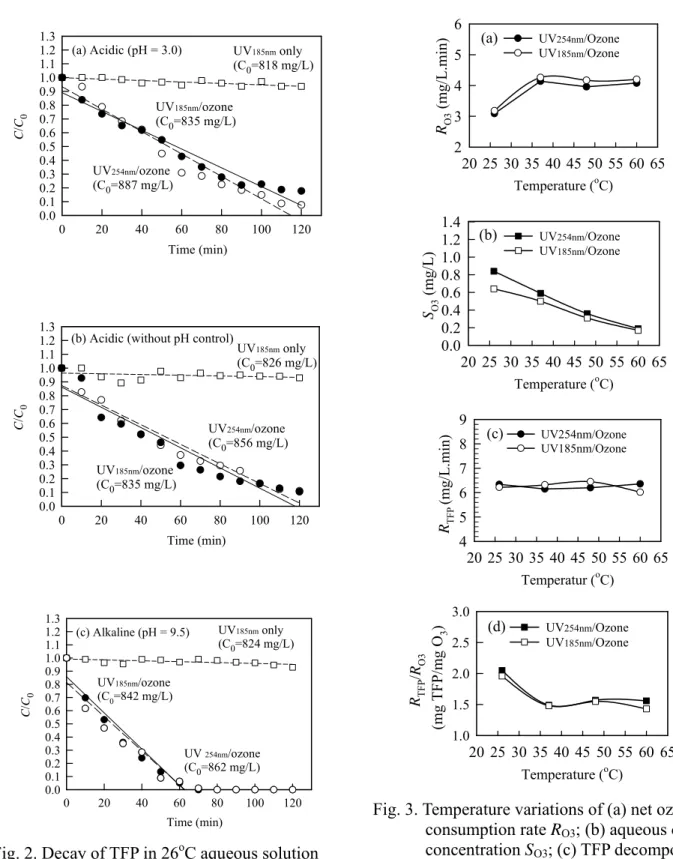
As shown in Fig. 2, the removal of TFP by UV185nm photolysis was only approximately 7%
under all pH conditions for an irradiation time of 120 min. The figure reveals that under all the pH conditions, the decomposition of TFP with UV185nm radiation only was much slower than
that with UV254nm/O3 or UV185nm/O3. This
indicates that almost all of the decay of TFP was caused by UV-induced radical species.
The time profiles of the TFP decomposition reveal that under all of the experimental
conditions, C/C0 varied linearly with
UV/ozonation time. The kinetics of aqueous TFP decomposition can thus be expressed as follows.
-dC/dt = RTFP = k C0 (2)
where C is the aqueous TFP concentration (mg/L); RTFP is the volumetric TFP
decomposition rate (mg/L.min); k is the rate constant (1/min), and C0 is the initial aqueous
TFP concentration (mg/L). In this case, ozone concentration remained approximately at
constant values in the reaction solutions (data not shown), and the reaction could thus be regarded as zero-order TFP-reaction rate control.
Figure 2(c) reveals that alkaline conditions favored TFP degradation. As discussed in the preceding sections, direct ozonation dominates at low pH and indirect reaction with radical species may dominate at high pH. Accordingly, at high pH, hydroxyl radicals may efficiently target pollutants via indirect reactions. At lower pH values, direct reactions of ozone may reduce the efficiency of the process due to the lower alcohol destruction ability of ozone.
To evaluate the effect of temperature on the TFP decomposition, experiments were conducted
at four different temperatures of 26, 37, 48 and 60 oC, respectively, with both UV254nm/O3 and
UV185nm/O3 for a reaction time of 120 min.
Figure 3 plots variations of RO3, SO3, RTFP and
RTFP/RO3 with the temperature. Figure 3(a)
indicates that RO3 was found to increase with
increasing temperature until 37 oC, and after that, it did not increase any further with the increasing temperature. Figure 3(b) shows that SO3
decreased with the increasing temperature and approached 0 at around 60 oC. As Fig.3(c) indicates, there was no significant difference in RTFP with UV254nm/O3 and UV185nm/O3 under the
four different reaction temperatures. Raising reaction temperature did not affect RTFP because
it enhanced the reaction rate constant and reduced the available OH.concentration
responsible for the TFP degradation to nearly the same degree. As shown in Fig. 3(d), RTFP/RO3
was higher for the reaction at 26 oC than for
those at other temperatures. This suggests that UV/ozone degradation of TFP can best be done at ambient temperatures.
Conclusions
The experimental data concerning the UV254nm/O3 and UV185nm/O3 degradation of
aqueous TFP in a batch reactor with initial concentrations of 772-887 mg/L support the following conclusions:
1. Alkaline conditions accelerated TFP degradation and increased the mass of TFP decomposition per unit mass of ozone consumption, in both 254nm and 185nm of UV wavelength.
2. A higher oxidation temperature in the range from 26 to 60 oC was found to be no help for UV254nm/O3 and UV185nm/O3 oxidation of
TFP in the tested concentration range. 3. The effect of UV wavelengths (254 nm and
185 nm) was found to be insignificant for the TFP decomposition.
4. With sufficient ozone application and an irradiated UV power intensity of 2.5 W/L to the reaction liquor, TFP exhibited
zero-order degradation kinetics.
References
[1] McCormick J. A.: A guide to optical starage technology, Richard D. Irwin, Inc. (1990). [2] Helgerson L. W.: CD-ROM: Facilitating
electronic publishing, Van Nostrand Reinhold (1992).
[3] Williams E. W., Lancaster G.: The CD-ROM and optical disc recording system, Oxford University Press Inc. (1994).
[4] Wu H. H.: Removal of VOCs Emission from CD-R/DVD-R manufacturing
process-Application of advanced oxidation technology, Chemical Monthly (Taiwan), 5, 42-47 (2003).
[5] Jan Y. F.: Treatment of wastewater and waste solvent from CD-R and DVD-R
manufacturing process, Master Degree Thesis (Taiwan), 7, (2004).
[6] Lee M. S.: Treatment technology of TFP wastewater from CD-R manufacture,
Environmental Protection Monthly (Taiwan), 8(2), 160-168 (2002).
[7] Huang G. H.: Pervaporation on the
dehydration of tetrafluoropropanol (TFP) solvent, Chemical Monthly (Taiwan), 12(6), 54-65 (2003).
[8] Liang M. T.: Treatment FTP solution by supercritical fluid fractionation, Proc. 20th Solid Waste Treatment Conference, The Chinese Institute of Environmental Engineering, (2005).
[9] Chen C. C.: TFP recovery from the TFP wastewater of CD-R manufacturing process, Master Degree Thesis (Taiwan), 6, (2005). [10] Vollmuth S., Niessner R. N.: Degradation of
PCDD, PCDF, PAH, PCB and chlorinated phenols during the destruction-treatment of landfill seepage water in laboratory model reactor (UV, Ozone, and UV/Ozone), Chemosphere, 30(12), 2317-2331 (1995). [11] Benitez F. J., Jesus B. H., Juan L. A., Teresa
G.: Degradation of protocatechuic acid by two advanced oxidation processes:
Ozone/UV radiation and H2O2/UV radiation,
[12] Balcioglu I. A., Getoff N., Advanced
oxidation of 4-chlorobenzaldehyde in water by UV-light, ozonation and combination of both methods, Chemosphere, 36(9),
1993-2005 (1998).
[13]Ku Y., Wang W., Shen Y. S.: Reaction behaviors of decomposition of
monocrotophos in aqueous solution by UV and UV/O3 processes, J. Hazard. Mater.,
B72, 25-37 (2000).
[14] Benitez F. J., Jesus B. H., Juan L. A., Rubio F. J.: Contribution of free radicals to chlorophenols decomposition by several advanced oxidation processes,
Chemosphere, 41, 1217-1277 (2000). [15] Yamada H., Tsuno H.: Characteristics of
advanced oxidation processes for the decomposition of organic compounds, Journal of the Chinese Institute of
Environmental Engineering, 10(1), 61-68 (2000).
[16] Esplugas S., Gimenez J., Contreras S., Pascual E., Rodriguez M.: Comparison of different advanced oxidation processes for phenol degradation, Wat. Res., 36,
1034-1042 (2002).
[17] Dombi A., Ilisz I., Laszlo Z., Wittmann G.: Comparison of ozone-based and other (VUV and TiO2/UV) radical generation
methods in phenol decomposition, Ozone Sci. Eng., 24, 49-54 (2002).
[18] Gilbert E.: Influence of ozone on the photocatalytic oxidation of organic compounds, Ozone Sci. Eng., 24, 75-82 (2002).
[19] Benitez F. J., Acero J. L., Real F. J.: Degration of carbofuran by using ozone, UV radiation and advanced oxidation processes, J. Hazard. Mater., B89, 51-65 (2002).
[20] Ku Y., Wang L. K.: Decomposition of 2-chlorophenol in aqueous solutions by ozone and UV/ozone processes in the presence of t-Butanol, Ozone Sci. Eng., 24, 133-144 (2002).
[21] Wang X., Huang X., Zuo C., Hu H.:
Kinetics of quinoline degradation by UV/O3
in aqueous phase, Chemosphere, 55, 733-741 (2004).
[22] Idil A., Dogruel S.: Pre-treatment of
penicillin formulation effluent by advanced oxidation processes, J. Hazard. Mater., B112, 105-113 (2004).
[23] Chen Y. H., Chang C. Y., Huang S. F., Shang N. C., Chiu C. Y., Yu T. H., Chiang P. C., Shie J. L., Chiou C. S.: Decomposition of 2-naphthalenesulfonate in electroplating solution by ozonation with UV radiation, J. Hazard. Mater., B118, 177-183 (2005). [24] Irmak S., Erbatur O., Akgerman A.:
Degradation of 17β-estradiol and bisphenol A in aqueous medium by using ozone and ozone/UV techniques, J. Hazard. Mater., B126, 54-62 (2005).
[25] Diaz R., Menendez D., Tabares F.: High frequency ozone generation system, Ozone Sci. Eng., 23, 171-176 (2001).
[26] Cooperative Research Report: Ozone in water treatment- Application and Engineering, Lewis Publishers (1991).
(a) Acidic (pH = 3.0) Time (min) 0 20 40 60 80 100 120 C /C0 0.0 0.1 0.2 0.3 0.4 0.5 0.6 0.7 0.8 0.9 1.0 1.1 1.2 1.3 UV185nm only (C0=818 mg/L) UV254nm/ozone (C0=887 mg/L) UV185nm/ozone (C0=835 mg/L)
(b) Acidic (without pH control)
Time (min) 0 20 40 60 80 100 120 C /C0 0.0 0.1 0.2 0.3 0.4 0.5 0.6 0.7 0.8 0.9 1.0 1.1 1.2 1.3 UV185nm only (C0=826 mg/L) UV185nm/ozone (C0=835 mg/L) UV254nm/ozone (C0=856 mg/L) (c) Alkaline (pH = 9.5) Time (min) 0 20 40 60 80 100 120 C /C0 0.0 0.1 0.2 0.3 0.4 0.5 0.6 0.7 0.8 0.9 1.0 1.1 1.2 1.3 UV185nm only (C0=824 mg/L) UV 254nm/ozone (C0=862 mg/L) UV185nm/ozone (C0=842 mg/L)
Fig. 2. Decay of TFP in 26oC aqueous solution by UV185nm ( ), UV254nm/O3 ({) and UV185nm/O3 (z) at (a) pH = 3.04; (b) initial pH = 6.97; (c) pH = 9.49. (a) Temperature (oC) 20 25 30 35 40 45 50 55 60 65 RO3 (mg/ L.mi n) 2 3 4 5 6 UV254nm/Ozone UV185nm/Ozone (b) Temperature (oC) 20 25 30 35 40 45 50 55 60 65 SO3 (mg/L) 0.0 0.2 0.4 0.6 0.8 1.0 1.2 1.4 UV254nm/Ozone UV185nm/Ozone (c) Temperatur (oC) 20 25 30 35 40 45 50 55 60 65 RTFP (mg/L. min) 4 5 6 7 8 9 UV254nm/Ozone UV185nm/Ozone (d) Temperature (oC) 20 25 30 35 40 45 50 55 60 65 R TF P /RO3 (mg TFP/mg O 3 ) 1.0 1.5 2.0 2.5 3.0 UV254nm/Ozone UV185nm/Ozone
Fig. 3. Temperature variations of (a) net ozone consumption rate RO3; (b) aqueous ozone
concentration SO3; (c) TFP decomposition
rate RTFP; (d) TFP decomposition per unit
ozone consumption RTFP/RO3 with ozone
dosing rate D = 4.50 mg/L.min and UV intensity = 2.50 W/L.