Luminescent mechanisms of ZnS:Cu:Cl and ZnS:Cu:Al
phosphors
Y.Y. Chen
a, J.G. Duh
a,U, B.S. Chiou
b, C.G. Peng
c aDepartment of Materials Science and Engineering, National Tsing Hua Uni¨ersity, 101, Sec. 2 Kuang Fu Road, Hsinchu 30043, Taiwan
b
Department of Electronics Engineering, National Chiao Tung Uni¨ersity, Hsinchu, Taiwan
c
Electronics Research and Ser¨ice Organization, Industrial Technology Research Institute, Hsinchu, Taiwan
Received 7 January 2001; received in revised form 13 March 2001; accepted 15 March 2001
Abstract
Ž .
ZnS:Cu:Cl and ZnS:Cu:Al phosphors are fabricated by a flux fusion method to be used in cathode ray tube CRT monitors for green emission. The emission spectra of the phosphors depend on the Cu concentration. A series of luminescence measurements have been conducted, and several models are applied to explain the luminescent phenomenon of these phosphors. It is revealed that ZnS:Cu:Cl and the ZnS:Cu:Al phosphors exhibit green emission yet their luminescence mechanisms are different. The emission spectrum from the as-fabricated green phosphors is not a typical Gaussian distribution. The combination of blue and green band luminescence is attributed to the green-luminescence quenching derived from the interstitial Cuq ions. 䊚 2001 Elsevier Science B.V. All rights reserved.
Keywords: Phosphor; Dopant; Luminescence mechanism; Emission spectra
1. Introduction
The current status of computer technology is toward the multimedia, and might gradually replace the con-ventional television and audio. Intel Inc. once
an-Ž .
nounced the Pentium Central Processing Unit CPU
Ž .
with an extra and practical memory multiplex MMX system which could drastically improve the function of multimedia in the personal computer. To meet the requirement for multimedia applications, the colorful and diversified display is also required in the feature. So far, the CRT display is commonly used as a com-puter monitor. However, to meet the demands of high speed and true color images for multimedia displays, the properties of the phosphors employed on CRT have to be modified and improved.
UCorresponding author. Tel.: q886-3573-1164; fax: q886-3571-2686.
Ž .
E-mail address: [email protected] J.G. Duh .
The ZnS activated with Cu ions is the most efficient cathodoluminescence phosphors. There has been a steady market for CRT application, because of their good stability against chemical and physical treatments
w x
during CRT operation processes 1 . Furthermore, ZnS-based phosphors are extensively employed on other
Ž .w x
displays such as field emission display FED 2 , plasma Ž . w x
display penal PDP 3 , and electron luminescence ŽEL. w x4 . Particularly, blue and green emitting ZnS:Cu:Cl and ZnS:Cu:Al phosphors used in CRT are well-known phosphors. The direct evidence of high efficiency was reported using the infrared absorption spectrum induced by ultraviolet irradiation and using
w x
the characteristic decay curve 5 . The origin of the luminescence of the practical ZnS phosphors can be explained with the donor᎐acceptor recombination model.
w x
Kuboniwa 6 et al. explained the saturation effects of the ZnS:Cu:Al phosphors under pulse excitation, and the mechanisms of concentration quenching of the 0040-6090r01r$ - see front matter 䊚 2001 Elsevier Science B.V. All rights reserved.
Ž .
green-Cu luminescence in ZnS:Cu:Al under cathode-w x ray excitation were discussed by Kawai et al. 7 . How-ever, only a limited number of papers have been de-voted to investigations on the detailed cathodolumines-cence properties. Green and blue emission in Cu doped ZnS have been recognized as a result of electron-hole recombination of donor᎐acceptor pairs. Excess or less
Ž .
impurity-doped concentrations copper might reduce the luminescent efficiency and discolor the lumines-cence of the phosphors. In this study, the cathodolumin-escence spectra, and brightness of the as-fabricated green and blue phosphors were measured. In addition, the dependence of the activator-doped concentration to the luminescent behavior and the optical᎐electrical properties of the phosphor were discussed.
2. Experimental procedure
Fluxes of eutectic NaCl᎐MgCl composition are a2 feasible way to fabricate the ZnS:Cu:Cl phosphor. With appropriate Al3q ion addition into ZnS fired by the
mixture of NaI and NaBr, ZnS:Cu:Al phosphors can be w x
fabricated 8 . The blended powder was transferred to a crucible, followed by firing at 850⬚C for 1 h and then the furnace was cooled down to room temperature.
After the firing process was completed, the phos-phors were washed by water and dilute HCl. In the washing process, the sintered rod of phosphors from the furnace was soaked in the hot water at 70⬚C with stirred action for 2 h, and then the water was removed after the powder was sedimented. The phosphors were again washed with a 2 wt.% dilute HCl solution. Finally, the phosphors were washed with hot water to remove the residual HCl solution.
A screen method was employed to print the
as-Ž .
fabricated phosphors on the indium tin oxide ITO
Ž .
glass. Polyvinyl alcohol PVA acted as a binder. Fixed amounts of PVA and as-fabricated phosphors were homogeneously mixed. The as-fabricated phosphors were printed with an average thickness of 0.1 mm. To examine the intrinsic luminescence of phosphors, sam-ples were fired at 450⬚C for 1 h to decompose the binder.
Phosphor samples were placed in the chamber at a pressure under 5=10y8 torr and excited by an elec-tron beam with controlled accelerating voltage and probe current density. The emission spectrum was
de-Ž
tected by Fourier transfer analysis Nicolet MX-1, Ac-.
ton Research Corporation , and the detecting range was from 360 to 830 nm. The sample temperature was kept at room temperature. The relative intensity of cathodoluminescence spectrum of phosphor was recorded with an in situ recorder. The Commission
Ž .
International de l’Eclairage CIE color coordinates of phosphor luminescence were determined with a
Ž .
Chroma Meter Minolta CS-100, Japan . A pulsed
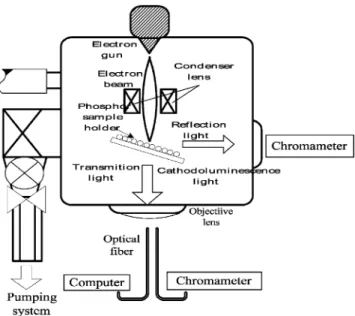
Fig. 1. Schematic diagram of the luminescence measurement system.
Ž .
Nd:YAG laser Spectra Physics DCR-2 was used as an Ž .
exciting source for photo luminescence PL measure-ment. The repetition frequency was set at 10 Hz, and the mean duration of the exciting laser was approxi-mately 10 ms. The wavelength of the exciting laser was 1046 nm, which was shifted to 355 nm after the laser
Ž
passed through a harmonic generator MODE HG-2, .
USA to excite the sample. The photoluminescence was detected with a photo multiplier tube through a
Ž .
monochromator Jobin-Yvon, USA and a controller ŽSpectralinic, USA . The PL spectra were analyzed by. Asyst-4 software in a personal computer. The detecting range of the wavelength was from 450 to 700 nm. The schematic diagram of the luminescence measurement system is shown in Fig. 1.
3. Results and discussion
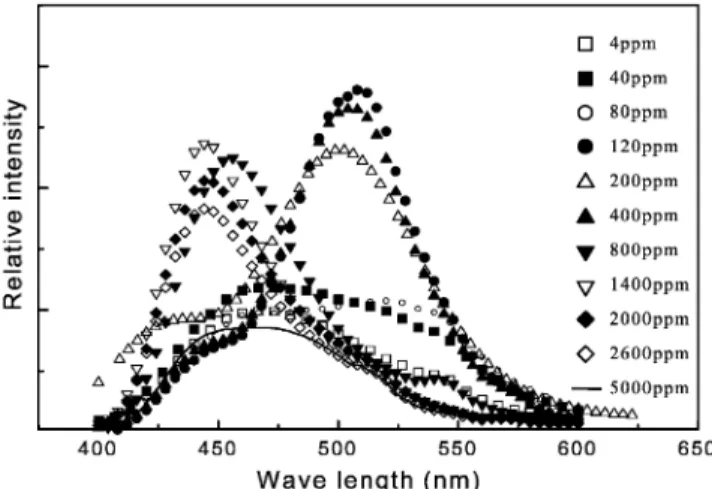
ZnS:Cu:Cl with green luminescence was fabricated with fluxes of NaCl᎐MgCl . Fig. 2 shows the emission2 spectrum of as-fabricated phosphors with various cop-per-doped concentrations. The wavelength of the green emission phosphor ranges from 475 to 525 nm. Powders with Cu-doped values of 120, 200, 400 ppm are close to the green emission. However, the emission of powders over 800 ppm turns to blue which ranges from 425 to 475 nm, while the phosphor less than 80 ppm exhibits emission from 450 to 550 nm. A further investigation indicates that the emission spectra of those phosphors are the combination of two main peaks, i.e. 450 and 500 nm.
The partition of both peak intensities closely de-pends on the Cu-doped concentration. The emission peak of 450 nm is significantly dominant in the spec-trum of Cu-doped over 800 ppm, while the emission
Fig. 2. The cathodoluminescence spectra of ZnS:Cu:Cl phosphors with various Cu-doped concentrations.
peak at 500 nm corresponds to the dominant peak for the spectrum of Cu-doped with 80, 120, 200, 400 ppm. However, both peak intensities emitted from 4, 40 and 80 ppm Cu-doped phosphors are equally weak and a broadening spectra is revealed.
The cathodoluminescence spectra are markedly de-pendent on copper concentrations. It is rather close to the intrinsic properties of pure ZnS powders with blue luminescence when copper concentrations are less than 80 ppm, while the blue emission occurs with copper concentrations greater than 400 ppm. The phosphors emit green luminescence with color coordinates of ap-proximately xry ᎏ 0.300:0.545 in the range from 120 to 400 ppm of Cu-doped.
In a parallel study, the ZnS:Cu:Al phosphor was also fabricated with fluxes of NaI᎐NaBr, which shows a green luminescence. Fig. 3 represents the cathodolumi-nescent spectra of as-fabricated ZnS:Cu:Al phosphors with various copper-doped concentrations. The wave-length of green emission phosphor ranges from 475 to 525 nm. Powders with Cu-doped of 150, 200, 250 ppm exhibit the green emission with color coordinates of approximately xry ᎏ 0.272:0.488. However, the emis-sion of powders with Cu-doped above 300 ppm tends to the blue band, ranging from 425 to 475 nm. The emission peak of 450 nm is significantly dominant when the Cu-doped concentration is above 300 ppm, while the peak at 500 nm is predominated in the spectra of Cu-doped 150, 200, 250 ppm.
w x
Von Gool 9 et al. employed a solid state model to explain the discolor mechanism in ZnS:Cu:Cl and ZnS:Cu:Al phosphors, and proposed that the lumines-cence color difference with copper activator
concentra-Ž .
tions is due to the ratio of the activator Cu and the
Ž .
coactivator Al or Cl . The different wavelengths emit-ted are attribuemit-ted to the copper activator concentra-tion. It is summarized that the luminescence color difference with copper activator concentration is due to
the ratio of the activator to the coactivator. When the concentration of the Cu activator is equal to that ratio, the luminescence color should be green. If the activa-tor concentration is higher than the coactivaactiva-tor con-centration, the luminescence color will turn to blue. However, the blue emission occurs again if the activa-tor concentration is much lower than the coactivaactiva-tor concentration. This implies that the self-luminescence properties of ZnS play a major role when low activators are doped.
w x
In the study of Kawai et al. 7 the concentration dependence of the luminescence intensity is well ex-plained by a model assuming complete pairing of the donor and acceptor. The concentration quenching of the green-Cu luminescence in ZnS:Cu:Al is derived if the interstitial Cuq ions, due to excess Cu dopant, act as recombination centers for free carriers and provide the dominant non-radiative path for excitation energy when doped Cu is much greater than the Al ion.
The emission spectrum measured from as-fabricated green phosphors is not a typical Gaussian distribution, yet it consists of blue and green band luminescence. This can be well explained by the model provided by
w x
Kawai 7 in which the green-luminescence quenching is derived from the interstitial Cuq. Hence, it is impor-tant to estimate the concentration of interstitial Cuq. In general, interstitial Cuq centers are formed during the fabrication process and their concentrations can be determined through thermodynamic equilibrium with other defects at the firing temperature. In fact, the results from the study of Kawai et al. could be em-ployed to estimate the concentration of interstitial Cuq, only if the Cu ion with a positive charge can be identified in the as-fabricated ZnS:Cu:Al and ZnS:Cu:Cl phosphors.
Ž .
Electron paramagnetic resonance EPR spectra are routinely obtained from paramagnetic transition ions in crystals. The peaks would be observed in EPR
spec-Fig. 3. The cathodoluminescence spectra of ZnS:Cu:Al phosphors with various Cu-doped concentrations.
Ž .
Fig. 4. EPR spectra of a 150 ppm Cu-doped ZnS:Cu:Al phosphor Ž .b 5000 ppm Cu-doped ZnS:Cu:Cl phosphor c 400 ppm Cu-dopedŽ .
Ž .
ZnS:Cu:Cl phosphor d pure ZnS fired at 800⬚C.
trum when the transition metal ions possess an odd number of electrons. Fig. 4d shows the EPR spectrum of the pure ZnS powders fired with NaCl at 800⬚C. The separated peaks with regular space indicate that ZnS powder is completely crystallized. However, a weak
U Ž
peak appears where the mark is indicated G value at .
approx. 3525 in Fig. 4d. The EPR spectra of ZnS:Cu:Cl phosphors with 5000 and 400 ppm are shown in Fig. 4b,c, respectively, which are almost identical to that of
Ž .
the pure ZnS powder fired with NaCl at 800⬚C Fig. 4d except the intensity of the U marked peak is higher than that in Fig. 4d. EPR spectrum of ZnS:Cu:Al with 150 ppm Cu-doped is shown in Fig. 4a. The peaks separated by regular space are observed, however, the
U marked peak disappears.
The weak marked peak observed in Fig. 4d is at-tributed to two factors. First, it might be the residual flux containing Cl ion on the surface of phosphor. Secondly, the Cl ion is difficult to diffuse to the ZnS lattice due to the charge incompatibility of sulfur and chloride. Namely, a trace amount of Cl ions can re-place the sulfur site in the ZnS lattice. Hence, the weak marked peak is observed and it can be recognized as the chloride ion in the EPR spectrum. The charge
Ž incompatibility will be vanished when the activator Cu
.
ion with one positive charge is employed. The Zn and S sites in ZnS lattice can easily be replaced by Cu and Cl, respectively, at the same time, since the Cu ion with a positive charge is compatible with the chloride with a negative charge. The activation energy of diffusion for Cu and Cl ions to ZnS lattice is reduced, thus the
Ž intensity of the marked peak intensity is enhanced Fig.
.
4b,c . It can be reconfirmed that the extra marked peak
is the paramagnetic transition for Cl ion, since there is no extra peak observed in the EPR spectra of ZnS:Cu:Al as shown in Fig. 4a. The electron configu-ration for one positive charge copper is 4 s03d10, so no EPR signal is revealed due to the even number of electron observed in the d orbital. It is argued that the Zn site is replaced by the Cu ion with a positive charge in ZnS:Cu:Al, since no other paramagnetic transition is observed in the EPR spectrum.
The results of EPR spectra illustrate that the Cu ion with a positive charge might diffuse to the ZnS lattice. An estimation of the concentration of interstitial Cuq with the aid of Kawai study is approximately 1=10y10 gratom per mole. Thus, the cathodoluminescence spectrum tends to the blue band due to interstitial Cuq, which acts as the recombination center for free carriers and provides the non-radiative path for excita-tion energy.
The cathodoluminescence brightness of the phos-Ž . phor is a function of both applied voltages V and
Ž .
currents I due to the basic principle in elementary
electronics. The brightness and brightness efficiency of the ZnS:Cu:Cl phosphor of 120 ppm Cu-doped is plot-ted as function of the substrate current as shown in Fig. 5, which indicates that the brightness is a linear function of substrate current. However, no saturation behavior is observed when the substrate current ex-ceeds 2000 nA in the as-fabricated ZnS-base phosphor. It is also indicated that the luminescence efficiency is reduced if more electron beams are applied on the as-fabricated phosphors.
The brightness and brightness efficiency of 200 ppm Cu-doped ZnS:Cu:Al phosphors as a function of sub-strate currents are illusub-strated in Fig. 6. The saturation behavior is observed when the substrate current ex-ceeds 2000 nA in the as-fabricated ZnS-base phos-phors. It appears that the luminescence efficiency is reduced as the substrate current is increased. To study
Fig. 5. The brightness and brightness efficiency of 120 ppm Cu-doped ZnS:Cu:Cl phosphors as a function of substrate current under an applied voltage of 10 kV.
Fig. 6. The brightness and brightness efficiency of the 200 ppm Cu-doped ZnS:Cu:Al phosphor as a function of substrate current under an applied voltage of 10 kV.
the green emission efficiency, the green phosphors with various Cu-doped concentrations were employed to make a comparison. Since the Cu 150 ppm doped ZnS:Cu:Al phosphor did not exhibit purely green lum-inescence as shown in Fig. 3, the comparison was made between the Cu 200 ppm ZnS:Cu:Al green phosphor and 120 ppm ZnS:Cu:Cl green phosphor. Only between the identical green emission phosphors that the com-parison of brightness efficiency makes sense. Observa-tion of Figs. 5 and 6 indicates that the brightness efficiency of 200 ppm ZnS:Cu:Al green phosphor is higher than that of the 120 ppm ZnS:Cu:Cl phosphor. A preliminary measurement reveals that the bright-ness is independent of the applied current in the ZnS:Cu:Al phosphor when the substrate current is above 2000 nA due to the saturation behavior. The saturation behaviors take place in the ZnS:Cu:Al
phos-Ž .
phor Fig. 6 , however, it is not observed in the ZnS:Cu:Cl phosphor even when the substrate current is
Ž .
increased to 2000 nA Fig. 5 . This fact leads to a conclusion that the saturation behavior takes place due to a limited number of luminescent centers. At high excitation densities, an excited donor᎐acceptor pair can easily find a filled donor or acceptor in the near neighborhood and the saturation is induced when the donor᎐acceptor recombination reaches the steady state. Both atoms of Al and Cu are positively charged, there-fore the solubility of the Al ion in the ZnS lattice is much lower than that of Cl in ZnS. The number of luminescent centers is limited in the ZnS:Cu:Al phos-phor, while that of ZnS:Cu:Cl phosphor is so large that no saturation behavior is observed. This implies that no saturation behavior is observed since the applied cur-rent density is not sufficient to completely promote all the donor᎐acceptor pairs to an elevated energy level.
The ZnS:Cu:Al phosphor with a limited number of luminescent centers is easily excited by applying a rather low current. Conversely, the ZnS:Cu:Cl
phos-phor with a large number of luminescent centers are not able to excite efficiently since the large number of the luminescent centers might disperse the energy when the applied current is weak. The substrate current dependence of luminescence efficiency and the satura-tion behavior of both phosphors can be clearly demon-strated by the fact that saturation is derived from the limited luminescent centers.
According to the solid state kinetics, the population Ž .
of luminescent ions in the excited state, Ne t after an excitation pulse can be expressed as
Ž . Ž . Ž . Ž .
Ne t sNe 0 =exp ytrR 1
Ž .
where Ne 0 is the initial population; R is the decay time, indicating that the population in the excited state has decreased to 1re after time R. The decay intensi-ties of luminescence emitted from the as-fabricated phosphors as a function of time are illustrated in Fig. 7. The decay time for the ZnS:Cu:Cl and ZnS:Cu:Al phosphor are evaluated to be 0.05 and 0.035 s, respec-tively. The commercial Kasei-Optonic phosphor is also shown in Fig. 7a for comparison. It seems that the luminescence is decayed as the measuring time in-creases for all the phosphors. However, the decay curves
Fig. 7. The decay intensities of luminescence emitted from the Ž .
as-fabricated phosphors as a function of time a Kasei-optonic
Ž . Ž .
commercial phosphors b 250 ppm Cu-doped ZnS:Cu:Al c 200 ppm
Ž . Ž .
Cu-doped ZnS:Cu:Al d 120 ppm Cu-doped ZnS:Cu:Cl e 40 ppm Cu-doped ZnS:Cu:Cl.
of ZnS:Cu:Cl phosphors with 40 and 200 ppm doped Cu in Fig. 7e,d are a little different from ZnS:Cu:Al phosphors with 200, 250 ppm doped Cu in Fig. 7c,b. It appears that the curve of the ZnS:Cu:Al peak is very sharp, while that of ZnS:Cu:Cl is rather broad. It is concluded that the decay time of phosphors with the Cu co-dopant are relatively longer, since the emission of Cl co-doped phosphors can last for longer periods in its highest brightness.
4. Conclusions
ZnS-based green phosphors have been successfully fabricated with the flux of eutectic NaCl᎐MgCl and2
NaBr᎐NaI. A series of luminescence measurements are carried out under various applied voltages and currents. The spectra measured from as-fabricated green phosphors, including both ZnS:Cu:Cl and ZnS:Cu:Al, are not a normal Gaussian distribution. The Cu dopant concentration plays a major role in the luminescence behavior and the green-luminescence quenching might be derived from the interstitial Cuq that can be identified by EPR analysis. The concentra-tion of interstitial Cuq in the as-fabricated phosphor can be estimated at approximately 1=10y10 gratom per mole. Various optoelectronic behaviors and decay curves are observed in the Al and Cl co-dopant phos-phors. The brightness efficiency of ZnS:Cu:Al is higher than that of the ZnS:Cu:Cl phosphor at low substrate current, due to a limited number of luminescent
cen-ters in the phosphors. The substrate current depen-dence of luminescence efficiency and saturation behav-ior of both phosphors can be elucidated by the fact that saturation is derived from the limited luminescent cen-ters.
Acknowledgements
This work is supported by the Electronics Research and Service Organization, Industrial Technology
Re-Ž .
search Institute ERSO, ITRI , Taiwan under contract No. E88010. Partial support from National Science Council under the contract No. NSC 88-2216-E-007-35 is also acknowledged.
References
w x1 H. Bechtel, W. Czarnojan, M. Haase, W. Mayr, H. Nikol, Ž .
Philips J. Res. 50 1996 433.
w x2 J.S. Sebastian, H.C. Swart, T.A. Trottier, S.L. Jones, P.H. Ž .
Holloway, J. Vac. Sci. Technol. A 15 1997 2349. w x3 C.R. Ronda, J. Alloy Compd. 225 1995 534.Ž .
w x4 Y. Nakanishi, H. Yamashita, G. Shimaoka, Jpn. J. Appl. Phys. Ž .
20 1981 2261.
w x5 P. Peka, H.J. Schulz, Physica B 193 1994 57.Ž .
w x6 S. Kuboniwa, H. Kawai, T. Hoshina, Jpn. J. Appl. Phys. 19 Ž1980 1647..
w x7 H. Kawai, S. Kuboniwa, T. Hoshina, Jpn. J. Appl. Phys. 13 Ž1974 1593..
w x8 Y.Y. Chen, MS Thesis, National Tsing Hua University, Hsinchu, Ž .
Taiwan 1999 .