This article was downloaded by: [National Chiao Tung University 國立交通大學] On: 28 April 2014, At: 04:20
Publisher: Taylor & Francis
Informa Ltd Registered in England and Wales Registered Number: 1072954 Registered office: Mortimer House, 37-41 Mortimer Street, London W1T 3JH, UK
Journal of Modern Optics
Publication details, including instructions for authors and subscription information:
http://www.tandfonline.com/loi/tmop20
Method of solving triplets consisting
of a singlet and air-spaced doublet
with given primary aberrations
Chao-Hsien Chen a , Shin-Gwo Shiue a & Mao-Hong Lu a aInstitute of Electro-Optical Engineering, National Chiao Tung University , 1001 Ta Hsueh Road, Hsinchu, 30050, Taiwan
Published online: 03 Jul 2009.
To cite this article: Chao-Hsien Chen , Shin-Gwo Shiue & Mao-Hong Lu (1998) Method of solving triplets consisting of a singlet and air-spaced doublet with given primary aberrations, Journal of Modern Optics, 45:10, 2063-2084, DOI: 10.1080/09500349808231743
To link to this article: http://dx.doi.org/10.1080/09500349808231743
PLEASE SCROLL DOWN FOR ARTICLE
Taylor & Francis makes every effort to ensure the accuracy of all the information (the “Content”) contained in the publications on our platform. However, Taylor & Francis, our agents, and our licensors make no representations or warranties whatsoever as to the accuracy, completeness, or suitability for any purpose of the Content. Any opinions and views expressed in this publication are the opinions and views of the authors, and are not the views of or endorsed by Taylor & Francis. The accuracy of the Content should not be relied upon and should be independently verified with primary sources of information. Taylor and Francis shall not be liable for any losses, actions, claims, proceedings, demands, costs, expenses, damages, and other liabilities whatsoever or howsoever caused arising directly or indirectly in connection with, in relation to or arising out of the use of the Content.
This article may be used for research, teaching, and private study purposes. Any substantial or systematic reproduction, redistribution, reselling, loan, sub-licensing, systematic supply, or distribution in any form to anyone is expressly forbidden. Terms & Conditions of access and use can be found at http://www.tandfonline.com/ page/terms-and-conditions
JOURNAL OF MODERN OPTICS, 1998, VOL. 45, NO. 10, 2063-2084
Method of
solving triplets consisting of
a singlet and air-
spaced doublet with given primary aberrations
CHAO-HSIEN CHEN, SHIN-GWO S H I U E and
Institute of Electro-Optical Engineering, National Chiao Tung University, 1001 T a Hsueh Road, Hsinchu 30050, Taiwan MAO-HONG L U
(Received 2 April 1997; revision received 3 February 1998)
Abstract. An effective algebraic algorithm is proposed as a computational tool for solving the thin-lens structure of a triplet which consists of a singlet and an air-spaced doublet. The triplet is required to yield specified amounts of lens power and four primary aberrations: spherical aberration, coma, longitudinal chromatic aberration and secondary spectrum. In addition, the air spacing is used to control the zonal spherical aberration and spherochromatism. T h e problem is solved in the following manner. First, the equations for power and chromatic aberration are combined into a quartic polynomial equation if the object is at a finite distance, or combined into a quadratic polynomial equation if the object is at infinity. The roots give the element powers. Second, the lens shapes are obtained by solving the quartic polynomial equation which is obtained by combining the equations of spherical aberration and coma. Since quartic and quadratic equations can be solved using simple algebraic methods, the algorithm is rapid and guarantees that all the lens forms can be found.
1. Introduction
Optical decision problems in which the system will be designed from primary aberration theory normally begin with two stages. First, the optical thin-lens layout and the aberration targets of each optical component are decided. T h u s the lens power and aberration targets of each component, the separation between adjacent components, and the paraxial marginal and chief ray heights at each component are determined. Second, there follows a thin-lens design stage for each component. During this stage, a suitable type of lens is chosen for each component and then the glass materials and curvatures are found to meet the power and aberration targets. According to the possibility of satisfying the targets, the lens type may be a single element, doublet, triplet or even a complex assembly of many elements. These thin-lens components are used as the starting points for future thickening and optimization. T h e primary aberration targets of thin lenses where the stop is at the lens are normally three in number: the Siedel coefficients S 1 , S2c
and CL, representing spherical aberration, central coma and longitudinal chro- matic aberration respectively. Central coma is defined as the coma value for the case of the stop located at the lens. There is no need for the targets of the other primary aberrations: coma S 2 , astigmatism S 3 , field curvature Sq,distortion S5
and lateral chromatic aberration CT, since they can be expressed as combinations of K, S1, S2c and CL by using the well known stop-shift formulae of aberration theory.
0950-0340/98 $12.00 0 1998 Taylor & Francis Ltd.
2064 C.-H. Chen et al.
Hence, systematic thin lens design methods for various lens types are useful tools and have been the research subject of several workers. For example, the thin- lens designs of various doublet types have been provided by Dreyfus et al. [l], Kingslake [2], Khan and Macdonald [3], Smith [4] and Chen et al. [S], among many others.
Triplets are also elementary lenses which are used in many optical systems. Conrady [2, 61 has given a study of cemented triplets which have four surfaces as degrees of freedom to meet the specified lens power
K ,
primary spherical aberrationS1,
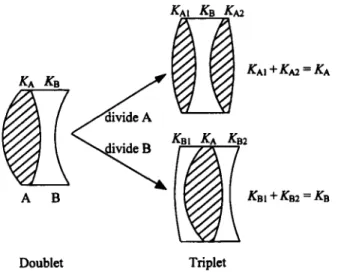
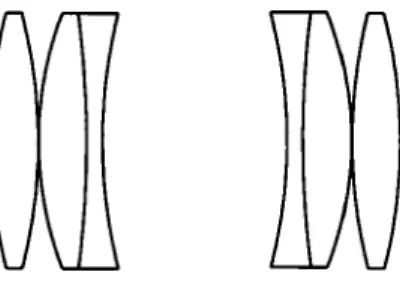
central coma S ~ C , and longitudinal chromatic aberration CL. T h e triplets are produced from dividing cemented doublets and thus have the same glass type for the first and third elements (figure 1). Recently, we [7] have derived an algorithm to solve cemented triplets with three different glass types (figure 2). In general, these triplets can have a lower secondary spectrum than the triplets with two glass types. However, they still cannot control the amount of secondary spectrum precisely because of the discontinuous distribution of glasses, and lenses with more than four degrees of freedom are required for the task. T h e tripletA B
Doublet Triplet
Figure 1. The cemented triplets with two glass types are obtained from dividing either the flint lens or the crown lens of the cemented doublets into two parts [2, 61. The triplets have the same values of focal length and chromatic aberration with the doublet; they also produce the same amounts of secondary spectrum.
Figure 2. We have derived an algorithm to solve the cemented triplet with three different glass types [7]. This triplet is usually more effective to reduce the secondary spectrum than the triplet with two glass types.
Method of solving triplets 2065
Figure 3. The schemes of the two thin-lens triplet types: singlet leading and doublet leading. These triplets have five surfaces as degrees of freedom to yield specified amounts of lens power, spherical aberration, central coma, chromatic aberration and secondary spectrum [8].
which consists of a singlet and a cemented doublet with the two lenses in contact has five surfaces as degrees of freedom to fit the purpose (figure 3). We have also derived an algorithm to solve this triplet type [8].
T h e chromatic variation of spherical aberration is often an important consideration in lens performance. Because of the residuals of zonal spherical aberration and spherochromatism, the triplets shown in figure 3 are usually limited to use at somewhat lower lens speeds. On the other hand, if the singlet and cemented doublet are separated by an air spacing, the extra variable may be used to reduce the zonal spherical aberration and spherochromatism, thus obtaining lenses with somewhat higher speeds. This has been discussed in detail elsewhere In this paper, we propose an algorithm for solving the thin-lens solutions of a triplet which consists of a singlet and an air-spaced doublet. To control both longitudinal chromatic aberration and secondary spectrum, CL is divided into CL1
and C L ~ (defined in the following section). T h e triplet has five surfaces to meet
five specified target values K, S1, coma S2, CL, and C L ~ , and uses the air spacing d
as an indirect parameter to control the spherical aberration curves which include not only primary but also higher-order aberrations. It is noteworthy that the comatic aberration is given by coma S2 instead of central coma S2c; this is
required because S2c cannot be properly defined for such an air-spaced lens unless d is zero.
From a mathematical point of view, the problem is to solve a set of five nonlinear simultaneous equations with five variables. However, the solving process can be simplified by two steps. First, the power of each element is obtained by solving the simultaneous equations of
K ,
C L ~ and C L ~ . T h e three equations are combined into a quartic polynomial equation if the object is at a finite distance, or combined into a quadratic polynomial equation if the object is at infinity. T h e roots of the quartic or quadratic equation give the element powers. Second, the lens shapes are obtained b y solving the quartic polynomial equation which is obtained by combining the equations of S1 and S2. Finally, the thin-lens solutions which meet the aperture requirement and has better spherical aberration curves are chosen as starting points for future thickening and optimization. Since the roots of quartic and quadratic equations can be solved by using simple algebraic methods [lo], the algorithm is rapid and guarantees that all the lens structures can be found.12, 91.
2066 C.-H. Chen et al.
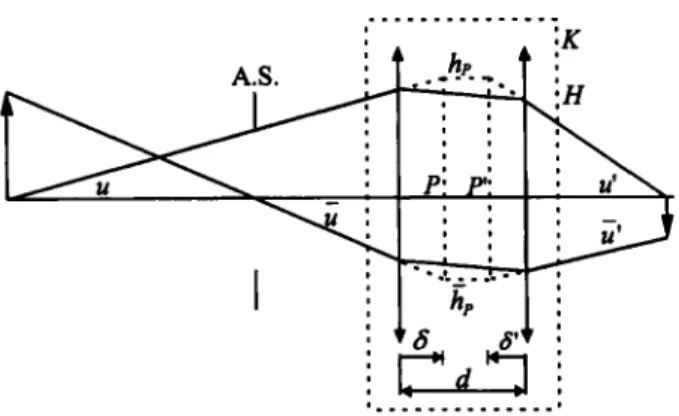
Figure 4. The notation for the Gaussian optics of the air-spaced thin-lens triplet.
2. Method
as follows.
T h e first-order layout of the triplet is shown in figure
4.
T h e notation is defined(1) K is the power which is the inverse of the focal length. (2) d is the spacing between the two lenses.
(3)
P
and P' are the first and second principal points respectively; they coincide if d is equal to zero.(4) h p and h p are the marginal and principal ray heights at the principal planes, being positive if they are above the axis.
( 5 ) u, ii, u' and ii' are the paraxial angles of the marginal and princpal rays in the object and image spaces respectively. A ray angle is defined as positive if a clockwise rotation of the ray brings it parallel to the optical axis. (6) H = hpu - hpii is the optical invariant.
(7) 6 (6') is the distance from the front (rear) lens to the front (rear) principal surface; the sign is positive if the disance is to the right of the front (rear) lens.
Since the principal planes are at neither the singlet nor the doublet, it is important to keep h p and h p unchanged; otherwise the first-order layout of the whole system will be destroyed.
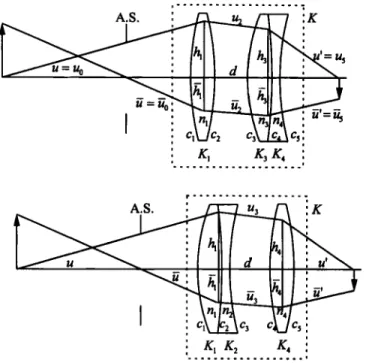
Two triplet types, singlet leading and doublet leading, are shown in figure 5. Because the algorithms of solving both types are similar, we only propose the one for the singlet-leading type. If c denotes the surface curvature and n is the refractive index, then
Ki
= (ni - l ) ( c i-
ci+l) is the power of element i . In addition, we define the following.( 1 ) E; = &/hi is the eccentricity factor for surface
i.
(2) Ep = & p / h p is the eccentricity factor for principal planes,
(3) Ai = ni-1 (hici
+
ui-1) = ni(hici+
ui) is the refraction invariant for surface i.In the case when d = 0, the triplet, which has the central coma value SZC = S2
-
( h p / h p ) S 1 , can be solved by using the method described in [8].Method of solving triplets 2067
i
-...-..*...-..-....
K, K2 K4i
Figure 5. T h e schemes of the two types, singlet leading and doublet leading, of air- spaced thin-lens triplets. Since the algorithms of solving both types are similar, we only propose that for solving the singlet-leading type in this paper.
2.1. Determining the element powers by solving the formulae for K , CL1 and C L ~
Let As, AM and XL be the short, middle and long wavelengths respectively over
the band of interest. n s , nM and n L are the associated refractive indices. T h e well known Seidel formula for CL of a thin singlet in air is given by
h2 K
CL =-
v ’
where
denotes the Abbe number. If CL is equal to zero, the foci of AS and XL are coincident, but they usually do not coincide with that of AM. T o control all three foci, define C L ~ and C L ~ by analogy to CL as follows:
h 2 K CL1 =
c,,,,
h2 K
where
V S M
andV M L
are defined analogously toV
as n M-
1 V S M =- n s - n M ’ n M - 1V M L
= n M - nL (3) (4)2068 C.-H. Chen et al.
CL1 and C L ~ indicate the departures of the foci between XS and X M and between
AM and XL respectively. It can be seen that CL is equal to the sum of CL1 and C L ~ .
If CL1 and C L ~ are both zero, the foci of all the three wavelengths are coincident and the triplet is apochromatic.
T h e formulae for K , CL1 and C L ~ of the triplet are [ l l ]
K1+ (K3
+
K4) - dK1 (K3+
K4) = K , (5)We wish to solve K1,3,4 from these equations; therefore hl and h3 have to be expressed as functions of K1,3,4. It is usual to normalize the lens such that the corresponding normalized lens has unity power and unity h p [3, 121. T o achieve this, we define the following dimensionless normalized parameters:
1 k 1 , 3 , 4 = KK1,3,4,
Ci
= Kd, Ci 7 . . .,5,z.--
i = l ’ - K ’ 1 hPK - = 1 hP(61,
ii)
=-
(ui, iij), i = 0 , .. . ,
5,(hi, hi) = -(hi,
&),
i = 1 , .. .
,5,(8, d‘)
= (6, 6’)K, s1=--
1 s2=--
1 h:K3 ‘ I’
HhiK2”’
Considerd
= ( k 3+
k 4 ) 48’
=-klJ;
Ithen &,3 and h1,3 can be expressed as functions of K 1 , 3 , 4 as follows:
(9)
Method of solving triplets 2069
-
hp -6~
hl =---
1 - (E3+
K4)di-i,
h P k1 = E p - (K3+
K4)&-
h3 = E p+K&’.
i t is apparent that the eccentricity factors El and E3 are also equal to
&/&,
respectively. Equations (1-3) can now be rewritten asand
k1
+
(k3 +K4)-dRl(K3
+
K4) = 1, (11)These dimensionless normalized formulae are independent of K and hp. By equation ( l l ) , we have
I
-
1-K1K3
+
K4 =_I.
1-
dK1After substituting the above equation into equations (12) and (13), we get
where Ql and 9 2 are functions of
El:
6 ~
-
2[1 - d c ( l -I‘?1)/(1 - d K 1 ) ] 2 K l / ( v M L ) 1 (1+
dfilK,)2Q2 =
Then, we can solve k3and K 4 as functions of k1as follows:
and hence
K3
+
Z4=vaQi
+
v b Q 2 , where2070 C.-H. Chen et al.
Substituting equation (1 9) into equation (14) and after some mathematical manipulation, we can get the following quartic equation for El:
T4Kf
+
T3K:+
T2K:+
T1Kl+To
= 0, (21) where T4 = -Gr2J3, with 2 -2w1
= -(ii‘-
1) d,
w2 = 2(1-
ii)(l -&)J,
w3= w4= -(1-
(iii)2, w5 = -26J, w7= -2&2(i. w6= e L 2 ( i 2 ,Once the values of coefficients To to T4 are calculated, the values of k1 are obtained by solving the quartic equation (21). There may have a; most four roots. For each root of
R1, the corresponding values of
&,
i 1 , 3 , h1,3,s‘
ands“
are obscured from- equations (1 8), (10) and (9), the eccentricity factors E1,3 are obtained from h1,3/i1,3, and the value of i i 2 can also be obtained fromi i 2 = ii
-
i l K 1 . (24)Hence, the power distribution and the ray paths outside the lenses are obtained. If the object is at infinity,
ii
= 0 and ii’ = -1, Q1 and Q2 are reduced as follows:Method of solving triplets 207 1 From equations (14) and (1 9), it is easy to obtain the following quadratic equation in K1:
for which there are at most two real roots. T h e next step is to find the lens shapes.
2.2. Determining the curvatures by solving formulae for S1 and S2
T h e spherical aberration and central coma of the front singlet are given by [l 13 h:K:
4
( S l ) , =-[Mo(nl)X: - M l ( n l ) X ~ Y l +M2(n1)Y: +M3(ni)19 (28)
respectively, where the shape factor X I , the conjugate factor Y1 and the functions Mo(n) to Ms ( n ) are defined as
c1
+
c2 - 21+
i.2 X I = ---
21 - i.2’
u2+u - ii2+ii y1 =-- 242-24 i i 2 - i i ’ c1 - c2 4(n+
1 ) M l ( n ) =-
n(n - I )’
3 n + 2 n M2(n) =-,
n + l n(n-
1)’
M4(n) =-
2 n + 1 n MS(n) =-.
T h e subscripts S in equations (28) and (29) denotes singlet. T h e normalized forms of ( S l ) , and ( S z ) , are
where the coefficients g1 to gs are as follows:
2072 C.-H. Chen et al.
The Hopkins-Venketeswara Rao [ 121 expressions for the spherical aberration and central coma of a cemented doublet are
+
k 5 ( n 3 ) ( F ) 2 -N~(n4)(?)~+?]respectively, where the functions No(n) to N5(n) are defined as 2
No(.) =
;’
(34)
(35)
and
Method of solving triplets 2073
-
K D K D = K 3+
K 4 , K D =-
= K 3+
K 4 K K 3-
K 4 - K 3 - K 4 - (37) K D E D’
P = u ’ + u 2 i2’+ii2 u ’ - u 2 i i ’ - i i 2 ’--
Y D =--
1 A 4 = - A 4 . 1 a = - h 3 K D h 3 K DThe subscript D denotes doublet. K D is the power of the doublet, p describes the
power distribution and
g 9 = - ~ J K D 2
From
S1 = ( 3 1 ) s
+
( j l ) D , j 2 = ( s 2 ) s+
( s 2 ) D ,’
we have the following two second-order equations in X1 and 2 4 :
2074 C.-H. Chen et al.
by reducing the above simultaneous equations into a quartic equation (see appendix A), the values of X1 and A 4 can be solved. Consider
A3 = 4323
+
62; (45)then we can have the value of A3 from A 4 using A3 = A4
+-
n3 43K3.n3 - 1
Finally, it is straightforward to obtain (21, 22) from ( X I , k 1 ) and (23,24,25) from (23, k 3 , k 4 ) as follows: I ( X l + l ) k l 2(n1 - 1)
'
c1 =-
A 3 4 2 c3=-, 4 3 (47)-
-
2 3 c4 = c3 -- 123-
1 ' I I K 4 cs = c4 -- n4 - 1 'Thus, the surface curvatures are solved. Finally, the thin-lens solution which meets the aperture requirement and has better spherical aberration curves is chosen as the starting point for future thickening and optimization.
3. Example
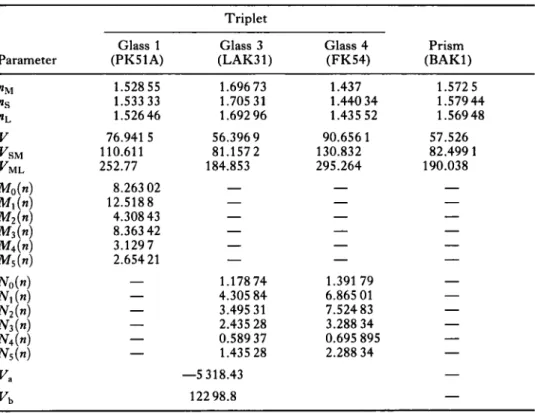
As an example to demonstrate the calculation process of the method in detail, we solve the thin-lens structures of a telescope objective system which has a focal length of 300mm, a relative aperture of F / 3 , a field of view of f 3 " , and an image height of 15.72mm (figure 6). T h e object is infinite. T h e optical invariant H = -2.618mm. T h e wavelengths over the band of interest are the hydrogen F
line (0.4861 pm), the helium d line (0.5876pm), and the hydrogen C line (0.6563pm). The glasses PKSlA, LAK31 and FK54 are used for the triplet, and the glass BAKl is used for the prism. These glasses are chosen from the Schott catalogue; the explicit values for all glass parameters are listed in table 1. T h e desired primary aberrations for the whole system are of zero spherical aberration and coma, and correction of both longitudinal chromatic aberration and secondary spectrum.
Method of solving triplets 2075
Prism ii = U'= 0.0524 \
v
Figure 6. Gaussian design of the telescope objective system. The aberrations S1, S 2 , C L ~ and C L ~ produced by the prism are going to be balanced by the triplet to make the whole system both aplanatic and apochromatic.
Table 1. Data for the chosen glasses. Triplet
Glass 1 Glass 3 Glass 4 Prism
Parameter (PK5 1 A) (LAK31) (FK54) (BAK1)
1.528 55 1.533 33 1.526 46 76.941 5 110.61 1 252.77 8.263 02 4.308 43 8.363 42 3.1297 2.654 21 12.5188
-
-
-
-
-
-
1.696 73 1.705 31 1.692 96 56.396 9 81.1572 184.853-
-
-
-
-
-
1.178 74 4.305 84 3.495 31 2.435 28 0.589 37 1.435 28 -5318.43 122 98.8 1.437 1.440 34 1.435 52 90.656 1 130.832 295.264-
-
-
-
-
-
1.391 79 6.865 01 7.524 83 3.288 34 0.695 895 2.288 34 1.572 5 1.579 44 1.569 48 57.526 82.499 1 190.038-
-
-
-
-
-
-
--
-
-
-
-
-
T h e prism induces the following primary aberrations [ll]:
n2 - 1 1.572S2 - 1
s,
=-- DuI4 =-
s2
=-s1 = 137(-0.1667)4 = -0.040038, n3 1.572S3 ii' 0.0524 s1= 0.012 59, Ul -0.1667 137 1.5725-1 (-0.1667)2 = -0.0106841, CL1 = n - 5 2 - VSM n2 u12 = -~ VML n2 190.038 1 .572S2 82.497 -I- 1 .572S2 137 1.5725-1 (-0.1667)2 = -0.004638 2,D
n - 1 CL2 = (48)2076 C . - H . Chen et al.
Table 2. Abberation targets of the triplet.
Seidel Wave front' Normalized Seidel Aberration coefficient (in units of Ad) coefficient
-
s
Spherical S1 = 0.040038 1 - = 8.5173 S - 2 - 0 . 1 7 2 9 6 5 - h4K3 - Coma S2 = -0.012 59 -s2
= -10.7131 s2 -0.1731 S1 8xd-
Hh2K2 2xd-
CL1 CL2 Secondary chromatic CL1 = 0.010 684 1-
cL1 = 9.0913 2xd CL1 =h 2 ~
= 0.001 283 cL2 3.946 73 6 ~= 2 = 5.565 84 x h K C L ~ = 0.004 638 2-
= 2xd Ad = 0.000 587 6 mm.where D = 137mm is the thickness of the prism. T o keep the whole system aplanatic and apochromatic, the aberrations induced by the prism must be balanced by the front triplet. T h e aberration targets for the triplet are expressed in three forms in table 2. T o show the ability of reducing higher-order aberrations by using the air spacing, comparison between a triplet with d = 0 and a triplet with a finite air spacing is given.
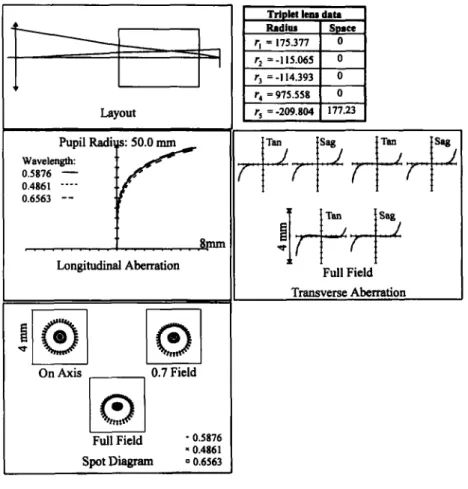
I n the case of d = 0, the triplet has the form shown in figure 3 which is solved by using the method proposed in [8]. As a general rule, weak lens surfaces are more preferred than strong surfaces because the former induces fewer higher-order aberrations. For this reason, we choose only the solution which has the weakest lens surfaces. Layout, longitudinal spherical and transverse aberration curves, and spot diagrams of the thin-lens solution are shown in figure 7. It can be seen that the three foci are consistent, but the tops of the longitudinal spherical and transverse aberration curves are far from the ideal positions.
As a comparison, a second triplet which has a suitable air spacing is solved. It is hard to give a suitable air spacing directly because our algorithm is based on the primary aberrations but the aberration curves and spot diagrams include not only primary but also high-order aberrations. Hence, we solve several triplets with different air spacings and find that the triplet with an air spacing d = 2.5 mm
(2
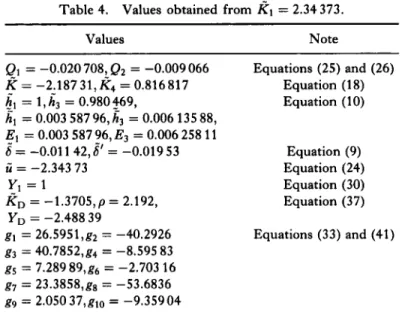
= 8.333 x has the best aberration performance. T o enable a user tovalidate several intermediate steps in the calculation as well as the final result, the values for derived parameters are also given. T h e normalized Gaussian parameters are shown in table 3. From equation (26), we have the following quadratic equation in K1:
T h e equation has two real roots which are 49.8397 and 2.343 73. T h e surface radii induced by the first root are too small to meet the aperture requirement. From the second root, we have the values shown in table 4. T h e locations of the front and rear principal planes are 6 = -3.426 24 and 6' = -5.859 32 respectively. Using these values and the method in appendix A, we have the following quartic equation in XI:
8.333 x 10⁻³k;
-
0.434 862Kl+
0.973 424 = 0. (49)-1.00923Xf
+
79.8157X: - 823.332X;+
1223.4X1+
192.602 = 0 , (50)Method of solving triplets 2077 Layout Wavelength: Longitudinal Aberration On Axis 0.7 Field Full Field * I( 0.5876 OA861 Spot Diagram 0 0.6563 r, =-115.065 r, =-114.393 r, = 915.558 d
Zl+TiFo
Full Field Transverse AberrationFigure 7. Layout, longitudinal spherical and transverse aberration curves, and spot diagram of the thin-lens telescope objective system in which the air spacing of the
triplet is zero. Table 3.
Normalized Gaussian parameters Note Values of the normalized Gaussian parameters.
H = -0.314 16 6 = 0,G’ = - 1
= 0.3142,;’ = 0.3142
Equation (8)
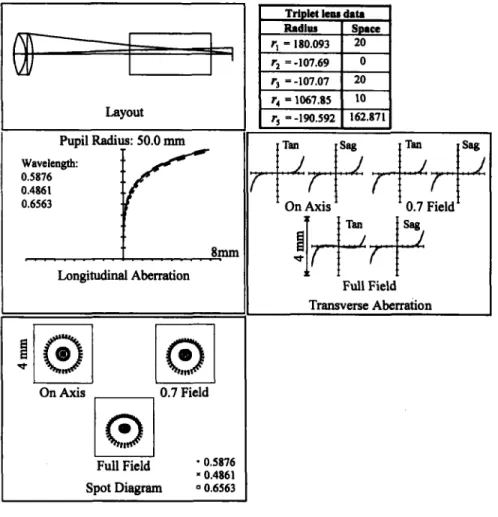
which has four real roots. Table 5 shows the corresponding four solutions. Solutions 2, 3 and 4 are useless because their surface radii are too strong to meet the aperture requirement. Layout of solution 1 with its aberration is shown in figure 8. Compare figures 7 and 8; the latter has better aberration curves and smaller spots. This indicates that a suitable air spacing can be used to reduce aberrations.
Once the thin-lens systems are obtained, the next step is to find the corre- sponding thickened optical systems which have the same Gaussian designs and the primary aberrations. If the thin-lens system is not good enough, the aberrations of the corresponding thickened system may be changed by a significant factor. This
2078 C.-H. Chen et al.
Table 4. Values obtained from I?1 = 2.34373.
Values Note Q 1 = -0.020 708, (22 = -0.009 066 K = -2.18731,I?4 = 0.816817
El
= 1,h3
= 0.980 469,hl
= 0.003 587 96,h3
= 0.006 135 88,8 =
-0.011 42,f’= -0.01953 Equation (9) ii = -2.343 73 Equation (24) Y1 = 1 Equation (30) I?D = - 1 . 3 7 0 5 , ~ = 2.192, Equation (37) gl = 26.5951,g2 = -40.2926 Equations (33) and (41) Equations (25) and (26) Equation (1 8) Equation ( 10) El = 0.003 587 96, E3 = 0.006 258 11 Y D = -2.488 39 g3 = 40.7852,g4 = -8.595 83 gs = 7.289 89,gb = -2.703 16 g7 = 23.3858,ga = -53.6836 gg = 2.05037,g1, = -9.35904 ~~ ~~ ~Table 5. Four thin-lens solutions.
Solution 1 Solution 2 Solution 3 Solution 4 Note Xi = -0.1434 A 4 = 0.298 81 A 3 = -4.923 87 21 = 1.89918 22 = -2.535 05 23 = -2.631 54 24 = 0.507 866 25 = -1.361 29 r1 = 157.963 r2 = -118.341 r4 = 590.707 r5 = -220.379 73 = -114.002 Yes Xi = 1.972 18 A4 = 9.094 87 A 3 = 3.872 18 21 = 6.58969 22 = 2.155 45 23 = 6.339 74 24 = 9.479 14 25 = 7.60999 rl = 45.5257 r2 = 139.182 r3 = 47.3206 r4 = 31.6484 r5 = 39.4219 No Xi = 10.039 A4 = 33.5791
23
= 28.3565 21 = 24.4747 22 = 20.0404 23 = 31.3117 Z4 = 34.4512 25 = 32.582 rl = 12.2576 r2 = 14.9697 r3 = 9.581 07 r4 = 8.707 98 75 = 9.207 54 No X1 = 67.218 A 4 = -204.157 Equation (A3) A3 = -209.379 Equation (46) 21 = 151.247 Equation (47) Roots of equation (50) Z2 = 146.813 23 = -211.16 24 = -208.02 25 = -209.89 rl = 1.983 51 r2 = 2.043 41 r3 = -1.42073 r4 = -1.442 17 r5 = -1.429 32 Surface radiiNo Meet the aperture requirement
thickening procedure can be performed using the method of Hopkins and Venkateswara Rao [12] or using the optimization methods supported in com- mercial optical design software. T w o suitable thickened systems corresponding to figures 7 and 8 are shown in figures 9 and 10 respectively. T h e aberration curves of the thickened systems shift only slightly from those of the original thin systems, and the aberrations in figure 10 are smaller than those in figure 9. T h e system in figure 10 is preferred to be used as a starting point for further full optimization.
Method of solving triplets Layout Pupil Radius: 50.0 mm 0.6563
--
Wavelength: 0.5876-
0.4861----
Longitudinal Abemtion 2079+an+
On Axis !..qT:+w
8+jank
Full Field Transverse AberrationFull Field 0.5876 o,486,
Spot Diagram 0 0.6563
Figure 8. Layout, longitudinal and transverse aberration curves, and spot diagram of the thin-lens telescope objective system in which the air spacing of the triplet is
2.5 mm. The locations of the front and rear principal planes are 6 = -3.426 mm and
6' = -5.859 mm respectively. T o maintain the first order layout, the aperture stop is set on the first principal plane of the triplet, and the distance from the last surface of the triplet to the first plane of the prism is set as 177.23 + 6 ' = 171.37. It can be seen that the aberrations are smaller than in figure 7 .
Air spacings cannot improve aberrations for every glass combination. For example, if w e use t h e glasses Ohara BSL7, Schott PK51A a n d O h a r a LAL59 f o r the triplet, t h e n t h e triplet without a n air spacing will induce t h e best aberrations. Figures 11 a n d 12 show t h e system with d = 0 a n d d = 5 m m respectively. As a conclusion, we can use several air spacings to solve t h e triplets a n d t h e n find the best.
4. Discussion
T h e triplet consisting of a singlet a n d a n air-spaced doublet is a n important lens type which is widely used as a component in m a n y optical systems, for
2080 C.-H. Chen et al. Layout Pupil Radius: 50.0 m m Wavelength: 0.5876 0.4861 0.6563
1
. . . . , . . 8- Longitudinal Aberration 0.7 Fieldn
On A x i s + 0.5876 0.4861 Full Field Spot Diagram 0 0.6563 0.7 Field' I d Full Field Transverse AberrationFigure 9. Layout, longitudinal and transverse aberration curves, and spot diagram of the thickened version corresponding to the system shown in figure 7. The aperture stop is located on the first surface. The aberrations do not change much.
example telescope objectives, telephoto lenses, zoom and Petzval lenses. We have proposed an algebraic algorithm to solve the lens with specified amounts of
K ,
S1,S z , C L ~ and C L ~ . However, the complexity of derived coefficients prevents insights
into the interactions of the parameters of the triplet; we therefore regard the algorithm as only a computational tool for the pre-design of such a lens.
Although we can directly solve the surface radii to meet the K, S1 , S2, CL1 and
C L ~ , we cannot directly solve the air spacing d to meet the specified spherical
aberration curves which include not only primary but also higher-order aberra- tions. However, the air spacing is not always a useful variable. For some glasses, triplets with air spacing may induce more aberrations than triplets without air spacing. Some iterations are needed to find a proper air spacing. T h e proposed algorithm is useful to investigate the aberration properties at the thin-lens design stage.
For a thin lens, the primary aberrations S2, S3, S 4 and Ss can be expressed as combinations of K, S1 and S ~ C by using the well known stop-shift formulae of
Method of solving triplets 2081 Layout ~ Pupil Radius: 50.0 mm 0.4861
----
0.6563--
8mm Longitudinal Aberration On Axis.
0.7 FieldFull Field ~ + 0.5816 o,4861
Spot Diagram 0 0.6563 Radius r, = 159.869
on
Axis/9"
d Full Field Transverse. AberrationFigure 10. Layout, longitudinal and transverse aberration curves, and spot diagram of the thickened version corresponding to the system shown in figure 8. The aperture stop is relocated on the first surface. The aberrations are better than those in figure 9.
aberration theory. Since the air-spaced triplet has an air spacing, we cannot define central coma S ~ C for such a lens. Hence, it is noteworthy that, although each solution has the same value of K,
S
1
and S2, it may have different values of S3, S,and
S5.
One might consider as an alternative method to give the pre-design of a triplet the use of intuitive guesswork. This may work well for an experienced designer but it is usually difficult for a beginner. T h e damped least-squares (DLS) method is a numerical method for solving nonlinear simultaneous equa- tions. It can also be used to solve thin-lens design. We had used the D L S method for the task and usually suffered from the difficulty of giving a proper initial guess which is critical for the DLS method. As a comparison, the proposed algorithm is a simple algebraic process which is quick and guarantees to find all the solutions.
2082 C.-H. Chen et al. Trl kt knr data
B
I
P=-i+-l
r. = -96.68 I ' I'
on
Axis'
T, Full Field Transverse Aberration Pupil Radius: 50.0 mm Wavelength: 0.5876-
0.4861----
0.6563--
Longitudinal Aberration 1 I On Axis,
,
0.7Field Spot Diagram 0.6563 Figure 11. Longitudinal spherical and transverse aberration curves, and spot diagramof the thin-lens telescope objective system in which the glasses used for the triplet are Ohara BSL7, Schott PKl5A and Ohara LAL59. The air spacing of the triplet is zero.
Tri let knr data
-1
I r, -339.11 I 0 1 I ' I I r, =98.21 I 5 I I ' I I ' I I r. =-90.67I
0 I I - I I Full Field Transverse Aberration Pupil Radius: 50.0 mm:;..,.r-
0.4861----
Longitudinal Aberration 0.5876 Spot Diagram 0 0.6563Figure 12. Longitudinal spherical and transverse aberration curves, and spot diagram
of the thin-lens telescope objective system in which the air spacing of the triplet is 5mm. In comparison with figure 11, this system induces more high-order aberrations.
Method of solving triplets 2083 Appendix A
Consider the following nonlinear simultaneous equations: alX2
+
a2x2+
a3 y 2+
a4 Y+
as = 0 , asX2+
a 7 x 2+
as y 2+
a9Y
+
a10 = 0 ,(A 1) (A 2) where X and Y are the variables t o be solved, and a1 t o a10 are constant
coefficients. Using equation (A 1) multiplied by a8 minus equation (A 2) multiplied by a3 to eliminate the Y 2 term, we obtain
PO
= aSaS - a 3 a l 0 .After substituting equation (A 3) into equation (A l), we obtain a quartic equation of
x:
m 4 x 4
+
m 3 x 3+
m 2 x 2+
m l X+
mo = 0, (A 5)where the coefficients m4 t o mo are as follows: 2
m4 = a3P2,
m0 = a3pi
+
a4pOp3+
asp:.T h e roots can be solved by the algebra described in [lo]. Once t h e values of X are solved, the corresponding values of Y are then obtained from equation (A 3).
References
[l] DREYFUS, M. G., BISHOP, R. E., and MOORHEAD, J. E., 1960, J . opt. SOC. A m . , 50,
375.
[2] KINGSLAKE, R., 1978, Lens Design Fundamentals (New York: Academic Press), [3] IQBEL KHAN, M., and MACDONALD, J., 1982, Optica A c t a , 29, 807.
[4] SMITH, W. J., 1991, Modern Optical Engineering (New York: McGraw-Hill).
[5] CHEN, C.-S., SHIUE, S.-G., and Lu, M.-H., 1997, Proc. Natln. Sci. Council ROCA, 21,
[6] CONRADY, A. E., 1960, Applied Optics and Optical Design, Part 2 (New York: Dover [7] CHEN, C.-S., SHIUE, S.-G., and Lu, M.-H., 1997, J. mod. Optics, 44, 753.
[8] CHEN, C.-S., SHIUE, S.-G., and Lu, M.-H., 1997, J. mod. Optics, 44, 1279.
p. 173.
75.
Publications), 554.
2084 Method of solving triplets
[9] SMITH, W. J., 1984, Modern Lens Design (New York: McGraw-Hill). [lo] SPIEGEL, M. R., 1968, Mathematical Handbook (New York: McGraw-Hill).
[ l l ] WELFORD, W. T., 1974, Aberrations of the Symnettrical Optical System (London: [12] HOPKINS, H. H., and VENKATESWARA RAO, V., 1970, Optica Acta, 19, 497.
Academic Press).