Ekevier Scientific publishing Company, Amsterdam - Printed in The Netherlands
PREPARATION AND ANALYTICAL PROPERTIES OF A CHELATING RESIN CONTAINING CYSI’EINE GROUPS
CHUEN-YING IJU and PENG-JOUNG SUN*
Department of Chemistry, National Taiwan University. Taipei, Taiwan (Republic of China)
(Received 21stMay1981)
SUMMARY
A macroporous, cross-linked polyacrylonitrile copolymer was synthesized, the nitrile groups were converted to carboxylic acid by hydrolysis, and these carboxylic acid groups were treated with L-cysteme and 1,6-hexanediol (binding agent). Studies of the basic characteristics of this resin showed that it was highly selective for silver(I), mercury@), gold(III) and platinum(IV) in aqueous acidic solution, the maximum capacities being 0.97, 0.65, 1.22 and 0.39 mm01 g' of dry resin, respectively_ These four metal ions can be separated from each other, or concentrated from very dilute solutions, on a short column of the resin. The effects of different acids and of various common metal ions are reported.
The chemical behavior of an ion-exchange resin is determined by the nature
of the functional groups attached to the hydrocarbon skeleton. Highly selec-
tive chelating resins can be synthesized by attaching appropriate ligand
groups to the resin
matrix. Cysteine, with three coordination sites, is aninteresting ligand: at low pH values, only the sulfhydryl group is used in
complex formation [l]
_Studies have shown that sulfur-containing ligands
exhibit better selectivity for the noble and heavy metals than their oxygen
and nitrogen analogs [ 21.
Althoughmany complexes of cysteine and its
alkyl esters, both in solution and in the solid state with a variety of metals
have been described [3-lo],
less information is available about the com-
plexes of noble metals with cysteine [ 11, 121. No information on resins con-
taining cysteine groups seems to have been reported. This paper describes
the synthesis and basic characteristics of a resin with cysteine ligands and its
analytical application in the chromatography of silver and some noble
metals.
EXPERIMENTAL
Instrumentation and reagents
A Radiometer pH meter was used with saturated calomel (Type K401)
and glass (Type G202B) electrodes, which were calibrated against Beckman
standard buffer solutions of pH 4.00 and 7.00. A Hitachi model 624 digital
spectrophotometer connected to a Hitachi model QDls recorder and IO-mm
acrylonitrile and divinylbenzene as described by Vernon and Eccles [13]
_The copolymer was air-dried, ground and sieved. The 60-100
mesh fraction
was used for the further synthesis after being washed with 12 M HCI, water
and acetone. The copolymer (200 g) was stirred at 80°C with 1 1 of 37%
(w/v) sodium hydroxide solution until ammonia evolution ceased. The
hydrolyzed polymer was cooled to room temperature, collected by filtration
under suction and washed with 12 M HCl, water and acetone.
For the first esterification, the carboxylic acid resin (200 g) was mixed
with 600 g of molten 1,6-hexanediol (m-p. 41°C) containing 50 ml of 18 M
sulfuric acid as catalyst. The mixture was kept at 70°C for 30 h for esterifica-
tion. The product was collected from the hot solution by filtration under
suction, and washed with boiling methanol_ For the second esterification, a
mixture of 55 g of this product and 300 g of r_,-cysteine was added to 500 ml
of dioxane containing 20 ml of 18 M sulfuric acid. The mixture was heated
at 90°C for 30 h. The fmal product was collected by filtration under suction
and washed sequentially with water, 12 M HCl, water and acetone.
Characterization of resin
In
order to verify the presence of cysteine groups in the synthesized resin,
the infrared spectrum of the resin was obtained with KBr pellets after each
step in the synthesis. The i-r. spectrum of the polyacrylonitrile-divinyl-
benzene copolymer showed bands at 2260-2240
cm-’ (--CN),
whereas the
spectrum of the hydrolyzed product exhibited bands at 3500-2500,
1720,
and 920 cm-’ (-COOH). The spectrum of the diol ester intermediate (Fig. la)
exhibited bands at 3450 (-OH),
1735, 1163, and 1064 cm-’ (-COOR)_
The spectrum of the final product (Fig. lb) showed bands at 2545 (-SH),
2960,1610,
and 1513 (-NH;),
and 1735,1163
and 1064 cm-’ (--COOR).
The nitrogen and sulfur contents, the hydrogen ion capacity, the capacities
for ..4g(I), Hg(II), Au(II1) and Pt(IV) at pH 1, and the acid ionization con-
stants, were determined with the results shown in Table 1.
The distribution coefficients
of the metal ions, defmed by the equation D =(mm01 of metal/g of dry resin)/(mmol of metal/ml of solution), were
determined by using the batch equilibrium method. For each equilibrium
experiment, 25 ml of a mixture consisting of various amount.. of acid and
0.3 mmol of the metal ion in question was treated with 0.2 g of fresh resin
and the solution was stirred for 8 h at room temperature (25°C). Thesolution
4000 2800 1800 1200 600
Wave Number km-‘)
Fig. 1. Infrared spectra: (a) RCOO(CH,),OH intermediate; (b) resin with cysteine group. was
filtered to remove the resin and the metal ion content of the filtrate was
determined by conventional spectrophotometric procedures. The results are
shown in Tables 2 and 3.
On the basis of these experiments, the order of selectivity of the resin
was Au > Ag > Hg > Pt > MO. The results also show that ‘he resin readily
retains Au(III), Ag(I), Hg(I1) and Pt(IV) from either 0.1 M HCIOd or 0.1 M
KCl. Molybdenum is also retained by the resin from 0.1 M HCl. Negligible
adsorption was shown by the alkali metals, alkaline earths, iron(III), cobalt-
(II), nickel(II), zinc(II), cadmium(II), and lead(I1) in 0.1 M acid. This sug-
gested that column chromatographic separation and concentration of metal
ions (Pt(IV), Hg(II), Ag(I), Au(II1)) should be possible with this resin.
Chroma tographic application
The resin column (6 mm i.d., 55
mmlong) was conditioned with 30
ml of 0.1 M HCl at 0.5 ml
mm-*_A sample that contained 0.4-1.5
pmol
each of Ag(I), Hg(II), Au(II1) and Pt(IV) in 0.1 M acid was added to the
column and the liquid level was allowed to drop to the top of the resin
bed. The wall of the reservoir was rinsed with 0.1 M hydrochloric acid
and then 10 ml of 0.1 M hydrochloric acid was used to elute any other metal
ions from the column while the above metals were retained. The retained
TABLE
1Physical and chemical characterization of the cysteine-containing resin (SO-100 mesh) Percent cross-linkiig 5.8% Gold capacityb 1.22 mm01 g-’ Nitrogen content? 1.16 mmol g-’ Mercury capacity’
Silver capacityb
0.65 mmol g“
Sulfur content 1.15 mm01 g-1 0.97 mm01 g-*
Hydrogen ion capacity 2.85 mm01 g-’ Platinum capacityb 0.39 mm01 g-1 pK, (-COOH, -NH,+, -SH) 5.65, 6.59, 7.16 Molybdenum capacityb 0.22 mm01 g’ The nitrogen content of the original copolymer was 25.0% (17.9 mmol g-I). All weights refer to dry resin. OAt pH 1.0.
& 95 102 104 104 117 96 AU 1360 2430 13300 18000 24300 28300 I-& .54 43 40 38 22 21 Pt 39 46 55 75 68 50 Hydrochloric acid _4U 220 315 337 442 473
Hg
58
22 20 16 0 Pt 17 6 9 14 9 MO 16 28 1 3 27Hydra bromic acid
Au 112 195 165 282 374 326 195 - - 473 0 4 12 20600 2800 1150 21 17 13 34 34 - 537 - - - - - - - - 16 26 -
Pt(IV), Hg(II), and Ag(1) were eluted sequentially with 0.5 M HCI, and with
a 6 M HCI-2 M HC104 solution. The metals were determined spectrophoto-
metrically as their chloride complexes at 262,229 and 213 nm, respectively_
The gold(II1) retained by the resin was eluted with 0.1% thiourca in 0.1 M
HCIand determined spectrophotometrically at 269 nm as the thiourea
complex. -4 separation curve for the 4component
mixture is shown in
Fig. 2.
The effects of other metal ions on the recoveries of Pt, Hg, Ag and Au are
listed in Table 4. Samples containing gold and various other metal ions were
separated on the column by elution with 6 M HCl; good recoveries of gold
were obtained in all cases (Table 5).
TABLE 3
Distribution coefficients in mixtures of hydrochloric acid and perchloric acid Ion Final concentration (M)
HCIO, 1.5 2.0 2.5 3.0 3.5 4.0
HCI 7.0 6.0 5.0 4.0 3.0 2.0
Au 498 548 577 578 578 676
Ht.z 10 0 12 12 12 12
6 40 60 120 160
Eluent Volume (ml)
Fig. 2. Separation of Pt(IV), Hg(II), Ag(1) and Au(III) with the resin column. Column 55 x 6 mm i-d.; flow rate 0.5 ml min-‘; 0.45 ctmol each of Ag, Hg and Pt; 1.50 pmol of Au.
Concentration procedure
‘..
_The resin column (6 mm i.d., 25 mm long) was conditioned with 0.1 M
HCl; then 500 ml of a very dilute solution of the metal ion tested was passed
through the column at a flow rate of 0.5 ml mm-‘. The sorbed metal ions
were eluted and determined spectrophotometrically. The results are shown
in Table 6.
DISCUSSION
The
infrared frequencies for the cysteine-containing resin are in good
agreement with those for the cysteine monomer [ 51. A potentiomet.ric titra-
tion curve obtained when the synthesized resin in the acid form was titrated
with 0.1 M KOH at ionic strength 0.1 showed three breaks, only the first of
which was quite distinct, corresponding to pK values of 5.65, 6.59 and 7.16
which are assignable to the residual carboxylic acid, amino and the sulfhydryl
TABLE 4Effect of 5.0 pmol of various metal ions on the recovery of 0.45 Mmol of Pt(IV), Hg(II) and Ag(1) and 1.50
pmol of
Au(III)Metal ion Recovery (%)
I% Hg Ag Au
cu
97 100 100 100 Fe 99 101 101 100 Pb 97 99 99 .lOO Zn 100 101 100 100 Ni 100 100 100 1001.0, which was sufficiently acidic to avoid
any interaction of the metal ions
with other coordinated
groups in the synthesized resin, and ensured that
only the sulfhydryl group was involved in complexation.
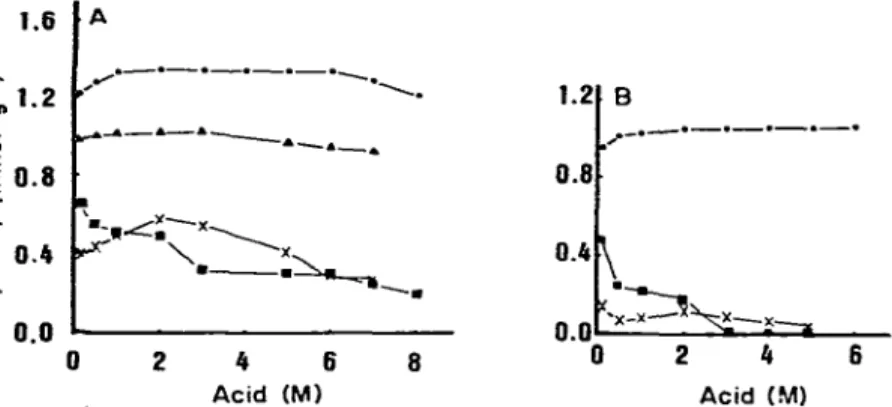
The maximum capacity of the resin, determined by the batch method in perchloric acid medium, was 1.10 mm01 g-’ for silver, 0.65 mm01 g-’ for mercury, 1.34 mm01 g-’ for gold and 0.59 mmol g-l for platinum (Fig.
3A).
The
sulfurcontent of
this resin is1.15 mm01 g-l, so that 1:l complexes are
indicated for the resin functional group with silver and gold while
2:l com- plexes are indicated for mercury and platinum_ Several workers have similarly reported that cysteine binds silver and gold at a 1:l ligand-to-metal ratio [14, 151, but mercury and platinum at a 2:l ratio [12,16] _ The formation of the 1:l complex with gold suggests that gold(II1) was reduced to gold(I) by the resin [ 15]_ The higher than theoretical capacity for gold on the basis of I:1 complex formation in perchloric acid medium may be due to some reduction of gold to the metal. In hydrochloric acid medium, the maximum capacity was 1.16 mmol g-’ for gold, 0.48 mmol g-’ for mercury and 0.14 mm01 g-’ for platinum (Fig. 3B). The formation of a 1: 1 complex of gold with the resin functional group is indicated_ The reduction potential of the metal ions is clearly decreased by the formation of stable chloro complexesin the hydroch!oric
acid medium compared with in perchloric acid medium.
TABLE 6Collection of metal ions from dilute solutions Metal
ion Amount added* (pmol)
&
0.45 0.23 Au 1.50 1.50 0.45 I-k 0.45 0.23 Pt 0.45 0.23 Eluent 6 M HCl-2 M HCIO, 100.2 6 M HCl-2 M HCIO, 98.1 0.1% thiourea in 0.1 M HCI 99.5 lo-' M thiourea in lo-’ M HCI 90.3 0.1% thiourea in 0.1 M HCl 78.4 6 M HCl-2 M HClO, 101.2 6 M HCI-2 M HCIO, 91.1 0.5 hl HCl 99.6 0.5 M HCl 65.7 Recovery (%) =IR 500 ml of 0.1 M HCI.1.6 c 1.2 z g 0.8 i 0.4 P G 0.0 0 2 4 6 8 Acid (Ml ,_._.-.d_._. 0.8 t Acid (M)
Fig. 3. Total capacity of the cysteine-containing resin for metai ions versus molarity of (A) perchloric acid and (B) hydrochloric acid: (0) Au(II1); (A) Ag(1); (I) Hg(I1); (x) Pt(IV).
The lower capacities for mercury and platinum in hydrochloric acid than in
perchloric acid at the same hydrogen concentration can be ascribed to com-
petition of the chloride ion with the resin ligand.
REFERENCES
1 P. Dhar and G. N. Mukherjee, J. Indian Chem. Sot., 56 (1979) 1258. 2 F. E. Beamish, Taiantq 14 (1967) 991.
3 C. A. McAuIiffe and S. G. Murray, Inorg. Chim. Acta Rev., 6 (1972) 103. 4 H. Shindo and T. L. Brown, J. Am. Chem. Sot., 87 (1965) 1904.
5 Y. K. Sze, A. R. Davis and G. A. Neville, Inorg. Chem., 14 (1975) 1969. 6 C. P. Sloan and J. H. Krueger, Inorg. Chem., 14 (1975) 1481.
7 P. de Meester, D. J. Hodgson, H. C. Freeman and C. J. Moore, Inorg. Chem., 16 (1977) 1494.
8 Y. N. Kothari and D. H. Busch, Inorg. Chem., 8 (1969) 2276. 9 A. Kay and P. C. H. Mitchell, J. Chem. Sot. (A), (1970) 2421.
10 V. R. Ott, D. S. Swieter and F. A. Schultz, Inorg. Chem., 16 (1977) 2539.
11 M_ Chandrasenkharan, M. R. Udupa and G. Aravamudan, Inorg. Chim. Acta. 7 (1973) 88; J. Inorg. NucI. Chem., 36 (1974) 1417.
12 G. Pneumatikakis and N. Hadjiliadis, J. Inorg. Nucl. Chem., 41 (1979) 429. 13 F. Vernon and H. Eccles, Anal. Chim. Acta, 82 (1976) 369.
14 G. D. Zegzhda, S. I. Neikovskii, T. V. Zegzhda, F. M. Tulyupa and N. A. Dorofeeva, Chem. Abstr., 90 (1979) 77249d.
15 T. D. Zucconi, G. E. Janauers, S. Donahe and C. Lewkowicz, J. Pharm. Sci., 68 (1979) 426.