Synthesis and Characterization of
Allyl(
β-ketoiminato)palladium(II) Complexes: New
Precursors for Chemical Vapor Deposition of Palladium
Thin Films
Yeng-Lien Tung,
†Wen-Cheng Tseng,
†Chi-Young Lee,
†Peng-Fu Hsu,
†Yun Chi,*
,†Shie-Ming Peng,
‡and Gene-Hsiang Lee
‡Department of Chemistry and Material Research Center, National Tsing Hua University, Hsinchu 30043, Republic of China, and Department of Chemistry and Instrumentation Center,
National Taiwan University, Taipei 10764, Taiwan, Republic of China Received August 28, 1998
Treatment of β-ketoiminates with [(allyl)Pd(µ-Cl)]2 affords volatile, air-stable
allyl(β-ketoiminato)palladium(II) complexes. The structure of [(methallyl)Pd(Phacac)] (Phacac )
MeCOCHCMeNPh) was determined by single-crystal X-ray diffraction. In solution1H NMR
analyses indicate either a direct rotation of a planar allyl ligand about the allyl-palladium axis or a solvent-assisted exchange process involving the transient formation of a mono-dentate ketoiminato ligand. The physical properties of the complexes were modified by
altering the β-ketoiminato or the η3-allyl ligands. Some derivatives are liquid at room
temperature and were known to be suitable for chemical vapor deposition of Pd thin films.
The preparation of thin films of palladium by metal organic chemical vapor deposition (CVD) is becoming increasingly attractive for the fabrication of electronic
devices1 because such films have potentially useful
applications in replacing gold as electrical contacts in integrated circuits and in making gas sensors,
magne-tooptical data storage devices, etc.2The largest obstacle
to CVD of Pd films has been the lack of suitable precursors, as most volatile Pd complexes suffer from
poor stability in air and moisture.3 Recently, this
problem was partially overcome by Puddephatt, who reported the preparation of volatile allyl(β-diketonato)-palladium(II) complexes, which are liquid and stable at room temperature and are excellent CVD precursors for
Pd films.4In view of these results, we felt it desirable
to investigate analogous complexes having
β-ketoimi-nate ligands, which allow for organic functional group variation on the imine nitrogen as a possible way to fine-tune physical and chemical properties. In this article, we report the synthesis and characterization of such β-ketoiminato complexes and a preliminary investiga-tion of their applicainvestiga-tion in the generainvestiga-tion of Pd films.
Experimental Section
General Information and Materials. Infrared spectra
were recorded on a Perkin-Elmer 2000 FT-IR spectrometer.
1H and13C NMR spectra were recorded on a Bruker AM-400
or AMX-300 instrument. Mass spectra were obtained on a JEOL SX-102A instrument operating in fast atom bombard-ment (FAB) mode. Thermogravimetric analyses were made with a Seiko TG/DTA 300 instrument. Melting points were determined using Seiko SSC 5000 differential scanning calo-rimetry. Elemental analyses were performed at the NSC Regional Instrumentation Center at National Cheng Kung University, Tainan, Taiwan.
SEM micrographs of palladium films were obtained using a Hitachi S-4000 scanning electron microscope. Resistivities of films were measured using a LR-400 four-wire AC resistance bridge, manufactured by Linear Research Inc. XPS spectra of films were recorded with a Physical Electronics PHI 1600 ESCA instrument with an Al/Mg dual anode X-ray source. The surface compositions in atomic percentage deduced from XPS spectra were determined after 1-2 min sputtering with argon at 4 keV until a constant composition was obtained. AES spectra for surface scanning and depth profile were recorded on a Physical Electronics PHI 670 Xi Auger instrument after sputtering with argon at 3 keV. XPS is most useful for detection of carbon (detection limit, ca. 0.5%), while Auger spectra are useful to detect oxygen and fluorine in the presence
* To whom correspondence should be addressed. FAX: (886) 3 572-0864. E-mail: [email protected].
†National Tsing Hua University. ‡National Taiwan University.
(1) (a) Bhaskaran, V.; Hampden-Smith, M. J.; Kodas, T. T. Chem. Vap. Deposition 1997, 3, 85. (b) Zhang, Y.; Chio, S. W.-K.; Puddephatt, R. J. J. Am. Chem. Soc. 1997, 119, 9295. (c) Sordelli, L.; Martra, G.; Psaro, R.; Dossi, C.; Coluccia, S. J. Chem. Soc., Dalton Trans. 1996, 765. (d) Thomas, R. R.; Park, J. M. J. Electrochem. Soc. 1989, 136, 1661. (e) Feurer, E.; Suhr, H. Thin Solid Films 1988, 157, 81. (f) Kudo, T.; Yamaguchi, A. Jpn. Pat. JP62 207 868, 1987.
(2) (a) Gliem, R.; Schlamp, G. Met. Technol. 1987, 41, 34. (b) Dubin, V. M.; Lopatin, S. D.; Sokolov, V. G. Thin Solid Films 1993, 226, 94. (c) Dossi, C.; Psaro, R.; Bartsch, A.; Brivio, E.; Galasco, A.; Losi, P. Catal. Today 1993, 17, 527. (d) Hierso, J.-C.; Serp, P.; Feurer, R.; Kalck, P. Appl. Organomet. Chem. 1998, 12, 161.
(3) (a) Gozum, J. E.; Pollina, D. M.; Jensen, J. A.; Girolami, G. S. J. Am. Chem. Soc. 1988, 110, 2688. (b) Yuan, Z.; Jiang, D.; Naftel, S. J.; Sham, T.-K.; Puddephatt, R. J. Chem. Mater. 1994, 6, 2151.
(4) (a) Yuan, Z.; Puddephatt, R. J. Adv. Mater. 1994, 6, 51. (b) Yuan, Z.; Puddephatt, R. J. Chem. Vap. Deposition 1997, 3, 81. (c) Zang, Y.; Yuan, Z.; Puddephatt, R. J. Chem. Mater. 1998, 10, 2293.
10.1021/om980728c CCC: $18.00 © 1999 American Chemical Society Publication on Web 02/05/1999
Downloaded by NATIONAL TAIWAN UNIV on August 18, 2009
of palladium. In all cases analyses are corrected for relative sensitivities of each element.
Allylpalladium complexes with the empirical formula [(allyl)Pd(µ-Cl)]2were prepared according to literature proce-dures.5Ketoimines were prepared from the direct condensation
of acetylacetone and amines at room temperature,6or from
reaction of hexafluoroacetylacetone and amines using mont-morillonite K10 as a catalyst.7 Abbreviations used for the β-ketoiminate ligands are as follows: Mehfac ) CF3COCHCCF3
-NMe, Buhfac ) CF3COCHCCF3NnBu, Mohfac ) CF3
COCHC-CF3NCH2CH2OMe, Alhfac ) CF3COCHCCF3NCH2CHdCH2,
Phacac ) MeCOCHCMeNPh, Meacac ) MeCOCHCMeNMe, Moacac ) MeCOCHCMeNCH2CH2OMe, Alacac )
MeCOCHC-MeNCH2CHdCH2. Two typical synthetic procedures for the
preparation of β-ketoiminato Pd complexes are described below, together with spectral and analytical data for the compounds prepared. Due to thermal instability or physical state, some compounds did not give satisfactory elemental analyses.1H NMR spectra for these complexes (2, 6, 8-11, 13, 14) have been deposited in the Supporting Information.
[Pd(η3-CH
2CMeCH2)(Phacac)] (1). A mixture of distilled
water (40 mL), NaOH (250 mg), and PhacacH (175 mg, 1.00 mmol) was stirred at 45 °C for 30 min to give a homogeneous solution, which was then added to a suspension of [Pd(η3-CH
2
-CMeCH2)(µ-Cl)]2(217 mg, 0.55 mmol) in diethyl ether (20 mL).
The mixture was stirred for 10 min, and the ether layer was separated, washed with distilled water (3× 10 mL) and dried over sodium sulfate; then the solvent was evaporated to give the product [Pd(η3-CH
2CMeCH2)(Phacac)] as a yellow solid
(yield, 289 mg, 86%). Single crystals of 1 suitable for an X-ray diffraction study were obtained from recrystallization in saturated acetone solution at room temperature.
[Pd(η3-CH
2CMeCH2)(Mehfac)] (15). A mixture of diethyl
ether (30 mL), NaOMe (200 mg), and MehfacH (450 mg, 2.04 mmol) was stirred at room temperature for 30 min to give a homogeneous solution, which was then added to a mixture of [Pd(η3-CH
2CMeCH2)(µ-Cl)]2(400 mg, 1.02 mmol) and NaOH
(250 mg) in water (50 mL). The mixture was vigorously stirred for 10 min; the ether layer was separated, washed with distilled water (3× 10 mL), and dried over sodium sulfate. Then the solvent was evaporated to give the product [Pd(η3
-CH2CMeCH2)(Mehfac)] as a yellow solid (yield, 740 mg, 95%). Spectroscopic Data for β-Ketoiminato Complexes. Complex 1, [Pd(η3-CH
2CMeCH2)(Phacac)]. MS (FAB, 107Pd): m/z 335 (M+).1H NMR (300 MHz, CDCl 3, 293 K): δ 7.24 (t, 2H, JHH) 7.5 Hz), 7.00 (t, 1H, JHH) 7.5 Hz), 6.88 (br, 1H), 4.97 (s, 1H), 3.52 (d, 1H, JHH) 2.8 Hz), 2.73 (s, 1H), 2.34 (s, 1H), 2.03 (s, 3H), 1.98 (s, 3H), 1.92 (d, 1H, JHH) 2.8 Hz), 1.64 (s, 3H).13C NMR (75 MHz, CDCl 3, 293 K): δ 178.7, 163.9, 156.9, 130.5, 128.5 (2C), 123.7 (2C), 122.8, 97.3, 58.8, 57.1, 27.1, 23.3, 22.9. Anal. Calcd for C15H19NOPd: C, 53.67; H, 5.70; N,
4.17. Found: C, 53.19; H, 5.65; N, 4.30. Complex 2, [Pd(η3-CH 2CHCH2)(Meacac)].1H NMR (300 MHz, CDCl3, 293 K): δ 5.67-5.54 (m, 1H), 4.80 (s, 1H), 3.78 (d, 1H, JHH) 6.9 Hz), 3.49 (s, 3H), 3.22 (d, 1H, JHH) 6.6 Hz), 3.01 (d, 1H, JHH) 12.5 Hz), 2.71 (d, 1H, JHH) 11.7 Hz), 2.00 (s, 3H), 1.95 (s, 3H).13C NMR (75 MHz, CDCl 3, 293 K): δ 175.8, 165.4, 115.1, 97.8, 60.0, 53.2, 49.1, 26.3, 21.5. Complex 3, [Pd(η3-CH 2CHCHMe)(Meacac)]. MS (FAB, 107Pd): m/z 273 (M+ ).1H NMR (300 MHz, CDCl 3, 293 K): δ 4.78 (s, 1H), 3.54 (d, 1H, JHH) 2.6 Hz), 3.45 (s, 3H), 2.96 (d, 1H, JHH) 2.6 Hz), 2.84 (s, 1H), 2.62 (s, 1H), 2.10 (s, 3H), 1.91 (s, 3H), 1.86 (s, 3H).13C NMR (75 MHz, CDCl 3, 293 K): δ 176.1, 165.4, 130.7, 97.7, 58.5, 53.5, 49.1, 26.5, 23.4, 21.5. Anal.
Calcd for C15H19NOPd: C, 43.89; H, 6.28; N, 5.12. Found: C,
44.27; H, 6.21; N, 5.28.
Complex 4, [Pd(η3-CH
2CMeCH2)(Meacac)]. MS (FAB, 107Pd): m/z 273 (M+ ).1H NMR (300 MHz, CDCl 3, 293 K): δ 5.31-5.21 (m, 1H), 4.74 (s, 1H), 3.70-3.60 (m, 1H), 3.45 (s, 3H), 3.00 (d, 1H, JHH) 6.7 Hz), 2.46 (d, 1H, JHH) 11.5 Hz), 1.94 (s, 3H), 1.90 (s, 3H), 1.29 (d, 3H, JHH) 6.3 Hz).13C NMR (75 MHz, CDCl3, 293 K):δ 177.1, 165.4, 114.3, 97.7, 75.6, 49.3,
49.1, 26.9, 21.2, 16.1. Anal. Calcd for C10H17NOPd: C, 43.89;
H, 6.26; N, 5.12. Found: C, 44.20; H, 6.12; N, 5.22. Complex 5, [Pd(η3-CH
2CMeCH2)(Moacac)]. MS (FAB, 107Pd): m/z 317 (M+ ).1H NMR (300 MHz, CDCl 3, 293 K): δ 5.31-5.21 (m, 1H), 4.93 (s, 1H), 3.96-3.87 (m, 1H), 3.85-3.76 (m, 1H), 3.71-3.61 (m, 1H), 3.50 (t, 2H, JHH) 6.6 Hz), 3.29 (s, 3H), 2.93 (d, 1H, JHH) 6.5 Hz), 2.44 (d, 1H, JHH) 11.6 Hz), 1.93 (s, 3H), 1.91 (s, 3H), 1.31 (d, 3H, JHH) 6.2 Hz).13C NMR (75 MHz, CDCl3, 293 K): δ 177.8, 165.3, 133.7, 98.1,
76.2, 73.5, 59.3, 59.0, 48.8, 27.1, 21.2, 16.0. Anal. Calcd for C12H21NO2Pd: C, 45.37; H, 6.66; N, 4.41. Found: C, 45.80; H,
6.56; N, 4.60.
Complex 6, [Pd(η3-CH
2CMeCH2)(Alacac)]: MS (FAB, 107Pd): m/z 299 (M+ ).1H NMR (300 MHz, CDCl 3, 293 K): δ 5.91-5.79 (m, 1H), 5.14-5.07 (m, 2H), 4.80 (s, 1H), 4.36-4.33 (m, 2H), 3.56 (d, 1H, JHH) 2.8 Hz), 2.86 (d, 1H, JHH) 2.8 Hz), 2.82 (s, 1H), 2.60 (s, 1H), 2.08 (s, 3H), 1.96 (s, 3H), 1.88 (s, 3H). 13C NMR (75 MHz, CDCl 3, 293 K): δ 176.8, 165.5, 135.6, 130.6, 114.6, 98.0, 62.0, 58.4, 54.5, 26.7, 23.2, 21.0. Complex 7, [Pd(η3-CH 2CMeCHMe)(Meacac)]: MS (FAB, 107Pd): m/z 287 (M+).1H NMR (300 MHz, CDCl 3, 293 K): δ 5.06 (dd, 1H, JHH) 12.0, 7.1 Hz), 4.72 (s, 1H), 3.45 (s, 3H), 3.00 (d, 1H, JHH) 7.1 Hz), 2.64 (d, 1H, JHH) 12.0 Hz), 1.89 (s, 3H), 1.84 (s, 3H), 1.40 (s, 3H), 1.20 (s, 3H).13C NMR (75 MHz, CDCl3, 293 K): δ 177.8, 165.6, 108.5, 97.5, 88.7, 49.1,
46.7, 27.2, 25.0, 21.0, 20.9. Anal. Calcd for C11H19NOPd: C,
45.93; H, 6.66; N, 4.87. Found: C, 46.66; H, 6.46; N, 4.95.
Complex 8, [Pd(η3-CH
2CHCMe2)(Moacac)]. MS (FAB, 107Pd): m/z 331 (M+).1H NMR (300 MHz, CDCl 3, 293 K): δ 5.09 (dd, 1H, JHH) 12.0 Hz, 7.2 Hz), 4.74 (s, 1H), 3.97-3.80 (m, 2H), 3.54 (t, 2H, JHH) 3 Hz), 3.33 (s, 3H), 2.96 (dd, 1H, JHH) 7.3 Hz, 1.3 Hz), 2.63 (dd, 1H, JHH) 12.0, 1.3 Hz), 1.93 (s, 3H), 1.92 (s, 3H), 1.44 (s, 3H), 1.22 (s, 3H).13C NMR (75 MHz, CDCl3, 293 K): δ 178.6, 165.5, 108.1, 98.1, 86.6, 73.5, 59.3, 59.1, 46.2, 27.4, 25.1, 21.1, 21.0. Complex 9, [Pd(η3-CH 2CMeCMeCH2OMe)(Moacac)]: MS (FAB,107Pd): m/z 375 (M+ ).1H NMR (300 MHz, CDCl 3, 293 K): δ 4.74 (s, 1H), 3.87 (t, 2H, JHH) 6.3 Hz), 3.64 (d, 1H, JHH ) 10.6 Hz), 3.51 (t, 2H, JHH) 6.3 Hz), 3.32 (s, 3H), 3.16 (s, 3H), 3.10 (d, 1H, JHH) 10.6 Hz), 2.96 (d, 1H, JHH) 1.1 Hz), 2.86 (d, 1H, JHH) 1.1 Hz), 2.11 (s, 3H), 1.92 (s, 3H), 1.91 (s, 3H), 1.40 (s, 3H).13C NMR (75 MHz, CDCl 3, 293 K):δ 178.3, 165.4, 123.5, 98.0, 80.7, 73.4, 73.0, 59.1 (2C), 57.3, 51.6, 27.2, 21.2 (2C), 17.1. Complex 10, [Pd(η3-CH 2CMeCMeCH2OMe)(Mehfac)]. MS (FAB,107Pd): m/z 439 (M+ ).1H NMR (300 MHz, CDCl 3, 293 K): δ 5.60 (s, 1H), 3.74 (d, 3H, JHH) 2.0 Hz), 3.62 (d, 1H, JHH) 10.7 Hz), 3.32 (s, 1H), 3.18 (s, 3H), 3.12 (d, 1H, JHH) 10.7 Hz), 3.11 (s, 1H), 2.17 (s, 3H), 1.39 (s, 3H).13C NMR (75 MHz, CDCl3, 293 K): δ 166.1 (q, CO, JCF) 32 Hz), 155.6 (q, CN, JCF) 26 Hz), 126.9, 120.1 (q, CF3, JCF) 282 Hz), 120.0 (q, CF3, JCF) 286 Hz), 87.5, 84.9, 73.7, 58.3, 55.1, 50.7, 21.6, 18.2. Complex 11, [Pd(η3-CH 2CMeCMeCH2OMe)(Mohfac)]. 1H NMR (300 MHz, CDCl 3, 293 K): δ 5.61 (s, 1H), 4.10-4.03 (m, 2H, JHH) 6.9 Hz), 3.65-3.57 (m, 3H), 3.38 (d, 1H, JHH) 10.6 Hz), 3.35 (s, 3H), 3.19 (s, 3H), 3.13 (s, 1H), 3.10 (d, 1H, JHH) 10.6 Hz), 2.19 (s, 3H), 1.40 (s, 3H).13C NMR (75 MHz, CDCl3, 293 K): δ 166.4 (q, CO, JCF) 32 Hz), 156.1 (q, CN, JCF) 26 Hz), 126.6, 120.0 (q, CF3, JCF) 286 Hz), 119.9 (q, CF3, JCF) 279 Hz), 87.6, 85.2, 74.6, 73.6, 60.8, 59.8, 58.4, 55.6, 21.5, 18.2.
(5) (a) Robinson, S. D.; Shaw, B. L. J. Chem. Soc. 1963, 4806. (b) Sakakibara, M.; Takahashi, Y.; Sakai, S.; Ishii, Y. J. Chem. Soc., Chem. Commun. 1969, 396. (c) Akermark, B.; Hansson, S.; Krakenberger, B.; Vitagliano, A.; Zetterberg, K. Organometallics 1984, 3, 679.
(6) Greenhill, J. V. J. Chem. Soc. Rev. 1977, 6, 277.
(7) Braibante, M. E. F.; Braibante, H. S.; Missio, L.; Andricopulo, A. Synthesis 1994, 898.
Allyl(β-ketoiminato)palladium(II) Complexes Organometallics, Vol. 18, No. 5, 1999 865
Downloaded by NATIONAL TAIWAN UNIV on August 18, 2009
Complex 12, [Pd(η3-CH 2CHCH2)(Mehfac)]. MS (FAB, 107Pd): m/z 367 (M+).1H NMR (300 MHz, CDCl 3, 293 K): δ 5.82-5.67 (m, 1H), 5.67 (s, 1H), 4.07 (d, 1H, JHH) 6.8 Hz), 3.78 (s, 3H), 3.53 (d, 1H, JHH) 6.5 Hz), 3.24 (d, 1H, JHH) 12.4 Hz), 2.94 (d, 1H, JHH ) 11.8 Hz). 13C NMR (75 MHz, CDCl3, 293 K): δ 165.6 (q, CO, JCF ) 33 Hz), 155.6 (q, CN, JCF) 27 Hz), 120.2 (q, CF3, JCF) 282 Hz), 120.0 (q, CF3, JCF
) 286 Hz), 117.8, 87.5, 63.3, 57.1, 50.9. Anal. Calcd for C9H9
-NOF6Pd: C, 29.41; H, 2.47; N, 3.81. Found: C, 30.30; H, 2.64; N, 4.05. Complex 13, [Pd(η3-CH 2CHCH2)(Buhfac)].1H NMR (300 MHz, CDCl3, 293 K): δ 5.81-5.68 (m, 1H), 5.64 (s, 1H), 4.07 (d, 1H, JHH) 6.7 Hz), 3.89-3.79 (m, 2H), 3.41 (d, 1H, JHH) 6.7 Hz), 3.22 (d, 1H, JHH) 12.2 Hz), 2.94 (d, 1H, JHH) 12.2 Hz), 1.71 (m, 2H, JHH) 7.2 Hz), 1.34 (m, 2H, JHH) 7.2 Hz), 0.93 (t, 3H, JHH) 7.2 Hz).13C NMR (75 MHz, CDCl3, 293 K): δ 165.6 (q, CO, JCF) 32 Hz), 154.5 (q, CN, JCF) 26 Hz), 120.2 (q, CF3, JCF) 277 Hz), 120.1 (q, CF3, JCF) 286 Hz), 117.1, 87.4, 63.4, 62.3, 56.6, 36.5, 20.9, 14.5. Complex 14, [Pd(η3-CH 2CHCH2)(Mohfac)]. MS (FAB, 107Pd): m/z 411 (M+).1H NMR (300 MHz, CDCl 3, 293 K): δ 5.82-5.68 (m, 1H), 5.66 (s, 1H), 4.08 (m, 2H, JHH) 6.7 Hz), 4.09-4.06 (m, 1H), 3.61 (t, 1H, JHH) 6.7 Hz), 3.53 (d, 1H, JHH) 6.1 Hz), 3.33 (s, 3H), 3.21 (d, 1H, JHH) 12.4 Hz), 2.95 (d, 1H, JHH) 11.9 Hz).13C NMR (75 MHz, CDCl3, 293 K): δ 166.3 (q, CO, JCF) 34 Hz), 156.1 (q, CN, JCF) 27 Hz), 120.0 (q, 2CF3, JCF) 287 Hz), 117.3, 87.6, 74.4, 63.4, 61.1, 59.8, 57.4.
Anal. Calcd for C11H13NO2F6Pd: C, 32.09; H, 3.18; N, 3.40.
Found: C, 30.89; H, 3.07; N, 3.30.
Complex 15, [Pd(η3-CH
2CMeCH2)(Mehfac)]. MS (FAB, 107Pd): m/z 381 (M+ ).1H NMR (300 MHz, CDCl 3, 293 K): δ 5.65 (s, 1H), 3.84 (d, 1H, JHH) 2.2 Hz), 3.77 (q, 3H, JHF) 2.0 Hz), 3.30 (d, 1H, JHH) 2.2 Hz), 3.08 (s, 1H), 2.84 (s, 1H), 2.19 (s, 3H).13C NMR (75 MHz, CDCl 3, 293 K): δ 165.5 (q, CO, JCF) 32 Hz), 155.4 (q, CN, JCF) 26 Hz), 134.0, 120.2 (q, CF3, JCF) 282 Hz), 120.0 (q, CF3, JCF) 285 Hz), 87.4, 61.7, 57.0,
50.8, 23.9. Anal. Calcd for C10H11NOF6Pd: C, 31.47; H, 2.91;
N, 3.67. Found: C, 32.15; H, 2.90; N, 3.88.
Complex 16, [Pd(η3-CH
2CMeCH2)(Alhfac)]. MS (FAB, 107Pd: m/z 407 (M+).1H NMR (300 MHz, CDCl 3, 293 K): δ 5.96-5.84 (m, 1H), 5.68 (s, 1H), 5.20 (d, 1H, JHH) 10.2 Hz), 5.12 (d, 1H, JHH) 18.0 Hz), 4.57 (s, 2H), 3.84 (d, 1H, JHH) 2.7 Hz), 3.18 (d, 1H, JHH) 2.7 Hz), 3.18 (s, 1H), 2.82 (s, 1H), 2.12 (s, 3H).13C NMR (75 MHz, CDCl 3, 293 K): δ 166.2 (q, CO, JCF) 32 Hz), 155.4 (q, CN, JCF) 26 Hz), 136.4, 133.6, 120.2 (q, CF3, JCF) 282 Hz), 120.1 (q, CF3, JCF ) 286 Hz),
116.6, 87.3, 66.5, 63.4, 58.3, 23.5. Anal. Calcd for C12H13NOF6
-Pd: C, 35.36; H, 3.21; N, 3.44. Found: C, 35.97; H, 3.14; N, 3.61.
X-ray Crystallography. The X-ray diffraction
measure-ment was carried out on a Nonius CAD-4 diffractometer at room temperature. Lattice parameters were determined from 25 randomly selected high-angle reflections. Three standard reflections were monitored every 3600 s. No significant varia-tion in intensities (e1%) was observed during the course of all data collection. Intensities of diffraction signals were corrected for Lorentz, polarization, and absorption effects (ψ scans). The structure was solved with the NRCC-SDP-VAX package. All non-hydrogen atoms had anisotropic temperature factors, while hydrogen atoms of organic substituents were placed at calculated positions with UH ) UC + 0.1. The
crystallographic refinement parameters of complex 1 are summarized in Table 1.
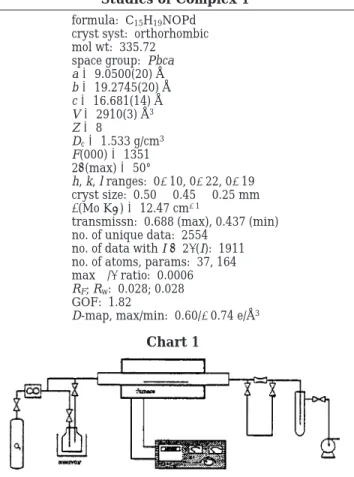
CVD Procedures. Thermal CVD reactions were conducted
in a horizontal hot-wall Pyrex reactor, consisting of a Pyrex tube of internal diameter 25 mm, placed within an electric temperature-controlled tube furnace, as described in Chart 1. Precursors were loaded in the glass container. The carrier gas was introduced through a side arm of the container and became saturated with vapors of palladium precursors before entering the hot zone. Si substrates were cleaned using the
RCA cleaning method; SiO2substrates were placed in dilute
HF solution for 12 h, and then washed with deionized water and dried at 120 °C for 10 min. The flow rate of carrier gas was adjusted to 20-40 mL/min. The duration of deposition was typically between 30 min and 1 h.
Results and Discussion
Synthesis and Characterization of Precursors.
The synthesis ofβ-ketoimine ligands involved the simple
condensation of acetylacetone and a primary amine
(H2-NR1; R1 ) Ph, Me, Bun, methoxyethyl, allyl) in an
aromatic solvent.6After the mixture was stirred at room
temperature for 2 days, the freeβ-ketoimine was then
isolated in 75-89% yields. The preparations involving hexafluoroacetylacetone (hfacH) utilized K-10
mont-morillonite as a catalyst7 to afford the analogous
fluorine-substitutedβ-ketoimine ligand in 60-85% yield
upon heating in CHCl3solvent for 2 days (Scheme 1).
Formation of the ammonium salt [hfac][NH3R],8 a
kinetic product obtained by direct mixing of hexafluo-roacetylacetone with amine, was not observed. The latter synthetic procedure is effective for the large-scale generation of the required
bis(trifluoromethyl)-substi-tutedβ-ketoimine ligands.
Table 1. Crystal Data for the X-ray Diffraction Studies of Complex 1
formula: C15H19NOPd cryst syst: orthorhombic mol wt: 335.72
space group: Pbca a ) 9.0500(20) Å b ) 19.2745(20) Å c ) 16.681(14) Å V ) 2910(3) Å3 Z ) 8 Dc) 1.533 g/cm3 F(000) ) 1351 2θ(max) ) 50° h, k, l ranges: 0-10, 0-22, 0-19 cryst size: 0.50× 0.45 × 0.25 mm µ(Mo KR) ) 12.47 cm-1
transmissn: 0.688 (max), 0.437 (min) no. of unique data: 2554
no. of data with I > 2σ(I): 1911 no. of atoms, params: 37, 164 max∆/σ ratio: 0.0006 RF; Rw: 0.028; 0.028 GOF: 1.82
D-map, max/min: 0.60/-0.74 e/Å3
Chart 1
Scheme 1
Downloaded by NATIONAL TAIWAN UNIV on August 18, 2009
The complexes [(allyl)Pd(µ-Cl)]2 were prepared
ac-cording to literature methods.5 Five allyl complexes
were synthesized; their molecular structures are
Our synthetic strategy was to select congested, highly substituted allyl ligands while avoiding unnecessarily large organic substituents which could reduce the volatility of the palladium complexes.
In the synthesis of allyl(β-ketoiminato)palladium(II)
complexes, theβ-ketoimine ligand is first converted to
theβ-ketoiminate salt on treatment with a slight excess of NaOH in aqueous media or NaOMe in diethyl ether. Mixing this solution with a second solution containing
[(allyl)Pd(µ-Cl)]2in equal proportion generates the allyl
β-ketoiminato complexes (allyl ) C3H5, C3H4Me, C3H3
-Me2, C3H2Me2(CH2OMe); Scheme 2). Theβ-ketoiminato
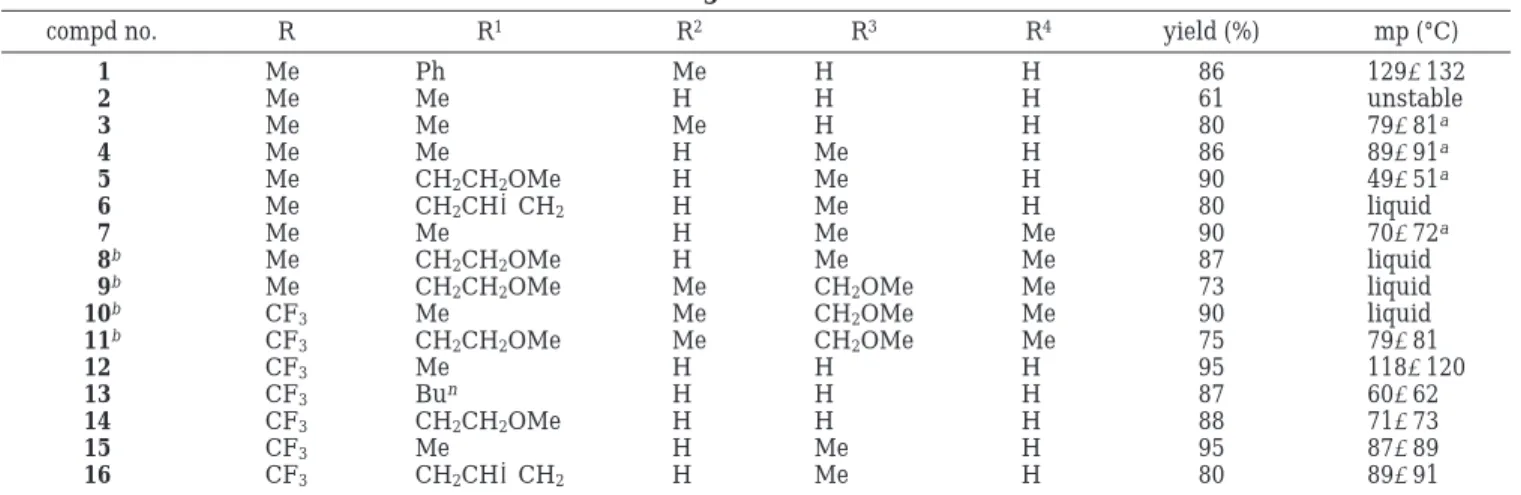
Pd complexes prepared during this study are listed in Table 2, along with their structural properties, reaction yields, and melting points.
The physical properties of the β-ketoiminate
com-plexes differ substantially: 1 possesses the highest melting point and is relatively nonvolatile at room temperature, while 2 is unstable at room temperature and even decomposes to form a Pd film on the wall of the reaction flask during workup. Complexes 1, 8-10, and 14-16 can be stored at room temperature for long periods, whereas other less stable analogues have to be kept below 0 °C to avoid decomposition. The thermal stability of the Pd complexes can be improved by
changing the substituents R on the ketoimine ligand from Me to CF3, increasing the numbers of methyl
substituents on theη3-allyl ligand, or attaching a bulky
or long-chain hydrocarbon, such as an n-butyl, meth-oxyethyl, or allyl group to the nitrogen of the ketoimi-nato ligand. Evidently, steric interactions on both the
η3-allyl andβ-ketoiminate ligands is the principal factor
that stabilizes these complexes. The presence of a methoxy and a second allyl pendant also seems to improve the thermal stability.
The volatility and thermal stability of the Pd com-pounds were investigated, since these are important in CVD applications. Using thermogravimetric analysis (TGA) it was found that Pd complexes with ketoimine ligands derived from acetylacetone are less thermally stable. This effect is best seen from the TGA of 8, which exhibits a sudden weight loss of 68% between 146 and 182 °C and which leaves a black residue nearly equiva-lent to the theoretical weight of Pd metal. In contrast, complexes derived from hexafluoroacetylacetone are more volatile and robust under conditions of TGA experiments. Thus, most of these fluorine-substituted complexes partially evaporated and partially decom-posed, producing a small amount of metallic Pd residue. Of particular interest is the TGA of 10, which showed a simple one-step loss of nearly 100% within the temperature range 139-175 °C. This observation is consistent with highly effective transportation of Pd metal into the gas phase without decomposition.
The physical properties, such as the melting point, of the Pd complexes can be modified by changing the ligand environment to give liquid CVD precursors having distinct advantages in applications due to their
reproducible and steady rates of evaporation.9As
indi-cated in Table 2, complexes 4-12 possess fairly low melting points and show potential for CVD application as liquid precursors, while complexes 8-10 exist as slightly viscous liquid materials at room temperature. Structure of Ketoiminato Complexes. Confirma-tion of the molecular structure was provided by a single-crystal X-ray analysis of the N-substituted phenyl complex 1. As can be seen from Figure 1, the Pd atom possesses a distorted-square-planar coordination
envi-ronment consisting of O and N atoms of the
β-ketoimi-nate ligand and C(1) and C(3) of the allyl ligand. The Pd-O distance (2.056(3) Å) is nearly equal to that of (8) Shin, H.-K.; Hampden-Smith, M. J.; Kodas, T. T.; Rheingold, A.
L. J. Chem. Soc., Chem. Commun. 1992, 217.
(9) (a) Maury, F. J. Phys. IV 1995, C5, 449. (b) Maury, F. Chem. Vap. Deposition 1996, 2, 113.
Table 2. Structures and Melting Points of Palladium Precursors 1-16
compd no. R R1 R2 R3 R4 yield (%) mp (°C)
1 Me Ph Me H H 86 129-132 2 Me Me H H H 61 unstable 3 Me Me Me H H 80 79-81a 4 Me Me H Me H 86 89-91a 5 Me CH2CH2OMe H Me H 90 49-51a 6 Me CH2CHdCH2 H Me H 80 liquid 7 Me Me H Me Me 90 70-72a 8b Me CH 2CH2OMe H Me Me 87 liquid 9b Me CH
2CH2OMe Me CH2OMe Me 73 liquid
10b CF 3 Me Me CH2OMe Me 90 liquid 11b CF 3 CH2CH2OMe Me CH2OMe Me 75 79-81 12 CF3 Me H H H 95 118-120 13 CF3 Bun H H H 87 60-62 14 CF3 CH2CH2OMe H H H 88 71-73 15 CF3 Me H Me H 95 87-89 16 CF3 CH2CHdCH2 H Me H 80 89-91
aSample decomposed upon melting.bSelected for CVD experiments.
Scheme 2
Allyl(β-ketoiminato)palladium(II) Complexes Organometallics, Vol. 18, No. 5, 1999 867
Downloaded by NATIONAL TAIWAN UNIV on August 18, 2009
the Pd-N distance (2.066(3) Å), while the N-C(8) distance (1.308(5) Å) and its adjacent C(7)-C(8) distance (1.407(6) Å) are also similar to the O-C(6) distance (1.275(5) Å) and the respective C(6)-C(7) distance (1.372(6) Å), indicating formation of evenly distributed
and delocalizedπ-interactions on the ketoiminato ligand.
The Pd-C distances and the N-Pd-C(1) and O-Pd-C(3) angles, respectively, are within the limits of experimental error of the related ketoiminate complex, but the latter contains a nondelocalized ketoiminato
ligand.10
For compounds that contain an asymmetricη3-allyl
ligand, only one set of 1H NMR proton signals were
observed for all examples at even lower temperature. Thus, only one isomer is present in solution for the
asymmetric η3-allyl complexes, in which the
non-hydrogen substituents are believed to be located at the
position trans to the nitrogen atom of theβ-ketoiminate
ligand, because of reduced steric interaction.
Fluxional Behavior in Solution. The allyl( β-ke-toiminato)palladium complexes possess novel dynamic behavior in solution, as revealed from the
variable-temperature 1H NMR studies of methallyl complexes
3, 6, 15, and 16 in CDCl3, toluene, or DMSO. For instance, olefinic proton signals of the methallyl ligand
in complex 6 appear atδ 3.48 (JHH) 2.8 Hz), 2.72, 2.58
(JHH) 2.8 Hz), and 2.33 in d8-toluene at room
temper-ature. These four signals are assigned to syn, anti, syn,
and anti protons on the basis of the pattern of 4JHH
coupling observed. When the temperature is raised to 343 K, all signals broadened substantially, indicating the onset of chemical exchange. This behavior was
confirmed by a1H NMR spin saturation transfer
experi-ment conducted on complex 3 in CDCl3solution at room
temperature. In the latter experiment, irradiation of one anti proton signal led to the complete suppression of the second anti signal but gave no obvious diminution of the syn proton signals. The same observation was noted on irradiation of the syn proton signals under similar
conditions. These 1H NMR SST experiments clearly
indicate the presence of a dynamic process that causes the pairwise exchange between pairs of anti protons and syn protons but produces no scrambling among the anti and syn protons.
The fluxional behavior was observed to be more rapid in a polar organic solvent. This is best exemplified by
the variable-temperature1H NMR studies of complex
6 in d6-DMSO. As seen in Figure 2, the syn protons at δ 3.41 and 2.87 and the anti protons at δ 2.75 and 2.61 observed at room temperature broaden substantially when the temperature is increased. When the temper-ature is raised to 353 K, the anti protons produce a
broad signal atδ 2.71, while the syn protons completely
merge into the baseline; no coalescence of syn protons was observed at this temperature because their
chemi-cal shifts differ greatly. Moreover, the 1H NMR
spec-trum of 16 in d6-DMSO at room temperature exhibits
only two signals: one is a broad signal at δ 3.62 and
the second is a relatively sharp signal atδ 3.07 due to
syn and anti protons, which is in marked contrast to
observation of four distinct olefinic signals of η3-allyl
ligand in CDCl3or d8-toluene solution, confirming the
(10) Claverini, R.; Ganis, P.; Pedone, C. J. Organomet. Chem. 1973, 50, 327.
Figure 1. Molecular structure of complex 1, emphasizing
the coordination environment about Pd and showing the atomic numbering scheme. Relevant bond distances (Å): Pd-O ) 2.056(3), Pd-N ) 2.066(3), N-C(8) ) 1.308(5), O-C(6) ) 1.275(5), C(6)-C(7) ) 1.372(6), C(7)-C(8) ) 1.407(6), Pd-C(1) ) 2.097(4), Pd-C(2) ) 2.116(4), Pd-C(3) ) 2.139(4), C(1)-C(2) ) 1.410(6), C(2)-C(3) ) 1.399(6). Bond angles (deg): O-Pd-N ) 91.2(1), N-Pd-C(1) ) 101.5(2), O-Pd-C(3) ) 99.3(2).
Figure 2. Variable-temperature 13C NMR spectra (d6-DMSO) of 6, showing the olefinic protons of the methallyl ligand.
Downloaded by NATIONAL TAIWAN UNIV on August 18, 2009
existence of a similar, but much faster, pairwise ex-change of syn and anti protons.
The lack of interchange between syn and anti protons in all experiments clearly shows that the fluxional
process is not due to aη3-η1-η3interconversion of the
allyl ligand.11Other likely explanations would be 180°
rotation of the planar η3-allyl ligand about the
allyl-palladium axis12 and the formation of a
solvent-coordinated intermediate that contains either an O-bound or a N-O-bound monodentate ketoiminato ligand, followed by interchange of the solvent molecule and the ketoiminato ligand (Scheme 3), as both latter processes would average the environment of syn-syn and anti-anti protons, but not interchange syn and anti-anti protons. Direct rotation of the allyl ligand seems to be the process occurring in chloroform or toluene, as these nonpolar solvents coordinate poorly to the Pd atom. However, on altering the solvent to DMSO, incorporation of the solvent molecule into the coordination sphere of the palladium atom is more facile; thus, the solvent-assisted pathway becomes the dominant exchange process in solution. Interestingly, this exchange pathway is mecha-nistically similar to that observed in palladium com-plexes [(allyl)PdClL], generated by the addition of DMSO, phosphine, or arsine ligand, to allylpalladium
chloride complexes [(allyl)Pd(µ-Cl)]2.13
CVD of Palladium. CVD experiments were con-ducted in a horizontal hot wall reactor with selected ketoiminato precursors 8-11 at reduced pressure. Other complexes were not tested in CVD experiments because of low volatility and poor thermal stability. The experi-ments were carried out at 200-300 °C and precursor samples were kept between 25 and 70 °C, with oxygen as carrier gas (20-40 mL/min) to suppress carbon
impurities.14Although experimental conditions were not
optimized, the Pd films obtained were shiny and mir-rorlike. They adhered well to silicon substrates but poorly to SiO2, as tested by scratch or adhesive-tape tests. Preliminary XPS and Auger spectroscopy identify the films prepared from 8 and 9 as g98% Pd with e2% of carbon and no nitrogen contamination, while films from 10 and 11 differ in that detectable amounts (<2%) of residual fluorine are retained, when the deposition experiments were conducted at 200-300 °C. However, when the deposition temperature is increased to 300 °C and the flow rate of oxygen carrier gas to 40 mL/min,
the amount of carbon impurities dropped to∼1%, which
represents the best film we obtained in this work. A summary of typical experimental conditions, together with analytical data for palladium films, is given in Table 3. Electrical conductivity measurement of films
in one example give a resistivity of 1.6 × 10⁻⁵ Ω cm,
slightly higher than that of bulk Pd metal (1.1× 10⁻⁵
Ω cm). Again, this effect is attributed to incorporation of carbon impurities in the Pd films.
Conclusion. Allyl(β-ketoiminato)palladium(II) com-plexes can serve as precursors for chemical vapor deposition of Pd thin films. Unlike diketonato
com-pounds reported previously,4 which require fairly
ex-pensive fluorinated diketonato ligands, the compounds discussed herein can be prepared in good yields from easily accessible and inexpensive commercially available materials. Furthermore, the melting points and thermal stabilities of these precursors can be tailored by
sys-tematic modification of the η3-allyl or β-ketoiminato
group. After appropriate adjustment of substituents, some complexes display excellent thermal stability and volatility at or above room temperature. In the case of complexes 8-10, stable liquid phases are obtained: they are among the best CVD precursors for Pd thin films reported to date.
Acknowledgment. We thank the National Science Council of the Republic of China for financial support (Grant No. NSC 87-2113-M007-027-COM).
Supporting Information Available: Tables of atomic
coordinates and anisotropic thermal parameters for complex
1 and1H NMR spectra for complexes 2, 6, 8-11, 13, and 14.
This material is available free of charge via the Internet at http://pubs.acs.org.
OM980728C
(11) (a) Cotton, F. A.; Faller, J. W.; Musco, A. Inorg. Chem. 1967, 6, 179. (b) van Leeuwen, P. W. N. M.; Praat, A. P. J. Chem. Soc., Chem. Commun. 1970, 365.
(12) (a) Davison, A.; Rode, W. C. Inorg. Chem. 1967, 6, 2124. (b) Faller, J. W.; Incorvia, M. J. Inorg. Chem. 1968, 7, 840. (c) Faller, J. W.; Incorvia, M. J.; Thomsen, M. E. J. Am. Chem. Soc. 1969, 91, 518. (13) Ramey, K. C.; Statton, G. L. J. Am. Chem. Soc. 1966, 88, 4387.
(14) Hierso, J.-C.; Satto, C.; Feurer, R.; Kalck, P. Chem. Mater. 1996, 8, 2481.
Scheme 3 Table 3. Deposition Conditions and Thin-Film
Propertiesa atom % precursor sample temp (°C) deposition temp (°C) O2flow rate (mL/min) Pd C F 8 70 300 10.0 95 4.2 8 70 300 40.0 98 1.5 8 70 200 40.0 98 2.0 9 70 250 40.0 98 1.2 10 25 200 34.0 97 1.5 1.4 10 60 200 25.0 97 1.4 1.6 11 60 300 35.0 97 1.2 1.2 11 60 200 25.0 97 1.4 2.1 aAll experiments were carried out under a pressure of (1-3)× 10-2Torr, depending on the O
2flow rate; substrates were broken Si wafers.
Allyl(β-ketoiminato)palladium(II) Complexes Organometallics, Vol. 18, No. 5, 1999 869
Downloaded by NATIONAL TAIWAN UNIV on August 18, 2009