國
立
交
通
大
學
電子工程學系 電子研究所碩士班
碩
士
論
文
利用 MPEG-21 REL 實現數位影像廣播系統中
的數位內容保護
A Digital Content Protection Scheme Using
MPEG-21 REL with Applications to DVB
Systems
研 究 生:施瑛姿
指導教授:杭學鳴 博士
利用 MPEG-21 REL 實現數位影像廣播系統中的數位內容保護
A Digital Content Protection Scheme Using MPEG-21 REL
with Applications to DVB systems
研究生: 施瑛姿
Student: Ying-Tzu Shih
指導教授: 杭學鳴
Advisor: Hsueh-Ming Hang
國 立 交 通 大 學
電子工程學系 電子研究所碩士班
碩 士 論 文
A Thesis
Submitted to Department of Electronics Engineering & Institute of Electronics National Chiao Tung University
in partial Fulfillment of the Requirements for the Degree of
Master in
Electronics Engineering
November 2005
HsinChu, Taiwan, Republic of China
利用 MPEG-21 REL 實現數位影像廣播系統中的數
位內容保護
研究生: 施瑛姿
指導教授: 杭學鳴 博士
國立交通大學
電子工程學系 電子研究所碩士班
摘要
在數位電視中,條件式存取(Conditional Access)提供了設定存取限
制的方法。但是一般的條件式存取系只能對數位內容提供存取的限制,並
無法更進一步地對接收到的內容之使用權限做保護及控管。本論文的目的
是利用MPEG REL在數位電視系統上實現條件式存取以及權限管理。證明可
以使用MPEG REL作為數位影像廣播系統(DVB)以及數位權限管理系統(DRM)
的橋樑。在本論文中,我們把MPEG REL的License放入至DVB-SI中廣播出去,
使接收端可以根據收到的License來控制使用者的使用權限。於是我們設計
了兩個應用系統來證明透過廣播MPEG REL的License不僅可以做到條件式存
取還可以達到權限管理的功能。另外,在我們的應用中為了達到存取限制,
還設計了一個金鑰管理機制。
A Digital Content Protection Scheme Using
MPEG-21 REL with Applications to DVB Systems
Student: Ying-Tzu Shih
Advisor: Dr. Hsueh-Ming Hang
Department of Electronic Engineering & Institute of Electronics
National Chiao Tung University
Abstract
In a digital TV system, the Conditional Access (CA) system is essential to protect digital contents from unauthorized use. However, an ordinary CA system has only the ability to restrict the access to certain material. It cannot provide a further protection and prohibit unauthorized uses after the content has been downloaded and descrambled. The goal of the thesis is to use the MPEG REL to implement both the CA and the rights management systems. We will show how one can use the MPEG REL to bridge the gap between a DVB system and a DRM system. In this thesis, we insert a license, according to MPEG-21 REL expressions, into the Service Information of a DVB bit stream. With this license, the operators can
constrain the user’s operations on the content through the DRM system and the smart card. To demonstrate the method we propose, we implement two application examples to show that using the REL can achieve both conditional access protection of digital content and manage the utilization of digital assets. In addition to the usage control of the MPEG REL, we also
propose a key management machine in our applications to protect the content from being illegal accessed.
誌謝
很感謝我的指導教授 杭學鳴 老師這兩年來對我的指導,並且提供我機會參與工研 院的計畫,讓我學習到許多相關的知識。在生活上,老師也給予我們很多的關懷與鼓勵, 支持我度過那些困境,我才能夠持續下去完成我的碩士論文,我真的非常感激。 此外,我也要感謝峰誠學長,他這段日子裡不吝提供經驗,在我論文的準備過程中, 多虧有學長的幫助,我才能順利完成。當然,我也非常感謝 Commlab 內一起打拼的夥 伴,他們讓我的研究所的生活非常歡樂與溫馨。 最後,我要感謝我的親人以及德原和秀慧。你們的支持與包容,讓我能夠心無旁鶩 的準備我的論文,在此,謹獻上我最高的謝意。Contents
摘要 ...i
Abstract...ii
Chapter 1 Introduction... 1
Chapter 2 Digital Video Broadcasting System ... 4
2.1 Anatomy of an MPEG-2 Stream... 4
2.2 Service Information in DVB systems ... 8
2.2.1 Service Information Description ... 9
2.2.2 Event Information Table ... 12
2.3 Conditional Access Control ... 14
Chapter 3 TwinHan DVB-T PCI Card SDK... 17
3.1 Component Object Model ... 17
3.2 DirectShow ... 18
3.3 TwinHan DTV SDK ... 19
Chapter 4 MPEG-21 Rights Expression Language specification... 24
4.1 Objectives [7] ... 24 4.2 Data Model ... 25 4.2.1 License... 27 4.2.2 Grant ... 27 4.2.3 Principal... 27 4.2.4 Right ... 28 4.2.5 Resource ... 29 4.2.6 Condition ... 30 4.2.7 Issuer... 30
4.3 Extensibility and Profiling... 31
4.4 Authorization Model... 34
4.5 The Relation with The Other standards in MPEG-21 ... 37
Chapter 5 Application Exapmples of the DRM system... 38
5.1 Application One – Digital TV Conditional Access... 40
5.1.1 Cryptography ... 41
5.1.2 Key Management... 44
5.1.4 An Implementation of the Condition Access Scheme ... 51
5.1.5 Conditional Access Demonstration System... 55
5.2 Application 2 –Validity Interval Condition ... 59
5.2.1 MPEG-21 REL Reference Software... 60
5.2.2 Implementation of Validity Interval Condition ... 64
5.2.3 Demo of Validity Interval Condition Scenario ... 66
Chapter 6 Conclusion ... 72
6.1 Contributions ... 72
6.2 Future Works ... 72
List of Tables
Table 2-1 Event Information Section [2] ... 12 Table 5-1 License Descriptor... 38 Table 5-2 Event Information Section [2] ... 40
List of Figures
Figure 2-1 Overview of MPEG-2 Transport Stream Multiplexer [22]... 5
Figure 2-2 The relationship in the PSI structure... 8
Figure 2-3 The structure of a DVB transport stream... 9
Figure 2-4 The process of decoding a DVB transport stream [22] ... 11
Figure 2-5 The flow of the CA system in a server provider ... 14
Figure 2-6 ECM and EMM [3]... 15
Figure 2-7 The flow of the CA system in a receiver ... 16
Figure 3-1 Filter Graph... 18
Figure 3-2 The Whole Frame ... 19
Figure 3-3 The Graph Frame ... 20
Figure 3-4 The Filter Graph for Transponder Stream... 21
Figure 4-1 An example of REL expression ... 26
Figure 4-2 Data model of license [6]... 26
Figure 4-3 Jane is identified as the holder of a particular key... 28
Figure 4-4 The print right ... 29
Figure 4-5 An E-book is represented as a digitalResource with a URI... 29
Figure 4-6 A constraint condition ... 30
Figure 4-7 Issuer... 31
Figure 4-8 Extensibility structure. ... 32
Figure 4-9 Authorization model [4]... 34
Figure 4-10 The relationships between the entities in the authorization model [11]35 Figure 5-1 Cryptography [15] ... 42
Figure 5-2 General idea of the conditional access scheme... 44
Figure 5-3 Key management procedure ... 45
Figure 5-4 Architecture of the conditional access scheme on DVB-T system ... 47
Figure 5-5 Flow chart of the license server ... 50
Figure 5-6 Filter graph of the DVB-T PCI Card in the conditional access scheme . 52 Figure 5-7 The server provider part and the DVB-T PCI card part of the receiver . 53 Figure 5-8 Dataflow after retrieving the REL license and the downloaded video file ... 54
Figure 5-10 Screenshot... 58
Figure 5-11 The console window of the second case ... 59
Figure 5-12 Dataflow of the reference software [20] ... 61
Figure 5-13 The control flow of the reference software [21] ... 64
Figure 5-14 The server provider and the receiver in Application 2... 65
Figure 5-15 Control flow of rendering and authorization process ... 66
Figure 5-16 Authorization result dialog ... 68
Figure 5-17 The screenshot ... 69
Figure 5-18 Log of authorization ... 69
Figure 5-19 Authorization result dialog ... 70
Chapter 1
Introduction
Digital Television (DTV), a new type of broadcasting, is quickly catching on around the world. In the DTV system, the TV signals are converted into digital format and transmitted as MPEG-2 transport streams. DTV improves service quality and provides interactivity between consumers and service provider. It also provides better bandwidth utilization than the classical analog color TV broadcasting system. It can also be used to broadcast other types of digital data. Because the digitization of media content can easily created identical copies, how to protect the digital content from unauthorized access and the other illegal uses is an important issue. To solve this problem, the Digital Rights Management (DRM) technology becomes a must.DRM is a concept for managing and controlling the access and utilization of digital assets. In the DTV system, Conditional Access (or CA) systems have been designed for offering a mechanism to restrict access to certain material (sports or film channels, for example) without permission. The CA systems protect the content intellectual property by encrypting the data so that it can only be accessed by the authorized users. While using CA systems can provide the addressability in a
broadcasting network by using the smart card, it can not provide a further protection and manage the authorized uses of the content.
DRM does not mean only access control of digital content but also it includes the right management, which is more flexible in file downloading and content
implement interoperable applications for managing and distributing multimedia content is the consideration of their digital rights. A recently approved ISO standard, MPEG-21 Part 5 - Rights Expression Language (REL) [4], is an important technology for the development of interoperability across various DRM systems. The MPEG REL is an XML-based language that can declare rights and conditions for the authorized distribution and use of any content, resources, or services. It is intended to facilitate the expression and representation of rights regarding the digital resources and support guaranteed end-to-end interoperability, consistency and reliability between different systems and services.
The goal of the thesis is to study the MPEG-21 REL standard, use it to
implement both CA and rights right management systems. We will show how one can use the REL as the bridging between a Digital Video Broadcast (DVB) system and Digital Rights Management (DRM) system. The DRM system protects digital content by associate it with usage rules. In this thesis, we insert a license, according to
MPEG-21 REL expressions, into the Service Information in the DVB system. With this license, the operators can constrain the users’ usage on the content through the DRM player and the smart card. To demonstrate the method we propose in practice, we implement two application examples to show that using the REL can achieve both the conditional access protection of digital content and the utilization management of digital assets. Besides the use of the MPEG REL, we also propose a (encryption) key management machine in one of our applications to protect the content from illegal access.
This thesis is organized as follows. In chapter 2, we introduce the DVB digital TV system including of the specification for Service Information in DVB systems and the Conditional Access system of DTV. Chapter 3 briefly describes the SDK of the
Twinhan DVB-T PCI Card, which is used in our experiments to make the demonstration closer to practical system. Next, we will give an overview of the MPEG REL in chapter 4. In chapter 5, we describe the details of our design and implementation of the content protection scheme for the Terrestrial DVB system by using MPEG-21 REL concept an format. A briefly conclusion is given in chapter 6.
Chapter 2
Digital Video Broadcasting System
In 1995, the Digital Video Broadcasting (DVB) project organized by theEuropean Broadcasting Union (EBU) has published a set of formal standards which define a new Digital Video Broadcast system. These standards are widely used in Europe, Asia, Australia, and many other regions of the world starting in 1996. Parts of DVB standards describe digital TV transmission over satellite (DVB-S; EN 300 421), cable (DVB-C; EN 300 429), and terrestrial systems (DVB-T; EN 300 744).
A digital TV program is transmitted as a bit stream of MPEG-2 data known as a transport stream. Although the DVB-T system is used in the implementation examples of the thesis, the source coding and multiplexing approach can also be used in the satellite and cable systems. Here we focus on the structure of a DVB transport stream and the service information in the DVB system. Additionally, we will also describe the general model of Digital TV Condition Access mechanism.
2.1 Anatomy of an MPEG-2 Stream
In any digital broadcasting system, the compression technique used is the MPEG-2 video/audio, and the signal format is the MPEG-2 transport stream (TS). The compressed video and audio contents are called elementary streams (Video ES and Audio ES; ES), each containing one video or one audio track. To make the multiplexing process easier, these elementary streams are split into packets, called packetized elementary stream or PES. The MPEG-2 standard, ISO/IEC 13818-1[1], defines a multiplexing system which combines Video/Audio or data packetized
elementary streams to form a transport stream. The multiplexing system also allows one or more transport streams to be combined into a transport stream.
To create a transport stream, the PES streams are packaged into transport stream packets, which have a fixed size of 188 bytes and consist of 4 bytes header and 184 bytes data payload. This extra level of packetization allows this format to support much more powerful error collecting techniques.
Figure 2-1 Overview of MPEG-2 Transport Stream Multiplexer [22]
As shown in Figure 2-1, in a DVB system, the multiplexing technique is used to put more than one programs into one single transport stream, which has a data rate of around 25 megabits/second for terrestrial networks. Finally, the transport stream is the output sent to a DVB modulator. A modulator will convert it to an analog signal suitable for broadcasting.
Because a transport stream can carry multiple elementary streams, there must be a way to reconstruct these streams into something that a receiver can present to users.
To solve this problem, MPEG and DVB both specify that other information should be added into the transport stream and this data are coded in a number of elementary streams which are added into the transport stream during the multiplexing process. The data defined by MPEG is known as Program Specific Information (PSI). This PSI can be thought of a number of tables in which each describes the structure of the transport stream and the type of data contained in the stream.
In the multiplexing system, each elementary stream has a unique Packet ID (PID) which is contained in the header of transport stream packets. The PID identifies, via the PSI tables, the contents of the data contained in the Transport Stream packet. Transport Stream packets of the same PID value carry data of one and only one elementary stream.
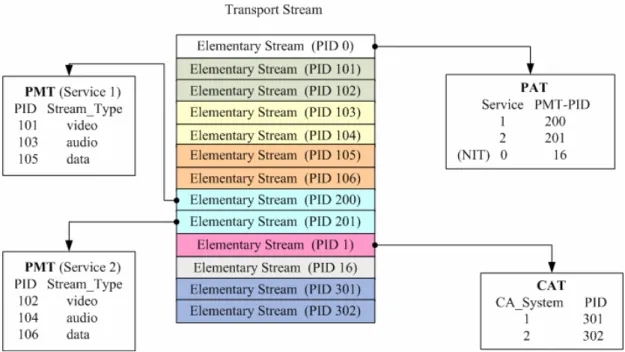
In the Transport Stream, PSI is classified into four table structures as shown below. While these structures may be thought of as simple tables, they shall be segmented into sections and inserted in Transport Stream packets.
1) Program Association Table (PAT)
Within a transport stream, each group of elementary streams that makes up a single TV channel is a program, or called a service in DVB system. The PAT indicates the location (the PID value of the transport stream packets) of the corresponding Program Map Table of each service. The PAT also gives the location of the Network Information Table. The PAT is always assigned to PID 0x000. Each Transport Stream shall contain one PAT.
The PMT describes the locations and type of the streams used by a service, and it tells the receiver the location of the Program Clock Reference fields for a service. The PMT is not broadcast on a fixed PID. For each service in a transport stream, there must be a corresponding PMT within the transport stream.
3) Conditional Access Table (CAT)
The CAT provides the information about the CA systems that are in use in the transport stream. The information tells the receiver how to decode them; it is private and depend on the CA system. The CAT is sent with the well-known PID value of 0x001.
4) Network Information Tables (NIT)
The NIT provides information about the physical network and also describes how transport streams are organized on the current network. The data format is outside the scope of ISO/IEC 13818-1 [1]. The syntax and semantics of the NIT are defined in a specification of DVB [2].
Figure 2-2 is a simple example to present the relationship between the four PSI tables and the Transport Stream.
In DVB system, the PSI is referred to as Service Information (SI). Besides these four tables listed above, DVB specifies other nine tables in the Service Information standard [2].
Figure 2-2 The relationship in the PSI structure
2.2 Service Information in DVB systems
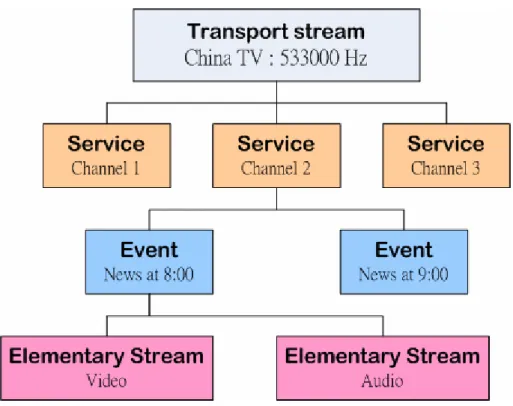
The structure of a DVB transport stream is shown in Figure 2-3. In the DTV-terms, a transport stream is also known as a multiplex, because it contains a number of services multiplexed together. Each service consists of a group of
elementary streams that makes up a single TV channel. Each TV show is known as an Event, which contains at least one audio stream, at least one video stream and usually several data streams. The service (TV channel) consists of a series of individual events broadcast one after another.
In addition to the PSI defined by MPEG, DVB specifies other information to provide identification of services and available events for the user. The coding rule of this data is defined in ETSI EN 300 468.
Figure 2-3 The structure of a DVB transport stream
2.2.1 Service Information Description
In contrast to the PAT, CAT, and PMT of the PSI, which give information only about the architecture of the multiplex for helping the receiver to reconstruct these streams, the additional information defined in EN 300 468 can also provide information on services and events carried by different multiplexes.
This data is known as Service Information (SI). The SI data is structured as nine types of tables [2]:
1) Bouquet Association Table (BAT) provides information regarding bouquets. A
bouquet is several services that are grouped together logically, for instance, sports package (which contains 8 sports channels) or movie package (which contains 5 movie channels). As well as giving the name of the bouquet, it provides a list of
2) Service Description Table (SDT) contains data describing the services in the
system e.g. names of services, the service provider, etc.
3) Event Information Table (EIT) contains data concerning events or programs such
as event name, start time, duration, etc.
4) Running Status Table (RST) gives the status of an event (running/not running).
The RST updates this information and allows timely automatic switching to events.
5) Time and Date Table (TDT) gives information relating to the present time and
date. This information is given in a separate table due to the frequent updating of this information.
6) Time Offset Table (TOT) gives information relating to the present time and date
and local time offset. This information is given in a separate table due to the frequent updating of the time information.
7) Stuffing Table (ST) is used to invalidate existing sections, for example at delivery
system boundaries.
8) Selection Information Table (SIT) is used only in "partial" (i.e. recorded)
bitstreams. It carries a summary of the SI information required to describe the streams in the partial bitstream.
9) Discontinuity Information Table (DIT) is used only in "partial" (i.e. recorded)
bitstreams. It is inserted where the SI information in the partial bitstream may be discontinuous.
Figure 2-4 The process of decoding a DVB transport stream [22]
A prototypical decoder for a DVB transport stream in the system layer is depicted in Figure 2-4 to illustrate how to construct these streams. In the process of decoding, synchronization is the first step. The sync byte is 0x47. After that, decoders extract video, audio and data streams according to PAT and PMT. If the transport stream is scrambled, the CAT is used to descramble it. Then these elementary streams are synchronized in according with some parameters which are added in the process of MPEG-2 encoding. These parameters include PCR (Program Clock Reference), PTS (Program Time Stamp) and DTS (Decoding Time Stamp). If there are SI tables in the transport stream, decoders must decode the content in these tables.
Using the SI tables, more applications could be developed in DVB system. In this thesis, we just use the Event Information Table to implement a DRM application. Next, we will describe the definition and syntax of EIT.
2.2.2 Event Information Table
The EIT provides information in chronological order regarding the events contained within each service. For mapping all MPEG-2 tables and SI tables into transport stream packets, these tables shall be segmented into one or more sections. So that, the EIT must be segmented into one or more Event Information Sections, before insertion into Transport Stream packets, with the following syntax.
Table 2-1 Event Information Section [2]
This EIT sections shall be transmitted in TS packets with a PID value of 0x0012. The EIT section is identified by the use of table_id which is an 8-bit field and always assigned 0x4E. The bits of the next three fields (section_syntax_indicator,
the number of bytes of the section, starting immediately following the section_length field and including the CRC. The section_length shall not exceed 4093 so that the entire section has a maximum length of 4096 bytes. The service_id is a label used to identify this service from other service within a transport stream. The version_
number and current_next_indicator indicate that which version of EIT section is
valid. The section_number, next_section_number, segment_last_section_number and last_table_id allows receiver reassembling these sections. transport_stream_id serves as a label for identification of this transport stream from any other multiplex within the delivery system. original_network_id gives the label identifying the network_id of the originating delivery system.
The inside of the for-loop contains the essential information about the TV shows (events) of a service. The event_id is the unique identification number of the
described event. The start_time and duration just are the start time and duration of the event respectively. The running_status indicates the status of the event: running or not, pausing and stats in a few seconds. All the component streams of the event are scrambled or not are indicated in the free_CA_mode field. The descriptors_loop_
length gives the total length in bytes of the following descriptors. The CRC_32 field
contains the Cyclic Redundancy Check value.
Each descriptor loop contains one or more descriptors contain some information for the decrypted event. ETSI defined many descriptors that can be re-used in the SI tables. This allows a flexible approach to the organization of the tables and allows for future compatible extensions. For all descriptor, the descriptor_tag and descriptor_
length are applied to it for identifying each descriptor and specifying the length
these value for their requirement. By using different descriptors, the EIT can transmit different kinds of event information.
2.3 Conditional Access Control
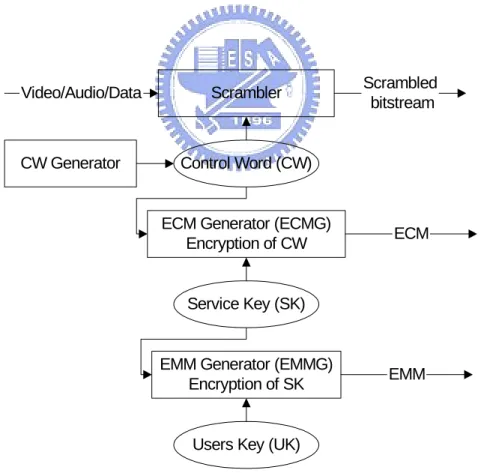
Conditional access (or CA) system is designed for offering the ability to restrict access to certain material (sports or film channels, for example). To each CA vendor, the techniques and implementations used for this is proprietary. In general, the CA model used in the DVB system includes three main functions: scrambling /
descrambling, entitlement checking and entitlement management. Figure 2-5 is the general model of digital TV Conditional Access in a service provider.
Scrambler
CW Generator
ECM Generator (ECMG) Encryption of CW
EMM Generator (EMMG) Encryption of SK Control Word (CW)
Service Key (SK)
Users Key (UK)
Video/Audio/Data Scrambled
bitstream
ECM
EMM
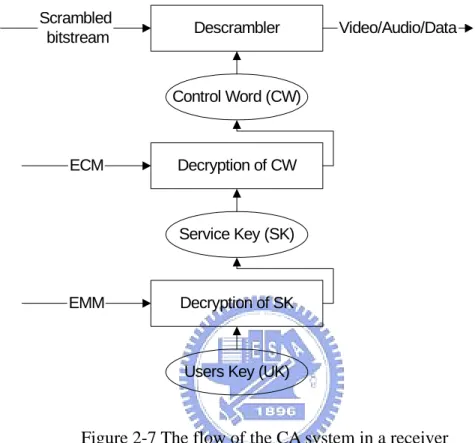
The control word (CW), which provides the first level of scrambling the TV content, is encrypted using the service key (SK). This service key may be common to a group of users. The encrypted control word is broadcast in an Entitlement Control Messages (ECM) which is shown in Figure 2-6. Next, for making sure that only authorized users can decrypt the control word, the service key is encrypted using the user key (UK) which is unique to each single user. For each authorized user, the service key encrypted using their user key is broadcast as part of an EMM Entitlement Management Messages (EMM) which is shown in Figure 2-6.
Figure 2-6 ECM and EMM [3]
These two private CA messages, ECM and EMM, must also be sent in transport stream packets to allow the receivers descrambling the TV content before decoding. Entitlement Control Messages specify control words and possibly other, typically stream-specific, scrambling and/or control parameters. Entitlement Management Messages specify the authorization levels or the services of specific decoders. They may be addressed to single decoders or groups of decoders [1]. The conditional access descriptor listed in the Conditional Access Table (CAT) is used to specify both EMMs and ECMs.
users, the receivers use their user key to decrypt the service key in EMM. Then, the receivers initialize the descrambling hardware and actually descramble the content after decryption of control words in ECM.
Descrambler
Decryption of CW
Decryption of SK Control Word (CW)
Service Key (SK)
Users Key (UK)
Video/Audio/Data
ECM
EMM Scrambled
bitstream
Figure 2-7 The flow of the CA system in a receiver
Not all CA systems use the same algorithms. There are some variances between them. And the EMMs may be used for other CA-related tasks besides decrypting service keys. But, basically, they work in the same way.
Chapter 3
TwinHan DVB-T PCI Card SDK
In this thesis, we use the DVB-T PCI Card made by the TwinHan company to receive and de-multiplex the DVB- Terrestrial signal. The Software Development Kit (SDK) of the Twinhan DVB-T PCI Card (called Twinhan DTV SDK for short) will be introduced in this chapter. The SDK is written in C++ and based on the Component Object Model (COM). Microsoft DirectX 8.1 or above is requirement for using the card to watch digital TV.3.1 Component Object Model
The Component Object Model (COM), developed by Microsoft, is a
platform-independent, distributed, object-oriented system for creating binary software components that can interact. COM specifies an object model and programming requirements that enable COM objects to interact with other objects. COM objects are discrete components, each with a unique class identity (called CLSID). They are completely language-independent and have built-in inter-process communications capability and easily fit into an object-oriented program design. Conceptually, a COM objects can be considered as a black box that can be used by applications to perform one or more tasks without getting any idea of how it works. They are most commonly implemented as a dynamic-link library (DLL).
Accessing to an object’s data is achieved exclusively through one or more sets of related functions. These function sets are called interfaces, and the functions of an interface are called methods. Each interface is identified by a unique identity.
Communication between two objects in a system occurs by calling the functions in an interface through a pointer to that interface.
3.2 DirectShow
The TwinHan DTV SDK uses some components provided by DirectShow. DirectShow is one of components in Microsoft DirectX. It is designed to simplify the task of creating digital media applications on the Windows platform by isolating applications from the complexities of data transports, hardware differences, and synchronization.
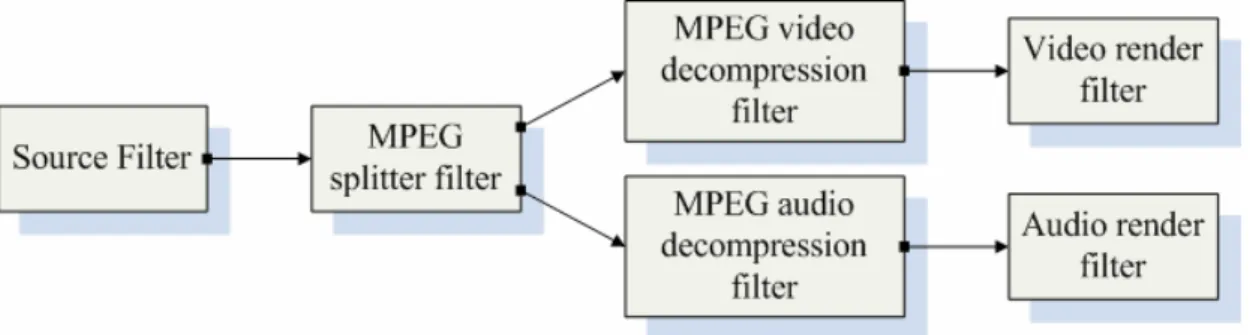
DirectShow uses a modular architecture, where each stage of processing is done by a COM object called a filter. As Figure 3-1 shows, each filter is connected to one or more other filters. The filter chain is called a filter graph. The connection points are also COM objects, called pins. The pins are divided into tow classes, output and input pin. Filters use pins to move data from one filter to the next. The arrows in Figure 3-1 show the direction in which the data travels. DirectShow also provides a COM object, Filter Graph Manager, which could control the filters in a filter graph.
3.3 TwinHan DTV SDK
This section explains the concept and architecture of Twinhan DTV SDK for windows. It describes how to use the SDK to receive, process, and render the DVB signals. Figure 3-2 is the whole frame of the Twinhan DVB-T PCI Card.
Figure 3-2 The Whole Frame
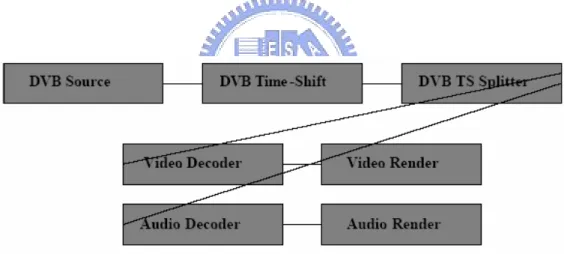
Twinhan DTV SDK provides COM objects and the interfaces that assist in demultiplexing, decoding, and other signal processing. Using Twinhan DTV SDK simplifies the signal processing procedure. Figure 3-3 illustrates the high-level architecture of the SDK. It is the procedure of rendering the source signals.
The SDK offers a DVB Source filter which should only be loaded through a graph manager which will handle all the pin connections and provide access to the different decoder interfaces. It has four output pins for “Stream 1”, “Transponder Stream”, “Analog Video”, and “VBI”. The connection format of “Stream 1” output
pin is MEDIATYPE_Stream/MEDIASUBTYPE_NULL. It works in the pull mode. When it is working, the PES stream which only includes video and audio will flow out. In order to work properly, before connecting the output pin to the next filter, we should initialize the filter with the open interface. The connection format of another pin “Transpond Stream” is MEDIATYPE_Stream/MEDIASUBTYPE_MPEG2_ TRANSPORT, and it is working in the push mode. When it is active, the whole transport stream will flow out from it. The output pin “Analog Video” is designed for Analog Video. Its connection format is MEDIATYPE_Video/MEDIASUBTYPE_ RGBx and it use Source Stream as the output pin type. For the output pin “VBI”, the connection type is MEDIATYPE_VBI/MEDIASUBTYPE_VPVBI. It delivers a stream of VBI waveform samples.
Figure 3-3 The Graph Frame
The TS Splitter filter takes in the interleaved stream and outputs separate audio and video streams. It has 1 input pin and 2 output pins, one is for video, which supports MPEG2_Video; another is for audio, which supports MPEG1AudioPayload and AC3. If the stream includes AC3 audio, the connection format is DOLBY_AC3.
The DVB Time-Shift filter allows seeking and positioning in a previously encoded MPEG2 stream. The special functionality of the DVB Time-Shift filter
allows data seeking with real-time multiplexed streams. DVB Time-Shift filter has 1input pin and 1 output pin, it needs to be linked between the source filter and the splitter. User only controls the graph state for the time-shifting function, such as pause for enter time-shifting mode, play for playback in time-shifting mode and stop for exit.
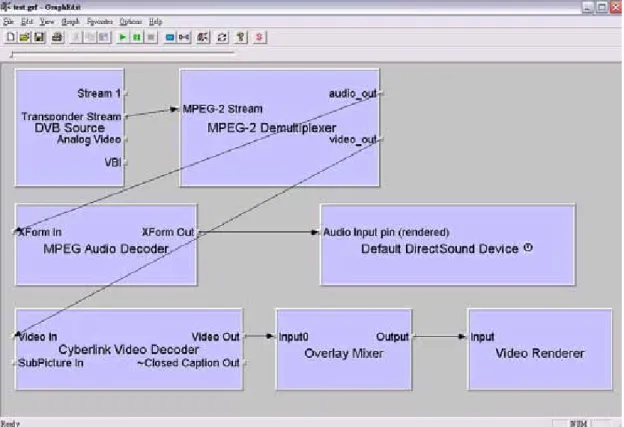
Figure 3-4 The Filter Graph for Transponder Stream
Figure 3-4 is the Filter Graph for receiving a real-time DVB-T signal. Here we focus the DVB Source filter because all the filters in Figure 3-4 are provided by DirectShow except the Source Filter. For more information on these filters refer to DirectShow. The Source Filter will detect the card automatically and work well on this card. It supports more than one interface to allow user to:
y Change the transponder and other options, such as LNB. y Lock the channel.
y Access to multi-card and support the media files (MPEG2 format) playback function.
y Read remote control code and turn on/off the tuner power.
Using the interface, the user can lock a channel, capture PES stream which includes video and audio streams, scan programs etc. This is achieved through some supported APIs as follows.
STDMETHOD(LockChannel)
( THIS_
long Frequency, //[in] frequency, KHz long SymbolRate, //[in] bandwidth
int HV, //[in] 1 for Digital, 0 for Analog ) PURE;
STDMETHOD(SetPid)
( THIS_
int SetType, //[in] type for control stream long VideoPid1, //[in] video stream pid long AudioPid1, //[in] audio stream pid
bool Scrambled, //[in] the program is scrambled or not long PMTPid, //[in] if Scrambled is valid, it must be filled long ProgramNumber, //[in] if Scrambled is valid, it must be filled long VideoPid2,
long AudioPid2 ) PURE;
STDMETHOD(ScanChannel) () PURE;
In order to play back programs, user must call two APIs, “LockChannel” and “ScanCannel”, to lock and scan the channel that the user wants to play firstly, and then use the API “SetPid” to set the PID of video and audio for one program. When all are done, the stream will be ready and user can render the output pin to build the
whole graph. Besides these three APIs, there are also plenty of APIs supported to let the Source Filter more powerful.
Note that all the filters, such as demultiplexer, video and audio decoder need to be loaded in the graph prior to rendering graph. Because the formats of the video and audio may be distinct between different programs, it needs re-render the whole graph when changing channel in this frame now.
Chapter 4
MPEG-21 Rights Expression Language specification
In this chapter, we will briefly review the International Standard ISO/IEC21000-5:2004, MPEG-21 Rights Expression Language [4] (called the MPEG REL for short). The ISO/IEC MPEG, Moving Picture Experts Group, committee started the development process for the MPEG REL in 2001 with a Call for Proposals and an evaluation process. After a few years of efforts, the Extensible Rights Markup Language (XrML) proposed by ContentGuard [5],was selected as the core architecture and base technology [6].
We will give an overview of the MPEG REL in terms of its objectives, data model, structure for extensibility and profiling, authorization model, and the relation with the other standards in MPEG-21.
4.1 Objectives [7]
The MPEG REL is an XML-based declarative language that can declare rights and conditions for authorized distribution and use of any content, resources, or services. It defines the syntax and semantics of a machine interpretable language that can be used to specify rights unambiguously.
The MPEG REL is intended to provide a flexible, interoperable mechanism to support transparent and augmented use of digital resources in publishing, distributing, and consuming digital content (including digital movies, digital music, electronic books, broadcasting, interactive games, computer software and other creations in digital form) in a way that protects digital content and honors the rights, conditions,
and fees specified for digital contents. It is also intended to support specifications of access and to control digital content usage in the cases where financial exchange is not part of the terms of use, and to support exchange of sensitive or private digital contents.
For protecting consumer privacy, the MPEG REL provides a flexible
interoperable mechanism to ensure personal data is processed in accordance with the individual rights and to meet the requirements for users to express their rights and interests in a way that addresses issues of privacy and use of personal data.
To support guaranteed end-to-end interoperability, consistency and reliability between different systems and services, the MPEG REL must offer richness and extensibility in declaring rights, conditions and obligations, ease and persistence in identifying and associating these with digital contents, and flexibility in supporting multiple usage/business models.
4.2 Data Model
The main function of the MPEG REL is to specify rights related to digital resources (such as content, services, or software applications). Using this language, anyone owning or distributing digital resources can identify
y The principals (such as users, groups, devices, and systems) who are authorized to use the resources
y The rights accorded to those principals
Figure 4-1 An example of REL expression
For example, an E-book named “Why Cats Sleep and We don’t”, distributed by “T Publisher”, to a consumer (Jane) that she is allowed to print 3 times. Figure 4-1 shows this simple REL example, Jane is granted the right to print the E-book “Why Cats Sleep and We don’t” 3 times under the permission of T Publisher, in its structural form.
Figure 4-2 Data model of license [6]
In the MPEG REL terminology, Jane is considered as a principal; print, a right; E-book “Why Cats Sleep and We don’t”, a resource; 3 times, a condition; and T Publisher, an issuer of the right. This simple example above is consists of the essential elements and the relationship among those elements of the MPEG REL expression. The expression conveys a statement of the following form: An issuer states that a principal has some right to a resource under some condition. The right-granting
portion of this statement is called a grant and the entire statement is called a license which contains both grants and issuers. In this example, the statement, Jane can print the E-book “Why Cats Sleep and We don’t” 3 times, is a grant; the statement, T publisher issues a grant that Jane can print the E-book “Why Cats Sleep and We don’t” 3 times, is a license.
The essential elements and the relationship among those elements of the MPEG REL are shown in Figure 4-2, the MPEG REL data model. The MPEG REL adopts a simple and extensible data model. In this data model, a license consists of one or more grants and issuers. And a grant contains four basic entities, including principal, right, resource, and condition. The roles of these elements of the MPEG REL data model will explained in detail in the following sections:
4.2.1 License
A license is a key top-level construct in the MPEG REL. It is a container of grants, issuers, and some other information. Conceptually, a license is a collection of grants issued by one or more issuers.
4.2.2 Grant
A grant is the element within the license that essentially conveys to a principal the right to use a resource, possibly subject to certain conditions.
4.2.3 Principal
MPEG REL provides the principal element that encapsulates the identification of a party to whom a right is granted. Each principal identifies exactly one party. In
Principal is typically identified by using information unique to that entity, which often includes an associated authentication mechanism by which the Principal can prove its identity. For example, an X.509 certificate is one of an authentication proof.
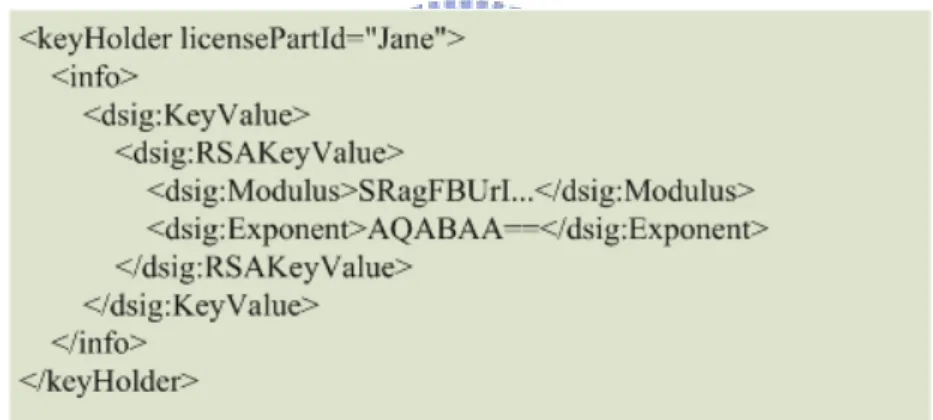
To support identification, the following technologies are provided: 1) a principal must present multiple credentials, all of which must be simultaneously valid, to be authenticated; 3) a principal is a keyHolder, who is identified as possessing a secret key such as the private key of a public / private key pair. 3) Other identification methods that may be invented by others.
The following figure shows an example: the principal Jane is represented by using the keyHolder element.
Figure 4-3 Jane is identified as the holder of a particular key
4.2.4 Right
A right is the "verb" that a principal can be granted to exercise against some resources under certain conditions. Typically, a right specifies an action (or activity) or a class of actions that a principal may perform on or use the associated resource.
A right element within a grant encapsulates information about rights and provides a set of commonly used, specific rights, such as play, print and adapt, as well as notably rights relating to other rights, such as issue, revoke and obtain.
The following figure illustrates how the print right would appear in a license. In this figure, the prefix mx: indicates that the print right is defined in the MPEG media extension schema namespace that will be introduced in section 4.3.
Figure 4-4 The print right
4.2.5 Resource
A resource is the "object" to which a principal can be granted a right. A resource can be a digital work (such as an e-book, an audio or video file, or an image), a service (such as an email service, or B2B transaction service), or even a piece of information that can be owned by a principal (such as a name or an email address). A grant can also be a resource.
MPEG REL provides a resource element that encapsulates the information necessary to identify and assign Rights to a particular Resource. In particular, it provides a variety of pattern mechanisms to allow identification of a collection of resources with some common characteristics. Extensions to these mechanisms define Resources appropriate to specific business models. The following figure illustrates that an e-Book is identified as a digitalResource with a particular URI.
4.2.6 Condition
A condition specifies the terms, conditions and obligations under which rights can be exercised. A simple condition is a time interval within which a right can be exercised. A slightly complicated condition is to require the existence of a valid, prerequisite right that has been issued by some trusted entity. Using this mechanism, the eligibility to exercise one right can be dependent on the eligibility to exercise other rights.
MPEG REL defines a condition element that encapsulates the information necessary to determine whether the condition is met. Figure 4-7 presents constraint condition that identifies a right may be exercised only 3 times. The prefix sx: in this figure indicates that the elements (exerciseLimit and count) are defined in the MPEG standard extension schema namespace that will be introduced in section 4.3.
Figure 4-6 A constraint condition
4.2.7 Issuer
The issuer element identifies a license issuer who digitally signs a license and provides additional details about its issuance. By signing the license, a license issuer authorizes the grants contained in a license and it can facilitate reliable establishment of trustworthiness of the license.
A license may have any number of issuers, or the element may be omitted entirely. However, no additional semantics is associated with the joint signing; it is as
if each had signed a copy of the License independently. No collective meaning is implied by several issuer elements appearing in a license.
The following figure illustrates how this issuer information is represented in the MPEG REL expression.
Figure 4-7 Issuer
4.3 Extensibility and Profiling
MPEG recognizes that different applications require different levels of
complexity and flexibility in REL and that specific industries and user communities may need to modify the language to better meet their specific needs. To facilitate easy mapping of the REL to these industry-specific applications, MPEG has developed a process of extending and profiling of the language. [8]
The extension process, including developing new verbs and schematic elements, enables individuals to define new elements specific to their requirements to improve efficiency in a specific domain. The syntax of MPEG REL is defined using the XML Schema and Namespace Recommendations by W3C [9],[10], which enables the REL to offer a high degree of richness and flexibility in its extensibility. The following figure illustrates the MPEG REL architecture.
Figure 4-8 Extensibility structure.
These architectural parts: core, standard extension, multimedia extension, and their XML schemas are normative components of the overall MPEG REL
specification.
Core schema defines the general constructs which are essential and form the architectural basis for the language. The namespace for the MPEG REL Core is identified with the prefix “r:”. In some cases, this prefix is omitted.
Standard extension schema defines the concepts that are generally and broadly applicable to the DRM usage scenarios. It extends the condition type in the XrML core. The namespace for the MPEG REL standard extension is identified with the prefix “sx:”. Figure 4-6 is a simple example.
Multimedia extension schema extends the Core schema for concepts (e.g., rights, resources, and conditions) specifically related to the multimedia domain. As shown in Figure 4-4, the namespace for the MPEG REL multimedia extension is identified with the prefix “mx:”.
The extension process enables that the other parties can define their own (possibly domain-specific) extensions to the MPEG REL and its future extensions. This is accomplished by using the existing, standard XML Schema and XML
Namespace mechanisms. More specifically, extensions to the MPEG REL can define: 1) principals appropriate to specific technical applications; 2) rights appropriate to using specific types of resource, such as play and print; 3) resources appropriate to specific business models and technical applications; 4) conditions appropriate to specific distribution and usage models, such as watermark, destination, and rendering application.
The profile process enables individuals to select only those language elements required to meet a specific application’s need. Many MPEG REL elements and attributes are optional, and their occurrences can be included or omitted in a profile to optimize payload of digital items and computation requirements of MPEG terminals. For a specific purpose or different devices, this involves the creation of a subset of the language. For instance, the full power of the MPEG REL, which is required by a PC, may not be available for a mobile phone. So a down-size version of this language, a new profile, can be created for this application.
Extension and Profile can be used concurrently to optimize the applicability of the MPEG REL to one specific application.
4.4 Authorization Model
Authorization story
Primitive grant
Authorized r:Grant or r:GrantGroup
Authorizer r:License r:Principal Time instant Authorization context Authorization story Authorization request r:Principal r:Right r:Resource Interval of time Authorization context r:License elements r:Grant elements that do not require an authorizer is authorization
proof for
Figure 4-9 Authorization model [4]
The MPEG REL provides an authorization model, as shown in Figure 4-9, to determine if a principal has the right to perform an action on a resource according to the REL expressions in a set of licenses.
The authorization model makes use of an authorization request, an authorization story, authorization context, and an authorizer to create authorization proofs, which define the semantics of licenses for performing authorization requests. Figure 4-10 illustrates the relationship between the entities in the authorization model. An authorization request is permitted if there is one authorization story that provides an authorization proof for the request.
Figure 4-10 The relationships between the entities in the authorization model [11]
Authorization Request
An authorization request contains the information that conceptually represents the question "is it permitted for a given Principal to perform a given Right upon a given Resource during a given time interval based on a given authorization context, a given set of Licenses, and a given trust root?"
Authorization Story
An authorization story is a structure created for the purpose of finding a grant to match the requested permission. An authorization story contains:
y A primitive grant containing no variables, derived from a grant that is authorized by an authorizer and is a part of the set of licenses provided in the authorization request.
y Optionally, an authorizer is a structure containing the information about issuance of the License.
Conceptually, an authorization story contains all the information necessary to state the following fact: “A given primitive grant (i.e., a grant with no variables) may be derived from a given grant authorized by a given authorizer, which identifies a principal from a license at a time instant based on an authorization context and supported by an authorization story.”
Authorization Context
An authorization context is a set of properties that are relevant to an authorization request. A property refers to a truth statement that is used in the evaluation of a Condition. A Condition, which is evaluated based on some authorization context properties, refers to those properties in its semantics. [11]
Authorization Proof
If all the relationships shown by the broken lines are valid in Figure 4-10, an authorization story is said to be an authorization proof for an authorization request. More specifically, the request is permitted if the following are true: 1) the primitive grant in the story is equal to the principal, right, and resource in the request and its condition is satisfied with the authorization context in the request; 2) the primitive grant must be derived from the grant; 3) the issuance of the grant in the first
the authorizer in the first authorization story; 4) the recursive authorization eventually terminates in one of the trust roots given in the authorization request. [6] When the request is permitted, there shall be at least one authorization story that supports an authorization proof for the authorization request.
4.5 The Relation with The Other standards in MPEG-21
The MPEG-21 REL [4] can declare rights and permissions using the terms as defined in the Rights Data Dictionary (RDD) [12]. The RDD specifies a dictionary of terms and provides a methodology for extending the dictionary to include new terms. The MPEG REL also can use the Digital Item Identification (DII) [13] to identify digital items described in the language defined by the Digital Item Declaration (DID) [14] and hence specify rights over those digital items. The MPEG REL can also be included in digital item declarations. [6]Chapter 5
Application Exapmples of the DRM system
In this chapter, we describe our implementations of DRM systems in which we use rights expression languages (REL) to implement an effective digital rightsmanagement (DRM) scheme on a DVB-T platform. In the implementations, we insert the REL license into the service information tables (SI) of DVB and it is broadcasted along with the content carried by the MPEG-2 transport bit stream. When a new TV program begins, a new License is broadcasted.
In order to insert the license into SI, we define a descriptor, license_descriptor, as show in Table 5-1. This license_descriptor has a few attributes and their syntax are defined in Table 5-1. Then, the descriptor shall be inserted into the corresponding descriptor_loop field of the event information table (EIT) as shown in Table 5-2.
The descriptor_tag of license_descriptor is an 8-bit field. According to the specification of ETSI EN300 468 [2], the tag value from 0x80 to 0xFE could be defined by user. We define the descriptor tag value of the license_descriptor is 0x80. The “reserved” bits shall be set to 1. The descriptor_length is a 12-bit field specifying the total number of bytes of the data portion of this descriptor following the bytes defining the value of this field. Note the descriptor_length shall not exceed 4063 so that the entire descriptor has a maximum length of 4066 bytes. The
descriptor_number gives the index of the descriptor. It is used to a license which is cannot be fitted into a single descriptor. The descriptor_number of the first
license_descriptor of an associated set of license_descriptors shall be “0x00”. Within each segment of a license the descriptor_number shall increment by 1 with each additional license_descriptor. The last_descriptor_number specifies the index of the last license_descriptor (that is, the descriptor with the highest descriptor _number) of the associated set of descriptor. A string of “text_char” field specifies the text of a license.
Two DRM applications using this mechanism, broadcasting license within SI tables of MPEG-2 transport stream, are implemented. The first application is Digital TV Conditional Access (CA). We will describe its architecture and the demo system implementation in the next section. In the second application, we use an MPEG-21 REL Reference software to interpret an REL license for managing the right of using the contents. And we will show a “Validity Interval” condition case.
Table 5-2 Event Information Section [2]
5.1 Application One – Digital TV Conditional Access
In general, conditional access system of digital TV follows the classical DVB Condition Access System (CAS) mechanism as described in section 2.3. The Entitlement Control Messages (ECMs) and Entitlement Management Messages (EMMs) are broadcasted. They carry the information for decrypting the content.In this application example, we present how to use REL license to implement another conditional access scheme. This implementation uses cryptography and key management machine to protect content from illegal access.
5.1.1 Cryptography
We use two security techniques including symmetric and asymmetric cryptography to encrypt content in this implementation.
5.1.1.1 Symmetric Cryptography
Symmetric cryptography, also called secret key cryptography (SKC) or private key cryptography, is the most popular of cryptography method. With symmetric cryptography, a single cryptographic key is used for both encryption and decryption. As shown in Figure 5-1.A, the sender uses a key to encrypt the plaintext and sends the cipher text to the receiver. The receiver must apply the same key to decrypt the
message and recover the plaintext. Symmetric algorithms generally can be divided into stream ciphers and block ciphers. Stream ciphers encrypt a single bit (byte or computer word) of the message at a time and implement some form of feedback mechanism so that the key is constantly changing. The most widely used stream cipher is RC4 (Rivest Ciphers) algorithm. In Block ciphers a key and algorithm are applied to blocks of data rather than individual bits in a stream. Data Encryption Standard (DES) and Advanced Encryption Standard (AES) are the common block encryption algorithm.
Here, we will introduce the RC4 algorithm we used in this implementation. RC4 was developed by Ron Rivest in 1987. It is a stream cipher. This means it essentially functions as a random number generator whose output is combined with the plaintext by using XOR.
Figure 5-1 Cryptography [15]
RC4 has two stages in the procedure of generating random numbers. The first stage is the key-scheduling algorithm (KSA). It initializes a permutation (denoted “S” below) based on a variable length key. The algorithm is described below.
for i = 0 .. N-1 S[i] = i; j=0; for i = 0 .. N-1 j=j + S[i] + K[i % 1]; Swap (S[i], S[j]);
After initialization, the second step is the pseudo-random generation algorithm (PRGA). It actually returns a random byte. Here is the algorithm.
i = j = 0; i = i+ 1; j= j + S[i]; Swap (S[i], S[j]); return S[ S[i] + S[j] ];
The return value is XORed with the plaintext to produce the ciphertext, or the ciphertext to produce the plaintext.
5.1.1.2 Asymmetric Cryptography
Asymmetric cryptography, also called public key cryptography (PKC), was invented by Diffie and Hellman in 1976 [16]. The essential difference to symmetric cryptography is that this kind of algorithm uses two different keys for encryption and corresponding decryption. As shown in Figure 5-2.B, public key cryptography allows users to communicate securely without having to share a secret key by using a pair of cryptographic keys, designated as public key and private key, which are related mathematically. One key is used to encrypt the plaintext and the other key is used to decrypt the cipher text. Which key is applied first is not important. Who has the private key can share the related public key to others, but the private key can not be known by anyone.
RSA is the best known and most frequently used reversible asymmetric algorithm. It is named for its inventors Rivest, Shamir and Adelman [17]. The algorithm is described below.
1. Key Generation:
(a) Choose two prime number p and q and let n=pq. (b) phi(n) = (p-1)(q-1).
The values of p, q, and phi(n) should be kept secret. (c) Choose a random number E such that gcd(E, phi(n)) = 1. (d) Compute an exponent D such that ED ≣ 1 mod (phi(n)).
The public key is the pair of values (n,E) and the private key is (n,D). n is known as the modulus.
E is known as the public exponent or encryption exponent. D is known as the secret exponent or decryption exponent.
Let Pi is the block of plaintext message and its length is smaller than phi(n). The encrypted text Ci is calculated from the equation Ci ≣ PiE mod(n).
3. Decryption
We calculate Pi = CiD mod(n).
5.1.2 Key Management
This section presents a key management mechanism which is used within the conditional access scheme. The key management mainly uses a trans-encrypting operation. The entire scheme of this conditional access application is composed of a service provider, receivers, and a license server, as shown in Figure 5-2.
Figure 5-2 General idea of the conditional access scheme
Service provider broadcasts a scrambled TV program and its associated REL license to receiver. The scrambling key used to encrypt the TV program is encrypted by the license server’s public key and put into the license. Here we use RC4 and RSA algorithms to scramble the program and encrypt the RC4 scrambling key, respectively. In addion to the encrypted scrambling key, this license also contains the license server information. Using the license information, the receiver send a request to the license
server for the scrambling key. This message includes both the encrypted RC4 key and receiver’s name. The license server will check if the receiver has the right to watch the program or not. If the receiver has the right to watch the program, the license server does two things. It first decrypts the RC4 scrambling key by using its own private key. In order to protect the RC4, the license server encrypts the scrambling key by using the receiver’s public key to ensure the receiver’s identity.
Figure 5-3 Key management procedure
Figure 5-3 shows how the keys are exchanged. According to our proposal, the content scrambling key is inserted into the license information carried by the content bit stream. Therefore, we can reduce the real-time synchronization requirement imposed on the communication between the service provider and the license server. Typically, the scrambling key is changed very frequently, for example, once per second.
5.1.3 Architecture Design
Figure 5-4 is the overall architecture of this conditional access scheme. There are mainly three parts: Service Provider, Receivers, and License Server. We now
elaborate on their structures and operations.
5.1.3.1 Service Provider
The service provider part acts as a transmitter for transmitting the DTV broadcast and the related information. As shown in Figure 5-4, the service provider broadcasts a scrambled MPEG-2 video elementary stream and its associated REL license to
receivers. The scrambling key is encrypted by the license server’s public key and then is inserted into the REL license. The syntax of the license is based on the MEPEG-21 REL[4], Digital Item Declaration (DID) [14], and Digital Item Identification (DII) [13]. In addition to the encrypted scrambling key, the license also contains the license server’s information. In the service provider part, this license is inserted into the service information table (SI). The multiplexer takes in the encrypted MPEG -2 stream and converts it into a transport stream with the SI. Then, the consumers can use a DTV Card to receive the broadcast programs. The functionalities of each component are described below.
Scrambler: The Scrambler encrypts the data. Typically a cryptography is
adopted for its simple operation. The algorithm used to encrypt the data in this application is RC4 stream encryption algorithm. The key used to encrypt the content is called the scrambling key.
RSA Encryption: It is responsible to encrypt the scrambling key by using an
asymmetric cryptography structure. The input, scrambling key, is encrypted by the license server’s public key. When the user contacts the license server, the scrambling key is encrypted by the user’s public key. The algorithm used in this application is the RSA asymmetric encryption algorithm.
SI Editor: The SI editor is responsible to edit the EIT tables. First, a REL license
is segmented into license_descriptors according the syntax in Table 5-1. Then, the descriptor is inserted into EIT as show in Table 5-2. Finally, in order to be multiplexed into a transport stream later, the EIT is packetized and the data is stored in the
transport packets.
Multiplexer:Multiplexer multiples MPEG-2 video bit stream with program service information (PSI) and service information (SI) and produces the MPEG-2 Transport (ISO/IEC 13818-1) streams.
DVB Modulator: It converts the transport stream to an analog signal so that we
can broadcast it.
5.1.3.2 Receiver
The receiver part is responsible to receive and decode a digital video broadcast program transmitted by the service provider and render it by a display device such as a television or a monitor.
The architecture of the receiver is shown in Figure 5-4. Before descramble the MPEG-2 video stream, the license shall be parsed for generating a message to request for the content scrambling key. The request message includes the information
extracted from the received license. The message contains the receiver’s name for identification, the identifier of the MPEG-2 digital content, the right that the consumer wants to exercise, and the content scrambling key encrypted by the license server’s public key. For security reason, the license server will send the content scrambling key encrypted by the receiver’s public key if the consumer was authorized to consume the digital content by the license server. So, the receiver needs to decrypt the
scrambling key by the receiver’s private key after receiving the key from the license server. Finally, the consumer can descramble the TV program for decoding and displaying.
The functionalities of each component are described below.
Demultiplexer: It takes in the MPEG-2 transport stream from the server
provider and demultiplexes the bit stream based on packet IDs (PIDs).
SI Parser: It retrieves the SI tables from an MPEG-2 transport stream and parses
the license_descriptor to retrieve the MPEG-21 REL license.
REL Parser: It parses the MPEG-21 REL license and extracts the license
server’s information and the encrypted scrambling key from the license to make the request message.
RSA Decryption: It is responsible to use the receiver’s private key to decrypt the
scrambling key sent from the license server. The algorithm used in this application is the RSA asymmetric encryption algorithm.
Descrambler: Using the scrambling key to decrypt the TV program. The
algorithm used to decrypt the cipher text in this application is RC4 stream decryption algorithm.
5.1.3.3 License Server
License Server is a third party to authorize the receiver to access the scrambling key by using a trans-encrypting operation.
The flow chart of the license server operation is show in Figure 5-5. The license server will check the right of the receiver as soon as it receives the request message. If the receiver has the right to exercise this TV program, the license server will use its private key to decrypt the scrambling key contained in the request message. After decryption, the license server also needs to encrypt the scrambling key by the receiver’s public key for protection. At this step, the encryption can protect the key from being used by illegal receiver.
5.1.4 An Implementation of the Condition Access Scheme
This implementation uses the Twinhan DVB-T PCI Card for the Receiver part to receive and demultiplex the DVB-T signal. The SDK of the Twinhan DVB-T PCI Card is described in chapter 3.
To match the SDK of the Twinhan DVB-T PCI Card, the receiver part of this conditional access scheme and the next application example are both written in C++. And because of hardware restrictions of the DVB-T PCI Card, we can not perform the real-time descramble for playing back when the bit stream is received in real-time. So, we will download the TV program stream at the receiver for performing offline
conditional access.
Figure 5-6 shows the filter graph of the DVB-T PCI Card in this implementation. We add two filters, the MPEG-2 Sections and Tables filter and the Sample Grabber filter, into the filter graph of the DVB-T PCI Card.
Figure 5-6 Filter graph of the DVB-T PCI Card in the conditional access scheme
The MPEG-2 Sections and Tables filter, provided by Microsoft® DirectX®, retrieves the Program Specific Information (PSI) tables from an MPEG-2 transport stream. We can use this filter to obtain any PSI data, such as ATSC Program and System Information Protocol (PSIP) tables, DVB service information (SI), conditional access tables (CATs), DSM-CC messages, or private table data [18]. The MPEG-2 Sections and Tables filter is connected to an output pin of the MPEG-2 Demultiplexer. It acts as the SI parser as shown in Figure 5-4.
The Sample Grab filter, also provided by Microsoft® DirectX®, provides a way to retrieve samples as they pass through the filter graph. It is a transform filter with one input pin and one output pin. It passes the downstream unaltered. The filter has no preferred media type. This means it can be connected to almost any filter in the graph, but then we do not have control on the type of data that it outputs. Because the
hardware restriction of the DVB-T PCI Card, we could not directly add the
Therefore, we use the filter to retrieve the scrambled video stream and save it in a file. Then, the file will be descrambled in a separate process as shown in Figure 5-8.
Figure 5-7 shows the server provider part and the DVB-T PCI card part of the receiver. We use the SDK of the Twinhan DVB-T PCI card to receive and demultiplex the DVB signal, parse the SI tables, and download the TV program to save in a video file.
Figure 5-7 The server provider part and the DVB-T PCI card part of the receiver
Figure 5-8 shows the dataflow after retrieving the REL license and the downloaded video file. We use an Internet Information Services (IIS) Web server hosted on the local host as the license server for this demonstration. The receiver sends a request message to request an XML data file from the license server, a local web server, using HTTP. The XML data consists of the scrambling key information
that is stored as an XML file on the server. The scrambling key is encrypted by the receiver’s public key. The license server fulfils the request through an ASP page, which is accessible from the localhost virtual directory.
In our implementation, we use a library called KivcoRSA as the RSA Encryption and the RSA Decryption components. It is a small library of encryption routines that communicate with the ASP using the ATL COM standard. It provides many
implementations of cipher algorithm, such as AES, DES, RSA, and many others. And the library provides both stream ciphers and block ciphers [19].
![Figure 2-4 The process of decoding a DVB transport stream [22] A prototypical decoder for a DVB transport stream in the system layer is depicted in Figure 2-4 to illustrate how to construct these streams](https://thumb-ap.123doks.com/thumbv2/9libinfo/8236661.171187/22.892.262.631.109.513/figure-decoding-transport-prototypical-transport-depicted-illustrate-construct.webp)
![Figure 4-2 Data model of license [6]](https://thumb-ap.123doks.com/thumbv2/9libinfo/8236661.171187/37.892.152.745.568.831/figure-data-model-of-license.webp)