A New Steganography Scheme in the Domain
of Side-Match Vector Quantization
Chin-Shiuh Shieh1, Chao-Chin Chang1, Shu-Chuan Chu2, and Jui-Fang Chang3
1 Department of Electronic Engineering, Kaohsiung University of Applied Sciences,
415 Chien-Kung Road, Kaohsiung, 807, Taiwan, R.O.C. [email protected]
2 Department of Information Management, Cheng Shiu University,
840 Cheng-Cing Rd., Niaosong Township, Kaohsiung County, 833, Taiwan, R.O.C [email protected]
3 Department of International Trading, Kaohsiung University of Applied Sciences,
415 Chien-Kung Road, Kaohsiung, 807, Taiwan, R.O.C. [email protected]
Abstract. This article reports a pioneer work on a steganography
scheme in the domain of side-match vector quantization. The challenge associated with dynamic state code books had been resolved by two possible alternatives, namely code book partition by code words’ mean and code book partition by pseudo random sequence. Experiment re-sults reveal that imperceptibility required for secret communication can be ensured with the proposed approaches.
1
Introduction
Data secrecy had become an important issue as communication networks getting commoditization and widely spread, especially with the blooming of the Inter-net. Among others technologies, digital watermarking and steganography had received considerable attention in recent years for their theoretical and practi-cal significance. Aimed at copyright protection, arbitration, and authentication, watermarking is the process of embedding extra information into a media clip. There have been a vast number of established methods [1]. However, it is still far from trivial to make the embedded watermark robust. Although closely related to digital watermarking, steganography has its own appeal for secret communi-cation [2]-[3]. Steganography is the hiding of a secret message within an ordinary message and the extraction of it at its destination. Conventional cryptography techniques, such as DES and RSA [4], convert plain messages into random mes-sages. Such a diffusion and confusion process tells potential attackers that there exist enciphered confidential message. Steganography takes cryptography a step farther by hiding an encrypted message in ordinal message so that no one sus-pects it exists. Ideally, anyone scanning your data will fail to know the existence of encrypted data [5].
R. Khosla et al. (Eds.): KES 2005, LNAI 3683, pp. 1032–1038, 2005. c
A New Steganography Scheme 1033
The primary objective of steganography is the imperceptibility. That is, the carrier message should show no significant difference after the embedding of secret messages. In later sections, we will present a new steganography scheme in the side-match vector quantization domain. The proposed approach embeds a black-and-white icon into a gray-level carrier image, and maintains desired imperceptibility at the same time.
2
Side Match Vector Quantization
In order to reduce the bandwidth requirement for data transmission and space requirement for data storage, various data compression techniques had been developed [6]. Vector quantization (VQ) [7] is a widely adopted approach for lossy data compression. In applications regarding image, audio, and video, human sensory system is sophisticated enough to filter out limited data loose in the process of encoding and decoding. VQ and its descendents try to maintain high compression rate while retaining essential information carried in media clips.
The codebook size is a critical design parameter. It decides the encoding speed and the image quality. It seems that there is an inevitable tradeoff between these two important criteria. However, side-match vector quantization (SMVQ) [8] ingeniously tackles this dilemma by using dynamic, smaller code books for internal image blocks. A smaller code book implies fewer bits in encoding the indices. At the expanse of higher computational cost, overall compression rate can be significantly improved. This virtue makes SMVQ prevail in applications with limited bandwidth capacity.
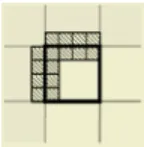
With SMVQ, the image blocks in the first row and first column are dealt with in the same way as regular VQ. They differ in the processing of internal image blocks. Only a small portion of the main code book, called state code books, are used to encode internal image blocks. The state code books are selected from the main code book based on the surrounding information of the internal block to be encoded. Fig.1 illustrates the general idea of SMVQ.
Fig. 1. Illustration for the processing of internal blocks with SMVQ
In Figure 1, blocks in gray denote blocks already encoded, and the block in bold border is the block under processing. 4-pixel by 4-pixel image blocks are used in the illustration. Let Xi,j and ˆXi,j denote the original and encoded image blocks on the i-th row and the j-th column of the carrier image, and let Xi,j(m, n) denote the gray value of the pixel on the m-row and n-th column
1038 Chin-Shiuh Shieh et al.
(a) (b)
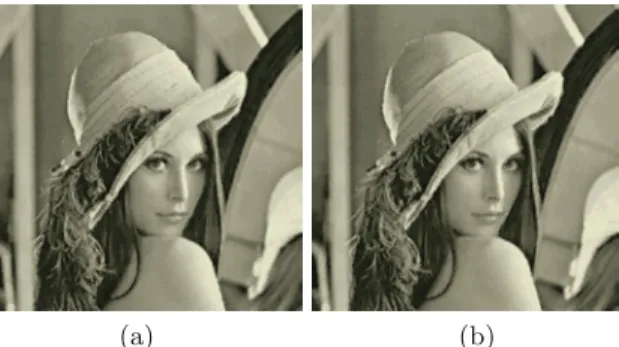
Fig. 4. Embedded carrier image with (a) state code book partitioning by code words’
mean and (b) state code book partitioning by pseudo random sequence
References
1. Pan, J.-S., Huang, H.-C., and Jain, L. C., (Eds.), Intelligent Watermarking Tech-niques, World Scientific Publishing Company, Singapore, (2004).
2. Katzenbeisser, S. and Petitcolas, F. A.P., (Eds.), Information Hiding Techniques for Steganography and Digital Watermarking, Artech House Publishers, (2000). 3. Cole, E., Hiding in Plain Sight : Steganography and the Art of Covert
Communi-cation, Wiley, (2003).
4. Stallings, W., Cryptography and Network Security: Principles and Practice, 3rd Ed., Prentice Hall, (2002).
5. SearchSecurity.com at http://searchsecurity.techtarget.com
6. Sayood, K., Introduction to Data Compression, 2nd Ed., Morgan Kaufmann, (2000).
7. Gray, R. M., ”Vector quantization”, IEEE ASSP Magazine, pp. 4-29, (1984). 8. Chang, R.-F. and Chen, W.-T., ”Image coding using variable-rate side-match
finite-state vector quantization,” IEEE Transactions on Image Processing, vol. 2, no. 1, pp. 104-108, 1993.
9. Lu, Z.M. and Sun, S.H., ”Digital image watermarking technique based on vector quantization”, IEE Electronics Online, vol.36, no.4, pp. 303-305, (2000).
10. BletchleyPark.net, Cryptograph, at http://www.bletchleypark.net/cryptology 11. Goldberg, D.E., Genetic Algorithms in Search Optimization and Machine Learning,