High-Color-Purity Organic Light-Emitting Diodes Incorporating
a Cyanocoumarin-Derived Red Dopant Material
Mei-Ying Chang,a,
*
,zYu-Kai Han,b,*
Chih-Chia Wang,aShih-Chin Lin,a Yi-Jan Tsai,aand Wen-Yao Huangaa
Institute of Electro-Optical Engineering, National Sun Yat-Sen University, Kaohsiung, 804 Taiwan b
Department of Chemical and Materials Engineering, National Kaohsiung University of Applied Sciences, Kaohsiung, 807 Taiwan
This paper describes a red dopant material, the cyanocoumarin derivative 9-cyano-10- 共2-benzothiazolyl兲-1,1,7,7-tetramethyl-2,3,6,7-tetrahydro-1H,5H,11H-benzo 关l兴 pyrano关6,7,8-i j兴quinolizin-11-one 共RC545T兲, and its use in organic light-emitting diodes共OLEDs兲. Because RC545T exhibits 共i兲 redshifted fluorescence 共max= 607 nm兲 and 共ii兲 a
narrower full width at half-maximum 共fwhm; 48 nm兲 relative to the corresponding signal for 4-共dicyanomethylene兲-2-tert-butyl-6-共1,1,7,7-tetramethyljulolidyl-9-enyl兲-4H-pyran 共DCJTB; max= 605 nm; fwhm = 73 nm兲, which is currently one of
the most efficient red dopant materials, we could fabricate red OLEDs exhibiting improved color purity. A device incorporating RC545T as a dopant and rubrene as an assistant dopant in the configuration indium–tin oxide 共ITO兲/N,N⬘-bis 共1-naphthyl兲-N,N⬘-diphenyl-1,1⬘-biphenyl-4,4⬘-diamine共65 nm兲/tris共8-hydroxyquinoline兲aluminum 共Alq3兲:15 wt % rubrene:2 wt % RC545T
共30 nm兲/Alq3共30 nm兲/LiF 共0.8 nm兲/Al 共250 nm兲 exhibited a maximum luminance of 8000 cd/m2at 12.5 V, with near-saturated
CIE coordinates of共0.64, 0.35兲, significantly better red color purity than that of the device featuring DCJTB as the dopant material 关CIE coordinates: 共0.63, 0.37兲兴, thereby rendering RC545T a good red-emitting dopant for OLED applications.
© 2008 The Electrochemical Society. 关DOI: 10.1149/1.2990718兴 All rights reserved.
Manuscript submitted February 21, 2008; revised manuscript received September 4, 2008. Published October 14, 2008.
Organic light-emitting diodes共OLEDs兲1are being widely used in flat-panel displays because of their superior brightness, contrast, viewing angle, response time, and production cost. The performance of red OLEDs, however, remains a weak point in the development of organic full-color displays because of their poor color purity and low efficiency. The search for better red emitters has established a target specification for a saturated color having CIE coordinates close to 共0.65, 0.35兲. A doping system1-5 is often required in red OLEDs6-11 to obtain higher efficiencies and prevent concentration quenching. One of the earliest dopants used in OLEDs to generate an efficient red electroluminescence 共EL兲 emission was 4-共dicyanomethylene兲-2-methyl-6-p-共dimethylamino兲styryl-4H-pyran 共DCM兲,6,7which fluoresces at a value of
maxof 596 nm with a 78% photoluminescence 共PL兲 quantum yield and a full width at half-maximum共fwhm兲 of 100 nm. In the optimized device structure, the CIE coordinates are共0.56, 0.44兲. Subsequently, it was discovered that increasing the rigidity of the Et2N donor moiety via cyclization to form the julolidine ring, i.e., 4- 共dicyanomethylene兲-2-methyl-6-共julolidyl-9-enyl兲-4H-pyran 共DCJ兲, provided a more fluo-rescent dye with better color purity. This behavior arises, presum-ably, by virtue of the cyclic structure aligning the orbitals of the nitrogen atom to overlap with the orbitals of the phenyl ring for more effective conjugation and also from constraint of the molecular structure in space, which reduces the degree of energy loss through molecular vibration and/or rotation. The disadvantage of employing DCJ in devices is that it aggregates readily because of its planar structure. Further modification of the julolidyl ring in DCJ, by introducing strategically positioned methyl groups as steric spacers to minimize dye–dye interactions, led to the preparation of 4- 共dicyanomethylene兲-2-methyl-6-共1,1,7,7-tetramethyljulolidyl-9-enyl兲-4H-pyran 共DCJT兲 and 4共dicyanomethylene兲2tertbutyl6共1,1,7,7 tetramethyljulolidyl 9 -enyl兲-4H-pyran 共DCJTB兲. The high luminance efficiency, better color purity, and resistance to concentration quenching make DCJTB an ideal candidate for use as a red dopant material for OLED display applications.
Unfortunately, DCJTB possesses an unacceptable fwhm 共ca. 73 nm兲 and its optimized device structure displays far-from-ideal CIE coordinates of共0.63, 0.37兲. The broad fwhm may be due to the
stilbene group adjacent to the julolidyl ring lacking structural con-straint in terms of molecular vibration and/or rotation. In this paper, we report a cyanocoumarin-containing red emitter, 9- cyano-10- 共2-benzothiazolyl兲-1,1,7,7-tetramethyl- 2,3,6,7-tetrahydro-1H,5H,11H-benzo关l兴 pyrano关6,7,8-ij兴quinolizin-11-one 共RC545T兲, and its use in the fabrication of red-light OLEDs. This material takes advantage of the high efficiency of 10- 共2-benzothiazolyl兲-1,1,7,7-tetramethyl-2,3,6,7-tetrahydro-1H,5H,11H-benzo关l兴 pyrano 关6,7,8-ij兴quinolizin-11-one 共C545T兲, which is one of the best green dopants used in many of today’s OLED applications. RC545T dis-plays not only a fwhm of 48 nm, much narrower than that of the DCM derivatives, but also a high fluorescence quantum yield, pre-sumably because of the structural constraint provided by the cyclic julolidyl–coumarin group. These characteristics make the red mate-rial RC545T a good candidate for use in color-purity, high-luminescence red OLEDs.
In this study, we used tris共8-hydroxyquinoline兲aluminum 共Alq3兲 as a host material because of its high stability and good carrier transport properties. Alq3emits green light, which is weakly asso-ciated with the absorption spectrum of RC545T. As a result, energy transfer from the Alq3host to the red emitter, RC545T, is not com-plete. Thus, we used rubrene as an assistant dopant12-17to aid the energy transfer from Alq3to RC545T and, thus improve the optical and electrical properties of the red OLEDs. With this system, we obtained red OLEDs exhibiting a maximum luminance as high as 8000 cd/m2, with excellent CIE coordinates of共0.64, 0.35兲. Herein, we describe the electrical and optical properties of these codoped devices and the mechanism of energy transfer.
Experimental
A detailed synthetic procedure for the preparation of RC545T will be reported elsewhere.18Figure 1a presents the molecular struc-ture of RC545T in addition to that of the reference red emitter, DCJTB.
The devices were fabricated on glass substrates consisting of 130 nm indium–tin oxide 共ITO兲 having a sheet resistance of ca. 13⍀/䊐. The substrates were cleaned through ultrasonication in iso-propyl alcohol and DI water, followed by treatment with oxygen plasma. All of the organic layers and the LiF/Al layers were evapo-rated onto the substrates at 10−6Torr without breaking the vacuum. The evaporation speed and thickness of the organic and metal layers were monitored using quartz oscillators. The device structure was ITO/N,N
⬘
-bis共1–naphthyl兲-N,N⬘
-diphenyl-1,1⬘
-biphenyl-4,4⬘
-*Electrochemical Society Active Member.z
E-mail: [email protected]
Journal of The Electrochemical Society, 155共12兲 J365-J370 共2008兲
0013-4651/2008/155共12兲/J365/6/$23.00 © The Electrochemical Society J365
devices. In our codoped共Alq3:rubrene:RC545T兲 system, the emis-sion from RC545T could theoretically have occurred in one of the following ways:共i兲 electron–hole recombination on Alq3followed by energy transfer from Alq3 via rubrene to RC545T or directly from Alq3 to RC545T, 共ii兲 direct electron–hole recombination on rubrene followed by energy transfer from rubrene to RC545T, or 共iii兲 direct electron–hole recombination on RC545T.
At low concentrations of the assistant dopant rubrene, incom-plete energy transfer occurred from the host Alq3 to rubrene and from rubrene to the dopant RC545T because the average distances between these species were too large. Furthermore, under such con-ditions, rubrene molecules acted as charge carrier trapping sites, affecting the carrier transport properties and thus resulting in poorer electrical properties. Because energy transfer directly from Alq3to RC545T dominated the emission process at low concentrations of the assistant dopant, and because there was poor overlap between the signals in the PL spectrum of Alq3and the absorption spectrum of RC545T, the signal for the emission from Alq3appeared, causing poor color purity.
At higher concentrations of rubrene, electron–hole recombina-tion occurred more readily on rubrene molecules and, thus, energy transfer from rubrene to RC545T dominated the emission process. The small signal arising from the emission of Alq3disappeared and the electrical properties improved as a result of rubrene’s good
car-rier transporting properties. These phenomena gave rise to the higher luminance efficiency and improved color purity.
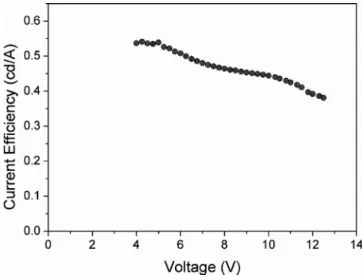
Figure 8 displays the current efficiency–voltage characteristics of the RC545T/rubrene codoped devices incorporating rubrene at a concentration of 15 wt %. The current efficiency decreased only slightly over a wide range of potentials共4–12.5 V兲, with good CIE coordinates of 共0.64, 0.35兲, thereby revealing the stability of the RC545T/rubrene codoped devices.
Conclusions
RC545T is a red-emitting dopant material for OLEDs; it exhibits a narrow fwhm. A codoped OLED system having the configuration ITO/NPB 共65 nm兲/Alq3:15 wt % rubrene:2 wt % RC545T 共30 nm兲/Alq3 共30 nm兲/LiF 共0.5 nm兲/Al 共250 nm兲 exhibited a maximum luminance of 8000 cd/m2at 12.5 V, with near-saturated CIE coordinates of共0.64, 0.35兲, revealing that RC545T is an excel-lent red-emitting dopant for OLED applications.
Acknowledgment
We are grateful to the National Science Council共grant no. NSC 95-2113-M-110-013兲, Taiwan for financial support.
National Sun Yat-Sen University assisted in meeting the publication costs of this article.
References
1. C. W. Tang and S. A. Van Slyke, Appl. Phys. Lett., 51, 913共1987兲. 2. Z. Y. Xie, L. S. Hung, and S. T. Lee, Appl. Phys. Lett., 79, 1048共2001兲. 3. E. J. W. List, S. Tasch, C. Hochfilzer, G. Leising, P. Schlichting, U. Rohr, Y.
Geerts, U. Scherf, and K. Müllen, Opt. Mater. (Amsterdam, Neth.), 9, 183共1998兲. 4. Y. D. Jin, J. P. Yang, P. L. Heremans, M. V. Auweraer, E. Rousseau, H. J. Geise,
and G. Borghs, Chem. Phys. Lett., 320, 387共2000兲.
5. G. Sakamoto, C. Adachi, T. Koyama, Y. Taniguchi, C. D. Merritt, H. Murata, and Z. H. Kafafi, Appl. Phys. Lett., 75, 766共1999兲.
6. C. W. Tang, S. A. Van Slyke, and C. H. Chen, J. Appl. Phys., 65, 3610共1989兲. 7. C. T. Chen, Chem. Mater., 16, 4389共2004兲.
8. V. Bulović, A. Shoustikov, M. A. Baldo, E. Bose, V. G. Kozlov, M. E. Thompson, and S. R. Forrest, Chem. Phys. Lett., 287, 455共1998兲.
9. M. A. Baldo, D. F. Brien, Y. You, S. S. Shoustikov, M. E. Thompson, and S. R. Forrest, Nature (London), 395, 151共1998兲.
10. V. Bulović, R. Deshpande, M. E. Thompson, and S. R. Forrest, Chem. Phys. Lett., 308, 317共1999兲.
11. Y. Hamada, H. Kanno, T. Tsujioka, H. Takahashi, and T. Usuki, Appl. Phys. Lett., 75, 1682共1999兲.
12. T. W. Lee, O. O. Park, H. N. Cho, and Y. C. Kim, Curr. Appl. Phys., 1, 363共2001兲. 13. B. W. D’Andrade, M. A. Baldo, C. Adachi, and J. Brooks, Appl. Phys. Lett., 79,
1045共2001兲.
14. Y. Hamada, H. Kanno, T. Tsujioka, and H. Takahashi, Appl. Phys. Lett., 75, 1682 共1999兲.
15. Y. Ohmori, H. Kajii, T. Sawatani, H. Ueta, and K. Yoshino, Thin Solid Films, 393, 407共2001兲.
Figure 6. B-V characteristics of red OLEDs incorporating various
concen-trations of the assistant dopant.
Figure 7. CIE coordinates共x,y兲 of red OLEDs incorporating various
con-centrations of the assistant dopant.
Figure 8. Current efficiency–voltage characteristics of the RC545T/rubrene
codoped devices incorporating rubrene at a concentration of 15 wt %. J369
Journal of The Electrochemical Society, 155共12兲 J365-J370 共2008兲 J369
16. J. Feng, F. Li, W. Gao, G. Cheng, W. Xie, and S. Liu, Thin Solid Films, 499, 343 共2006兲.
17. H. Tang, Y. Li, X. Wang, W. Wang, and R. Sun, Semicond. Sci. Technol., 22, 287 共2007兲.
18. W. Y. Huang, M. Y. Chang, Y. K. Han, To be submitted. 19. R. G. Bennett, J. Chem. Phys., 41, 3037共1964兲.
20. C. C. Wang, M.Sc. Thesis, National Sun Yat-Sen University, Taiwan, 2007. 21. C. C. Lee, M. Y. Chang, P. T. Huang, Y. C. Chen, Y. Chang, and S. W. Liu, J. Appl.
Phys., 101, 114501共2007兲.
22. C. C. Lee, M. Y. Chang, Y. D. Jong, T. W. Huang, C. S. Chu, and Y. Chang, Jpn.
J. Appl. Phys., Part 1, 43, 7560共2004兲.
23. C. C. Lee, Y. D. Jong, P. T. Huang, Y. C. Chen, P. J. Hu, and Y. Chang, Jpn. J. Appl.
Phys., Part 1, 44, 8147共2005兲.
24. V. Podzorov, S. E. Sysoev, E. Loginova, V. M. Pudalov, and M. E. Gershenson,
Appl. Phys. Lett., 83, 3504共2003兲.
25. K. Okumoto, H. Kanno, Y. Hamada, H. Takahashi, and K. Shibata, Appl. Phys.
Lett., 89, 013502共2006兲.
26. H. Suzuki and S. Hoshino, J. Appl. Phys., 79, 8816共1996兲.
27. H. Murata, C. D. Merritt, and Z. H. Kafafi, IEEE J. Sel. Top. Quantum Electron., 4, 119共1998兲.
28. S. E. Shaheen, B. Kippelen, N. Peyghambarian, J. F. Wang, J. D. Anderson, E. A. Mash, P. A. Lee, N. R. Armstrong, and Y. Kawabe, J. Appl. Phys., 85, 7939 共1999兲.
29. T. Förster, Discuss. Faraday Soc., 27, 7共1959兲.
J370 Journal of The Electrochemical Society, 155共12兲 J365-J370 共2008兲
J370