Orbital susceptibilities of PbSe quantum dots
W. B. Jian, Weigang Lu, Jiye Fang, S. J. Chiang, M. D. Lan, C. Y. Wu, Z. Y. Wu, F. R. Chen, and J. J. Kai
Citation: The Journal of Chemical Physics 124, 064711 (2006); doi: 10.1063/1.2168444 View online: http://dx.doi.org/10.1063/1.2168444
View Table of Contents: http://scitation.aip.org/content/aip/journal/jcp/124/6?ver=pdfcov Published by the AIP Publishing
Articles you may be interested in
Charge-transfer dynamics in multilayered PbS and PbSe quantum dot architectures Appl. Phys. Lett. 104, 051112 (2014); 10.1063/1.4863953
Electroabsorption spectra of PbSe nanocrystal quantum dots Appl. Phys. Lett. 98, 161911 (2011); 10.1063/1.3583450
Optical properties of PbSe nanocrystal quantum dots under pressure Appl. Phys. Lett. 90, 043110 (2007); 10.1063/1.2431777
Spontaneous magnetization and ferromagnetism in PbSe quantum dots J. Appl. Phys. 99, 08N708 (2006); 10.1063/1.2171130
Synthesis and characterization of PbSe quantum dots in phosphate glass Appl. Phys. Lett. 71, 3406 (1997); 10.1063/1.120349
Orbital susceptibilities of PbSe quantum dots
W. B. Jiana兲Department of Electrophysics, National Chiao Tung University, Hsinchu 300, Taiwan, Republic of China
Weigang Lu and Jiye Fang
Department of Chemistry and Advanced Materials Research Institute, University of New Orleans, New Orleans, Louisiana 70148
S. J. Chiang and M. D. Lan
Department of Physics, National Chung Hsing University, Taichung 402, Taiwan, Republic of China
C. Y. Wu
Opto-Electronics and Systems Laboratories, Industrial Technology Research Institute, Hsinchu 310, Taiwan, Republic of China
Z. Y. Wu, F. R. Chen, and J. J. Kai
Department of Engineering and System Science, National Tsing Hua University, Hsinchu 300, Taiwan, Republic of China
共Received 8 July 2005; accepted 23 December 2005; published online 14 February 2006兲
Different sizes of three-dimensional PbSe quantum dots have been synthesized for the study of orbital magnetic susceptibilities. Two types of orbital susceptibilities have been found, including the Curie susceptibility and finite-size corrections to the Landau susceptibility. The Curie term of a quantum dot manifests itself in the temperature dependence of magnetic susceptibility at low temperatures, while the field dependence of differential susceptibility at high temperatures shows finite-size corrections to the Landau susceptibility. Both of the two kinds of orbital susceptibility, estimated per quantum dot, show linear dependence on the size. © 2006 American Institute of Physics.关DOI:10.1063/1.2168444兴
Semiconductor and diluted magnetic semiconductor quantum dots共QDs兲 have drawn a lot of attention since their physical properties can be modified by the quantum confine-ment effects1–3 and they possess a potential application in building spintronic devices such as quantum computer.4 Re-cently, due to a successful development of synthetic meth-ods, high-quality preparation of many II-VI and IV-VI semi-conductor QDs have been carried out and it has become possible to characterize their physical properties, especially the optical properties.5–9
Physics at mesoscopic scales often leads to striking phe-nomena due to intrinsic quantum effects.10Magnetic proper-ties of materials, when transferred to the nanophase, may be much different from those in their bulk state. For example, carbon nanotubes, such as two-dimensional structures of graphite, exhibiting large diamagnetic susceptibility and ow-ing mainly to orbital row-ing currents, have been studied experi-mentally and theoretically.11,12Another example is that be-low a threshold diameter, Pd and Au nanoparticles, which correspond to para- and diamagnetic metals in bulk states, respectively, may display spontaneous magnetization.13–15 According to a theoretical calculation, a mesoscopic tube is diamagnetic when the radius is larger than a threshold value, but becomes paramagnetic when its radius is smaller.10
Orbital magnetism had been an important theoretical work to understand the magnetic properties of ballistic
bil-liard in mesocopic regime,16 for example, to explain the
magnetization of a large amount of two-dimensional semi-conductor QDs which were fabricated by the lithography
technique.20 Two different theoretical approaches were
adopted. One was taking quantum dots as atomiclike objects to demonstrate the orientational paramagnetism and preces-sional diamagnetism which were like the Curie and Langevin susceptibilities of atoms, respectively.17The oscillatory para-magnetic susceptibility as a function of the number of elec-trons in the QD was predicted. The other theoretical method was starting from the Landau susceptibility in bulk states. The free-electron diamagnetic susceptibility was then modi-fied by finite-size corrections.16,18,19 A zero-field paramag-netic peak which was firstly observed in experiments by Lévy et al.20was reproduced theoretically. Recently, the ex-perimental report21showed information about magnetization of two-dimensional electron system and QDs which were differentiated in their field dependencies. The magnetization of QDs confirmed the zero-field paramagnetic peak.
Although quite a lot of theoretical works have been con-ducted to simulate the orbital magnetic response of QDs, the experimental studies of both the Curie and finite-size correc-tions to the Landau susceptibility of QDs have not been re-ported. With a help of high- quality preparation of
monodis-perse semiconductor QDs 共Refs. 22 and 23兲 and a careful
separation of magnetic contribution from atoms and QDs, we report a direct observation of the two kinds of orbital mag-netism.
a兲Author to whom correspondence should be addressed. Electronic mail: [email protected]
0021-9606/2006/124共6兲/064711/4/$23.00 124, 064711-1 © 2006 American Institute of Physics
7.9 g of selenium powder共99.999%, Aldrich兲 was added
into 100 mL of trioctylphosphine 共TOP, 90%, Aldrich兲. The
mixture was stirred for overnight in a glove box to form a clear TOP-Se solution共1M for Se兲. In a typical experiment, 1.081 g of lead acetate trihydrate 关共CH3CO2兲2Pb· 3H2O,
99.99+ %, Aldrich, 2.85 mmol兴, 1.8 mL of oleic acid 共90%, Aldrich兲, and 15 mL of phenyl ether were mixed and heated to 150 ° C for 30 min under argon atmosphere. After the so-lution was cooled to 40 ° C, it was transferred to a glove box and mixed with 4.0 mL of TOP-Se stock solution. This room-temperature mixed solution was then rapidly injected into vigorously stirred phenyl ether 共15 mL兲 that was pre-heated to 150 ° C in a three-neck flask equipped with a con-denser under argon stream. After the injection, the tempera-ture of the mixtempera-ture dropped to about 135 ° C and then was kept constant at 150– 200 ° C for 10 min, depending on the desired size of PbSe nanocrystals. The PbSe dispersion was then cooled and ethanol was added to flocculate the nano-crystals which were subsequently separated from solution by centrifugation. The size distribution of PbSe nanocrystals was further narrowed by a size-selection post-treatment us-ing a pair of solvents, hexane/ethanol system.
PbSe QDs with different sizes have been prepared. The size distribution was monitored by using transmission
elec-tron microscope 共TEM兲, where the standard deviations are
7.1% and 4.1% for QDs with diameters of 10.5 and 6.7 nm, respectively. The crystalline structure and the spherical shape of the PbSe QDs were confirmed by the high-resolution TEM images shown in Fig. 1. The TEM images were carried out on a JEOL JEM-2010F. Magnetic properties of PbSe QDs were measured, over a temperature range of 2 – 300 K and a field from 0 to 50 kOe, by a superconducting quantum
interference device 共SQUID兲 magnetometer 共Quantum
De-sign MPMS-7兲. The magnetization of PbSe QDs is at least
ten times larger than the sample holder background which is
mainly from the capsule and is about −1⫻10−6emu at
1 kOe. The susceptibility was calculated by dividing the mo-lar grams of PbSe, not that of QDs.
The as-grown PbSe QDs stabilized with capping agents of both TOP and oleic acid. The total ratio of capping agents
in all samples is ⬃10 wt % which was obtained by using
differential scanning calorimetry and thermogravimetric
analysis 共DSC-TGA兲. The molecular susceptibilities
from TOP and oleic acid are −3.20 and −2.10
⫻10−4 emu/ mol Oe, respectively.24
The temperature- and field-independent susceptibilities of TOP and oleic acid,
which are about −0.06 and −0.06⫻10−4emu/ mol Oe in our
samples, are ten times smaller than the diamagnetic suscep-tibility of PbSe in the bulk state and are neglected. We only subtract the core diamagnetism of PbSe, taken as −1.0 ⫻10−4 emu/ mol Oe,25
from the raw data. To examine the magnetization from contamination of magnetic impurities, a large-size system of Mn-doped PbSe nanoarrays were synthesized.23We have observed that the field dependence of magnetization of PbSe with Mn impurities had paramagnetic response under high magnetic fields while that of the pure PbSe QDs did not have any paramagnetic response at 5 K, even though the temperature dependence of molar suscepti-bilities and the Curie constants for them both are the same. The following data are solely from the QDs.
How many electrons or holes are there in a QD? If no free electron exists, we cannot observe any orbital suscepti-bility. A native hole doping of PbSe is typically having a bulk carrier concentration of⬃1018holes/ cm3.26
It generates less than one hole per QD with a size of 10 nm. Beside doping carriers, it had been established that PbSe, when exposed to the air or oxygen, formed a strong p-type surface layer
and had high surface charge densities of 2 – 5
⫻1013carriers/ cm2.26
We then estimate it being 15–40 holes in the 10-nm-sized QD when exposed to the air.
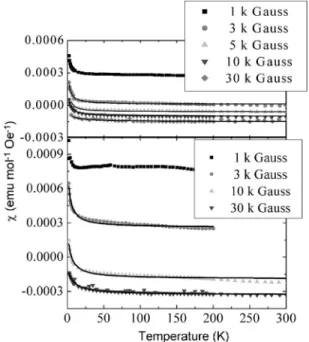
Temperature-dependent susceptibilities are shown in Fig. 2. The magnetic susceptibilities of the PbSe QDs are given by =C,atom+L,atom+C,QD+L,QD+Landau, where C,atom,
L,atom,C,QD, andL,QDare the atomic Curie, atomic
Lange-vin, the QD’s Curie, and the QD’s Langevin susceptibilities, respectively, and Landau is the contribution from finite-size corrections to the Landau susceptibility. The filled shells of electrons in PbSe result in a zero susceptibility of the atomic Curie term, and the core Langevin diamagnetism of PbSe is subtracted from the data. The remaining contribution to the temperature-dependent susceptibility is the Curie susceptibil-ity of QDs. It can only be observed at temperatures
T⬍10K, and no field dependence of paramagnetism has
been observed at a temperature exceeding 5 K. The disap-pearance of the QD’s Curie susceptibility at a slightly higher temperature comes from the degraded quantization since the QDs have a much larger diameter compared with the atomic size. The susceptibility as a function of temperature is then fitted by=0+ C /共T−TC兲, where0is a constant shift, C is
the Curie constant, and TCis the Curie or Weiss temperature.
The samples studied under different external fields are listed in Tables I and II. We only subtract the core diamagnetism
with a value of −1.0⫻10−4emu/ mol Oe from our raw data.
FIG. 1. TEM images of PbSe QDs with diameters of 10.5 nm关共a兲 and 共c兲兴 and 6.7 nm关共b兲 and 共d兲兴. The image sizes of 共a兲 and 共b兲 are 90⫻90 nm2and the image sizes of 共c兲 and 共d兲 are 12.3⫻12.3 nm2 and 7.4⫻7.4 nm2, respectively.
064711-2 Jian et al. J. Chem. Phys. 124, 064711共2006兲
The fitted results show the same Curie constants for QDs with the same size and approve good fitting. The Curie con-stant of 6.7 nm QDs is⬃2.8 times of that of 10.5 nm QDs. It roughly corresponds to 共10.5/6.7兲2, that is proportional to
D−2, where D is the size of the QDs. The positive shift of 0
is from the orbital Landau susceptibility, not from the Curie susceptibility. The contribution to the negative TC, the Weiss
temperature, is from the orbital Curie susceptibility. An in-crease of the Weiss temperature with a raising field may indicate a strong interaction in the QD.
A clear evidence of zero-field paramagnetic peak which agrees well with the theory of finite-size corrections to the Landau susceptibility is shown in Fig. 3. The differential susceptibilities of both the 6.7- and 10.5 nm QDs taken at 200 K show paramagnetic with positive value under low fields and a transition to negatively saturated susceptibility under high magnetic fields. The saturated Landau dia-magnetism in a high field gives −4.16 and −1.88
⫻10−4emu/ mol Oe for 6.7 and 10.5 nm PbSe QDs,
respec-tively. The orbital Landau susceptibility of the QDs per PbSe is several times larger than that of the core diamagnetism of PbSe. The saturated Landau diamagnetism of the QDs varies with the diameter D as a function of D−2. Differential
sus-ceptibilities under low magnetic fields are displayed in the inset of Fig. 3 to display its consistency of enhancement in
the 6.7 nm QDs. The temperature effect on the differential susceptibility is inspected for 6.7 nm QDs. It shows a broader zero-field paramagnetic peak at 5 K. The constant shifts0s, listed in Tables I and II, are plotted in Fig. 3. They
tend to lie on the differential susceptibility taken at 5 K. For a flux quantum threading through a 10 nm QD, a magnetic field up to 520 kOe is needed. The extremely high field is required to see a complete cycle of oscillatory sus-ceptibility. A transition from positive susceptibility to nega-tively saturated susceptibility in Fig. 3 may be understood by the probing length of the magnetic field. We found that, for the differential susceptibility taken at 200 K, the required fields to approach a negatively saturated susceptibility are ⬃3 and ⬃7 kOe for the QDs with sizes of 10.5 and 6.7 nm, respectively. The smaller-size QDs having a higher magnetic field to approach the saturated susceptibility verify that the magnetic response is mainly from the QDs.
We calculate the magnetization of a QD by multiplying the total number of PbSe unit cells and draw the field-dependent magnetization in Fig. 4. It shows a small positive increase in fields lower than 1 kOe and a large decrease in high fields. The high-field magnetization exhibits linear de-pendence on magnetic fields at higher temperatures. Since the number of PbSe unit cells is proportional to D3, and the
Curie and finite-size corrections to the Landau susceptibili-ties per mole of PbSe are both proportional to D−2, we find that the orbital magnetic susceptibilities of the QD vary lin-early with its diameter as D1. The results of field-dependent differential susceptibilities and the size dependencies agree well with theoretical calculation of two-dimensional QDs.19 Here, we use the concept of thermal length LT=បF/ kBT to
see the temperature effect. A periodic orbit contributes
sig-TABLE II. Fitting results of 6.7 nm PbSe QDs.
H共kOe兲 0共emu/mol Oe兲 C共emu K/mol Oe兲 TC共K兲
3 2.6⫻10−4 1.7⫻10−3 −2.7 10 −1.9⫻10−4 1.9⫻10−3 −4.2 30 −3.3⫻10−4 1.8⫻10−3 −7.3
FIG. 3. Differential susceptibilities per mole PbSe. The open circles are calculated from field-dependent magnetization of 10.5 nm QDs at 200 K. The crosses and the pluses represent susceptibilities of 6.7 nm QDs at 200 and 5 K, respectively. The closed circles and squares are0s in Tables I and II of PbSe QDs with diameters of 10.5 and 6.7 nm, respectively. Inset: susceptibility in the low-field regime.
FIG. 2. Temperature dependence of susceptibilities of PbSe QDs under several external fields indicated in the graph. The susceptibilities are esti-mated per mole of PbSe. The solid lines represent best fitting curves.
TABLE I. Fitting results of 10.5 nm PbSe QDs.
H共kOe兲 0共emu/mol Oe兲 C共emu K/mol Oe兲 TC共K兲
1 2.7⫻10−4 6.0⫻10−4 −1.7 3 0.1⫻10−4 6.9⫻10−4 −1.5 5 −0.6⫻10−4 5.6⫻10−4 −1.4 10 −1.0⫻10−4 6.1⫻10−4 −1.9 30 −1.5⫻10−4 7.4⫻10−4 −8.6
nificantly only if the size is of the order or shorter than
the thermal length D⬍LT.18 This leads to a relation
T⬍បF/ kBD. As the size of the QDs is smaller, the orbital
susceptibility can be observed at a higher temperature. Com-paring with previous experiments performed at 0.2 and 8 K for QDs with sizes of 4.5m and 550 nm, respectively, the orbital susceptibility of the 10 nm QD can exist up to room temperature.
Two kinds of orbital susceptibilities, including the Curie and finite-size corrections to the Landau susceptibilities, have been observed in the three-dimensional PbSe QDs. The temperature dependence of susceptibility at low temperature shows the Curie susceptibility of the QDs. In addition, the field dependence of differential susceptibility shows zero-field paramagnetic peak and reveals finite-size corrections to the Landau susceptibility. Both the two kinds of orbital sus-ceptibilities display linear dependence on the size of the QD. Since the averaged susceptibility per PbSe unit cell decrease as a function of inverse square of the size, the susceptibilities from the QD disappears in the bulk state. Theories of orbital magnetization of two-dimensional QDs can explain some ex-perimental results of our three-dimensional PbSe QDs.
This work was supported by the National Science Coun-cil of R.O.C. under Grant No. 93-2112-M-009-038 and by
NSF CAREER program共Grant DMR-0449580兲. The authors
thank Dr. S. J. Cheng for helpful discussion.
1L. E. Brus, J. Chem. Phys. 80, 4403共1984兲.
2A. I. Ekimov, A. L. Efros, and A. A. Onushchenko, Solid State Commun.
56, 921共1985兲.
3A. P. Alivisatos, Science 271, 933共1996兲.
4S. A. Wolf, D. D. Awschalom, R. A. Buhrman, J. M. Daughton, S. von Molnar, M. L. Roukes, A. Y. Chtchelkanova, and D. M. Treger, Science
294, 1488共2001兲.
5R. N. Bhargava, D. Gallagher, X. Hong, and A. Nurmikko, Phys. Rev. Lett. 72, 416共1994兲.
6J. A. Gupta, D. D. Awschalom, X. Peng, and A. P. Alivisatos, Phys. Rev. B 59, R10421共1999兲.
7A. D. Andreev and A. A. Lipovskii, Phys. Rev. B 59, 15402共1999兲. 8F. R. Wise, Acc. Chem. Res. 33, 773共2000兲.
9H. Du, C. Chen, R. Krishnan, T. D. Krauss, J. M. Harbold, F. W. Wise, M. G. Thomas, and J. Silcox, Nano Lett. 2, 1321共2002兲.
10P. S. Davids, L. Wang, A. Saxena, and A. R. Bishop, Phys. Rev. B 48, 17545共1993兲.
11R. P. Ramirez, R. C. Haddon, O. Zhou, R. M. Fleming, J. Zhang, S. M. McClure, and R. E. Smalley, Science 265, 84共1994兲.
12J. P. Lu, Phys. Rev. Lett. 74, 1123共1995兲.
13H. Hori, T. Teranishi, Y. Nakae, Y. Seino, M. Miyake, and Y. Yamada, Phys. Lett. A 263, 406共1999兲.
14H. Hori, T. Teranishi, M. Taki, S. Yamada, M. Miyake, and Y. Yamamoto, J. Magn. Magn. Mater. 226–230, 1910共2001兲.
15H. Hori, Y. Yamamoto, T. Iwamoto, T. Miura, T. Teranishi, and M. Miyake, Phys. Rev. B 69, 174411共2004兲.
16K. Richter, D. Ullmo, and R. A. Jalabert, Phys. Rep. 276, 1共1996兲. 17Y. H. Zeng, B. Goodman, and R. A. Serota, Phys. Rev. B 47, 15660
共1993兲.
18F. von Oppen, Phys. Rev. B 50, 17151共1994兲.
19D. Ullmo, K. Richter, and R. A. Jalabert, Phys. Rev. Lett. 74, 383共1995兲. 20L. P. Lévy, D. H. Reich, L. Pfeiffer, and K. West, Physica B 189, 204
共1993兲.
21M. P. Schwarz, D. Grundler, M. Wilde, C. Heyn, and D. Heitmann, J. Appl. Phys. 91, 6875共2002兲.
22T. Ji, W.-B. Jian, and J. Fang, J. Am. Chem. Soc. 125, 8448共2003兲. 23W. Lu, P. Gao, W. B. Jian, Z. L. Wang, and J. Fang, J. Am. Chem. Soc.
126, 14816共2004兲.
24G. Föex, Constantes Selectionnées Diamagnetisme et Paramagnetisme
Relaxation Paramagnetique共Masson, Paris, 1957兲, Vol. 7.
25J. R. Anderson, G. Kido, Y. Nishina, M. Górska, L. Kowalczyk, and Z. Golacki, Phys. Rev. B 41, 1014共1990兲.
26M. H. Brodsky and J. N. Zemel, Phys. Rev. 155, 780共1967兲. FIG. 4. Field dependence of magnetization per QD under high magnetic
fields. Inset: magnetization under low magnetic fields.
064711-4 Jian et al. J. Chem. Phys. 124, 064711共2006兲