Journal o/ I/W Euwpe~a? Ccwnric .Soc~c~~ 17 ( 1997) 725-141 Q 1997 Elsevier Science LImited Prmted in Great Britain. All nghts reserved PII: SO955-2219(96)00083-O 0955-2219/971%17.00
Effect of Sintering Atmosphere on the Mechanical
Properties of Ni/Al,O, Composites
W. H. Tuan, H. H. Wu & R. Z. Chen
Institute of Materials Science and-Engineering, National Taiwan University. Taipei, Taiwan 10764 (Received 7 August 1995; revised version received 2 April 1996; accepted 3 May 1996)
Abstract
In the present study, nickel-toughened aluminas are prepared by sintering in either hydrogen or carbon
monoxide. By choosing suitable sintering tempera- tures, the size of nickel inclusions is the same in the composites sintered in H2 and CO. The addition of nickel inclusions enhances the toughness of alumina. As the inclusion size is bigger than 2.7 pm, micro- cracks are formed at the interface in the composites sintered in H? The toughness and strength of the composites are thus reduced. However, no micro- cracks are observed at the interface in the compos- ites sintered in CO. The toughness and strength of the composites sintered in CO is therefore higher than those of the composites sintered in H?. For example, for the composite containing 20 voM inclusions and sintered in CO, the toughness is 9 MPa m”’ and the strength is 630 MPa. 0 1997 Elsevier Science Limited. All rights reserved.
resistance. Dense Ni/Al,O, composites have been prepared by a powder metallurgy technique,’ a selective reduction process,’ a powder coating pro- cess6 and a sol-gel process7.’ The reported proper- ties for the composites containing -13 vol% Ni are shown in Table 1. Some data from the present study are also shown for comparison. These stud- ies indicate that the toughness of alumina can be enhanced by adding nickel inclusions. However, the reported values show a strong dependence on the sintering atmosphere employed. Zhang et al.
suggested that higher oxygen content in the sinter- ing atmosphere can result in higher toughness.’ Despite the oxygen content in the sintering atmo- sphere being varied, no reaction phase at the interface was observed. Chang et al. observed no spine1 interphase in their Ni/Al,O, composites as we11.9 However, an amorphous carbon film was observed at the interface instead.
1 Introduction
Brittle ceramics can be toughened by the incorpo- ration of ductile inclusions.’ ’ The toughness enhancement is mainly contributed by the plastic deformation of metallic inclusions. Two condi- tions have to be fulfilled in order for the plastic deformation to be fully exploited: (1) to ensure that the crack is attracted by the metallic particles, the elastic modulus of the metal should be lower than that of the ceramic matrix; (2) the metallic particIes need to be firmly bonded to the brittle matrix. The size of the inclusions should therefore be kept below the critical size at which thermal mismatch stresses become sufficient to induce cracks.4 If the ductile inclusion is weakly bonded to the matrix, the crack will propagate along the interface, and the contribution from ductility to the toughening enhancement will be negligible.
The interactions between Al,O, and NiO, Al,O, and Ni have been studied extensively.‘“.” A1,03 reacts with NiO to form NiAI,O, spine1 above 700°C in air.‘” The spine1 can also be formed at Al,O1/Ni interfaces as the oxygen solubility in nickel is higher than a threshold value.” However, the stability of NiAl,O, depends on the oxygen partial pressure in the atmosphere. When the oxy- gen partial pressure is low, the NiAl,O, interphase will eventually reduce to alumina, nickel and oxy- gen after its formation.” In the present study, the effect of sintering atmosphere on the microstruc- tural evolution and toughening behaviour of Ni/Al,O, composites is investigated in detail. Fur- thermore, the effect of sintering atmosphere on the strength of composites has not been investigated in previous studies. In this study, the effect of sin- tering atmosphere on the strength is also investigated.
2 Experimental
Among metals that can be used to toughen alu- Alumina (TM-DR, Taimei Chemical Co., Ltd, mina, nickel is frequently chosen for its oxidation Tokyo) and various amounts of nickel oxide
736 W. H. Tuan et al. Ni content (vol!!,) 13 12 12 13 IO 13 I3
Table 1. Reported values for the toughness and strength of nickel-toughened aluminas
Size of Ni inclusions (pm) Toughness k,,&c.o Measurement technique for K,, Strength u&0 Processing conditions and sintering atmosphere Ref: I.1 20 pm long, 2-3 pm wide 20 pm long, 2-3 pm wide I.1 0.02-50 2.1 5012.1 ID 4,1/3,6 SENB 4.913.6 SENB 5.614.0 SENB 6.313.8 ID 5.013.6 SENB 4621399 4061456 selective 2 reduction, CO powder 5 metallurgy, CO powder 5 metallurgy, Ar powder coating, 6 H2 sol-gel, 7 hot-pressing
selective this study reduction; H2 2.6 7.514.0 SENB 6591317 selective reduction, co this study
Notes: K,c,c = fracture toughness of the composite (MPa m” 5); K,,,, = fracture toughness of alumina alone (MPa m” ‘); ID = inden- tation technique; SENB = single-edge notched beam technique; gc = flexural strength of the composite (determined by the four- point bending technique) (MPa); o. = flexural strength of alumina alone (determined by the four-point bending technique) (MPa).
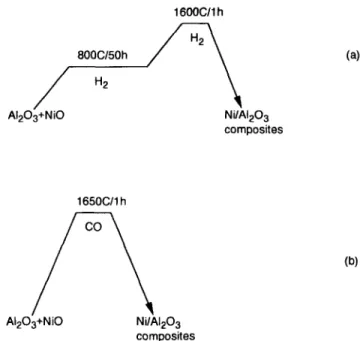
(Johnson Matthey Co., USA) were milled together for 4 h in ethyl alcohol with a turbo-mixer. The powder mixtures would result in 0, 2, 5, 8, 13 and 20 ~01% nickel after sintering in a reducing atmo- sphere. The grinding medium used was zirconia balls. The slurry of the powder mixtures was dried with a rotary evaporator. The dried lumps were crushed and sieved through a plastic sieve. Powder compacts were formed by first uniaxially pressing at IO MPa, then by isostatic pressing at 250 MPa. For the composites sintered in flowing hydrogen (HZ). the sintering was performed with a tube fur- nace. The sintering atmosphere was a mixture of 5% hydrogen and 95% nitrogen. The gas mixture was first passed through concentrated sulfuric acid (HSO,) to reduce the water content. The powder compacts were reduced in hydrogen at 800°C for 50 h, then sintered at 1600°C for 1 h, Fig. l(a). The sintering atmosphere of carbon monoxide (CO) was generated by arranging specimens in covered graphite crucible. The crucible was then fired in a box furnace. The sintering in CO was performed at 1650°C for 1 h, Fig. l(b). The sinter- ing temperatures were chosen to result in the same inclusion size for the composites sintered either in H2 or in CO. The heating and cooling rates were 5°C min. ’
The final density of the composites was deter- mined by a water displacement method. Before submerging the specimens in water, a wax was applied to the surface to prevent water penetra- tion. The polished surfaces were prepared by
grinding and polishing with diamond paste to 6 pm and with silica suspension to 0.05 pm. The size of the nickel inclusions after sintering was determined by using the linear intercept technique. The polished specimens were then thermally etched at 1500°C for 1 h in H2 to reveal the grain boundaries of the matrix. The size of the matrix grains was also determined by using the linear intercept technique. The microstructure of the specimens was observed by scanning electron microscopy (SEM) and transmission electron micro-
16OOCll h (4 165OCll h composites (b) A1203+Ni0 NilAl composites
Fig. I. Sintering profiles for the composites sintered in (a) Hz and (b) CO.
Sintering utrnosphrre und mx~hmicul proprrtirs of Ni/AI,O, 137 scopy (TEM). Phase identification was performed
by X-ray diffractometry (XRD). Silicon powder was used as internal standard to determine the lattice parameter of nickel.
The sintered composites were machined longitu- dinally with a 325 grit metal-bonded diamond wheel at cutting depths of 5 pm per pass. The final dimensions of the specimens were 3 X 4 X 36 mm3. The strength of the specimens was deter- mined by the four-point bending technique. The upper and lower spans were 10 mm and 30 mm, respectively, and the rate of loading was 0.5 mm min’. The fracture toughness was determined by the single edge notched bean (SENB) technique. The notch was generated by cutting with a dia- mond saw.
3 Results and Discussion 3.1 Thermodynamic analysis
Passing the gas through concentrated sulfuric acid reduces the water content to 0.003 mg per litre of gas.‘* The partial pressure of oxygen can be esti- mated with the reaction equation as
H,(g) + +- O,(g) = HP(g)
At 16OO”C, the Gibbs free energy change for the reaction is -140000 J mo1m’.‘3 The oxygen partial pressure at 1600°C is therefore 8 X lo-” atm.
At temperatures higher than 700°C carbon is mainly reacted with oxygen to form carbon monoxide asI
C(s) + +
O*(g)= CO(g)
The Gibbs free energy change for the reaction at 1650°C is -560 000 J mol-‘. By assuming unit activity for the solid phase, the equilibrium oxy- gen partial pressure at 1650°C is lo-l5 atm.
Nickel melt can react with A1203 and O2 to form NiAl,O, as
Ni(1) + t O,(g) + Al2O3(~) = NiAl,O,(s) (3) The Gibbs free energy change for the above reaction between 1500 and 1700°C has been expressed asI
AG = -241800 + 74.2 T J mol-’ (4) where T is temperature in K. The equilibrium oxygen pressure for reactions (l), (2) and (3) is shown in Fig. 2. Because the oxygen partial pres- sure in the sintering atmosphere is much lower than the oxygen pressure needed for reaction (3) to take place, the formation of NiAl,O, is not possible.
600 600 1000 1200 1400 1600 1600
temperature I “C
Fig. 2. Oxygen partial pressure during sintering as a function of temperature.
The starting material used in the present study comprises powder mixtures of A&O, and NiO. As NiO is fully reduced to Ni first at 800°C for 50 h, the formation of NiAl,O, during sintering is not possible. As Al,O,/NiO powder mixtures are sin- tered in CO without the pre-sintering stage, NiAl,O, can be formed at the beginning of sinter- ing. However, the NiAl,O, phase tends to be reduced fully to Al203 and Ni eventually. In XRD patterns, no NiAl*O, spine1 was observed in the composites after sintering in Hz or in CO. There- fore, the XRD results confirm the thermodynamic analysis.
3.2 Sintering and microstructural evolution
For sintering in H,, the pre-sintering stage is essential to produce a uniform microstructure: sintering the A&O,/NiO powder compacts at 1600°C for 1 h in hydrogen without pre-sintering at 800°C resulted in a non-uniform microstruc- ture. The skin layer of the fired compact is com- posed of only Al203 and Ni; however, not only Al,O, and Ni but also NiAl,O, are found in the central region. This is due to the densification of the skin layer being faster than the reduction of NiO and NiAl,O,. When a dense skin layer is formed, the reduction of NiO and NiAl,O, is diffi- cult because the diffusion of oxygen through the dense skin is slow. The powder compacts were thus pre-sintered at 800°C for 50 h in Hz to reduce NiO first. After pre-sintering, neither NiO nor NiAl,O, is observed.
For the A1203/Ni0 powder compacts sintered in CO at 1650°C dense Ni/Al,O, composites are obtained without a pre-sintering treatment. To be shown later, the grain size of alumina in the com- posites sintered in CO is bigger than that in the composites sintered in H,. The densification rate of the composites sintered in CO is thus slower. The reduction of NiO and NiAl,O, can thus be achieved before densification is completed.
W. H. Tuun et al.
1 . . . . 1. s 8. 1 I . 11..
0 5 10 15 20 25
nickel content / vol %
Fig. 3. Relative density of Ni/A120, composites as a function Fig. 5. Size of matrix A&O, grains in NilA120, composites as
of nickel content. a function of nickel content.
The relative density of the composites is shown as a function of nickel content in Fig. 3. The rela- tive density of the composites is greater than 96%. Mehrotra and Chaklader have determined the A1203/Ni interfacial energy as a function of oxy- gen pressure. I6 They suggested that the energy is independent of oxygen pressure at oxygen pres- sures lower than 10-j atm. The oxygen pressure under investigation in the present study ranges from lo-” to lO_” atm. The Al,O,/Ni interfacial energy is therefore independent of sintering atmo- spheres used in the present study. The sintering behaviour of Ni/Al,O, composites in H, and in CO should be very similar. The density difference for the composites sintered in the different sinter- ing atmospheres is indeed small.
The inclusion size of nickel is shown as a func- tion of nickel content in Fig. 4. The inclusion sizes in the composites sintered in CO and H, are very close to one another. The toughness enhancement for the ceramic/metal composites depends strongly on the size of the metaHic inclusion.” The mech- anical properties can thus be compared on the same inclusion size and similar density. The effect of sintering atmosphere on the mechanical proper-
,‘.‘.‘f..‘.‘.““‘..““‘,’
0 5 10 15 20 25
nickel content / vol % lb)
Fig. 4. Size of nickel inclusions in Ni/AI,O, composites as a Fig. 6. Typical microstructures for the Ni/AI,O, composites function of nickel content. sintered in (a) HZ and (b) CO.
12 ',,,,."'1."'I,"'I".'
NilAl ,03 composites
5 10 15 20 25
nickel content I vol %
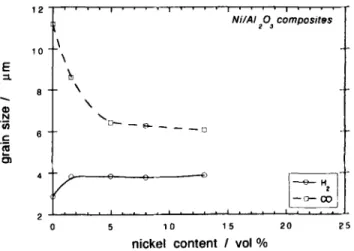
ties can therefore be identified. The grain size of the alumina matrix is shown as a function of nickel content in Fig. 5. Typical microstructures for the composites are shown in Fig. 6. Because the composites sintered in CO were sintered at higher temperature, the resulting grain size is thus bigger. Furthermore, the Al,OJNiO powder com- pacts were fired directly to the sintering tempera-
ture in CO. During the heating-up stage, a small amount of nickel oxide can dissolve into alumina. The nickel ions segregate preferentially at the boun- daries of alumina,lx thus refining the matrix grain size. For the composites sintered in HZ, NiO is fully reduced to Ni first. The solubility of metallic nickel in alumina during sintering is limited, and hence the influence of the nickel oxide addition on the grain growth of alumina during sintering in H, is small. 3.3 Mechanical properties/microstructure
relationships
The flexural strength of the composites is shown as a function of nickel content in Fig. 7. Each point in the figure represents the average value of four specimens, while the error bars indicate the
maximum and minimum values measured. The
grain size of alumina sintered in Hz is smaller than that of alumina sintered in CO, thus the strength of alumina sintered in H2 is higher than that of the alumina sintered in CO. The strength of the composites sintered in CO is significantly higher than that of alumina alone. For example, the strength of the composite containing 20 vol%, Ni is 630 MPa, this strength being twice that of alu- mina alone. As can be seen from Fig. 5, the grain size of alumina decreased with increasing nickel content as the composites were sintered in CO. As the strength of the composites is increased with increasing nickel content, the microstructural refinement contributes to the strengthening effect.
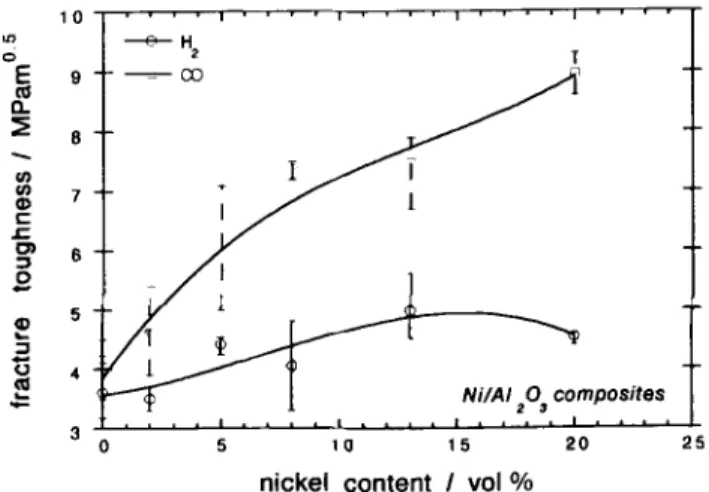
The toughness of the composites is shown as a function of nickel content in Fig. 8. The toughness of alumina is enhanced by adding nickel inclu- sions. Microstructural observation shows, similar to the previous studies,lmb that the toughness enhancement is contributed by crack bridging and crack deflection. The highest toughness value observed in the present study is 9 MPa mo5, which is 2.3 times that of alumina alone, for the composite containing 20 ~01% Ni and sintered in CO. How-
J
N//AI ,03 composites200 6 . ’ * 5 ’ . . . . 10 15 20 25
nickel content I vol %
Fig. 7. Flexural strength of Ni/AI,O, composites as a function of nickel content.
Fig. 8. Fracture toughness of Ni/Al,O, composites as a function of nickel content.
ever, the toughness of the composites sintered in H, increased only slightly and the toughness dropped at Ni contents higher than 13 ~01%. At that Ni content, the corresponding nickel size is 2.7 pm. Several composites were used for TEM observation. No second phase was observed at the interface in the composites sintered in H2 or in CO, Fig. 9. However, microcracks were observed at the interface of the composites sintered in HZ. Even within one specimen, microcracks were observed only at the interface with inclusions larger than 2-7 pm. One exampIe is shown in Fig. 9(a). For composites sintered in CO, after careful observation of several specimens, no microcrack was observed at the interface. An example is shown in Fig. 9(b). Despite the inclu- sion size in Fig. 9(b) being larger than 4 pm, no microcrack is present at the interface.
The presence of microcracks deviates the propa- gation of cracking. However, the contribution from crack deflection around spherical particles to tough- ness enhancement is limited.” As Ni inclusions are firmly bonded to the matrix, the plastic deformation of nickel inclusions is then possible. The tough- ness can be enhanced significantly by the plastic deformation of the ductile inclusions. The presence of microcracks degrades the strength of ceramics. At nickel contents of 13 ~01% Ni, the strength of the composites sintered in H, dropped whereas the strength of composites sintered in CO increased with increasing nickel content. This results from grain refinement and the absence of microcracks.
Chang et al. sintered their Ni/Al,O, composites using a graphite powder bed,’ and amorphous carbon was found at the interface. In the present study, attempts to locate the carbon film at the interface were not successful. However, carbon from the sintering atmosphere can dissolve in nickel at high temperature. This has been con- firmed by measurement of the lattice parameter of nickel. The lattice parameter of nickel in the
740 W. H. Tuan et al.
(b)
Fig. 9. TEM micrographs of the Ni/A&O, composites sintered in (a) H3 and (b) CO. The microcrack is indicated with an
arrow.
composite sintered in CO is 2.036 A, which is higher than the reported JCPD value (2.034 A), suggesting that carbon is dissolved in nickel dur- ing sintering. The reported properties” for pure nickel and nickel containing a small amount of carbon are shown in Table 2. As can be seen, the presence of carbon has little effect on the thermal expansion coefficient, elastic modulus and hard- ness. However, the yield strength of nickel is significantly increased as the carbon content is in- creased. The toughness increase due to the addi- tion of a ductile inclusion is proportional to its yield strength. I7 The toughness enhancement of the composites sintered in CO is thus higher.
The thermal expansion of nickel (13 pm/m K) is higher than that of alumina (9 pm/m K); the Al,O,/Ni interface is thus subjected to a radial tensile stress as the composite cools from the firing temperature. As the yield strength is higher, the metallic inclusion is more difficult to deform plas- tically upon cooling. The Al*O,/Ni interface may thus be intact upon cooling. Plastic deformation of the ductile inclusions during the subsequent fracture process is therefore possible. The tough- ness is enhanced significantly due to the plastic deformation of nickel inclusions and the absence of microcracks.
4 Conclusions
In the present study, Ni/Al,O, composites were sintered in hydrogen or in carbon monoxide and the effect of sintering atmosphere on the mechanical properties of the Ni/Al,O, composites investigated. The composites were sintered in CO at 1650°C or in Hz at 1600°C. After sintering, no NiAl,O, spine1 is formed at the interface. The density and the inclusion size of the resulting composites are very similar. In composites sin- tered in CO a small amount of carbon dissolved into the nickel, thus increasing the yield strength of the nickel inclusion. The toughness of the composites sintered in CO is thus higher. Further- more, because the yield strength is high, the nickel inclusion is not easily deformed plastically upon cooling. The Al,OdNi interface remains stable, and microcracks were not observed at the interface in the composites sintered in CO. The toughness and strength of the alumina are therefore significantly enhanced. However, micro- cracks are observed in the composites sintered in Hz. The toughness enhancement of the com- posites is thus low, as is the strength of the composites.
Acknowledgement
This work was supported by the National Science Council, Republic of China, through contract number NSC83-0405E002-014.
Table 2. Reported properties for pure nickel and nickel containing a small amount of carbon”
Materials Linear thermal
expansion (&m K)
Elastic nmiulus (CPU)
Hurdness Yield strength
IMPa)
Nickel 200” 0.15 13.3 204 109 HB
Nickel 201h 0.02 13.1 207 129 HB
a Composition = 99.0% Ni(min). 0.25% Cu. 0.40% Fe. 0.35% Mn, 0.15% C. 0.35% Si. 0.01% S. ’ Composition = 99.0% Ni(min). 0.25% Cu. 0.40’%> Fe, 0.35% Mn. O.OZ’i/n C. 0.35% Si, O~Olo/o S.
148 103
Sintering atmosphere and mechanical properties of Ni/AI,O, 741 References
1. Aghajanian, M. K., MacMillan, N. H.. Kennedy, C. R., Luszcz, S. J. & Roy, R., Properties and microstructures of Lanxide Al@-Al ceramic composite materials. J. Muter. Sci., 24 (1989) 658-670.
2. Tuan, W. H. & Brook, R. J., The toughening of alumina with nickel inclusions. J. Eur. Cerum. Sot., 6 (1990) 31-37. 3. Chou, W. B. & Tuan, W. H., Toughening and strength-
ening alumina with silver inclusions. J. Eur. Cerum. Sot., 15 (1995) 291-295.
4. Davidge, R. W. & Green, T. J., The strength of two- phase ceramic/glass materials. J. Muter. Sci., 3 (1968)
629-634.
5. Zhang, X., Lu, G., Hoffmann, M. J. & Metselaar, R., Properties and interface structures of Ni and Ni-Ti alloy toughened Al,O, ceramic composites. J. Eur. Ceram.
Sot., 15 (1995) 225-232.
6. Tuan, W. H., Wu, H. H. & Yang, T. J., The preparation of A&O,/Ni composites by a powder coating technique. J. Muter. Sri., 30 (1995) 855-859.
7. Breval, E., Deng, Z., Chiou, S. & Pantano, C. G., Sol- gel prepared Ni-alumina composite materials, part 1, microstructure and mechanical properties. J. Muter. Sci., 27 (1992) 1464-1468.
8. Rodeghiero, E. D., Tse, 0. K. & Giannelis, E. P., Inter- connected metal<eramic composites by chemical means. J. Metal, 47 (199.5) 26-28.
9. Chang, L., Chen, S. C., Tuan, W. H. & Brook, R. J., Interfacial characterization of Al,O,/Ni composites.
J. Eur. Cerum. Sot., 12 (1993) 479486.
10. Simpson. Y. K.. Colgan. E. G. & Carter, C. B.. Kinetics of the growth of spine1 on alumina using Rutherford backscattering spectroscopy. J. Am. Ccrtrm. SW.. 70 (1987) C-149-C-151.
I I. Trumble K. P. & Ruehle, M.. The thermodynamics of spine1 interphase formation at diffusion-bonded Ni/AI,O? interfaces. Actu MetdI. Muter.. 39 ( 199 I ) 19 l5- 1924. 12. Yoe. J. H., Efficiency of drying agents. In CRC Hord-
book, 58th edn, ed. R. C. Weast. CRC Press. Florida. 1978, p. E-22.
13. Daniels, F. & Alberty, R. A. In Physid Chmistr~. 4th edn. John Wiley & Sons, Inc.. New York. 1975. p. 178. 14. SGTE Substance Data File, Thermodata GmbH. Greno-
ble University, St. Martin d’Heres. France, 1987. 15. Jacob, K. T., Solubility and activity of oxygen in liquid
nickel in equilibrium with (Y-AI,O~ and NiO (I +.Y) Al?O+
Metull. Truns., 17B ( 1986) 763-770.
16. Mehrotra, S. P. & Chaklader. A. C. D.. Interfacial phe- nomena between molten metals and sapphire substrate.
Metull. Truns., 16B (1985) 567-575.
17. Ashby, A. F., Blunt, F. J. & Bannister, M., Flow charac- teristics of highly constrained metal wires. A~ILI Mefull., 37(1989) 1847-1857.
18. Jorgensen, P. J. & Westbrook, J. H.. Role of solute segre- gation at grain boundaries during final-stage sintering.
J. Am. Cerum. Sot., 47 (1964) 332-338.
19. Faber, K. T. & Evans, A. G., Crack deflection processes - I, theory. Actu Metall.. 31 (1983) 565-576.
20. Mankins, W. L. & Lamb, S., Nickel and nickel alloys. In
Metals Humfhook, 10th edn. ASM International, OH,