植物生理
植物荷爾蒙
李澤民
海洋植物研究室
A Survey of Plant Hormones
The major plant hormones include
Auxin Cytokinins Gibberellins Abscisic acid Ethylene Brassinosteroids Jasmonates Strigolactones
Auxin
Any response resulting in curvature of organs toward or away from a stimulus is called a
tropism
In the late 1800s, Charles Darwin and his son
Francis conducted experiments on phototropism, a plant’s response to light
They observed that a grass seedling could bend toward light only if the tip of the coleoptile was present
They postulated that a signal was transmitted from the tip to the elongating region
In 1913, Peter Boysen-Jensen demonstrated that the signal was a mobile chemical substance
Figure 39.5 Control Light Shaded side Illuminated side Boysen-Jensen Light Light
Darwin and Darwin
Results Tip removed Opaque cap Trans-parent cap Opaque shield over curvature Gelatin (permeable) Mica (impermeable)
Figure 39.5a Control Light Shaded side Illuminated side
Figure 39.5b
Light
Darwin and Darwin
Tip removed Opaque cap Trans-parent cap Opaque shield over curvature
Figure 39.5c Boysen-Jensen Light Gelatin (permeable) Mica (impermeable)
The term auxin refers to any chemical that promotes elongation of coleoptiles
Indoleacetic acid (IAA) is a common auxin in plants; in this lecture the term auxin refers specifically to IAA
Auxin is produced in shoot tips and is transported down the stem
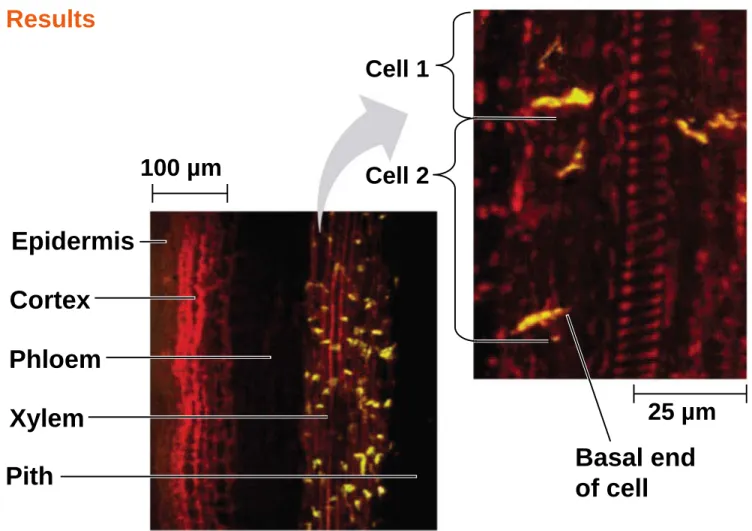
Auxin transporter proteins move the hormone from the basal end of one cell into the apical end of the neighboring cell
Figure 39.6 Cell 1 Cell 2 Basal end of cell Results 100 µm Epidermis Cortex Phloem Xylem Pith 25 µm
Figure 39.6a 100 µm Epidermis Cortex Phloem Xylem Pith
Figure 39.6b Cell 1 Cell 2 Basal end of cell 25 µm
The Role of Auxin in Cell Elongation
According to the acid growth hypothesis, auxin
stimulates proton pumps in the plasma membrane
The proton pumps lower the pH in the cell wall, activating expansins, enzymes that loosen the wall’s fabric
Figure 39.7 CELL WALL CYTOPLASM Plasma membrane H+ H+ H+ H+ H+ H+ H+ H+ H+ ATP Low pH activates expansins. Acidity increases. Proton pump activity increases. Cell wall-loosening enzymes cleave cross-linking polysaccharides. Plasma membrane Cell wall H2O Nucleus Cytoplasm Vacuole Sliding cellulose microfibrils allow cell to elongate. 1 2 3 4 5
Figure 39.7a Low pH activates expansins. Acidity increases. Proton pump activity increases. 1 2 3 4 CELL WALL CYTOPLASM Plasma membrane
Cell wall-loosening enzymes cleave cross-linking polysaccharides. H+ H+ H+ H+ H+ H+ H+ H+ H+ ATP
Figure 39.7b Plasma membrane Cell wall H2O Nucleus Cytoplasm Vacuole
Sliding cellulose microfibrils allow cell to elongate.
Auxin also alters gene expression and stimulates a sustained growth response
Auxin’s Role in Plant Development
Polar transport of auxin plays a role in pattern formation of the developing plant
Reduced auxin flow from the shoot of a branch stimulates growth in lower branches
Auxin transport plays a role in phyllotaxy, the arrangement of leaves on the stem
Polar transport of auxin from leaf margins directs leaf venation pattern
The activity of the vascular cambium is under control of auxin transport
Practical Uses for Auxins
The auxin indolbutyric acid (IBA) stimulates adventitious roots and is used in vegetative propagation of plants by cuttings
An overdose of synthetic auxins can kill plants
For example 2,4-D is used as an herbicide on eudicots
Cytokinins
Cytokinins are so named because they stimulate cytokinesis (cell division)
Control of Cell Division and Differentiation
Cytokinins are produced in actively growing tissues such as roots, embryos, and fruits
Cytokinins work together with auxin to control cell division and differentiation
Control of Apical Dominance
Cytokinins, auxin, and strigolactone interact in the control of apical dominance, a terminal bud’s
ability to suppress development of axillary buds
If the terminal bud is removed, plants become bushier
Figure 39.8
(a) Apical bud intact (not shown in photo)
(b) Apical bud removed
(c) Auxin added to decapitated stem
Lateral branches
“Stump” after removal of apical bud
Figure 39.8a
Figure 39.8b
(b) Apical bud removed
Lateral branches
“Stump” after removal of apical bud
Figure 39.8c
Anti-Aging Effects
Cytokinins slow the aging of some plant organs by inhibiting protein breakdown, stimulating RNA and protein synthesis, and mobilizing nutrients from
Gibberellins
Gibberellins have a variety of effects, such as stem elongation, fruit growth, and seed
Stem Elongation
Gibberellins are produced in young roots and leaves
Gibberellins stimulate growth of leaves and stems
In stems, they stimulate cell elongation and cell division
Figure 39.9
(a) Rosette form (left) and
gibberellin-induced bolting (right)
(b) Grapes from control vine (left) and gibberellin-treated vine (right)
Figure 39.9a
(a) Rosette form (left) and
gibberellin-induced bolting (right)
Figure 39.9b
(b) Grapes from control vine (left) and gibberellin-treated vine (right)
Fruit Growth
In many plants, both auxin and gibberellins must be present for fruit to develop
Gibberellins are used in spraying of Thompson seedless grapes
Germination
After water is imbibed, release of gibberellins from the embryo signals seeds to germinate
α-amylase Figure 39.10 Aleurone Endosperm Water Scutellum (cotyledon) Radicle 1 2 3 GA GA α-amylase Sugar
Abscisic Acid
Abscisic acid (ABA) slows growth
Two of the many effects of ABA
Seed dormancy
Abscisic acid
Seed Dormancy
Seed dormancy ensures that the seed will germinate only in optimal conditions
In some seeds, dormancy is broken when ABA is removed by heavy rain, light, or prolonged cold
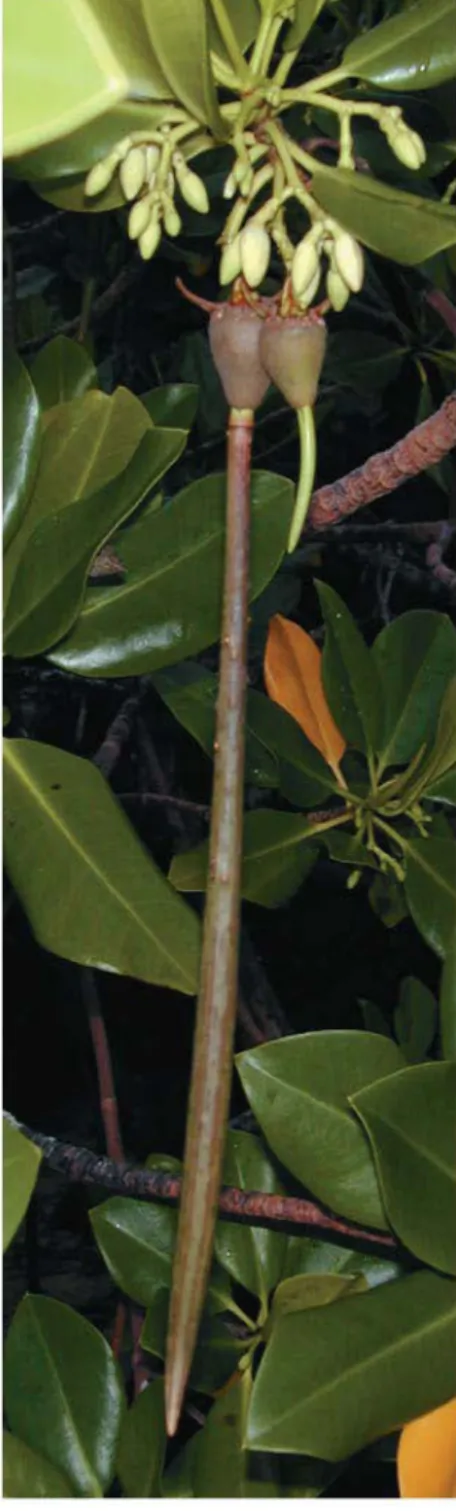
Precocious (early) germination can be caused by inactive or low levels of ABA
Figure 39.11 Red mangrove (Rhizophora mangle) seeds Maize mutant Coleoptile
Figure 39.11a
Red mangrove
(Rhizophora mangle) seeds
Figure 39.11b
Maize mutant
Drought Tolerance
ABA is the primary internal signal that enables plants to withstand drought
Ethylene
Plants produce ethylene in response to stresses such as drought, flooding, mechanical pressure, injury, and infection
The effects of ethylene include response to
mechanical stress, senescence, leaf abscission, and fruit ripening
The Triple Response to Mechanical Stress
Ethylene induces the triple response, which allows a growing shoot to avoid obstacles
The triple response consists of a slowing of stem elongation, a thickening of the stem, and
Figure 39.12
0.00 0.10 0.20 0.40 0.80
Ethylene-insensitive mutants fail to undergo the triple response after exposure to ethylene
Other mutants undergo the triple response in air but do not respond to inhibitors of ethylene
Rice coleoptile elongation – anoxia and
ethylene
Figure 39.13
ein mutant
ctr mutant
(b) ctr mutant (a) ein mutant
Figure 39.13a
ein mutant
Figure 39.13b
ctr mutant
Senescence
Senescence is the programmed death of cells or organs
A burst of ethylene is associated with apoptosis, the programmed destruction of cells, organs, or whole plants
Leaf Abscission
A change in the balance of auxin and ethylene
controls leaf abscission, the process that occurs in autumn when a leaf falls
Figure 39.14
Stem Petiole
Protective layer Abscission layer 0.5 mm
Figure 39.14a
Stem Petiole
Protective layer Abscission layer 0.5 mm
Fruit Ripening
A burst of ethylene production in a fruit triggers the ripening process
Ethylene triggers ripening, and ripening triggers release of more ethylene
Fruit producers can control ripening by picking green fruit and controlling ethylene levels
More Recently Discovered Plant Hormones
Brassinosteroids are chemically similar to the sex hormones of animals
They induce cell elongation and division in stem segments
They slow leaf abscission and promote xylem differentiation
Jasmonates, including jasmonate (JA) and methyl jasmonate (MeJA) play important roles in plant
defense and development
They are produced in response to wounding and involved in controlling plant defenses
Jasmonates also regulate many other physiological processes, including Nectar secretion Fruit ripening Pollen production Flowering time Seed germination Root growth Tuber formation Mycorrhizal symbiosis Tendril coiling
Strigolactones are xylem-mobile chemicals that
Stimulate seed germination
Suppress adventitious root formation
Help establish mycorrhizal associations
Help control apical dominance
Strigolactones are named for parasitic Striga plants
Striga seeds germinate when host plants exude