
應用在近場光學記錄的光纖讀寫頭模組
17
0
0
全文
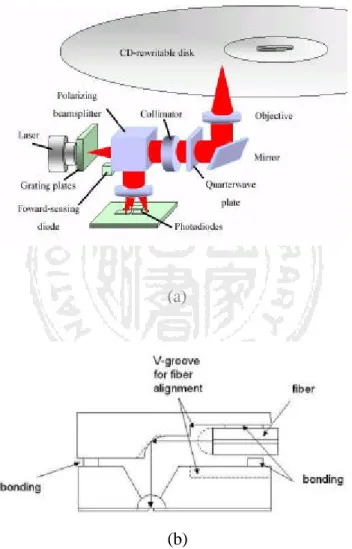
(2) Near-field optics, one of the super resolution techniques, can be used for high recording density. The schematic view of the proposed near-field optical head is shown in Fig.1-1 (b)[1]. The optical head module is composed of a front-end optical fiberlens in a well-defined V-groove, a 45° mirror[2], a solid immersion lens, and an aperture. The laser beam is guided by the fiber, collimated by the front-end fiberlens, and reflected by the 45° mirror. The beam size is further reduced by the solid immersion lens and the aperture. Solid immersion lenses (SIL) and apertures are two near- field optical techniques to generate spot size smaller than the diffraction limit[3]. Smaller spot can read signals with higher contrast and lead to an increase in signal-to-noise ratio (SNR) and recording density. To achieve high recording density and fast data rate, higher tracking precision is also required. The optical head should be miniaturized for fast access motion. The microlens [4-5] and the aperture are fabricated by thermal reflow[6] and electroplating process. The complicated assembly of the microlens and the aperture can be avoided in such an integrated process.. 1.1 Optical data storage technology. Optical data storage technology plays a key role in the multimedia era. In systems such as DVD or future video-audio broadcast and information storage systems, the only way to realize ultrahigh quality multimedia broadcast and ultrahigh density information storage is to increase the storage density and obtain rapid access time of information.. Nowadays, optical data storage industries are continuous ly growing with rapid progress in semiconductor, integrated circuit, multimedia and network markets. Therefore, technologies for recording more information become increasingly 2.
(3) demanded. Since the audio compact disk was introduced in 1983, great advances have been made in read-only optical storage medium such as VCD, CD-ROM, DVD-Video, and DVD-ROM[7-8]. The read-only optical disks have the advantages of large capacity, removability, low production cost, and no n-contact data retrieval using non-contact optical pick-up system[9-10]; therefore, they are being used to distribute software, catalogues, large data-bases, and have become the most popular multimedia distribution media. However, users can not store new information or update data on the pre-recorded read-only disks. There are several optical storage media for different applications, including read-only memory (ROM), write-once-read- many (WORM) and rewritable (RW). Two common types of ROM are the Compact Disk (CD) and its higher-density successor, Digital Versatile Disc (DVD). Data are stored as patterns of embossed pits that produce changes in reflectivity as the readout beam scans over them. Since the only function of a CD player is to readout the data through the plastic substrate, the optical components are relatively simple. WORM media are useful for customers who wish to record information permanently. Compared with CD players, more issues should be considered in a WORM drive since more light energy has to be focused on the recording layer during the writing process. The most popular WORM media is CD-R (CD-Recordable). Organic dye material is locally deformed by the focused laser beam, thereby leaving a location where a change in reflectivity can be detected. For rewritable media, the data pattern can be erased, thus the recording layer can be recycled for new information. The main usage of the rewritable media is to store the information that needs not to be updated frequently, such as audio, digital camera images, motion pictures, and TV-Programs. Consequently, the rewritable media are useful for applications in the video and entertainment, but inconvenient for use in frequently renewed data, such as the computer data files. In most cases, the rewritable recorder is more complicated than the WORM recorder because of 3.
(4) additional complications in either writing or readout. Nevertheless, rewritable optical disks also possess the advantages of portability, high capacity, and long lifetime; therefore, the y are often used in the information processing, communication and multimedia applications.. There are two major recording media for rewritable optical disks: magneto-optical (MO) and phase change (PC) optical disks. The most popular MO recording material system is TbFeCo, whose perpendicularly magnetized domains can be altered with the application of an external magnetic field and heat energy simultaneously. At room temperature, the orientation of the magnetic domain is very resistant to change. In MO recording, the medium is heated by a diffraction- limited laser spot to the Curie point (~200℃) to randomize the magnetic moments. An external field H is then applied to determine the magnetization direction of the domain after it is cooled. The recorded marks can be detected by the polarization rotation due to the Kerr effect[11]. In PC media, the reflectivity of alloy GeTe -Sb2 Te3 -Sb pseudo-ternary material changes between the crystalline and amorphous phases. Different waveforms of laser pulses are used to write or erase data on the PC optical disks. In writing, the phase change media are melted and quenched to the amorphous state; in erasing, the phase change media are annealed to crystalline state. The reflectivity difference between the amorphous and crystalline states of the phase change materials is used for the digital recording[12-13] . As the information can be randomly recorded and erased, optical disks were once expected to replace the hard disks as the mass storage devices of the computer system in the late 1980’s. However, optical disks still can not replace hard disks due to disadvantages in access time and data transfer rate. Therefore, hard disks are still used as the non-moveable storage media for operating systems and application programs due to the fast access time and high data transfer rate. On the 4.
(5) other hand, optical disks are used as the peripheral storage devices for audio, software, motion pictures, video games, and multimedia files for their portability, convenience, and low disk cost. Consequently, they coexist for the complement functions in the multimedia era.. 1.2 Hybrid recording. Thermally assisted magnetic recording that combines the benefits of magnetic and magneto-optical recording was proposed to achieve very high density storage. Perpendicular magnetic recording has attracted much attention for its less thermal fluctuation at very high recording density than in the longitudinal recording media. Besides, rare earth-transition metal amorphous alloys, which are used for magneto-optical recording media. Thus, there has been intensive investigation in magnetic recording on RE- TM materials, due to its large perpendicular magnetic anisotropy and variety of magnetic properties controlled by changing the composition.. 1.2.1 Magneto-optical writing process. In magneto-optical recording systems, signal recording is accomplished by thermo- magnetically writing reversed magnetic domains on a pre-saturated medium. The recording medium usually has a magnetic easy axis along the film normal such that the magnetization lies perpendicular to the film plane [14]. The coercivity, which is on the order of several thousand oersteds at room temperature, decreases with increasing temperature. Therefore, recording is achieved by heating a micron or sub- micron area on the media with a focused laser spot with a moderately high power (5-10mW) under the influence of a small bias magnetic field of several hundred 5.
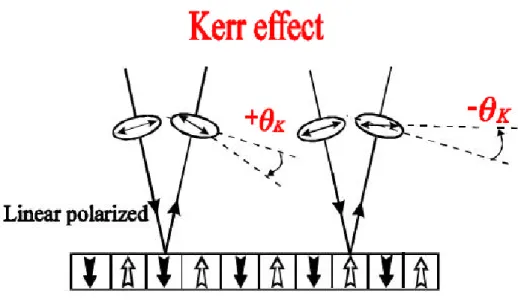
(6) oersteds. The bias magnetic field is lower than the coercivity of the media at room temperature but higher than the coercivity of the region heated by the laser beam. Therefore, only the magnetic moments in the locally heated spots will be reversed by the bias magnetic field.. 1.2.2 Magneto-optical reading process. Signal readout is performed by using the magneto-optic Kerr effect. Upon reflection of a linearly polarized laser beam from the material, the beam becomes elliptically polarized with its major axis rotating clockwise or counterclockwise depending on whether the magnetization component along the beam direction is parallel or anti-parallel to the incident beam direction, as shown in Fig. 1-2. The stored information can thus be retrieved by detecting the polarization modulation of the reflected beam. The intensity of incident laser beam during the reading of information is kept below that during the writing process. Thus the increase in the film temperature and the decrease in coercivity are not sufficient to change the direction of magnetization.. 6.
(7) Fig. 1-2 Schematic of magneto-optical Kerr effect. 1.2.3 Laser intensity modulation (LIM) and magnetic field modulation (MFM). During the thermo- magnetic writing process, data can be used to modulate the laser intensity or the bias magnetic field. In laser intensity modulation (LIM), the electromagnet produces a constant field while the data are used to modulate the power of the laser beam. As the disk rotates under the focused spot, the on/off laser pulses create a sequence of up/down domains along the track. As shown in Fig. 1-3 (a), the domains are highly stable and may be read over and over again without significant degradation. Furthermore, the electromagnet needs not to be switched rapidly.. Another scheme of thermo-magnetic recording is based on magnetic field modulation (MFM). Here the laser intensity is kept constant while the recorded signal is used to modulate the direction of the magnetic field. Typical domain patterns of MFM are shown in Fig. 1-3 (b). The magnetization aligns itself with the applied field 7.
(8) within a region whose temperature has reached beyond a certain critical value. Due to disk rotation and the continuously applied laser, the written domains have crescent shapes[15] . The advantages of MFM recording are: (1) direct overwriting is possible, and (2) domain walls positioned along the track are rather sensitive to laser defocus and power fluctuations and can be fairly accurately controlled by the timing of the magnetic field switching.. (a). (b). Fig. 1-3 MFM photograph of magnetic domain written by (a) light intensity and (b) magnetic field modulation recording. 1.2.4 Origin of hybrid recording. In recent years, hybrid recording has been under investigations in both magnetic and optical data storage industries because of its capability to increase the storage densities beyond current theoretical limitations[16] . In the hybrid recording system, optical and magnetic data storage technologies are combined to benefit from the advantages of each system. From the magnetic point of view, the thermo- magnetic writing capability of the hybrid recording system provides a way to abort the limit on media coercivity which is governed by the writing field. Besides, for longitudinal. 8.
(9) recording media[17], with the increasing of high recording density, it will gradua lly become difficult to form “well- formed” magnetic domains because of the thermal fluctuation, which is called superparamagnetic effect[18]. From the optical point of view, the recording density is restricted by the optical diffraction limit of the readout laser beam. In order to increase the recording density, shorter wavelength laser sources and several methods have been proposed to increase the recording density beyond this limitation. However, the readout signal is still too low to read small mark size. Therefore, by combining the advantages of thermo-magnetic writing, magnetic flux detection by GMR head and using perpendicular amorphous MO media, the hybrid recording would exhibit great potential for high-density storage. The configuration of the hybrid recording is shown in Fig. 1-4.. As described above, there are two main requirements for the recording media for hybrid recording. One is large perpendicular anisotropy and large coercivity for maintaining the stability of the recorded domains. The other is high magnetization for magnetic flux sensing since the carrier-to-noise ratio (CNR) is proportional to the residual magnetization.. Fig. 1-4 Schematic of the thermo-magnetic writing and magnetic flux detection 9.
(10) 1.3 Miniaturization of pickup heads. Key issues in future pickup improvement include miniaturization, integration, and parallel processing (multiple beams). These technologies are expected to reduce the cost, size, and weight of the opto- mechanical structure, making the device more competitive in terms of price and performance.. Several integrated pickup by MOEMS technology have been proposed to make the head smaller and lighter for fast access, direct overwriting and high data transfer rate. For practical applications, the issues that need to be addressed include: (1). improvement of fabrication accuracy, (2). increase of optical throughput power, and (3). appropriate actuator mechanism for the focusing/tracking servo.. 1.3.1 Micro-Opto-Electro-Mechanical-systems (MOEMs). MEMs technology applies equally well to both microsensors and microactuators. It is highly compatible with micro-optic and micro-electronic processing. Academic institutions worldwide have developed excellent capabilities in MEMs technology and a number of companies are engaging in the commercialization of this technology. MEMs devices are already appearing and more are expected as companies discover how the technology can be applied to new generations of their products. Integrating micro-optics, micro-electronics, and micro-mechanics creates a new and broader class of Micro-Opto-Electro-Mechanical (MOEM) devices (shown in Fig. 1-5). Commercial examples include torsional mirrors, digital micro-mirror devices. 10.
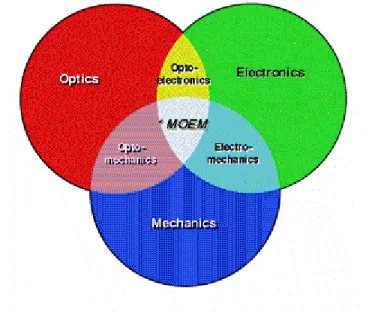
(11) (DMDs), laser scanners, fiber data distribution interface (FDDI) switches, 3-D tunable Fabry-Perot etalons, optical shutters, MEMs optical switches, optical interconnections, data storage devices, and MEM s corner cube reflectors. Integrated devices based on MOEM systems can form free-space integrated optics and micro-optical benches on a chip. Both MOEM technologies can take advantage of batch processing and embossed replication, which makes them highly attractive for commercial applications.. The design of pickup heads plays a key role in the performance of an optical storage system. Recently, a great deal of interest is raised in the monolithic integration of optical pickup heads by MOEMs technology. The integration will not only reduce the assembly cost by eliminating bulk optical elements but also enhance the device performance. Because the optical pickup head is usually placed in a feedback loop to maintain its focusing and tracking, lighter heads will lead to higher data access speed.. Fig. 1-5 Overlapping of the three major fields. MEMs technology is based on electromechanics, and MOEM technology is based on interaction of all three major fields. 11.
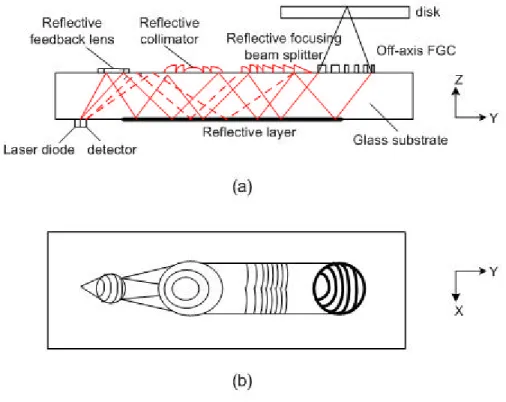
(12) 1.3.2 Planar pickup based on glass substrate light guide. Diffractive optical elements (DOEs) can be used to replace individual refractive optics. T. Shiono et al[19]. integrated various planar diffractive structures on a glass substrate. The glass substrate was used as a light guide in whom the beam followed a zigzag optical path, as shown in Fig. 1-6. In this approach, the beam hits those diffractive elements in order. The focusing/tracking error detections were based on the foucault/push-pull methods, respectively, which were achieved by the off-axis blazed structure called reflection-twin-focusing beam splitter.. Fig. 1-6 Schematic of the planar optical disk pickup based on glass-substrate based: (a) side view, (b) top view.. 12.
(13) The focused spot in FWHM was about 1.0 µm at λ = 0.63 µm. This value was close to the diffraction limit (0.98 µm). Theoretical efficiency of the system was about 46 %, with reflection loss neglected at each interface. This design required precision alignment on both sides of the substrate and was very sensitive to optical crosstalk due to the high-order diffraction beams.. 1.3.3 Free space micro-optical bench. As proposed by M. C. Wu et al[20]., a Si substrate was used as a micro-optical bench. on. which. optical. elements,. micro-positioners, and actuators were. monolithically fabricated by silicon surface micromaching. The optical configuration in this approach was the same as the conventional pickup but had an extremely tiny size. The schematic drawing of the pickup is shown in Fig. 1-7. The NA of the focusing micro Fresnel lens was measured to about 0.17. In this structure, fine optical alignment (< 0.1 µm) and dynamic tracking can be achieved by on-chip micro actuators with electronic driving.. Fig. 1-7 Optical bench module structure 13.
(14) 1.3.4 Integrated-optic implementation based on waveguides and holographic components. S. Ura et al[21]. employed a focusing grating coupler (FGC) in the pickup. A FGC has a chirped and curved grating pattern to couple a guided wave from the laser diode to a focusing beam in the free space, as shown in Fig. 1-8. Focusing and tracking error detections were based on the foucault/push-pull methods, respectively. The optical system were modified for implementation with diffractive components in a waveguide. The focus spot width was measured as approximately 2 µm, while the theoretical diffraction- limited value was 1.4 µm. Major aberrations induced by the fabrication tolerance are astigmatism and coma, which can easily cause the deterioration of the focused spot. Since holographic optical elements (HOE) are dispersive elements, the wavelength deviation is also an issue in the optical design. The fabrication accuracy required to obtain diffraction- limited focused spots becomes move stringent with increasing NA of the focusing grating. For example, the maximum tolerance in the FGC dimension and wavelength deviation are approximately ±0.6% and ±0.9%, respectively, for NA = 0.24. The tolerance is reduced to ±0.09% and ±0.1%, respectively, for NA = 0.45.. 14.
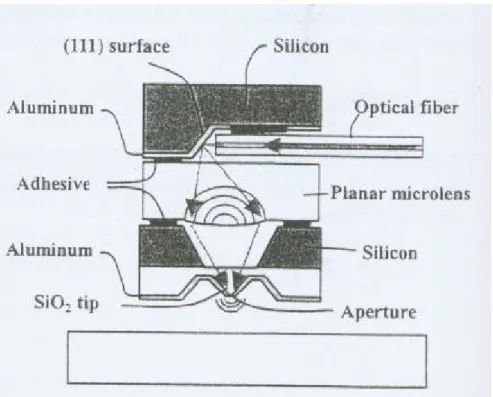
(15) Fig. 1-8 Schematic of the integrated optic disk pickup (IODPU). The curved and chirped grating incorporates the input/output coupling and the focusing by the wavefront conversion based on holography.. 1.3.5 Miniaturized near-field optical head with high throughput. To track to data bits precisely at high speed, the optical head needs to be miniaturized. A miniaturized near-field optical head with high optical throughput was fabricated by K. Kato et al. at Seiko Instruments Inc [1]. The cross-section is shown in Fig. 1-9. High throughput was resulted from the aperture at the apex of SiO 2 tip. To miniaturize the optical head, a commercial planar microlens with gradient- index was used instead of an objective lens. The planar microlens had a 340 µm thickness and a diameter of 85 µ m. Light emitted from the optical fiber was reflected to the aperture by the aluminum film deposited upon Si (111) surface. The high throughput aperture, planar microlens, and mirror on Si (111) surface were bonded by an adhesive. 15.
(16) Fig. 1-9 Cross section of the near-field optical head. 1.4 Research objective. Hybrid recording technique, which combines magneto-optical (MO) and conventional magnetic technologies, has recently received considerable attention based on potentially exceeding superparamagnetic limits faced by conventional magnetic recording[22-23]. An integrated read/write head must be developed that brings the optical field, the magnetic field, and the magnetoresistive (MR) read sensor to the medium[24]. Therefore, integrated hybrid head designs are another popular research topic in recent years.. The first goal of thesis is to increase the recording density by using high-resolution head, especially solid immersion lens (SIL) technique. Through the coupling of evanescent waves into the recording medium, the mark size that 16.
(17) SIL-based optical system read/write can be substantially reduced. Access time is also an important parameter of a disk drive. In general, the traditional optical head is considerably larger and heavier than the magnetic head of HDD; thus, the access time of the optical drivers is slower than that of HDD. Currently, a significant effort is being made to reduce the size and weight of the optical heads by miniaturizing mechanical-optical structure and integrating each component. Hence the second goal of this research work is to develop a new-structure pickup module, which combines the fiber optics, SIL, and micrometer aperture.. 1.5 Organization of this thesis. The thesis is organized as following: The fundamental fabrication theory and near- field optics are presented. Moreover, the fiber-based integrated vertical optical pickup is reviewed in Chapter 2. In Chapter 3, some wet etching results and the major instruments used to characterize the fabricated component are described. The integration of the pickup system, optical throughput calculation and optical measurement of the micro mirror are shown in Chapter 4. Finally, the summary of this thesis and future works will be presented in Chapter 5.. 17.
(18)
數據

+5


相關文件
If applicant entity (person) wishes to pick-up documents in-person, “In-person Document Pick-up Declaration” must be filled-out if application is submitted via written
If applicant entity (person) wishes to pick-up documents in-person, “In-person Document Pick- up Declaration” must be filled-out if application is submitted via written
If applicant entity (person) wishes to pick-up documents in-person, “In-person Document Pick- up Declaration” must be filled-out if application is submitted via written
If applicant entity (person) wishes to pick-up documents in-person, “In-person Document Pick- up Declaration” must be filled-out if application is submitted via written
Number of laser modes depends on how the cavity modes intersect the optical gain curve.. In this case we are looking at modes within
A total of 380 MICE (Meetings, Incentives, Conventions & Exhibitions) events were held in various venues in the fourth quarter of 2010, up by 1% year-on-year; the average
6 《中論·觀因緣品》,《佛藏要籍選刊》第 9 冊,上海古籍出版社 1994 年版,第 1
A factorization method for reconstructing an impenetrable obstacle in a homogeneous medium (Helmholtz equation) using the spectral data of the far-field operator was developed
