This content has been downloaded from IOPscience. Please scroll down to see the full text.
Download details:
IP Address: 140.113.38.11
This content was downloaded on 26/04/2014 at 02:18
Please note that terms and conditions apply.
Using dual ring structure with different coupling ratio for S-band erbium-based fiber laser
View the table of contents for this issue, or go to the journal homepage for more 2008 Laser Phys. Lett. 5 51
Abstract: An S-band erbium-doped fiber (EDF) ring laser, using a dual coupler ring structure (DCRS) with different coupling ra-tio injecra-tion, is proposed and demonstrated experimentally. The proposed fiber ring laser does not use any fiber Bragg gratings or etalon filters (passive or active filter) into the loop cavity to lase a single wavelength. This proposed fiber laser has an opti-cal signal to noise ratio (OSNR) of > 38.2 dB and output power of − 3.8 dBm at 1506.28 nm, while the coupling ratio in a ring cavity is 10%. Moreover, the performances of output power and wavelength stabilities have also been studied and discussed.
S-band ASE Spectrum
Po w er , d B m -20 -30 -40 -50 -60 1530 1520 1510 1500 1490 1480 Wavelength, nm
Output ASE spectrum of the S-band EDFA while the pumping power operates at 280 mW
c
° 2008 by Astro Ltd.
Published exclusively by WILEY-VCH Verlag GmbH & Co. KGaA
Using dual ring structure with different coupling ratio for
S-band erbium-based fiber laser
C.-H. Yeh,1,∗C.-N. Lee,2F.-Y. Shih,2and S. Chi2,3
1
Information and Communications Research Laboratories, Industrial Technology Research Institute, Hsinchu 310-40, Taiwan
2
Department of Electrical Engineering, Yuan Ze University, Chungli 320-03, Taiwan
3
Department of Photonics and Institute of Electro-Optical Engineering, National Chiao Tung University, Hsinchu 300-10, Taiwan Received: 8 August 2007, Revised: 13 August 2007, Accepted: 17 August 2007
Published online: 14 September 2007
Key words: fiber laser; dual-coupler; erbium-doped; S-band PACS: 42.60.Da, 42.81.-i
1. Introduction
Erbium-doped fiber (EDF) ring lasers are more useful and necessary, and the lasers are applicable to loss measure-ments of optical components, optical sensing systems, and tunable transmitters in wavelength-division-multiplexing (WDM) systems. Therefore, the fiber lasers were mainly used with fiber Bragg grating or etalon filters in the loop cavity for single wavelength lasing and wavelength-tunable operation, [1–6]. In addition, due to the band-width limitation of erbium-doped fiber (EDF), the wave-length range of erbium-doped fiber ring lasers can only cover both C- and L-bands from 1530 to 1610 nm [7– 10]. Recently, an S-band erbium-doped fiber amplifier (EDFA), which uses erbium-doped silica fiber with de-pressed cladding design and 980-nm pump laser to
gen-erate EDF gain extension effect, has been reported [11– 13]. By using this S-band fiber amplifier, the operating wavelengths of EDF ring lasers can be extended to S-band range.
In this paper, we propose and demonstrate experimen-tally an S-band single wavelength fiber ring laser using a dual coupler ring structure (DCRS) with different cou-pling ratio injection. The behaviors of the output power and wavelength stabilities, and optical signal to noise ratio (OSNR) have also been studied.
2. Experiments and results
The schematic of our experimental setup for the S-band fiber ring laser is shown in Fig. 1. The proposed laser
∗
52 C.-H. Yeh, C.-N. Lee, et al.: Using dual ring structure with different coupling ratio PC PC Output C VC “a” W W EDF EDF Isolator 980 nm pum p LD C S-ba nd E DF A mo dule
Figure 1 (online color at www.lphys.org) Proposed S-band EDF compound ring laser by using a DCRS
S-band ASE Spectrum
Po w er , d B m -20 -30 -40 -50 -60 1530 1520 1510 1500 1490 1480 Wavelength, nm
Figure 2 (online color at www.lphys.org) Output ASE spec-trum of the S-band EDFA while the pumping power operates at 280 mW
scheme consists of an S-band EDFA, a 2 × 2 and 50:50 optical coupler (CP), two polarization controllers (PCs) and a 1 × 2 variable coupler (VC) with difference coupling ratio. The proposed S-band fiber ring laser, using a dual coupler ring structure (DCRS) to lase a single wavelength, is shown in Fig. 1. The S-band EDF inside EDFA mod-ule has a depressed cladding design in order to provide a sharp, high-attenuation, long-wavelength cutoff filter into active fibers. The erbium-doped fibers in the first and sec-ond stages have different characteristics. The fiber in the first stage has the fiber length of 20 m, and can provide low
-60 -50 -40 -30 -20 -10 0 0 20 40 60 80 100 1480 1490 1500 1510 1520 Wavelength , nm Coup ling ratio , % O u tp u t p o w e r, d B m
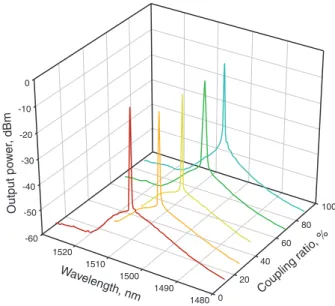
Figure 3 (online color at www.lphys.org) Output wavelength spectra of proposed fiber laser under the coupling ratio of 10, 30, 50, 70, and 90%, respectively
noise figure and medium gain by forward pumping. The fiber in the second stage has the fiber length of 30 m, and can produce large output power by backward pumping. In addition, the optical isolator between these two stages can reduce backward amplified spontaneous emission (ASE) and improve noise figure performance. The total pump power of this amplifier module can be up to 280 mW while the bias current is operated at 356 mA. Therefore, Fig. 2 shows the ASE spectrum of the S-band EDFA for the wavelengths of 1480 to 1520 nm while the bias cur-rent operates at 356 mA. The maximum ASE power level is − 28.4 dBm at 1508.43 nm.
The compound ring is completed with a DCRS to serve as an in-line mode selector and an output coupler. The VC has different coupling ratio, which is 90, 70, 50, 30, and 10%, respectively, at “a” point as seen in Fig. 1. Two fiber rings have the laser light propagate in a counterclockwise direction oriented by the two couplers, as shown in Fig. 1. The two cavities have the free spectral ranges (FSRs), FSR = c/nL, where c is the speed of light in vacuum,
n is the average refractive index of the single-mode fiber
of 1.468 and L is the total cavity length. Therefore, the smaller cavity has a ring length of ∼ 4 m, which gives a FSR of 50.5 MHz. The total length of larger ring is about 58.5 m long, corresponding to a passive cavity mode spac-ing of 3.5 MHz. Two in-line polarization controllers are used to control the intracavity polarization states. More-over, the output power and wavelength of proposed fiber laser are measured by an optical spectrum analyzer (OSA) with a 0.01 nm resolution.
In the compound ring laser, since the DCRS is polarization-dependent, the output power can be adjusted
c
° 2008 by Astro Ltd.
Outpu t p ow e r, dBm -14 -11 -8 -5 -2 1 SMSR, dB 26 30 34 34 38 42 1507 1506 1505 1504 Wa vel eng th, nm 0.5 0.4 0.3 0.2 0.1 0 Ban dw idt h, n m (a) (b) 0 20 40 60 80 100 0 20 40 60 80 100 Coupling ratio, % Output power Wavelength SMSR Bandwidth
Figure 4 (online color at www.lphys.org) (a) – Output wave-length and output wavewave-length, and (b) – optical signal to noise ratio (OSNR) and 3 dB bandwidth in the proposed S-band EDF laser under the coupling ratio of 10, 30, 50, 70, and 90%, respec-tively
by varying the eigenstate of the polarization in the ring. Therefore, by rotating the PCs to align the maximal out-put power of eigenstate of the polarization can always be obtained. Fig. 3 shows the S-band output spectrum of las-ing wavelength in the EDF rlas-ing laser, while the “a” point of VC has the coupling ratio of 90, 70, 50, 30, and 10%, respectively. Fig. 3 presents the larger and smaller output power at 10 and 70% coupling ratio, respectively. It also displays the narrower wavelength bandwidth at 10% cou-pling ratio. Therefore, Fig. 4a shows the output power and wavelength in the S-band EDF dual ring laser under the coupling ratio of 10, 30, 50, 70, and 90%, respectively. The output power and wavelength is − 3.8, − 11.26, − 11,
− 11.86, and − 11.3 dBm, and 1506.28, 1504.68, 1504.58,
1504.43, and 1504.83 nm, respectively. Fig. 4b also illus-trates that the optical signal to noise ratio (OSNR) and 3-dB bandwidth in the S-band laser is 38.2, 34.5, 35.4, 32.4, and 29.3 dB, and 0.09, 0.25, 0.14, 0.34, and 0.24 dB under the coupling ratio of 10, 30, 50, 70, and 90%, respectively. Then, Fig. 4a also presents similar spectral curves at the output wavelength and power under different coupling ra-tios, and the maximum output wavelength and power vari-ations are 1.85 nm and 8.06 dB. Moreover, the OSNR will reduce as the coupling ratio increase gradually, as shown in Fig. 4b. From the experimental results of Fig. 4, when the coupling ratio is 10%, the fiber ring laser will obtain the
Outpu t p ow e r, dBm -3.4 -3.6 -3.8 -4.0 -4.2 -4.4 1506.4 1506.3 1506.2 1506.1 Wa vel eng th , nm 0 10 20 30
Observing time, min Output power
Wavelength
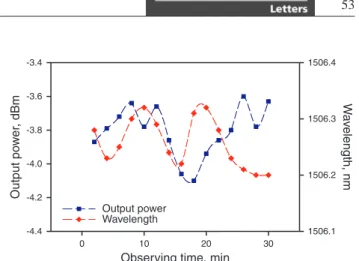
Figure 5 (online color at www.lphys.org) Observing short-term stability of the proposed laser over 30 minutes observing time. The lasing wavelength is 1506.28 nm initially at the coupling ratio of 10%
better output efficiency, which has the larger output power (− 3.8 dBm) and OSNR (38.2 dB), and a narrower 3 dB bandwidth (0.09 nm).
To verify and investigate the laser performances of out-put power and outout-put wavelength stabilities, the short-term stability of the proposed structure is measured and shown in Fig. 5. The lasing wavelength is 1506.28 nm initially and the observing time is over 30 minutes when the cou-pling ratio is 10%. From observed results, the output cen-tral wavelength variation and the output power fluctuation of the proposed ring laser are smaller than 0.1 nm and 0.4 dB, respectively, as shown in Fig. 5. During an hour observation, the stabilized output of the ring laser can be still maintained. Moreover, we also experiment the stabil-ity measurement in the other coupling ratios. However, the observed results are worse than that of 10% coupling ratio. Compared with the past studies, the proposed fiber laser doesn’t use any passive or active filter [1–7] or nonlinear effect [4,10] inside cavity to lase wavelength. Therefore, our proposed dual ring structure fiber laser has the advan-tage of simply architecture, cost-effective and high output efficiency.
3. Conclusion
In summary, we have proposed and investigated an S-band EDF ring laser, employing a DCRS with different coupling ratio injection. The proposed fiber ring laser does not use any fiber Bragg gratings or etalon filters (passive or active filter) into the loop cavity to lase a single wavelength. This proposed fiber laser has an OSNR of > 38.2 dB and output power of − 3.8 dBm at 1506.28 nm, while the coupling ratio in a ring cavity is 10%. Moreover, the performances of output power and wavelength stabilities have also been studied and discussed.
54 C.-H. Yeh, C.-N. Lee, et al.: Using dual ring structure with different coupling ratio
References
[1]T. Haber, K. Hsu, C. Miller, and Y. Bao, IEEE Photon. Tech-nol. Lett. 12, 1456–1458 (2000).
[2]H.Y. Ryu, D. Lee, K.-D. Park, W.-K. Lee, H.S. Moon, S.K. Kim, and H.-S. Suh, Appl. Phys. B 79, 583–586 (2004). [3]D. Chen, H. Ou, H. Fu, S. Qin, and S. Gao, Laser Phys. Lett.
4, 287–290 (2007).
[4]D. Chen and L. Shen, Laser Phys. Lett. 4, 368–370 (2007). [5]Z.X. Zhang, L. Zhan, X.X. Yang, S.Y. Luo, and Y.X. Xia,
Laser Phys. Lett. 4, 592–596 (2007).
[6]S.-Y. Chou, C.-H. Yeh, and S. Chi, Laser Phys. Lett. 4, 382– 384 (2007).
[7]Y. Sun, J.W. Sulhoff, A.K. Srivastava, J.L. Zyskind, T.A. Strasser, J.R. Pedrazzani, C. Wolf, J. Zhou, J.B. Judkins,
R.P. Espindola, and A.M. Vengsarkar, Electron. Lett. 33, 1965–1967 (1997).
[8]L. Talaverano, S. Abad, S. Jarabo, and M. L ´opez-Amo, J. Lightwave Technol. 19, 553–558 (2001).
[9]S. Yamashita, IEEE J. Select. Topics Quantum Electron. 7, 41–43 (2001).
[10]M.H. Al-Mansoori, A.W. Naji, S.J. Iqbal, M.K. Abdullah, and M.A. Mahdi, Laser Phys. Lett. 4, 371–375 (2007). [11]M.A. Arbore, Y. Zhou, G. Keaton and T. Kane, in:
Proceed-ings of the 28th European Conference on Optical Commu-nication (ECOC 2002), September 8–12, 2002, vol. 1. [12]C.-H. Yeh, C.-C. Lee, and S. Chi, IEEE Photon. Technol.
Lett. 15, 1053–1054 (2003).
[13]S.W. Harun, K. Dimyati, K.K. Jayapalan, and H. Ahmad, Laser Phys. Lett. 4, 10–15 (2007).
c
° 2008 by Astro Ltd.