ELSEVIER
0 19% Elsevier Science Limited Printed in Northern Ireland. All rights reserved
PPI: SO141-3910(96)00098-S 0141-3910/%/$15.im
Thermal degradation kinetics of
polybutadiene rubber
Jyh-Ping Lin,” ChipYuan
Chang,“* Chao-Hsiung WU’ & Shin-Min Shih
“Graduate Institute of Environmental Engineering, National Taiwan University, Taipei 106, Taiwan, China hDepartment of Environmental Engineering, Da-Yeh Institute of Technology, Chang-Hwa 515, Taiwan, China“Department of Chemical Engineering, National Taiwan University, Taipei 106, Taiwan, China (Received 5 February 1996; accepted 7 March 1996)
The thermal degradation kinetics of polybutadiene rubber (BR) was investig- ated by dynamic thermogravimetry, in a nitrogen atmosphere, over the temp- erature range 177-577°C and at constant nominal heating rates of 3, 5 and 7”C/min, respectively. Two distinct mass change stages in the thermogravimet- ric analysis (TGA) curves indicated that the degradation of BR may be attributed to two reactions. The corresponding activation energies, frequency factors and reaction orders of the two reactions were determined. A simplified two-reaction model based on the TGA curves was also proposed for engineering purposes. Satisfactory agreements between the proposed model and the experimental results were obtained. The results of this study are useful for the utilization of scrap BR as an alternative energy resource. 0 1996 Elsevier Science Limited
1 INTRODUCTION
market-ready products has become a principalfocus from both the economical and environmen- tal standpoints.
In Taiwan, polybutadiene rubber (BR) is classified as one of the principal manufacturing products of the synthetic rubber industry. Production quantities of BR have increased from about 35 000 metric tons in 1986 to about 43 000 metric tons in 1993.’ About 78000 metric tons of used tyres were discarded in 1991, while the amount was estimated to be 58 000 metric tons in 1989.* The growth rate of scrap tyres is high. Therefore, the treatment and disposal of rubber wastes has become a problem because of concern for the environment and care of the globe. Some studies and review literature indicate that proper pyrolysis methods may be appropriate solutions for both problems of treatment and minimization of rubber waste or scrap tyres3-” Scrap tyres contain a vast amount of synthetic rubber with extremely high calorific value, say 40 000 kJ/kg. Because of the high calorific value, the conversion of scrap tyre or rubber wastes to
Several types of pyrolysis processes, such as fluidized bed processes,12-14 batch processes,15-19 vacuum processes,2o molten salt processes,21-23 and coprocessing with heavy oi1,7,24 have been tried for the treatment of rubber wastes, scrap tyres and automobile shredder wastes. The gas products may contain hydrogen, methane, ethane, propylene, butene, butadiene, etc., while benzene, toluene, xylene, ethylbenzene, limo- nene, naphthalene, etc. are identified in the oil products.13,14,‘9 The conversion of pyrolysis residues into activated carbon may be one of the most effective usages of chars obtained through pyrolysis of rubber wastes, and the desired characteristics of final solid products could also be obtained.18~25~26
Methods for the treatment of mass-loss curves, obtained through thermogravimetric analysis (TGA), have previously been studied and reviewed.27-29 The thermal degradation of poly- * To whom all correcpondence should be addressed. butadiene with an apparent activation energy of
(DTG).3” The decomposition of polybutadiene, studied by pyrolysis gas chromatography (PGC), is mainly by bond scission followed by unzipping to yield butadiene monomer at lower tempera- tures, while at higher temperatures the H transfer reaction is followed resulting in the formation of one saturated end and the other unsaturated.31 A dynamic thermogravimetry study indicated that the pyrolysis of used tyres in the temper- ature range of 417-457°C follows first-order
kinetics with an activation energy of
170 kJ/mo1.32 The activation energies for the pyrolysis of BR and styrene-butadiene rubber
(SBR) were reported to be 263.4 and
253.6 kJ/mol with maximum degradation rate occurring at 473 and 46O”C, respectively, but the pyrolysis schemes were not mentioned any further.33 The pyrolysis of waste tyres, in the temperature range from 300 to 900°C has been investigated by isothermal TG, and the activation energy was determined to be 613.0 kJ/mol with the second-order reaction.34 For the temperature range 175-450°C the activation energies for the pyrolysis of BR in an oxidative atmosphere were estimated to be 66.8 (175- 275”(Z), 86.1 (275-350°C) and 209.4 (350- 450°C) kJ/mo1.35 In the temperature range 300-500°C a first-order reaction could be adequately used to describe the pyrolysis kinetics of BR with activation energy 215 kJ/mol and frequency factor 6.32 X 1Ol4 min-‘.36 Also, no reaction scheme was suggested. Therefore, there is a need to propose a convenient method to determine the reaction rate for the pyrolysis of BR and to suggest a simplified reaction model which may properly describe the pyrolysis history of BR.
It is thus the aim of the present work to deal with the degradation of BR to provide a simple reaction model for engineering purp- oses. The pyrolyzer was a dynamic thermo-
gravimetry system at the temperature-
programmed constant heating rates of 3, 5 and 7’C/min, respectively, in a nitrogen atmosphere. The corresponding activation energies, frequency factors and orders of reactions were determined. A simple reaction model is proposed for describing the pyrolysis of BR. All these results are useful for the pyrolytic treatment of rubber wastes of BR.
2.1 Materials
A commercial-grade BR was used in this study. It was supplied by the Taiwan Synthetic Rubber Corporation. Property, elemental and calorific value analyses of the samples are listed in Table 1. Nitrogen gas, with 99.99% purity, was purchased from the Ching-Feng-Harng Co. Ltd in Taipei, Taiwan.
2.2 Apparatus and procedures
The experimental flow diagram for the pyrolysis of BR is shown in Fig. 1. Details of the experimental methods have been described in detail previously.37
3 RESULTS AND DISCUSSION
3.1 Effects of temperature and heating rate The residual mass fraction of active reactant (M) is expressed on a normalized basis, M = (W - W,)/(W, - W,), where W, W,, W, = mass, initial mass and final mass of the sample, respectively. The variation of
M
with reaction temperature (T) is shown in Fig. 2. There are two principal reactions as distinguished by the two distinct mass changes in Fig. 2 over the experimentalTable 1. Some properties of BR used in this study
Item Property
Trade name TAIPOL BR 0150
Configuration 96%“ Cis minimum
Elemental analysis (weight %)
C 88.72(0.005)h H 11.17 (0.01) N ND 0 co.1 S 2.04 (0.01) Cl 0.36 (0.01) Composition analysis (wt %) Moisture 0.22(0.0037) Ash 0.08(0.0030) Combustible 99.70d Calorific value (kJ/kg) 45 600 ..~ ~_._ u In weight percent.
’ Numbers in parentheses are standard deviations. L Not detected.
297
Fig. 1. Schematic diagram of apparatus for the pyrolysis of BR. 1: Nitrogen; 2: flow meter with needle valve; 3: reactor; 4: extension wire and sample disk; 5: trap; 6: furnace; 7: electrobalance; 8: temperature controller; 9: electrobalance controller; 10: data acquisition unit; 11: personal computer;
12, 13: K-type thermocouples.
range for the three different heating rates (p) under investigation. At a temperature of about 227°C (500 K), the first reaction of mass change begins and goes on up to about 427°C (700K) with M = 0.805, which may also be judged by the use of plots of dX/dt and d2X/dt2 versus T (X = 1 - M, I = reaction time). Afterwards, the second reaction proceeds and goes on to the end. The first reaction may be attributed to the thermal formation of volatiles V1, which are much easier to form at lower temperatures and with a slower reaction rate. The second reaction, which is a reaction with a faster rate, may be the degradation of intermediates yielding volatiles v2. 0.8 c \cb\ -I 0.0 150 250 350 450 550 T (deg. C)
Fig. 2. Comparison of residual mass fraction (M) by model prediction with experimental data at different heating rates (p) for pyrolysis of BR. 0 and 1, 0 and 2, and A and 3: experimental and predicted results for /3 = 3, 5 and 7”C/min.
- 0.10 ‘; .E
.E
-I
z:!
0.05 _.__ 150 250 350 450 550 T (deg. C)Fig. 3. Variations of instantaneous reaction rates (dX/dt) with temperature (7’) for pyrolysis of BR at various heating
rates (p). 1,2,3: /3 = 3,5,7”C/min.
The variations of instantaneous reaction rates (r = dX/dt) with temperature (T) under the three heating rates are shown in Fig. 3. It is noted that two peak rates can be identified from the rate curves. For instance, the first peak occurs at about 387°C (660 K) with a reaction rate of about 0.021 min-’ for a heating rate of 7”C/min; the second is around 467°C (740 K) with a reaction rate of 0.147 min-’ under the same heating rate. This may suggest that two major reactions proceed throughout the experimental conditions. The corresponding fractions 4 and fi caused by the first and second reactions are determined to be 0.195 ( = 1 - 0.805) and 0.805, respectively. 3.2 Kinetic parameters
The foundation for the study of kinetic data from the mass-loss curve is based on the basic rate equation:
where
r = dX/dt = kf(X) (1)
k = the Arrhenius rate constant,
k = Aexp( - EIRT),
A,E = frequency factor, activation energy, R,n = universal gas constant, reaction order, f(X) = the function of conversion X, f(X) =
(1 -X)Y
The differential, iso-conversion method for determining the activation energy was employed in this study. The activation energies at various conversions are shown in Fig. 4. The results indicate that values of the activation energy for
”
01
’ I I I I I I I I0.0 0.2 0.4 0.6 0.6 1.0
x (-1
Fig. 4. Variations of activation energies (E) with conversion (X) for pyrolysis of BR.
the pyrolysis of BR are about 50-500 kJ/mol. According to the results shown in Figs 2 and 3, two reactions are observed. The arithmetic means of the activation energies corresponding to the two reactions are 59.8 kJ/mol for the first reaction (X:0.02-0.11) and 197.0 kJ/mol for the second reaction (X:0.40-0.80), respectively. Some kinetic parameters of scrap tyres or rubber wastes are listed in Table 2 indicating that the activation energies are in the range of about 50-600 kJ/mol. The reaction order (n) can be obtained from the slope of the plot of ln[(dX/dt)/exp( - E/(RT))] versus ln(1 -X) for each reaction as shown in Fig. 5. Therefore, the reaction orders of the two different reactions are
// 1:Y=1~665~xX+10.5165 0 10.2 11 26 1 I I I I I I I I 10.0 -5 -4 -3 -2 -1 0 In (I-X)
Fig. 5. Variations of ln[(dX/dt)/exp( - E/(RT))] with ln(1 - X) for determination of reaction order and frequency factor for pyrolysis of BR. 0 and 1, and 0 and 2: experimental and correlated results of first and second
reactions.
1.27 (E = 59.8 kJ/mol) and 1.49 (E =
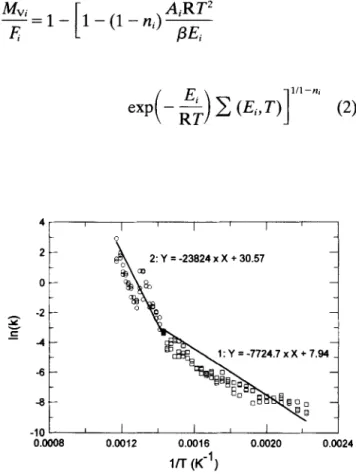
197.0 kJ/mol) for the first and second reactions, respectively. The frequency factors are deter- mined by the use of temperature dependence of reaction rate constant, i.e. the Arrhenius law as shown in Fig. 6, which shows Ink versus l/T with the slope of -E/R and the intercept of 1nA. Thus, the values of frequency factors are 2.8 X lo3 and 1.9 X 10¹³ min-’ for the first and second reactions, respectively. Values of E, A, n
and F for the two reactions of BR pyrolysis are listed in Table 3.
Table 2. Comparison of kinetic parameters of pyrolysis of scrap tyres or rubber wastes
Material used Polybutadiene3” Tyre waste” Used tyre”* BR33 SBR33 Waste tyre34 BR3’ SBR3’ BR36 SBR3’ BR” Test method Derivative TG Batch process Dynamic TG Dynamic TG Dynamic TG Isothermal TG Dynamic TG Dynamic TG Derivative TG Derivative TG Dynamic TG Activation energy (kJ/mol) _ 251 125.5 170.0 263.4 253.6 613.0 66.8; 86.1; 209.4h 112; 126.9; 331.1; 160.7’ 215 152 59.8 197.0
Max. reaction Reaction Frequency factor rate (mini’) order (mini’)
0.0091 (375°C)” - 1 1.1 x 10” 1 _-1;;zj 0 - 2 3.3 x los 7.2 x IO’; 4.9 x 10h; x 3:7 1 4 x 10” lo’*; 9.5 x 10⁹; 7.9 x 10²³; 2.5 x 10”’ 1 6.32 x 10“’ 1 1.78 x 10”’ 0.021 (387°C) 1.27 2.8 x 10’ 0.147 (467°C) 1.49 1.9 x 10” n Numbers in parentheses are temperatures at which max. reaction rates occur.
’ Temperature ranges: 175-275°C for 66.8, 275-350°C for 86.1, and 350-450°C for 209.4; under oxidative atmosphere. “Temperature ranges: 17%275°C for 112, 275-350°C for 126.9, 350-450°C for 331.1, and above 450°C for 160.7; under oxidative atmosphere.
’ This study.
3.3 Kinetic model
According to the kinetic parameters obtained above and the temperature dependence of reaction rates (Fig. 6), there exist two reactions which may proceed for the pyrolysis of BR in this study. Thus, a reaction model based on the residual curves is proposed to represent the pyrolysis of BR as follows:
Table 3. Values of E, A, R and F for two reactions of BR pyrolysis in this study
First reaction Second reaction
E (kJ/mol) 59.8 197.0
A (min-‘) 2.8 x lo3 1.9 x lOI
: 0.195 1.27 0.805 1.49
F: fraction contributed by each reaction.
b Volatiles V, (M,,)
BR 09 t Intermediates b Volatiles
I
-. Residues
v2
mw
where V, and V, are the volatiles (with mass fractions of Mv, and A.&, respectively) obtained from the pyrolysis of BR and its intermediates, respectively. It can be shown that
where ZW)=C [(-$?ir @+1)] j=o I k=O A.RT’ l-(l-ni)L PEi (3) exp( - 5) C (Ei, T)]‘;‘^’
6 and F2 are 0.195 and 0.805, respectively, as (2) previously determined. The variations of M,, and
M,, against T at S”C/min heating rate are shown in Fig. 7. The accumulated release of V, increases
c 4 2:~ =-23824xX +30.57 l:Y=-7724.7xX+7.94 _ -lOL I 1 I I I I I 00008 0.0012 O.OO16 0.0020 0.0024 l/-T (K-l)
Fig. 6. Temperature dependence of the reaction rate constant (k) for Arrhenius’ law. q and 1, 0 and 2: experimental data and correlated results of first and second
reactions. 0.a 0.6 T x 0.4 350 450 550 T (deg. C)
I$. 7. Comparison of experimental data (0) and predicted values (0) of residue mass fraction (M), and computed values (*) of mass fractions of V,(Mv,) and V,(M,) for
justify the two distinct mass changes of M in Fig. 2. A comparison of residual mass fractions predicted by the proposed model and those obtained by experiments is also shown in Fig. 2, indicating satisfactory agreements.
To verify the applicability of kinetic para- meters and the validity of the proposed model, the coefficients of determination (R*) are examined for 0.05 < M (predicted) < 0.95, and the values of R2 are 0.981,0.997 and 0.994 for the heating rates of 3, 5 and 7”C/min, respectively. This thus shows the validity and practical applicability of the proposed two-reaction model for describing the pyrolysis of BR without specifying the detailed chemical reactions involved.
4 CONCLUSIONS
Thermal degradation experiments on BR were carried out by a dynamic TG reaction system, in nitrogen atmosphere, over the temperature range 177-577°C and at pre-set heating rates. A simplified two-reaction model was proposed to model the experimental results. The activation energies, frequency factors and reaction orders were determined for the two reactions under experimental conditions. The pyrolysis of BR can be adequately described by the proposed model. This study greatly assists the reutilization of scrap BR as an energy resource.
ACKNOWLEDGEMENTS
We express our sincere thanks to the National Science Council of R.O.C. Taiwan for their financial support, under contract number NSC83- 0410-E-002-022, and we would also like to thank the Taiwan Synthetic Rubber Corporation for providing the rubber sample.
REFERENCES 1. 2. 3. 4. 5.
DOS/MOEA (Department of Statistics/Ministry of Economic Affair), Industrial Production Statistics Monthly Taiwan Area, The Republic of China on Taiwan, 302 (1994) 127.
Yang, G. C. C., Resourc. Conserv. Recycl., 9 (1993) 191. Crane, G. & Kay, E. L., Rubber Chem. Technol., 48
(1975) 50. 20. 21. 22. 23. 24. 25. 26. 27. 28. 29. 30. 31. 32. 33. 34.
Poller, R. C., J. Chem. Technol. Biotechnol., 30 (1980) 35.
152. 36.
Dodds, J., Domenico, W. F., Evans, D. R., Fish, L. W., Lassahn, P. L. & Toth, W. _I., Scrap Tyres: A Resource and Technology Evaluation of Tire Pyrolysis and Other
37. 10. 11. 12. 13. 14. 15. 16. 17. 18. 19. A20 (1985) 149.
Bouvier, J. M. & Gelus, M., Resourc. Conserv., 12 (1986) 77.
Buekens, A. G. & Schoeters, J. G., Conserv. Recycl., 9 (1986) 253.
Cypres, R. & Bettens, B., In Pyrolysis and Gasification, eds G. L. Ferrero, K. Maniatis, A. Buekens & A. V. Bridgwater. Elsevier, New York, 1989, p. 209.
Budrugeac, P. & Ciutacu, S., Polym. Degrad. Stab., 33 (1991) 377.
Kaminsky, W., Makromol. Chem. Macromol. Symp., 57 (1992) 145.
Araki, T., Niikawa, K., Hosoda, H., Nishizaki, H., Mitsui, S., Endoh, K. & Yoshida, K., Comer-v. Recycl., 3 (1979) 155.
Kaminsky, W. & Rossler, H., CHEMTECH, 22 (1992) 108.
Wey, M. Y., Liou, B. H., Wu, S. Y. & Zhang, C. H., J. Air and Waste Manage. Assoc., 45 (1995) 855.
Bouvier, J. M., Charbel, F. & Gelus, M., Resourc. Conserv., 15 (1987) 205.
Ogasawara, S., Kuroda, M. & Wakao, N., lnd. Engng Chem. Res., 26 (1987) 2552.
Barbooti, M. M., Hassan, E. B. & Issa, N. A., 1. Pet. Res., 8 (1989) 229.
Merchant, A. A. & Petrich, M. A., AIChE J., 39 (1993) 1370.
Williams, P. T., Besler, S. & Taylor, D. T., Proc. Inst. Mech. Engrs, Part A: .I. Power and Energy, 207 (1993) 55.
Roy, C., Labrecque, B. & De Caumia, B., Resourc. Conserv. Recycl., 4 (1990) 203.
Larsen, J. W. & Chang, B., Rubber Chem. Technol., 49 (1976) 1120.
Chamber, C., Larsen, J. W., Li, W. & Wiesen, B., Ind. Engng Chem. Process Des. Dev., 23 (1984) 648.
Bertohni, G. E. & Fontaine, J., Conseru. Recycl., 11 (1987) 331.
Bouvier, J. M., Farhadi, F. & Gelus, M., Int. Chem. Engng, 23 (1983) 645.
Boukadir, D., David, J. C., Granger, R. & Vergnaud, J. M., J. Anal. Appl. Pyrolysis, 3 (1981) 83.
Giavarini, C., Fuel, 64 (1985) 1331.
Nishizaki, H., Yoshida, K. & Wang, J. H., J. Appl. Polym. Sci., 25 (1980) 2869.
Wendlandt, W. W., Thermal Analysis. John Wiley and Sons Inc., New York, 1986.
PetroviC, Z. S. & Zavargo, Z. Z., J. Appl. Polym. Sci., 32 (1986) 4353.
Brazier, D. W. & Schwartz, N. V., J. Appl. Polym. Sci., 22 (1978) 113.
Radhakrishnan, T. S. & Rao, M. R., J. Polym. Sci., Polym. Chem. Ed., 19 (1981) 3197.
Funazukuri, T., Takunashi, T. & Wakao, N., J Chem. Engng Jpn., 20 (1987) 23.
Kleps, T., Jaroszynska, D. & Piaskiewicz, M., J. Therm. Anal., 36 (1990) 2257.
Chang, Y. M., Study on Degradation Rate of Waste Tyre during Pyrolysis Treatment, NSC82-0113-E-027-023-T, National Science Council of R.O.C. on Taiwan, Taipei, 1993 (in Chinese).
Kopsch, H., Plaste Kautsch, 41 (1994) 172.
Yang, J., Tanguy, P. A. & Roy, C., AZChE J., 41 (1995) 1500.
Lin, J. P., Chang, C. Y. & Wu, C. H., J. Chem. Technol. Biotechnol. (in press).


![Fig. 5. Variations of ln[(dX/dt)/exp( - E/(RT))] with ln(1 - X) for determination of reaction order and frequency factor for pyrolysis of BR](https://thumb-ap.123doks.com/thumbv2/9libinfo/8872663.248764/4.918.80.430.93.353/fig-variations-determination-reaction-order-frequency-factor-pyrolysis.webp)