Clinical observations on laser acupuncture in simple obesity
therapy
Wen-Long Hu, M.D.1,2,3,5, Chih-Hao Chang, M.D.2,3,4, Yu-Chiang Hung, M.D.1 1
Department of Chinese Medicine, Chang Gung Memorial Hospital Kaohsiung Medical Center, Chang Gung University College of Medicine, Taiwan
2
Kaohsiung Medical University College of Medicine, Taiwan
3
Fooyin University College of Medicine and Health, Taiwan
4
Division of Chinese Internal Medicine, Kaohsiung Municipal Chinese Medical Hospital, Taiwan
5
Chinese Medical Association of Acupuncture, Taiwan
Correspondence: Wen-Long Hu
No.123, Dapi Rd., Niaosong Township, Kaohsiung County 833, Taiwan Tel: +886-7-7317123 ext. 2334; Fax: +886-7-7317123 ext. 2335
Summary
Background: Over the last 30 years, low-level lasers have been adapted for use in
acupuncture and are now widely used in medical fields. Laser acupuncture has proven to be a useful treatment for visceral postmenopausal obesity when combined with a low-calorie diet.1 However, the determining factor in low-calorie diet success is long-term compliance, which is controlled by the dieter and is difficult for investigators to manipulate.2
In the present study, we observed the clinical effects of laser acupuncture for the treatment of simple obesity, defined as a body mass index (BMI) exceeding 30 kg/m2 (27 kg/m2 in Taiwan) resulting from primary causes, not secondary to obesity-related diseases.3 The study participants underwent laser acupuncture and followed a non-restrictive diet protocol.
Methods: Patients who visited the outpatient acupuncture clinic at Kaohsiung
Medical University Hospital were recruited between January, 2004 and November, 2005. In total, 73 women and 22 men aged 14–76 years (mean age, 36.78 ± 13.24 years; mean height, 162.35 ± 7.48 cm) with simple obesity and a BMI of 27 kg/m2 or greater were enrolled. Women were maintained on a normal diet and were recommended to achieve a daily energy intake calculated by the following formula: (height in cm [160.0 ± 6.0] – 70) × 0.6 × 30 kcal (1620.0 ± 180.0). The recommended daily energy intake for men was calculated as follows: (height in cm [170.2 ± 6.6] – 80) × 0.7 × 30 kcal (1894.2 ± 198.0). For both men and women, the recommended daily energy intake was between that which an active person (28.66 kcal/kg/day) and a moderately active person (33.07 kcal/kg/day) would require to maintain their body weight.4
Each subject was treated three times per week for four weeks with a gallium aluminum arsenide (GaAlAs) Handylaser Trion (maximal power, 50 mW; wavelength, 785 nm; area of probe, 0.03 cm2; power density, 50 mW/cm2; pulsed wave, Bahr frequencies) (RJ-Laser, Reimers & Janssen GmbH, Germany). The instrument was used to deliver 0.25 J of energy to each of the following points sequentially: Stomach and Hunger (auricular points), ST25 (Tianshu), ST28 (Shuidao), ST40 (Fenglong), SP15 (Daheng), and CV9 (Shuifen). The laser was applied to each point for 10 s.
The subjects’ body weights and body mass indexes were recorded before treatment, and again at four weeks after treatment, and the percent reduction in each parameter was calculated.
Results: Statistically significant differences were observed in BW and BMI after four
weeks of laser acupuncture therapy. Before treatment, the mean BW was 84.79 (± 14.08) kg, and the mean BMI was 32.10 (± 4.30) kg/m2. These values decreased to 81.61 (± 13.88) kg and 30.88 (± 4.29) kg/m2, respectively, following treatment. The
mean reduction in BW was 3.17 (± 1.47) kg (p < 0.001) and that of BMI was 1.22 (± 0.62) kg/m2 (p < 0.001). The mean percent reductions in BW and BMI were 3.80% (± 1.79%) and 3.78% (± 2.07%) respectively.
Discussion: The essential treatment of obesity includes a low-calorie and low-fat diet,
increased physical activity, and lifestyle modification. Importantly, setting realistic goals before beginning treatment is necessary because unrealistic expectations regarding weight loss frequently result in a failure to manage weight.5 With the employment of weight loss strategies, a deficiency of 500 kcal/d can yield weight loss at a rate of approximately 0.5 kg per week.2 In the present study, daily energy intake was recommended to be no more than a moderately active person would require to maintain his or her body weight. Therefore, subjects should not have suffered from hunger.
In traditional Chinese medicine, the primary aspect of obesity is considered to be a spleen-kidney yang deficiency. The secondary aspect of obesity includes the formation of phlegm-dampness, and blood stasis due to qi stagnation.6,7 Stimulation of the Stomach and Hunger points may fortify the spleen and clear the stomach to induce appetite suppression. Stimulation of ST25 and SP15 can regulate qi movement to enable bowels to perform their activities. Stimulation of ST28 and CV9 can regulate waterways and induce diuresis to alleviate edema. Stimulation of ST40 can fortify the spleen and harmonize the stomach to reduce dampness and resolve phlegm.7,8
Acupuncture suppresses overeating and also inhibits increased gastrointestinal digestion and absorption, reducing calorie uptake. Furthermore, acupuncture can also enhance energy metabolism and promote mobilization and utilization of fat.9 Laser acupuncture integrates the positive effects of acupuncture and low-level lasers. Compared with needle-based acupuncture for obtaining qi, laser acupuncture is associated with no somatosensation but has the advantage of being noninvasive and aseptic. Moreover, laser acupuncture is painless and safe because no heat is generated during the procedure. Laser acupuncture is also effective and requires less time than needle-based acupuncture.10,11,12 No side effects or complications resulting from laser acupuncture were observed in our subjects.
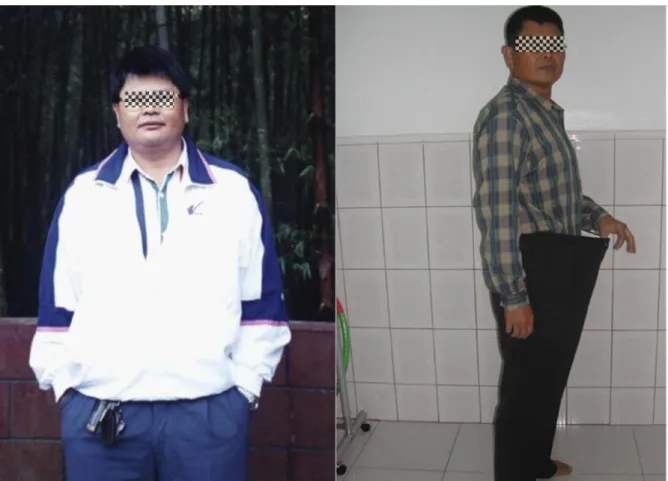
Conclusions: In the hands of an experienced physician, laser acupuncture can be
useful in controlling simple obesity (Fig. 1). Laser acupuncture produces a therapeutic effect on simple obesity by reducing both BW and BMI. Furthermore, subjects demonstrate good compliance with this comfortable and non-restrictive diet protocol.
Keywords: Laser acupuncture; simple obesity; traditional Chinese medicine
Fig. 1: A 45-year-old man before (105.1 kg) and 6 months after (81.0 kg) laser acupuncture treatment.
References
1. Wozniak P, Stachowiak G, Piêta-Doliñska A, Oszukowski P. Laser acupuncture and low-calorie diet during visceral obesity therapy after menopause. Acta Obstet Gynecol Scand. 2003; 82: 69–73.
2. Dubnov-Raz G, Berry EM. The dietary treatment of obesity. Endocrinol Metab Clin North Am. 2008; 37: 873–886.
3. National Institutes of Health. Clinical guidelines on the identification, evaluation, and treatment of overweight and obesity in adults: the evidence report. National Heart, Lung, and Blood Institute and National Institute of Diabetes and Digestive and Kidney Diseases, Bethesda, 1998.
4. Eckel RH. Obesity. Circulation 2005; 111: e257–e259.
5. Hainer V, Toplak H, Mitrakou A. Treatment modalities of obesity, what fits whom? Diabetes Care 2008; 31(Suppl. 2): S269–S277.
6. Shi DB. (eds.). The encyclopedia of traditional Chinese medicine, version 1.0 for PC (e-book in Chinese). Taipei: Yuan-Liou, 2002.
7. World Health Organization Regional Office for the Western Pacific (WPRO). WHO International Standard Terminologies on Traditional Medicine in the Western Pacific Region. Manila, WPRO, Philippines, 2007: pp 19, 20, 27, 45, 56, 64, 209, 214, 221.
8. Weng WL, Jiao DH (eds.). Practical integrated traditional Chinese and western medicine for the science of obesity. Taipei: Zhi-Yin, 2000: pp 219, 220, 226, 242, 261.
9. Liu ZC, Sun FM, Wang YZ, et al. Good regulation of acupuncture in simple obesity patients with stomach-intestine excessive heat type. Chinese Journal of Integrated Traditional and Western Medicine 1995; 15(3): 137–140.
10. Stellon A. The use of laser acupuncture for the treatment of neurogenic pruritus in a child—a case history. Acupunct Med. 2005; 23: 31–33.
11. Whittaker P. Laser acupuncture: past, present, and future. Lasers Med Sci. 2004; 19: 69–80.
12. Küblböck J. Needle acupuncture versus laserpuncture: synergism or opposition. ICMART Symposium, June 14–17, 2001, Berlin.
激光針治療單純性肥胖的臨床觀察
胡文龍1,2,3,5 ,張志浩2,3,4 ,洪裕強1 1 長庚紀念醫院高雄醫學中心中醫部,長庚大學醫學院,台灣 2 高雄醫學大學醫學院,台灣 3 輔英大學醫學與健康學院,台灣 4 高雄市立中醫醫院內科,台灣 5 中華針灸醫學會,台灣 通訊作者︰胡文龍 833 高雄縣鳥松鄉大埤路 123 號,台灣 電話︰+886-7-7317123 轉 2334 ; 傳真︰+886-7-7317123 轉 2335 電子郵件︰ [email protected]摘要
背景︰在過去的 30 年,低能激光已被應用於針刺治療,且正被廣泛地使用於醫 學領域。當合併低熱量飲食時,激光針已被證明對停經後的臟器性肥胖有效。但 是,決定低熱量飲食成功的因素是長期的順從,這取決於節食者並且對研究者來 說是難以掌握的。 本研究為激光針治療單純性肥胖的臨床療效觀察,單純性肥胖的定義為原發 性病因導致身體質量指數超過 30 千克/平方米(在台灣為 27 千克/平方米),而非 繼發於肥胖相關的疾病。本研究參與者接受激光針治療並遵循一份非限制的飲食 協議。 方法︰本研究參與者乃於 2004 年 1 月至 2005 年 11 月間,求診於高雄醫學大學 附設醫院針灸科門診者。共有 73 名女性和 22 名男性,年齡 14-76 歲(平均年齡 36.78 歲,平均身高 162.35 公分),患有單純性肥胖且身體質量指數大於或等於 27 千克/平方米。女性患者可保有正常飲食且建議依下列公式計算的每日熱量攝 取︰(身高[平均 160.0 公分]-70)×0.6×30 kcal(平均 1620.0 千卡)。建議男性患者的 每日熱量攝取公式如下︰(身高[平均 170.2 公分]-80)×0.7×30 kcal(平均 1894.2 千 卡)。男女患者建議的每日攝取熱量乃介於活動者(28.66 千卡/千克/天)和中度活動 者(33.07 千卡/千克/天)維持體重所需的熱量。 使用鎵鋁砷 Handylaser Trion 治療患者 4 週,每週 3 次(最大功率,50 毫瓦; 波長,785 奈米;探頭面積,0.03 平方公分;功率密度,50 毫瓦/平方公分;脈 衝波,巴爾頻率)(RJ 激光,德製)。該儀器輸出 0.25 焦耳能量依序至下列穴位︰ 胃和飢(耳穴),ST25(天樞),ST28(水道),ST40(豐隆),SP15(大橫),以及 CV9(水 分)。 激光作用于每穴各 10 秒。記錄治療前後每位患者的體重和身體質量指數,並計算每個參數減少的百分 比。 結果︰經過 4 週的激光針治療之後,在患者的體重和身體質量指數方面觀察到 統計學上顯著的差異。治療前平均體重是 84.79 千克,平均身體質量指數是 32.10 千克/平方米。這些數值在治療後分別減少到 81.61 千克和 30.88 千克/平方米。在 體重方面平均減少 3.17 千克(p<0.001),以及身體質量指數平均減少 1.22 千克/平 方米 (p<0.001)。體重和身體質量指數減少的百分比平均值為 3.80%和 3.78%。 討論︰基本的肥胖治療包括低熱量和低脂肪的飲食,增加體能鍛鍊和改變生活模 式。重要的是,在開始治療前訂定實際可行的目標是必要的,因為關於減肥不切 實際的預期經常導致體重管理失敗。每日 500 千卡的減少攝取或增加消耗,能 以大約每週 0.5 千克的速率減重,這符合減肥策略的運用。本研究的每日攝取熱 量建議不超過中度活動者所需維持體重的熱量。 因此,參與者不致受飢餓之苦。 中醫認為肥胖的病機以脾腎陽虛為其本,痰濕瘀滯為其標。刺激胃和飢點, 能健脾清胃,降低食慾。刺激天樞和大橫能升降氣機,通調腑氣。刺激水道和水 分能通調水道,利水消腫。刺激豐隆能和胃健脾,利濕化痰。 針刺能降低食慾並抑制亢進的胃腸消化和吸收,而降低熱量的攝取。此外, 針刺也能提升能量代謝並且促進脂肪的動員和利用。激光針結合了針刺和低能激 光的療效。與傳統針相比,激光針沒有得氣針感,但有非侵襲性及不需無菌的優 點。而且,激光針是無痛和安全的,因為治療中沒有熱的產生。激光針與傳統針 同樣有效但需時較短。本研究參與者沒有因激光針而發生任何副作用或併發症。 結論︰有經驗的醫師使用激光針能有效地控制單純性肥胖(圖 1),激光針透過降 低體重和身體質量指數對單純性肥胖產生療效。此外,參與者對這份舒適和非限 制的飲食協議顯示出良好的順從。 關鍵字︰激光針;單純性肥胖;中醫 圖 1.一位 45 歲男性經 6 個月的激光針治療後,體重從 105.1 公斤降到 81.0 公斤。