90° reorientation in the vortex lattice of borocarbide superconductors
Anton Knigavko*Department of Electrophysics, National Chiao Tung University, Hsinchu, Taiwan 30050, Republic of China Baruch Rosenstein
National Center for Theoretical Sciences and Department of Electrophysics, National Chiao Tung University, Hsinchu, Taiwan 30050, Republic of China
共Received 11 September 2000兲
We explain 90° reorientation in the vortex lattice of borocarbide superconductors on the basis of a phenom-enological extension of the nonlocal London model that takes full account of the symmetry of the system. Microscopic mechanisms that could generate the correction terms are analyzed. We show that for any disper-sion relation and longitudinal phonon-electron pairing mechanism the relevant quantity is strongly suppressed. Possible phenomenological interaction terms providing the effect are studied.
Abrikosov vortices in type II superconductors repel each other and therefore tend to form two dimensional lattices when thermal fluctuations or disorder are not strong enough to destroy lateral correlations. In isotropic s-wave materials the lattices are triangular, however in anisotropic materials or for ‘‘unconventional’’ d-wave or p-wave pairing interactions less symmetric vortex lattices 共VL兲 can form, as recent ex-periment on high-Tc cuprates,1 SrRuO4,2 and borocarbides have showed. The high quality of samples in the last kind of superconductors allows detailed reconstruction of the phase diagram by means of small angle neutron scattering, scan-ning tunnelling microscopy or Bitter decoration technique. For H兩兩c the presence of a whole series of structural trans-formations of VL was firmly established. At first, a high magnetic fields stable square lattice becomes rhombic, or ‘‘distorted triangular,’’ via a second order phase transition.3,4 Then, at lower fields, a reorientation of VL by 45° relative to crystal axes occurs.5,6 For H兩兩a a continuous lock-in phase transition was predicted.5Above the critical field of this tran-sition the apex angle of the elementary rhombic cell of VL does not depend on magnetic field, but below it such a de-pendence appears.
Theoretically the mixed state in nonmagnetic borocarbide superconductors RNi2B2C, R⫽Y,Lu can be understood in the framework of the extended London model7共in regions of the phase diagram close to Hc2(T) line the extended Ginzburg-Landau model can be used.4,8兲 So far this theory has always provided a qualitative and even quantitative de-scription of phase transitions in VL and various other prop-erties such as magnetization behavior,9 dependence of non-local properties on the disorder,10 etc. However, recently another ‘‘reorientation’’ phase transition has been clearly ob-served in neutron scattering experiment on LuNi2B2C, which cannot be explained by the theory despite considerable ef-forts. When a magnetic field of 0.3 T was applied along the
a axis of this tetragonal superconductor a sudden 90°
reori-entation of VL has been seen.11At this point rhombic共nearly hexagonal, apex angle⬇60°) lattice, oriented in such a way that the crystallographic axes are its symmetry axes, gets rotated by 90°. Both the initial and rotated lattices are found
to coexist in the field range of width 0.1 T around the tran-sition. Similar observations have been made in magnetic ma-terial ErNi2B2C.
In this paper we explain why the extended London model in its original form cannot generally explain even the exis-tence of the 90° reorientation transition. The reason is that it possesses a ‘‘hidden’’ spurious fourfold symmetry prevent-ing such a transition. Then we generalize the model to in-clude the symmetry breaking effect and explain why the re-orientation take place. Then we search for a microscopic origin of this effect. Using BCS type theory we find that anisotropy of the Fermi surface is ruled out due to the small-ness of its contribution. It is the anisotropy of the pairing interaction that provides the required mechanism. We, there-fore, suggest that there exist a correlation between the critical field of 90° reorientation in VL and the value of the anisot-ropy of the gap.
A convenient starting point of any generalized ‘‘London’’ model7,12is the linearized relation between the supercurrent
ji and the vector potential Aj:
共4/c兲ji共q兲⫽⫺Ki j共q兲Aj共q兲. 共1兲 In the standard London model the kernel Ki j(q) is approxi-mated just by its q⫽0 limit, inverse mass matrix, while in the extended London model the quadratic terms of the ex-pansion of the kernel near q⫽0 are also kept:7
Ki j共q兲⫽mi j⫺1/ 2⫹n
i j,klqkql. 共2兲 The significance of the tensor ni j,kl is that it accounts prop-erly for the symmetry of any crystal system while a rank two tensor mi j⫺1 does not guarantee this. At the same time ni j,kl expresses nonlocal effects which are inherent to the electro-dynamics of superconductors and below we call its compo-nent or their combination nonlocal parameters. From its defi-nition, ni j,kl⬅
1 2(
2/q
lqk)Ki j(q)兩q⫽0is a symmetric tensor with respect to both the first and the second pairs of indices. However, the way ni j,kl transforms when the first and the second pairs of indices are interchanged is not obvious be-cause the ‘‘origin’’ of these indices are quite different. The first pair (i j ) comes, roughly speaking, from the variation of the free energy of the system ‘‘a superconductor in weakly inhomogeneous magnetic field’’ with respect to the vector
PRB 62
potential while the second pair (kl) comes from the expan-sion in the vector q. Below we show that in general no sym-metry ni j,kl⫽nkl,i j is expected.
The original derivation of Eq. 共2兲 from BCS theory in quasiclassical Eilenberger formulation7 produced a fully symmetric rank four tensor: ni j,kl⬃
具
vivjvkvl典
withvibeing components of the velocity of electrons at the Fermi surface. In this calculation independence of the gap function on the orientation was assumed. Let us consider the vortex lattice problem with this result. Specializing to tetragonal borocar-bides, the number of independent components of the tensorni j,kl is four: naaaa, naabb, naacc and ncccc. In the case of an external magnetic field oriented along a axis the free en-ergy of VL, which is the relevant thermodynamic potential for a thin plate sample in perpendicular external field, reads
F⫽共B2/8兲
兺
关1⫹D共gx,gy兲兴⫺1, 共3兲 D⫽2共magx 2⫹m cgy 2兲⫹4关n共m agx 2⫹m cgy 2兲2⫹dg x 2 gy 2兴. Here B is the magnetic induction and the summation runs over all vectors g of the reciprocal VL. The nonlocal param-eters appearing in this equation have the form n⫽naacc andd⫽nccccmc 2⫹n
aaaama 2⫺6n
aaccmamc. The free energy of Eq. 共3兲 has been extensively studied numerically first mini-mizing it on the class of rhombic lattices with symmetry axes coinciding with the crystallographic axes5and more recently by us for arbitrary lattices with one flux per unit cell. Despite the fact that a great variety of vortex lattice transformation were identified, not a single 90° reorientation has ever been seen. The reason is quite simple: the free energy considered is actually effectively fourfold symmetric. After rescaling the reciprocal lattice vectors
gx→g˜x⬅gx/
冑
ma, gy→g˜y⬅gy/冑
mc 共4兲 the sum in Eq. 共3兲 becomes explicitly fourfold symmetric. Based on this observation one concludes that the energies of the lattices participating in the 90° reorientation are equal exactly. Therefore no phase transition between them is pos-sible in the framework of the extended London model of Eq. 共3兲 and further corrections are necessary to account for this transition.There might be a slight possibility that the observed 90° reorientation presents the lock-in transition described in the beginning of this paper. For this to happen the rescaled square VL should looks almost hexagonal and, correspond-ingly, a particular value of the mass asymmetry ma/mc ⫽关cos(60°)/cos(45°)兴2⫽1/2 is required. This is very differ-ent from the figures quoted in literature:5 ma/mc⫽0.9/1.22 ⫽0.74. More importantly, according to this scenario one should see two degenerate lattices at small fields below the transition and only a single lattice at high fields above the transition which experimentally is clearly not the case.
To explain the 90° reorientation we proceed by correcting the model of Eq.共3兲. On general symmetry grounds for H兩兩a one can expect more terms in the expression for D which describes vortex-vortex interactions. Given twofold symme-try of the present case we write down for D the expansion in Fourier series up to the fourth harmonic, perform rescaling defined by Eq. 共4兲 and obtain
Deff⫽D0共g˜兲⫹D4共g˜兲cos共4兲⫹D2共g˜兲cos共2兲, 共5兲 where is the polar angle in the rescaled b-c plane. The quantity D from Eq. 共3兲 produces only fourfold invariant terms:
D0共g˜兲⫽2˜g2⫹共n⫹d/8mamc兲4˜g4, 共6兲
D4共g˜兲⫽⫺共d/8mamc兲4˜g4. 共7兲 The new term D2(g˜ ) expresses the effective fourfold sym-metry breaking. Experimentally, it should be small as indi-cated by recent success in the qualitative understanding of the angle dependence of magnetization of LuNi2B2C,9with a field lying in the a-b plane on the basis of the theory without
D2 term. Accordingly, we can treat it perturbatively:F ⫽F(0)⫹F(pert) with
F(0)⫽共B2/8兲
兺
关1⫹D0⫹D4cos共4兲兴⫺1, 共8兲F(pert)⫽⫺共B2/8兲
兺
D2cos共2兲 关1⫹D0⫹D4cos共4兲兴2, 共9兲 where the summation is over g˜ 关see Eq. 共4兲兴. The original degeneracy of the two VL rotated by 90° with respect to each other is split now. To explain the 90° reorientation the sign of the perturbation should change at certain field Breo. The magnetic field influences the sum via the constraint that the area of the unit cell carries one fluxon. Roughly speaking
D2(g) should change sign when g˜⬇
冑
Breo/⌽0. The simplest way to implement this idea is to write for D2(g) the two lowest order terms in g˜ :D2⫽w4g˜4⫹w6˜g6. 共10兲
A quadratic term is not present since we have already rescaled it out in the derivation of Eq. 共5兲. In principle the coefficient w6can be derived from BCS similarly to the ni j,kl tensor within the framework of the original extended London model.7Then it is proportional to the Fermi surface average of six components of the Fermi velocity. To obtain w4, how-ever, the result ni j,kl⬃
具
vivjvkvl典
of Ref. 7 is not sufficient. Indeed, using the general expression for ni j,kl and repeating the derivation of Eq.共3兲 from Eqs. 共1兲 and 共2兲 we see thatw4⫽共naa,cc⫺ncc,aa兲/2. 共11兲 In what follows we first demonstrate the presence of a first order phase transition in the model of Eq. 共10兲 and then provide a microscopical derivation of w4. In order to be rel-evant for the 90° reorientation this coefficient should not be negligible. Otherwise a treatment of the reorientation of the vortex lattice in terms of the kernel K(q) expanded near q ⫽0 关see Eq. 共2兲兴 appears not appropriate.
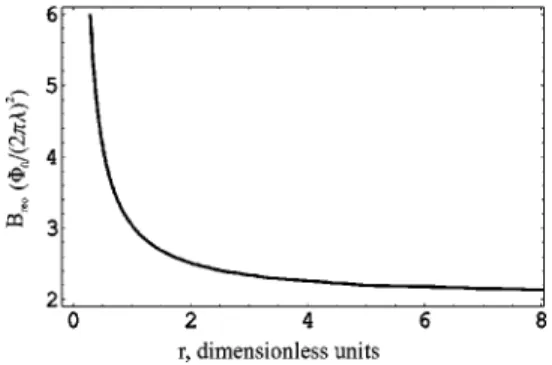
The critical magnetic field of the 90° reorientation Breo depends only on the ratio r⫽⫺2w6/w4. We determined this dependence numerically using standard computational methods. At first, for a fixed B the equilibrium form of VL unit cell was obtained by minimization of Eq.共9兲. Then, the zero of the perturbation energy Eq.共9兲 was found. As usual7 during the numerical calculations the cutoff factor exp
(⫺2˜g2) was introduced inside the above sums in order to properly account for the failure of the London approach in the vortex core. Figure 1 presents the result of calculations with nonlocal parameters d⫽0.05 and n⫽0.015 typical for LuNi2B2C. The critical magnetic field quickly drops as r becomes larger. Within the approximation of Eq. 共10兲 the 90° reorientation cannot happen at very low magnetic fields. For LuNi2B2C with⬇710 Å the field unit ⌽0/(2)2 is about 100 G. From the experimentally observed transition field Breo⫽2.95 kOe,11 we estimate the relative strength of the sixth and fourth order terms in D2 关see Eq. 共10兲兴 as r ⫽0.036.
Now let us discuss the possible microscopic origin of w4. We start from an effective many body Hamiltonian for elec-trons written in second quantized form
H⫽
冕
x†␣
†共x兲关共⫺iⵜ兲⫺兴
␣共x兲⫹V共␣†,␣兲‡, 共12兲
where a summation over spin indices␣⫽↑,↓ is assumed and
V is a two body interaction. The dispersion(k) will be kept
general because of the complicated band structure of boro-carbides. We define it in coordinate space replacing k→ ⫺i“ in Eq. 共12兲 in order to couple the magnetic field by minimal substitution⫺i“→⌸⬅⫺i“⫺A. This procedure is not unique because the components of ⌸ do not commute with each other. Therefore, (k) is presented by a Taylor expansion in symmetrized form.
The kernel Ki j(q) from Eq.共1兲 is obtained by treating the effect of a slowly varying magnetic field in the linear re-sponse approximation. The change in the Hamiltonian due to the presence of a magnetic field
H1关,A兴⬅H关,A兴⫺H关,0兴 共13兲
is taken into account perturbatively:
Ki j共x⫺y兲⫽
冓
␦2H 1 ␦Ai共x兲␦Aj共y兲⫺ ␦H1 ␦Ai共x兲 ␦H1 ␦Aj共y兲冔
, 共14兲 where angular brackets denote the statistical average with the unperturbed density operator. Thus, we have to expand the functional H1 up to the terms quadratic in A. Because our aim is to calculate w4 we need only the coefficients of this expansion for Az andAz/x.In its full generally the problem of Eq.共12兲 in a magnetic field is quite intractable and below we consider two
particu-lar cases in order to estimate quantitatively the magnitude of the different contributions to w4:共i兲 isotropic local interac-tion leading to pairing describing the major effect of longi-tudinal phonons 共overpowering Coulomb attraction兲
V1⫽⫺ g 4
冕
x␣ † ⫺␣ † ⫺␣␣ 共15兲and an arbitrary dispersion relation (k); 共ii兲 more compli-cated anisotropic model interactions with isotropic disper-sion(k)⫽k2/(2m).
In the case 共i兲 the part of H1 dependent on Az can be presented as follows: H1⫽⫺
冕
x␣ †冋
Az,z⫺i共xAz兲 ,zx 2 ⫺共x 2 Az兲 ,zx2 6册
␣ ⫹1 2冕
x␣ †冋
A z 2 ,z2⫺iAz共xAz兲,z2x⫺Az共x2Az兲 ,z2x2 3 ⫺共xAz兲2 ,z2x2 4册
␣, 共16兲where,zxmeans the second derivative of(⫺iⵜ) with re-spect to z and x components of the argument, and so on. Equation 共16兲 is the key point. To derive this compact ex-pression in terms of the derivatives of it is necessary to carefully collect the various terms and sometimes a proof by induction should be used to identify the numerical coeffi-cients. Calculating averages in a standard way one obtains the final result
w4⫽⫺ 1 V
兺
k冋
2 3R,z,zx2⫹ R ,z 2 ,x2⫺共x↔z兲册
, 共17兲 R⫽4 Tcosh ⫺2冋
E共k兲 2T册
, E共k兲⫽冑
„共k兲⫺… 2⫹⌬2. At zero temperature R and thereby w4 vanishes exponen-tially. As temperature increases, w4 increases monotonically and reaches its maximal value at T⫽Tc where it smoothly joins the corresponding component of the q-dependent mag-netic susceptibility tensor of the normal metal. For estima-tion we considered a simple dispersion relaestima-tion (k) ⫽(1/2m)k2⫹(␣˜ /4)kz 4
and assumed the deviations from a spherical Fermi surface to be small:␣⬅␣˜ m2Ⰶ1. Expand-ing in␣ we obtain at T⫽Tcthat
w4FS⫽2␣⌽02
冑
ប2/2m, 共18兲 where⌽0⫽2e/hc. This quantity is very small: comparing it with the components of ni j,klwhich produce contributions to Eq. 共3兲 we see that w4FS/nxxxx⬃␣(⌬/)2. It is not probable that such a tiny value of the asymmetry parameter w4 关see Eq. 共11兲兴 is responsible for the reorientation. What maybe more important is that temperature dependence of w4 given by Eq.共17兲 is not in accordance with the experiments which show only a slow dependence of the critical magnetic field of 90° reorientation on temperature.11Therefore, the origin of the 90° reorientation should be looked for elsewhere and we turn to the case共ii兲. In addition to the conventional local operator V1 defined in Eq. 共15兲
FIG. 1. Critical field of 90° VL reorientation as a function of parameter r⫽⫺2w
6/w4 for nonlocal parameters d⫽0.05 and n ⫽0.015 关see Eqs. 共10兲 and 共3兲兴.
which describes isotropic, phonon mediated attraction, there might be anisotropic corrections:
V2⫽
冕
x共␣ † ⫺␣兲共iⵜ兲共⫺␣† ␣兲⫽冕
k,q共k兲共q兲共k⫹q兲. 共19兲 The function(q) originates from both the phonon propaga-tor and the electron-phonon matrix element. However when the magnetic field is coupled via minimal substitution V2 will not lead to any contribution to H1关,A兴. This follows from a basic property of the longitudinal phonon-electron interaction: the phonon couples to the electron density (x) ⫽⫺␣† ␣ which is a neutral operator and therefore ⫺i“should not be substituted by ⌸ in Eq. 共19兲. Only when de-rivatives act on a charged operator is there a possibility to generate w4.
We therefore consider a phenomenological interaction
V3⫽⫺ g 4N␣ a†关1⫺␦ 0ⵜ2兴⫺␣ a† ⫺␣ b 关1⫺␦ 0ⵜ2兴␣ b , 共20兲 where N is the number of共real or auxiliary兲 ‘‘copies’’ of the Fermi surface enumerated by a, b. We calculated averages in Eq. 共14兲 using the 1/N expansion13rather than the BCS ap-proximation. The reason to resort to the 1/N expansion is twofold. First, the BCS expression for w4contains diagrams up to three loops关see Fig. 2共c兲兴 which are very complicated. Secondly, unlike BCS, this nonperturbative scheme is sys-tematically improvable. The last property is important when questions of principle are concerned.
The corresponding perturbation Hamiltonian found by the minimal substitution reads
H1⫽i
冕
x Az冋
1 2m␣ a† z␣ a⫹␦0 4NS↓↑ † U↓↑⫺cc册
, S␣⬅␣az a ⫹共z␣ a兲  a , 共21兲 U␣⬅␣aa⫹␦0 2 关␣ a z 2  a ⫹共z 2 ␣ a兲  a兴.Here the terms proportional to Az2 are omitted since they are local and cannot contribute to the derivatives of Kzz(q) with respect to qx required to obtain w4. For simpler situations like the case 共i兲 the leading order in 1/N expansion, with N set to 1, simply coincides with the BCS approximation. After observing that the order 1/N contributions, Fig. 2共a兲, all van-ish due to k⇔⫺k symmetry, we calculated the leading 1/N2 contributions to the magnetic kernel, Fig. 2共b兲. At T⫽0 to leading order in␦0共further reducing number of integrals兲 the result reads w4int⫽⫺ ␦ N2 8 105
冉
⌬冊
2 ⌽0 2冑
ប2/2m, 共22兲 where␦⬅␦0m is the dimensionless gap anisotropy. There-fore, in the physical case of interest N⫽1 we obtainw4gap/nxxxx⬃␦ that is not necessary very small. This result is to be compared with w4FSoriginating from the Fermi surface anisotropy which has a huge suppression factor (⌬/)2.
The physical origin of an interaction of the type Eq. 共20兲 is not clear at this stage. It might be a transverse phonon-electron coupling or some other force which first should be studied experimentally. We analyzed one possible candidate: the current-current interaction in metals. Although a relativ-istic effect, this coupling in normal metals has a long range at zero frequency.14 In superconductors it is cut off by the penetration depth. The current-current interaction is isotropic and gives a contribution to w4 in the case of an anisotropic dispersion relation only. This contribution turns out to be small, of order ␣(e2/បc)2(vF/c)2.
To conclude, we found that the extended London model is incapable of explaining the 90° reorientation in VL for H兩兩a because it produces an effective fourfold symmetry of the free energy of VL. This symmetry becomes explicit after a rescaling transformation. We showed that in the general case one should include into the extended London model correc-tion terms for which ni j,kl⫽nkl,i j 关see Eq. 共2兲兴. As a result, the true twofold symmetry of the system in a magnetic field
H兩兩a is restored and the 90° reorientation can be explained
naturally. We proved that for an arbitrary dispersion relation and conventional phonon pairing the correction terms vanish at T⫽0 and are strongly suppressed at T⫽Tc. Therefore, experimental observation of the reorientation points to the existence of a more intricate interaction. Note that inclusion of the correction terms will not change any conclusions of the extended London model for H兩兩c.
We are grateful to V.G. Kogan for bringing this problem to our attention and numerous illuminating discussions, to M.R. Eskildsen for discussions and correspondence, and also to R. Joynt, S.-I. Lee, D. Lopez, and S. K. Yip for valuable comments. The work was supported by the NSC of the Re-public of China, Grant No. 89-2112-M-009-039.
*Present address: Dept. of Physics, Univ. of Alberta, Edmonton, Canada T6G 2J1. Email address: [email protected]
1B. Keimer, W.Y. Shih, R.W. Erwin, J.W. Lynn, F. Dogan, and
I.A. Aksay, Phys. Rev. Lett. 73, 3459共1994兲.
2T.M. Riseman, P.G. Kealey, E.M. Forgan, A.P. Mackenzie, L.M.
Galvin, A.W. Tyler, S.L. Lee, C. Ager, D.M. Paul, C.M. Ae-gerter, R. Cubitt, Z.Q. Mao, T. Akima, and Y. Maeno, Nature
共London兲 396, 242 共1998兲.
3M.R. Eskildsen, P.L. Gammel, B.P. Barber, U. Yaron, A.P.
Ramirez, D.A. Huse, D.J. Bishop, C. Bolle, C.M. Lieber, S. Oxx, S. Sridhar, N.H. Andersen, K. Mortensen, and P.C. Can-field, Phys. Rev. Lett. 78, 1968 共1997兲; M. Yethiraj, D.McK. Paul, C.V. Tomy, and E.M. Forgan, ibid. 78, 4849共1997兲.
4Y. De Wilde, M. Iavarone, U. Welp, V. Metlushko, A.E.
FIG. 2. 共a兲 Diagrams of the order 1/N, which vanish in our model.共b兲 Diadrams of the order 1/N2contributing to w4.共c兲 An
example of complicated diagrams, which are of the order 1/N3and
Koshelev, I. Aranson, G.W. Crabtree, and P.C. Canfield, Phys. Rev. Lett. 78, 4273共1997兲.
5V.G. Kogan, M. Bullock, B. Harmon, P. Miranovich, Lj.
Dobrosavljevic-Grujic, P.L. Gammel, and D.J. Bishop, Phys. Rev. B 55, 8693共1997兲.
6D.McK. Paul, C.V. Tomy, C.M. Aegerter, R. Cubitt, S.H. Lloyd,
E.M. Forgan, S.L. Lee, and M. Yethiraj, Phys. Rev. Lett. 80, 1517共1998兲; A. B. Abrahamsen et al. 共unpublished兲; L. Vinni-kov共unpublished兲.
7V.G. Kogan, A. Gurevich, J.H. Cho, D.C. Johnston, Ming Xu,
J.R. Thompson, and A. Martynovich, Phys. Rev. B 54, 12 386
共1996兲.
8D. Chang, C.-Y. Mou, B. Rosenstein, and C.L. Wu, Phys. Rev. B 57, 7955共1998兲; K. Park and D.A. Huse, ibid. 58, 9427 共1998兲. 9L. Civale, A.V. Silhanek, J.R. Tompson, K.J. Song, C.V. Tomy,
and D.McK. Paul, Phys. Rev. Lett. 83, 3920 共1999兲; V.G. Kogan, S.L. Bud’ko, P.C. Canfield, and P. Miranovich, Phys. Rev. B 60, 12 577共1999兲.
10
K.O. Cheon, I.R. Fisher, V.G. Kogan, P. Miranovic, P.L. Gam-mel, and P.C. Canfield, Phys. Rev. B 58, 6463 共1998兲; P.L. Gammel, D.J. Bishop, M.R. Eskildsen, K. Mortensen, N.H. Andersen, P.C. Canfield, and V.G. Kogan, Phys. Rev. Lett. 82, 4082共1999兲.
11M. R. Eskildsen et al.共unpublished兲; P. Gammel 共unpublished兲. 12M. Franz, I. Affleck, and M.H.S. Amin, Phys. Rev. Lett. 79, 1555
共1997兲.
13B. Rosenstein, B.J. Warr, and S.H. Park, Phys. Rep. 205, 59 共1991兲; G. Kotliar, in Correlated Electron Systems, edited by V.
J. Emery共World Scientific, Singapore, 1993兲.