Synthesis and Properties of
Dumbbell-Shaped Dendrimers
Containing 9-Phenylcarbazole Dendrons
Ken-Tsung Wong,* Yu-Hsien Lin, Hsu-Hsuan Wu, and Fernando Fungo
Department of Chemistry, National Taiwan UniVersity, Taipei 106, Taiwan, and Departamento de Quı´mica, UniVersidad Nacional de Rı´o Cuarto, Agencia Postal 3 (5800), Rı´o Cuarto, Argentina[email protected] Received August 21, 2007
ABSTRACT
We report the synthesis and structural characterization of two dumbbell-shaped dendrimers incorporating 9-phenylcarbazole units as dendrons, as well as their thermal, morphological, photophysical, and electrochemical properties.
Dendrimers are monodispersed macromolecules possessing well-defined branched structures that can be precisely tailored with discrete and designated functionality to create multi-functional materials. Their unique structures and properties make dendrimers suitable subjects for a wide range of biomedical and industrial applications, such as drug delivery,1 multivalent bioconjugates2and multivalent diagnostics for magnetic resonance imaging (MRI),3 extremely efficient
light-harvesting antennae,4 and homogeneous catalysis.5 Recently, dendrimers have also found promising applications as materials for organic electronic devices, such as organic light-emitting diodes (OLEDs).6 Among the various types of dendrimers, carbazole-based dendrimers have emerged as a new family of intriguing materials that possess several attractive properties. For example, the fully conjugated 9-phenylcarbazole monodendrons synthesized by Moore and co-workers exhibit fluorescence quenching effects via through-space interactions.7Carbazole-based dendrons that have been incorporated at antennal positions surrounding porphyrin * Address correspondence to this author at National Taiwan University.
(1) (a) Svenson, S.; Tomalia, D. A. AdV. Drug DeliVery ReV. 2005, 57, 2106. (b) Najlah, M.; D’Emanuele, A. Curr. Opin. Pharmacol. 2006, 6, 522.
(2) (a) Baars, M. W. P. L.; Karlsson, A. J. K.; Sorokin, V.; de Waal, B. F. W.; Meijer, E. W. Angew. Chem., Int. Ed. 2000, 39, 4262. (b) Wu, P.; Malkoch, M.; Hunt, J. N.; Vestberg, R.; Kaltgrad, E.; Finn, M. G.; Fokin, V. V.; Sharpless, K. B.; Hawker, C. J. Chem. Commun. 2005, 5775.
(3) (a) Wiener, E. C.; Brechbiel, M. W.; Brothers, H.; Magin, R. L.; Tomalia, D. A.; Lauterbur, P. C. Magn. Reson. Med. 1994, 31, 1. (b) Caravan, P.; Thomas, J. E.; McMurry, T. J.; Lauffer, R. B. Chem. ReV.
1999, 99, 2293.
(4) (a) Nantalaksakul, A.; Reddy, D. R.; Bardeen, C. J.; Thayumanavan, S. Photosynth. Res. 2006, 87, 133. (b) Balzani, V.; Ceroni, P.; Maestri, M.; Vicinelli, V. Curr. Opin. Chem. Biol. 2003, 7, 657.
(5) (a) Astruc, D. Pure Appl. Chem. 2003, 75, 461. (b) van Koten, G.; Jastrzebski, J. T. B. H. J. Mol. Catal. A: Chem. 1999, 146, 317.
(6) (a) Shirota, Y. J. Mater. Chem. 2000, 10, 1. (b) Burn, P. L.; Lo, S.-C.; Samuel, I. D. W. AdV. Mater. 2007, 19, 1675.
(7) (a) Zhu, Z.; Moore, J. S. J. Org. Chem. 2000, 65, 116. (b) Zhu, Z.; Moore, J. S. Macromolecules 2000, 33, 801.
ORGANIC
LETTERS
2007
Vol. 9, No. 22
4531-4534
10.1021/ol702060u CCC: $37.00 © 2007 American Chemical Society
Published on Web 09/28/2007
Downloaded by NATIONAL TAIWAN UNIV on September 2, 2009 | http://pubs.acs.org
centers8and Ru(II)-complex cores9mediate highly efficient energy transfer; they have also been employed as effective charge transporting moieties for iridium-based phosphores-cent emitters.10Dendrimers equipped with carbazole-based dendrons are promising materials for use as efficient hole-transporting materials in OLEDs.11 Most carbazole-based dendrimers, except for those reported by Moore7 and Dehaen,12 have been prepared through formation of C-N linkages, coupling the nitrogen atoms of an external carbazole unit to the active C3 and C6 sites of an inner carbazole moiety. Here we report the convergent synthesis (through efficient C-N bond coupling reactions) and physical char-acterization of two novel dumbbell-shaped carbazole-containing dendrimers incorporating 9-phenylcarbazole den-drons. Carbazole derivatives exhibit high triplet energy and are capable of transporting hole, thus, these new carbazole-containing dendrimers may present interesting applications as efficient hole-transporters as well as host materials in electrophosphorescence devices.
Scheme 1 outlines our synthesis of the 9-phenylcabazole-based dendrons. The generational growth began with con-nection of the phenylene rings of two 9-phenylcabazole molecules through Pd-catalyzed C-N bond formation be-tween 9-(4-aminophenyl)carbazole and
9-(4-iodophenyl)-carbazole13to afford the G1-N-G1 system 1 in good yield. Using the same synthetic protocol, we coupled compound 1 with 3,6-dibromo-9-(4-nitrophenyl)carbazole, which we had synthesized in moderate yield through the bromination of 9-(4-nitrophenyl)carbazole with Br2, to give the nitro-substituted G2 dendron 2 in good yield. Reduction of the nitro group of 2 with SnCl2gave a good yield of the amino-G2 dendron 3, which we further coupled with 1-bromo-4-tert-butylbenzene to afford the unsymmetrical dendron 4 in moderate yield. Linking this dendron to 4,4′-didromobiphenyl provided a moderate yield of the unsymmetrical dumbbell-shaped dendrimer 5. For comparison, we synthesized the G1-derived counterpart 6 in a similar two-step synthetic route with a total yield of 70% (see the Supporting Information). Although we were unable to convert the primary amino group of 3 into an iodo moiety, we did prepare the triflate-substituted G2 derivative 7 (Scheme 2) as an electrophilic variant of that dendron. Coupling of the G1-N-G1 species 1 with 3,6-dibromo-9-(4-methoxyphenyl)carbazole gave a high yield of the methoxy-substituted dendron 8, the methyl group of which we subsequently removed through treatment with BBr3to afford a high yield of the hydroxy-substituted G2 dendron 9. Treatment of 9 with triflic anhydride gave the desired pseudohalogen-substituted G2 dendron 7 in good yield. C-N coupling of the amino- and triflate-substituted G2 dendrons 3 and 7 in the presence of Pd2(dba)3as catalyst and 2-(di-tert-butylphosphine)biphenyl as cocatalyst provided a moderate yield of the G2-N-G2 dendron 10.
Our attempts at coupling this G2-N-G2 dendron with 4,4′ -dibromobiphenyl or the more reactive 4,4′-diiodobiphenyl under the conditions of Pd-catalyzed C-N bond formation produced complicated mixtures of products. Gratifyingly, conventional Ullmann conditions (Cu, K2CO3, dichloroben-(8) (a) Loiseau, F.; Campagna, S.; Hameurlaine, A.; Dehaen, W. J. Am.
Chem. Soc. 2005, 127, 11352. (b) Xu, T. H.; Lu, R.; Qiu, X. P.; Liu, X. L.; Xue, P. C.; Tan, C. H.; Bao, C. Y.; Zhao, Y. Y. Eur. J. Org. Chem. 2006, 4041.
(9) McClenaghan, N. D.; Passalacqua, R.; Loiseau, F.; Campagna, S.; Verheyde, B.; Hameurlaine, A.; Dehaen, W. J. Am. Chem. Soc. 2003, 125, 5356.
(10) (a) Lo, S.-C.; Namdas, E. B.; Shipley, C. P.; Markham, J. P. J.; Anthopolous, T. D.; Burn, P. L.; Samuel, I. D. W. Org. Electron. 2006, 7, 85. (b) Zhou, G.; Wong, W.-Y.; Yao, B.; Xie, Z.; Wang, L. Angew. Chem., Int. Ed. 2007, 46, 1149.
(11) (a) Kimoto, A.; Cho, J.-S.; Higuchi, M.; Yamamoto, K. Macromol. Symp. 2004, 209, 51. (b) Kimoto, A.; Cho, J.-S.; Ito, K.; Aoki, D.; Miyake, T.; Yamamoto, K. Macromol. Rapid Commun. 2005, 26, 597.
(12) Hameurlaine, A.; Dehaen, W. Tetrahedron Lett. 2003, 44, 957.
(13) Chen, Y.-C.; Huang, G.-S.; Hsiao, C.-C.; Chen, S.-A. J. Am. Chem. Soc. 2006, 128, 8549.
Scheme 1
4532 Org. Lett.,Vol. 9, No. 22, 2007
Downloaded by NATIONAL TAIWAN UNIV on September 2, 2009 | http://pubs.acs.org
zene) allowed us to react the G2-N-G2 dendron 10 with 4,4′ -diiodobiphenyl to form the symmetrical dumbbell-shaped dendrimer 11 in good yield. As compare to the unsym-metrical 5, the symmetric 11 could provide different mor-phology in solid films, which is an important parameter governing the charge mobility in organic electronic devices. For comparison, we synthesized the G1-derived counterpart 12 in high yield through Pd-catalyzed C-N bond formation reactions between the G1-N-G1 system 1 and 4,4′ -dibromo-biphenyl (see the Supporting Information).
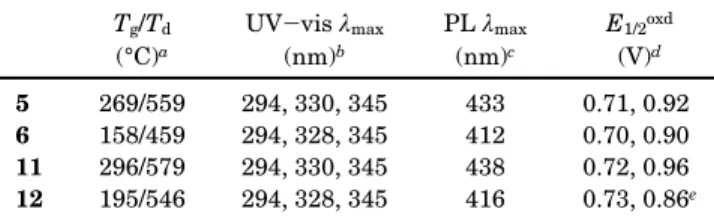
We obtained satisfactory spectroscopic and MALDI-TOF mass spectrometric (Figure S-1, Supporting Information) data that were consistent with the structural identity of the high molecular weight dendron 10, the unsymmetrical dumbbell-shaped dendrimer 5, and the symmetrical dumbbell-dumbbell-shaped dendrimer 11. Table 1 summarizes the results of thermo-gravimetric analysis (TGA) and differential scanning calo-rimetry (DSC) measurements of the various compounds. We attribute the observed increased thermal and morphological stabilities of 5 and 11srelative to those of their low molecular weight counterparts 6 and 12, respectivelysto their greater molecular weights.
Figure 1 provides a comparison of the electronic absorption and fluorescence spectra of the unsymmetrical dumbbell-shaped dendrimer 5, the symmetrical dendrimer 11, and their respective counterparts 6 and 12.
The UV-vis spectra of these compounds exhibit the absorption characteristics (peaks at 294, 328, and 345 nm)
of their phenylcarbazole moieties, with the absorbance intensity increasing along with an increase in the number of phenylcarbazole units per molecule. We ascribe the absorp-tions at wavelengths exceeding 350 nm to the presence of the tetraphenylbenzidine (TPB) cores.14The photolumines-cence spectra of 6 and 12 display the typical emission characteristics of TPB moieties. The corresponding spectra of the dendrimers 5 and 11 exhibit slightly red-shifted emission wavelengths, centered at 433 and 438 nm, respec-tively, relative to those of their counterparts 6 and 12. Because the G2-N-G2 dendron 10, which lacks a TPB chromophore, displays an emission maximum centered at Scheme 2
Table 1. Physical Properties of Dendrimers 5 and 11 and Their Low Molecular Weight Counterparts 6 and 12
Tg/Td (°C)a UV-vis λmax (nm)b PL λmax (nm)c E1/2oxd (V)d 5 269/559 294, 330, 345 433 0.71, 0.92 6 158/459 294, 328, 345 412 0.70, 0.90 11 296/579 294, 330, 345 438 0.72, 0.96 12 195/546 294, 328, 345 416 0.73, 0.86e aT
d) 5% weight loss temperature.bMeasured from a 1.0× 10⁻⁶M
solution in CH2Cl2.cMeasured from a 1.0× 10⁻⁶M solution in CH2Cl2,
excited at 330 nm.dMeasured from a 1.0× 10⁻³M solution in CH
2Cl2
containing 0.1 M Bu4NPF6as the supporting electrolyte and with use of a
glassy carbon electrode.eMeasured with a Pt electrode and 0.1 M Bu
4NClO4
as the supporting electrolyte.
Org. Lett.,Vol. 9, No. 22, 2007 4533
Downloaded by NATIONAL TAIWAN UNIV on September 2, 2009 | http://pubs.acs.org
436 nm, the long-wavelength fluorescence observed for 5 and 11 can be unambiguously attributed as arising mainly from the lowest π-π* transition of the 3,6-diamino-9-phenylcarbazole chromophore.
We used cyclic voltammetry (CV) to characterize the electrochemical properties of the high molecular weight dendrimers 5 and 11 and their low molecular weight counterparts 6 and 12. When the CV scanning range was between 0 and 1.2 V (vs Ag/AgCl)susing a glassy carbon electrode as the working electrode in CH2Cl2and 0.1 M Bu4 -NPF6as the supporting electrolyteswe observed two revers-ible oxidation potentials (at ca. 0.70 and 0.90 V) for the dendrimers 5, 6, and 11. In contrast, the CV trace of 12 under the same conditions displayed a peak typical of a product adsorbed weakly onto the electrode surface (Figure S-2, Supporting Information). The two reversible oxidations of 12 were recovered when using a Pt working electrode (Figure S-3, Supporting Information). It appears quite reasonable to assign these potentials of the dendrimers 6 and 12 to the successive oxidations of the TPB-like cores. Because car-bazoles lacking substituents at the C3 and C6 positions normally undergo oxidation at higher potentials, the presence of oxidized carbazole moieties usually leads to polymeric materials.15Indeed, the consecutive increases in the response currents, together with the oxidation peaks shifting to lower
potentials, over multiple CV scans (0-1.6 V) for dendrimers 5, 6, and 11 are good indicators that electropolymerization occurred at the peripheral carbazole groups (Figure S-2, Supporting Information). Accordingly, oxidation of the carbazole groups can be excluded from the contributions to the first two oxidation potentials of dendrimers 5 and 11, which contain four oxidizable sites (the four different nitrogen atom centers). Furthermore, the CV trace of dendron 10 revealed two reversible oxidation potentials, at 0.71 and 0.89 V, respectively (Figure S-3, Supporting Information), which we suggest may be ascribed to the oxidations of the more-electron-rich 3,6-diaminocarbazole moiety. Because the oxidation potentials of 10 are similar to those of the TPB-like core of dendrimer 6, it is difficult to accurately determine the origins of the first two oxidation potentials detected for dendrimers 5 and 11. Nevertheless, our results indicate that the inner chromophores (i.e., TPB or 3,6-diaminocarbazole) have lower oxidation potentials, whereas the outer carbazole moieties oxidize at higher potentials; thus an intriguing redox gradient of electroactive dendrimers can be achieved,16which may facilitate the hole migration from the core to the peripheral carbazoles
In summary, using efficient C-N bond formation reactions and a convergent strategy, we have synthesized two dumb-bell-shaped dendrimers (5 and 11) containing 9-phenylcar-bazole units as dendrons and have characterized their structures and photophysical and electrochemical properties. The application of these dendrimers as hole-transporting and host material in organic optoelectronic devices is currently under investigation.
Acknowledgment. This study was supported financially by the National Science Council and Ministry of Education of Taiwan.
Supporting Information Available: Detailed experi-mental procedures, spectroscopic characterization of new compounds, MALDI-TOF mass spectra of compounds 5, 10, and 11, and cyclic voltammograms of compounds 5, 6, 10, 11, and 12. This material is available free of charge via the Internet at http://pubs.acs.org.
OL702060U
(14) Koene, B. E.; Loy, D. E.; Thompson, M. E. Chem. Mater. 1998, 10, 2235.
(15) (a) Ambrose, J. F.; Carpenter, L. L.; Nelson, R. F. J. Electrochem. Soc. Electrochem. Sci. Technol. 1975, 122, 876. (b) Natera, J.; Otero, L.; Sereno, L.; Fungo, F.; Wang, N.-S.; Tsai, Y.-M.; Hwu, T.-Y.; Wong, K.-T. Macromolecules 2007, 40, 4456.
(16) (a) Selby, T. D.; Blackstock, S. C. J. Am. Chem. Soc. 1998, 120, 12155. (b) Li, Z.; Wong, M. S. Org. Lett. 2006, 8, 1499.
Figure 1. UV-vis absorption and photoluminescence spectra of the high molecular weight dendrimers 5 and 11 and their respective low molecular weight counterparts 6 and 12.
4534 Org. Lett.,Vol. 9, No. 22, 2007
Downloaded by NATIONAL TAIWAN UNIV on September 2, 2009 | http://pubs.acs.org