Clausal-Packaging of Path of Motion in the Second Language
Acquisition of Russian and Spanish
Kawai Chui
Hsiang-lin Yeh
Wen-Chun Lan Yu-Han Cheng
National Chengchi University,
NO.64, Sec.2, ZhiNan Rd.,Wenshan District,Taipei City 11605
Taiwan (R.O.C.)
[email protected] [email protected] [email protected] 101555001@ nccu.edu.tw
Abstract
Given that Mandarin is a verb-serializing language, Russian a satellite-framed language, and Spanish a verb-framed language, the current study examines Mandarin college students’ acquisition of Russian and Spanish as L2, to understand the strength of L1 preferences for expression of PATH on Russian and Spanish majors’ second language acquisition in Taiwan. Based on oral narrative data, the study focuses on lexicalization and concatenation preferences in L1 and L2 languages. First, Russian majors’ morphosyntactic preferences show that L1 Mandarin affects students’ acquisition of Russian at the elementary level. However, in the acquisition of Spanish, learners’ native language does not hold strength; Spanish majors’ morphosyntactic patterning conforms more to that in L2 Spanish for both elementary and intermediate levels. Moreover, the Spanish majors appear to be developing their L2 concatenation patterning in a way that is divergent from the target L2 Spanish. The findings provide a deeper understanding of the different degrees of L1 influence on learners’ acquisition of L2 Russian and of L2 Spanish at various levels of proficiency.
1 Introduction
The packaging of PATH and MANNER of motion at the level of the clause has been discussed since the typological distinction between ‘satellite-framed’ languages and ‘verb-framed’ languages was proposed (Talmy, 1985, 1991), in that the former incorporate motion with MANNER in the main verb and express PATH with a verb particle or a satellite, whereas the latter incorporate motion with PATH in the main verb and express MANNER in the subordinated verb. Later, Slobin (2004: 249) added a group of ‘equipollently-framed’ languages to the typology, where “[p]ath and manner are expressed by
equivalent grammatical forms” and the typical construction type for verb-serializing languages is MANNER VERB + PATH VERB. Mandarin Chinese, as a verb-serializing language in both spoken and written discourse (Slobin, 2000, 2004; Huang and Tanangkingsing, 2005; Chen, 2007; Chen and Guo, 2009; Chui, 2009), belongs to the equipollently-framed group. The use of path verbs such as fēi-chū ‘fly-exit’ or manner-path-deictic verbs such as fēi-chū-qù ‘fly-exit-out’ are common in Mandarin oral narratives and daily conversations (Chui, 2009, 2012).
Russian is a satellite-framed language and Spanish is a verb-framed language (Talmy, 1985, 1991; Slobin 2004). Together with Mandarin, the three languages have their own language-specific lexicalization patterns for the expression of motion events, as illustrated by the following examples from Slobin (2004: 224). The appearance of the movement of an owl is encoded by the manner-path serial verb fēi-chū in Mandarin, by vy-skočila ‘jump’ – a manner verb with the path prefix vy- in Russian, and by the path verb sale ‘exit’ in Spanish.
Mandarin: Fei1-chu1 yi1 zhi1 mao1 tou2 ying1. (=Fly out one owl.)
Russian: Tam vy-skočila sova. (=There out-jumped owl.)
Spanish: Sale un buho. (=Exits an owl.)
“Cross-linguistic differences in surface forms and accompanying linguistic conceptualizations raise potential problems for L2 learners” (Brown and Gullberg, 2011: 81). Then, in Mandarin speakers’ second language acquisition of Russian and Spanish in Taiwan, does the typical patterning of motion in L1 Mandarin transfer to students’ L2, be it Russian or Spanish, during their learning in Taiwan? If such is the case, does the effect of such transfer differ in the case of the learning of Russian and in that of Spanish? Does the transfer continue throughout the four years of study in college?
None of these questions have as yet been well investigated, and they will be addressed in the current study.
Brown and Gullberg (2010, 2011, 2012, 2013) have done a series of research on L1-L2 influence in second language acquisition, based on the expression of PATH and/or MANNER in Japanese and English at the clause level. In Brown and Gullberg (2010, 2011), they focused on different PATH components and examined the performance of the same speakers in the L1 and L2. With regard to the lexicalization and concatenation patterns, the studies demonstrated “a strong influence of the L1 on the L2 and a more subtle influence of the L2 on the L1” (2011: 90). Considering both PATH and MANNER, Brown and Gullberg (2012) found that not only learners’ first language (L1) affected the acquisition of an L2, but also L2 had influence on L1, owing to learners’ multicompetence. Finally, learners’ established and emerging linguistic systems could become similar as a result of L1-L2 convergence (Brown and Gullberg, 2013). Following this line of research, the present study looks at the clausal packaging of PATH of motion in typologically different L1 and L2 languages, to understand learners’ emerging grammar of motion and whether L1 Mandarin strongly affects the acquisition of L2 Russian and that of Spanish.
Specifically, the present study investigates the morphosyntactic patterning of PATH and the concatenation of the lexical and adverbial expressions of PATH in L1 and L2 languages. The research questions include: What are the typical morphosyntactic devices used in the L1 and L2 expression of PATH during speaking? How many path elements tend to be concatenated within a clause in L1 and L2? Do the typical usages in the L1 and the target L2 languages transfer to students’ L2, be it Russian or Spanish? If such is the case, to what extent and in what way do learners’ L2 Russian and their L2 Spanish follow the preferred patterns in L1? Does the effect of such transfer differ at various levels of proficiency during acquisition? Is there any cross-linguistic difference between the acquisition of Russian and that of Spanish?
The study contributes to understanding the nature of the relationship between established L1 and emerging L2 within the multilingual mind. It also has implications for language pedagogy and assessment.
2 Data and methodologies
Participants
In this study, there were five groups of participants. Three of the groups were comprised of native speakers, the other two of learners. All of the participants were students at National Chengchi University (NCCU). Group 1 was comprised of five native speakers of Mandarin producing L1 Mandarin; they were freshmen aged 18 or 19 in 2002. They were neither majors in Russian or Spanish nor did they study foreign languages as L2 at the university. Group 2 was comprised of five native speakers of Russian producing L2 Russian, aged from 19 to 27, studying in a Chinese or an academic program at NCCU. Group 3 was comprised of five native Spanish speakers producing L2 Spanish; they aged from 21 to 29, also studying in a Chinese or an academic program.
The other two groups were comprised of learners. They were Russian or Spanish majors at some point in time (Years 1, 2, 3 or 4) in the four years of college at NCCU in the 2012/13 academic year. They produced learners’ L2 Russian and learners’ L2 Spanish, respectively. The number of Russian participants and Spanish participants totaled twenty for each language, with five students from each grade. They were all native Mandarin speakers aged from eighteen to twenty-two. They were studying Russian or Spanish as a foreign language in a non-immersion context, and had little or no knowledge of these two languages prior to entering college.
Stimulus for L1 and L2 production
To compare the data from the various language groups on a common basis, we elicited all of the spoken data from the same stimulus - a seven-minute-long cartoon episode of the ‘Mickey Mouse and Friends’ series. The soundtrack of the cartoon includes music and only a very small amount of dialogue. The episode contains numerous motion events: Mickey, Minnie, Pluto and a bull are holding a party at the beach, and eating and playing around, and then they have a fight with an octopus. Finally, Mickey and his friends win.
Procedure
The participants across the five groups were not informed about our particular research interests. They were told that they were taking
part in a study of storytelling. They were paid for their participation.
All of the participants were tested individually. First, each of them viewed the cartoon episode two times on TV or a laptop computer in a quiet classroom. Immediately afterwards the participant was led to another classroom and requested to retell the story to an adult listener, knowing that the listener had not viewed the episode. The participant sat on a classroom chair with no armrests, facing the listener who was about 90cm away. The recounting in Mandarin, Russian, or Spanish as L1 or L2 was filmed by a visible video camera. Details about the duration of narrations can be found in Table 1.
The spoken data were documented in the NCCU Spoken Corpus of Mandarin, the NCCU Learner Corpus of Russian, and the NCCU Learner Corpus of Spanish.
L1 Mandarin 7 min. 17 sec. L2 Russian 7 min. L2 Spanish 3 min. 50 sec. Learners’ L2
Russian 6 min. 8 sec. Learners’ L2
Spanish 3 min. 6 sec.
Table 1. Average duration of narration in the five language groups
Transcription, segmentation, and coding of data The L1 Mandarin narratives were transcribed by graduate students with Mandarin as their L1. The storytellings in L2 Russian (produced by native speakers), L2 Spanish (produced by native speakers), learners’ L2 Russian, and learners’ L2 Spanish were transcribed by students majoring in either Russian or Spanish and then checked by a professor of Russian or a professor of Spanish, respectively. All of the data were first segmented into clauses, i.e., ‘‘any unit that contains a unified predicate… (expressing) a single situation (activity, event, state)’’ (Berman and Slobin, 1994: 660). Complements were not separated.
Next, motion-event clauses containing path information were identified and coded. The occurrences across the five datasets are: 128 instances in L1 Mandarin; 45 instances in L2 Russian; 44 instances in L2 Spanish; 51 instances in learners’ L2 Russian; and 46 instances in learners’ L2 Spanish. As to learners’
L2 production, the Russian and Spanish majors in the first two years of college were considered as elementary learners; those in the third and fourth years as intermediate learners. Whether the acquisition of an L2 differs with respect to the two levels of proficiency will be investigated in Section 4. Finally, the clauses were coded for (1) the lexical form of a motion verb, and (2) the adverbial elements encoding path information about the same motion event, including particles, adverbs, and adpositional phrases expressing location, source, goal, direction, etc.
3 Clausal packaging of PATH in L1 and
L2 production: Mandarin, Russian,
and Spanish
In every language, lexical verbs and adverbials can be used to express PATH in a single clause. That multiple adverbials can be stacked to provide more PATH descriptions is language-specific. Some languages allow several path components outside the verb, while others require a separate verb for each component (Slobin, 2004). This section investigates the morphosyntactic preferences for the expression of PATH and the stacking of PATH components in the three languages spoken by native speakers.
3.1 L1 Mandarin production
The lexicalization and concatenation of PATH elements in L1 Mandarin can be illustrated by two examples. The clause in Example 1 is about Pluto hiding under a picnic table and the octopus pouncing up on top of it. The pouncing event is represented by the serial manner-path-deictic verb pū-shàng-qù ‘pounce-go up-‘pounce-go’, encoding the manner pū ‘pounce’, the upward direction shàng and the deictic movement qù ‘go’. In Example 2, the clause is about a sausage being dropped into the sea. The dropping event is expressed lexically by the manner verb diào ‘drop’ and adverbially by the prepositional phrase of GOAL dào ‘to’ hăi ‘sea’
lĭmiàn ‘in’.
(1) ..ránghòu nà zhī... zhāngyú jiù
then that CL octopus then
pū- le shàng-qù
pounce PRF go up-go
‘Then, the octopus pounces onto (Pluto).’ (2) ..nàge.. nàcháng.. diào dào hăi lĭmiàn that sausage drop to sea inside
There are 128 motion clauses conveying path information in the Mandarin dataset. As shown in Table 2, Mandarin speakers have two lexical preferences: (1) use of serial verbs (47.7%), among which manner-path-deictic verbs like păo-chū-lái ‘run-exit-come’ are the majority; and (2) use of single manner verbs accompanied by path adverbials (43%). Second, it is also common to convey path information outside the verb: 53.9% (69 clauses) of all of the motion clauses realize different components of a path, including location, source, goal, and direction. Among all the 77 occurrences of PATH components in the data, the expression of GOAL constitutes the majority (66.2%).
Verb types PATH adverbials manner verb
(with path adverbial) 43.0% location 11.7%
path verb 6.3% source 9.1%
deictic verb 3.1% goal 66.2%
path-deictic verb 7.8% direction 13.0% manner-path verb 0.8% Total 100.0% manner-deictic verb 2.3%
manner-path-deictic verb 36.7%
Total 100.0% Table 2. Morphosyntactic expression of PATH in L1 Mandarin
The concatenation of PATH elements lies in the number of path elements in the verbal or adverbial form per clause. Mandarin allows stacking path components outside the verb within a clause, yet the spoken data shows a strong preference by the speakers (82.8%) to mention a single path element. See Table 3.
1 path element 2 path elements 3 path elements 82.8% 16.4% 0.8% Table 3. Number of path elements in L1 Mandarin
3.2
L2 Russian productionLexical verbs in Russian can take a path prefix, such as ‘за-’ ‘into’ in Example 3. The Russian native speaker in the example talks about a motion event involving Mickey Mouse going into the sea. It is encoded lexically by the deictic verb ходить ‘go’ accompanied by the path prefix ‘за-’, and adverbially by the prepositional phrase of GOAL в воду ‘into water’.
(3) ... Микки Маус преспокойно Mickey Mouse extremely.calmly
за-ходит в воду
into-go into water
‘Mickey Mouse goes into the water extremely calmly.’
There are in total 45 motion clauses encoding PATH in the L2 Russian dataset. 37.8% of all of the motion clauses are of the PATH PREFIX + MOTION VERB type; manner verbs taking path adverbials are also common (33.3%), and path/deictic verbs also constitute a substantial portion (28.9%). Moreover, the occurrence of path adverbials is 73.3% (33 clauses) of all of the motion clauses speakers. Among all the 35 occurrences of PATH components, GOAL (62.9%) was mostly brought up. See Table 4.
Verb types PATH adverbials manner verb
(with path adverbial) 33.3% location 11.4%
path verb 20.0% source 17.1%
deictic verb 8.9% goal 62.9%
path prefix-deictic
verb 17.8% direction 8.6%
path prefix-manner
verb 20.0% Total: 100.0%
Total: 100.0%
Table 4. Morphosyntactic expression of PATH in L2 Russian
Slobin (2004) noted that Russian, a satellite-framed language, expresses PATH primarily in a wide range of adverbials; thus, more PATH segments per clause would be brought up for the discussion of a motion event. In our data, the occurrence of path adverbials in Russian is higher than that in Mandarin (73.3% vs. 53.9%). Moreover, Table 5 shows that as many as 44.4% of all clauses encode two path elements in Russian (cf. 16.4% in Mandarin).
1 path element 2 path elements 55.6% 44.4%
Table 5. Number of path elements per clause in L2 Russian
3.3 L2 Spanish production
The use of path verbs is regarded as the typical pattern for the expression of PATH in verb-framed languages like Spanish (Talmy,
1985, 1991; Slobin, 2004). As shown in Example 4, the Spanish native speaker tells that the cow goes into the water. The motion event is expressed lexically by the path verb entra and adverbially by the prepositional phrase of GOAL
al agua ‘to the water’.
(4) ..la vaca entra al agua the cow enter to.the water
‘The cow goes into the water.’
Besides path verbs, manner verbs could also be used to characterize certain types of motion events (Aske, 1989; Slobin and Hoiting, 1994; Slobin 1996; Naigles et al., 1998). Aske (1989) found that resultative events with a source or a definite endpoint, such as to the house, were described by path verbs, whereas events taking place at or in a single location, such as in the
house, could be characterized by manner verbs.
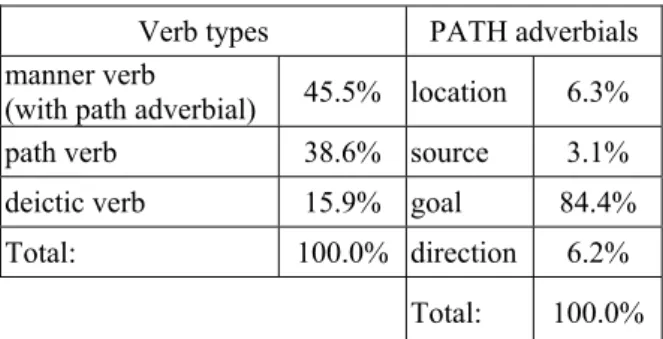
Slobin and Hoiting (1994) distinguished between boundary-crossing events and non-boundary-crossing events; the former would be described by path verbs and the latter by manner verbs. Similar results were also found in Naigles et al. (1998), with ten black-and-white line drawings of ordinary intransitive motion events and twelve colored dynamic videos of common intransitive motion events as stimuli. These findings suggest that the use of manner verbs is not a rarity. This is borne out by our narrative data: While the use of path verbs and deictic verbs constitutes the majority (54.5%) of all the 44 motion events in the L2 Spanish dataset, a substantial portion of the clauses comprise manner verbs and adverbial expression of PATH (45.5%). See Table 6. Finally, just as in the case of the other two languages, the rate of the occurrence of path adverbials is high (72.7%, 32 out of all the 44 clauses). GOAL, again, is the most frequently brought up component in Spanish narration.
Verb types PATH adverbials manner verb
(with path adverbial) 45.5% location 6.3%
path verb 38.6% source 3.1%
deictic verb 15.9% goal 84.4%
Total: 100.0% direction 6.2%
Total: 100.0% Table 6. Morphosyntactic expression of PATH in L2 Spanish
Regarding the concatenation of PATH elements, Slobin (2004: 244) found that the description of PATH components in Spanish typically requires separate verb clauses, so that “V-language writers in the sample almost never used a motion verb with more than one ground…. V-language writers and frog story narrators prefer to provide ground information in scene-setting descriptions rather than in clauses with motion verbs.” The statistics in Table 7 support the occurrence of less path information within a clause, as most of the clauses include merely one path element (72.7%).
1 path element 2 path elements 72.7% 27.3%
Table 7. Number of path elements per clause in L2 Spanish
In summary, the three languages spoken by native speakers have their own language-specific lexicalization and concatenation patterns in narrative discourse. L1 Mandarin speakers encode PATH primarily in a range of serial verbs comprising at least one path component and also utilize single manner verbs with path adverbials. Such typical patterns of usage are different from the common use of motion verbs with a path prefix, manner verbs, and path/deictic verbs in Russian, and also from the use of path/deictic verbs and manner verbs in Spanish.
The expression of PATH both lexically and adverbially is predominant and most of the speakers mention the GOAL component across the three languages. As to the number of path elements per clause, both Mandarin and Spanish prefer one element. In Russian, however, a significantly higher number of clauses convey two path elements – one in the verb and the other in a prepositional phrase. The next section examines the acquisition of Russian and that of Spanish by elementary and intermediate learners to understand the strength of preferences for expression of PATH in L1 on learners’ second language acquisition with respect to two levels of proficiency, and whether the acquisition of Russian and that of Spanish differ.
4 Clausal packaging of PATH in
learners’ L2 production: Spanish and
Russian
Given that Mandarin is a verb-serializing language, Russian a satellite-framed language, and Spanish a verb-framed language, how do
learners of Russian and of Spanish each develop their L2 in the presence of knowledge from two typologically different languages? Is there any difference in the L1 transfer, if there any, between these two groups of learners, and between the elementary and the intermediate learners in each language group?
4.1 Learner’s L2 Russian production
The Russian majors produced 51 PATH clauses; 40 of them consisting of path adverbials (80.4%). The learners did not use the PATH PREFIX+MOTION VERB pattern frequently, probably because of its language-specificity and grammatical optionality. See Table 8. For differences in the use of manner verbs and the use of path/deictic verbs, the chi-square value shows significant difference between L2 production at elementary level and that at intermediate level (X2=4.21, d.f.=1, p<.05). In
other words, elementary learners prefer manner verbs (60%) and intermediate learners prefer path/deictic verbs (58.0%). Nonetheless, the use of path adverbials is prevalent in L2 production, regardless of proficiency levels: 85% for elementary learners; 77.4% for intermediate learners.
Verb types Years 1 & 2 Years 3 & 4
manner verb 60.0% 32.3% path verb 5.0% 19.4% deictic verb 25.0% 38.6% path-deictic verb 10.0% 6.5% path-path verb 0.0% 3.2% Total: 100.0% 100.0%
PATH adverbials Years 1 & 2 Years 3 & 4
location 0.0% 0.0%
source 5.9% 12.5%
goal 88.2% 62.5%
direction 5.9% 25.0%
Total: 100.0% 100.0%
Table 8. Morphosyntactic expression of PATH in L2 Russian
The concatenation patterns do not differ between the two groups of Russian learners, as evidenced by the statistically insignificant chi-square value with regard to the distribution of one-path-element, two-path-element, and
three-path-element clauses (X2=2.64, d.f.=2, p<.05). See Table 9.
1 path
element elements 2 path elements3 path Years 1 & 2 70.0% 30.0% 0.0% Years 2 & 3 48.4% 48.4% 3.2% Table 9. Number of path elements per clause in L2 Russian
4.2 Learner’s L2 Spanish production
There are in total 46 PATH clauses in the L2 Spanish production, among which adverbials encoding PATH constitute 38 clauses (82.6%). The use of path/deictic verbs is predominant with no statistically significant difference between the elementary and the intermediate learners (X2=2.88, d.f.=1, p<.05). The occurrence of path adverbials is higher in the narratives of intermediate learners (89.3%) than in those of elementary learners (72.7%). Nonetheless, the GOAL component, again, is most frequently brought up in the storytellings, regardless of level of proficiency. See Table 10.
Verb types Years 1 & 2 Years 3 & 4
manner verb 5.6% 25.0%
path verb 50.0% 32.1%
deictic verb 44.4% 42.9%
Total: 100.0% 100.0%
PATH adverbials Years 1 & 2 Years 3 & 4
location 7.7% 4.0%
source 0.0% 0.0%
goal 92.3% 96.0%
direction 0.0% 0.0%
Total: 100.0% 100.0%
Table 10. Morphosyntactic expression of PATH in L2 Spanish
1 path element 2 path elements Years 1 & 2 33.3% 66.7% Years 2 & 3 35.7% 64.3% Table 11. Number of path elements per clause in L2 Spanish
The concatenation patterns are also consistent between the two groups of Spanish learners (X2=0.274, d.f.=1, p<.05). They
manifest a preference to express two path elements in a clause, 66.7% in elementary
students’ production and 64.3% in intermediate students’ production. See Table 11.
When comparing the production of Russian learners and Spanish learners, we found that the two groups of students acquire the two L2 languages in different ways. Learners of Russian at elementary level mainly use manner verbs while those at intermediate level prefer the path/deictic verbs. Levels of proficiency, however, do not affect the preference of learners of Spanish to use path/deictic verbs. Another difference lies in the quantity of path information: While learners of Russian mostly produce a single path element in each clause, learners of Spanish frequently produce two elements. Finally, the similarities between the learners of Russian and those of Spanish are found in the high occurrence of path adverbials and of the GOAL component.
5 Strength of L1 on second language
acquisition
Section 3 has shown that native speakers of L1 Mandarin, L2 Russian, and L2 Spanish utilize their own typical language-specific morpho-syntactic patterns in the expression of PATH of motion. In Section 4 it was demonstrated that the second language acquisition of Spanish is not in complete alignment with that of Russian. Based on the findings, this section will compare the patterning of L1 Mandarin, L2 Russian, and L2 Spanish to understand how Mandarin learners acquire the knowledge of a different linguistic system, and the strength of L1 preferences on Russian and Spanish majors’ second language acquisition.
Does learners’ L2 Russian pattern like L1 Mandarin or L2 Russian?
A lexicalization pattern commonly used in Russian is the co-occurrence of a path prefix and a motion verb, yet learners rarely use this optional language-specific pattern to express PATH. See Table 12. Regarding the choice between manner verbs and path/deictic verbs, native Mandarin speakers prefer to use manner verbs but native Russian speakers use more path/deictic verbs. These two languages influence learners in different ways: The preference for manner verbs along with PATH adverbials in elementary L2 production resembles L1, without a significant difference between Mandarin and elementary L2 Russian
(X2=2.02, d.f.=1, p<.05). A significant
difference was found between Mandarin and intermediate L2 Russian (X2=19.7, d.f.=1,
p<.05). The usage rate of path/deictic verbs is significantly higher on the part of intermediate learners.
Groups of
speakers Manner verb Path/deictic verb Path prefix+ motion verb
L1 Mandarin 82.1% 17.9% -- L2 Russian 33.3% 28.9% 37.8% Learners’ L2 Russian (Years 1 & 2) 60.0% 30.0% 10.0% Learners’ L2 Russian (Years 3 & 4) 32.3% 58.1% 9.6% Table 12. Lexicalization of PATH in Mandarin and Russian
L1 transfer is also found in the patterning of the concatenation of the path elements. Just like native Mandarin speakers, elementary learners typically encode one path element per clause, with no significant difference between the L1 and the L2 production (X2=2.26, d.f.=2, p<.05).
On the contrary, intermediate learners significantly mention two path elements in their narration (X2=16.3, d.f.=2, p<.05). See Table 13.
Groups of speakers 1 path element 2 path elements 3 path elements L1 Mandarin 82.8% 16.4% 0.8% L2 Russian 55.6% 44.4% 0.0% Learners’ L2 Russian (Years 1 & 2) 70.0% 30.0% 0.0% Learners’ L2 Russian (Years 3 & 4) 48.4% 48.4% 3.2% Table 13. Concatenation of PATH in Mandarin and Russian
In brief, the L1 effect is not consistent with respect to the two levels of proficiency: Elementary learners are more affected by their native language; the language produced by intermediate learners resembles the target language more.
Does learners’ L2 Spanish pattern like L1 Mandarin or L2 Spanish?
According to the narrative data produced by native Spanish speakers in Table 6, the use of
manner verbs with a path adverbial is nearly as frequent as that of path verbs and deictic verbs. Nevertheless, learners prefer to use path/deictic verbs. See Table 14. In other words, given the distribution of the frequency of manner verbs and path/deictic verbs, the significant differences between L1 Mandarin and the two groups of L2 Spanish (X2=37.0, d.f.=1, p < .05 for
elemen-tary learners; X2=28.4, d.f.=1, p < .05 for
inter-mediate learners) provide evidence that L1 Mandarin with its prevalent use of manner verbs does not affect learners’ acquisition of Spanish.
Groups of
speakers Manner verb Path/deictic verb
L1 Mandarin 82.1% 17.9% L2 Spanish 45.5% 54.5% Learners’ L2 Spanish (Years 1 & 2) 5.6% 94.4% Learners’ L2 Spanish (Years 3 & 4) 25.0% 75.0%
Table 14. Lexicalization of PATH in Mandarin and Spanish
Groups of
speakers element 1 path elements 2 path elements 3 path L1 Mandarin 82.8% 16.4% 0.8% L2 Spanish 72.7% 27.3% 0.0% Learners’ L2 Spanish (Years 1 & 2) 33.3% 66.7% 0.0% Learners’ L2 Spanish (Years 3 & 4) 35.7% 64.3% 0.0% Table 15. Concatenation of PATH in Mandarin and Spanish
With regard to the concatenation patterns, the production of the Spanish learners, different from that of the Russian learners, reveals an idiosyncrasy in the development of learners’ L2 language. As shown in Table 15, both Mandarin and Spanish native speakers tend to encode one path element per clause, either lexically or adverbially. L2 Spanish learners, on the other hand, mostly express two elements, one lexical and one adverbial. This preference for quantity is found to be the same for both elementary and intermediate learners. The significant chi-square values are: X2=22.8, d.f.=2, p<.05 for L1
Mandarin and elementary learners’ L2 Spanish;
X2=28.1, d.f.=2, p<.05 for L1 Mandarin and
intermediate learners’ L2 Spanish; X2=8.36,
d.f.=1, p<.05 for L2 Spanish and elementary learners’ L2 Spanish; X2=9.64, d.f.=1, p<.05 for L2 Spanish and intermediate learners’ L2 Spanish.
In brief, the L1 effect was not found in the acquisition of Spanish. Spanish majors’ morphosyntactic patterning conforms more to that in L2 Spanish, regardless of proficiency levels. Finally, the Spanish majors appear to be developing their L2 concatenation patterning in a way that is divergent from the target L2 Spanish. More data are needed to testify as to the nature of this apparently idiosyncratic development.
By examining the morphosyntactic and concatenation preferences in the L1 and L2 languages, the current study found that the distinct preferences in Mandarin, Russian, and Spanish affect learners’ second language acquisition of Russian and of Spanish in various ways. More importantly, the findings as a whole provide understanding of the different degrees of L1 influence on learners’ acquisition of L2 Russian and of L2 Spanish at two levels of proficiency. The question as to why Mandarin influences the acquisition of Russian rather than that of Spanish awaits future research.
6 Conclusion
Three typologically different languages were investigated in the present study: Mandarin, a verb-serializing language; Russian, a satellite-framed language; and Spanish, a verb-satellite-framed language. The acquisition of Russian and of Spanish as L2s was examined across the four years of study in college in Taiwan to understand the ways in which learners develop their L2 with knowledge from two typologically different languages, and the strength of L1 preferences for the expression of PATH within the clause on learners’ development of each of the L2s.
The findings of this study contribute to the understanding of the nature of the relationship between established L1 and L2 languages and learners’ emerging L2 languages, and to the linguistic conceptualization of PATH of motion in
the bilingual mind. The findings may also provide a base for language pedagogy and assessment.
In the future, learners’ written production in class should also be examined to obtain a more complete picture of learners’ L2 production and of L1 effect on second language acquisition. Moreover, the ways in which learners’ knowledge of a second language may affect
performance in their first language can be studied to understand more about learners’ multi-competence (Cook 1991; Brown and Gullberg 2013).
Acknowledgments
This research was funded by grants from The Aim for the Top University and Elite Research Center Development Plan, National Chengchi University. We would like to thank the reviewers for their insightful comments and helpful suggestions. All errors of interpretation are our own responsibility.
References
Aske, J. (1989). Path predicates in English and Spanish: A closer look. In K. Hall, M. Meacham, & R. Shapiro (Eds.), Proceedings of the Fifteenth Annual Meeting of the Berkeley Linguistics Society (pp. 1-14). Berkeley: Berkeley Linguistics Society. Berman, R. A., & Slobin, D. I. (1994). Relating events
in narrative: A crosslinguistic developmental study. Hillsdale, N.J.: Lawrence Erlbaum Associates. Brown, A., & Gullberg, M. (2010). Changes in
encoding of path of motion after acquisition of a second language. Cognitive Linguistics, 21, 263-286.
Brown, A., & Gullberg, M. (2011). Bidirectional cross-linguistic influence in event
conceptualization? Expressions of Path among Japanese learners of English. Bilingualism: Language and Cognition, 14, 79-94.
Brown, A., & Gullberg, M. (2012). Multicompetence and native speaker variation in clausal packaging in Japanese. Second Language Research, 28, 415-442.
Brown, A., & Gullberg, M. (2013). L1-L2
convergence in clausal packaging in Japanese and English. Bilingualism: Language & Cognition, 16, 477-494.
Chen, L. (2007). The Acquisition and Use of Motion Event Expressions in Chinese. München: LINCOM Europa.
Chen, L., & Guo, J. (2009). Motion events in Chinese novels: Evidence for an equipollently-framed language. Journal of Pragmatics, 41(9), 1749-1766. Cook, V. (1991). The poverty of the stimulus
argument and multicompetence. Second Language Research, 7, 103-17.
Huang, S., & Tanangkingsing, M. (2005). Reference to motion events in six western Austronesian languages: Toward a semantic typology. Oceanic Linguistics, 44, 307-340.
Slobin, D. I. (1996). Two ways to travel: Verbs of motion in English and Spanish. In M. Shibatani, & S. Thompson (Eds.), Grammatical constructions: Their form and meaning (pp. 70–96). Oxford: Oxford University Press.
Slobin, D. I. (2000). Verbalized events: a dynamic approach to linguistic relativity and determinism. In S. Niemeier, & R. Driven (Eds.), Evidence for linguistic relativity (pp. 107-138). Amsterdam: John Benjamins Publishing.
Slobin, D. I. (2004). The many ways to search for a frog: linguistic typology and the expression of motion events. In S. Strömqvist, & L. Verhoeven (Eds.), Relating events in narrative: Typological and contextual perspectives (pp. 219-257). Hillsdale, N.J.: Lawrence Erlbaum Associates. Slobin, D. I., & Hoiting, N. (1994). Reference to
movement in spoken and signed languages: Typological considerations. In S. Gahl, A. Dolbey, & C. Johnson (Eds.), Proceedings of the twentieth annual meeting of the Berkeley Linguistics Society (pp. 487-505). Berkeley: Berkeley Linguistics Society.
Talmy, L. (1985). Lexicalization patterns: semantic structure in lexical forms. In T. Shopen (Ed.), Language typology and syntactic description (Vol. 3, pp. 57-149). Cambridge: Cambridge University Press.
Talmy, L. (1991). Path to realization: a typology of event conflation. In L. A. Sutton, C. Johnson, & R. Shields (Eds.), Proceedings of the Seventeenth Annual Meeting of the Berkeley Linguistics Society (pp. 480-519). Berkeley: Berkeley Linguistics Society.