Dynamics carrier relaxation in InGaN/GaN Multiple Quantum Well
Structures
Shih-Wei Fenga, Yung.-Chen Chenga, y1y1 Chunga, c.
W.LjU', Ming-Hua Maoa, Chih-Chung
Yangli, Yen-Sheng Lin", Kung-Jeng Mab, and Jen-Inn Chyi'
(a) Department of Electrical Engineering and Graduate Institute of Electro-Optical Engineering,
National Taiwan University, 1, Roosevelt Road, Sec. 4, Taipei, Taiwan, R.O.C.
(b) Department of Mechanical Engineering, Chung Cheng Institute of Technology, Tahsi, Taoyuan,
Taiwan, R.O.C.
(c)Department of Electrical Engineering, National Central University, Taiwan, R.O.C.
Keywords: carrier dynamics, localized states, InGaN/GaN quantum well, carrier transportABSTRACT
We report the fast and slow decay lifetimes of multi-component photoluminescence (PL) intensity decays in the time-resolved photoluminescence measurements at the room temperature and a low temperature (12K). The fast decay component was essentially due to carrier dynamics, that is, carrier transport from weakly localized to localized states. Such a carrier transport process results in extremely long PL decay time (up to almost 120 ns) for strongly localized states at the low temperature. At room temperature, because of thermal energy and hence carrier escape from strongly localized states, effective lifetimes becomes shorter.
1. Introduction
Due to the low miscibility between InN and GaN, indium aggregation and phase separation (formation of either InN or GaN
clusters) occurred in InGaN/GaN quantum well (QW) rutu1 .Indium-richclusters in such a QW structure form the
localized states, which may trap carriers for radiative recombination2. Time-resolved photoluminescence (TRPL) results of InGaN/GaN QW samples have been reported by many groups3'4'5. However the decay mechanism in InGaN/GaN QWs has
not been well discussed yet, particularly the non-single exponential decay feature4'6. In this paper, we report carrier dynamics of three InGaN/GaN QW samples with varied indium contents. We conducted TRPL measurements at room temperature (RT) and low temperature (LT) at 12K with the same excitation photon energy. Different relaxation behaviors
including two-component and one-component decays of PL intensity were observed. We discussed the mechanisms, which are responsible for the observed carrier dynamics.
2. Sample Preparation and Experimental Procedures
The samples were grown in a low-pressure metal-organic chemical vapor deposition reactor. The InGaN/GaN multiple QW
samples consisted of five periods of Si-doped InGaN well with 3 nm in thickness. The designated indium compositions of the sample were 1 1, 16, and 2 1 % (samples A, B, and C, respectively). The Si doping concentration was 1018 cm3.The
barrier was 7 nm GaN. In each sample, the QW layers were sandwiched with a 1 .5j.tmGaN bufferlayer on a sapphire
substrate and a 50nmGaN cap layer. The growth temperatures were 1050 and 740 C for GaN and InGaN, respectively. The TRPL measurements were performed with a Hamamatsu streak camera (resolution 4.7 ps). Frequency-doubled optical pulses of about 100 fs width were generated from a mode-locked Ti:sapphire laser for excitation. The pumping photon energy of TRPL was 3 .1 eV (400nm). The samples were placed in the cryostat system to measure the low
temperature TRPL at 12K.
3. Experimental Results and Discussions
Figure 1 shows the temporal decay profiles of low temperature PL of sample B at different emission photon energy. The temporal behavior on the high-energy side shows a multiple-exponential decay with the fast and slow decays at the earlier
')Corresponding author; Phone: 886-23657624, Fax: 886-23652637, e-mail: [email protected]
Ultrafast Phenomena in Semiconductors VI, Kong-Thon F. Tsen, Jin-Joo Song, Hongxing Jiang,
and later times, respectively. The fast-decay component tends to disappear when emission photon energy is below a certain
value around 2.805eV. For the multi-exponential decays, we fitted the fast and slow decays with individual single exponential for the fast and slow lifetimes. On the other hand, a single decay profile was fitted with a single exponential. Note that the stretched exponential model with the parameter [4,6] cannot fit well the early stage of the decay profiles on
the high-energy side.
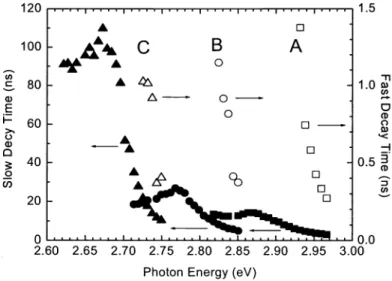
Fig. 2 shows the lifetimes of all the three samples at 12K. On the high-energy side, the fast decay time can be shorter than 300 ps. Such an order of magnitude of decay time can not be only attributed to radiative canier recombination. In
GaAs/AlGaAs multiple quantum-wells, the non-single exponential decay behavior was also observed7'8. It was attributed to
carrier transfer between free-carriers and the bound states. In our system, besides recombination such a short decay time is due to an additional process, i.e., carrier transport from weak-localized states to strong-localized ones. Therefore, the fast-decay component corresponds to canier recombination in weakly localized states as well as carrier transport from weakly localized states to strongly localized ones. Note that carrier dynamics includes carrier transport between different energy levels and different spatial locations. Such a process will disappear after a quasi-equilibrium state is reached. From Fig. 1 ,onecan see that this carrier transport process lasts for several ns. The decreasing trends of the fast-decay lifetimes, as shown by the empty symbols in Fig. 2, are reasonable because it is easier for carriers in the weaker localized states to relax down to stronger localized states.
As for the slow-decay or long-term decay component, carrier capture of a strongly localized state occurs in a longer time range. This lifetime shows a peak in each of the three samples. For Sample C, this lifetime can be as larger as almost
120 ns. Such a long lifetime is attributed to the quasi-balance of carrier decay due to recombination and net carrier supply due to carrier transport. Thus the decay slope could be considered to be the effective carrier lifetime for the interplay
between carrier decay and supply. In each sample, the decreasing trend on the lower energy side of the lifetime peak can be attributed to the relatively higher difficulty for carrier to relax into the deeply localized states. This result may be related to
state population distribution among localized states. At a low temperature, without thermal energy carrier relaxation into
deeply localized states might be difficult.
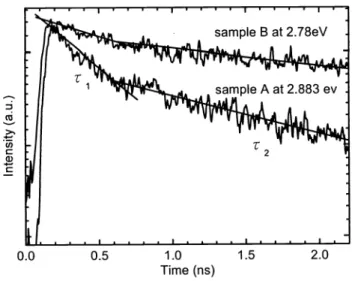
To study the effects of thermal energy, we also conducted RT TRPL. Two RT TRPL intensity profiles of two samples at two photon emission energies are shown in Fig. 3 .Thetwo-component decay with clear turning point in either profile can
be seen. We fitted our data with two-step exponential decay to obtain the fast decay time tj andslow decay time z2.The
slow decay time of the three samples are shown as functions of emission photon energy in the upper portion of Fig. 4. The decay time r2 increases with decreasing photon energy for each of all three samples. This is a typical property of the carrier localization model. The slow decay lifetimes can be regarded as mainly describing the recombination of localized excitons. Note that the comparison between Fig. 2 and the upper portion of Fig. 4 shows that the RT lifetimes are shorter than those of LT. This naturally results from the effect of defect recombination. Also, the monotonic variations of the RT results can be attributed to the fact that at RT it is easier to reach a quasi-equilibrium condition among all localized states because ofthe thermal energy.
For the fast decay part, r , on the high-energy side describes the decay rate of the combined effect of 1) carrier transport from weakly localized states to strongly localized states; 2) non-radiative recombination related to defects; 3) radiative recombination of carriers in weakly localized states. On the other hand, v jonthe low-energy side describes the
decay rate ofthe combined effect of 1) carrier escape from strongly localized states to weakly localized ones and defects via
thermal energy; 2) radiative recombination. Note that carrier escape means the net effect of carrier capture and carrier go-away. With the thermal energy, carrier escape results in insignificant increasing trend of the fast decay time with
decreasing photon energy. This is a difference between RT and LT results, as shown by the comparison between Fig. 2 and
the lower portion ofFig. 4. 4. Conclusions
In summary, we have demonstrated the fast and slow decay times of multi-component PL intensity decay in the TRPL measurements at both RT and LT. The fast decay was essentially due to carrier dynamics between strongly localized and weakly localized states. At room temperature, due to thermal energy and hence carrier escape from strongly localized states, effective lifetimes becomes shorter.
Acknowledgements:
This research was supported by National Science Council, The Republic of China, under the grants of NSC
90-21 12-M-002-052, NSC 90-2215-E-002-027, and NSC 90-2215-E-002-04l, also by Chung-Shan Institute of Science and
Proc. SPIE Vol. 4643 170
Technology.
References
[1] Y. S. Lin, K. J. Ma, C. Hsu, S. W. Feng, Y. C. Cheng, C. C. Liao, C. C. Yang, C. C. Chou, C. M. Lee, and J. I. Chyi,
Appl. Phys. Lett. 77, 2988 (2000).
[2] T. Hino, S. Tomiya, T. Miyajima, K. Yanashima, S. Hashimoto, and M. Ikeda, Appl. Phys. Lett. 76, 3421 (2000).
[3] H. S. Kim, R. A. Mair, J. Li, J. Y. Lin, and H. X. Jiang, App!. Phys. Left. 76, 1252 (2000).
[4] M. Pophristic, F. H. Long, C. Tran, I. T. Ferguson, and R. F. Karlicek, Jr., J. Appi. Phys. 86, 1114. [5]
Y.
Narukawa, Y. Kawakami, Sz. Fujita, Sg. Fujita and S. Nakamura, Phys. Rev. B 55, R1938 (1997).[6] J. —Chr. Hoist, A. Hoffinann, D. Rudioff, F. Bertram, T. Riemann, J. Christen, T. Fery, D. J. As, D. Schikora, and K. Lischka: App!. Phys. Lett. 76, 2832 (2000).
[7] H. X. Jiang, E. X. Ping, P. Zhou, and J. Y. Lin, Phys. Rev. B 41,12949 (1990).
[8] M. Kohl, D. Heitmann, W.W. R(.h!e, P. Grambow, and K. Pioog, Phys. Rev. B 41,12338 (1990).
2.80eV 2.78eV 2.76eV 2.73eV Time (ns)
.
.
.
0z
Fig. 1 Temporal decay profiles oflow temperature (12K) PL of sample B at different emission energy.
I20 1.5 A
0
100 E4c
B
A
A0
.E. 80A 2
.i.o
C,, cC,Lx—
0—S-E0
0
CD60
>
0—-
)
0 A ci) o Ao
40 o A0.5
:3 0)A
0
C/) 20 2.60 2.65 2.70 2.75 2.80 2.85 2.90 2.95 3.00 Photon Energy (eV)Fig.2 Decaytime of fast and slow components as functions of emission photon energy of all three samples at 12K.
>
(I)
C C
Fig. 3 Typical TRPL profiles and fitting curves of sample A and B at room temperature.
Photon Energy (eV)
Fig 4. Decay time r1 and r2 as functions of emission photon energy for the three samples at RT.
Time (ns) 30 25
A
A 20 15 10 5AC
oA
OB
(I) C Cl) CLC
I.,
l.l.I.I.I.l,.I.I.I.
4 32
Iz
0 B N CD B CD CD CO 0) CD CD 0)0
2.55 2.60 2.65 2.70 2.75 2.80 2.85 2.90 2.95Proc. SPIE Vol. 4643 172