I
NTRODUCTION
Wireless mesh networks (WMN) are rapidly emerging as a promising complement to existing broadband access infrastructures, because they extend wireless local area network (WLAN) access beyond traditional hotspot areas to enhance coverage and provide seamless mobility. In WMNs, all communications between mesh network nodes are over radio links. Applications of WMNs include backhaul for broadband access networks, metropolitan area mobile networks, and citywide surveillance systems.
TCP is the predominant technology used on the Internet to support upper layer applications with reliable data transfer and congestion con-trol services. Furthermore, it is expected that traditional TCP applications (e.g., Internet access) will continue to constitute the major traf-fic component during the initial deployment of wireless mesh networks. New TCP applications, such as media streaming and online games, will follow if quality of service (QoS) is satisfactory. The sharp drop in WMN throughput as a TCP
connection traverses a large number of wireless hops is now a major research issue [1, 2]. In a wireless multihop network, TCP packet loss may be caused by one or more of the following fac-tors:
• Transmission failure due to the high bit error rate of the wireless channel
• Channel access contention in the medium access control (MAC) scheme used
• Transmission failure due to channel inter-ference, known as the hidden terminal and exposed terminal problems
• Channel access contention between TCP data packets and TCP acknowledgment (ACK) packets when they share the same wireless resources
Unlike WMNs in which the mesh nodes are sta-tionary, in wireless ad-hoc networks, node mobil-ity is responsible for another possible cause of packet loss, namely, route failure. In this article, we focus on the issues described previously and discuss their impact on TCP performance in wireless mesh networks.
In the remainder of the article, we first review the properties of multihop wireless com-munication networks. We also consider the hid-den terminal and exposed terminal problems, each of which has a significant impact on the transmission performance of wireless mesh net-works. Then, using simulations, we analyze a TCP connection in a wireless chain network to illustrate how the problems affect TCP through-put performance. The analysis shows that the hidden terminal problem results in many trans-mission failures; thus, it affects TCP transmis-sions significantly. The exposed terminal problem, on the other hand, leads to inefficient channel use by adjacent mesh nodes and limits overall network throughput. After the analysis, we present a review of the literature about schemes that have been proposed to address the TCP performance degradation issue in multihop wireless networks. Finally, based on the spatial channel reuse property, we propose a multi-channel assignment algorithm. Its purpose is to construct a no-hidden terminal problem trans-mission zone in a wireless mesh network to resolve channel access contention and improve TCP performance.
A
BSTRACT
TCP is the predominant technology used on the Internet to support upper layer applications with reliable data transfer and congestion con-trol services. Furthermore, it is expected that traditional TCP applications (e.g., Internet access) will continue to constitute the major traf-fic component during the initial deployment of wireless mesh networks. However, TCP is known for its poor throughput performance in wireless multihop transmission environments. For this article, we conducted simulations to examine the impact of two channel interference problems, the hidden terminal and exposed terminal, on TCP transmissions over wireless mesh networks. We also propose a multichannel assignment algorithm for constructing a wireless mesh net-work that satisfies the spatial channel reuse property and eliminates the hidden terminal problem. The simulation results demonstrate the effectiveness of the proposed approach in improving the performance of TCP in wireless multihop networks.
W
IRELESS
M
ESH
N
ETWORKS
Li-Ping Tung and Wei-Kuan Shih, National Tsing Hua University
Te-Chung Cho and Yeali S. Sun, National Taiwan University
Meng Chang Chen, Academia Sinica
TCP Throughput Enhancement over
Wireless Mesh Networks
T
HE
P
ROPERTIES OF
M
ULTIHOP
W
IRELESS
C
OMMUNICATION
N
ETWORKS
C
ARRIERS
ENSE, T
RANSMISSION,
ANDI
NTERFERENCER
ANGESeveral wireless communication properties affect the efficient performance of a mesh network. First, because a wireless channel is a shared medium, a radio receiver may receive multiple signals from different sources at the same time. However, because of the power sensitivity set-ting, a device can decode only signals whose strength is greater than the configured sensitivity level. Three threshold parameters are important during the transmission and receipt of radio sig-nals: the carrier sense threshold (CSThresh), the receive threshold (RXThresh), and the capture threshold (CPThresh). When a station receives a radio signal whose strength is less than the CSThresh, it discards the signal as noise and regards the channel as idle. Otherwise, the chan-nel is set to the busy state, and any transmission from the station is deferred to avoid collisions. Three parameters are relevant to the configura-tion of a wireless mesh network topology: the carrier sense range (Rcs), the transmission range (Rtx), and the interference range (Rir). The carri-er sense range (Rcs) is the maximum distance over which a wireless station can correctly detect a signal or activity in a channel and thereby determine the state of the channel (i.e., idle or busy). A station can receive a packet successfully if the received signal power is greater than the RXThresh. The packet is then passed to the MAC layer. Thus, the Rtxdefines the area within which a station can correctly receive a packet if there is no interference from other stations. To deal with channel interference, a station uses the CPThresh to determine whether an incoming signal can be filtered out from other transmis-sions. The quality of the received signal is mea-sured by the signal to interference ratio (SIR), defined as the ratio of the power of the wanted signal to the power of the interference or unwanted signals in the channel. If the signal value is greater than CPThresh, it is captured as a valid packet; otherwise, the channel is set to the collision state. The received signal power is a function of the distance between the sender and receiver. The Riris the range within which a sta-tion in receiving mode experiences interference from an unrelated transmitter and thus, suffers collisions and packet loss.
T
HEH
IDDENT
ERMINALP
ROBLEM In wireless networking, the hidden terminal prob-lem refers to the scenario where a target wireless receiver cannot receive a packet correctly because of interference from other transmis-sions, whose source nodes are hidden from the node that sent the packet to the receiver. In other words, a hidden sending terminal is within the interference range of the target receiver, but outside the sensing range of the sender. For example, in Fig. 1, there is an ongoing transmis-sion, B, from node 3 to node 4. Since node 3 is outside the carrier sense range of node 0, thelatter is not aware of this transmission instance. If node 0 initiates a transmission instance, A, to node 1 during transmission B, node 1’s receiving signal will be corrupted by B because node 3 is in node 1’s interference range. The hidden ter-minal problem results in a collision of the signals at the receiver.
The hidden terminal problem in one-hop WLANs can be resolved by using a virtual sens-ing scheme, such as ready-to-send/clear-to-send (RTS/CTS) handshaking. In the multihop hidden terminal problem, however, the hidden nodes are not necessarily within the transmission range of the target receiver. For example, in Fig. 1, suppose node 0 successfully sends an RTS sage to node 1, which replies with a CTS mes-sage to warn its neighbor, node 2, about the impending transmission. Then, at the instant that node 0 is about to send the data frame to node 1, node 3 senses that the channel is idle and initiates a transmission instance by sending an RTS message to node 4. Since node 3 is with-in node 1’s with-interference range, its transmission will prevent node 1 from receiving the data frame successfully, resulting in a transmission failure. In summary, for any two transmission instances (s1, r1) and (s2, r2), the hidden terminal problem occurs if the following three conditions exist:
• Senders s1and s2are outside each other’s carrier sense range.
• s1is in the interference range of r2, or s2is in the interference range of r1.
• The transmission times of the two transmis-sion instances overlap.
T
HEE
XPOSEDT
ERMINALP
ROBLEM In a multihop wireless transmission environ-ment, the exposed terminal problem refers to the situation where a node within the carrier sense range of an ongoing transmission is prevented from making a transmission, even though its transmission will not interfere with the existing one. For example, in Fig. 1, there is an ongoing transmission B from node 3 to node 4. Because node 3 is within the carrier sense range of node 1, the latter cannot transmit because the channel ■Figure 1. The multihop hidden terminal problem.B
Transmission range of node 3 (250 m)
Carrier sense range of node 3 (550 m)
Carrier sense range of node 0 (550 m) 5 2 3 4 A 1. RTS 3. DATA
Interference range of node 1 (550 m)
2. CTS 1 0
is busy. However, we know the transmission from node 1 to node 0 will not interfere with transmission B. In fact, both instances could be transmitted successfully in parallel, but the exposed terminal problem forces the two adja-cent wireless links to share a single wireless channel, which results in inefficient channel uti-lization.
In summary, for any two transmission instances (s1, r1) and (s2, r2), the exposed termi-nal problem occurs if:
• Senders s1and s2are within each other’s carrier sense range.
• s1is outside the interference range of r2and vice versa.
• One sender is forced to defer its transmis-sion when another node is transmitting a packet.
P
ERFORMANCE
A
NALYSIS OF
TCP
OVER A
W
IRELESS
C
HAIN
N
ETWORK
To illustrate the causes of the sharp perfor-mance degradation of TCP in a multihop wire-less network, we simulated a single persistent TCP NewReno connection (i.e., a node that always has data to send) over an IEEE 802.11b wireless chain network using ns-2 [3]. The packet size is 1460 bytes. In the simulation, the trans-mission range is configured as 250 m, and the distance between two adjacent nodes is 200 meters. Thus, each mesh node can transmit data successfully only to its one-hop neighbors. The carrier sense range and the interference range are both set to 550 meters. Hence, a node can detect the transmission activities of nodes two hops away, and an incoming signal can be affect-ed only by transmissions that are at most two hops away. From the simulation results shown in Fig. 2, we observe that the TCP throughput is approximately inversely proportional to the size of the wireless transmission path. For reference, the throughput performance of the same sce-nario in a wired network with similar simulationsettings1also is shown in the figure. The TCP performance degradation can be ascribed to the hidden terminal and exposed terminal problems.
It is known that, in a wired network, TCP performance is inversely proportional to the packet loss rate and the round trip time (RTT) [4]. Packet loss triggers the TCP congestion con-trol mechanism, which slows down the data sending rate by reducing the size of the conges-tion window. Because of the self-ticking nature of TCP, the longer the RTT, the slower the con-gestion window will grow. For a TCP packet traversing a multihop wireless network, the RTT is the sum of the queuing delay, the probably non-zero head-of-line channel access delay, and the MAC layer transmission time at each wire-less hop. In multihop wirewire-less networks, trans-mission failures due to the hidden terminal problem increase the channel access delay and the queuing delay of a TCP packet more than such failures in a single hop WLAN. If the num-ber of MAC layer retransmissions exceeds a cer-tain limit, the packet will be dropped from the interface. Moreover, inefficient channel utiliza-tion between adjacent mesh nodes due to the exposed terminal problem further limits overall network throughput. This explains why TCP throughput performs poorly even when it tra-verses a few wireless hops.
Let the HTP (hidden terminal problem) fail-ure count denote the total number of transmis-sion failures caused by the hidden terminal problem; and the ETP (exposed terminal prob-lem) count be the total number of occurrences due to the exposed terminal problem. Figures 3a and 3b, respectively, show the relationship between TCP throughput and the HTP failure count and the ETP count for different numbers of hops on the transmission path. The HTP fail-ure count is approximately two orders of magni-tude greater than the ETP count. We further analyze the types of MAC frames involved in HTP failures, as shown in Fig. 3c. Note that a successful TCP data packet or TCP ACK packet transmission in the MAC layer requires success-ful transmission of an RTS message, a CTS mes-sage, a MAC layer data frame (MAC_DATA), and a MAC_ACK. Let RTSfailure_TCP_DATA and RTSfailure_TCP_ACK denote the total number of transmission failures of RTS mes-sages in TCP data packet and ACK packet trans-missions, respectively. Clearly, RTS message collisions comprise the major portion (73 per-cent) of the HTP failure (RTSfailure_TCP_DATA = 42 percent, and RTSfailure_TCP_ACK = 31 percent). This is as expected because an RTS message is always transmitted first to test the network. MAC_DATA transmission failures account for the remaining 27 percent of the HTP failure count. The simulation results indicate that although the RTS/CTS scheme largely resolves the potential hidden terminal problem during ACK packet transmissions, there is still a high probability the problem will occur during data packet transmissions. In fact, the results show that 99.87 percent of MAC_DATA failures involve TCP data packet transmissions.
Because of the cumulative acknowledgment scheme in TCP congestion control, the loss of a ■Figure 2. TCP throughput under different-sized wireless/wired transmission
paths.
Size of the chain network (hops) 2 0 0 0.5 Throughput (Mb/s) 1 1.5 2 2.5 3 3.5 4 4 6 8 10 Wired networks Wireless networks 12
1The capacity of the
wired links is set to the maximum throughput a TCP connection can achieve when transmitting over a single wireless link.
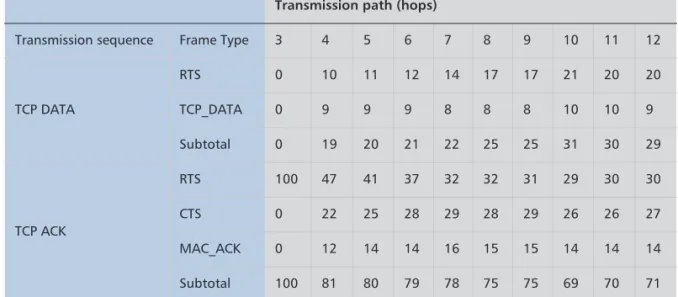
TCP data packet has a greater impact on end-to-end TCP throughput than the loss of a TCP ACK. This factor motivates us to investigate the collision behavior of TCP data packets. Table 1 presents a detailed analysis of the types of MAC frames that a TCP data packet collides with due to the hidden terminal problem. It is noteworthy that more than 70 percent of TCP data packet collisions are with TCP ACKs. Based on this observation, we suggest two possible ways to improve TCP performance in multihop wireless communications:
• Reduce contention between TCP data and TCP ACK packets.
• Reduce the number of outstanding TCP packets to alleviate channel contention between wireless links.
S
PATIALC
HANNELR
EUSEThe previous analysis shows that performance degradation due to the hidden and exposed ter-minal problems is location-dependent, that is, the problems occur within at most four contigu-ous hops. Our findings suggest that such degra-dation can be minimized through proper scheduling of channel reuse by wireless links. We formally define the notion of spatial channel reuse in a multihop wireless network as follows. Let e→s,rdenote a MAC frame transmission from node s to node r, and let d(s, r) denote the geo-graphic distance between s and r. Given two MAC frame transmissions, e→s1,r1and e
→ s2r2, e
→ s2r2is
said to have the single frame non-overlapping property with respect to e→s1,r1, if:
• The sending nodes s1and s2are outside each other’s carrier sense range (i.e., d(s1, s2) > Rcs).
• Both the receiving nodes r1and r2can cor-rectly receive frames without interference (i.e., d(s1, r2) > Rirand d(s2,r1) > Rir). Note that in the IEEE 802.11 standard, except for broadcast messages, a complete MAC layer transmission consists of the transmissions of a MAC frame followed by a MAC acknowledg-ment if the frame is correctly received by the receiver. Let es,rdenote a complete MAC layer transmission from s to r. Two complete MAC transmissions, es1r1and es2r2, are said to be inter-ference-free if any two nodes (sender or receiver) are outside each other’s carrier sense range, i.e., d(sx, ry) > Rcs, x, y ∈ {1,2}, x ≠ y. Hence, if two interference-free transmissions can be scheduled concurrently using the same channel frequency, they are said to have the spatial channel reuse property. By exploring this property between wireless links, a good scheduling strategy can be devised to scale up the network throughput per-formance.
P
ERFORMANCEI
MPROVEMENTA
PPROACHES Because of the hidden terminal and exposed ter-minal problems, TCP data and ACK packets may be required to make several attempts to tra-verse a wireless hop, which increases both the RTT and the TCP data loss rate. Moreover, if TCP data packets and ACK packets are routed on the same wireless path, they could contend for the same set of wireless channels. This rarely happens in wired networks because nearly all wired transmission links are full-duplex. Inmul-tihop wireless networks, however, such con-tention has a complex negative effect on the TCP self-ticking congestion control mechanism. Furthermore, if the TCP congestion window is larger than the capacity of the wireless pipe (i.e., the bandwidth-delay-product [5] between the source and the destination), severe contention between TCP data packets themselves would limit the congestion window size and affect the TCP end-to-end performance. Therefore, in the literature, many approaches for improving TCP throughput in multihop wireless networks focus on how to avoid or alleviate the hidden and exposed terminal problems. Generally, the approaches can classified into two categories: • Those that reduce channel contention
between TCP data and TCP ACK packets [6, 7]
• Those that reduce channel contention between TCP data packets themselves [8–10]
In the first category, [6] proposes a dynamic adaptive strategy that minimizes the number of TCP ACK packets in transit by using delayed
■Figure 3. Multihop TCP performance analysis: a) HTP failure count; b) ETP
count; c) MAC frame analysis in HTP failures.
Size of the chain network (hops) (a)
0 0 20,000
Number of occurences Throughput (Mb/s)
40,000 60,000 80,000 100,000 120,000 3.53 2.5 2 1.5 1 0.5 0 4 140,000 2 4 6 8 10 12
Size of the chain network (hops) (b)
0
Number of occurences Throughput (Mb/s)
3.5 1400 3 2.5 2 1.5 1 0.5 0 4 1200 1000 800 600 400 200 0 2 4 6 8 10 TCP thorughput TCP thorughput ETP count HTP failure count 12
Size of the chain network (hops) (c) 2 0 0 20 Ratio (%) 40 60 80 100 4 6 8 10 RTSfailure_TCP_DATA RTSfailure_TCP_ACK CTS MAC_ACK MAC_DATA 12 RTSfailure_TCP_DATA RTSfailure_TCP_ACK CTS MAC_DATA MAC_ACK
ACKs. In [7], on the other hand, separate paths are used for TCP data and ACK transmissions.
In the second category, [8] shows that an excessive number of packets on the fly intensifies the link-layer channel contention and packet loss problems as TCP packets move along a path. Based on the spatial channel reuse property, the authors show that, under ideal multihop channel scheduling with packets of identical size, maxi-mal TCP throughput can be achieved when the congestion window size is set to n/4 for large n (or an additional one or two packets for small n). In [9], to alleviate the hidden terminal prob-lem, the notion of a deferral interval is proposed whereby a node defers its next packet transmis-sion until the previously transmitted packet has traveled far enough along the path to avoid a collision. Similarly, in [10], an adaptive TCP layer data sending scheme based on the notion of four-hop propagation delay (FHD) is
pro-posed. The approaches in both of the previous categories are based on the spatial channel reuse property in multihop wireless transmission.
C
HANNELA
SSIGNMENT FORN
ON-HTP Z
ONES Based on the spatial channel reuse property, we now propose a channel assignment scheme that can construct a wireless mesh network in which certain zones are not affected by the hidden ter-minal problem. A non-HTP zone is defined as a set of wireless links in which each node is within the carrier sense range of every other node. Within a non-HTP zone, all mesh nodes share the same channel and use the same medium access control scheme, for example, CSMA/CA, for packet transmission.The steps of the channel assignment algo-rithm for constructing a mesh network with non-HTP zones are as follows. The algorithm is given three inputs: a wireless mesh network G, a set of available non-overlapping channels C, and maxWiLinks, the maximum number of wireless links allowed in a non-HTP zone. In each round, we randomly select an unassigned wireless link and check if there exists a feasible channel assignment for the link that satisfies both the spatial channel reuse property and the maxWiLinks constraint. If there are no feasible channels for the current link, we backtrack to the previous assignment and try to find another feasible assignment for the link. The algorithm terminates when every wireless link has been assigned to a channel; otherwise, it backtracks to the initial link because no feasible channel assignment can be found for the current link. There is a trade-off between maxWiLinks and the number of non-overlapping channels required to satisfy the spatial reuse property. In general, the larger the value of maxWiLinks, the greater the number of mesh nodes contending for the same channel, which means there is less throughput per node. A small maxWiLinks value, however, requires more non-overlapping chan-nels to satisfy the spatial channel reuse property. In practice, the choice of the maxWiLinks value depends on the wireless technology adopted to implement the mesh network.
Figure 4 presents a feasible channel assign-■Figure 4. Channel assignments for non-HTP zones in a wireless mesh
net-work, where maxWiLinks = 3 and |C| = 12.
■Table 1. Analysis of collision behavior in TCP data packet transmission failures caused by HTP (%).
Transmission path (hops)
Transmission sequence Frame Type 3 4 5 6 7 8 9 10 11 12
TCP DATA RTS 0 10 11 12 14 17 17 21 20 20 TCP_DATA 0 9 9 9 8 8 8 10 10 9 Subtotal 0 19 20 21 22 25 25 31 30 29 TCP ACK RTS 100 47 41 37 32 32 31 29 30 30 CTS 0 22 25 28 29 28 29 26 26 27 MAC_ACK 0 12 14 14 16 15 15 14 14 14 Subtotal 100 81 80 79 78 75 75 69 70 71
ment pattern for non-HTP zones in a wireless grid network, where maxWiLinks = 3 and |C| = 12. Note that there exists a base channel assignment pattern for a 5 × 10 grid network that repeats across the entire network. The pro-posed scheme enables an Internet service provider to easily extend its metropolitan or wide-area wireless network connectivity by incre-mentally adding a small wireless mesh network module. Figure 5 compares the average TCP throughput performance under the proposed non-HTP zone scheme with that of a single-channel case in a 5 × 10 grid network. Each mesh node arbitrarily establishes a TCP connec-tion with another node in the grid. There are 50 flows in total, and the sizes of the transmission paths range from one to ten hops. Our scheme clearly outperforms the single-channel case, which suffers from serious transmission failures due to the hidden terminal and exposed terminal problems, as well as channel access contention between TCP data packets and ACK packets.
C
ONCLUSION
Wireless mesh networking technology is current-ly receiving a great deal of attention because it offers a promising solution to the challenges pre-sented by next-generation networks. We expect that traditional TCP applications (e.g., Internet access) will continue to constitute the major traf-fic component during the initial deployment of wireless mesh networks. However, it is known that TCP performs poorly in a multihop wireless transmission environment.
Using simulations, we analyzed how the mul-tihop hidden terminal and exposed terminal problems affect TCP throughput performance in a wireless mesh network. Our analysis shows that the hidden terminal problem causes many trans-mission failures and thus significantly affects TCP performance. Although implementing the RTS/CTS scheme can reduce TCP data packet and ACK packet transmission failures by more than 70 percent, there is still a large number of TCP packet transmission failures. Nearly all such failures are due to TCP data packets colliding with TCP ACKs. Because the loss of a TCP data packet has a greater impact on end-to-end TCP throughput than the loss of a TCP ACK, TCP throughput drops rapidly when a packet must traverse a few more hops. Our analysis also shows that the number of transmission failures due to the hidden terminal problem is approxi-mately two orders of magnitude greater than the number of occurrence caused by the exposed terminal problem. The latter leads to inefficient channel use between adjacent mesh nodes and limits overall network throughput.
Based on our observations, we suggest two ways to improve TCP performance in multihop wireless communications:
• Reduce contention between TCP data pack-ets and TCP ACK packpack-ets.
• Reduce the number of TCP packets in tran-sit to alleviate channel contention between wireless links.
Our analysis also shows that performance degradation due to the hidden and exposed ter-minal problems between wireless links is
loca-tion-dependent and occurs within at most a four-contiguous-hops range. We formally define the notion of spatial channel reuse in a multihop wireless network. Based on this property, we propose a multichannel assignment algorithm that constructs a mesh network without the hid-den terminal problem to resolve channel access contention and improve TCP performance in wireless mesh networks. The simulation results demonstrate the efficacy of the proposed scheme.
A
CKNOWLEDGMENTThis work was partly supported by NSC under Grant 94-2213-E-002-065 and 94-2213-E-001-001.
R
EFERENCES[1] M. Gerla et al., “TCP over Wireless Multi-hop Protocols: Simulation and Experiments,” Proc. IEEE ICC ’99, Van-couver, Canada, June 1999, pp. 1089–94.
[2] G. Holland and N. Vaidya, “Analysis of TCP Performance over Mobile Ad Hoc Networks,” Proc. ACM MOBICOM ’99, Seattle, WA, Aug. 1999, pp. 219–30.
[3] Network Simulator ns-2, available at http://www.isi.edu/nsnam/ns/
[4] J. Padhye et al., “Modeling TCP Throughput: A Simple Model and Its Empirical Validation,” Proc. ACM SIG-COMM ’98, Vancouver, Canada, Sept. 1998, pp. 303–14.
[5] K. Chen et al., “Understanding Bandwidth-Delay Prod-uct in Mobile Ad Hoc Networks,” Elsevier Comp. Com-mun. J., Special Issue on Protocol Engineering for Wired and Wireless Networks, vol. 27, no. 10, 2004, pp. 923–34.
[6] R. de Oliveira and T. Braun, “A Dynamic Adaptive Acknowledgment Strategy for TCP over Multihop Wire-less Networks,” Proc. IEEE INFOCOM ’05, Miami, FL, Mar. 2005, pp. 1863–74.
[7] C. de M. Cordeiro, S. R. Das, and D. P. Agrawal, “COPAS: Dynamic Contention-Balancing to Enhance the Performance of TCP over Multihop Wireless Networks,” Proc. ICCCN ’02, Miami, FL, Oct. 2002, pp.14–16. [8] Z. Fu et al., “The Impact of Multihop Wireless Channel
on TCP Performance,” IEEE Trans. Mobile Comp., vol. 4, no. 2, Mar./Apr. 2005, pp. 209–21.
[9] A. Varshavsky and E. de Lara, “Alleviating Self-Interfer-ence in MANETs,” Proc. 29th Annual IEEE Int’l Conf. on Local Comp. Networks, Tampa, FL, Nov. 2004, pp. 642–49.
■Figure 5. Comparison of TCP throughput performance in a mesh network
with and without HTP zone-based channel assignment.
1 2 3 4 5 6 7 8 9 10
Length of the transmission paths (hops) 0 0.2 Average throughput (Mb/s) 0.4 0.6 0.8 1 1.2 1.4 Single channel
[10] S. M. ElRakabawy, A. Klemm, and C. Lindemann,” TCP with Adaptive Pacing for Multihop Wireless Networks,” Proc. ACM MOBIHOC ’05, Urbana-Champaign, IL, May 2005, pp. 288–99.
B
IOGRAPHIESLI-PINGTUNG([email protected]) received her B.Ed. degree in information and computer education from the National Taiwan Normal University in 2000, and her Ph.D. degree in computer science from National Tsing Hua University in 2007. She joined the Institute of Information Science, Academia Sinica, Taiwan, as a postdoctoral fellow in July 2007. Her research interests are wireless personal area networks, quality of service, wireless mesh networks, and performance modeling and evaluation.
TE-CHUNGCHO([email protected]) received B.S. and M.S. degrees from the Department of Information Man-agement, National Taiwan University, Taipei, in 2004 and 2006, respectively. His research interests are wireless mesh networks, voice over IP, and quality of service.
YEALISUNNYSUN([email protected]) received her M.S. and Ph.D. degrees in computer science from the University of California, Los Angeles in 1984 and 1988, respectively. In August 1993 she joined National Taiwan University and is currently a professor and chairperson of the Department of Information Management. Her research interests are in
the areas of wireless mesh networks, quality of service, Internet security and forensics, and performance modeling and evaluation. From 1988 to 1993 she was with Bell Communications Research (Bellcore, now Telcordia). MENGCHANGCHEN([email protected]) received a Ph.D. degree in computer science from the University of Califor-nia, Los Angeles in 1989 and then joined AT&T Bell Labs. Currently, he is with the Institute of Information Science, Academia Sinica, Taiwan, as an associate research fellow. From 1999 to 2002 he took additional responsibility as deputy director of the institute. His current research inter-ests include wireless MANs/LANs, networking with QoS support, and data and knowledge engineering. From 2000 to the end of 2003, he served as the chair of Standards and Technology Transfer group of the National Science and Technology Program for Telecommunications Office (NTPO).
WEI-KUANSHIH([email protected]) received his B.S. and M.S. degrees in computer science and information engineering from the National Taiwan University in 1982 and 1984, respectively and his Ph.D. in computer science from the University of Illinois, Urbana-Champaign in 1992. Currently, he is a professor at the National Tsing Hua Uni-versity, Taiwan. His research interests include real-time sys-tems, wireless and personal communication syssys-tems, Internet technology, and multimedia systems.