
The Multi-Image Copyright-Protection Scheme Based on Neural Network
6
0
0
全文
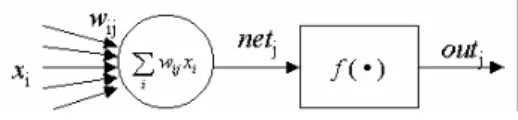
(2) Int. Computer Symposium, Dec. 15-17, 2004, Taipei, Taiwan.. this new technique are no losing of the original image and no needing of the original image when it extract watermark later. Because this new technique do not embed watermark into the image actually, we call it “No Loss Copyright-Protection Scheme”. Chin-Chen Chang et al. recently proposed two new techniques [6, 11] of “No Loss Copyright-Protection Scheme”. In this paper, we adopt the essence of the “No Loss Copyright-Protection Scheme”. Our Scheme do not embed watermark (copyright pattern) into the image actually. First, it use the Discrete Wavelet Transform (DWT) to catch the characteristic value of the protected image. Second, it use the capacity of learning and adapting of the BPN(Back Propagation Network) neural network [10] to learn the relationship between the protected image and watermark (copyright pattern). So, it can extract the copyright pattern later. Because our scheme do not embed copyright pattern into the image actually, it will not cause a loss of the protected image. It conquers the problem of image loss. So, our scheme is suitable for the high quality images (e.g. Medical images) and carton images which are hard to embed watermark. By the way, in the results of our experiments we verify that our scheme can extract copyright pattern more correct than the scheme in [4]. Finally, our scheme can handle multiple images one time, so it outperforms than the schemes used in [7, 8].. to produce corresponding result by testing data. In the experiments of this paper, we choose Back-Propagation Network (BPN) as the network type of Neural Network. Back-Propagation Network is the most typical network model of Neural Network. It is a supervised learning network which the learning rule of it is based on MSE (min square error) and it use the gradient steepest descent’s method to minimize error function. Back-Propagation Network adopts non-linear transformation function, so the values of it’s output are continuous values. The learning of Back-Propagation Network can be divided into two passes: the forward pass and the backward pass. The forward pass begins with input layer, it forward and calculate the output values of neurons layer by layer. The backward pass begins with output layer, it backward (layer by layer) the error of previous layer and revise the values of links. This is why this type of neural network is called Back-Propagation Network. The Fig 2 below is Back-Propagation Network with one hidden layer. The left four neurons is the input layer, the middle three neurons is the hidden layer and the right four neurons is the output layer.. Fig 2 The Back-Propagation Network with one hidden layer. 2. Neural Network and Back-Propagation Network (BPN). We choose the S type function as the transformation function. The S type function and it’s derivatives are the following:. Neural Network is a model developed by the research of men’s mental and activities of brain. From the network framework point of view, it is composed by many simple connected neurons. From the network function point of view, it is a new method of information process and calculation inspired by biology model. The below figure is the computation model of single neuron.. 1 1 + e − net f ' ( net ) = net (1 − net ) f ( net ) =. The algorithm of Back-Propagation Network is as below[10]: (1) Set the parameters of the network and random initial values of the links. (2) Input the training pairs: input vector X and target output vector T. (3) Calculate the input net value from input layer to hidden layer. net. h j. =. ∑. w ijh x i. i. Fig 1 Computation model of neuron. (4) Calculate the output net value of neuron j of hidden layer.. The process of Neural Network can be divided into two phases. The first phase is a learning phase and the second phase is a retrieving phase. In a learning phase, the major work of Neural Network is to decide parameters of system (e.g. Wij: value of link) by training data. In a retrieving phase, the work of Neural Network is. H. j. = f ( net hj ). (5) Calculate the input net value of neuron k of output layer. net ko =. ∑w. o jk. H. j. j. (6) Calculate the practical output values of. 721.
(3) Int. Computer Symposium, Dec. 15-17, 2004, Taipei, Taiwan.. neural network.. transformations. Step3: Learning the relationships between protected images and the copyright pattern by BPN network. Step 4: Saving the network parameters and the values of links. Step 5: Registration copyright of the protected images (by transformation the values obtained in step 4) on some certification center.. O k = f ( net ko ). (7) Calculate the errors of output layer. δ ko = (Tk − Ok ) f ' (net ko ) = (Tk − Ok )Ok (1 − Ok ) (8) Calculate the errors of hidden layer. δ. h j. = f ' ( net hj ) ∑ δ ko w ojk = H j (1 − H j ) ∑ δ ko w ojk k. k. (9) Update the values of links of output layer (η is the learning rate chosen by us). w ojk = w ojk + η δ ko H j (10) Update the values of links of hidden layer. w ijh = w ijh + η δ hj x i. 3.2 Phase II : Verifying Copyright of Some Image. (11) Calculate the error (mean square error). E =. 1 2. ∑. (T k − O k ) 2. Step 1: Input some image X which is planed to verify and suppose the copyright pattern is W. Step 2: Transfer the image through four times DWT transformations. Step 3: Input the result of step 2 to the learned neural network obtained by Phase I and Obtain the result W’. Step 4: To judge the copyright of the image.. k. (12) Repeat step 2 to step 11 until the convergence of neural network. 3. The Multi-Image Copyright-Protection Scheme The multi-image copyright-protection scheme proposed in this paper can be split into two phase. In the phase I, we do two jobs. First, we catch the characteristic values of the protected images and the attacked images of protected images by Discrete Wavelet Transform (DWT), see Fig 3. Second, we use the characteristic values of images as the input and copyright patterns as the output, so that the neural network can learn the relationship between them. In the phase II, we take some image (for verifying the copyright) as the input of learned neural network in Phase I. If the output of the neural network is clear copyright pattern, then we can judge the copyright of the image.. Fig 3. If the image X is the protected image, then the image W’ will be the same as copyright pattern W and if the image X is some attacked image on protected image then the image W’ will be very similar to copyright pattern W. But if the image X is not the protected image, then the image W’ will be not similar to copyright pattern W.. 4. Experiments and Discussions To verify the robustness of our copyright protection scheme, we do some experiments described below. In our experiments, we use a PC Intel 586(RAM 1GB) for simulating platform, and C++ 5.0 for writing interface program and MATLAB 6.5 as the neural network simulating tool. In the first group of experiments, we choose gray level image Lena (Fig 4), Airplane (Fig 5) and Tower (Fig 6) as our protected images and a Qoo (Fig 7) graph as the copyright pattern. In the second group of experiments, we choose gray level image Airplane (Fig 5) and Tower (Fig 6) as our protected images and a seal graph (Fig 8: Chinese words that mean the name of our department and our school) as our copyright pattern. The size of above protected images is 512 × 512 and the size of copyright pattern is 32 × 32. We use the PSNR value as evaluating standard of image quality of test image. The definition of PSNR value is as below:. The Lena original image and DWT of it. Detail and statements of our schema are as below:. 3.1 Phase I :Preprocessing and Learning We suppose protected images are 256 × 256 gray level images (8 bits per pixel) and copyright pattern is a 32 × 32 binary image (8 bits per pixel). Step 1: Input multiple images which are desired to protect. Step 2: Transfer protected images (including the attacked images of protected images) through four times DWT. PSNR = 10 log10. 722. 2 Emax × H X × WX ∑ [ xij − xij' ]2.
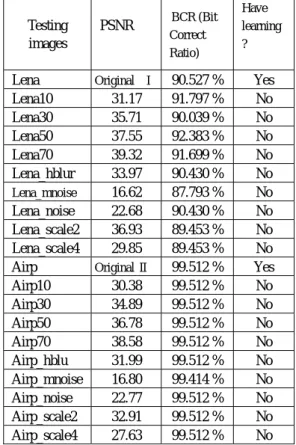
(4) Int. Computer Symposium, Dec. 15-17, 2004, Taipei, Taiwan.. The Emax is the maximum of every pixel in the test image. For example, the Emax is 255 in gray level image. The xij represents the coefficient of the pixel on (i,j) position of the original image and x’ij represents the coefficient of the pixel on (i,j) position of attacked image of original image. If the value of PSNR is bigger, then the similarity of these two images is higher. And if the value of PSNR is bigger then 30dB, the loss of the image is not aware by human’s vision.. We use the protected images Lena, Airplane and Tower as input training groups of neural network (the copyright pattern Qoo as output). Protected Images — Lena, Airplane and Tower Image JPEG Compression — ratios of compression are 10%, 30%, 50%, 70% (Lena10, Airp30, Tower50, Lena70…) Image Blurring — blurring the images (Lena_hblur, Airp_hblu, Tower_hblu) Image Noising — adding noise to images (Lena_noise, Airp_ noise, Tower_ noise…) Lena_mnoise represents adding more noise to the Lena image… Image Scaling — shrinking the images to 1/2 or 1/4 size and then enlarge to original size (Lena_scale2, Lena_scale4, Airp_scale2 …). Fig 4 Original Image І : Lena. The results of the first group of experiments are shown by Fig 9 and Table 1 bellow.. Fig 5 Original Image Ⅱ: Airplane. Fig 9 The example of verifying phase. (The left side of Fig 9 is the original copyright pattern, the right side of Fig 9 is the copyright pattern extracted form the verified image. The BCR value is 99.5%) Table 1 The result of using three original images and 27 testing images for verifying Fig 6 Original Image Ⅲ : Tower Testing images Fig 7 The first copyright pattern. Lena Lena10 Lena30 Lena50 Lena70 Lena_hblur. Fig 8 The second copyright pattern. For the quality measurement of extracted copyright pattern through Phase II, we use Bit Correct Ratio (BCR). The definition of BCR is as below. BCR =. ∑ ∑ WH i =1. Ww j =1. w(i, j ) ⊕ w (i, j ). W H × Ww. Lena_mnoise. BCR (Bit. PSNR. Correct Ratio). Original. 31.17 35.71 37.55 39.32 33.97 16.62 22.68 36.93 29.85. I. Lena_noise Lena_scale2 Lena_scale4 Airp Original Ⅱ Airp10 30.38 Airp30 34.89 Airp50 36.78 Airp70 38.58 Airp_hblu 31.99 Airp_mnoise 16.80 Airp_noise 22.77 Airp_scale2 32.91 Airp_scale4 27.63. '. × 100%. The w(i,j) is represented the coefficient on (i,j) position of original copyright pattern and the w’(i,j) is represented the coefficient on (i,j) position of extracted copyright pattern. The sign ♁ is represented the XOR operation. If the BCR value is closer to 1 (100%), the quality of the extracted copyright pattern is better.. 4.1 The first group of experiments. 723. 90.527 % 91.797 % 90.039 % 92.383 % 91.699 % 90.430 % 87.793 % 90.430 % 89.453 % 89.453 % 99.512 % 99.512 % 99.512 % 99.512 % 99.512 % 99.512 % 99.414 % 99.512 % 99.512 % 99.512 %. Have learning ?. Yes No No No No No No No No No Yes No No No No No No No No No.
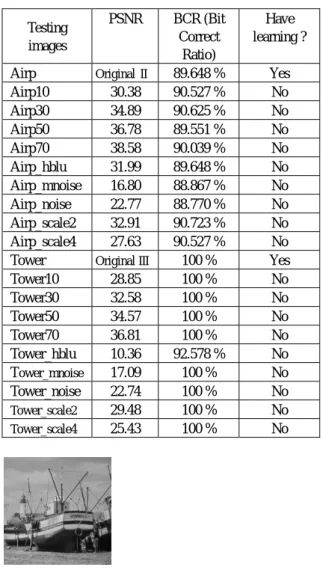
(5) Int. Computer Symposium, Dec. 15-17, 2004, Taipei, Taiwan.. Table 1 continue Testing images Tower Tower10 Tower30 Tower50 Tower70 Tower_hblu. PSNR. BCR (Bit Correct Ratio). Original Ⅲ. Tower_mnoise. Tower_noise Tower_scale2 Tower_scale4. 28.85 32.58 34.57 36.81 10.36 17.09 22.74 29.48 25.43. 92.090 % 91.113 % 91.895 % 91.895 % 91.797 % 94.141 % 90.625 % 91.699 % 91.602 % 91.309 %. Testing images. Have. PSNR. learning. Airp Original Ⅱ Airp10 30.38 Airp30 34.89 Airp50 36.78 Airp70 38.58 Airp_hblu 31.99 Airp_mnoise 16.80 Airp_noise 22.77 Airp_scale2 32.91 Airp_scale4 27.63 Tower Original Ⅲ Tower10 28.85 Tower30 32.58 Tower50 34.57 Tower70 36.81 Tower_hblu 10.36 Tower_mnoise 17.09 Tower_noise 22.74 Tower_scale2 29.48 Tower_scale4 25.43. ?. Yes No No No No No No No No No. 4.2 The second group of experiments We use protected images Airplane and Tower as input training groups of neural network (the copyright pattern Fig8 as output). The results of the second group of experiments are shown by Fig 10 and Table 2 bellow.. Fig 10 The example of verifying phase. Fig11. BCR (Bit Correct Ratio) 89.648 % 90.527 % 90.625 % 89.551 % 90.039 % 89.648 % 88.867 % 88.770 % 90.723 % 90.527 % 100 % 100 % 100 % 100 % 100 % 92.578 % 100 % 100 % 100 % 100 %. Have learning ? Yes No No No No No No No No No Yes No No No No No No No No No. Some image (boat) not registered. (The left side of Fig 10 is the original copyright pattern, the right side of Fig 10 is the copyright pattern extracted form the verified image. The BCR value is 100%) Table 2 The result of using two original images and 18 testing images for verifying (table can be seen in right upper side). Fig 12. The result of Fig 11 as an input. (The left side of Fig 12 is the original copyright pattern, the right side of Fig 12 is the copyright pattern extracted form the verified image – boat. We can not see clear copyright pattern in the right side.). 4.3 Discussion From the above two group of experiments, we can know that many test images (image processed from original image) can still be extracted clear copyright pattern. So, the multi-image copyright-protection scheme proposed in this paper is robust. Now we consider another condition, if we choose some image which is not registered before as a test input, will the scheme output some copyright pattern? To know the answer of the question, we take an image boat (see Fig 11) for the test. In this test, our scheme can not produce any clear copyright pattern.. Maybe readers still have a question. If some one stole the images of a company, and used the scheme proposed by this paper to set up the learning capability and verifying capability of these images. Then, how the judiciary decides who owns the images when there is a dispute of copyright. For solving this problem, Voyatz and Pitas[9] proposed the idea that to solve thoroughly the copyright protection problem of digital images, we must get the help from the trusted third party (e.g. certification center). So,. 724.
(6) Int. Computer Symposium, Dec. 15-17, 2004, Taipei, Taiwan.. Min-Shiang Hwang, "A block based digital watermarks for copy protection of images," in Fifth Asia-Pacific Conference On Communications /Fourth Optoelectronics And Communications Conference, Beijing, China, October 1999. [5] M.J. Tsai, K.Y. Yu, and Y.Z. Chen, "Joint Wavelet and Spatial Transformation for Digital Watermarking," IEEE Transactions on Consumer Electronics, vol. 46, no.1, pp. 241-245, Feb., 2000. [6] C.C. Chang, K.F. Hwang, and M.S. Hwang, “Robust authentication scheme for protecting copyrights of images and graphics,” IEE Proceedings-Vision Image and Signal Processing, vol. 149, no. 1, pp. 43-50, Feb., 2002. [7] Gwoboa Horng, Chun-Hua Chen, Bean-Cheng Tzeng, Tzung-Her Chen, “A Robust and losses Copyright-Protection Scheme Based on Neural Network”, Proceedings of the 7th Conference on Artificial Intelligence and Applications (TAAI2002), Wufon, Taiwan, pp. 579~584, Nov., 2002. [8] Gwen-Hua Chen , Gwoboa Horng, Tzung-Her Chen, "A Robust Copyright-Protection (Digital Watermark) Scheme Based on Neural Network," SCI 2003 Proceedings , Orlando, USA, vol. 15, pp. 345-349, July, 2003. [9] G. Voyatzis and I. Pitas, "Protecting Digital-Image Copyrights: A Framework,” IEEE Computer Graphics and Applications, vol. 19, no. 1, pp. 18-24, Jan.-Feb., 1999. [10] Jeng-Hung Chou, “Neural network ─ Theory and Implement”, Sung Gang Book Corporation, Taiwan, 1996. [11] C.C. Chang, and J. C. Chuang, “An image intellectual property protection scheme for gray-level images using visual secret sharing strategy,” Pattern Recognition Letters, vol. 23, no. 8, pp. 931-941, June, 2002. [12] S. Katzenbeisser, “On the Design of Copyright Protection Protocols for Multimedia Distribution Using Symmetric and Public-Key Watermarking,” in 12th International Workshop on Database and Expert systems Applications, Fifth International Query Processing and Multimedia Issues in Distributed Systems Workshop, IEEE Computer Society Press, pp. 815-819, Sept., 2001.. we add the step 5 in phase I for registration image copyright on some certification center. S. Katzenbeisser proposed another solution [12] for this problem, he suggest the use of public key technique. Through the encryption, no one else can steal the images and the copyrights of the images. Finally, we compare the scheme proposed in this paper to other related schemes. Table 3 The comparisons between schemes of image copyright protection. Robustness. Having loss ?. Number of images processed. Schemes in [1, 3] Schemes in [4, 6] Schemes in [7, 8] Scheme in this paper. good. Yes. one. excellent. No. one. excellent. No. one. excellent. No. multiple. 5. Conclusions In the results of our experiments, we verify that our scheme can resist many classes of attacks (or processes). Our scheme can extract the copyright pattern of high Bit Correct Ratio (BCR) in our experiments. And it will not extract the copyright patterns form the images which do not register in advance (see experiment result in Fig. 12). Because our scheme do not embed copyright pattern into the image actually, it will not cause a loss of the protected image. Finally, this scheme can process multiple images at one time, so it can reduce the cost of registration on some certification center.. Reference [1]. [2]. [3]. [4]. Chiou-Ting Hsu and Ja-Ling Wu, "Hidden Digital Watermarks in Images," IEEE Transactions on Image Processing, vol. 8, no. 1, pp. 58-68, Jan., 1999. Min-Shiang Hwang, Chin-Chen Chang, Kuo-Feng Hwang, "Digital Watermarking of Images Using Neural Networks," Journal of Electronic Imaging, vol. 9, no. 4, pp. 548-555, Jan., 2000. Chiou-Ting Hsu and Ja-Ling Wu, "Multiresolution Watermarking for Digital Images," IEEE Transactions on Circuits and System-II: Analog and Digital Signal Processing, vol. 45, no. 8, pp. 1097-1101, August, 1998. Chin-Chen Chang, Kuo-Feng Hwang and. 725.
(7)
數據

+2
![Table 3 The comparisons between schemes of image copyright protection Robustness Having loss ? Number of images processed Schemes in [1, 3]](https://thumb-ap.123doks.com/thumbv2/9libinfo/8917751.261981/6.892.137.439.293.510/comparisons-schemes-copyright-protection-robustness-having-processed-schemes.webp)
相關文件
For example, Ko, Chen and Yang [22] proposed two kinds of neural networks with different SOCCP functions for solving the second-order cone program; Sun, Chen and Ko [29] gave two
In this paper, we have studied a neural network approach for solving general nonlinear convex programs with second-order cone constraints.. The proposed neural network is based on
Wang, Solving pseudomonotone variational inequalities and pseudo- convex optimization problems using the projection neural network, IEEE Transactions on Neural Network,
Then, based on these systematically generated smoothing functions, a unified neural network model is pro- posed for solving absolute value equationB. The issues regarding
Random Forest: Theory and Practice Neural Network Motivation.. Neural Network Hypothesis Neural Network Training Deep
Idea: condition the neural network on all previous words and tie the weights at each time step. Assumption: temporal
This study proposed the Minimum Risk Neural Network (MRNN), which is based on back-propagation network (BPN) and combined with the concept of maximization of classification margin
To solve this problem, this study proposed a novel neural network model, Ecological Succession Neural Network (ESNN), which is inspired by the concept of ecological succession
