Proceedings of the 2004 IEEE
International Conference on Networking, Senring & Control Taipei, Taiwan, March 21-23, 2004
An Active Network-Based
Intrusion Detection and Response Systems
Han-Pang Huang* and Chia-Mmg Chang
+Robotics Laboratory, Deparbnent of Mechanical Engineering, National Taiwan University, Taipei, 10660, TAIWAN
TEUFAX:
(886) 2-23633875, Email: hanosneiantu.edu.m'Profmor
and
wrteswndence addressee. chduate student , .IAhmu - The w o r k sea&
ir
gdling m r e WortanI keaurc of increasing wnm ond n d w r kam& in meal yews. More rmd more scarity
nmh-m M intralrccd to p m u d f m n , attack, such a$
fvovoUs
and h i o n ddcdion sysicnsm.
This- pmposcr M &e nuwork pMgnuMling mddconpming m a mdidod w o r k , om'vc n m r k ~ . W S
the nods p m g n w m d k
e.
It &ph the cz&elMyork technobe. The mpomt-, s&e drproynrcnt nnd
senier updmc S C h a l K J
*
0" thiv tech-. The proposed infnrrion d&&n rmd m p m rspm
(IDW m s r o p m t a e * r m r h c f t s r l i n c M d m p o d a $ f ~ a s possiMc to reduce the dmnagc MlUday
inmrdus Itpmvids thr ebiMm of d a d o n , report and mponse The p m p e d pmtorvpr
spm
adope thenovel dma
Ddningu c h o l o p u p p o ~ ¶ VeMI machine to enhance the damlion fundion
1
Introduction
1.1
Objectives and Motivation
With the wide spnad of internet, various hds of Internet S w i c e s are developed, such as e-wmmem, web
Senics. Nehwrk d l yis M important issue. According
to the repart of Cmegie Mellon Uni-ity's Computer Emergency Response Team's (CERn I211 Coordination Center, the sophisficatlon of attacks is dramatieally increasing and ihere
are
usually several stager involved in one attack Thefirewalls
can protect a system from e x l e d mks, but it cannot keep up with new waeks. "he Urnusion detection system ( I D S ) is much more dynamic and m provide advance network defence mechanism. The previousIDS
ammoslly focused on passive model, which a i m at deledon and al-. The present IDS me static and lackthe
functionality of adding new featlrns and system monfigunng. Active networkis
a novel approach tonetwork mhitechne in which the nodes of the network perform
customized wmputafions on the messages nowing
lhrough them. This paper p m p s a scalable inrmsion detection system bssed on active neouork technology. The system can tailor the detection mechanism to the system and replace them with improved detection model. Current IDSs have limited mechanism and emphasize on detecting attacks.The delay tlme in alert and response may
atfen
the innuences af the attacks. Therefore, an automated intrusion response system combined withms
is necessary. Responding IIItime and taking appropriate measures eanmake the system immune to the
similar
?vpes of the attacks. Unlike the traditional network, which only passivelyuansfom
the packets, active network allows the network node to exende the mobile w d e within packets. The proposedIDS
combines distributed manibring and data mining approach (thraugh individual host and LAN monitors) with centralized data analysis (through the Intrusion Detection Center).1 2
Background Knowledge Survey
Active network l11l21l41ll0lll51[16][l7][l9][20] is a novel approach to network a r c h i m in network nodes,
such as switches, mufers, hubs, btidger, gatnuay. The
network nodes perform customized wmputafian for the packets flowing through them The swnfial featun of active network is the programmability. New network feature and service ean be dpmically added to the nehwrk
infmstmchm on demand. Note that active nemork is difiemt fmm programmable networks [5][7][9][14]. Active networks carry executable ccde within packets, d e p r o g m m b l e networks are focused on a standard programming interface for network wntrol. Intrusion detection is defined as the p m of monitoring and analyzing even0 w d
in a computer or network and
e resulfs to the adminimtor. The related research z z o n detection started in the early 1980s. Ithas
wntlnued through scveral major DARPA (and other GovemmeN) programs. In the b%uuung of the 19%, intrusion detection becomes red hot research topic and wmmercial IDS stvts to emerge.2
Active
Network-Based
Intrusion
Detection System Design
In
this paper, an i n m i o n detection system is designed for d d s t l n g both well-hwn and unknown intrusion behaviors. The system is composed of i n m i o n detection system ( I D S ) , management center and intrusiop detecfion center (roc). The relatiomhip mong them is shown in Figure I.I I
Figure 1 Swrce Management
If any surpeaed BCtlviner are dlseovered, the
correspndmg respomes of
ms
are
s ~ l t toIDC
for furthm analyaw Management has the abllily to dmpateh m c c agents The achve node can gel the des& services form the Management center according to Its needs and enwoment It also allows theIDC
to update the detechon model Thecenter is responsible for a subnd. Its duty is to deploy and update the services. It also maintains and monitors the
slam
of agents of the m k e d e .In addition
to handling ulese eMllls,IDC
provides the d d o n modules forIDS.
It dispatches them by applying mobile agent technology to satisfy the need of different environments.2.1
Intrusion Detection Systems
An i n m i o n deteman system
(IDS)
is composed of node manager, active network monitor, inmciion -on agent, inmciion response agent and m a r k managementagent. Each component will be introduced in the following d o n s .
21.1
Node Manager
A node manager is built in evey host to provide the m i e m agent execution enwOnment su that Vanous agents
can
paform tasks. Itcan be
seen asthe
ampemtion of ageno that residewithin
the agent-basedEE.
A node manager atnmonitor agents. It has to chcek any illegal aperations and 6Iter out malicious behaviors. The main function of a node manager is to m p t e all agents according to the host system information
2.1.2
Active Network Monitor
Active network monitor (ANM) wiuch plays the impomt role in the system is a programmable tratfic monitor. It captlnes packets from in- according to the
mer's i n s r m C n ~ ~ . It allows the remote manager to dynamically specify the packel type. The manager can gel the analysis results and know the quality and tratfic of lhe whole network.
2.13
Intrusion Detection Agent
The inmionW o n Igent (IDA) implements data mining methods, e.g., neural network and suppon vector machine. It is responsible for the
achlal
inmciion d W o n job. There areovo
kinds of intrusion deledon agents: servius-spccikd mode and general mode, as shown inFigurc3.
U
Figwe 3 Detection mode of Inrmsion Rsponw A g e
2.1.4 Intrusion Response Agent
Inbusion -me agent (IRA) j,like the commander in the
IDS.
It is an agent responsiblefor
w h t action shouldtake when receiving an event or npan. It sends out the response eommands based on the murity policy. For those locally intrusions, it takes responses such as -nf& the film rules, terminating the connections. If no existing
knowle&-e or d e s are available. it will pass the message to
mc
in astandard format.2.1.5 Network Management Agent
The purpose of the nsearch is to integrate the IDS and NMS in tams of audit s o w s , analysis techniques and deployment shategies. "his is the W n s i b i l i t y of the
Nefwork Management Agent (NMA). The inteption of intrusion deMlan and network management systems will provides a unified view of network security stam to the system manager and rignificanlly improve the d t y management.
~
2 2
Management Center
Management center is responsible for service deployment
and
service update. It is service-domain independent and performs tasks without knowing the detail of the service. It is like data warehouse which repositS the agents or mobile codes to deploy sewice. IfIDS
or other applications, such as video conference and network management, intend to update the agents, they jusl sendthe
mid or new edition agent to the management center. It will automatically rehieve the related client s o k modules according to its node information.
2.3
Intrusion Detection Center
decision will be made based on the infomation, such as attack type and priority. Basically, the i n m i o n will k sent to detection module to compare
with
p i o u s l y known patterns. If the discovered pattern is indislincl, it mayoeed
other nrpcrts to idenhfy whether they are normal pallems 01intrusion. If it is d l y an intrusion panem, it will update the knowledge base
2.4
Programming Model
The programming model is intended to support a
general class of active nemoorLs. It uses ANEP I31 as the
basic transformafion protocol. The pmgramming model adopts Java programming language in order to be operating
syslem independent. Besides, programs based on this model should be seamlssly executed on different execution ... environments. The user should inherit and o v d e the
ANPackI class of the model to define the unique
communieation mechanism. Therefore, every active packet can be cxemted to paform the --specified d o n on the active node which it has traveled through.
New
servicecan
be developed by mending the abshact classes of the progamuing model. The hasic mmponents of the nehwrk m i s s in the propmmhg model me Acme Poc*ez Acnve
service
h e ,
Ah'Appliutim and ANDoemonFigure 4illusb;ltes a general view of the pmgramming model.
A
new protocol and service can k dcvelopcd by extending ,4"ackef. ANEae, and Ah'Applicoflon. Basedon this
programming model, it provides a convenient way to c o ~ F t the active w o r k - b a s e d services. In ihis paper, the proposed active network-based inmciion d W a n system is baxd onthis
model.~ ~~. ~. ...
. . ... .... . . . ~.
Figure 4 Active network pmpmning Model
2.5
IDS
based active network Model
Based on
the programming model mentioned in the p i o u s section, the proposedIDS
is cons!m&. The user should overwite the A"acko, Ah'Bare and A h ' h l i O n to creafe and &@e cornpanems to p w d e the &&ce The ram classs based on Uus propammmg model are Dspockef, IOsBae, and lDsApp,carop*r n s p d e t
repmnted by the speoitied
IDS.
The servicerD
is used to i d e m senices In the pro@ prototypemS,
only thegeneral model and web service are defined. The web savice is the only implementation of service specified services. Services T p is used to spiry the envimnment of the www
services. The C l m
ID
is used to identify the type of this Ah'Paket. According to the above infomation, the variation mobile wde or just data The user can handle and execute it in the ANBare or Ah'4plicatim.IDSBase
part
can
be further processed. The variable pomon can be aIt mendsthe sbshan class Ah'iBare. The node manager has the implementation of the 1D-e. It pmvides the w n t m for the p r o w
that
inherits IDsqPPlicaion It also o ~ p o r l s the basic findion of the API far efliency.msApplcation
It extends the abmact class ANApplicaiton. Active network monitor, intrusion detedion agent, inmuion response agOa, and network management agent are all the implementation of the IDS4ppl;dm. For the emtian of the IDS4pplimtim. it should designate thc ANBare. Then, the node manager can monitor and contml these components by the default mechanism of the and Ah'4p1;cdim Each component can easily commlrmcate with other wmponents to perform !risks
2.6
Protocol
Several protocals are used in our proposed prototype system. These protocols implemented for intemperability are described in the fallowing d o n .
O A N E P
The Adive Network Encapsulation Protowl
(A")
[31 is defined for interopability. TheANEP
header
format is shown in Figure 5 .The Intrusion Deteaion Mssage Exchange Formaf (lDhEF)[6] is M Fxtcmible uvkup Language (XML.) Dacwnent Type Defition
(om)
developed by the Inmuion Detedion &change Format Working %up (IDWG) [22] of the Internet Engineering Task Farce (IEIT), which is an El? working group aims at defining common data f o m t s and exchanging protocals far Lnformationsharing among h i o n detection and response systems, and management system.
2.7
Intrusion Responses
Passive Response
Passive responses of the
IDS
are used to notify the proper authority. Theycan
provide usefulinfomation
to the manager. Sweral passive responses are used in the proposed prototype system and will be described as fallowed.arm
are the mponses adopted in thems.
ney inform usm when attacks are detected. They provide the detailed information in the alann message about the events,such as the s o w and target
IP
addresses of theattack
the suspicious activities, and the event priority.Active
Responses
Active IDS respanses are automated actions taken when the wmsponding suspicious behavior is detected. In
general, the
mss
will produce plenty of false a l m s . The false alm will waste systemreso-
and cause packet loss when the n m o r k traffic overloads. The prototype system will gatha the infomaion about the suspicious target and intluder hosts by increasing the sensitivity of damion. The additional information can help resolve the detection of inmuions. Anothm adive response is to stop the attack in p r o w s by bl-the
subsequmt access of inlmder. The p m t o w system resides the t q e t hosf will discaMed all the connmim from the inmden, and notifies the routers and firewalls to blwk the nehvorkpack& from
the
atfacker When attacks occur, it is import to respond as fast as possible to reduce damage. The pmtotype ~ y s t e m will h-dee the inmder It will notify and update the active node services to isolate the lrmuder. TheIDS
system will follow the policy to take action according tothe
eveat. The pro@ prototype system repam the system mhu to the oetwork management system. The IDS contains the netmrk management agent that can send S N M P traps and messages to post alarm and alerts to the eenhal nawork management consoles. Hence, it is easy to d d m the abnormal events and repart to $e manager.0
15 16
31
Version
I
Flag
I
Type
ID
1
I
ANEP Header Length
[
ANEP Packet Length
[
I
Payload
I
F i m e 5 Active Network Enca~sulatian Rotoeol
(A")
header f&nat
2.7.1
Deployment Scheme
The framework provides the flexibility and convenience far m i c e deployment. It adopts mobile agent
technology to construct the active network-based services. Each m i c e can negotiate to decide the format of the protacol and the parametes of the spsitied services. The deployment steps are r e p r e d below:
Step]: The node manager apdtes the mobile agent
according to the user configWafion and system
environment.
Skp2: The designed mobile agent is sent to the management colter. The mobile agent negotiates with the management center to get the specific
service.
The management colter whioh is respansible far providing services can dispatch the appropriate mobile agents to the client awarding to the infomation carried by the previous user's mobile
agolt.
When the mobile agenb arrive at the client host and reside into the node manager, they begin to
p e h r m the assigned tasks or m i c c s . Besides, they can communicate with the predefined protocol.
Step 3:
Skp4:
2.8
Service Update Scheme
Management center deploys the miw according to the user's demand and save the related information. When it is necessary to update the Agent versioc the Management
Center can &eve the s o hmadulc fmm other s m m
and check the databare. Then, the m e r search- the Management Table by wmponding System
m,
Servicem,
and Service Type to 6nd out the agent and its position to update the module.3
Modeling and Methodology
3.1
Detection Models
The general model deals with the general sitcation and is independent of the System environment. The service speoifed model is for the s p i t i e d services. The attack approach of the IIS is quite diffeKm fmm Apache. If the host daes not have the web m e r , it is unnsessary to consttnlct the web attack detection services. The
IM:
will prepare theweb mhuslon detmian Of three different e d l h O N (nS,
Apache and others)
3 2
General Development Procedures
32.1
Data Format
General Model llstedbelow I 2 Tmebasedfeahlrer 3 C o ~ e c t i o n based features Service Specified ModelIn case of m e e spauied model, oniy the content of the WMCC~OIIS are w n m e d The data format IS only w ma b u t keywords shown m Table 1 and Table 2
Three groups of feahlres defined by KDD Cup are Basic featuRs of mdivldval TCP W M ~ C ~ O ~
Table 1 General Keywords of WWW Server Specified
~~~~~
System,
winut,
Html
,GET,
HEAD, Host,
m ,
scripts,
www, Exe, Couunection, Close,
Accept,
DLL,
ns,
MICROSOFT,Content,Seer,Ran
Table 2 Selected Individual b i o n Kevwords
In!msion
Keyword
WEB-IIS ISAPI .ida
1
Ida,
GetTickCouut,
I
attempt
I
LoadLibraryA
EXPERIMENTAL.
1
~ ; I I S .asp@"
1
Smartsaver,
:
;
a
1
overtlow attem
WEB-IIS
cmd.exe Lwrite, msadc,cmd
access
WEB-MISC
crossmute.
buffer MSOFFICE9
WEB-MISC
v2 root.exe access
3 2 2
Data preprocessing
General Model
The five-fold mss
validation
ts used mthe
timnmg dataset to find out Wtuch parameters wiuch have better performanceS e m c e
Specified
ModelEvery WM~CIIO~I betwea the diad and sewer can be newd as a d-ent Thm the text c a t e g o m m ldm~que uses the keyword as the farmre to represent the wnnahon So cach wnuahon can be ccded as a feahlre
v ~ a r dcpmdmg on the w n t a d 11 w n m the keyword h a m the feature llst In the service specmed model of WWW atrack, keywords are selcaed as features to represent every WMCChOn
Featum Selection
The word features mms form two pans: basic w m o n words and keywords h m intnrsion. Twenty words are
selected to rep-nt these kinds of features. Finally. the last keywords are selected according to the I D F ~ , ~ ) . The selectedmethodisbasedanthe
IDF(W,,d)
function.D w m = w D F ~ ~ ~ F ( K $ (I) Here,
w;
is L e keyword. ~p(w,)represents the number ofC O M ~ ~ ~ ~ O W hat the word
W,
occurs in the total number ofWining COnnFctions. ~ ~ ( ~ y , d ) r e p r e s e n t s the number of c o n n e ~ t i o ~ Ulat the word
w;
occurs in the speciiied inhusion. Intuitively,the
inverse document frequency(JDF)
of a word is low if it occurs in many C O M S t i O n S and ~ c c u r sonly few limes in the i n w i o n d
.
It is the highest one if it mum in few total connections and o m u s only everyi n w i o n d
32.3
Detection Algorithms
Different detection models are implemented by the
development procedure described in the previous Wenon. The delection algorithm lists below.
Stcpl: ReCnvenetwnk packetsofwnneztions.
Step2 For each detection model, prepmcess the packets to featme yecton according to the detection matel profile.
Stcp3: Classify t h e s specified feature vectors using data
mining algorithm such a.v support vector machine.
Stcpl: If the i n w i o n is idenlified by the service specified inhusion detection agent the relaled i n f o d o n will forward to Urnusion response apent. The intrusion response agem will handle the event.
4
Experimental Results
In this Wenon, we try to campare the differenl data mining mahods and data pnmssinp techniques that are implemented in IDC for wnshucting the detection model.
4.1
Performances Measures
Some expcnments made for verification of accunq (general
and
senice specifled detection model).Firsf
we try to analyze the DARF'A KDD Cup 1999 dataand
compare the result with the champion. Second, the proposed service speciiied is venfed by accuracy and false alarmme.
We use different data mining methods such as neural nelwokand
support vector
machine
to wmparethe
results. The SVM kernel adopts the LlBSVh4 -a simple and easy-t+use support vector machine tml for classification [23].4 2
Experimental Resolts
Geueral model
wmpared to the Bagged Boasting [24]-the winner of the
KDDCUP. In summary, the final prediaor was an ensemble of 50x10 C5 decision mes [XI. The SVM is relatively -nsitive to the size of the damel and is less independent of dimensionality of feature space
[SI.
Therefore, there are some experiments made by using SVM [I 11[121[131 to IDS. The experiments show high accuracy and low 'mining lime. Although it has m e n d o u s high accu~dcy, the result can not wmpan with thechampion. Because it remanges the sourced a m the new datasct only has two classes: intrusion and normal. It does not imply that the SVM can not solve the multiclass problem. Hence, some nperkents are wnducted by applying SVM to the KDDCW multi-class
a d .
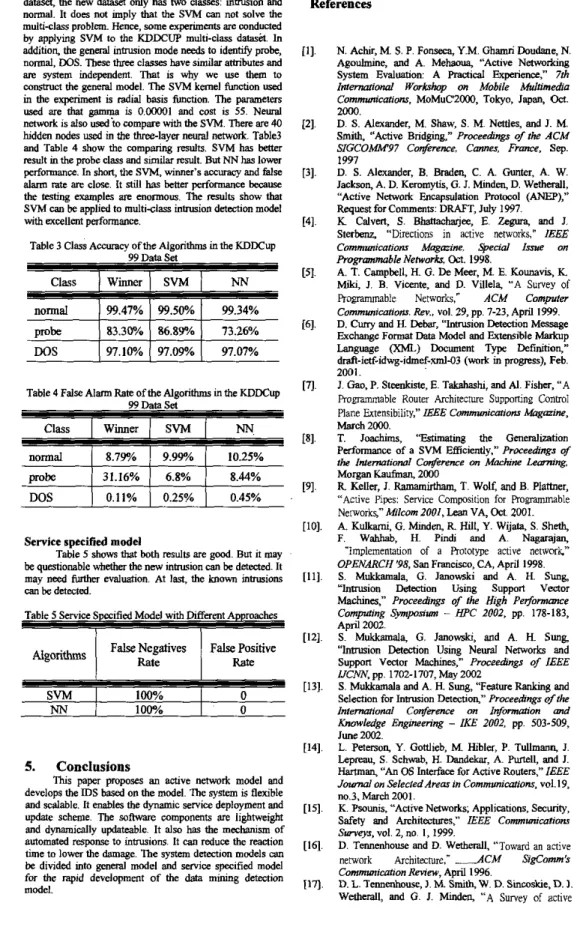
In addition, the general intrusion mode needs to iden@ probe, normal, D O S . These three clssses have similar attributes and am system indepndent lbat is why we use them toeonstruef the general model. The SVM kernel function used in the experiment is radial basis funcum The m e t e r s used are that gsmma is 0.0XQI and cost is 55. N e d network is also usedb wmpare with the SVM. There are 40 hidden nodes used in the thw-layer neural network. Table3 and Table 4 show the wm- results. SVM har better result in the probe class and similar result. But NN has lower performance. In short, the SVM, winner’s a e c w and false
alarm
rate are close. It still has better perfommce because the testing examples are enonnous. The results show that SVM cao be applied to multiclass inmion d e t d o n model with excellent perfomance.Table 3 Class Accuracy ofthe Algorithms inthe KDDCup
probe
1
83.30% 99 Data Set classI
winner
I
SVM
I
86.89%I
73.26% normalI
99.475.I
99.500/.I
99.345.WS
97.10% 97.09% 97.07%Table 4 False Alarm Rate of the Al~orithms in the KDDCuo
Class
I
winner
1
SVMI
NN8.7907 9.99% 10.25%
31.16% 6.8%
8.44%
0.11% 0.25% 0.45%
Service specified model
Table 5 shows that both results are good. But it may be quwtomble whether the new i n m i o n cao be detected. It may med further evaluation. At last, the known mmions can be detected
tugorithms
SVM
I
100%I
0
NN
I
100%I
05.
Conclusions
l h s paper propass an actwe network model and develops the IDS based on the model ?he system IS flexlble and scalable It enables the dynarmc Y N U deployment and
update scheme The soffware components are Ir&twe,ght and dynamically updateable It also has the m s h a m m of automated response to mtrusmm It cao reduce the m a i o n
m e to lower the damage The system detection models CM
be divlded mto general model and S ~ N I C ~ specified model for the rapid development of the data mmmg detection mode1
References
N. Achir, M. S . P. Fonseca, Y.M. G h d Doudane, N. Agoulmine, and A. Mehaoua, “Active Nehvorldng System Evaluation: A Practical Experience,” 7th Intemikmd Workshap on Mobile Mulrimeda Contmmicatim, MoMuCZOOO, Tokyo, Japan, ocf.
zwo.
D. S. Alexander, M. Shaw, S. M. Nettles, and J.
M.
Smith “Active Bridging,” Prmeedings of the ACM S I G C O W 9 7 Co+me, C m a , Frame, Sep 1997
D. S. Alexander, B. Braden, C. A. Gunter, A. W. Iaelrson, A. D. Kemmytk, G. J . Minden, D. Wetherall, “Active Netwok Encapsulation Pmtoool (A”): Request forComments: DRAFT, July 1997.
K Calven, S. Bhattachaqee, E. 2 , s ~ and I. S t e r k “Duections in active networks,” IEKE Commrmiwtiom Mqmim, S@dd
Lwe
anFrogrmmable Neworks On. 1998.
A. T. Campbell, H. G.
De
M m , M. E. Kouaavis, K Mki, 1. B. Vicente, andD.
Villela, “A Surveyof
Rogmmable Networks.” ACM Compfer Communiwtiom. Rev., vol. 29, pp. 7-23,April 1999.D. Cuny and H. &bar, ”Intrusion Detection Message Exchange Format Data Model and m i b l e u v k u p Language @ML) Document Type Defstion,” draft-ietf-idwg-idmef-d-03 (work in progress), Feb.
2001.
1. Gao, P. Steenluste, E. Takahashi, and Al. Fisher, “A R o m a b l e Router ArdutecIure Suppotting Contml Plane Extenaibili%“ E E K CommunrUmOnr Ahgazim, March Z O O .
T. Joachims, ‘F&matmg the Generalization P e r f o m c e of a SVM Efficiently,” Prmedings of
the INemofom~ c‘wfe-e on Moehrne Le&”g, Morgan Kaufma% 2000
R KeUer, I. Ramamirtham, T. Wolf, and
B.
Platlner, “Active Pipes: Service Composition for Pmgrammable Nework~”Mik0m 2001, Lean V& On. 2001. A. Kulkami, G. Minden, R Hill, Y. Wijata, S. Sheth, F. Wahhab, H. Pindi and A. N-jan,“implemenmtion of a FmtotyW active netwok“ OPENARCH ‘98, San Francisco, CA, April 1998.
S. Mukkamala, G. Janowski and A. H. Sung, =Inmion Detection Using Suppmt Vector Machines,” P m e d n g s of he High Peffommze Cornpuling svnrpo.ilmr - HPC 2002, pp. 178-183, April 2002.
S. Mukkamalq G. Janowki, and A. H. Sung.
“Intrusion Detection Using Neural Neiworks and Suppan Vector Machines,” Prmedngs of IKKE UCW, pp. 1702-1707, May ZOOZ
S. M u k k d a and A. H Sung, “Feature
Ranking
and Selection for Inmion D e t m i q ” Proceedings of the Intemalional cof!ferme 0” 1”f-On rmdKMwledge Engineering - IKE 2002. pp. 503-509, lune 2002.
L. Peterso% Y. Gofflieb, M Hibler, P. Tullmmn. 1.
L e p w S. Schmb, H. Dad&, A. PURell, and I. Hartman, “An OS Interface for Active Routen,”lEEE
Jamrol on SelecledArear in Commtmicmions, vol. 19, “0.3, March 2001.
K. Psouis, “Active Network Applications, Security, Safety and A r c h i t a s , ” E E E Commwriwtiom S w y s , vol. 2, no. I , 1999.
D. Tennenhoura and D. Wetherall, “Toward an active network ArchitecNre,” L C M SigComm’s Comm~icalion Mew, April 1996.
D. L. Tennmhouse, I.
M
Smith,W.
D. Simskie, D. I. Wetherall, and G. I. men, “A Survey of activenetwork Research” IEEE C m m i a t i o n r Masm.ne,
val. 35, no. I, pp. 80-86, J a n 1997.
[MI. 0. Vigna and R A. Kernern, ’WetSTAT: a neouork-based lnrmsiandetecdon approach,” Proceed”@ of l e 141h CompUrer Secwily D. I. Wetherall and D. L. Tennenhausc. ‘Towards an active network Architecture”’, C o m p m CommuniuUionReview, pp. 5-18, April 1996.
[ZO].
D. J. Weherall, U. Lcgedza, and 1. Cuttap,“htmducing New Intanel Services: W h y and How,” ffiEENetwork.M~garine, July 1998.
[21]. C m T mrdination center, hnp: //wwwefl.orp/
[U]. hrmsion DeMlon Exchange Format (idwg), hm:/iuww. r e r l o r P l n r m l . c h o r r e r ~ ~ ~ ~ ~ ~ i ~ ~ html
[23]. L I B S W - A Library for Suppal Vector Machines, h n p : / / ~ . e s i e . m u . e d u . t w / - c j l ~ i b s v m i m
[%I.
Wmmg the KUm Classiiication Cup,http:/hvwwai.univle.ac.at/-bemhardlkddcup9
AppIicmionr confeeenee, pp. 25-34.199s. [19].