Hedonic Pricing Analysis of DSL Internet Services in the UK
Eugenia Y. Huang, Department of Management Information Systems, National Chengchi University,64 Sec.2, ZhiNan Rd., Taipei 11605,Taiwan (R.O.C), 886-2-29387348, [email protected] Houn-Gee Chen, Institute of Technology Management, National Tsing Hua University,
101, Section 2 Kuang Fu Road, Hsinchu 30013, Taiwan (R.O.C.), 886-3-5742449, [email protected] Louis Y. S. Lo, Department of Management Information Systems, National Chengchi University,
64 Sec.2, ZhiNan Rd., Taipei 11605,Taiwan (R.O.C), 886-2-82373462, [email protected]
Abstract: The DSL services in the U.K. currently account for 67% of market share, which is double of that of cable services. This paper focuses on identifying the key explanatory characteristics of DSL services that govern the pricing. Hedonic approach was followed to select the set of explanatory variables; then Box-Cox methodology was employed to determine the appropriate data transformation that produced the optimal model fitting. Four explanatory variables are identified following a multivariate regression; they are the download speed, the number of dynamic IPs, the number of email accounts, and the download limit per month.
INTRODUCTION
Internet has forever changed many facets of human activities. The competitiveness of businesses has thus been gradually tied to the ability to leverage the potential of Internet, that of countries and regional economies, and their Internet infrastructure. It is not surprising that prestigious research and consultant institutes, such as IMD (International Institute for Management Development), IDC (International Data Corporation), and EIU (Economist Intelligence Unit), have adopted Internet infrastructure as one of the factors for assessing the competitiveness of countries and regions.
A decade ago, dial-up access was a common offering in the household Internet service market, because broadband service was not widely available and the Internet applications then usually did not require the transmission of multimedia data. As the Internet is well marching into the second decade after its commercialization, broadband Internet access is becoming more available and affordable. Many Internet users consider broadband access a necessity due to ever increasing Internet applications and the multimedia demands on the Internet. The future growth of Internet activities depends on not only the net penetration, but also the broadband service penetration. At present, three major types of broadband services are available in the household market, namely, DSL, cable and satellite.
The penetration of satellite Internet service has been slow, as the service is relatively costly and the bandwidth is not comparable to that of DSL and cable services. Cable Internet service started out as a popular choice, because it is often offered through the same physical wiring of the existing cable TV. The technology of cable Internet service mandates bandwidth sharing among subscribers in the same network, resulting congestion or bandwidth degradation with increasing subscriptions. Though an unnecessary worry, users also indicated concerns over security issues caused by the transmission of both the cable TV service and cable Internet service over the same physical line (Cathey & Wiggins, 2002; Hancock, 2000). According to the market overview of 2004, cable Internet services only accounted for one of the third broadband market share in the UK, while DSL dominated the rest of broadband market share (Mueller & Johnson, 2005).
In the UK, DSL is customarily offered as bundled services in the household market. Therefore, it is hard to discern on the surface what factors really dictate the price. From the microscopic perspective, the pricing is of great interest both to the sellers and the buyers; from the macroscopic perspective, the pricing can translate to affordability and penetration. Thus this study attempts to identify the key factors that determine the pricing of DSL service. The result of this study should aid the potential users of DSL services to sort out the maze of pricing practices, and the marketers to devise effective pricing strategies.
LITERATURE REVIEW
In the past, hedonic pricing model had been used successfully to model the pricing of various IT products and services (Brynjolfsson & Kemerer, 1996; Cole et al., 1986; Gallaugher & Wang, 2002; Gandal, 1994; Lynch, Raghav, & Lin, 1990; Rao & Lynch, 1993). Thus it is adopted in this study to model the pricing of DSL services. In the following, the current DSL service market in the UK is first reviewed; then, the hedonic pricing model is introduced, followed by the description of Box-Cox methodology, which supports the selection of appropriate data transformation for the model fitting.
DSL Market in the UK
Under the DSL umbrella, there is a spectrum of offerings which targeting different markets. They include SDSL (Symmetric DSL), ADSL (Asymmetric DSL), and IDSL (Integrated DSL). SDSL and IDSL target the small and medium enterprises (SMEs), while ADSL targets the household market. Since the focus of this study is on the household market, SDSL and IDSL services for SMEs
are excluded
UK is one of the countries who deregulated their telecommunication in as early as 80’s, but its physical telephone lines are mainly owned by British Telecom (BT), so BT is thus the major incumbent telecommunications operator with monopolistic advantage, offering both retail and wholesale DSL services in the UK. Other Internet service providers, such as, Tiscali, Virgin.net, FreeNet, Pipex sell the wholesale services of BT, but only half of them have their market share exceeded 1%, so we include only those ISPs with market share over the threshold value to constitute our data collected.
Hedonic Pricing
Hedonic pricing is based on multiple regression method. The hedonic approach signifies the selection process of product characteristics that are used in the regression. Waugh (1928) first used this approach to price vegetables. Later, Court (1939) applied the approach to capture the characteristics of automobiles that affect pricing, where the characteristics were associated with consumers' "pleasure and comfort," through which the term hedonic was coined. Hedonic approach attempts to guide the selection of characteristics by their economic meanings.
To be economically meaningful or interpretable, variables chosen for the regression equation are the product characteristics “which not only absorb producers’ resource cost but also generate value to users” (Triplett, 1986). The following three principles were proposed by Triplett:
1. The selected variables are homogeneous economic building block from which heterogeneous goods are priced. 2. The selected variables are valued by both buyer and seller.
3. The price represents the valuation of all the variables combined. Box-Cox Methodology
Multiple regression method is a linear model which estimates how the dependent variable is predicted by the independent variables. Box-Cox methodology provides a means to relax the assumption of linearity by determining the adequate data transformation that gives rise to the best goodness-of-fit.
Box-Cox methodology is an objective estimation method, through which subjectivity could be eliminated in the choice of functional form for the independent variables (Berndt, 1991). The criteria that Box-Cox methodology employs to estimate the goodness-of-fit is based on Equation 1,
, ⎟
(
)
+(
)
∑(
⎠ ⎞ ⎜ ⎝ ⎛ − = n ln Residual SS n -1 ln Y 2 Lmax λ)
(1) wheren = the total number of observations,
Residual SS= the sum of the square with respect to specific λ, and λ is a parametric variable.
The Box-Cox methodology is about finding the λ that would maximize the criteria L. The λ which corresponds to Lmax is
denoted by λ*, and the confidence interval for λ* is
( )
1/2
2(1
-
)
1*
χ
α
λ
±
. The optimal model is represented by Equation 2a or 2b, with λ* plugged in.If
λ
≠
0
,(
)
∑
(
)
= + = m 1 i i i 0 1 -X B B 1 -Y λ λ λλ , where m = the number of variables. (2a)
If
λ
=
0
,, where m = the number of variables. (2b)
( )
∑
( ) = + = m 1 i i i 0 B ln X B Y lnTo determine where Lmax lies, λ is typically stepping through an interval of 1/4, 1/3, or 1/2, between +2 and -2 (Lynch et al.,
1990). Plotting L against λ would help determine Lmax and the corresponding λ*.
METHODOLOGY
This section explains the method of data collection, describes how independent variables are selected based on the hedonic approach, and how λ* is determine by following the Box-Cox methodology.
The data for DSL service offerings were collected through searching engines and corporate websites. Though they may be available in well-structured formats through commercial databases, this study chose the above unstructured venues for two reasons: to avoid costly membership fees for accessing commercial databases, and to make the best effort in securing the newest data.
The duration of data collection is from the early September till the end of November of 2004. This study selected top ten DSL services providers for data collection purpose. They together account for nearly 85% of DSL Internet service market share (Mueller & Johnson, 2005). The data set consists of 32 observations. Based on Triplett’s three principles of hedonic approach, the set of chosen variables is listed in Table 1.
Variables Abbreviation Explanation Variable Type
Monthly Fee MONFEE Monthly subscription fee Numerical
Download Speed DNSPED In kilo bits per second (kbps) Numerical
Upload Speed UPSPED In kilo bits per second (kbps) Numerical
Static IP STCIP Number of fixed IP assigned Numerical
Dynamic IP DYNIP Number of IPs assigned on demand Numerical
# of email accounts NEMAL Number of free e-mail accounts Numerical Download Limit DNLIMIT The monthly quota of downloading Numerical
Table 1. Initially selected variables.
The available download speed for the Internet service is usually faster than the available upload speed, since most Internet surfers act as information receivers rather than information providers on the net. But there are some DSL services with symmetric download speed and upload speed for household market in the UK.
Static IP is a valuable resource for power users, as most of them have the need of setting up a server, which requires a fixed IP address to provide uninterrupted services on the Internet. With a dynamic IP service, IP addresses are assigned whenever the user logs in, and there is no guarantee that the same address will be assigned.
Though free email services provided by Internet portals are easily obtained, and the values-added functions, such as anti-virus and anti-spam services are readily available with the free services, the paid email services provided by DSL are even more attractive. These paid services are characterized by faster email transferring speed, and higher disk quota. Even though Yahoo! and other well-known Internet portals are ready to boost their disk quota, the email transferring speed is considerably slower than that of paid services. Accordingly, the number of email accounts is valued to DSL service providers as well as to subscribers.
Download limit is the monthly download quota. There are half numbers of DSL Internet services which are entry level services and impose the monthly download constraint to household users. This phenomenon is quite peculiar as compared with entry level DSL Internet services of broadband leading countries, such as U.S. and Taiwan. This is probably because of eager to catch up the pace of mainstream broadband DSL services of leading countries as soon as possible, so DSL providers in U.K. are attempting to push household users to leap across entry level DSL services and embrace the high speed ones through the mechanism of restraint for monthly download quota.
Further Screening of Variables
The selection of variables is refined by statistical justification. The further screening of variables is necessitated by the desire to eliminate potential colinearity. Pearson’s correlation method is used to perform the first step of screening. Pair-wise correlations revealed a strong colinearity between STCIP and DYNIP, with ρ = -1, and thus STCIP and DYNIP are surrogate variables reciprocally, so it is no need of deliberating upon eliminating variables. In consequence, STCIP is eliminated, for dynamic IPs are more commonly offered.
Subsequent screening involves regressing five remaining independent variables on one, say MONFEE. The variables with significant coefficients were retained for the final model. It turned out that only DNSPED, DYNIP, NEMAL, and DNLIMIT passed the significance test (p
≤
0.05). They were entered to the final pricing model.Vairables Coefficient Statistical significance
DNSPED 0.741 p < 0.001 UPSPED -0.153 p = 0.105 DYNIP -0.346 p < 0.001 NEMAL -0.288 p < 0.001 DNLIMIT 0.143 p = 0.048 Adjusted R2 0.865 F-statistic 40.871
Modeling and Evaluation
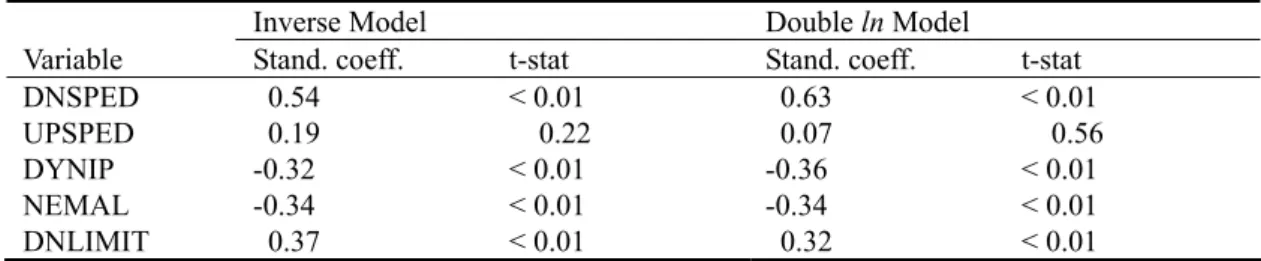
After the variables for the final pricing model were determined, the Box-Cox methodology was employed to learn the appropriate data transformation. The values of L and λ are tabulated in Table 3, where the λ value associated with the maximum value of L, Lmax, is denoted by λ*, which is -0.50, and the 95% confidence interval for λ is from -2.59 to 1.25.
Table 4 shows the analysis results for both the inverse, and the double ln regression models, which correspond to λ = -1, and λ = 0 respectively. In inverse and double ln regression models, variables equal to zero are approximated by 0.000001 (Rao & Lynch, 1993). λ Lmax 3 -80.44 2 -61.32 1 -46.45 0 -35.21 -0.5* -33.89 -0.67 -34.02 -1 -36.14 -2 -42.69 -3 -48.58
Table 3. Lmax for DSL service market.
Inverse Model Double ln Model
Variable Stand. coeff. t-stat Stand. coeff. t-stat
DNSPED 0.54 < 0.01 0.63 < 0.01
UPSPED 0.19 0.22 0.07 0.56
DYNIP -0.32 < 0.01 -0.36 < 0.01
NEMAL -0.34 < 0.01 -0.34 < 0.01
DNLIMIT 0.37 < 0.01 0.32 < 0.01
Table 4. The analysis results for the inverse and the double ln regression models. Note. Adjusted R2 = 0.78, F-stat = 22.31, and L
max = -36.14 for inverse model; Adjusted R2 = 0.85, F-stat = 36.23, and
Lmax = -35.21 for double ln model.
According to Table 4, the adjusted R2 and F-statistics of the double ln regression model are better than those of the inverse
regression model, though their results of t-testing on coefficients are approximate, so double ln regression model has better explanatory power to variance, and double ln regression model is thus the preferred model.
ANALYSIS AND IMPLICATIONS
In the final double natural ln function model, there are four explanatory variables. Among them, DNSPED is the most important one, as the corresponding coefficient is significant and has the largest magnitude. This is probably because household users in the UK prefer content consumption to content creation and sharing, and download speed determines the cost of time to satisfy their needs. Another reason might be nearly two thirds of DSL Internet services configure their download speed no more than 512 kbps, which is barely adequate for transferring MP3 or picture-format files, and not fast for transferring high resolution stream video files, it results in a threshold and is in the way of convenience, so household users strongly concern about it.
The remaining most important explanatory variables are DYNIP, NEMAL, and DNLIMIT respectively. DYNIP and NEMAL have negative effects on the price of DSL service with their corresponding coefficients in the final natural ln function, while DNLIMIT has positive effect. However, due to positive corresponding coefficient in final natural ln function model, DNLIMIT is more important than DYNIP and NEMAL. DNLIMIT is the monthly download quota for each subscription. It is a locally characteristic variable and a control mechanism selected for entry level DSL Internet services, which is attempting to take advantage of household users’ sense of inconvenience to push ahead with the subscription of higher speed and expensive DSL Internet services without constraint on monthly download quota.
DYNIP, completely negatively correlated with STCIP, is the number of dynamic IPs determines how many users in the same household can access the Internet simultaneously with an added router, access point, switch, or hub. On the other hand, IP addresses now are scarce resources, as Internet population has been growing in an exploding rate. Consequently, providing dynamic IPs rather than static IPs temporarily resolves the urgent need for IPs and enables ISPs to continue serving existing and prospective customers, and buys more time for ISPs to find other solutions. One interesting and counter-intuitive result is that the coefficient for DYNIP is negative, meaning the more dynamic IPs provided, the cheaper the price.
The next most important explanatory variable is NEMAL, the number of email accounts provided. Three fourths of DSL Internet services provide more than one email account for each subscription, for example, AOL, BT, Demon Internet, FreeServe, Karoo, PIPEX, Tiscali, Virgin.net, and others. This variable with negative corresponding coefficient indicates that it is no longer a characteristic factor that is able to differentiate DSL Internet services.
CONCLUSIONS
In this research, through hedonic approach and Box-Cox methodology, key characteristics of DSL Internet services, which determine the price, were identified. They are the download speed, the number of dynamic IP, and the number of email accounts, and download limit. The appropriate data transformation for the UK market was found to be when λ = 0, which leads to a natural
ln function modeling. The most important explanatory variable in this model is the download speed. Its importance implies that
household users in UK may engage in more content receiving than content creation activities, thus the demand for download speed is more than upload speed. The next important variable is the number of dynamic IP, which determines how many users in the same household can access the Internet simultaneously with the addition of a home router. The number of email accounts provided for each subscription and download limit per month are the last two important explanatory variables, in which the former has negative effect on the price of DSL service, while the latter does contrarily.
Due to time and geographical limitations, not all the possible independent variables were captured in the current data set, such as various bundling promotions, DSL market share of incumbent telecos, customer’s impression on ISPs. They can be included in the future model. Moreover, a longitudinal study will certainly be of great interest, as the technology is constantly advancing. However, one important area of study is the duplication of this research in regions outside of the UK, if globalization of DSL services is desirable. Many countries in the Europe and the Asia-Pacific region have dedicated considerable effort and investments to boost household Internet penetration. Countries on Scandinavia, such as Sweden, Finland, Denmark, and those in the Asia-Pacific region, such as Taiwan, Japan, Korea, and Singapore, are the ones that have very high Internet penetration, and thus worth close investigations.
REFERENCES
Berndt, E. R. (1991). The measurement of quality change: Constructing a hedonic price index for computers using multiple regression methods. In The practice of econometrics: Classic and contemporary (pp. 127-131). New York, NY: Addison-Wesley. Brynjolfsson, E., & Kemerer, C. F. (1996). Network externalities in microcomputer software: An econometric analysis of the spreadsheet market. Management Science, 42(12), 1627-1647.
Cathey, J. M., & Wiggins, C. E. (2002). Broadband: New speeds, new risks. Strategic Finance, 83(9), 38-43.
Cole, R., Chen, Y. C., Barquin-Stolleman, J. A., Dulberger, E., Helvacian, N., & Hodge, J. H. (1986). Quality-adjusted price indexes for computer processors and selected peripheral equipment. Survey of Current Business, 66(1), 41-50.
Court, A. T. (1939). Hedonic price indexes with automotive example. In The dynamics of automobile demand (pp. 99-117). Detroit, MI: General Motors.
Gallaugher, J. M., & Wang, Y.-M. (2002). Understanding network effects in software markets: Evidence from web server pricing.
MIS Quarterly, 26(4), 303-327.
Gandal, N. (1994). Hedonic price indexes for spreadsheets and an empirical test for network externalities. The Rand Journal of
Economics, 25(1), 160-170.
Hancock, B. (2000). Home pc's targeted by hackers (duh!). Computers & Security, 19(5), 387-388.
Horrigan, J. B., & Rainie, L. (2004, May 30). The broadband difference: How online americans' behavior changes with high-speed internet connections at home. Retrieved Oct. 12, 2005, from http://www.pewinternet.org/pdfs/PIP_Broadband_Report.pdf
Lynch, B. D., Raghav, H., & Lin, W. T. (1990). Economic analysis of micorcomputer hardware. Communications of the ACM,
33(10), 119-129.
Mueller, K., & Johnson, T. (2005). Uk broadband market monitor: Point Topic Ltd.
Rao, H. R., & Lynch, B. D. (1993). Hedonic price analysis of workstation attributes. Communications of the ACM, 36(12), 95-102.
Triplett, J. E. (1986). The economic interpretation of hedonic methods. Survey of Current Business, 66(1), 36-40. Waugh, F. V. (1928). Quality factors influencing vegetable prices. Journal of Farm Economics, 10(2), 185-196.