Vertex fault tolerance for edge-bipancyclicity of
hypercube
Chun-Nan Hung
Department of Computer Science and Information Engineering Da-Yet University, Changhua,
Taiwan 51505, R.O.C Email:[email protected]
Yu-Chun Lin
Department of Computer Science and Information Engineering Da-Yet University, Changhua,
Taiwan 51505, R.O.C Email:[email protected]
Abstract—A bipartite graph G = (V, E)
edge-bipancyclic if every edge lies on the cycles of every even length from 4 to |V |. Let Qn = (Vb∪ Vw, E) be an
n-dimensional hypercube where Vb and Vw are the sets of
black and white vertices, respectively. Let Fb(resp. Fw) be
the set of black (resp. white) faulty vertices. In this paper, we will show that Qn− Fb − Fw is edge-bipancyclic if |Fb|, |Fw| ≤ b
n−1 4 c.
Index Terms—hypercube, edge-bipancyclic, bipartite
graph, vertices fault-tolerance
I. INTRODUCTION
The hypercube network is one of the most popular interconnection networks. It has many attractive properties, such as regularity, symmetry, small de-gree and diameter, maximum fault tolerance, easy routing algorithms.
An interconnection network is usually repre-sented by a graph where vertices represent proces-sors and edges represent links between procesproces-sors. Let G = (Vb∪ Vw, E) be a bipartite graph where Vb
and Vw are two disjoint vertex sets such that each
edge of E consists of one vertex from each set. Let d(u, v) be the distance of the vertices u and v. A
bi-partite graphG = (Vb∪ Vw, E) is Hamiltonian lace-able if there exists a Hamiltonian path between x, y
for any x ∈ Vb, y ∈ Vw. The graphG = (Vb∪Vw, E)
is hyper-Hamiltonian laceable if ∀v ∈ Vb(resp. Vw),
there exists a Hamiltonian path ofG − {v} between
each pair of vertices ofVw(resp.Vb). In [13], Tsai et
al. proved that Qn− Fe is Hamiltonian laceable for
Fe ⊂ E(Qn), |Fe| ≤ n − 2 and hyper-Hamiltonian
laceable for Fe ⊂ E(Qn), |Fe| ≤ n − 3. A bipartite
graph G = (V, E) is edge-bipancyclic if every edge
of E lies on cycles of every even length from 4 to |V |. In [8], Li et al. proved that Qn− Fe is
edge-bipancyclic for Fe ⊂ E(Qn), |Fe| ≤ n − 2.
There is little literature about general vertex fault tolerant Hamiltonian properties of hypercube Qn =
(Vb ∪ Vw, E). Some literatures concern embedding
fault-free cycles or paths for hypercube with faulty vertices. The upper bound of longest fault-free cycle of Qn− Fv is 2n− 2f where Fv is the faulty set of
vertices ofQn andf = max{|Fv∩Vw|, |Fv∩Vb|}. In
[2], [4], [10], [12], the authors showed that a fault-free cycle of length2n−2f
v can be constructed with
fv faulty vertices. In [5], [14], the authors showed
that every edge in Qn− Fv − Fe lies on cycles of
every even length from 4 to 2n− 2|F
v| if |Fv| +
|Fe| ≤ n−2. When all faulty vertices are in the same
partite set, this result is the vertices fault tolerance for edge-bipancyclicity ofQn. However, there exist
longer cycles when both partite vertex sets contain some faulty vertices.
In [1], Caha et al. proposed the multiple span-ning paths problem for hypercube. Let si, ti, for
1 ≤ i ≤ k, be vertices of Qn. The {si, ti}ki=1 is a connectable family if there exists k spanning paths P (si, ti) of Qn for 1 ≤ i ≤ k. The {si, ti}ki=1 is balanced if it has the same number of vertices in
each partite set. Caha showed that every balanced family {si, ti}ni=1 is connectable in Q2n if d(si, ti)
is odd for 1 ≤ i ≤ n. Caha also showed that
every balanced family {si, ti}ni=1 is connectable
in Q6n. In [7], Hung et al. investigated the fault
Let the family {si, ti}Fb,KbFw,Kw of Qn be the vertex set
Kb ∪ Kw = {si, ti| for 1 ≤ i ≤ (|Kb| + |Kw|)/2}
of Qn − Fb − Fw. The family {si, ti}Fb,KbFw,Kw is
balanced if 2|Fb| + |Kb| = 2|Fw| + |Kw|. The
family {si, ti}Fb,KbFw,Kw is connectable if there exit
(|Kb| + |Kw|)/2 spanning disjoint paths P (si, ti)
for 1 ≤ i ≤ (|Kb| + |Kw|)/2 of Qn − Fb − Fw.
The authors showed that every family {si, ti}Fb,KbFw,Kw
ofQnis connectable if|Kb|+|Kw|+|Fb|+|Fw| ≤ n
and 4|Fb| + 2|Kb| = 4|Fw| + 2|Kw| ≤ n + 1.
In this paper, we incorporate the adjacently faulty vertices into the vertex fault tolerance of multiple spanning paths of hypercube. Let {si, ti}Fb,KbFw,Kw be
a family of G = (Vb ∪ Vw, E) − Fa where Kb ∪
Kw = {si, ti|1 ≤ i ≤ (|Kb| + |Kw|)/2} is the set
of fault-free vertices, Fa is the set of |Fa| pairs of
adjacently faulty vertices, Fb ⊂ Vb andFw ⊂ Vw are
sets of faulty vertices. In this paper, we will show that every family{si, ti}Fb,KbFw,Kw of hypercubeQn−Fa
is connectable if|Fb|+|Fw|+|Kb|+|Kw|+|Fa| ≤ n,
4|Fb| + 2|Kb| + |Fa| = 4|Fw| + 2|Kw| + |Fa| ≤ n + 1,
for n ≥ 3. Applying this result, we can obtain that Qn − Fb − Fw is edge-bipancyclic if |Fb|, |Fw| ≤
bn−1 4 c.
The rest of this paper is organized as follows. In Section 2, we introduce some important defini-tions and lemmas. Section 3 shows the vertex fault tolerance for multiple spanning paths. The vertex fault-tolerance for edge-bipancyclicity is introduced in Section 4. We finally give some conclusion in Section 5.
II. PRELIMINARIES
An n-dimensional hypercube Qn = (Vb∪ Vw, E)
is a bipartite graph whose vertices are labeled by distinct n-bit binary strings. Two vertices are linked
by an edge if and only if their labels differ exactly in one bit. The hypercube Qn can be constructed
recursively as Qn = Qn−1× K2. We can partition
Qn as two subgraphs Q0n−1 and Q1n−1 by choosing
any one bit of binary string.
We call the Vb black vertex set andVw white
ver-tex set. LetVbj andVwj be the black and white vertex
set of Qjn−1 for j = 0, 1. And let Vj = Vj
b ∪ Vwj for
j = 0, 1. Thus, Vb = Vb0∪ Vb1, Vw = Vw0 ∪ Vw1, V =
Vb∪ Vw = V0∪ V1.
Let Fb be the set of black faulty vertices and Fw
be the set of white faulty vertices of Qn. Similarly,
we also use Fbj and Fj
w to denote the black and
white faulty vertex set of Qjn−1, respectively, for
j = 0, 1. Thus, Fb = Fb0∪ Fb1, Fw = Fw0∪ Fw1, F0 =
F0
b ∪ Fw0, F1 = Fb1∪ Fw1.
Let Fa be the set of adjacently faulty vertices
of Qn. Similarly, we also use Faj to denote the
adjacently faulty vertex set of Qjn−1, respectively,
forj = 0, 1. Thus, Fa = Fa0∪ Fa1. We further define
F = Fb∪ Fw∪ Fa.
Let Kb andKw be the black and white fault-free
vertex set. LetK = Kb∪Kw = {si, ti|1 ≤ i ≤ |K|2 }.
And letKbj = Kb∩Vj, Kwj = Kw∩Vj, for j = 0, 1.
Let φ(v) be a vertex of Vi for every v ∈ Vj
such that (v, φ(v)) ∈ E and {i, j} = {0, 1}. Let X = {x1, x2, · · · , xk} be a vertex subset of Qin−1
for i = 0, 1. We define the free neighbor set of X
is N(X) = {uj|(xj, uj) ∈ E(Qin−1) and φ(uj) /∈
(F ∪ K) for 1 ≤ j ≤ k, i = 0, 1}. Let φ(X) = {φ(v)|v ∈ X} be a vertex subset of Vj for X ⊂ Vi
for {i, j} = {0, 1}.
We need some previous results for our proofs. The following lemma is proposed in [6].
Lemma 1: The graphQnisf -adjacency (n − 2 −
f ) edges Hamiltonian for 0 ≤ f ≤ (n − 2), f
-adjacency (n−2−f ) edges Hamiltonian laceable for 0 ≤ f ≤ (n − 3), and f -adjacency (n − 3 − f ) edges
hyper-Hamiltonian laceable for 0 ≤ f ≤ (n − 3).
A bipartite graph G = (Vb∪ Vw, E) has property 2H if for any s1, s2 ∈ Vb and t1, t2 ∈ Vw there exist
two spanning disjoint paths P (s1, t1) and P (s2, t2)
of G. Su et al. proved the following lemma in [11].
Lemma 2: The graph Qn− Fa− Fe has property
2H whereFais the set of|Fa| pairs adjacently faulty
vertices and Fe is the set of faulty edges and 0 ≤
|Fa| + |Fe| ≤ n − 3.
III. VERTEX FAULT TOLERANCE FOR MULTIPLE SPANNING PATHS IN HYPERCUBE
In this section, we will prove the vertex fault tolerance for multiple spanning disjoint paths of
hypercube. The following lemma is the proof for some property for Q4.
Lemma 3: Let s1, t1 ∈ Vw ands2, t2 ∈ Vb be two
pairs of fault-free vertices. there exist two spanning disjoint paths P (s1, t1) and P (s2, t2) of Q4.
Proof. By symmetry of hypercube, we can arrange
s1 in Q03 andt1 in Q13. We will prove this lemma in
the following cases.
Case 1. s2 and t2 in the same subcube.
Without loss of generality, we can assume thats2, t2
are in Q1
3. We can construct a Hamiltonian path
hs2
P(s2,t2)
−→ t2, x
P(x,t1)
−→ t1i of Q13. We can also
construct a Hamiltonian path P (s1, φ(x)) of Q03.
Thus, P (s2, t2) and hs1
P(s1,φ(x))
−→ φ(x), x P−→ t(x,t1) 1i
are two spanning disjoint paths of Q4.
Case 2. s2 and t2 in different subcubes.
Without loss of generality, we can assume that s2 ∈
Q1
3 and t2 ∈ Q03. We can construct a Hamiltonian
path hs1
P(s1,x1)
−→ x1, x2
P(x2,t2)
−→ t2i of Q03 for x1 ∈ Vw0
and{φ(x1), φ(x2)}∩{s2, t1} = ∅. Applying Lemma
2, we can further construct two spanning disjoint paths P (φ(x1), t1) and P (s2, φ(x2)) of Q13. Thus,
hs1 P(s1,x1) −→ x1, φ(x1) P(φ(x1),t1) −→ t1i and hs2 P(s2,φ(x2)) −→ φ(x2), x2 P(x2,t2)
−→ t2i are two spanning disjoint paths
of Q4. 2
Theorem 1: Every family {si, ti}Fb,KbFw,Kw of
hyper-cubeQnis connectable if|Fb|+|Fw|+|Kb|+|Kw|+
|Fa| ≤ n, 4|Fb| + 2|Kb| + |Fa| = 4|Fw| + 2|Kw| +
|Fa| ≤ n + 1, |Fa| ≤ n − 3 for n ≥ 3.
Proof: We will prove this theorem by induction on
n. When |Fb|+|Fw|+|Kb|+|Kw|+|Fa| < n, 4|Fb|+
2|Kb| + |Fa| = 4|Fw| + 2|Kw| + |Fa| < n + 1, |Fa| <
n − 3, the proof of Qn is the same as the proof of
Qn−1. Thus, we only need to prove that at lest one of
the conditions|Fb| + |Fw| + |Kb| + |Kw| + |Fa| = n,
4|Fb| + 2|Kb| + |Fa| = 4|Fw| + 2|Kw| + |Fa| =
n + 1, |Fa| = n − 3 holds.
Applying Lemma 1, we can obtain that Qn− Fa is
Hamiltonian laceable and hyper-Hamiltonian lace-able for |Fa| = n − 3. Thus, this theorem is true for
|Fa| = n − 3. It is true for n = 3.
We consider the case for n = 4. Applying Lemma
2, we can also obtain that Q4 has the property 2H.
Applying Lemma 3, we can construct two spanning disjoint pathsP (s1, t1) and P (s2, t2) of Q4forKb =
{s1, t1}, Kw = {s2, t2}. Thus, this theorem is true
for n = 4.
We will prove the induction step for |Fa| ≤ n − 4
and n ≥ 5 with the following cases. By the
symmetry of hypercube, we can assume that every pair of adjacently vertices is either in Q0
n−1 or
Q1
n−1. We draw Q12 in figures of some cases for
illustration.
Case 1: n − |Fa| is even.
When |Fb| + |Fw| ≥ 1, the proof of this case is
the same as the case of Qn−1. Thus, we only need
to prove this case for |Fb| = |Fw| = 0. We can
infer that |Kb| + |Kw| + |Fa| = n. Without loss of
generality, we can assume that |F0
a| ≥ |Fa1|.
Case 1.1: |Fa| = 0.
Without loss of generality, we can assume that
|K0| ≥ |K1| ≥ 1 and |K0
b| ≥ |Kw0| ≥ 1.
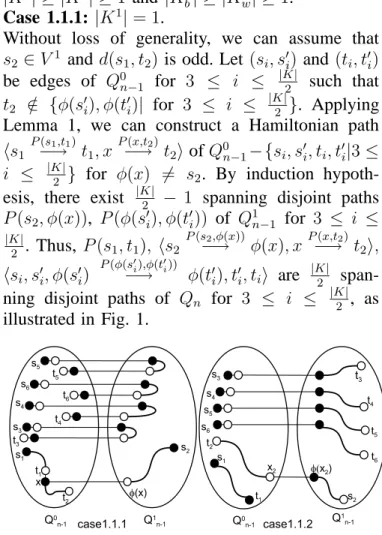
Case 1.1.1: |K1| = 1.
Without loss of generality, we can assume that
s2 ∈ V1 and d(s1, t2) is odd. Let (si, s0i) and (ti, t0i)
be edges of Q0 n−1 for 3 ≤ i ≤ |K| 2 such that t2 ∈ {φ(s/ 0i), φ(t0i)| for 3 ≤ i ≤ |K| 2 }. Applying
Lemma 1, we can construct a Hamiltonian path
hs1
P(s1,t1)
−→ t1, x P(x,t2)
−→ t2i of Q0n−1−{si, s0i, ti, t0i|3 ≤
i ≤ |K|2 } for φ(x) 6= s2. By induction
hypoth-esis, there exist |K|2 − 1 spanning disjoint paths P (s2, φ(x)), P (φ(s0i), φ(t0i)) of Q1n−1 for 3 ≤ i ≤ |K| 2 . Thus, P (s1, t1), hs2 P(s2,φ(x)) −→ φ(x), xP−→ t(x,t2) 2i, hsi, s0i, φ(s0i) P(φ(s0 i),φ(t0i)) −→ φ(t0 i), t0i, tii are |K|2
span-ning disjoint paths of Qn for 3 ≤ i ≤ |K|2 , as
illustrated in Fig. 1.
Fig. 1. Illustration of Case 1.1.1 and Case 1.1.2
Case 1.1.2: |K1| ≥ 2 and s
i, ti ∈ K0 for some
Without loss of generality, we can assume that
s1, t1 ∈ Q0n−1. Let t2 be vertex of Q0n−1 with
{s1, t1, t2} 6⊂ Kb and {s1, t1, t2} 6⊂ Kw. Without
loss of generality, we can assume that s1, t1 ∈
Kb, t2 ∈ Kw. Let x2 ∈ Kw0 for φ(x2) /∈ K1. Let
K0 = K0− {s
1, t1, t2}, N(K0) be the free neighbor
set of K0. Applying Lemma 3, we can construct
two spanning disjoint paths P (s1, t1) and P (x2, t2)
of Q0
n−1− K0 − N(K0). By induction hypothesis,
there exist |K|2 − 1 spanning disjoint paths between (φ(N(K0)) ∪ K1∪ {φ(x2)}) of Q1n−1. Therefore, we
can construct |K|2 spanning disjoint paths between
Kb∪ Kw of Qn as illustrated in Fig. 1.
Case 1.1.3: si andti in different subcubes for every
1 ≤ i ≤ |K|2 .
Without loss of generality, we can that si ∈ Q0n−1,
andti ∈ Q1n−1for1 ≤ i ≤ |K|
2 . Suppose thatd(si, ti)
is odd for some 1 ≤ i ≤ |K|2 . Without loss of gener-ality, we can assume thatd(s1, t1) is odd. Let (t01, t1)
be an edge of Q1
n−1 fort01, φ(t01) /∈ K. Let (si, s0i) be
edges of Q0
n−1 for s0i, φ(s0i) /∈ (K ∪ {t01, φ(t01)}) for
2 ≤ i ≤ |K|2 . Applying Lemma 1, we can construct a Hamiltonian pathP (s1, φ(t01)) of Q0n−1−{si, s0i|2 ≤
i ≤ |K|2 }. By the induction hypothesis, there
ex-ist |K|2 − 1 spanning disjoint paths P (φ(s0
i), ti) of
Q1
n−1 − {t1, t01}. Therefore, we can construct |K|
2
spanning disjoint paths hs1
P(s1,φ(t0 1)) −→ φ(t0 1), t01, t1i, hsi, s0i, φ(s0i) P(φ(s0 i),t0i) −→ t0 ii of Qn for 2 ≤ i ≤ |K|2 , as illustrated in Fig. 2.
Fig. 2. Illustration of Case 1.1.3
Suppose that d(si, ti) is even for every 1 ≤ i ≤ |K|2 .
Without loss of generality, we can assume that
s1 ∈ Kb and s2 ∈ Kw. Let (t01, t1), (t02, t2) be edges of Q1 n−1 for t02, t02, φ(t01), φ(t02) /∈ K. Let (si, s0i) be edges of Q0n−1 for s0i, φ(s0i) /∈ (K ∪ {t0 1, t02, φ(t01), φ(t02)}), for 3 ≤ i ≤ |K| 2 . By induction
hypothesis, there exist two spanning disjoint paths
P (s1, φ(t01)) and P (s2, φ(t20)) of Q0n−1− {si, s0i|3 ≤
i ≤ |K|2 }. By induction hypothesis, there also
exist |K|2 − 2 spanning disjoint paths P (φ(s0
i), ti) of
Q1
n−1− {t1, t01, t2, t02}. Therefore, we can construct |K|
2 spanning disjoint pathshsi
P(si,φ(t0 i)) −→ φ(t0 i), t0i, tii, hsj, s0j, φ(s0j) P(φ(s0 j),t0j) −→ t0 ji of Qn for 1 ≤ i ≤ 2, 3 ≤ j ≤ |K|2 , as illustrated in Fig. 2(b). Case 1.2: |Fa| ≥ 1 and |Fa1| = 0. Case 1.2.1: |K1| = 0.
We can infer that |Kb| ≥ 2 and |Kw| ≥ 2 since
|Fb| = |Fw| = 0 and |Fa| ≤ n − 4. Without
loss of generality, we can assume that s1, t1 ∈ Vb
and s2, t2 ∈ Vw. Let (si, s0i), (t0i, ti) be edges of
Q0
n−1 for s0i, t0i ∈ (K ∪ F ) for 3 ≤ i ≤/ |K|
2 .
Applying Lemma 2, we can construct two span-ning disjoint paths hs1
P(s1,s0 1) −→ s0 1, t02 P(t0 2,t2) −→ t2i and hs2 P(s2,s0 2) −→ s0 2, t01 P(t0 1,t1) −→ t1i of Q0n−1 − Fa0 − {si, s0i, ti, t0i|3 ≤ i ≤ |K| 2 }. By induction
hypoth-esis, we can construct |K|2 spanning disjoint paths
P (φ(s0 i), φ(t0i)) of Q1n−1 for 1 ≤ i ≤ |K| 2 . Therefore, hsi P(si,s0 i) −→ s0 i, φ(s0i) P(φ(s0 i),φ(t0i)) −→ φ(t0 i), t0i, P(t0 i,ti) −→ tii, hsj, s0j, φ(s0j) P(φ(s0 j),φ(t0j)) −→ φ(t0 j), t0j, tji are |K|2
span-ning disjoint paths of Qn− Fa for 1 ≤ i ≤ 2, 3 ≤
j ≤ |K|2 , as illustrated in Fig. 3.
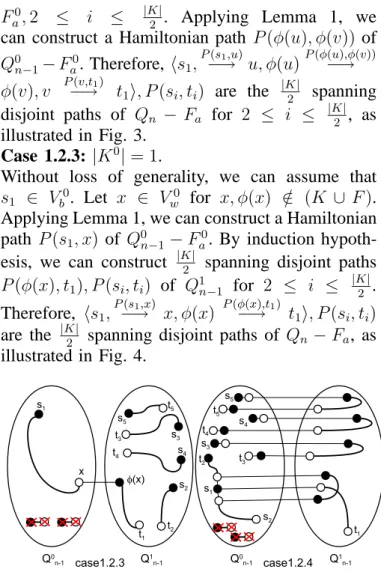
Fig. 3. Illustration of Case 1.2.1 and Case 1.2.2
Case 1.2.2: |K0| = 0.
By induction hypothesis,we can construct |K|2 span-ning disjoint paths betweenKb∪Kw ofQ1n−1.
With-out loss of generality, we can denote these paths as
hs1, P(s1,u)
F0
a, 2 ≤ i ≤ |K|
2 . Applying Lemma 1, we
can construct a Hamiltonian path P (φ(u), φ(v)) of Q0
n−1− Fa0. Therefore, hs1, P(s1,u)
−→ u, φ(u)P(φ(u),φ(v))−→ φ(v), v P−→(v,t1) t1i, P (si, ti) are the |K|2 spanning
disjoint paths of Qn − Fa for 2 ≤ i ≤ |K|2 , as
illustrated in Fig. 3.
Case 1.2.3: |K0| = 1.
Without loss of generality, we can assume that
s1 ∈ Vb0. Let x ∈ Vw0 for x, φ(x) /∈ (K ∪ F ).
Applying Lemma 1, we can construct a Hamiltonian path P (s1, x) of Q0n−1− Fa0. By induction
hypoth-esis, we can construct |K|2 spanning disjoint paths
P (φ(x), t1), P (si, ti) of Q1n−1 for 2 ≤ i ≤ |K|2 .
Therefore, hs1, P(s1,x)
−→ x, φ(x) P(φ(x),t1)−→ t1i, P (si, ti)
are the |K|2 spanning disjoint paths of Qn− Fa, as
illustrated in Fig. 4.
Fig. 4. Illustration of Case 1.2.3 and Case 1.2.4
Case 1.2.4: |K1| = 1.
Without loss of generality, we can assume that t1 ∈
V0
w. Since |Vb| ≥ 2, |Vw| ≥ 2, we can choose two
black vertices and one white vertex of K0. Without
loss of generality, we can assume that s1, t2 ∈
Vb, s2 ∈ Vw and φ(s1) 6= t1. Let (si, s0i), (t0i, ti) be
edges of Q0
n−1 for s0i, t0i, φ(s0i), φ(t0i) /∈ (K ∪ F ) for
3 ≤ i ≤ |K|2 . Applying Lemma 1, we can construct a Hamiltonian path hs2 P(s2,s02) −→ s0 2, s1, t02 P(t02,t2) −→ t2i of Q0 n−1 − Fa0 − {si, s0i, ti, t0i|3 ≤ i ≤ |K| 2 }. By
induction hypothesis, there exist |K|2 spanning dis-joint paths P (φ(s1), t1), P (φ(s0i), φ(t0i)) of Q1n−1 for
2 ≤ i ≤ |K|2 . Therefore, hs1, φ(s1) P(φ(s1),t1) −→ t1i, hs2 P(s2,s0 2) −→ s0 2, φ(s02) P(φ(s0 2),φ(t02)) −→ φ(t0 2), t02 P(t0 2,t2) −→ t2i, hsi, s0i, φ(s0i) P(φ(s0 i),φ(t0i)) −→ φ(t0 i), t0i, tii are the |K|2
spanning disjoint paths of Qn− Fa for 3 ≤ i ≤ |K|2 ,
as illustrated in Fig. 4.
Case 1.2.5: |K1| ≥ 2, |K0| ≥ 2.
Without loss of generality, we can assume that
s1, s2 ∈ Q0n−1. Let (s1, s01), (s2, s02) be edges of
Q0
n−1 and s01, φ(s01), s02, φ(s02) /∈ (F ∪ K). Let K0 =
K0 − {s
1, s2} and N(K0) be the free neighbor set
of K0. Applying Lemma 2, we can construct two
spanning disjoint paths P (s1, s01) and P (s2, s02) of
Q0
n−1 − Fa − K0 − N(K0). By induction
hypoth-esis, we can construct |K|2 spanning disjoint paths between K1∪ φ(N(K0)) ∪ {φ(s0
1), φ(s02)} of Q1n−1.
Therefore, we can construct |K|2 spanning disjoint paths between Kb∪ Kw of Qn− Fa.
Case 1.3: |F0
a| ≥ 1 and |Fa1| ≥ 1.
Without loss of generality, we can assume that
|K0| ≥ |K1|.
Case 1.3.1: |K1| = 0.
there exist |K|2 spanning disjoint paths hs1, P(s1,u) −→ u, v P−→(v,t1) t1i, P (si, ti) of Q0n−1 − Fa0 for φ(u), φ(v) ∈ F/ 1 a, 2 ≤ i ≤ |K| 2 . Applying
Lemma 1, we can construct a Hamiltonian path
P (φ(u), φ(v)) of Q1
n−1 − Fa1. Therefore, hs1 P(s1,u)
−→ u, φ(u)P(φ(u),φ(v)−→ φ(v), vP−→ t(v,t1) 1i, P (si, ti) are |K|2
spanning disjoint paths of Qn− Fa for2 ≤ i ≤ |K|2 ,
as illustrated in Fig. 5.
Fig. 5. Illustration of Case 1.3.1 and Case 1.3.2
Case 1.3.2: |K0| ≥ 1 and |K1| ≥ 1
Let N(K1) be the free neighbor set of K1. By
induction hypothesis, we can construct |K|2 spanning disjoint paths betweenK0∪φ(N(K1)) of Q0
n−1−Fa0
and |K1| spanning disjoint paths between N(K1) ∪
K1 of Q1
n−1− Fa1. Therefore, we can construct |K|
2
spanning disjoint paths betweenKb∪Kw ofQn−Fa,
Case 2: n − |Fa| is odd.
When |Fb| + |Fw| = 0, the proof of this case is
the same as Qn−1. Thus, we only need to prove
this case for |Fb| + |Fw| ≥ 1. We can infer that
4|Fb| + 2|Kb| + |Fa| = 4|Fw| + 2|Kw| + |Fa| =
n + 1. By symmetry of hypercube, we can assume
that |F0
w| + |Kw0| ≥ 1 and |Fw1| + |Kw1| ≥ 1 when
|Fa| = 0. Without loss of generality, we can assume
that 4|F0| + 2|K0| + |F0 a| ≥ 4|F1| + 2|K1| + |Fa1| and |F0 b| ≥ |Fw0|. Case 2.1: 4|F0 b| + |Fa0| = n + 1. Since4|F0 b|+|Fa0| = n+1, |Fb1| = |Fa1| = |Kb| = 0. Let b ∈ F0 b and Fb0 = Fb1− {b}. Case 2.1.1: |K1| = 0. Let (t0 1, t1) ∈ E(Q0n−1) for t01 ∈ (F ∪ K)./
Let ui ∈ Vb be the white vertices of Q0n−1
for 1 ≤ i ≤ 2|F1 w|. By induction hypothesis, there exist |K|2 + |F1 w| spanning disjoint paths hs1 P(s1,b0) −→ b0, bi, P (si, ti), P (u2j−1, u2j) of Q0 n−1 − Fb0 − Fw0 − {t1, t01} for 2 ≤ i ≤ |K|2 , 1 ≤ j ≤ |F1 w|. By induction
hypothesis, we can also construct |F1
w| + 1 spanning
disjoint paths P (φ(b0), φ(u
1)), P (φ(u2j), φ(u2j+1)), P (φ(u2|F1 w|), φ(t 0 1)) of Q1n−1 − Fw1 for 1 ≤ j ≤ |F1 w| − 1. Therefore, hs1 P(s1,b0) −→ b0, φ(b0) P(φ(b−→0),φ(u1)) φ(u 1), u1 P(u1,u2) −→ u2, φ(u2), · · · , u2|F1 w|, φ(u2|Fw1|) P(φ(u2|F 1w |),φ(t 0 1)) −→ φ(t0
1), t01, t1i, P (si, ti) are |K|2 spanning disjoint
paths of Qn− (Fb∪ Fw ∪ Fa) for 2 ≤ i ≤ |K|2 , as
illustrated in Fig. 6.
Case 2.1.2: |K0| ≥ 1, |K1| ≥ 1.
Without loss of generality, we can assume that s1 ∈
V0
w. Let U = {ui|ui ∈ Vw0 and ui, φ(ui) /∈ (K ∪ F )
for 1 ≤ i ≤ (2|F1
w| + |K1| − 1)}. By induction
hypothesis, there exist(|K|2 +|F1
w|) spanning disjoint
paths between(K0∪U ∪{b
1}) of Q0n−1−Fb0. Without
loss of generality, we can assume one of these(|K|2 + |F1
w|) spanning disjoint paths is hs1
P(s1,b0)
−→ b0, bi.
By induction hypothesis, we also can construct the
|F1
w| + |K1| spanning disjoint paths between K1∪
φ(U) ∪ {φ(b0
1)} of Q1n−1 − Fw1. Therefore, we can
construct |K|2 spanning disjoint paths between Kw
of Qn− Fb− Fw− Fa, as illustrated in Fig. 6.
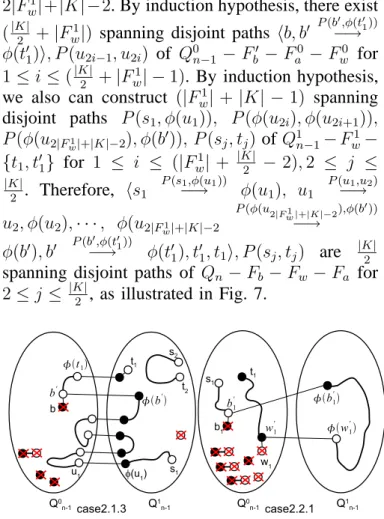
Case 2.1.3: |K0| = 0.
Let (t0
1, t1) ∈ E(Q1n−1) for t01, φ(t01) /∈ (F ∪ K).
Let ui ∈ Vw0 for ui, φ(ui) /∈ (F ∪ K), 1 ≤ i ≤
Fig. 6. Illustration of Case 2.1.1 and Case 2.1.2
2|F1
w|+|K|−2. By induction hypothesis, there exist
(|K|2 + |F1
w|) spanning disjoint paths hb, b0
P(b0,φ(t0 1))
−→ φ(t0
1)i, P (u2i−1, u2i) of Q0n−1− Fb0 − Fa0 − Fw0 for
1 ≤ i ≤ (|K|2 + |F1
w| − 1). By induction hypothesis,
we also can construct (|F1
w| + |K| − 1) spanning
disjoint paths P (s1, φ(u1)), P (φ(u2i), φ(u2i+1)),
P (φ(u2|Fw|+|K|−21 ), φ(b0)), P (sj, tj) of Q1 n−1− Fw1− {t1, t01} for 1 ≤ i ≤ (|Fw1| + |K| 2 − 2), 2 ≤ j ≤ |K| 2 . Therefore, hs1 P(s1,φ(u1)) −→ φ(u1), u1 P(u1,u2) −→ u2, φ(u2), · · · , φ(u2|Fw|+|K|−21 P(φ(u2|F 1w |+|K|−2),φ(b 0)) −→ φ(b0), b0 P(b0,φ(t01)) −→ φ(t0 1), t01, t1i, P (sj, tj) are |K|2
spanning disjoint paths of Qn− Fb − Fw− Fa for
2 ≤ j ≤ |K|2 , as illustrated in Fig. 7.
Fig. 7. Illustration of Case 2.1.3 and Case 2.2.1
Case 2.2: 4|F0 b| + |Fa0| = 4|Fw0| + |Fa0| = n − 1. Since 4|F0 b| + |Fa0| = 4|Fw0| + |Fa0| = n − 1, |Fb1| = |F1 w| = |Fa1| = 0 and |Vb| = |Vw| = 1. Let Kw = {s1} and Kb = {t1}. Let b1 ∈ Fb, w1 ∈ Fw, Fb0 =
Fb− {b1} and Fw0 = Fw− {w1}. We will construct
the Hamiltonian pathP (s1, t1) of Qn−Fb−Fw−Fa
Case 2.2.1: |K1| = 0.
By induction hypothesis, we can construct two spanning disjoint paths hs1
P(s1,b0 1) −→ b0 1, b1i and hw1, w01 P(w0 1,t1) −→ t1i of Q0n−1 − Fa0 − Fb0 − Fw0.
Applying Lemma 1, we can obtain a Hamiltonian path P (φ(b0 1), φ(w10)) of Q1n−1. Thus, hs1 P(s1,b0 1) −→ b0 1, φ(b01) P(φ(b0 1),φ(w01)) −→ φ(w0 1), w10 P(w0 1,t1) −→ t1i is a
Hamiltonian path ofQn−Fb−Fw−Fa, as illustrated
in Fig. 7.
Case 2.2.2: |K1| = 1.
Without loss of generality, we can assume that
s1 ∈ V0 and t1 ∈ V1. By induction hypothesis,
we can construct a Hamiltonian path hs1
P(s1,w0 1) −→ w0 1, w1i of Q0n−1 − Fa− Fb − Fw0 and a Hamilto-nian path P (φ(w0 1), t1) of Q1n−1. Thus, hs1 P(s1,w0 1) −→ w10, φ(w01) P(φ(w0 1),t1) −→ t1i is a Hamiltonian path of Qn− Fb− Fw − Fa, as illustrated in Fig. 8.
Fig. 8. Illustration of Case 2.2.2 and Case 2.2.3
Case 2.2.3: |K1| = 2
Let (b0
1, b1), (w10, w1) ∈ E(Qn−10 ) for b01, w01, φ(b01),
φ(w0
1) /∈ (F ∪K). Let (b01, u), (v, w10) ∈ E(Q0n−1) for
u, v /∈ (Fb∪ Fw∪ Fa). By induction hypothesis, we
can construct a Hamiltonian pathP (u, v) of Q0 n−1−
F0
b − Fw0 − (Fa ∪ {b1, b01, w1, w01}) and two
span-ning disjoint paths P (s1, φ(b01)) and P (φ(w10), t1)
of Q1 n−1. Thus, hs1 P(s1,φ(b0 1)) −→ φ(b0 1), b01, u P(u,v) −→ v, w0 1, φ(w01) P(φ(w0 1),t1) −→ t1i is a Hamiltonian path of Qn− Fa− Fb− Fw, as illustrated in Fig. 8. Case 2.3: 4|F0 b| + |Fa0| ≤ n − 1 and 4|Fw0| + |Fa0| ≤ n − 3 and |K1| = 0. Case 2.3.1: |F1 a| = 0 and |F1| = 0. Since 4|F0 b| + |Fa0| ≤ n − 1 and |K1| = 0, |Kb0| ≥ 1.
Without loss of generality, we can assume that
t1 ∈ Vb. Let (t01, t1) ∈ E(Q0n−1) for t01 ∈/
(K ∪ F ). By induction hypothesis, there exist
|K|
2 − 1 spanning disjoint paths P (si, ti) for 2 ≤
i ≤ |K|2 of Q0
n−1 − F0 − Fa0 − {t1, t01}. Without
loss of generality, we can assume that s1 is on
the path P (s2, t2). We can denote P (s2, t2) as
hs2
P(s2,u)
−→ u, s1, v P(v,t2)
−→ t2i. By induction
hypoth-esis, we can construct two spanning disjoint paths
P (φ(s1), φ(t01)) and P (φ(u), φ(v)) of Q1n−1.
There-fore, hs1, φ(s1) P(φ(s1),φ(t0 1)) −→ φ(t0 1), t01, t1i, hs2 P(s2,u) −→ u, φ(u) P(φ(u),φ(v))−→ φ(v), v P−→ t(v,t2) 2i, P (si, ti) are
|K|
2 spanning disjoint paths of Q 1
n−1− Fb− Fw− Fa
for 3 ≤ i ≤ |K|2 , as illustrated in Fig. 9.
Fig. 9. Illustration of Case 2.3.1 and Case 2.3.2
Case 2.3.2: |F1
a| = 0 and |F1| ≥ 1 and (|Fb1| = 0
or |F1 w| = 0).
Without loss of generality, we can assume that |F1
b| = 0 and t1 ∈ Vb0. Let
(t0
1, t1) ∈ E(Q0n−1) for t01 ∈ (K ∪ F ). Let/
U = {ui|ui ∈ Vw0 and ui, φ(ui) /∈ (K ∪ F )
for 1 ≤ i ≤ (2|F1
w| − 1)}. By induction
hypothesis, there exist (|K|2 + |F1
w| − 1) spanning
disjoint paths P (s1, u1), P (u2i, u2i+1), P (sj, tj)
of Q0 n−1 − Fb0 − Fw0 − Fa0 − {t1, t01} for 1 ≤ i ≤ |F1 w| − 1, 2 ≤ j ≤ |K| 2 .
By induction hypothesis, we also can
construct the |F1
w| spanning disjoint paths
P (φ(u2i−1), φ(u2i)), P (φ(u2|F1
w|−1, φ(t 0 1))of Q1 n−1 − Fw1 for 1 ≤ i ≤ |Fw1| − 1. Therefore, hs1 P(s1,u1) −→ u1, φ(u1) P(φ(u1),φ(u2)) −→ φ(u2), · · · , φ(u2|F1 w|−1 P(φ(u2|F 1w |−1),φ(t 0 1)) −→ φ(t0 1), t01,
t1i, P (sj, tj) are |K|2 spanning disjoint paths of
Qn− Fb − Fw − Fa for 2 ≤ j ≤ |K|2 , as illustrated
Case 2.3.3: |F1
a| ≥ 1 or |Fw1| = |Fb1| ≥ 1.
By induction hypothesis, there exist |K|2 spanning disjoint paths P (si, ti) of Q0n−1 − Fb0 − Fw0 − Fa0
for 1 ≤ i ≤ |K|2 . Without loss of generality, we can assume that P (s1, t1) = hs1
P(s1,u)
−→ u, v P−→(v,t1) t1i for φ(u), φ(v) /∈ Fa1. Applying Lemma 1, we
can construct a Hamiltonian path P (φ(u), φ(v)) of Q1
n−1− Fa1. Therefore, hs1 P(s1,u)
−→ u, φ(u)P(φ(u),φ(v))−→ φ(v), v P(v,t1)−→ t1i, P (si, ti) are |K|2 spanning disjoint
paths of Qn − Fb − Fw − Fa for 2 ≤ i ≤ |K|2 , as
illustrated in Fig. 10.
Fig. 10. Illustration of Case 2.3.3 and Case 2.3.4
Case 2.3.4: |F1
a| + |Fb1| ≥ 1 and |Fa1| + |Fw1| ≥ 1
and |F1
b| 6= |Fw1|.
Without loss of generality, we can assume that
|F1
w| ≥ |Fb1|. Let m = |Fw1| − |Fb1|. Let
U = {ui|ui ∈ Vw0 and ui, φ(ui) ∈ (K ∪/
F ) for 1 ≤ i ≤ 2m}. By induction
hy-pothesis, there exist (|K|2 + m) spanning disjoint
paths P (s1, u1), P (u2i, u2i+1), P (u2m, t1), P (sj, tj)
of Q0
n−1 − Fb0 − Fw0 − Fa0 for 1 ≤ i ≤ m −
1, 2 ≤ j ≤ |K|2 . By induction hypothesis, we also can construct the m spanning disjoint paths P (φ(u2i−1), φ(u2i))of Q1n−1− Fw1− Fb1− Fa1 for1 ≤
i ≤ m. Therefore, hs1 P(s1,u1) −→ u1, φ(u1) P(φ(u1),φ(u2)) −→ φ(u2), · · · , φ(u2m−1 P(φ(u2m−1),φ(u2m)) −→ φ(u2m), u2m P(u2m,t1)
−→ t1i, P (sj, tj) are |K|2 spanning disjoint paths
of Qn− Fb− Fw− Fa for2 ≤ j ≤ |K|2 , as illustrated in Fig. 10. Case 2.4: 4|F0 b| + |Fa0| ≤ n − 1 and 4|Fw0| + |Fa0| ≤ n − 3, |K1| ≥ 1. Case 2.4.1: |K1 b| + |Fb1| + |Fa1| = 0 or |Kw1| + |Fw1| + |F1 a| = 0.
Without loss of generality, we can assume that
|K1
b| + |Fb1| + |Fa1| = 0. Let b be a faulty vertex
of F0
b. Let m = |Kw1| + 2|Fw1|. Let U = {ui|ui ∈
V0
w, ui ∈ (K/ 0 ∪ F0 ∪ Fa0) for 1 ≤ i ≤ m − 1}.
By induction hypothesis, there exist |K|2 spanning disjoint paths between K0 ∪ U ∪ {b} of Q0
n−1 −
Fa− Fw− (Fb− {b}) where P (s1, b) is one of these
spanning disjoint paths. We can denote P (s1, b)
as hs1
P(s1,b0)
−→ b0, bi. By induction hypothesis, we
can construct |K1
w| + |Fw1| spanning disjoint paths
between φ(U) ∪ K1
w∪ {φ(b0)} of Q1n−1− Fw1. Thus,
we can construct |K|2 spanning disjoint paths of
Qn− Fb− Fw− Fa, as illustrated in Fig. 11.
Fig. 11. Illustration of Case 2.4.1 and Case 2.4.2
Case 2.4.2: |K1
b| + |Fb1| + |Fa1| ≥ 1 and |Kw1| +
|F1
w| + |Fw1| ≥ 1.
Without loss of generality, we can assume that
2|F0
b|+|Kb0| ≥ 2|Fw0|+|Kw0|. Let m = 2|Fb0|+|Kb0|−
2|F0
w| − |Kw0|. Let X = {[si, ti]|si andti in different
subcubes } and |X| be the number of pairs of X.
Suppose that m ≥ |X|. Let Uw = {ui|ui ∈ Vw0, for
1 ≤ i ≤ m} and Ub = ∅. Suppose that m < |x|.
Let Uw = {ui|ui ∈ Vw0, for 1 ≤ i ≤ |X|+m 2 } and Ub = {ui|ui ∈ Vb0, for 1 + |X|+m 2 ≤ i ≤ |X|.
By induction hypothesis, there exist |K0|+|Uw|+|Ub|2 spanning disjoint paths between K0 ∪ U
w ∪ Ub of
Q0
n−1− Fb0 − Fw0 − Fa0 and
|K1|+|Uw|+|Ub|
2 spanning
disjoint paths of between K1 ∪ φ(U
b) ∪ φ(Uw)
of Q1
n−1 − Fb1 − Fw1 − Fa1. Therefore, we can
construct |K|2 spanning disjoint paths between of
Qn− Fb− Fw− Fa, as illustrated in Fig. 11. 2
IV. VERTICES FAULT-TOLERANCE FOR
EDGE-BIPANCYCLICITY OF HYPERCUBE
In this section, we prove the vertices fault-tolerance for edge bipancyclicity of hypercube. The
following lemma is proved in [4].
Lemma 4: Every edge in Qn − Fv − Fe lies on
a cycle of every even length from 4 to 2n− 2|F v|
even if |Fv| + |Fe| ≤ n − 2, for n ≥ 3.
Theorem 2: Let Fb and Fw be the sets of faulty
black vertices and faulty while vertices, respectively, of hypercube Qn. The graph Qn− Fb− Fw is
edge-bipancyclic if |Fb|, |Fw| ≤ bn−14 c for n ≥ 3.
Proof: Let e = (s, t) be an arbitrary edge of Qn− Fb− Fw for s ∈ Vb. Applying Lemma 4, we
can obtain that there exist cycle containing the edge
e with even length from 4 to 2n − 2(|F
b| + |Fw|)
of Qn− Fb − Fw. Let Fb = {b1, b2, · · · , bf1} and
Fw = {w1, w2, · · · , wf2}. Without loss of generality,
we can assume that f1 ≥ f2. Let Fa = {bi, xi| for
(bi, xi) ∈ E(Qn) and xi ∈ (F/ b ∪ Fw ∪ {s, t}) for
f2+ 1 ≤ i ≤ f1} and |Fa| be the number of pair of
adjacently vertices of Fa. Let Faj = {bi, xi, wi, yi|
for (bi, xi), (wi, yi) ∈ E(Qn) and xi, yi ∈ (F/ b ∪
Fw ∪ {s, t}) for j ≤ i ≤ f2} for 1 ≤ j ≤ f2 and
|Faj| be the number of pair of adjacently vertices of
Faj. Let Fb0 = {b1, b2, · · · , bf2}. We can check that
|Fa|+|Fw|+|Fb0|+|Faj|+2 = f1+f2+2 ≤ n+32 < n
and4|F0
b|+2+|Fa|+|Faj| = 4|Fw|+2+|Fa|+|Faj| ≤
n + 1 for 1 ≤ j ≤ f2. Applying Theorem 1,
we can construct a Hamiltonian path P (s, t) of Qn− Fb0− Fw− Fa− Faj for 1 ≤ j ≤ f2. Thus, we
can construct the cycles hsP−→ t, si containing the(s,t)
edge e with even length from 2n− 2(|F
b| + |Fw|) to
2n− 2 max{|F
b|, |Fw|} of Qn− Fb− Fw. Therefore,
Qn− Fb− Fw is edge-bipancyclic. 2
V. CONCLUSION
In this paper, we show that every family
{si, ti} Fb,Kb
Fw,Kw of hypercubeQn−Fa is connectable if
|Fb| +|Fw| +|Kb| +|Kw| +|Fa| ≤ n, 4|Fb| +2|Kb| +
|Fa| = 4|Fw| + 2|Kw| + |Fa| ≤ n + 1, for n ≥ 3.
Applying this result, we show that Qn− Fb− Fw is
edge-bipancyclic if |Fb|, |Fw| ≤ bn−14 c.
REFERENCES
[1] Rostislav Caha and Vclav Koubek, Spanning multi-paths in hypercubes, Discrete Mathematics, Vol. 307, Issue 16, pp.2053-2066, 2007.
[2] J. S. Fu, ”Fault-tolerant cycle embedding in the hypercube,”
Parallel Computing, 29, pp.821-832, (2003).
[3] J. S. Fu, ”Longest fault-free paths in hypercubes with vertex faults,” Information Processing Letters, 176, pp. 759-771, (2006)
[4] S. Y. Hsieh, ”Fault-tolerant cycle embedding in the hypercube with more both faulty vertices and faulty edges,” Parallel
Com-puting, vol. 32, pp.84-91, (2006).
[5] Sun-Yuan Hsieh, Tzu-Hsiung Shen, ”Edge-bipancyclicity of a hypercube with faulty vertices and edges,” Discrete Applied
Mathematics , vol. 156, pp.1802-1808, (2008).
[6] Chun-Nan Hung, Y. H. Chang, and C. M. Sun, “Longest paths and cycles in fault hypercubes,” Proceedings of the IASTED
ICPDCN, pp.101-110, (2006).
[7] Chun-Nan Hung and Guan-Yu Shi, Vertex fault tolerance for multiple spanning paths in hypercube, Proceedings of the 24th
Workshop on Combinatorial Mathematics and Computational Theory, pp.241-250, 2007.
[8] Tseng-Kuei Li , Chang-Hsiung Tsai , Jimmy J.M.Tan , and Lih-Hsing Hsu, ”Bipanconnectivity and edge-fault-tolerant bi-pancyclicity of hypercubes,” Information Processing Letters, 87, pp.107-110, (2003).
[9] C. D. Park and K. Y. Chwa, ”Hamiltonian properties on the class of hypercube-like networks,” Information Processing Letters, 91, pp.11-17, (2004).
[10] Abhijit Sengupta, ”On ring embedding in hypercubes with faulty nodes and links,” Information Processing Letters, 68, pp.207-214, (1998).
[11] Wen-Yan Su and Chun-Nan Hung, The longest ring embedding in faulty hypercube, Proceedings of the 23rd Workshop on
Combinatorial Mathematics and Computational Theory,
pp.262-272, 2006.
[12] Y. C. Tseng, ”Embedding a ring in a hypercube with both faulty links and faulty nodes,” Information Processing Letters, 59, pp.217-222, (1996).
[13] C. H. Tsai, J.J.M. Tan, T.Liang, and L.H. Hsu, ”Fault-tolerant Hamiltonian laceability of hypercubes,” Information Processing
Letters, 83, pp.301-306, (2002).
[14] Chang-Hsiung Tsai, ”Fault-tolerant cycles embedded in hyper-cubes with mixed link and node failures,” Applied Mathematics