
居家環境中照片的意義
84
0
0
全文
(2) 居家環境中照片的意義 The meaning of photos at home to family members. 研 究 生:陳俊宇. Student:Chun-Yu Chen. 指導教授:鄧怡莘. Advisor:Yi-Shin Deng. 國 立 交 通 大 學 應 用 藝 術 研 究 所 碩 士 論 文. A Thesis Submitted to Institute of Applied Arts College of Humanities and Social Science National Chiao Tung University in partial Fulfillment of the Requirements for the Degree of Master in. Arts in Design June 2006 Hsinchu, Taiwan, Republic of China. 中華民國九十五年六月.
(3) 居家環境中照片的意義. 學生:陳俊宇 指導教授:鄧怡莘 國立交通大學應用藝術研究所碩士班. 摘. 要. 近年來數位影像科技大幅地進步,數位照片相關產品的功能變得越來越 強大,價格也越來越便宜。因此,數位照片裝置的普及率以很快的速度上升, 使得數位相機市場即將趨於飽和。為了找出潛在的數位照片相關產品未來發 展方向,使用者的照片使用經驗成為數位照片相關產業在創新需求時的關鍵 議題。 從傳統照片到數位照片,照片的形式改變了,數位照片比傳統照片更容 易儲存也更容易分享。拍照漸漸變成一個日常活動,人們時常透過照片與親 友分享生活經驗與情緒。這表示不僅是照片的形式有所改變,照片對於使用 者的意義也有了不同。照片不再只是紀錄特定事件的媒體,而在人們的情感 溝通上扮演了重要的角色。 本研究以家庭為主要的研究場域,採用脈絡訪查法(Contextual Inquiry) 探查家庭脈絡下的日常照片使用經驗,經由在受訪者家中進行實地的訪談與 觀察來了解照片與家庭成員的關係,家庭中的照片使用行為,與數位影像科 技對家中照片使用行為的影響。根據對人們的照片使用行為與人們對家中傳 統照片與數位照片的態度的探索,本研究歸納出七種照片在家庭中現有的使 用上的意義,包括紀錄個人或家庭的歷史、保存記憶、代表所愛的人、分享 經驗、展示成就、藝術創作與發展社交關係。此外研究中對實體照片與數位 照片間差異的理解,也說明了不同世代間因為對數位科技接受程度不同而產 生的照片分享斷層,與資訊產品因對家庭生活造成負擔而難以進入家庭的現 象。相信本研究對家庭中照片使用經驗的探討,與依據研究結果所提出的未 來數位照片科技應用發展方向,將讓未來的數位照片相關產品或服務更能符 合使用者生活中的需求。. i.
(4) The meaning of photos at home to family members student:Chun-Yu Chen. Advisors:Dr. Yi-Shin Deng. Institute of Applied Arts National Chiao Tung University. ABSTRACT. In the last few years, digital photo technologies have had a great improvement. Digital photo applications have become more powerful and cheaper than ever. It is also true that digital photo devices are getting popular. With the growing popularity, however, the digital camera market is near saturation. In order to find out new directions for potential digital photo applications, to uncover users’ needs on photo usages has become the key issue in the digital photo industry. This study explores relationships between family members and photos, features of home photo usages, and influences of digital photo technology on home photo usages through Contextual Inquiries. In-field interviews and observations on informant families’ daily photo usages and attitudes toward photos at home are conducted. Through the in-field studies, understandings about the present usage and attitude of people toward both conventional and digital photos in the family are revealed. According to these findings, seven different meanings of photos at home to family members are identified, including creating personal or family histories, preserving memories, substituting for one’s love, sharing experiences, manifesting achievements, creating artwork, and developing social relationships. Besides, the differences between printed photos and digital photos in these uses help us explain the big gulf of photo sharing between generations and the difficulties for adopting computing technology at home. Based on the knowledge above, new directions for the applications of future digital photo technologies that actually fit in with users' needs are pointed out. ii.
(5) 誌. 謝. 誠摯的感謝所有接受我們拜訪的朋友與我們分享你們珍貴的照片以及 豐富的相關經驗,少了你們,這個研究無法如此順利地完成。 感謝我的指導老師—鄧怡莘老師耐心的教導,讓我在兩年的研究所生 涯裡循序漸進地對研究建立了應有的概念。 謝謝莊明振老師、許有真老師和李峻德老師細心地閱讀我的論文,指 出其中的不足,並提出改進上的建議。 謝謝家成學長、華憫學姊在研究過程中為我指引方向並給予我鼓勵。 謝謝鈺喬在研究過程中對我的協助,沒有你的幫忙,我也許無法獨力 完成龐大的逐字稿作業。 謝謝我的同學、朋友、家人和女友對我的支持,帶給我信心和力量來 完成這本論文。 最後謝謝交大應藝所提供一個美好的學習環境,讓我不僅充實了學 識,更從中多獲得許多感動。. iii.
(6) CONTENTS 中文摘要. ……………………………………………………………………………. i. ABSTRACT. ……………………………………………………………………………. ii. 誌謝. …………………………………………………………………………… iii. CONTENTS. …………………………………………………………………………… iv. FIGURES. …………………………………………………………………………… vii. TABLES. …………………………………………………………………………… vii. 1. INTRODUCTION ………………………………………………………. 1. 1.1. Current Trend of Digital Photo Devices…………………………………. 1. 1.2. Digital Home ……………………………………………………………. 2. 1.3. Motivation ………………………………………………………………. 3. 1.4. Objective…………………………………………………………………. 4. 1.5. Scope ……………………………………………………………………. 4. 1.6. Significance………………………………………………………………. 4. 1.7. Outline of Thesis…………………………………………………………. 5. LITERATURE REVIEW ………………………………………………. 6. 2.1. Photo-related Research …………………………………………………. 6. 2.1.1. Photo-based Research……………………………………………………. 6. 2.1.2. Photo Usage ……………………………………………………………. 8. 2.1.3. Digital Photo-related Prototype Systems ………………………………. 10. 2.2. Meaning of Objects ……………………………………………………. 12. 2.3. Summery ………………………………………………………………. 14. 2. METHOD ……………………………………………………………… 15. 3 3.1. Contextual Inquiry………………………………………………………. 17. 3.2. Recruiting Informants …………………………………………………. 18. 3.3. Research Questions ……………………………………………………. 20. 3.4. Analysis…………………………………………………………………. 24. iv.
(7) 4. FINDINGS………………………………………………………………. 26. 4.1. Photo-related Activities ………………………………………………… 26. 4.1.1. Photo Taking …………………………………………………………… 26. 4.1.2. Photo Management……………………………………………………… 27. 4.1.3. Photo Browsing ………………………………………………………… 29. 4.1.4. Photo Sharing …………………………………………………………… 30. 4.1.5. Photo Display …………………………………………………………… 30. 4.2. Photo Usage in Different Family Life Stages…………………………… 32. 4.2.1. Family of Married Couple ……………………………………………… 33. 4.2.2. Family with Preschool and School-age Children………………………… 34. 4.2.3. Family with Teenagers …………………………………………………. 4.2.4. Family with Launching Children………………………………………… 37. 4.2.5. Family of Middle-aged and Aging Parents……………………………… 37. 4.3. Differences Between Conventional and Digital Photo Usage…………… 38. 4.3.1. Digital Photography vs. Conventional Photography …………………… 38. 4.3.2. Immaterial Photos vs. Material Photos ………………………………… 40. 4.3.3. Categorizing and Annotating Conventional and Digital Photos………… 41. 4.3.4. Digital Photo Browsing vs. Conventional Photo Browsing ……………. 42. 4.3.5. Digital Photo Sharing vs. Conventional Photo Sharing…………………. 42. 36. DISCUSSIONS ………………………………………………………… 44. 5 5.1. The Meaning of Photos to a family……………………………………… 44. 5.1.1. Creating Personal or Family Histories…………………………………… 44. 5.1.2. Preserving Memories …………………………………………………… 45. 5.1.3. Substituting for One’s Love……………………………………………… 45. 5.1.4. Sharing Experiences……………………………………………………… 46. 5.2. Meaning of Photos to an Individual in a Family………………………… 47. 5.2.1. Manifesting Achievements……………………………………………… 47. 5.2.2. Creating Artwork………………………………………………………… 47. 5.2.3. Developing Social Relationships………………………………………… 48. v.
(8) 5.3. The Impact of Digital Technology on Photo Usage …………………… 48. 5.3.1. Digital photos for Sharing and Conventional Photos as Mementos …… 48. 5.3.2. Differences in Technology Acceptance between Family Members of Different Age …………………………………………………………… 49. 5.3.3. Big Gulf of Photo Sharing between Generations………………………… 50. 5.3.3. Difficulties for Adopting Computing Technology at Home …………… 51. 6. DESIGN IMPLICATIONS……………………………………………… 52 6.1. Automatic Photo Management ………………………………………… 52. 6.2. Bridge between Printed Photos and Digital photos……………………… 52. 6.3. Personal/Family History Creation ……………………………………… 53. 6.4. Memory Preservation Assistant ………………………………………… 53. 6.5. Substitution of One’s Love……………………………………………… 54. 6.6. Remote Experience Sharing……………………………………………… 54. 7. CONCLUSIONS………………………………………………………… 56. REFERENCES …………………………………………………………………………… 60 Appendix A Appendix B. The Recruiting Plan for Contextual Inquiry …………………………… 62 The Screener for Recruiting …………………………………………… 63. Appendix C. The interview Script for Contextual Inquiry …………………………… 66. vi.
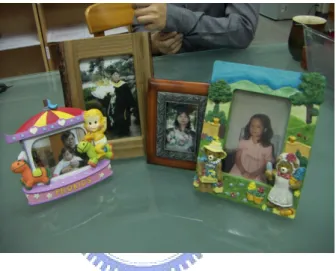
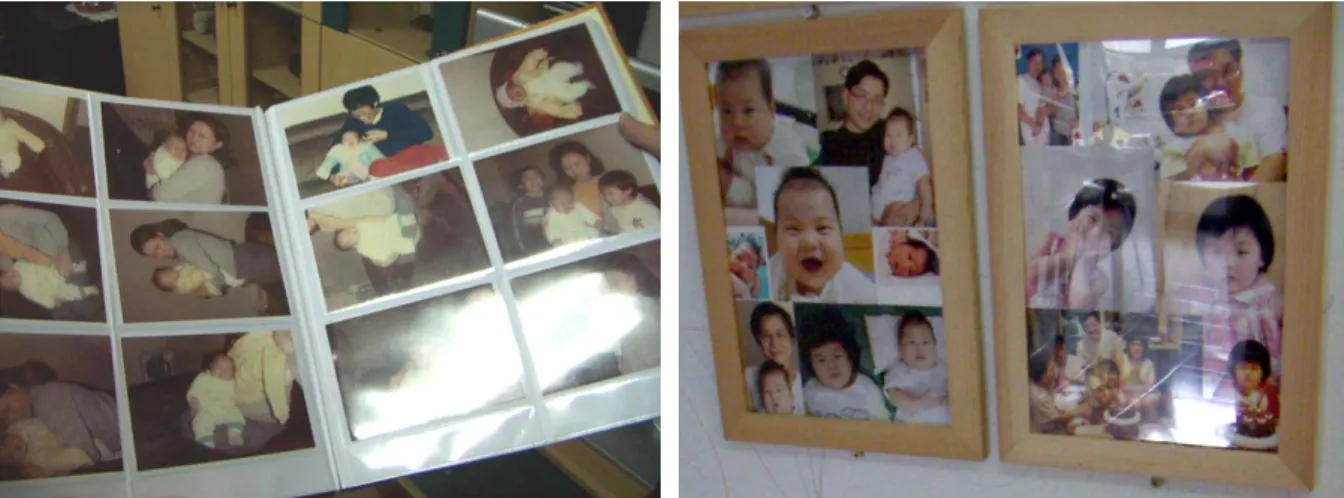
(9) FIGURES Figure 1. Research structure of this thesis ……………………………………………. 16. Figure 2. Procedures of Contextual Inquiry in this research …………………………. 21. Figure 3. Photos packed in light plastic bags …………………………………………. 28. Figure 4. Little photo albums …………………………………………………………. 28. Figure 5. Big photo albums stored in the closet ………………………………………. 28. Figure 6. Digital photos burned into CDs ……………………………………………. 28. Figure 7. Photos reflecting the changes of a family……………………………………. 31. Figure 8. A photo of a family member’s achievement…………………………………. 31. Figure 9. Photo frames in various forms ………………………………………………. 32. Figure 10. An online wedding photo album ……………………………………………. 33. Figure 11. A family photo after the wedding ceremony ………………………………. 33. Figure 12. Baby’s growth record ………………………………………………………. 34. Figure 13. Baby’s growth record ………………………………………………………. 34. Figure 14. Children’s photos displayed by parents ……………………………………. 37. Figure 15. Photos of university students having activities ……………………………. 37. Figure 16. Photos of touring ……………………………………………………………. 38. Figure 17. An old family photo…………………………………………………………. 38. Figure 18. Folders named with dates and events ………………………………………. 41. Figure 19. Annotation in a photo album…………………………………………………. 41. TABLES Table 1. Recruiting Informants ………………………………………………………. 19. Table 2. Research Issues………………………………………………………………. 23. vii.
(10) 1 INTRODUCTION As digital photo technologies have advanced rapidly in recent years, digital photo applications have become more powerful and affordable, and thus popular. However, with the fast-growing popularity, the digital camera market is near saturation. A survey from Camera & Imaging Products Association (CIPA) [1] shows the annual global market growth rate for digital camera has dropped from 70% in 2004 to less than 30% in 2005. At the same time, digital multimedia devices and internet services also begin to enter the domestic sphere. With these digital devices, images taken with the digital camera can be stored, browsed and shared. However, it remains problematic whether these digital devices meet the user's requirements for using photos at home. In order to find new directions for future digital photo applications, uncovering the users’ needs on “photo usage” become the key for digital photo industry. By “photo usage” in this research, it means a set of activities consisting of the technologies, photos, the photos as symbols, and the social aspects of photo circulation.. 1.1 Current Trend of Digital Photo Devices Digital photo devices have gained popularity in recent years. According to a survey published in 2005 by Market Intelligence Center (MIC), 44% of households in North America and 58% of households in Japan had digital cameras [2]. At the same time, the market share of camera phones over the whole cellular phone sales has risen from 30% in the first half of 2005 to 60% in the second half of 2005 [3]. The popularity of digital photo-related devices brings about a large number of digital photos of people's daily life.. From traditional analog photography to digital, not only the form of photo has changed, but the way people use photos and their attitude toward photo-taking activity have changed as well. Digital photos can be distributed through the Internet. In 2006, 65% of households in Taiwan use broadband Internet connections. [4] With the popularity of broadband Internet, digital photo sharing becomes an everyday activity. The online photo albums, which help people share their digital photos with friends on the Internet, are well accepted by the Internet users. One of the well-known online photo albums, flickr, has already cumulated 25 million 1.
(11) members [5]; and WRETCH, a popular Taiwan blog hosting site known for its album service, has reached 18 million members [6]. These records show that people have the desire to share their photos with others. With 3G camera phones and wireless digital cameras, digital photos can be shared easily and instantly with remote friends or family. There are already numerous tools and services in the market for taking and sharing digital images.. To expand the market of photo-related product, Philips has released Digital Photo Display for showing photos at home and Nokia has introduced Imagewear, a tiny wearable photo display. HP and Kodak both invested in exploring users’ capturing, browsing, sharing and printing activities. Digital photo application has already become a popular domain in the consumer product market.. 1-2 Digital Home Recently, “Digital Home” has become a very popular domain in the information technology market. Several information technology companies including Intel and Microsoft are pushing information devices and services into domestic sphere. Except continuing promoting Personal Computers (PCs), they try to bring consumer electronic products and wireless network into people’s homes. Their common ambition is transferring PCs into the center of digital multimedia entertainment devices at home. Meanwhile, consumers are getting more interested in digital multimedia devices which upgrade audio and video entertainment experience and home electric appliances which facilitate communication at home. There is great potential for expending the market of “Digital Home”.. As more and more digital media devices such as Digital Television, DVD Player/Recorder, and Personal Video Recorder enter domestic sphere, consumers produce and keep more and more digital audio/video contents. These digital contents are produced in different format with different devices and stored in different devices at home, thus each of them is usually watched or listened to only on a specific device. For example, digital photos stored in the computer could only be browsed on the computer screen, and TV programs recorded with the Personal Video Recorder could only be watched in the living room. Therefore, people in the 2.
(12) information technology business are aim at connecting all of the digital devices at home with in-home wireless network to support users watching or listening to any digital content at anywhere in their home without restricting by any specific digital media device. For instance, with in-home wireless network connecting computers, TVs and speakers, digital multimedia content in the computer can be played in the living room, where people used to spending their leisure time. Viewing digital photos with TV and listening to digital music downloaded in the computer with speakers in the living room are no longer an unreachable dream.. In 2004, more than a hundred companies in the information technology and consumer electronic device market announced their foundation of Digital Living Network Alliance (DLNA). [7] The goal of DLNA is establishing an interoperability framework between digital devices in the domestic sphere that facilitates shifting of digital multimedia contents between consumer electric devices and PCs and helps users share and exchange their digital contents with digital devices that connected to in-home wireless network. The integration of technologies builds a platform for the exchange of digital content at home, but development of digital media appliance that fits for the domestic sphere has just started. Presently, digital photos at home are usually browsed and shared with present devices such as computers and TVs, however, whether these devices meet users’ needs for applications of digital photos at home and whether digital photos can be applied in different ways in different contexts are still discussible issues. These issues are discussed in the following chapters.. 1-3 Motivation From conventional to digital media, the form of photo is changing. Digital photos are stored and shared in an easier way. Therefore, it has been getting more obvious that taking photos is becoming a daily activity and that people share their experiences and emotions with their family members and friends through photos. These behaviors have indicated that the meaning of photos to users is changing. Photos have not just been media for recording certain events, especially at home, but played an important role in the emotional communication between family members through mutual memory keeping and daily life experience sharing. Therefore, "home" is taken as the research field to explore users' existing experience of daily 3.
(13) life photo usage. Through discovering the meaning of photos to families, it is possible to point out directions for the applications of future digital photo technologies.. 1.4 Objective This research aims to explore the photo usage experience among the family members. One of the objectives is to understand family members’ photo-related behaviors that take place at home in their daily life, such as taking, managing, browsing, sharing and displaying photos. In addition, this study is intent to reveal the important characteristics of photo usage experiences, including the relationships between family members and photos, the features of home photo usage, and the influences of digital photo technology on home photo usage. To ground all the research findings to a vivid conclusion, this study also plans to establish the meaning of photos at home to family members, and point out the directions for how the future digital photo technologies may further enhance people’s photo usage experience at home.. 1.5 Scope The major field of this research is “home” setting. Usage of both conventional and digital photo at home in daily life is discussed while commercial photo usage such as commercial photography and using photos for commercial information exchange is not the major concern. Besides, to highlight the photo-related interaction between family members, this research focus on photos shared by family members instead of private personal photos. However, these photos are not necessarily family photos taken at home; as long as they are shared by family members, they are concerned in this research. In addition, professional photography techniques are not the focus in this research; the emphasis is put on users’ behaviors, motivations, and expectations.. 1.6 Significance On the trend of “Digital Home”, digital devices in domestic sphere will certainly be the focus of future information technology product design. Meanwhile, information technology product designers and developers care more about providing pleasant experiences for users these days. Thus, designers of future photo-related domestic appliances should explore 4.
(14) present user experiences and consider phenomena and problems about the uses of current photo-related appliances. Through this research, understandings of current usages and attitudes of people toward photos at their home are revealed. The influences of digital technology on the usages and attitudes of people toward photos are also discussed. Furthermore, a systematic knowledge about the relationship between families and photos at home is generalized, which will inspire designers the design of future home photo devices and services that fit in with people’s life better.. 1.7 Outline of Thesis This thesis consists of seven chapters: The research background, motivation, objective, scope, significance, and outline of this thesis are introduced in Chapter One. Several relevant studies of photos and meanings of objects are reviewed in Chapter Two. The method of data collecting and analyzing in this research are described in Chapter Three. Findings summed up from field data are presented in Chapter Four. Insights in terms of the meaning of photos in domestic sphere and key factors about how digital media influence photo usage at home are summarized in Chapter Five. The implications for future device and service design of photo usage are delivered in Chapter Six. At last, the conclusion of this thesis is in Chapter Seven.. 5.
(15) 2 LITERATURE REVIEW The purpose of this chapter is to consider present understandings of users' photo experience, and the meaning of photos to people, especially at home. In order to facilitate discussion about the direction of the following studies, prior researches about photo usage and the meaning of objects are reviewed in this chapter.. 2.1 Photo-related Research To reach preliminary understandings on users' present photo experience, gaining considerable issues, and form the structure of this research, the methods and findings of prior researches about conventional and digital photo usage and the meaning of photos from social sciences, design, and information technology points of view, and the development of digital photo-related appliance prototypes are discussed as follows.. 2.1.1 Photo-based Research Researchers in the social sciences such as anthropologists, psychologists and educators use photos to elicit memories and stories from people. The researches mentioned below discuss how researchers understand people’s life through photos.. Chalfen, R. [8] conducted structured interviews and unstructured discussions with teenagers to evaluate the relative merits of using still photography and videography as a preferred medium of family photography. He indicates that family photography is frequently associated with memory and general issues connected to recall of the past. He uses the metaphor of making a memory bank to describe taking photos. This metaphor is telling that a bank is locked up, it prevents loss, it preserves value, and in a sense, it disallows change. Besides, interest grows with investment of picture taking energy, and values increase with time. In other words, photos provide stability and permanency for one’s personal and family knowledge of the past.. The relationship between photos and time, and the link between family photography and 6.
(16) personal/family knowledge are also discussed by Cronin, Ó. [9]. He reviewed theoretical and therapeutic literature on the meaning and psychological significance of family photos. A series of assumptions underpinning the use of photos in research and clinical contexts was evaluated. One of the assumptions is that the essence of a photograph, which differentiates it from other forms of representation, is its relationship to time. He mentions that Boerdam and Martinius believe that photos are a protection against time. They argue that photography has the function of helping one to overcome the sorrow of the passing of time, either by providing a substitute for what time has destroyed or by making up for the failures of memory. Cronin, Ó also evaluated another two assumptions which are that family photographs can either tell us something about family dynamics, or can convey an impression of family unity and cohesiveness; and that family photographs are used to create personal histories. He indicated that therapists have used photos to explore family systems. From photos, phototherapists infer family dynamics, power relations and affectional bonds. He also quoted Sontag’s claim that photos came along to memorialize, to restate symbolically, the “imperiled continuity and vanishing extendedness of family life”. Besides, the rest of his assumptions are: that there are two types of photograph, those which contain information and those provoke an emotional reaction; that the use of photographs tends to be grounded within either a 'realist' or a 'symbolist' folk myth; that the meaning of a photograph arises in a narrative context.. Loeffler, T.A. [10] had also discussed about the issue that the meaning of a photo arises in a narrative context through her research which used photo-elicitation interviews to investigate the significance of university-based outdoor experiences for participants. She ascertains the role of photography in assisting students to make connections from their outdoor experiences to their everyday life. Photos are proved to be a powerful reflective tool that participants utilized as anchors and triggers for past memories. They used photographs to capture meaningful moments from their outdoor experiences and then used the photos to share their experiences more easily with family and friends. This research contributes to the ways in which photography facilitates participants’ connections to those experiences.. These studies generalized several meanings of photos to people, such as containing 7.
(17) information, connecting to experiences, and provoking emotional reactions, which are referable for understanding the meaning of photos to families. However, their theses gave little description about people’s daily photo usage such as capturing, managing, and sharing. The impact of digital technology on the meaning of photos is not included in these researches, too. Therefore, it is hard to gain direct information for developing home digital photo devices and services from these studies.. 2.1.2 Photo Usage In the studies summarized below, researchers covered the impact of digital technology to review people’s photo usage and show some different implications between printed photos and digital photos.. Mäkelä, A. et al. [11] conducted a field trial case study of leisure related communication with digital photos. Their three major findings about the usage of photos are: first, photos were mainly used for joking, expressing emotions and creating art; second, users' perception of photos changed from memory support to the expression of current activities and feelings; and third, photos were not enough for functional communication, therefore possibility for annotation with text or audio should be provided.. Frohlich et al. [12] studied eleven families by using a combination of ethnographic field observations, interviews, and self-recording techniques to investigate peoples’ sharing practices of conventional and digital photos and to find out what people want to do differently with digital photos. They classified the way people share their photos into four categories along two dimensions, here versus there, and now versus later. In the category, “Archiving”, it shows that photos can be exchanged asynchronously between people by accessing photo albums in a fixed location. Photo albums are seen as the best way of archiving conventional photos for future sharing. But it is hard for families to making up albums while lacking the time and motivation to do so. In “Sending”, it shows that photos can be exchanged asynchronously by mailing or e-mailing photos to others in a remote location. Photo-sending activities are embedded in ongoing interactions and relationships. Families experience joy 8.
(18) from the feedback and subsequent conversation around the photos they have sent. In “Remote sharing”, it shows that photos can be exchanged synchronously between people separated by distance. Many participants said that they frequently send and receive photos to or from remote locations, and then discuss those photos synchronously over the telephone. In “Co-present sharing”, it shows that photos can be exchanged in real time between people co-located in time and place. Of all the methods of interacting around photos, sharing photos in person was described as the most common and enjoyable. In contrast, many participants reported being “turned off” by looking at digital photos on a computer screen when sharing with friends and family.. Frohlich et al. have found that photos are taken ostensibly to capture memories for future personal reference, but in practice are used to review and communicate experiences with others. In general the most successful past and present photo-related technologies have been those with the greatest affordances for image-based communication. They believe people would like to use photos more extensively as catalysts for conversation in extended family and friendship contexts, and to improve individual relationships over distance and time. Future technology should help users in their socialization of digital photography products and services, in order to extending the sharability of digital photos cross a range of use contexts.. Interviewing 13 people about their current practices of taking, sharing, annotating, retrieving, and using photos, and conducting two focus groups, Van House et al. [13] identified three social uses of personal photography: memory, creating and maintaining relationships, and self-expression. They indicated that photos have an ability to evoke memories, including sensual memories. People's attitudes toward photo annotation are conjectured to be associated with issues of memory. Photos are used to maintain existing relationships and even create new ones, too. The strong presence of family and friends in people's photos high-lights the importance of interpersonal relationships and photos. Besides, photos are also used as self-expression, which give expression to our authentic self. In addition, Van House et al. had also discussed about people’s attachment to printed images and resistance to recording metadata in their research. They explained these phenomena with the 9.
(19) roles of orality, materiality and storytelling in photo usage: first, the materiality of prints interacts with the social uses of photos and the practices of creating photo albums and face-to-face photo sharing; second, the role of face-to-face oral communication in people's use of photos is associated with their overall lack of interest in assigning metadata and making annotations; and third, printed photos support the oral transmission of family stories and intergenerational experience and knowledge.. Voida, A. & Mynatt, E.D. [14] developed an instant messaging client as a technology probe to explore the use of digital photographs in computer-mediated communication. Six themes of the communicative appropriation of photographic images emerged from their analysis: the image as amplification, the image as narrative, the image as awareness, the image as local expression, the image as invitation, and the image as object/instrument.. These studies above gave detailed description about people’s daily photo usage and the impact of digital technology on their photo usage, which directly inspire the development of digital photo devices and services and are helpful for this research. Besides, the research methods of field study in these studies for obtaining users’ behavior and attitude are also referable for this research.. 2.1.3 Digital Photo-related Prototype Systems For designing digital photo devices and services at home, it is necessary to be acquainted with the latest digital technologies supporting photo usage. The researches motioned below are about prototype systems developed based on current technology for managing, browsing, and sharing personal photo collections by researchers of information technology and design.. Graham, A. et al. [15] developed two photo browsers for collections with thousands of time-stamped digital images. Their browsers exploit the timing information to structure the collections and to automatically generate meaningful summaries. The browsers differ in how users navigate and view the structured collections. They conducted user studies to compare the two browsers and an un-summarized image browser. The results showed that exploiting 10.
(20) the time dimension and appropriately summarizing collections can lead to significant improvements. For example, their browsers enabled improvement in speed of finding given images compared to the commercial browser.. Wenyin, L. et al. [16] present a novel approach to semi-automatically and progressively annotate images with keywords. When the user submits a keyword query and then provides relevance feedback, the search keywords are automatically added to the images that receive positive feedback and can then facilitate keyword-based image retrieval in the future. The coverage and quality of image annotation in such a database system is improved progressively as the cycle of search and feedback increases. The strategy of semi-automatic image annotation is better than manual annotation in terms of efficiency and better than automatic annotation in terms of accuracy.. Photos play a central role in many types of informal storytelling. Balabanović, M. et al. [17] developed an easy-to-use device that enables digital photos to be used in a manner similar to print photos for sharing personal stories. A portable form factor combined with a novel interface supports local sharing like a conventional photo album as well as recording of stories that can be sent to distant friends and relatives. User tests validated the design and revealed that people alternate between "photo-driven" and "story-driven" strategies when telling stories about their photos.. Sarvas, R. et al. [18] implemented a mobile phone photo sharing system "MobShare" that enables immediate, controlled, and organized sharing of mobile photos. The design combines research on photography, personal photo management, mobile phone camera use, mobile photo publishing, and an interview study they conducted on mobile phone camera users. The implementation describes solutions in immediate sharing of mobile photos to an organized web album, and in providing full control over with whom the images are shared.. These researches introduced the innovative features of photo-related prototype systems, how their functions worked, and the positive effect in using these systems. This information is 11.
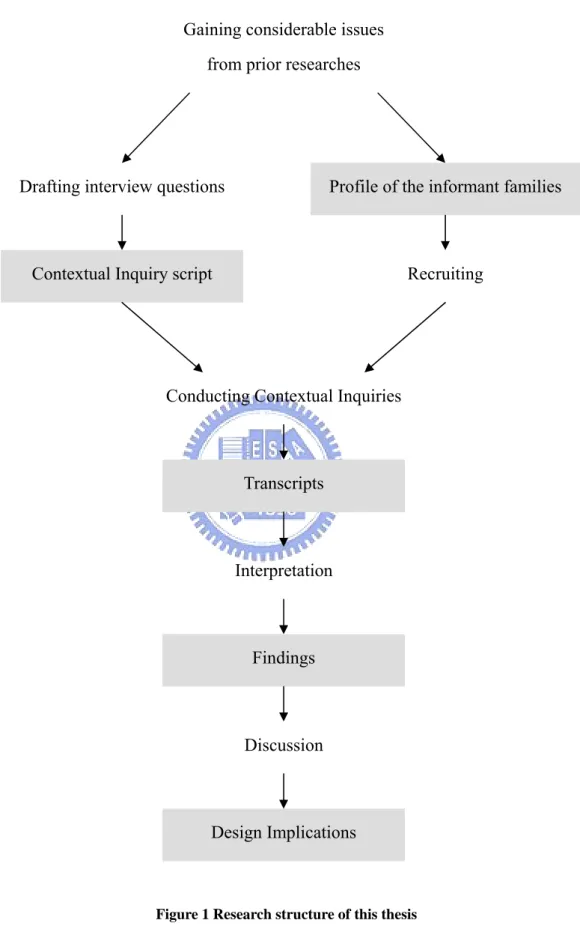
(21) helpful for the design of future photo devices and services which properly apply digital technologies.. 2.2 Meaning of Objects Photos are often regarded as meaningful objects in domestic environment. In order to facilitate discussion about the meaning of photos at home, studies of the meanings of objects in domestic environment are reviewed.. Richins [19] divided meanings into private and public. The sources of meaning are in Utilitarian value, Enjoyment, Representations of interpersonal ties, and Identity and Self-Expression. This relatively similar categorization leaves out the ‘companion’ category, and proposes enjoyment as a separate one. Her paper also presents a thorough analysis of approaches to product meaning and value.. Battarbee, K., and Mattelmäki, T. [20] analyzed 113 stories about meaningful products collected in Finland and divided three main categories of meaningful relationships with products: meaningful tool, meaningful association, and living object. If a tool is needed for a purpose, in which the activity itself, not the hardware, it is sorted in the category of "Meaningful Tool", such as a foldable hair brush, a mobile phone, and a sewing machine. If a product refers to or carries a meaning given by culture or an individual, it is sorted in the category of "Meaningful Association", such as a Pastilli chair and a wedding ring. If there is an emotional bond created between the person and the individual product, the product is sorted in the category of "Living Object", such as a toy car and a stuffed toy bunny. Battarbee and Mattelmäki also mentioned that people have many overlapping relationship to meaningful objects at the same time.. In "The meaning of things –Domestic symbols and the self", Csikszentmihalyi & Rochberg-Halton [21] studied the significance of material possessions in contemporary urban life, and of the ways people carve meaning out of their domestic environment. They interviewed 82 families in Chicago about things that are special for the family members and 12.
(22) the reasons of why those things are special. The “significations” of the special things were coded into 37 categories of meaning. Of all the reasons given for cherishing photos, Memories and Immediate Family had the largest proportion while no other object had such a high proportion of reasons in these two categories. Photos serve the purpose of preserving the memory of one's close relations more than any other object at home. Photos which bear the image of a departed kin impart a tenuous immortality to beloved persons and provide an identity, a context of belongingness, to one's descendants. In addition, Csikszentmihalyi & Rochberg-Halton mentioned that the preference for photos shows a dramatic age difference. Photos meant the most to grandparents and the least to children. Ten percent of the children mention at least on photo as being special, as compared to 22 percent of the parents and 37 percent of the grandparents.. Bih [22] investigated the role that objects have in helping people adapt to a new environment. Fourteen Chinese postgraduate students going abroad were interviewed one semester after their arrival in New York City. The meanings that students attached to objects, and how the meanings of objects changed during their adaptation to their new environment are discussed. The discussion is placed in the context of person-object relationships and it is emphasized that objects can both reflect and actively affect an individual’s feelings and emotion. Many of the students brought their photos to the new environment with them. One student brought the photos of his parents to encourage him. Two students brought their girl friend's photos that let them feel that their girl friends were still close to them. One student looked at the photos of 'the good old days' when she was in bad mood. One student brought an album of his travel pictures taken in 15 different countries. He said that it was very helpful for the development of social relations. Photos were brought to the new environment to connect with their past experience, present conditions, and future expectations.. Different from the researches mention above emphasized on description and categorization of meaning of objects, Bih focuses on the change in the relationship between human and objects. He indicates that meanings exist in a context of specific personal history and environment, meanings are the results of human-object interaction, meanings are not static, 13.
(23) how meanings change in different contexts and how people attach meanings to objects is discussible. Likewise, in this research, the meaning of photos in the context of the interaction between family members and the changes of the meaning of photos as family life changes are discussible and would be discussed in the following chapters.. These studies above did detailed analysis of the meanings of objects in people’s residence from psychological views. Some of them provided insights into the meaning of photos. The connections between photos and memory, family, achievement, and social exchange are revealed in these researches. Besides, the methods of obtaining the meaning of objects from the users in these studies are also referable. However, their studies did not cover digital photos, so the differences between the meaning of printed photos and digital photos are absent.. 2.3 Summary These studies reviewed above provide different points of view to review photo usage in different contexts and show the diversifications of photo usage. However, the study of covering both the meaning of conventional and digital photo and photo-related devices uses at home for individual and family is absent. This thesis aims at uncovering the detail of how people interact with photos at home based on Contextual Inquires discussed in next chapter. Furthermore, some design implications derived from findings are also discussed in Chapter Four to Chapter Six.. 14.
(24) 3 METHOD To fully acquire users’ experience about photo usage at home, understanding of users’ behavior and value is critical and indispensable. However, this kind of information cannot easily be learned through traditional research methods such as questionnaires. Thus, instead of collecting a large number of data through survey, a user research method called “Contextual Inquiry” that helps researchers enter the context of users’ daily life and acquire knowledge about user’s experience through interviews and observations about users’ activities is conducted to collect data about daily photo usage at home.. The research method in this research includes collecting data through Contextual Inquiry, analyzing data in a qualitative way, and proposing implications for future photo device and service design. First, considerable issues were acquired from prior researches and transferred to interview questions. Second, the Contextual Inquiry script was planned and profile of the informant families that describes the characteristic of the informant families and their photo experience was formed. Third, informant families were recruited and Contextual Inquiry was conducted. The Contextual Inquiry script was improved between each inquiry. Forth, the inquiries were taped and transferred into transcripts, which were coded into key ideas and interpreted into several themes. Finally, features of how people capture, manage, browse, share, and display photos and their attitudes toward photos at home were presented and the implications for future digital photo device and service design are delivered. (See Figure 1). 15.
(25) Gaining considerable issues from prior researches. Drafting interview questions. Profile of the informant families. Contextual Inquiry script. Recruiting. Conducting Contextual Inquiries. Transcripts. Interpretation. Findings. Discussion. Design Implications. Figure 1 Research structure of this thesis. 16.
(26) 3.1 Contextual Inquiry According to Hugh Beyer and Karen Holtzblatt's [23] definition, Contextual Inquiry is a field data-gathering technique that studies a few carefully selected individuals in depth to arrive at a fuller understanding of the work practice across all customers. Through inquiry and interpretation, it reveals commonalties across a system's customer base.. Contextual Inquiry is originated from ethnography, which was originally a research method used in anthropology. In the Contextual Inquiries, researchers observe users’ activities in the real environment they live in or work in to obtain information about the way they live or work. Contextual Inquiry differs from ethnography in that Contextual Inquiry researchers not only observe people’s activities in the real context, but also conduct in-field interview with the users. During the interview, researchers and users discuss about users’ activities, their motive of these activities, the problems they encounter, and the way they deal with the problems. The interview proceeds in an in-depth semi-structured way. There is a scheme for the interviewer, but no word-by-word questions to follow. The whole inquiry is a process for the researchers and users to explore users’ activity collectively. Users respond researchers questions with self-experience; and researchers ask further questions from users’ feedback. Through the process of Contextual Inquiry, researchers accumulate fuller understandings about the research issues, and keep asking further questions to be answered in the next inquiry. Unlike structured interview and questionnaire, the purpose of Contextual Inquiry is not to confirm the opinion of most users, but to explore users’ work practice broadly.. To understand users’ photo usage at home and uncover users' needs for photo-related domestic appliances, Contextual Inquiries that include in-field interviews and observations were conducted at the informant families’ home. Through in-field interviews with users, firsthand information about people's photo-capture, storage, and sharing behavior and their attitude toward photos under real environment are revealed. Each interview lasted about two hours. The interviews were taped, and photos of their cameras and other photo-related devices, places they keep their photos, their label and annotation on their photo, the photos they displayed in their home and every photo they mentioned were also taken during the interview 17.
(27) for the researchers to analyze.. 3.2 Recruiting Informants The key feature of Contextual Inquiry is obtaining information of issues concerned in this research through the participation of the users in the real environment. During the two-hour process, discussions with the informants and the representation of informants’ activities help disclosing users’ experiences. Representative users are recruited as informants in Contextual Inquiries to provide rich and firsthand information instead of a large number of respondents for quantitative survey.. Recruiting informants for this research was not easy. Most people hesitated to let strangers enter their home, especially when the strangers need to see their private photos. Therefore, the informants were mostly recruited from acquaintances of the researchers in this research. Thus, they were willing to have interviews at their home. Screeners were sent to each of the candidate informants. The screener is a questionnaire explains the purpose of this research and consists of a set of short questions, which reveals their photo-related behavior. (See Appendix B) It helps to filter out people who fit the criteria set for the contextual inquiry. The criteria for screening out the informants were the frequency of taking and sharing photos, the variations of using different photo taking devices such as conventional cameras, digital cameras, and camera phones, and the variations of media use for sharing photos such as flipping photo albums together, showing photos with photos frames in the public area, E-mailing their photos, and uploading their photos to the online photo albums. After filtering out informants who fit the criteria, they were asked for exact dates and times for the visit.. In order to explore the photo-related interaction between family members, a family was recruited as an informant unit. According to Kuniavsky’s [25] suggestion, five to eight informants should give a pretty good idea of the target user and should be enough for the inquiry. Therefore eight families were preplanned to be interviewed in this research. However, the number of informant families is not confirmed until the information acquired from the latest informant family is similar to previous inquiries very much. After the acquired data 18.
(28) reached “Theoretical Saturation”, no new informant family is added. Finally, the contextual inquiries were conducted with nine families in north Taiwan, especially in Taipei and Hsinchu area. In order to gain understandings of photo usage in different family life stage, these families are picked of different composition, including young couples with preschool children, middle-aged couples with and without their children living at home. (See Table 1). Table 1 Profiles of informant families. Family Composition. Camera. Storage. 1. Middle-aged couple. Traditional camera,. Photo album, Photo album,. without their young. Single-lens reflex camera, Photo frame, Photo frame,. children living at home Digital Camera, Camera phone. Sharing. Wall,. Computer,. Computer,. E-mail,. CD. Online album, Online space. 2. Couple with their. Traditional camera,. preschool children. Single-lens reflex camera, Wall,. Wall,. Digital Camera,. Computer,. Photo frame,. Camera phone. CD. Mail,. Photo album, Photo album,. Computer 3. Middle-aged mother. Traditional camera,. with her young children Digital Camera. Photo album, Photo album, Wall /Desk,. Computer,. Computer. Online album, Online space. 4. Couple with their. Traditional camera,. Photo album, Photo album,. preschool children. Digital Camera,. Computer,. Photo frame,. Camera phone. CD. Mail, Computer, E-mail. 19.
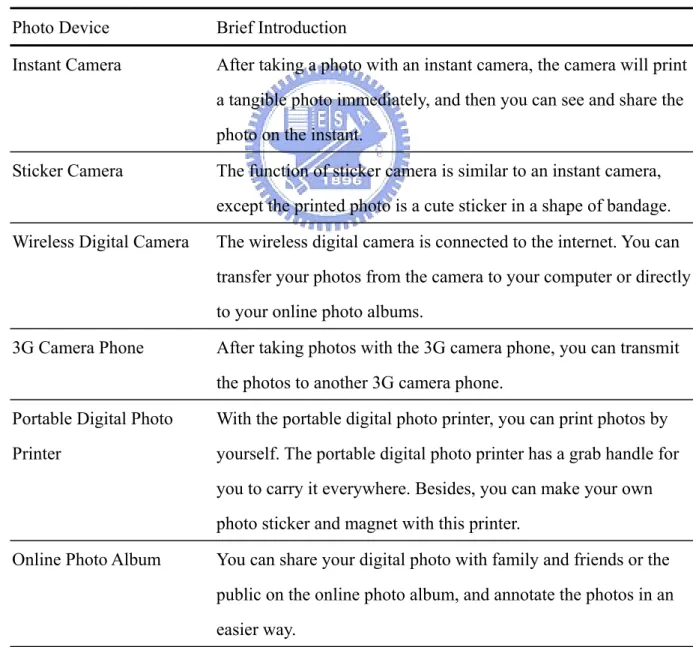
(29) 5. Middle-aged mother. Traditional camera,. with her young children Digital Camera. Photo album, Photo album, Wall /Desk,. Computer,. Computer,. E-mail,. CD. Online album, Online space. 6. Old-age couple with. Single-lens reflex camera, Photo album, Photo album,. their children living at. Digital Camera. home. Computer,. Photo frame,. CD. Computer, E-mail, Online space. 7. 8. 9. Old-age couple without Traditional camera,. Photo album, Photo album,. their children living at. Digital Camera,. Photo frame, Computer,. home. Camera phone. Computer,. E-mail,. CD. Online album. Middle-aged couple. Traditional camera,. Photo album, Photo album,. with their teenage. Digital Camera,. Computer,. children. Camera phone. CD. Middle-aged mother. Traditional camera,. Photo album, Photo album,. without her young. Digital Camera. Wall,. Photo frame,. Computer. Wall,. children living at home. E-mail. Mail. 3.3 Research Questions The in-depth inquiry was mainly focused on informants’ photo-related activities, including taking, managing, browsing, sharing, and display, and their motivations. The difference between their attitude toward conventional and digital photos and their opinions about photo devices or services recently in the market were also discussed. Figure 2 shows the entire procedures carry out for each informant family. During the in-field interviews, the processes and unexpected findings of the interviews are noticed momentarily and the interview questions are added or subtracted according to the feature of the informant families. 20.
(30) (Before the interview) Asking informants for picking photos having specific meanings to them. Introduction of researchers, research objective and procedures. Discussion of photos picked by informants. Discussion of photo-taking activities and devices. Discussion of photo-managing activities. Discussion of photo-sharing activities. Discussion of photo-display activities. Discussion of informants' attitude toward conventional and digital photos. Introduction and discussion of latest photo devices. Discussion of other related issues and Acknowledgement. Figure 2 Procedures of Contextual Inquiry in this research 21.
(31) The purpose of this research is to understand the meaning of photos to family members. It is hard for some informants to express their opinions about the meaning of photos directly. Through browsing and talking about informants’ photos, informants’ attitude toward photos is revealed. Therefore before the interview, the informants were requested to pick five photos having specific meanings to them. The photos must be taken by the informant or his family and viewed by more than two members in his family for revealing the photo-related interaction between family members. The informants were requested to show and introduce the photos they picked. Some questions about these photos were asked, such as why these photos are special to them, under what circumstances they took these photos, with what device they took these photos, why they took photos with the specific device, and which aspect of their photo-taking devices they like and hate about and why.. Some questions about their photo managing, browsing, sharing, and display habits and their photo usage between conventional and digital photos as follows were also asked:. Where do you store your photos at home? How do you manage your photos? How do you name, label or annotate your photos? Under what circumstances do you review your old photos? Which photos do you share with others? Whom do you share your photos with? How and for what purpose do you share your photos? How do your family members or friends share photos with you? Which photos are displayed at the public area at home? Where and why do you display these photos? Do you carry photos with you? Is there any difference between your conventional and digital photo usage? Which aspects do you like and dislike about conventional and digital photography? Do you have different attitude toward conventional and digital photos?. 22.
(32) At the end of the interview, photo devices and services recently in the market were introduced to the informants, including instant camera, sticker camera, wireless digital camera, 3G camera phone, portable digital photo printer, online photo album, digital photo frame, and digital photo necklace. (See Table 2) These products include conventional and digital devices and services used for photo taking, managing, sharing, and display in the domestic sphere. In order to increase the informants’ understanding to these products, pictures of these photo-related devices are displayed at the same time. The opinions about these products and the way they might want to use them were also asked and taped.. Table 2 Photo devices introduced in Contextual Inquiry (for more details please refer to Appendix C). Photo Device. Brief Introduction. Instant Camera. After taking a photo with an instant camera, the camera will print a tangible photo immediately, and then you can see and share the photo on the instant.. Sticker Camera. The function of sticker camera is similar to an instant camera, except the printed photo is a cute sticker in a shape of bandage.. Wireless Digital Camera. The wireless digital camera is connected to the internet. You can transfer your photos from the camera to your computer or directly to your online photo albums.. 3G Camera Phone. After taking photos with the 3G camera phone, you can transmit the photos to another 3G camera phone.. Portable Digital Photo. With the portable digital photo printer, you can print photos by. Printer. yourself. The portable digital photo printer has a grab handle for you to carry it everywhere. Besides, you can make your own photo sticker and magnet with this printer.. Online Photo Album. You can share your digital photo with family and friends or the public on the online photo album, and annotate the photos in an easier way.. 23.
(33) Digital Photo Frame. You can load hundreds of your digital photos into the digital photo frame. The digital photos can be view as slideshow with the frame on your desk.. Digital Photo Necklace. You can load your favorite photos to this tiny wearable display, and wear your necklace with a unique pendant.. 3.4 Analysis After each inquiry process, a debriefing session is proceeded as soon as possible. Questions about informant families’ taking, managing, and sharing activities, photo-related interactions between their family members, and differences between their attitude toward conventional and digital photos as follows are answered.. 1. What is their 6W1H (who, what, when, where, why, how, whom) of photo taking? 2. What is their 5W1H (who, what, when, where, why, how) of photo management? 3. What is their 6W1H (who, what, when, where, why, how, whom) of photo sharing? 4. What is their motive of using specific device to take, manage or share their photo? What are their needs for devices for taking, managing or sharing photo? 5. What troubles them in their photo usage? 6. What are the differences in their photo usage between conventional and digital photos? 7. Do they have different attitude toward conventional and digital photos? 8. Do different members in a family use photos in different ways? 9. What are similarity and differences in photo usage between different families? 10. Which photos are regarded as special and valuable ones? Which elements do they care most about photos? 11. How do the members in a family interact through photo usage? 12. Is there any additional issue worth discussing in the following inquiries?. Photo usage profile of each informant family was built through answering these questions; and key issues in each informant’s photo experience were captured at the same time.. 24.
(34) The data collecting and analyzing approaches in this research are primarily qualitative. All the relevant information gathered through Contextual Inquiry is detailed, multifarious, and jumbled. This information needs to be carefully re-organized for following discussion. Therefore after the in-field studies, the taped interview conversations were transferred into transcripts, which were later coded into key ideas and interpreted under several themes. Finally, features of how people capture, store, browse, share, and display photos, their attitudes toward photos at home, and their uses of photo-related appliances in domestic sphere were presented in the next chapter.. 25.
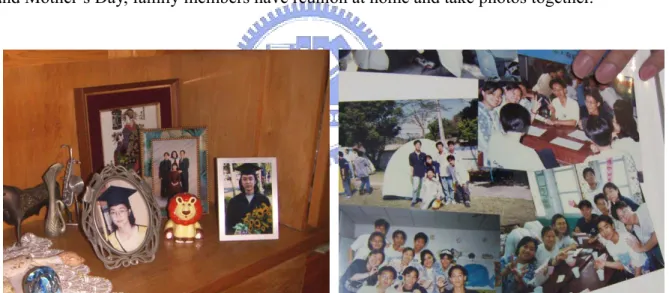
(35) 4 FINDINGS In this chapter, findings that cover several elements of photo usage at home, such as people, family context, activities, media, and technologies, are summarized from the interview transcripts. The findings are coded into several themes and presented under these themes for designers of digital photo devices to know the characteristics of home photo usage clearly and well. Three main themes in this chapter are: photo-related activities, photo usage in different family life stage, and differences between conventional and digital photo usage.. 4.1 Photo-related Activities Photo-related activities at home are categorized into photo taking, managing, browsing, sharing, and display in this section. The findings about people’s photo-related activities including people’s habits and preferences, the annoyances, and the tools people use, are described as follows.. 4.1.1 Photo Taking People like to take photos of memorable moments in a natural way for future reminiscence. The occasions for family photo taking include birthdays and weddings of each family member, parents' wedding anniversary, Father's Day and Mother’s Day, Chinese New Year, family travel, and some other family reunions. On these particular holidays or anniversaries, members in the family get together to have meals, chat and take photos of all family members attending the party.. Most of the informants consider family photography should be artless and dislike posing their family members before taking photos for them. They prefer to capture more natural and vivid look of their family and record family life honestly for future reminiscence. This can be seen in the quote below from the father of Family 1 (F1).1. 1. In subsequent quotes, the following notation is used to identify speakers: I= Interviewer, M1= Mother of Family 1, F2= Father of Family 2, S3= Only son of Family 3, D4c= Third daughter of Family 4. 26.
(36) F1: The purpose of family photography is recording dribs and drabs of family life. I would like it to be natural. I am opposed to adding artificial after effects on photos. It is not necessary to take family photos in an artistic way. I think taking family photos isn’t that complicated. Interesting dribs and drabs in the family captured with photos will simply become lovely reminiscences after several years.. When the informants were requested to pick photos having specific meanings to them, many of them use terms such as "for the first time", "rarely", and "memorable" to describe their photos. Photos recorded of memorable experiences can be very special to people. When people look at these photos, they can still recall and describe the special scenes they saw.. Besides, most of them are satisfied with the functions of their cameras. One of the informants said, for a good photo, the moment to take the photo is more important than the camera and technical skills. He indicated that good photos could also be taken with Instamatic (point-and-shoot camera).. 4.1.2 Photo Management The most common way people store their photos is putting them into photo albums. Printed photos retrieved from the printing store are packed in light plastic bags (See Figure 3) or little photo albums that are easy to be flipped (See Figure 4). These bags or albums are usually placed in a public area at home such as the living room. Photos in this form are accessible and browsed most frequently. After being in the public area for a few days, part of these photos is rearranged in bigger albums in some families. This rearranging behavior is similar to putting fragmental files in a big file clip. Big photo albums are stored in the closet of the living room or bedroom. (See Figure 5) Since the photos are stored in the closet, people rarely flip them. Likewise, after digital photos were burned into CDs, they were also scarcely browsed. (See Figure 6) In truth, people rarely browse old photos, especially when the photos are not easily accessible.. 27.
(37) Figure 3 (on the left) Photos packed in light plastic bags; Figure 4 (on the right) Little photo albums. Figure 5 (on the left) Big photo albums stored in the closet Figure 6 (on the right) Digital photos burned into CDs. Most people don't take much effort on managing photos. They only organize and annotate their photos simply. Arranging photos in chronological order is the basic way people manage their photos. When conventional photos in the same film are retrieved from the printing store, the clerk in the store puts the photos in plastic bags or photo albums chronologically for their clients. Likewise, when digital photos are transmitted into computers, they are automatically arranged in chronological order. Besides arranging photos in chronological order, some families annotated their photos with dates, places, events and other information on the big photo albums to preserve details of the photos for future remembrance. Most big photo albums are preplanned with memo columns beside the photo columns for users to add annotations. Different from preplanned photo albums, photo scrapbooks allow users to stick 28.
(38) their photos in their own way. One of the informants in this research uses photo scrapbooks to collage his photos enthusiastically with bookmarkers, letters from friends, and other objects related to the photos as decorations. Another informant puts printed material of her tour into photo album of her travel:. D6a: I used to arrange photos of my first travel aboard carefully in time order. Each photo was well annotated with information about the date, the place and my companions in the photo. I also put the tour schedule on the last page of the photo album as an appendix. After that, however, I rarely organize my photos in such careful way.. Unlike the enthusiastic informants mentioned above, most of the informants said that they are too busy and too lazy to annotate or arrange their photos carefully. One of the informant families originally put all of their photos in a big brown paper bag. One day when they tried to rearrange their photos into big photo albums, it was hard for them to organize the photos chronologically. Therefore, some of the photos in their photo albums were not arranged in time order, and that bothered them when they flipped the photo albums. Other families also have some loose old photos accidentally found in somewhere at home. These photos are usually later put in the blanks in the photo albums with neglect of their time relations with other photos in the albums. The neglect of the chronological order of photos would cause confusion when viewing photos several years later.. 4.1.3 Photo Browsing People rarely browse their old photos. The photos they browse more often are those taken or printed lately. Only when they want to find a specific photo or when they move their home, clean their room or reorganize their computer files, they may accidentally find their old photos and start to browse through them. However, once they start to browse the photos and memories of the old days emerge from the bottom of their heart, they cannot stop browsing. Because viewing old photos reminds people the happiness in the old days. When one of the informants was asked about when she browses her old photos, she said:. 29.
數據


+7



相關文件
Wang, Solving pseudomonotone variational inequalities and pseudocon- vex optimization problems using the projection neural network, IEEE Transactions on Neural Networks 17
volume suppressed mass: (TeV) 2 /M P ∼ 10 −4 eV → mm range can be experimentally tested for any number of extra dimensions - Light U(1) gauge bosons: no derivative couplings. =>
For pedagogical purposes, let us start consideration from a simple one-dimensional (1D) system, where electrons are confined to a chain parallel to the x axis. As it is well known
The observed small neutrino masses strongly suggest the presence of super heavy Majorana neutrinos N. Out-of-thermal equilibrium processes may be easily realized around the
Define instead the imaginary.. potential, magnetic field, lattice…) Dirac-BdG Hamiltonian:. with small, and matrix
incapable to extract any quantities from QCD, nor to tackle the most interesting physics, namely, the spontaneously chiral symmetry breaking and the color confinement..
(1) Determine a hypersurface on which matching condition is given.. (2) Determine a
• Formation of massive primordial stars as origin of objects in the early universe. • Supernova explosions might be visible to the most
