DOI: 10.1007/s00340-002-1086-2 Appl. Phys. B 76, 263–266 (2003)
Lasers and Optics
Applied Physics B
y.f. chen1,u s.w. chen1 s.w. tsai2 y.p. lan2
High-repetition-rate eye-safe optical
parametric oscillator intracavity pumped
by a diode-pumped Q-switched Nd:YVO
4
laser
1Department of Electrophysics, National Chiao Tung University, 1001 TA Hsueh Road, Hsinchu 30050,
Taiwan R.O.C.
2Institute of Electro-Optical Engineering, National Chiao Tung University, Hsinchu, Taiwan R.O.C.
Received: 10 July 2002
Published online: 26 February 2003 • © Springer-Verlag 2003
ABSTRACT A high-repetition-rate eye-safe optical paramet-ric oscillator (OPO), using a non-critically phase-matched KTP crystal intracavity pumped by an acousto-optically (AO) Q-switched Nd:YVO4laser, is experimentally demonstrated. It is found that the average OPO signal power at 1573 nm can be efficiently increased by increasing the pulse repetition rate. Moreover, the intracavity OPO process effectively shortens the pulse width so that it is in the range 5∼ 8 ns for pulse repetition rates of 10 to 80 kHz. As a result of the relatively short pulse, the peak power at 1573 nm is higher than 2 kW at a pulse repetition rate of 80 kHz.
PACS42.60.Gd; 42.65.Yj; 42.55.Xi
1 Introduction
Nanosecond pulsed lasers emitting in the eye-safe wavelength region (1.5–1.6 µm) are indispensable for appli-cations such as telemetry and for use in range finders [1]. The need for high-peak-power eye-safe laser sources has stim-ulated much interest in intracavity optical parametric oscil-lators (OPO’s). Intracavity OPO’s take advantage of a high power level within the oscillator to allow a low threshold and high efficiency compared to extracavity OPO’s. Although in-tracavity OPO’s have been proposed for over 30 years [2–4], only recently have their merits been appreciated, with the ad-vent of high-damage-threshold nonlinear crystals and diode-pumped Nd-doped lasers [1, 5–7]. Several crystals belong-ing to the potassium titanyl phosphate (KTP) family, when pumped by Nd-doped laser pumps around 1050–1070 nm, generate signal wavelengths around 1.55 µm [8–11]. One ad-vantage of the KTP family is the non-critical phase-matching configuration that allows a good OPO conversion efficiency even with poor-beam-quality pump lasers. Another advantage is the large available crystal size that allows the generation of high energies. Furthermore, using a diode-pumped Nd-doped laser to intracavity pump the OPO can offer a compact and rugged design with a low threshold and high efficiency.
The conventional intracavity OPO’s, in which flash lamps or quasi-cw diodes are used as the pump sources, u Fax: +886-35/729-134, E-mail: [email protected]
typically restrict operations to low repetition rates less than 1 kHz [12, 13]. Even though a compact diode-pumped Q-switched intracavity OPO has been demonstrated at fre-quency repetition rates from 1 to 20 kHz, the overall output peak power was less than 70 W [14]. A recent study has shown that a high-peak-power (> 1 kW) laser with a high repetition rate (> 10 kHz) is beneficial to the performance of a scanning, photon-counting laser altimeter [15].
In this work, we report the demonstration of a high-repetition-rate intracavity OPO based on a non-critically phase-matched KTP crystal excited by a cw-diode-pumped acousto-optically (AO) Q-switched Nd:YVO4 laser operat-ing at 10∼ 80 kHz. With an absorbed pump power of 12.6 W, the compact intracavity OPO cavity, operating at 80 kHz, pro-duces average powers at 1.573 µm up to 1.33 W and peak powers higher than 2 kW.
2 Experimental
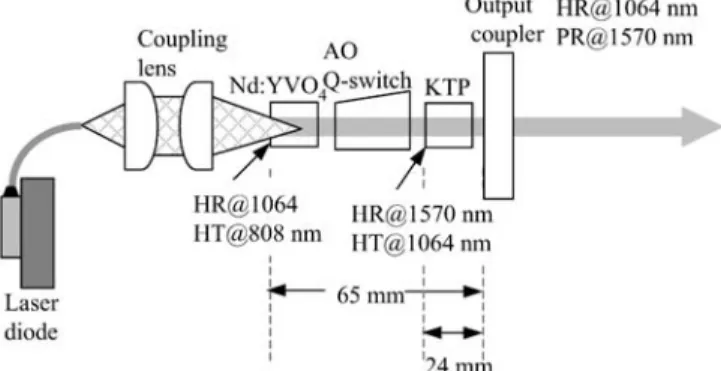
A schematic of the basic laser setup is shown in Fig. 1. The experimental setup makes use of a 0.8 mm core fiber with a numerical aperture of 0.16 and a maximum out-put power of 15 W. A focusing lens with a 12.5 mm focal length and 85% coupling efficiency was used to re-image the pump beam into the laser crystal. The waist diameter of the pump beam was around 300µm. The fundamental cavity was formed by a coated Nd:YVO4crystal and an output cou-pler. The a-cut 0.3 at. % Nd3+, 7-mm-long Nd:YVO4
crys-FIGURE 1 Schematic of the intracavity OPO pumped by a cw-diode-pumped AO Q-switched Nd:YVO4laser
264 Applied Physics B – Lasers and Optics
tal was coated for high reflectivity at 1064 nm (R> 99.9%) and high transmission at 808 nm (T> 95%) on one side. The other side was antireflection coated at 1064 nm. A Nd:YVO4
crystal with only a low doping concentration was used to avoid the thermally induced fracture [16]. The output coupler had a dichroic coating that was highly reflective at 1064 nm (R> 99.8%) and 85% partially reflective at 1573 nm. The 20-mm-long AO Q-switcher (Gooch and Housego) had an-tireflectance coatings at 1064 nm on both faces and was driven at a 40.68 MHz center frequency with 3.0 W of rf power. The OPO cavity was formed by a coated KTP crystal and an output coupler. The 20-mm-long KTP crystal was used in a type II non-critical phase-matching configuration along the x-axis (θ = 90◦ and ϕ = 0◦), to have both a maximum effective nonlinear coefficient and no walk-off between the pump, signal, and idler beams. The KTP crystal was coated to have high reflectivity at the signal wavelength of 1573 nm (R> 99.8%) and high transmission at the pump wavelength of 1064 nm (T> 95%). The other face of the KTP crystal was antireflection coated at 1573 nm and 1064 nm. Both the Nd:YVO4and KTP crystals were wrapped with indium foil
and mounted in a water-cooled copper block. The water tem-perature was maintained at 25◦C. The overall Nd:YVO4laser
cavity length was 65 mm and the OPO cavity length was 25 mm.
The present flat-flat cavity was stabilized by the thermally induced lens in the laser crystal. This concept was found at nearly the same time by Zayhowski [17] and by Dixon et al. [18]. However, an end-pump-induced thermal lens is not a perfect lens, but is rather an aberrated lens. The thermally in-duced diffraction losses have been found to rapidly increase with the increase of the mode-to-pump size ratio at a given pump power [19]. In practice, the optimum mode-to-pump ratio is in the range of approximately 0.8–1.0 when the in-cident pump power is greater than 5 W. In fact, the present cavity configuration has been applied to a diode-pumped Q-switched intracavity frequency-doubled Nd:YVO4/KTP green laser [16]. It has been experimentally and theoretically shown that an excellent mode matching can be obtained for pump powers in the range 5∼ 20 W at a cavity length of ap-proximately 60∼ 70 mm.
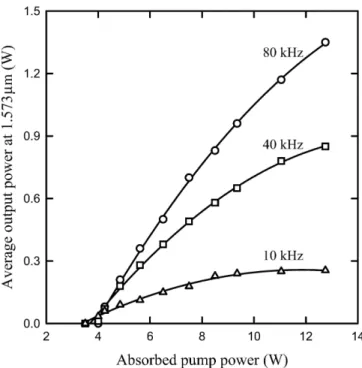
To avoid damage to the intracavity optical components, the Q switcher was operated above 10 kHz. Figure 2 shows the operation of the intracavity OPO for several pulse repeti-tion rates. Over this entire frequency range and for all pump powers the beam quality M2factor was found to be less than
1.3. The threshold for signal parametric oscillation was ap-proximately 3∼ 4 W and its dependence on different pulse repetition rates was not significant. At a repetition rate of 10 kHz, the average output power at 1573 nm was almost sat-urated to 0.26 W beyond 2.5 times the OPO threshold. In other words, the signal pulse energy was nearly saturated to 26µJ beyond 2.5 times the OPO threshold. Although the max-imum signal pulse energy is limited for the present cavity, increasing the pulse repetition rate can efficiently increase the average signal output power, as shown in Fig. 2. At a pulse repetition rate of 80 kHz, the average signal power was up to 1.33 W with an absorbed pump power of 12.6 W. The conver-sion efficiency from diode laser input power to OPO signal output power was 10.6% and the corresponding slope
effi-FIGURE 2 The average output power at 1573 nm versus the absorbed pump power for several pulse repetition rates
ciency reached 15.5%. To the best of our knowledge, this is the highest efficiency for average power conversion reported to date. The pulse temporal behavior at 1573 nm was recorded by a LeCroy 9362 digital oscilloscope (500 MHz bandwidth) with a fast germanium photodiode. Figure 3 depicts the peak power and pulse width versus the absorbed pump power at a pulse repetition rate of 80 kHz. A typical 1573 nm pulse is shown in Fig. 4. It can be seen that the overall pulse width was shorter than 10 ns at a pulse repetition rate of 80 kHz. The relatively short signal pulse indicates that the OPO ef-fectively cavity dumps the laser energy. The striking feature
FIGURE 3 The peak power and pulse width at 1573 nm versus the ab-sorbed pump power at a pulse repetition rate of 80 kHz
CHENet al. High-repetition-rate eye-safe laser with intracavity optical parametric oscillator 265
FIGURE 4 A typical pulse-shape at 1573 nm for a signal reflectivity of 85% on the output coupler
FIGURE 5 The dependence of the peak power and pulse width at 1573 nm on the pulse repetition rate at the maximum pump power of 12.6 W
is that with a 12.6 W absorbed pump power, the signal peak power can be higher than 2 kW at a pulse repetition rate of 80 kHz.
Figure 5 shows the dependence of the peak power and pulse width at 1573 nm on the repetition rate at a pump power of 12.6 W. Once again, the increase in the pulse width with increasing pulse repetition rate was not significant because of the effective cavity dump of the intracavity OPO. It can be seen that the pulse width slightly increased from 5 to 8 ns as the repetition rate varied from 10 to 80 kHz. As a result of the relatively short pulse, the peak power was generally on the order of several kilowatts at pulse repetition rates from 10 to 80 kHz.
Finally, experimental results reveal that the maximum sig-nal pulse energy mainly depends on the sigsig-nal reflectivity of the output coupler for a given cavity. In general, lowering the signal reflectivity results in higher signal pulse energies. This behavior was predicted in [20]. The maximum signal pulse en-ergies were experimentally found to be 15, 20, and 26µJ for signal reflectivities of 95, 90 and 85%, respectively.
Increas-FIGURE 6 A typical pulse-shape at 1573 nm for signal reflectivities of
a 90% and b 95% on the output coupler
ing the signal reflectivity of the output mirror not only reduces the pulse energy, but also may lead to satellite pulses accom-panying the signal pulse, as shown in Fig. 6. Therefore, the intracavity OPO can be improved by optimization of the sig-nal reflectivity of the output mirror and by variation of the pulse repetition rate.
3 Conclusions
Operation of a singly resonant pulsed KTP in-tracavity OPO pumped by an AO Q-switched Nd:YVO4
laser has been demonstrated. Using a type II non-critically phase-matched x-cut KTP crystal, eye-safe signal radiation at 1573 nm was generated in a plane-parallel to the intra-cavity OPO resonator. It was found that the maximum pulse energy may saturate beyond a given above-threshold intra-cavity OPO factor, but increasing the signal reflectivity of the output coupler can efficiently increases the average out-put power. The conversion efficiency for the average power is up to 10.6% from pump diode input to OPO signal out-put. The effective cavity dump of intracavity OPO leads to a relatively short signal pulse width for repetition rates from 10 to 80 kHz. As a consequence, the peak power for signal output can be up to several kilowatts for the entire frequency range. The compact size and high efficiency of the present laser make it an attractive source for practical applications.
266 Applied Physics B – Lasers and Optics
REFERENCES
1 L.R. Marshall, A.D. Hays, J. Kasinski, R. Burnham: Proc. SPIE 1419, 141 (1991)
2 E.O. Amman, J.M. Yarborough, M.K. Oshman, P.C. Montgomery: Appl. Phys. Lett. 16, 309 (1970)
3 M.K. Oshman S.E. Harris: IEEE J. Quantum Electron. 4, 491 (1968)
4 J. Falk, J.M. Yarborough, E.O. Amman: IEEE J. Quantum Electron. 7, 359 (1971)
5 R. Lavi, A. Englander, R. Lallouz: Opt. Lett. 21, 800 (1996)
6 A.R. Geiger, H. Hemmati, W.H. Farr, N.S. Prasad: Opt. Lett. 21, 201 (1996)
7 Y. Yashkir, H.M. van Driel: Appl. Opt. 38, 2554 (1999)
8 L.R. Marshall, J. Kasinski, R. Burnham: Opt. Lett. 16, 1680 (1991) 9 L.R. Marshall, A. Kaz: J. Opt. Soc. Am. B 10, 1730 (1993)
10 G. Xiao, M. Bass, M. Acharekar: IEEE J. Quantum Electron. 34, 2241 (1998)
11 R. Dabu, C. Fenic, A. Stratan: Appl. Opt. 40, 4334 (2001)
12 A. Dubois, S. Victori, T. L´epine, P. Georges, A. Brun: Appl. Phys. B 67, 181 (1998)
13 A. Agnesi, S. Dell’Acqua, G. Reali: Appl. Phys. B 70, 751 (2000) 14 R.S. Conroy, C.F. Rae, G.J. Friel, M.H. Dunn, B.D. Sinclair: Opt. Lett.
23, 1348 (1998)
15 J.J. Degnan: Surv. Geophys. 22, 431 (2001) 16 Y.F. Chen: Opt. Lett. 24, 1032 (1999)
17 J.J. Zayhowski, A. Mooradian: Opt. Lett. 14, 1989 (1989)
18 G.J. Dixon, L.S. Lingvay, R.H. Jarman: Proc. SPIE 1104, 107 (1989)
19 Y.F. Chen, T.M. Huang, C.F. Kao, C.L. Wang, S.C. Wang: IEEE J. Quan-tum Electron. 33, 1424 (1997)
20 T. Debuisschert, J. Raffy, J.P. Pocholle, M. Papuchon: J. Opt. Soc. Am. B 13, 1569 (1996)