Effect of lead additive on the ferroelectric properties and microstructure of Sr x Pb y Bi
2z Ta 2 O 9 thin films
San-Yuan Chen and Ving-Ching Lee
Citation: Journal of Applied Physics 87, 8024 (2000); doi: 10.1063/1.373491
View online: http://dx.doi.org/10.1063/1.373491
View Table of Contents: http://scitation.aip.org/content/aip/journal/jap/87/11?ver=pdfcov
Published by the AIP Publishing
Articles you may be interested in
Kinetic of phase transformation of SrBi 2 Ta 2 O 9 deposited by metalorganic decomposition on platinum electrodes
Appl. Phys. Lett. 81, 4410 (2002); 10.1063/1.1526926
Dielectric relaxation in SrTiO 3 –SrMg 1/3 Nb 2/3 O 3 and SrTiO 3 –SrSc 1/2 Ta 1/2 O 3 solid solutions
Appl. Phys. Lett. 77, 4205 (2000); 10.1063/1.1334908
Charge trapping and charge compensation during Auger electron spectroscopy on SiO 2
J. Appl. Phys. 86, 2337 (1999); 10.1063/1.371051
Elliptical grain growth in the solid-phase crystallization of amorphous SrBi 2 Ta 2 O 9 thin films
Appl. Phys. Lett. 74, 2933 (1999); 10.1063/1.123970
Electrical characterization of the p- Hg 1x Zn x Te interface after anodic sulfidization treatments
J. Vac. Sci. Technol. A 16, 2300 (1998); 10.1116/1.581344
Effect of lead additive on the ferroelectric properties and microstructure
of Sr
xPb
yBi
2zTa
2O
9thin films
San-Yuan Chena)and Ving-Ching Lee
Department of Materials and Science Engineering, National Chiao-Tung University, 300 Hsinchu, Taiwan, People’s Republic of China
共Received 30 November 1999; accepted for publication 21 February 2000兲
Ferroelectric thin films of bismuth-containing layered perovskite SrxPbyBi2zTa2O9 have been
prepared using the metalorganic decomposition method. The effect of both Sr and Pb content on the crystal structure, microstructure, and ferroelectric properties of SrxPbyBi2.3Ta2O9 films was
investigated. A maximum remanent polarization of 2 Pr⫽19.2C/cm2 was obtained for the
SrxPb0.2Bi2.3Ta2O9film with 20 mol % Sr-deficient composition as prepared at 800 °C, which could
be the compromising effects of Sr content on both grain growth and second phase formation of BiTaO4. The substitution of Pb for Bi is accompanied by the occurrence of oxygen vacancies to
compensate the charge balance, which is responsible for grain growth mechanism in Sr0.8Pb0.2Bi2.3Ta2O9films. Fatigue endurance of Sr0.8Bi2.3Ta2O9films becomes problematic after 109
cycles with a decrease in remanent polarization to 85% of the original value. This phenomenon was related to electron injection and creation of electron traps due to the occupation of Sr vacancies by Bi cations. It is demonstrated that the fatigue endurance of Sr0.8Bi2.3Ta2O9film can be improved by
doping with 20 mol % PbO. © 2000 American Institute of Physics. 关S0021-8979共00兲01311-6兴
I. INTRODUCTION
Bismuth-containing layered perovskites were found to be ferroelectric by Smolenskii et al.1,2 They belong to the family of Aurivillius compounds with a general formula of (Bi2O2)⫹2(Am⫺1BmO3m⫹1)2⫺, consisting of m-perovskite
units sandwiched between bismuth oxide layers.共Here A and B are the two types of cations that enter the perovskite unit. A is Bi⫹3, Ba⫹2, Sr⫹2, Pb⫹2, or K⫹1; B is Ti4⫹, Ta⫹5, Nb5⫹, Mo6⫹or W6⫹.兲
Ferroelectric thin films of SrBi2Nb2O9 共SBN兲,
SrBi2Ta2O9共SBT兲 and their solid solutions are being widely
investigated for applications in high density nonvolatile ferroelectric random access memories because of their excel-lent ferroelectric properties, characterized by limited polar-ization fatigue and low coercive field.3,4Various deposition methods have been used to produce Bi layer-structured ferro-electric thin films, such as rf sputtering,5laser ablation,6 met-alorganic chemical vapor deposition,7and wet-chemical pro-cesses 关sol–gel or metalorganic decomposition 共MOD兲兴.8–10 Ferroelectric properties, crystal structure, and micro-structure are remarkably influenced by the composition fluc-tuation in the bismuth layer structured compounds. Atsuki
et al.11 reported that the remanent polarization Pr of
SrxBi2zTa2O9(0.7⭐x⭐1.0, 2.0⭐2z⭐2.6) increased with the decrease of the Sr/Ta mole ratio for films annealed at 800 °C. A maximum remanent polarization was obtained for the 20 mol % Sr-deficient and 10 mol % Bi-excess composition.12 Noguchi et al. attributed the enhancement in
Pr with decreasing Sr content from x⫽1.0 to 0.8 to the
in-crease in grain growth. On the other hand, the dein-crease of Pr
value with further decreasing Sr content is due to the
disap-pearance of the SBT phase and the formation of a BiTaO4
second phase.13 On the other hand, Watanabe et al.14 re-ported that the dependence of Pron Sr content in SBN films was entirely due to the sensitivity of grain orientation to Sr content. The randomly oriented Sr-deficient SBN films have larger remanent polarization than c-axis oriented stoichio-metric SBN films. An asymstoichio-metric hysteresis loop was also observed in Sr-deficient SBT films. Excess Bi is usually re-quired to achieve stoichiometry due to the high volatility of Bi during processing15and Bi diffusion into the bottom elec-trode during annealing.16Watanabe et al.17reported that the SBT films grown with an excess bismuth of around 20% (2z⫽2.4) yields a maximum Pr value and a lower coercive
field.
PbBi2Nb2O9is another ferroelectric compound that has a
layered perovskite structure.1 It has a pseudotetragonal unit cell with lattice parameters a⫽5.492 Å, b⫽5.503 Å, c ⫽25.53 Å, and Z⫽4.18
Subbarao et al.19found well-defined hysteresis loops for PbBi2Nb2O9-based capacitors at 200 °C,
but its relatively high coercive field made it difficult to ob-tain ferroelectric switching at room temperature.20 From the viewpoint of the general formula of Aurivillius compounds, Pb, similar to Sr in the SrBi2Nb2O9, occupies the A site in
the perovskite unit of PbBi2Nb2O9. However, Pb and Bi are
known to have 6s2 lone pair electrons and tend to form
layered structures, thus promoting strong ferroelectricity. A recent study by Millan et al.21 reported that when the SrBi2Nb2O9 ceramic was doped with PbO, the Pb2⫹ cation was incorporated into the orthorhombic structure, leading to a monoclinic distortion, which increases with the increased substitution of Bi3⫹by Pb2⫹. From literature reports, it was found that vacancies usually play an important role in grain growth and have a remarkable effect on electrical properties of materials, especially for electronic ceramics such as
a兲Author to whom correspondence should be addressed.
8024
0021-8979/2000/87(11)/8024/7/$17.00 © 2000 American Institute of Physics
BaTiO3.22Therefore, it is also relevant to study the effect of
Pb⫹2 incorporation in the composition SrxBi2zTa2O9
com-pound in order to identify its role in the structure of this compound. In this work, we explore the correlation between the Sr deficiency in SBT films and the observed enhanced polarization from the viewpoint of defect chemistry. Based on the similar structures of PbBi2Ta2O9and SrBi2Ta2O9, the
effect of Pb2⫹substitution on remanent polarization and fa-tigue properties of SrxBi2yTa2O9composition was also
inves-tigated.
II. EXPERIMENT
The starting materials for the MOD process were bis-muth 2-ethylhexanoate 关Bi共CH3共CH2兲3CH共C2H5兲COO兲3兴,
strontium 2-ethylhexanoate
关Sr共CH3共CH2兲3CH共C2H5兲COO兲2兴, lead 2-ethylhexanoate
关Pb共CH3共CH2兲3CH共C2H5兲COO兲2兴, and tantalum ethoxide
关Ta共OC2H5兲5兴 with 2-ethylhexanoic acid as the solvent. The
metalorganic precursors were mixed to form solutions with compositions of SrxPbyBi2zTa2O9. Prior to film deposition,
the substrate (Pt/Ti/SiO2/Si) was cleaned in acetone and
al-cohol ultrasonic baths, then blown dry with N2gas. The
so-lutions were spin coated onto the substrate at a speed of 3000 rpm. After each coating, the as-deposited film was dried on a hot plate at a temperature of about 350 °C to remove the solvent before application of the next coating. After the pro-cess was repeated four times, the as-deposited films were sintered at 750– 800 °C in air for 30 min by directly placing the coated substrate into a preheated tube furnace.
The crystal structures of the films were analyzed by us-ing Siemens D5000 x-ray diffraction共XRD兲 with Cu K␣ ra-diation and a Ni filter. The chemical composition of the films was determined using inductively coupled plasma 共ICP兲 mass spectroscopy共Perkin Elmer, SCIEX ELAN 5000兲. The film thickness was measured by Dektak surface profilometer. Field-emission scanning electron microscopy Hitachi S4000兲 was performed to investigate the surface morphology of the films. Patterned top Au electrodes through a shadow mask on an area of 8.0⫻10⫺4cm2 area were sputter deposited onto the SBT layers to define capacitors in order to perform elec-trical measurements. A ferroelectric testing system共RT-66A, Radiant Technologies Inc.兲 operating in the virtual-ground mode was used to obtain the remanent polarization ( Pr)-coercive field (Ec) hysteresis characteristics and fa-tigue properties. Fafa-tigue tests of the films were conducted using a bipolar square wave of 5 V at 1 MHz.
III. RESULTS
A. SrxBi2zTa2O9thin films
1. Microstructure and phase evolution
XRD analysis was used to investigate the effect of Sr content on the phase development of SrxBi2Ta2O9film (0.5
⭐x⭐1.2) annealed at 800 °C for 0.5 h. As shown in Fig. 1, an unknown phase at 2⫽29.5° was observed for Sr0.6Bi2Ta2O9film and the peak intensity increased with
in-creasing Sr deficiency. This peak might originate from the formation of BiTaO4 共JCPDS 16-0906兲 according to the re-port of Hase et al.13
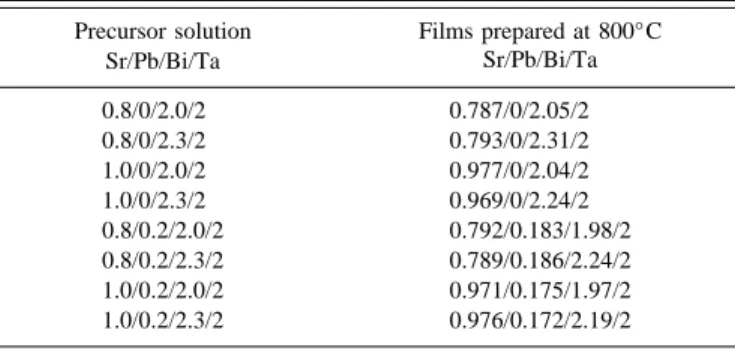
Table I lists the chemical compositions of SrxBi2Ta2O9 films annealed at 800 °C for 0.5 h. The molar numbers of Sr, Ta, and Bi in those films are very close to the compositions in the precursor solutions for Sr-deficient SrxBi2Ta2O9films.
In other words, the films with Sr deficiency show no obvious Bi loss. However, for the films with Sr (x)⫽1, a partial loss of Bi was found compared to those in precursor solutions. This might indicate that the occupation of Sr vacancies by Bi cations reduces the evaporation of Bi2O3 or Bi loss.
Simi-larly, for Sr-deficient Sr0.8Pb0.2Bi2.3Ta2O9 films, except for
the loss of Pb, the reduction of Bi was also observed. The microstructure evolution of SrBi2.3Ta2O9 films
changes substantially as a function of Sr content, as shown in Fig. 2. The grain size is larger for Sr-deficient films than for film with stoichiometric Sr content and the Sr-rich film. The microstructure of Sr0.6Bi2.3Ta2O9 film presents a rod-like
grain matrix interposed with a few smaller microcrystals in-dicated by the arrows in Fig. 2共a兲. The microcrystals were regarded to be the secondary phase 共probably BiTaO4兲 as
inferred from the XRD patterns 共Fig. 1兲. In addition, with increasing Sr content from Sr⫽0.6 to 1.2, grains become finer and rounder. The average grain sizes were measured to FIG. 1. XRD patterns of SrxBi2Ta2O9films annealed at 800 °C for 0.5 h.
TABLE I. Sr/Pb/Bi/Ta ratio normalized in Ta⫽2 for SrxPbyBi2zTa2O9
films. Precursor solution Sr/Pb/Bi/Ta Films prepared at 800°C Sr/Pb/Bi/Ta 0.8/0/2.0/2 0.787/0/2.05/2 0.8/0/2.3/2 0.793/0/2.31/2 1.0/0/2.0/2 0.977/0/2.04/2 1.0/0/2.3/2 0.969/0/2.24/2 0.8/0.2/2.0/2 0.792/0.183/1.98/2 0.8/0.2/2.3/2 0.789/0.186/2.24/2 1.0/0.2/2.0/2 0.971/0.175/1.97/2 1.0/0.2/2.3/2 0.976/0.172/2.19/2 8025
J. Appl. Phys., Vol. 87, No. 11, 1 June 2000 S-Y. Chen and V-C. Lee
be about 190, 145, 100, and 70 nm for x⫽0.6, 0.8, 1.0, and 1.2, respectively.
2. Electrical properties
Figure 3 shows the P–E hysteresis curves of both SrBi2Ta2O9 and Sr0.8Bi2.3Ta2O9 films annealed at 800 °C.
The 2 Pr value of Sr0.8Bi2.3Ta2O9 film was measured to be
about 15.9C/cm2, which is larger than that of SrBi2.3Ta2O9
films (2 Pr⫽6.7C/cm2) for an applied voltage of 5 V.
Here, the hysteresis curves of Sr-deficient SBT film often exhibit little horizontal shifts along the voltage axis as com-pared with that of stoichiometric SBT film. The Prvalue was
also found to be strongly dependent on Sr content in SrxBi2.3Ta2O9 compositions for a variety of Bi content (2y
⫽2.0– 2.3) 共Fig. 4兲. When the Sr content exceeded 20% (x ⫽1.2), there is no hysteresis curve. However, the 2Prvalue
increased with the decrease in Sr content from Sr⫽1.1 to Sr⫽0.8 and then decreased with further decreasing Sr con-tent from Sr⫽0.8 to Sr⫽0.6. The maximum value of 2Pr
was obtained at the SrxBi2.3Ta2O9films with Sr⫽0.8. A
simi-lar phenomenon was also observed for the SrxBi2.0Ta2O9
films.
Fatigue endurance was tested with 1 MHz bipolar pulses at 5 V. Figure 5 shows the fatigue behavior of SrxBi2zT2O9
films prepared at 800 °C for 0.5 h. Most of the SrxBi2.3Ta2O9
films show no appreciable fatigue after 109cycles. However, a partial loss of 2 Pr after fatigue was observed for
Sr0.8Bi2.3Ta2O9-based capacitors. The percentage of the
rem-anent polarization after 109 cycles was approximately 87% of the initial value. Similar dependence of fatigue endurance on composition was also observed by Noguchi et al.12
B. PbyBi2Ta2O9 thin films
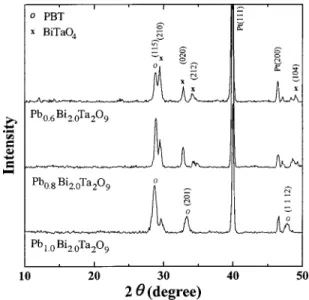
Figure 6 shows the XRD patterns of PbyBi2Ta2O9共PBT兲
films fired at 800 °C for 0.5 h. Some peaks at 2⫽29.4, 32.6, and 34.1, corresponding to BiTaO4 phase in
Sr0.6Bi2Ta2O9 film, began to develop. Furthermore, these
peak intensities increased with decreasing Pb content in PbyBi2Ta2O9films. The dependence of grain size on Pb
con-tent in PBT films was completely different from that of Sr in SBT films. As shown in Fig. 7, a fine-grained microstructure was developed in the PbyBi2Ta2O9 film with Pb⫽0.6 and
FIG. 2. Dependence of Sr content on microstructure of:共a兲 x⫽0.6, 共b兲 x ⫽0.8, 共c兲 x⫽1.0, and 共d兲 x⫽1.2 compositions in SrxBi2.3Ta2O9films
an-nealed at 800 °C for 0.5 h.
FIG. 3. P-E hysteresis loops of:共a兲 SrBi2Ta2O9and共b兲 Sr0.8Bi2.3Ta2O9films
annealed at 800 °C for 0.5 h under applied voltage of 5 V.
FIG. 4. Remanent polarization 2 Pr values in SrxBi2zTa2O9 and
SrxPbyBi2zTa2O9films fired at 800 °C for 0.5 h.
FIG. 5. Fatigue behavior of SrxBi2zTa2O9films with an applied voltage of 5
V at 1 MHz.
accompanied with the formation of pores because of volume shrinkage during the amorphous/crystalline transformation. With increasing Pb content, clusters appeared 关for stoichio-metric PBT films, Fig. 7共c兲兴, probably originated from a single nucleus, similar to spherulites commonly seen in amorphous-to-crystalline transitions. Some clusters with pores appear located near the center of each cluster and on the grain boundaries. Even for Pb-rich PBT films, the clus-ters are still seen关Fig. 7共d兲兴.
The hysteresis curve of PbyBi2Ta2O9 films with y⫽0.7
and 1.0 were further measured under an applied voltage of 5 V. The film with y⫽1.0 displayed a remanent polarization
Prof 3.3C/cm2but the remanent polarization could not be
measured for Pb-deficient PbyBi2Ta2O9 films such as y
⫽0.7. The fatigue behavior of PbBi2Ta2O9 films were also
tested and no appreciable loss after 109cycles was observed.
C. SrxPb1ÀxBi2.3Ta2O9thin films
Both SrBi2Ta2O9 and PbBi2Ta2O9 are
Aurivillius-structure layered bismuth compounds of (Bi2O2)2⫹
(Am⫺1BmO3m⫹1)2⫺with m⫽2. However, both SrxBi2Ta2O9
and PbyBi2Ta2O9films have completely different
microstruc-ture evolution and electrical properties with changing A site content. The optimal remanent polarization occurs for the Sr-deficient Sr0.8Bi2.3Ta2O9but a very poor polarization was observed in the Pb deficient Pb0.8Bi2.3Ta2O9films. This find-ing suggests that the A-site atom 共such as Sr or Pb兲 in the Aurivillius-structure layered bismuth compounds plays a very important role in the electric properties. In order to clarify the relative effect, the composition of SrxPb1⫺xBi2zTa2O9 films was chosen as a basis to compare
its role in polarization and microstructure.
When SrxPb1⫺xBi2.3Ta2O9 films were annealed at
750 °C for 0.5 h, a maximum value of 2 Pr, as shown in Fig.
8, occurs at the film with x⫽0, i.e., PbBi2.3Ta2O9. Moreover,
as the Sr content increases, the 2 Pr changes little up to x
⫽0.7 and then a sharp drop of 2Pr is observed at x⫽1.
When the annealing temperature was raised to 800 °C, a sec-ond phase was detected in the Pb-rich SrxPb1⫺xBi2.3Ta2O9
composition as observed in Pb-deficient PbyBi2.0Ta2O9 film
共Fig. 6兲, therefore, causing the remanent polarization to be apparently reduced, especially for a PbBi2.3Ta2O9film.
Con-sequently, a maximum remanent polarization (2 Pr
⫽16.7C/cm2) was obtained near the composition of Sr0.7Pb0.3Bi2.3Ta2O9 film (x⫽0.7). In this case, the results
also reflect the fact that the minor addition of Pb into SrxBi2.3Ta2O9 films does not strongly influence the
depen-dence of Sr content on Pr value.
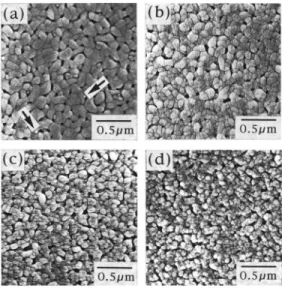
In order to further clarify the role of Pb additive in SrxBi2.3Ta2O9films, the electrical properties and microstruc-tural morphology of SrxBi2.3Ta2O9 films doped with 20 mol % PbO were studied. The XRD results show that no changes in the diffraction pattern were observed except for a slight variation in the intensity of some diffraction peaks. The dependence of film morphology on Sr content in the SrxPb0.2Bi2.3Ta2O9 compositions is shown in Fig. 9. As the
Sr0.6Bi2.3Ta2O9 film is doped with 20 mol % PbO, i.e.,
Sr0.6Pb0.2Bi2.3Ta2O9, the grains begin to grow and coalesce
with each other. Therefore, some large grains were formed along with finer pores located near the center of a large grain or at the grain boundaries. Obviously, the addition of PbO promotes the grain growth of Sr0.6Bi2.3Ta2O9 film.
Further-more, as compared with the grain size of SEM micrographs FIG. 6. XRD patterns of PbyBi2Ta2O9films annealed at 800 °C for 0.5 h.
FIG. 7. SEM plan views of PbyBi2Ta2O9 films with:共a兲 y⫽0.6, 共b兲 y
⫽0.8, 共c兲 y⫽1.0, and 共d兲 y⫽1.3 compositions annealed at 800 °C for 0.5 h.
FIG. 8. Dependence of Sr content on remanent polarization of SrxPb1⫺xBi2.3Ta2O9films annealed at 750– 800 °C.
8027
J. Appl. Phys., Vol. 87, No. 11, 1 June 2000 S-Y. Chen and V-C. Lee
in Fig. 2 for SrxBi2.3Ta2O9 films, a larger-grain
microstruc-ture was obtained for SrxPb0.2Bi2.3Ta2O9films. The average
grain size of SrxPb0.2Bi2.3Ta2O9 films, similar to
SrxBi2.3Ta2O9 compositions, decreases with the increase of
Sr content. The average grain size was measured to be around 210 nm at the compositions of x⫽0.8 and 150 nm at
x⫽1.0.
In order to compare the effect of 20 mol % PbO on the remanent polarization of SrxBi2.3Ta2O9films, the 2 Prvalues
of SrxPb0.2Bi2.3Ta2O9films were measured at 5 V. As shown
in Fig. 4, the film with 20% Sr deficiency (x⫽0.8) still gives a maximum 2 Pr of 19.2 C/cm2 for SrxPb0.2Bi2.3Ta2O9
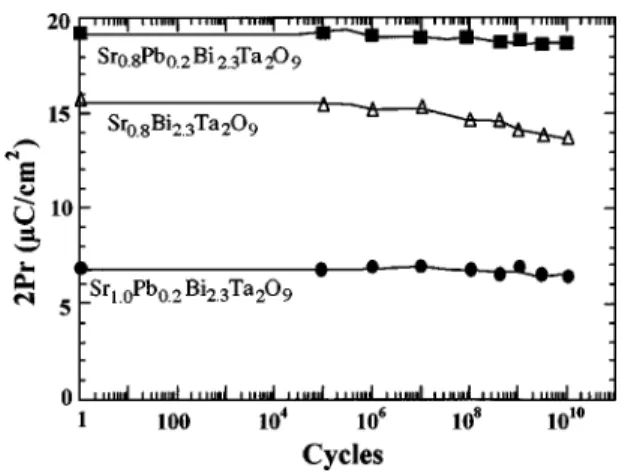
compositions. Figure 10 shows the fatigue behavior of SrxPb0.2Bi2.3Ta2O9films excited with 5 V pulses. The fatigue
of Sr0.8Bi2.3Ta2O9film is also placed in Fig. 10 for
compari-son. Most of the SrxPb0.2Bi2.3Ta2O9 films exhibit good
fa-tigue endurance except for Sr0.6Pb0.2Bi2.3Ta2O9films having
a slight degradation of 9%. The fatigue endurance of Sr0.8Bi2.3Ta2O9 film was obviously enhanced by 20 mol %
PbO additions.
IV. DISCUSSION
A. Microstructure and polarization properties
The 2 Prvalues increased with the decrease in Sr content
from Sr⫽1.1 to Sr⫽0.8 for SrxBi2.3Ta2O9films annealed at
800 °C. The enhanced Pr could be attributed to the grain
growth and grain orientation as reported in the literature.12–14 However, in our case, no preferred orientation was observed in the XRD pattern for SrxBi2.3Ta2O9 films, but the
micro-structure of Fig. 2 indeed revealed a grain morphology tran-sitioned from rod- to round-like as the Sr content increased. For Sr-deficient SrxBi2.3Ta2O9 compositions, the BiTaO4
phase was identified according to the XRD analysis of Fig. 1. Furthermore, the number of Sr defects would increase with the decrease in Sr content and therefore, the probability of domain pinning would increase, resulting in a reduced 2 Pr.
Although the Sr0.6Bi2.3Ta2O9film has larger grain size, both
Sr vacancy concentration and second phase formation of BiTaO4microcrystals overcame the grain-size effect.
There-fore, a maximum polarization was obtained at Sr⫽0.8 for both SrxPb0.2Bi2.3Ta2O9 and SrxBi2.3Ta2O9 films. The
en-hanced remanent polarization of the former composition could be attributed to the larger grain size compared to the latter composition without Pb.
As compared to SrBi2Ta2O9, the PbBi2Nb2O9 ceramic has a lower crystallization temperature and sintering tem-perature. Therefore, at the lower annealing temperature of 750 °C, Pb-rich composition 共i.e., x⫽0兲 in SrxPb1⫺xBi2.3Ta2O9(0⬍x⬍1) films gives a larger remanent
polarization as compared to the film with x⫽1. At 800 °C, however, a second phase was observed in the Pb-rich films as shown in the XRD pattern of Fig. 6 for PbBi2Ta2O9
com-position, and thus, the remanent polarization was strongly reduced for increasing Pb content共or decreasing Sr content兲. An optimal 2 Pr of 16.7C/cm2 was attained around the
composition of Sr0.7Pb0.3Bi2.3Ta2O9. Here, further increasing
Sr content leads to the decrease of remanent polarization since grain size was remarkably reduced.
B. Role of Pb in SrxPbyBi2zTa2O9films
From electronic structure, both Pb and Bi have a lone pair of out-shell electrons of 6s2. This chemical aspect could be significant since the lone-pair electrons of Pb and Bi are known to have a large polarizability and to promote strong ferroelectricity. However, from the viewpoint of ferroelec-tricity, Pb in PbBi2Ta2O9, as similar to Sr in SrBi2Ta2O9, i.e., it occupies the A site in Aurivillius compounds and the radii of Pb 共1.18 Å兲, Sr 共1.16 Å兲 and Bi 共1.02 Å兲 are very close.23 It will be interesting to study the role of Pb in SrBi2Ta2O9 film in order to identify the key chemical and structural elements that lead to optimal polarization and po-larization fatigue.
Assuming Pb can completely substitute for Sr in the SrBi2Ta2O9composition, the PbBi2Ta2O9film should display
a specific ferroelectricity. However, since PbO, after being annealed at high temperature, is easily evaporated, the PbBi2Ta2O9 composition probably became PbzBi2Ta2O9 (z
⬍1). Furthermore, if the role of Pb is similar to Sr, the measured polarization of PbzBi2Ta2O9film should have been
FIG. 9. SEM plan views of SrxPb0.2Bi2.3Ta2O9films with:共a兲 x⫽0.6, 共b兲 x⫽0.8, 共c兲 x⫽1.0, and 共d兲 x⫽1.2 compositions annealed at 800 °C
for 0.5 h.
FIG. 10. Effect of 20 mol % Pb additive on the fatigue characteristics of SrxBi2.3Ta2O9films under applied voltage of 5 V.
comparable with that of SrxBi2Ta2O9(x⬍1) films. However,
there was no appreciable polarization observed for Pb-deficient films such as Pb0.7Bi2Ta2O9. Obviously, the role of
Pb content in PBT film in polarization and microstructure is completely different from that of Sr in SrxBi2.3Ta2O9film.
With the addition of 20 mol % PbO, the dependence of grain size on Sr content in SrxPb0.2Bi2.3Ta2O9 films shows
similar tendency as the SrxBi2.3Ta2O9 films. However, we
found that the grain size of Sr0.8Pb0.2Bi2.3Ta2O9film共Fig. 9兲
was larger as compared with Sr0.8Bi2.3Ta2O9 film 共Fig. 2兲.
This observation indicates that the incorporation of PbO plays an important role in promoting grain growth of Sr0.8Bi2.3Ta2O9 film. That is the reason why the remanent polarization of Sr0.8Pb0.2Bi2.3Ta2O9 film is enhanced com-pared to Sr0.8Bi2.3Ta2O9film. According to the defect chem-istry, if the ionic defects were produced and the overall elec-troneutrality was kept, the substitution of Pb2⫹for Bi3⫹will create oxygen vacancies as follows:
2PbO——→
Bi2O3
2PbBi
⬘
⫹Vo••⫹2Oox, 共1兲 As reported for BaTiO3ceramics, the grain growth was usu-ally observed with increasing acceptor concentrations be-cause oxygen vacancies will be produced.22These phenom-ena reflected that the small amount of Pb was probably incorporated into the Bi site in the Sr0.8Pb0.2Bi2.3Ta2O9films.C. Fatigue behavior of Sr1ÀxPbxBi2.3Ta2O9films Ferroelectric thin films of bismuth-containing layered perovskite such as SrBi2Ta2O9 and SrBi2Nb2O9 have been
reported to have excellent good fatigue resistance. In our results, although Sr-deficient SrBi2.3Ta2O9film shows an
op-timal remanent polarization of 2 Pr⫽15.9C/cm2, a loss of
Pr of 15% was measured after 109cycles. A similar phenom-enon was also reported by Noguchi et al.12 In contrast, the SrBi2.3Ta2O9 or SrBi2Ta2O9 films show no appreciable
po-larization loss under the same applied voltage of 5 V. There are several proposals that attempt to explain the fatigue behavior of ferroelectric thin films especially for pi-ezoelectric transducers 共PZTs兲. These proposals are all re-lated to defects, which may be trapped at domain boundaries to lower their mobility. However, there have been different views of the species of the defects and the location of the trapping sites. Oxygen vacancy and electron/hole injection have been suggested as possible mechanisms for the fatigue of PZT films.24,25Support for the oxygen vacancy model was drawn from the observation that oxygen vacancy was pro-duced in PZT film because PbO was easily evaporated dur-ing high temperature annealdur-ing. In our case, however, the Sr0.8Bi2.3Ta2O9film prepared with both 20 mol % deficiency
Sr and 15 mol % excess Bi should have very few oxygen vacancies. Therefore, the oxygen vacancy mechanism is not applicable in explaining the fatigue behavior of Sr0.8Bi2.3Ta2O9 film. In the other model, the electron/hole
mechanism states that the injection of charge carrier共mainly electrons兲 will be trapped at domain boundaries to pin do-mains. The tendency for this to occur increases when the material is donor doped.25 For Sr0.8Bi2.3Ta2O9 film, it was
considered that Sr deficiency was compensated by excess Bi
since both radius of Sr 共1.16 Å兲 and Bi 共1.02 Å兲 are very close.11,26 The electron can be produced by substituting Bi for Sr vacancy according to the defect reaction as follows:
Bi2O3——→ 2SrO
2BiSr•⫹2Oox⫹2e⫺. 共2兲 With 15 mol % excess Bi, the Sr-deficient Sr0.8Bi2.3Ta2O9
film is probably considered as donor doped and the chance for electron injection is high. Therefore, after cycling, the injected electron was trapped by the ions BiSr*, which in turn
could pin the domain boundary movement, causing the swit-chable polarization to decrease. This is in agreement with our fatigue data shown in Fig. 5. Furthermore, the number of Sr defects would increase with the decrease in Sr content and therefore, cause a larger coercive field to polarize the film.
Although Pb is a volatile species, the anion 共oxygen兲 vacancies accompanied by the substitution of Pb for Bi do not seem to adversely affect the fatigue resistance as evi-denced in Fig. 10. This gives clearer evidence to rule out the oxygen vacancy mechanism for fatigue that has been pro-posed for PZT films.24 According to the fatigue model pro-posed by Warren et al.25and Eq.共2兲, the released electronic charge trapping at domain walls can inhibit the domain mo-tion and lead to the partial suppression of the switchable polarization in Sr0.8Bi2.3Ta2O9film. However, as indicated in
Table I, Sr0.8Bi2.3Ta2O9film shows almost no loss of Bi, but
the addition of Pb induces the reduction of Bi in the Sr0.8Pb0.2Bi2.3Ta2O9film. It is plausible for Pb to occupy the
Sr vacancies and produce free Bi which will be readily evaporated from the surface because of the high vapor pres-sure of Bi at high temperatures. Therefore, the reaction in Eq. 共2兲 is probably partially inhibited by doping Pb into the Sr0.8Bi2.3Ta2O9 film so that the electronic charge cannot be
easily released. Alternatively, the released electrons due to the Bi substitution for Sr can be possibly compensated from the hole or oxygen vacancies produced from the substitution of Pb for Bi as shown in Eq. 共1兲. Consequently, the fatigue behavior of Sr0.8Pb0.2Bi2.3Ta2O9film can be improved by in-corporating 20 mol % PbO into Sr0.8Bi2.3Ta2O9film.
V. CONCLUSIONS
SrxBi2.3Ta2O9and PbyBi2.3Ta2O9films have shown
com-pletely different dependence of microstructure evolution and ferroelectric properties on A site 共Sr or Pb兲 content in Au-rivillius compounds of (Bi2O2)2⫹ (A
m⫺1BmO3m⫹1)2⫺.
Ferroelectric properties of SrxBi2.3Ta2O9 films could be further enhanced by the addition of 20 mol % Pb.
The addition of Pb is responsible for the enhanced grain growth in Sr0.8Pb0.2Bi2.3Ta2O9films.
Fatigue endurance of Sr0.8Bi2.3Ta2O9 films in this study
become problematic after 109cycles with decreasing Sr con-tent. This was proposed to originate from with electron in-jection and traps due to the occupation of Bi for Sr vacan-cies.
Fatigue behavior of Sr0.8Bi2.3Ta2O9 film can be
im-proved by incorporating 20 mol % PbO because the release of electronic charge could be partially inhibited by doping Pb to occupy the Sr vacancies.
8029
J. Appl. Phys., Vol. 87, No. 11, 1 June 2000 S-Y. Chen and V-C. Lee
ACKNOWLEDGMENT
The authors gratefully acknowledge financial support by the National Science Council of the Republic of China through Contract No. NSC87-2218-E-009-016.
1
G. A. Smolenskii, V. A. Isupov, and A. I. Agranovskaya, Sov. Phys. Solid State 1, 149共1959兲.
2G. A. Smolenskii, V. A. Isupov, and A. I. Agranovskaya, Sov. Phys. Solid
State 3, 651共1961兲.
3
C. A. Paz de Araujo, J. D. Cuchiaro, M. C. Scott, L. D. McMillan, and J. F. Scott, Nature共London兲 374, 627 共1995兲.
4O. Auciello, J. F. Scott, and R. Ramesh, Phys. Today, 22共1998兲. 5H.-M. Tsai, P. Lin, and T. Y. Tseng, Appl. Phys. Lett. 72, 1787共1998兲. 6R. Dat, J. K. Lee, O. Auciello, and A. I. Kingon, Appl. Phys. Lett. 67, 572
共1995兲.
7Y. Zhu, S. B. Deau, T. Li, S. Ramanathan, and M. Nagata, J. Mater. Res. 12, 783共1997兲.
8Y. Ito, M. Ushikubo, S. Yokoyama, H. Matsunaga, T. Atsuki, T.
Yon-ezawa, and K. Ogi, Integr. Ferroelectr. 14, 123共1997兲.
9
T. Hayashi, H. Takahashi, and T. Hara, Jpn. J. Appl. Phys., Part 1 35, 4952共1996兲.
10I. Koiwa, T. Kanehara, J. Mita, T. Iwabuchi, T. Osaka, and S. Ono, Jpn. J.
Appl. Phys. 36, 1597共1997兲.
11
T. Atsuki, N. Soyama, T. Yonezawa, and K. Ogi, Jpn. J. Appl. Phys., Part 1 34, 5096共1995兲.
12T. Noguchi, T. Hase, and Y. Miyasaka, Jpn. J. Appl. Phys., Part 1 35,
4900共1996兲.
13T. Hase, T. Noguchi, K. Amanuma, and Y. Miyasaka, Integr. Ferroelectr. 15, 127共1997兲.
14K. Watanabe, M. Tanaka, E. Sumitomo, K. Katori, H. Yagi, and J. F.
Scott, Appl. Phys. Lett. 73, 126共1998兲.
15T. Hayashi, H. Takahashi, and T. Hara, Jpn. J. Appl. Phys., Part 1 35,
4952共1996兲.
16
P. Y. Chu, R. E. Jones, P. Zurcher, D. J. Taylor, B. Jiang, S. J. Gillespie, and Y. T. Li, J. Mater. Res. 11, 1065共1996兲.
17H. Watanabe, T. Mihara, H. Yoshmori, and C. A. Paz de Araujo, Jpn. J.
Appl. Phys., Part 1 34, 5240共1995兲.
18
B. Aurivillius, Ark. Kemi 1, 463共1949兲.
19E. C. Subbarao, Phys. Chem. Solids 23, 665共1962兲.
20J. Franco and G. Shirane, Ferroelectric Crystals共Pergamon, New York,
1962兲, p. 274.
21
P. Millan and A. Castro, Mater. Res. Bull. 28, 117共1993兲.
22D. M. Smyth, Prog. Solid State Chem. 15, 145共1984兲.
23R. D. Shannon and C. T. Prewitt, Acta Crystallogr., Sect. B: Struct.
Crys-tallogr. Cryst. Chem. 25, 925共1969兲.
24I. K. Yoo and S. B. Desu, Integr. Ferroelectr. 3, 365共1993兲.
25W. L. Warren, D. Dimos, B. A. Tuttle, R. D. Nasby, and G. E. Pike, Appl.
Phys. Lett. 65, 1018共1994兲.
26
M. A. Rodriguez, T. J. Boyle, B. A. Hernandez, C. D. Buchheit, and M. O. Eatough, J. Mater. Res. 11, 2282共1996兲.