行政院國家科學委員會補助專題研究計畫成果報告
※※※※※※※※※※※※※※※※※※※※※※※※※
※ 南海生地化整合研究— 子計畫四: 南海北部有機 ※
※ 碳氮磷生地化作用(II) ※
※ ※
※
※
※※※※※※※※※※※※※※※※※※※※※※※※※
計畫類別:□個別型計畫
▓整合型計畫
計畫編號:NSC 90-2611-M-110-010-OP1
執行期間:
90 年 8 月 1 日至 91 年 7 月 31 日
計畫主持人:洪佳章
共同主持人:
本成果報告包括以下應繳交之附件:
□赴國外出差或研習心得報告一份
□赴大陸地區出差或研習心得報告一份
■出席國際學術會議心得報告及發表之論文各一份
□國際合作研究計畫國外研究報告書一份
執行單位:中山大學海洋地質及化學研究所
中
華
民
國 91 年 11 月 28 日
南海生地化整合研究— 子計畫四: 南海北部有機碳氮磷生
地化作用(II)
Biogeochemical Processes of Organic Carbon, Nitrogen and
Phosphorus in the Northern South China Sea (II)
計畫編號:NSC 90-2611-M-110-010-OP1
執行期限:90 年 8 月 1 日至 91 年 7 月 31 日
主持人:洪佳章 中山大學海洋地質及化學研究所
計畫參與人員:王詩銘、何晟銘、洪佩瑩、黃美惠 中山
大學海洋地質及化學研究所
一、中文摘要 本研究的總體目標在瞭解南海北部上 層海洋溶解及顆粒態有機碳、氮、磷的動 態及預算平衡。然此目標的達成有賴整合 計畫中與其他子計畫研究成果的支援,例 如基礎生產力、顆粒沉降通量及浮游動物 日夜之遷移。因此本年度的成果主要在探 討南海北部基礎生產者對碳、氮、矽及磷 之吸收比率並比較顆粒有機物中碳、氮、 磷之比例,以及其中之意涵。南海北部 DOC 是總有機碳的主要貯存庫,約佔 80 ~ 95 % 左右,其分佈約介於 70 至 85 ìM 之間,而 POC 的分佈約介於 20 至 40 ìg / l 之間。高 的 DOC/POC 比值顯示南海北部為一貧營 養鹽環境。DOC 及 POC 均隨深度的增加 而遞減,但 C/N 比值卻隨深度的增加而增 加,表示有機氮較有機碳易於分解。雖然 顆 粒 有 機 物 中 △ POC/ △ PN/PP 比 值 (93:14:1~117:15:1) 相 當 接 近 Redfield 比 值,但生物吸收之比值(△DIC/△NO3/△Si/ △PO4=160:12.8:18:1~173:13:13.5:1)卻遠高 於 Redfield 比值,顯示有碳過度消耗的現 象。而此碳的過度吸收可以高 C/N 比值 (DOC/DON=15~20)的 DOM 釋 放 加 以 解 釋。然此 DOC 的釋放與 DON 的產生並不 一致,其相關性並不佳。由此推論若新生 產力的估算是由 NO3的吸收及 Redfield 比 值推演的話,則新生產力將有低估之虞。 但另一方面若 DOM 的產生不能有效的往 下層輸送,則其對 CO2的吸收並無太大幫 助。本區域初步估計 DOC 離開透光層之垂 直傳輸約為 10~20% POC 之輸出通量。另 一方面本實驗亦進行了浮游動物夜間捕食 及日間深層釋放的模擬實驗,由培養實驗 顯示浮游動物的 DOC 及 DIC 釋放主要在 1 小時內,由 DIC 及 DOC 的釋放速率及浮 游動物的遷移量可估算日夜遷移在碳傳輸 的重要性。 關鍵詞:南海北部,有機碳、氮、磷,貧 營養鹽,碳的垂直傳輸,生地化。 Abstr actThe overall goals of this study are to understand the dynamics and budgets of dissolved and particulate organic carbon, nitrogen and phosphorus in the upper layer of northern South China Sea (SCS). The overall goals, however, are relied on other studies conducted in the SIBEX program such as primary (new) productivity, vertical particle fluxes and zooplankton migration. The progress report of this year will focus on
biological uptake ratios and POM
stoichiometric patterns of carbon, nitrogen, silicon and phosphorus and their implications in the northern SCS. DOC was the major pool of total organic carbon (80~95% TOC), ranging from 70 to 85 μMC in the study area. The concentration of particulate organic
carbon (POC) was relatively low ranging from 20 to 40 μg/l. Very high DOC/POC ratios in the euphotic layer indicate that the
northern SCS was an oligotrophic
environment. DOC and POC decreased with depth but C/N ratios increased with depth, indicating that nitrogen was preferentially
decomposed over carbon. Although
∆POC/∆PN/∆PP (93:14:1 ~ 117:15:1) was
very close to the Redfield ratio (106:16:1),
the ∆DIC/∆NO3/∆Si/∆PO4 ratio
(160:12.8:18:1 ~ 173:13:13.5:1) was much
higher than the Redfield ratio. The
overconsumption of carbon may be explained
by the release of nitrogen and/or
phosphorus-poor DOM (DOC/N = 15 ~ 20) during carbon and nutrient assimilation. The produced DOC, however, was not coupled to the produced DON and poor relationship was found between DOC and DON. The carbon based new productivity (NP) may be underestimated if NP was estimated from nitrate uptake and Redfield ratio. The biologically produced DOM in the
euphotic zone may not contribute
significantly the drawdown of CO2 if DOM
was not effectively exported from the mixed layer. In general, the downward flux of DOC in the northern SCS was estimated to be ca. 20% of POC export flux. In order to realize the importance of zooplankton migration in vertical transport of carbon, the experiments of DIC respiration and DOC excretion from zooplankton collected from the study area were conducted for a period of 8 hrs. The preliminary results showed significant release of DOC and DIC from zooplankton after an hour incubation. The contribution of active transport to total carbon flux may be reasonably estimated if we know the diurnal shift of total migrants and sinking flux of carbon in the upper layer of northern SCS.
Keywor ds:Uptake ratio, DOC, DON,
Redfield ratio, SIBEX, South China Sea 二、緣由與目的 南 海 是 世 界 最 大 之 一 的 半 封 閉 邊 緣 海。其中央偏呂宋島西側最深處可達 4000 公尺以上,四週珊瑚礁群島羅列為一不對 稱海盆,總面積達三百五十萬平方公里。 南海與外界通道一般咸認主要經由巴士海 峽(72000m)與菲律賓海水交換,而南邊 則因交換通道較淺故其與蘇綠海或印度洋 之交換屬次要(Wyrtki,1961)。由於南海位處 亞洲季風區,冬季受東北季風而夏季受西 南季風的影響,因此南海漁產及流場在冬 夏季有明顯的變化。夏季南海表水大致均 在 29℃左右,而冬季大約介於 20℃(南) 至 27℃(北)之間。過去由古海洋(Huang et al., 1997)或生地化模式(Liu et al., 1999) 研究顯示南海之基礎生產力在夏季比冬季 低。可能與季風的影響有密切關係。除了 冬夏兩季南海湧昇流區域分佈有明顯的差 異外(Wu et al., 1998; Liu et al., 1999),另 外在冬季時可能由於東北季風盛行的影響 致使南海表層混合層深化(唐等,1999; 許等,1999)而造成營養鹽抬升,使得基 礎生產力明顯增加,間接使得無機碳與有 機碳分佈改變。 影響海洋水體中碳的組成主要驅動力 一 般 咸 認 為 與 「 生 物 幫 浦(biological pump)」有關(Chester,1990;Wottom,1994)。 在透光層中生物利用營養鹽與日光經由光 合 作 用 組 成 有 機 物 , 同 時 消 耗 水 體 中 DIC。「生物幫浦」不但決定透光層有機碳 之消長同時影響有機碳向下傳輸與深層 DIC 之釋放。除此之外,日夜垂直遷移的 浮游動物亦可能對水體剖面碳的組成造成 相當大的影響(Longhurst et al.,1990)。 過去全球的研究成果顯示「生物幫浦」 與氣候及物理作用過程具有密切的耦合關 係(Kamykowaiki,1987;Toggweiler,1989), 例 如 生 物 幫 浦 的 基 本 要 素 PAR (photosynthetically active radiation)與營養 鹽即分別受緯度、季節、日照以及水團水 平垂直運動所控制。而在南海地區因冬夏 季季風驅動力之差異可能造成「生物幫浦」
強弱的顯著差異。而「生物幫浦」的強弱 當然影響水體中無機碳與有機碳的生成、 轉換與儲存,而間接的決定了二氧化碳進 出水體之通量。 海洋有機碳的組成包括溶解性有機碳 (DOC)及顆粒態有機碳(POC)。其中 DOC 之存量約為 POC 的十倍以上(Carlson et al.,1998; Hung et al.,2000),為海洋中最大的 碳貯存庫之一。其主要來源包括陸源(河 川)輸入與生地化作用所產生。對離岸海 域而言後者為主要來源,因此對於南海而 言,生物作用產生之 DOC 可能比陸源輸入 更為重要。當基礎生產者於透光層利用營 養鹽及日光產生有機碳時即有一部份以 DOC 存在(過去常被忽略),但其淨累積 量則為經細菌利用後的存量。(Carlson et al.,1994)。因此對於低緯度的南海海盆而 言在光合作用的過程中如何利用營養鹽以 及進入 DOM 貯存庫的因碳、氮及磷的量 如何?以及致使全年 DOM 的改變如何是 本研究的興趣所在。另一方面南海為一貧 營養鹽之海域,其顆粒有機碳向下的傳輸 可能相當有限,而由浮游動物所扮演向下 傳輸的 DIC 及 DOC 所佔全碳輸出量的重 要性如何?均是瞭解南海上層海洋碳傳輸 的關鍵過程。 三、材料與方法 1. 研究區域:位於南海北部,如圖一所 示 , 其 涵 蓋 範 圍 大 約 介 於 18 ° N - 23°N;115°E-120°E 之間。主要測站 為 A、B、C、D、E 及 F 站。 2. 採樣方法:利用 20l-Niskin 採水瓶,繫 於加掛 CTD 等探針之 Rosette 上採水, 於 0-3500m 之間依不同深度後分裝以 進行各項分析工作。 3. 分析項目: 溶 解 有 機 碳 (DOC) : 海 水 經 現 場 GF/F(450℃,4hr)濾紙過濾後,加入 4﹪ HCl 酸化,利用高溫催化氧化法分析
(Hung and Lin,1995)。
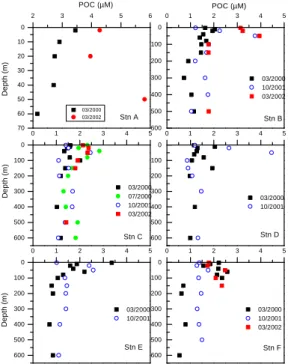
溶解有機氮(DON):海水經 GF/F 濾紙 過濾後,以 persulfate 高溫氧化法測定 總 氮 後 扣 除 DIN(dissolved inorganic nitrogen)後得到 DON。 溶解有機磷(DOP):海水經 GF/F 濾紙過 濾後,以 persulfate 高溫氧化法測定 總 磷 後 扣 除 DIP(dissolved inorganic phosphorus)後得到 DOP。 溶解無機碳(DIC)、氮(DIN)、磷(DIP): 分 別 以 SOMMA-Coulometric method, FLA-比色法測定之(Bates et al.,1996)。 顆粒態碳(POC)、氮(PON):以 GF/F 濾 紙過濾後,將濾紙加入 HCl 去除碳酸鈣 後以碳氮硫分析儀(Fisons,NA-1500) 測定之(Hung et al.,1999)。 顆粒態磷(POP):海水經 GF/F 濾紙過濾 後,將濾紙於 450-500℃下烘燒後,利 用 0.5M HCl 於 90℃下萃取後,以 6M NaOH 中和後利用比色法測定 DIP(Karl et al,1991)。 葉綠素 a:定量海水經 GF/F 濾紙過濾 後,冷凍攜回實驗室後以 90﹪丙酮萃取 後 以 螢 光 度 計 測 定 之 (Strickland and Parson,1972)。 4. 浮游動物碳釋放實驗: (i) 以 200μm 網目捕撈浮游動物。 (ii) 利用 GF/F 濾紙過濾大量海水分裝 於 1 升的 Pyrex 玻璃瓶中,培養浮 游動物 1~8 小時。 (iii)分 別 過 濾 培 養 液 且 測 定 DIC 及 DOC。 四、結果與討論 1. DOM 與 POM 之時空分佈變化 在南海北部的透光層中 DOC 的垂直分 佈約介於 67~85(表層)至 45 μM 之間,而 空間的變化與季節性的差異大約在 10 ìM 之 間 。而 POC 之分佈約 從表層最大值 (2.5~4 ìMC)遞減至底層~1 ìMC 左右。其 透光層空間及季節性變化範圍相對較小約
在 1~1.5 ìMC 左右(圖二)。此與南海貧營養 鹽特性有關。POC 與 DOC 之間的分佈並 無顯著的相關,此可能與兩者貯存量的控 制機制不完全相同有關。DOC 之分佈受水 柱穩定度的影響相當大,單是溫度的變化 可解釋 65﹪DOC 的變化程度。而 POC 之 分佈則絕對受制於基礎生產力之高低。 南海北部 DOC 與 POC 分配比值(DOC/POC Partition)是台灣附近海域(從潟湖至高屏海 域至東海,南海)最高的,約介於 30~65 之 間,而高的 DOC/POC 比值是貧營養鹽海 域之特性,而台灣七股及大鵬灣潟湖之富 營養鹽海域的 DOC/POC 比值均相對很 低,約在 15 以下。DOC/DOP 比值的差異 將顯示不同生態系有機碳的控制機制。在 貧 營 養 鹽 生 態 系 微 生 物 迴 路 (microbical loop)可能決定有機碳之生成與消耗及輸出 通量,而富營養鹽的生態系則受到典型食 物鏈的控制。 南海北部 DON 及 DOP 分佈約介於黑潮 水與東海陸棚之間。其隨深度遞減之速率 要高於 DOC,顯示其比 DOC 易於分解, 而由於垂直剖面分佈型態顯示大部份 DON 及 DOC 均於透光層或混合層中循環。 2. 南海北部有機碳、氮、磷比值及其意涵 南海北部透光層生物對碳、氮、矽及磷 之吸收比值(△DIC/△DIN/△Si/△DIP)約 為 173:13:13.5:1 (2000 年 3 月),而在 2000 年 7 月的△DIN/△DIP 比值約為 13,在 2001 年 3 月 的 吸 收 比 值 則 大 約 為 160:12.8:18:1。顯示生物吸收比值相對於碳 而 言 均 遠 高 於 Redfield ratio (106:16:16:1) 。 這 表 示 生 物 對 碳 而 言 有 Overconsumption 的現象。但由透光層中存 在的 POM 而言,其比值則分別為△POC/ △PN 介於 6.8(03/2000,03/2001,03/2002)與 8.3 (10/2001)之間。同時△POC/△PP 的比 值則分別為 95(03/2000),117(07/2000),93 (10/2001)及 102(03/2002),不論從 C/N 或 C/P 比 值 來 看 POM 之 比 值 均 趨 近 於
Redfield ratio。比較生物吸收比值及 POM 的元素比值暗示透光層中生物吸收之碳、 氮、磷必定以 DOM 方式釋放至水體當中, 而此 DOM 具有較高的 C/N/P 比值。因此 以 Redfield 來推估生物對 CO2的固定量可 能會造成低估的現象。此種生物對碳過量 吸收的現象可能與透光層中營養鹽的有效 性具有密切的相關性,最近的報導亦顯示 與 透 光 層 中 鐵 的 有 效 性 有 關 (Takeda,1998),生物在缺鐵時可能造成較 高的 C/N 及 Si/N 吸收比值。生物的高 C/N/Si 吸收比的另一層涵意在於新生產力 的估算可能偏低,因為大部份新生產力均 利用 NO3-之吸收率及 Redfield ratio 推估。 此種現象亦可解釋生產力與輸出通量之間 的差異所在。另外,透光層中產生的高比 值 DOM 若未能有效輸出進入較深層水 體,則其必定在透光層中循環,終究以 CO2 方式回到大氣,則對 CO2之淨吸收並無實 際效益。 3.南海北部 DOC 及 POC 之垂直通量 南 海 北 部 DOC 之 垂 直 擴 散 通 量 可 以
Fick’s First Law 來估計,F= -kzdc/dz,其中
最重要的垂直擴散係數應隨深度而改變, 但目前暫時以過去在南海所發表的數據
(Cai et al., 2002)為依據約為 2.0 m2d-1。
Ledwell (1993)曾用 0.95 m2d-1來估算東北
太平洋的 DOC 通量,Wong et al.,(2002)則
用 1.3 m2d-1 來估北太平洋次極區之 DOC 通量,因此採用 2.0 m2d-1 是一合理的估 算。因此南海北部的 DOC 垂直通量約為 24 mg C m2d-1,而 POC 的輸出通量雖無直 測資料(Sediment trap 之資料尚不足估算 POC 之輸出通量),但若暫時以新生產力 (New production)以作為輸出通量的依據, 則南海北部的 POC 輸出(離開透光層)的通 量約為 120 mgCm2d-1 (Chen,Y-L., Personal communication),由此初步資料顯示 DOC 之 垂 直擴 散 通量 約 為 POC 輸出通量的
20%。惟必需注意的是 DOC 及 POC 之垂 直輸出均隨深度之增加而改變,因此兩者 的輸出比亦應隨深度之變化而改變。 4.南海北部浮游動物日夜遷移與碳傳輸 南海北部浮游動物的日夜遷移與碳傳輸 的關係涉及浮游動物的呼吸(DIC)及 DOC 之釋放。因此過去分別在南海北部 B,C, F 站進行夜間 Zooplankton 收集以及現場的 DIC 呼吸率以及 DOC 釋放的實驗。初步估 計結果顯示浮游動物對 DIC 及 DOC 的釋 放約在 1~2hr 內完成>90%的 DOC 釋放。 但 DIC 之呼吸似有隨時間增加的現象。此 種 DIC 及 DOC 之遷移與現場日夜的 DIC 及 DOC 的分佈變化非常吻合(濃度變化為 黑夜>黎明>中午),此與黑夜 Zooplankton 將表層有機碳帶往深層及進行呼吸作用之 現象吻合(Longhurst and Harrison,1988, 1989; Longhurst and Harrison, 1988; Dam et al.,1995;Steinberg et al.,2000)。由於 DIC 及 DOC 之遷移通量涉及浮游動物日夜遷 移的總量,而此部份的工作非常繁瑣,因 此尚需一段時間才有辦法估算出碳的遷移 通量。 五、成果自評 本篇報告其內容完全符合計畫預期執行內 容,並可經改寫後投稿國際期刊。 六、參考文獻 許明光(1999)SAR 影像上台灣灘水深與 黃東海東海及南海北部內波之研究。88 年底海洋科學學門研究成果發表會論 文摘要集,173-175 頁. 唐存勇、梁文德及莊文思(1999)Buoy Observation in the South China Sea. 88 年度海洋科學學門研究成果發表會 論文摘要集,183-184 頁.
Anderson, L. A. and P. J. leB Williams (1998)
Modelling of seasonal cycling of
dissolved organic carbon at Station E1 in the English Channel. Estuarine, Coastal
and Shelf Science 46:93-109.
Bates, N. R., A. F. Michaels and A. H. Knap
(1996) Seasonal and interannual
variability of oceanic carbon dioxide species at the U.S. JGOFS Bermuda Atlantic Time-series Study (BATS) site. Deep-Sea Research II, 43:347-384.
Cai, P., Y. Huang, M. Chen, L. Guo, G. Liu and Y. Qiu (2002) New production based on 228Ra-derived nutrient budgets and thorium-estimated POC export at the intercalibration station in the South China Sea. Deep-Sea Research I, 49:53-66. Carlson, C. A., H. W. Ducklow and A. F.
Michaels (1994) Annual flux of dissolved organic carbon from the euphotic zone in the northwestern Sargasso Sea. Nature, 371:405-408.
Carlson, C. A., H. W. Ducklow, D. A. Hansell and W. O. Smith, Jr. (1998) Organic carbon partition during spring phytoplankton blooms in the Ross Sea
polynya and the Sargasso Sea.
Limmnology and Oceanography,
43(3):375-386.
Chester, R. (1990) Marine Geochemistry. Chapman & Hall, London.
Dam, h. G., M. R. Roman and M. J. Youngbluth (1995) Downward export of respiratory by diel-migrant mesozoopl-ankton at the JGOFS Bermuda time-series station. Deep-Sea Research I, 42:1187-1197.
Karl, D. M., J. E. Dore, D. V. Hebel and C. winn (1991) Particulate C, N, P and total mass analysis in US-JGOFS HOT. In D. C. Hurd and D. W. Spencer (eds.) Marine Particles: Analysis and Characterization. Pp.71-78, American Geophysical Union. Hansell, D. A. and C. A. Carlson (1998) Net
community production of dissolved organic carbon. Global Biogeochemical Cycles, 12:443-453.
Huang, C. Y., P. M. Liew, M. Zhao, T. C. Chang, C. M. Kuo, M. T. Chen, C. H. Wang and L. F. Zheng (1997) Deep-sea and lake records of southeast Asian paleomonsoons for the last 25 thousand years. Earth Plant. Sci. letts., 146:59-72.
Hung, J.-J. and P.-L. Lin (1995) Distribution of dissolved organic carbon in the continental margin off northern Taiwan. Terrestrial, Atmospheric and Oceanic Sciences, 6:13-26.
Hung, J. J., C. S. Lin, G. W. Hung and Y. C. Chung (1999) Laterial transport of lithogenic particles from the continental margin of the southern East China Sea. Estuarine, Coastal and Shelf Science, 49:489-499.
Hung, J.-J., P.-L. Lin and K.-K. Liu (2000) Dissolved and particulate organic carbon in the couthern East China Sea. Continental Shelf Research, 20:545-569. Kamykowski, D. (1987) A preliminary
biophysical model of the relationship between temperature and plant nutrients in the upper ocean. Deep-Sea Res., 34:1067-1079.
Liu, K. K., S. Y. Chao, P. T. Shaw, G. C.Gong and C. C. Chen (1999) Monsoon-forcedchlorophyll distributionand
primary production in the South China Sea: observations and a numerical study. 1999 Workshop for Oceanographic Research Programs, 261-262pp. Loh, A. N. and J. E. Bauer (2000)
Distribution, partitioning and fluxes of dissolved and particulate organic C, N and P in the eastern North Pacific and southern oceans. Deep-Sea Research I, 47:2287-2316.
Lounghurst, A. R. and W. G. Harrison (1988) Vertical nitrogen flux from the oceanic photic zone by diel migrant zooplankton
and nekton. Deep-Sea Research,
35:881-889.
Longhurst, A. R., A. Bedo, W. G. Harrison, E. J. H. Head, E. P. Horne, B. Irwin and C. Moralest (1989) NFLUX: a test of vertical nitrogen flux by diel migrant biota. Deep-Sea Research, 36:1705-1719. Longhurst, A. R., A. W. Bedo, W. G.
Harrison, E. J. H. Head and D. D.
Sameoto (1990) Vertical flux of respiratory carbon by oceanic diel migrant biota. Deep-Sea Res., 37:685-694.
Steinberg, D. K., C. A. Carlson, N. R. Bates, S. A. Goldthwait, L. P. Madin and A. F. Michaels (2000) Zooplankton vertical migration and the active transport of dissolved organic and inorganic carbon in the Sargasso Sea. Deep-Sea researchI, 47:137-158.
Strickland, J. D. H. and T. R. Parson (1972) A Practical Handbook of Seawater Analysis. Bull. Fish. Res. Fish. Res. Board Can., 2nd Edn., No. 167, 311pp. Takeda, S. (1998) Influenec of iron
availability on nutrient consumption ratio of diatoms in oceanic waters. Nature, 393:774-777.
Toggweiler, J. R. (1989) Is downward dissolved organic matter (DOM) flux important in carbon transport? In: W. H. Berger, V. S. Smetacek and G. Wefer (eds.) Productivity of the Ocean: Present and Past, pp:65-83, John Wiley & Sons, Chichester.
Wong, C. S., N. A. D. Waser, F. A. Whitney, W. K. Johnson and J. S. Page (2002) Time-series study of the biogeochemistry of the North East Subartic Pacific: recincilation of the Corg/N
remineralization and uptake ratios with the Redfield ratios. Deep-Sea Research, 49:5717-5738.
Wotton, R. S. (1994) The Biology of Particles in Aquatic Systems. Lewis Publishers, London.
Wu, C.-R., P. –T. Shaw and S. –Y. Chao (1998) seasonal and interannual variations in the velocity field of the South China Sea. J. Oceanogr., 54, 361-372.
the southeast Asian waters. NAGA Report Vol. 2, Scientific Results of Marine Investigation of the South China Sea and the Gulf of Thailland, Scripps Institution of Oceanography, La Jolla, California, 195 pp. 110 111 112 113 114 115 116 117 118 119 120 121 122 Longitude (oE) 16 17 18 19 20 21 22 23 24 L a ti tu d e (o N ) a b A c B d C e D f E g F h CHINA TAIWAN LUZON -4800 -4400 -4000 -3600 -3200 -2800 -2400 -2000 -1600 -1200 -800 -400 -100
Fig. 1. Sampling locations of study area
70 60 50 40 30 20 10 0 2 3 4 5 6 D e p th ( m ) Stn A POC (µ M) 03/2000 03/2002 D e p th ( m ) 600 500 400 300 200 100 0 0 1 2 3 4 5 POC (µ M) Stn B 03/2000 10/2001 03/2002 600 500 400 300 200 100 0 0 1 2 3 4 5 Stn C 03/2000 07/2000 10/2001 03/2002 D e p th ( m ) 600 500 400 300 200 100 0 0 1 2 3 4 5 Stn D 03/2000 10/2001 600 500 400 300 200 100 0 0 1 2 3 4 5 Stn E 03/2000 10/2001 600 500 400 300 200 100 0 0 1 2 3 4 5 Stn F 03/2000 10/2001 03/2002
Fig. 2. Seasonal and spatial variations of POC in the southern SCS.