H-Bonded effects on supramolecular liquid crystalline trimers
containing photoluminescent cores
Hong-Cheu Lin,*a,bHsin-Yi Sheu,aChiou-Ling Changcand Chiitang Tsaic a
Department of Materials Science and Engineering, National Chiao Tung University, Hsinchu, Taiwan, ROC. E-mail: [email protected]; Fax: z8863-5724727; Tel: z8863-5712121 ext.55305
b
Institute of Chemistry, Academia Sinica, Taipei, Taiwan, ROC c
Institute of Applied Chemistry, Chinese Culture University, Taipei, Taiwan, ROC
Received 14th February 2001, Accepted 10th August 2001
First published as an Advance Article on the web 9th October 2001
Several series of hydrogen-bonded (H-bonded) liquid crystalline trimers are constructed by complexation of two complementary components containing various bifunctional photoluminescent (PL) acceptor cores and
monofunctional proton donors (in a 1 : 2 molar ratio). These supramolecular liquid crystalline trimers (i.e. H-bonded trimers 1/3, 1/4, 1/5, 1/6, 2/3, 2/4, 2/5 and 2/6) are, respectively, obtained from bifunctional bis-pyridyl acceptors (containing conjugated benzene and thiophene centers) (1 and 2) complexed with monofunctional carboxylic acids (containing benzene, thiophene or naphthalene) (3–6) in a 1 : 2 acceptor–donor group stoichiometry. Though the PL bis-pyridyl acceptors (1 and 2) do not possess any mesophases, the distinct mesomorphism and supramolecular architecture of these H-bonded trimers are confirmed by polarizing optical microscopy (POM), DSC, and powder X-ray diffraction (XRD) experiments. Moreover, the PL properties of the photoluminescent bis-pyridyl cores can be adjusted not only by the central structures of the cores but also by their surrounding non-photoluminescent proton donors. In general, redder shifts occur in PL spectra of H-bonded trimers when proton donors of smaller pKavalues are H-bonded to the photoluminescent cores.
Significantly, different wavelengths and polarized light of PL emission can be obtained in these supramolecular structures possessing both liquid crstalline and photoluminescent properties.
Introduction
Recently, the application of hydrogen bonding in the forma-tion of new liquid crystalline materials, i.e. supramolecular liquid crystals, has been rapidly developed.1–4Supramolecular liquid crystals are molecular complexes generated from complexation of molecular species through non-covalent interactions, e.g. hydrogen bonding. The mesogenic properties can be easily modified by miscellaneous proton donors and proton acceptors, and new liquid crystalline properties, which are different from those of their original moieties, can be obtained by the supramolecular structures. Many kinds of hydrogen bonds and building elements have been explored in the H-bonded structures to stabilize liquid crystalline phases.5–12Among these approaches, intermolecular hydrogen bonding is easily obtained by complexation of carboxylic (or benzoic) acid and pyridyl moieties. Owing to the ease of tailoring and modification of the supramolecular structures, the H-bonded liquid crystalline materials have various potential applications in the fields of display and electro-optical devices.
Regarding the linearity of the supramolecular liquid crystals, the most common rigid cores in the supramolecular liquid crystals are linear structures with para-substituted aromatic rings H-bonded through the pyridyl and carboxylic acid moieties. Nonetheless, some supramolecular liquid crystals with nonlinear structures were reported to reveal interesting mesomorphic properties.13–20 Among these publications, our recent work shows that kinked supramolecules containing different bending sites provide the ability to manipulate the mesomorphic properties of the complexes using angular H-bonded interactions.17–18 In addition, thiophene-based supramolecular liquid crystals make use of non-N-heterocyclic structures as the H-bonded moieties. The thiophene-based structures supplying dipoles and bent configurations in the
supramolecules can simultaneously reduce the phase transition temperatures of the supramolecules and improve the solubility of the moieties.16,19–20 Novel mesomorphism has been suc-cessfully demonstrated by bending supramolecules and intro-ducing dipoles in their centers through using a five-membered heterocyclic ring. This thiophene-based nonlinear structure with lone-pair electrons (not contained in the hydrogen bond) providing strong dipoles is applied to our H-bonded trimers as building blocks of either proton acceptors or donors. Con-sequently, different linkages and rigid parts containing various aromatic rings, including heterocyclic thiophene and fused naphthalene rings, are utilized to study their influence on these H-bonded trimers.
Recently, a series of photoluminescent bis-pyridyl com-pounds have been developed and made into doped-LED devices.21 Since the bis-pyridyl compounds can be used as proton acceptors to form H-bonded trimers, several series of novel supramolecular liquid crystals containing these photo-luminescent bis-pyridyl compounds are demonstrated in this report. Various mesogenic phases, including nematic, smectic A, and smectic C phases, were observed in these H-bonded trimers. The mesogenic properties can be tuned by the proton donors and the bis-pyridyl cores. Some previous research showed that the pH level of the conjugated copolymers containing pyridine units in polyelectrolytes has pronounced effects on the emission spectra.22–24Besides, some protonated
products of bis-pyridyl derivatives have also been studied as laser dyes both in aqueous and in micellar media. To our knowledge, H-bonded effects on photoluminescent supra-molecules in solid films have not been reported yet. So far, there are few reports on H-bonded photoluminescent materials giving liquid crystalline properties. Our preliminary results show that a red shift occurs in these H-bonded trimers when proton donors of smaller pKa values are H-bonded to the
2958 J. Mater. Chem., 2001, 11, 2958–2965 DOI: 10.1039/b101471o
supramolecules. This is similar to the red shift in emission observed in previous polyelectrolytes in the aqueous form at lower pH values due to the protonation of the pyridine nitrogen. Therefore, we also would like to illustrate the H-bonded effects on the photoluminescence of these supra-molecular liquid crystals in their solid state form.
Experimental
Characterization
The1H and13C NMR spectra were recorded on a Bruker MSL 200 or 300 spectrometer (200 or 300 MHz) from a CDCl3or
DMSO solution with TMS as the internal standard. The elemental analyses were carried out on a Perkin–Elmer 2400 CHN. The thermal transition temperatures and textures of all products were obtained from a Perkin–Elmer DSC-7 and Leitz Laborlux S polarizing optical microscope (POM) equipped with a THMS-600 heating stage. The heating and cooling rates were 10uC min21 for all measurements unless mentioned.
Photoluminescence spectra were determined using a Hitachi F4500 fluorescence spectrophotometer and the concentrations of the solutions are less than 561026M. Powder X-ray
diffraction (XRD) patterns were obtained from a Siemens D-5000 X-ray diffractometer (40 kV, 30 mA) fitted with a TTK450 temperature controller. Nickel-filtered CuKa radia-tion was used as the incident X-ray beam.
Synthesis
All compounds (1–6) used in this study were synthesized by previous methods20–21,25 and they were identified as the
required materials and judged to be pure by 1H and
13
C-NMR spectroscopy.
Compounds 1 and 2. Both bifunctional bis-pyridyl com-pounds (1 and 2), i.e. 1,4-bis(4-pyridylethenyl)benzene PBP (1) and 2,5-bis(4-pyridylethenyl)thiophene PTP (2), were synthe-sized by following literature methods.21,25
Compounds 3–6. All monofunctional carboxylic acids (3–6), i.e. 4-decyloxybenzoic acid C10OBA (3),
6-decyloxy-2-naphthoic acid C10ONA (4), thiophene-2,5-dicarboxylic acid
monodecyl ester C10COOTHA (5) and terephthalic acid
monodecyl ester C10COOBA (6), were synthesized by following
previous methods.20
Preparation of H-bonded trimers
H-bonded trimers, i.e. 1/3, 1/4, 1/5, 1/6, 2/3, 2/4, 2/5 and 2/6 (molar ratio 1 : 2), were prepared by slow evaporation of THF solution containing the mixtures of a 1 : 2 group molar ratio of the H-bonded acceptor and donor moieties, followed by drying in vacuo at 60uC.
Results and discussion
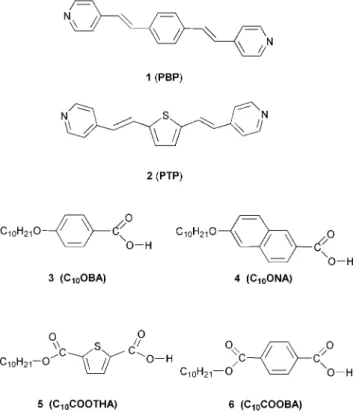
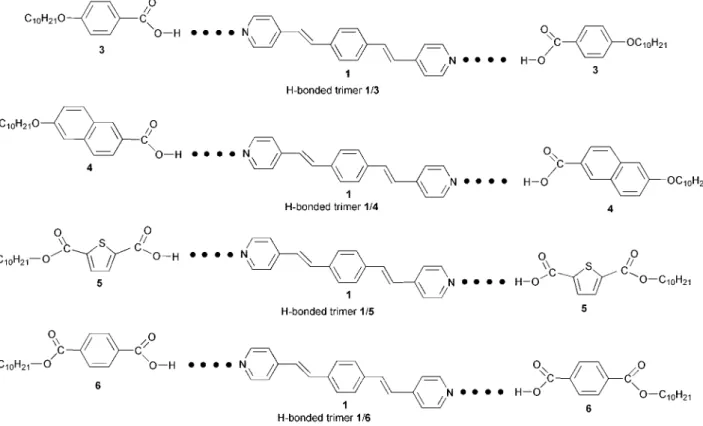
H-bonded trimers containing photoluminescent bis-pyridyl cores are obtained from bifunctional bis-pyridyl compounds (1 and 2) complexed with monofunctional caboxylic acids (3–6), i.e. 1/3, 1/4, 1/5, 1/6, 2/3, 2/4, 2/5 and 2/6 (molar ratio 1 : 2). All H-bonded moieties, i.e. acceptors (1 and 2) and donors (3–6), are listed in Fig. 1. The schematic structures of H-bonded trimers, i.e. H-bonded trimers 1/3, 1/4, 1/5 and 1/6 containing photoluminescent bis-pyridyl benzene core 1 and H-bonded trimers 2/3, 2/4, 2/5 and 2/6 containing photo-luminescent bis-pyridyl thiophene core 2, are shown in Fig. 2 and Fig. 3, respectively.
The thermal properties of H-bonded trimers 1/3, 1/4, 1/5, 1/6, 2/3, 2/4, 2/5 and 2/6 (molar ratio 1 : 2) are shown in Table 1. The phase transition temperatures of these individual proton
acceptors and donors, i.e. 1,4-bis(4-pyridylethenyl)benzene PBP (1), 2,5-bis(4-pyridylethenyl)thiophene PTP (2), 4-decyl-oxybenzoic acid C10OBA (3), 6-decyloxy-2-naphthoic acid
C10ONA (4), thiophene-2,5-dicarboxylic acid monodecyl ester
C10COOTHA (5) and terephthalic acid monodecyl ester
C10COOBA (6), are listed in the bottom appendix of
Table 1. Most H-bonded acceptor and donor moieties show poor mesomorphism except that H-bonded donors 3 and 4 (forming H-bonded dimers) reveal SC and N phases.
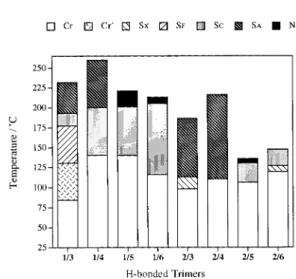
Impor-tantly, novel liquid crystalline properties (shown in Table 1), i.e. SF, SC, SAand N phases, which are different from those of
their original moieties, are obtained by the supramolecular structures and their phase diagram is illustrated in Fig. 4. It is observed that trimers 1/3, 1/4, 2/3 and 2/4 show the appearance of the SAphase, and trimers 1/5, 1/6, 2/5 and 2/6 reveal the
appearance of SCand/or N phases. Compared with analogous
H-bonded trimers containing the bis-pyridyl thiophene core (2), H-bonded trimers containing the bis-pyridyl benzene core (1) have higher clearing temperatures (Tc), e.g. 1/3w2/3,
1/4w2/4, and so on. Furthermore, H-bonded trimers contain-ing the bis-pyridyl benzene core (1) shown in Fig. 4 prefer to form or to broaden the SCphase to a greater degree than those
containing the bis-pyridyl thiophene core (2). However, H-bonded trimers containing the bis-pyridyl thiophene core (2) prefer to broaden the SAphase and reduce the N phase to a
greater degree than those H-bonded trimers containing the bis-pyridyl benzene core (1). Regardless of the central acceptor cores, similar phase behaviour occurs in the H-bonded trimers with the same proton donors, so their mesogenic properties might be mainly contributed from their proton donors. This can be explained by the higher molar ratio of donors in the H-bonded trimers (acceptor/donor molar ratio 1 : 2). For instance, the SAphase is preferred in the H-bonded trimers
consisting of donors with ether linkages (3 and 4), i.e. 1/3, 1/4, 2/3 and 2/4. SC and N phases seem to be favored in the
H-bonded trimers consisting of donors with ester linkages (5 and 6), i.e. 1/5, 1/6, 2/5 and 2/6. Another trend of the clearing temperatures happens in the series containing the proton donors 3, 4, 5 and 6, e.g. 2/4 (naphthalene donors)w2/3 (benzene donors with ether linkage) w2/6 (benzene donors with ester linkage)w2/5 (thiophene donors), except for that in 1/6
Fig. 1 Proton acceptors (1,2) and donors (3–6) used in H-bonded trimers.
J. Mater. Chem., 2001, 11, 2958–2965
(benzene donors with ester linkage)v1/5 (thiophene donors). In general, H-bonded trimers containing more rigid compo-nents (i.e. naphthalene donors compared with the other donors) and more linear shape (i.e. PBP (1) vs. the other
acceptor PTP (2)) may have higher clearing temperatures. Accordingly, the adjustment of the bis-pyridyl cores and proton donors in these H-bonded trimers can generate novel liquid crystalline properties.
Fig. 2 The schematic structures of H-bonded trimers 1/3, 1/4, 1/5 and 1/6 (molar ratio 1 : 2) containing photoluminescent core 1.
Fig. 3 The schematic structures of H-bonded trimers 2/3, 2/4, 2/5 and 2/6 (molar ratio 1 : 2) containing photoluminescent core 2.
J. Mater. Chem., 2001, 11, 2958–2965
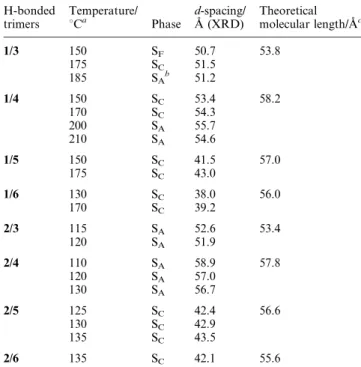
The d-spacing values of the layered SF, SC, and SAphases in
H-bonded trimers 1/3, 1/4, 1/5, 1/6, 2/3, 2/4, 2/5 and 2/6 shown in Table 2 are obtained from the powder XRD measurements. Their H-bonded trimeric architectures can be evidenced from the XRD patterns. Since the molecules are orthogonal to the layer in the SA phase, the largest d-spacing values of the SA
phases in Table 2 are correlated to the lengths of the supramolecules. Similar to most mesogenic materials, the d-spacing values of the SA phases in Table 2 decrease as the
temperature increases, so the largest d-spacing value of the SA
phases at the lowest temperature in each system is chosen to evaluate its molecular length. The lengths of all components calculated by the molecular modeling are listed as follows: PBP (1)~y15.6 A˚, PTP (2)~y15.2 A˚, C10OBA (3)~19.1/20.6 A˚ ,
C10ONA (4)~21.3/22.8 A˚ , C10COOTHA (5)~20.7/21.3 A˚ and
C10COOBA (6)~20.2/21.8 A˚ ; where the former value is the
molecular projection length along the rigid core and the latter value is the fully extended molecular length. The theoretical molecular lengths of H-bonded trimers estimated by the sum of molecular projection lengths of the three H-bonded compo-nents along the rigid cores through molecular modeling are also
Table 1 Phase transition temperatures (uC)a
and corresponding enthalpies (J g21), in parentheses, of H-bonded trimers 1/3, 1/4, 1/5, 1/6, 2/3, 2/4, 2/5, 2/6 (molar ratio 1 : 2) by complexation of 1,4-bis(4-pyridylethenyl)benzene PBP (1) or 2,5-bis(4-pyridylethenyl)thiophene PTP (2) with 4-decyloxybenzoic acid C10OBA (3), 6-decyloxy-2-naphthoic acid C10ONA (4), thiophene-2,5-dicarboxylic acid monodecyl ester C10COOTHA (5)
or terephthalic acid monodecyl ester C10COOBA (6)b
a
Phase transition temperatures and corresponding enthalpies were determined by the 2nd heating and cooling scans (at the heating and cooling rate of 10uC min21); abbreviations: Cr, Cr’~crystalline phases, S
X~unidentified smectic phase, SF~smectic F phase, SC~smectic C phase,
SA~smectic A phase, N~nematic phase, I~isotropic liquid. bThe phase transition temperatures (heating) of proton acceptor and donor
moieties are as follows: 1,4-bis(4-pyridylethenyl)benzene PBP (1): mp~265–266uC; 2,5-bis(4-pyridylethenyl)thiophene PTP (2): mp~210– 212uC; 4-decyloxybenzoic acid C10OBA (3): Cr 85.1uC SX 96.0uC SC 123.7uC N 142.4 uC I; 6-decyloxynaphth-2-oic acid C10ONA (4): Cr
104.8uC Cr’ 136.3 uC SC140.5uC N 175.9 uC I; thiophene-2,5-dicarboxylic acid monodecyl ester C10COOTHA (5): mp~104.8uC; terephthalic
acid monodecyl ester C10COOBA (6): Cr 69.0uC SX113.3uC I.cPhase transition temperature was observed through optical microscopy.
Fig. 4 Phase transition temperatures (on heating) of H-bonded trimers 1/3, 1/4, 1/5, 1/6, 2/3, 2/4, 2/5 and 2/6 (molar ratio 1 : 2).
J. Mater. Chem., 2001, 11, 2958–2965
shown in Table 2. According to XRD patterns, H-bonded trimers 1/3, 1/4, 2/3 and 2/4 have the largest d-spacing values of the SAphases (Table 2) correlated to their molecular lengths,
i.e. 51.2 A˚ (1/3 at 185 uC), 55.7 A˚ (1/4 at 200 uC), 52.6 A˚ (2/3 at 115uC) and 58.9 A˚ (2/4 at 110 uC), respectively. Comparing the layer spacing values with the theoretical molecular lengths, i.e. 53.8 A˚ (1/3), 58.2 A˚ (1/4), 53.4 A˚ (2/3) and 57.8 A˚ (2/4) (Table 2), all H-bonded trimers, i.e. 1/3, 1/4, 2/3 and 2/4, are proved to maintain their H-bonded trimeric architecture. On the basis of the XRD data, H-bonded trimers 1/4 and 2/4 have the largest d-spacing values (in the SAphase), respectively,
in both analogous H-bonded trimeric systems containing acceptors PBP (1) and PTP (2), and this result primarily corresponds with the longest molecular length of the naphtha-lene-based proton donor 4 in all donor moieties. Interestingly, some H-bonded trimers containing the shorter and more kinked core PTP (2) have larger supramolecular lengths than their analogous H-bonded trimers containing the longer and straighter core PBP (1). It is noticeable that the H-bonded trimers containing PBP (1) have shorter d-spacing values (y2.5 A˚ shorter) in the SA phase than their theoretical
molecular lengths in Table 2. This might be explained by the partially kinked structures that are formed to some extent in the H-bonded trimers containing PBP (1). Also, the theoretical molecular lengths of the other H-bonded trimers 1/5, 1/6, 2/5 and 2/6 (with no SA phase) are shown to be (see Table 2):
57.0 A˚ (1/5), 56.0 A˚ (1/6), 56.6 A˚ (2/5) and 55.6 A˚ (2/6). Although these H-bonded trimers show no SA phase in the
XRD measurements from which to judge their molecular lengths, they show much smaller d-spacing values for the SC
phase in H-bonded trimers 1/5, 1/6, 2/5 and 2/6 (38.0–43.5 A˚ in SC) in contrast to those in previous H-bonded trimers 1/3 and
1/4 (51.5–54.3 A˚ in SC). For the 1/3 and 1/4 systems possessing
both SCand SAphases, the d-spacing values of the SC phase
(51.5–54.3 A˚ in SC) are about the same as those of the SAphase
(51.2–55.7 A˚ in SA). This indicates that the larger tilt angles of
the H-bonded trimers 1/5, 1/6, 2/5 and 2/6 in the SCphase may
be correlated to their donors containing the ester linkage, which might enhance the formation of the SCphase with larger
tilt angles (about 40–45u tilt angles estimated from Table 2) and thus eliminate the SAphase (observed in our earlier comparison
of Fig. 4), rather than the ether linkage of the donors in H-bonded trimers 1/3 and 1/4, which may induce the formation of the SAphase instead. The layer spacing values of H-bonded
trimers in the SCphase seem to be majorly associated with the
linkage of the donors and thereafter related to the existence of the SAphase, i.e. smaller layer spacing values of the SCphase
in H-bonded trimers possessing no SAphase. Generally, the
d-spacing data match the calculated molecular lengths from the molecular modeling, and the XRD results have confirmed their supramolecular structures.
In order to analyze analogous H-bonded trimers, two given comparable H-bonded trimers 2/3 and (CnPS)2-THDA (where
n~10), in which both possess five aromatic rings (two benzene and pyridine rings on both sides, and one thiophene ring in the center), two –CLC– linkages, and two carboxylic acid H-bonds but owning different sequences in the structural combination, are compared and demonstrated below.
Table 2 The largest d-spacing values of the layered SF, SC and SA
phases in the X-ray diffraction (XRD) measurements of H-bonded trimers 1/3, 1/4, 1/5, 1/6, 2/3, 2/4, 2/5 and 2/6 (molar ratio 1 : 2) at different temperatures and their theoretical molecular lengths H-bonded trimers Temperature/ uCa Phase d-spacing/ A˚ (XRD) Theoretical molecular length/A˚c 1/3 150 SF 50.7 53.8 175 SC 51.5 185 SAb 51.2 1/4 150 SC 53.4 58.2 170 SC 54.3 200 SA 55.7 210 SA 54.6 1/5 150 SC 41.5 57.0 175 SC 43.0 1/6 130 SC 38.0 56.0 170 SC 39.2 2/3 115 SA 52.6 53.4 120 SA 51.9 2/4 110 SA 58.9 57.8 120 SA 57.0 130 SA 56.7 2/5 125 SC 42.4 56.6 130 SC 42.9 135 SC 43.5 2/6 135 SC 42.1 55.6 a
All temperatures reported were measured on heating scans. Small temperature deviation from DSC data may occur due to the annealing effect in XRD measurements.bThe largest d-spacing values of the S
A
and SCphases observed in this H-bonded trimer 1/3 are similar due to
a broad and vague transition between the SAand SCphases.cThe
the-oretical molecular lengths of H-bonded trimers are estimated by the sum of molecular projection lengths of the three H-bonded compo-nents along the rigid cores through molecular modeling.
J. Mater. Chem., 2001, 11, 2958–2965
With respect to the mesogenic properties and XRD results of (CnPS)2-THDA (where n~8 and 12), which were reported
earlier,16 (C
12PS)2-THDA has the following thermal
proper-ties: Cr 69.4uC Cr’ 140.3 uC SA 175.0uC N 188.8 uC I (on
heating) and (C8PS)2-THDA has similar mesogenic properties
with SAand N phases, and the largest d-spacing values of the
SAphase (from XRD) are around 54–55 A˚ in both H-bonded
trimers (CnPS)2-THDA (n~8 and 12). Thus, (C10PS)2-THDA
can be predicted to have both SAand N phases, which are not
possessed in both acceptor and donor moieties (C10PS and
THDA), and the largest d-spacing value of 54–55 A˚ in the SA
phase can be predicted as well. In contrast to analogous (C10PS)2-THDA, the H-bonded trimer 2/3 has a broader SA
phase (112.7–186.5uC on heating) but no N phase. Though the donor moiety of 2/3, i.e. donor 3, possesses both SCand
N phases, H-bonded trimer 2/3 has completely different mesomorphism, i.e. reveals a SA phase only. Besides, 2/3
has a similarly large d-spacing value of 52.6 A˚ (in the SA
phase) to that of analogous (C10PS)2-THDA (around
54–55 A˚ ), that suggests these two analogous H-bonded trimers 2/3 and (CnPS)2-THDA may have similar configurations of
H-bonded architecture.
The conjugated bis-pyridyl compounds (1 and 2) in these H-bonded trimers possess photoluminescent (PL) properties and they can be used as proton acceptors to form supramolecular structures in this study. According to our previous work,21the photoluminescent bis-pyridyl compounds 1 and 2 show different emission peaks depending on their central cores (benzene in 1 and thiophene in 2), and bis-pyridyl compound 2 containing the thiophene unit has larger lmaxthan that of
bis-pyridyl compound 1 due to the smaller energy gap (lower oxidation potential) of the thiophene-based structure in compound 2. We know that pH values of aqueous solutions may affect PL properties of polyelectrolytes containing pyridine; hence, hydrogen bonds in these supramolecular liquid crystals may have a critical influence on the PL properties of the conjugated bis-pyridyl compounds. Before the H-bonded effects on photoluminescent supramolecules in solid films have been surveyed, solution forms of photolumi-nescent bis-pyridyl acceptors (1 and 2) in different pH values of solvent, i.e. THF and CH3COOH, are investigated first. The
PL spectra of PBP (1) and PTP (2) in solutions of THF and CH3COOH are shown in Fig. 5 and Fig. 6, and their emission
peaks of lmax of solutions and solid films (reported
pre-viously)21are listed in Table 3. The exciting wavelength of the incident beam lexis 380 nm. In comparison with PBP (1) and
PTP (2) in a solution of THF, the emission peaks of lmaxof the
PL spectra in the solution of CH3COOH have approximately
50 nm red shifts (i.e. from 407 nm to 453 nm in 1 and from 458 nm to 505 nm in 2) due to its smaller solvent pH value in
CH3COOH. The pKavalue of the solvent CH3COOH is 4.07,
so the proton donor effect in CH3COOH solvent with higher
acidity is stronger than that in THF solvent with a more neutral pH value. Similar red shifts (36–96 nm) also occur in their pure solid films, which might be due to the formation of excimers originated from p–p stacking and molecular aggregation of conjugated bis-pyridyl compounds (1 and 2) in the solid state. Similar to solution approaches, the H-bonded effects on the photoluminescence of these supramolecular liquid crystals in the solid form are conceivable if we consider the supramole-cular systems as solid solutions (non-photoluminescent donors as solvents) with different degrees of hydrogen-bonding. The PL spectra of photoluminescent PBP (1) and PTP (2) in their supramolecular structures (in solid films), i.e. H-bonded trimers 1/3, 1/4, 1/5, 1/6, 2/3, 2/4, 2/5 and 2/6 (1 : 2 molar ratio) are shown in Fig. 7 and Fig. 8, and their emission peaks of lmaxin the PL spectra and the pKavalues of the pure proton
donors (3–6) are listed in Table 4. The proton donors (3–6) in the H-bonded trimers do not have photoluminescent pro-perties due to their lack of conjugated structures, and they only offer the solid solvent environment with different pKa
values (C10OBA (3): pKa~4.21; C10ONA (4): pKa~4.17;
C10COOTHA (5): pKa~3.49; C10COOBA (6): pKa~4.21)26
thus giving different degrees of H-bonding for the photolumi-nesent acceptor cores (1 and 2), i.e. different electron density caused by protonation of distinct solid donors. Consequently, the emission peaks of the H-bonded trimers containing the photoluminescent bis-pyridyl cores (1 and 2) in Table 4 can generate 30–40 nm difference of emission in lmaxdepending on
the non-photoluminescent proton donors. On the basis of our findings, the PL spectra of these H-bonded trimers indicate the largest red shift is observed in both H-bonded trimers 1/5 and 2/5 containing thiophene donor 5 possibly due to it having the smallest pKa value and the largest degree of H-bonding Table 3 The emission peaks, lmax(nm), of photoluminescence spectraa
of 1,4-bis(4-pyridylethenyl)benzene PBP (1) and 2,5-bis(4-pyridyl-ethenyl)thiophene PTP (2) in the solutions (THF and CH3COOH)b
and solid films
Acceptor lmax/nm
1 (in THF) 407
1 (in CH3COOH) 453
1 (in solid film) 443
2 (in THF) 458
2 (in CH3COOH) 505
2 (in solid film) 554
a
The exciting wavelength of the incident beam, lex, is 380 nm. b
The concentrations of solutions in THF and CH3COOH are less than
561026M and the pKavalue of CH3COOH is 4.07.
Fig. 5 Photoluminescence spectra of 1,4-bis(4-pyridylethenyl)benzene PBP (1) in solutions of THF and CH3COOH.
Fig. 6 Photoluminescence spectra of 2,5-bis(4-pyridylethenyl)thio-phene PTP (2) in solutions of THF and CH3COOH.
J. Mater. Chem., 2001, 11, 2958–2965
compared with the analogous systems. Similar results have been explained in the literature by the red shift emission of polyelectrolytes that occurs at lower pH values in the aqueous form due to the protonation of the pyridine nitrogen. Indeed, the results demonstrate that a red shift occurs in these H-bonded trimers when proton donors with smaller pKa
values are H-bonded to the supramolecules. Therefore, the lmax values, i.e. the colors, of the photoluminescence in the
supramolecular systems can be tuned not only by adjusting the photoluminescent cores but also by changing between the different pKa values of the non-photoluminescent proton
donors.
In another aspect, by adding proton donors to let the photoluminescent moieties possess liquid crystalline properties in the H-bonded strucutures, they can be aligned by heating of the mesogenic phase in the rubbing cells so as to generate linearly polarized light during the PL process. One proof of this prospect has been done by injection of H-bonded complex 2/4 into an antiparallel rubbing cell (with 9 mm cell gap) and heating up to 120uC (in the SAphase) to align the sample. By
irradiation of UV light (with exciting wavelength of lex~
365 nm) on the aligned SAphase at 120uC, polarized emission
of PL is observed with a polarizer parallel and perpendicular to the rubbing direction and the polarization intensity ratio is around 1.82 (as shown in Fig. 9). After cooling to room temperature, similar polarized photoluminescent properties are still sustained in the solid state, which means the alignment is somewhat maintained even after crystallization. A more
detailed study will be performed in the future. Accordingly, these results also show the feasibility of production of linearly polarized light from supramolecular design by using the combination of liquid crystalline and photoluminescent properties.
Overall, distinct supramolecular liquid crystalline materials can be generated by complexation of different complementary donors and acceptors. The supramolecular architecture and novel mesomorphic properties are confirmed by polarizing optical microscopy, DSC, and powder XRD experiments in this study. PL properties are also investigated to realize the H-bonded effects on these supramolecular trimers. Never-theless, the H-bonded trimers could not be utilized for LED applications due to the poor film-forming quality of the small molecules. In order to solve this problem, we have surveyed new H-bonded polymer systems containing photoluminescent bis-pyridyl acceptors H-bonded to polymeric donors, and it leads to high quality films of supramolecular LED poly-mers. Related results will be published later. Consequently, H-bonded photoluminescent materials possessing liquid crys-talline properties may find practical use in the future.
Conclusions
In conclusion, we can easily adjust the physical properties of the H-bonded trimers by tuning the H-bonded donors and acceptors in the complexes. Unique mesomorphic properties may occur in these supramolecular structures. Similar to traditional molecular structures containing naphthalene, ben-zene, and thiophene units, the H-bonded trimeric structures
Fig. 9 Photoluminescence spectra of 2/4 at 120uC (SAphase) with the
polarizer (a) parallel and (b) perpendicular to the rubbing direction and the polarization intensity ratio is around 1.82.
Table 4 The emission peaks, lmax(nm), of photoluminescence spectra a
of H-bonded trimers (in solid films) 1/3, 1/4, 1/5, 1/6, 2/3, 2/4, 2/5 and 2/6 (molar ratio 1 : 2) containing photoluminescent cores 1,4-bis(4-pyridylethenyl)benzene PBP (1) and 2,5-bis(4-pyridylethenyl)thio-phene PTP (2)b Trimer lmax/nm 1/3 (PBP/C10OBA) 438 1/4 (PBP/C10ONA) 457 1/5 (PBP/C10COOTHA) 467 1/6 (PBP/C10COOBA) 444 2/3 (PTP/C10OBA) 537 2/4 (PTP/C10ONA) 530 2/5 (PTP/C10COOTHA) 571 2/6 (PTP/C10COOBA) 551 a
The exciting wavelength of the incident beam, lex, is 380 nm. b
pKa
values of proton donors are as follows: 4-decyloxybenzoic acid C10OBA (3): pKa~4.21. 6-Decyloxy-2-naphthoic acid C10ONA (4):
pKa~4.17. Thiophene-2,5-dicarboxylic acid monodecyl ester
C10COOTHA (5): pKa~3.49. Terephthalic acid monodecyl ester
C10COOBA (6) pKa~4.21.
Fig. 7 Photoluminescence spectra of H-bonded trimers (in solid films) 1/3, 1/4, 1/5 and 1/6 (molar ratio 1 : 2) containing photoluminescent core 1,4-bis(4-pyridylethenyl)benzene PBP (1).
Fig. 8 Photoluminescence spectra of H-bonded trimers (in solid films) 2/3, 2/4, 2/5 and 2/6 (molar ratio 1 : 2) containing photoluminescent core 2,5-bis(4-pyridylethenyl)thiophene PTP (2).
J. Mater. Chem., 2001, 11, 2958–2965
have phase transition temperatures related to their nonlinearity and rigidity. In addition, the emission peaks of the photo-luminescent cores containing bis-pyridyl groups can be adjusted by their surrounding non-photoluminescent proton donors. A red shift is expected in the H-bonded structures where proton donors with smaller pKavalues are H-bonded to
the photoluminescent cores. Therefore, we can control the mesomorphic and photoluminescent properties effectively by these concepts in supramolecular architecture.
Acknowledgements
The Department of Materials Science and Engineering at National Chiao Tung University, Institute of Chemistry at Academia Sinica, China Petroleum Corporation (Grant No. NSC 88-CPC-M-001-007) and the National Science Council (Grant No. NSC 89-2113-M-001-045) of the Republic of China are acknowledged for the financial support of this project.
References
1 J. M. Lehn, Angew. Chem., Int. Ed. Engl., 1988, 27, 89. 2 J. M. Lehn, Angew. Chem., Int. Ed. Engl., 1990, 29, 1304. 3 T. Kato and J. M. J. Fre´chet, J. Am. Chem. Soc., 1989, 111, 8533. 4 T. Kato, T. Uryu, F. Kaneuchi, C. Jin and J. M. J. Fre´chet, Liq.
Cryst., 1993, 14, 1311.
5 T. Kato and J. M. J. Fre´chet, Macromolecules, 1989, 22, 3818. 6 T. Kato and J. M. J. Fre´chet, Macromolecules, 1990, 23, 360. 7 U. Kumar, T. Kato and J. M. J. Fre´chet, J. Am. Chem. Soc., 1992,
114, 6630.
8 U. Kumar, T. Kato and J. M. J. Fre´chet, J. Am. Chem. Soc., 1992, 114, 10093.
9 T. Kato, H. Kihara, T. Uryu, A. Fujishima and J. M. J. Fre´chet, Macromolecules, 1992, 25, 6836.
10 U. Kumar, J. M. J. Fre´chet, T. Kato, S. Ujiie and K. Iimura, Angew. Chem., Int. Ed. Engl., 1992, 31, 1531.
11 U. Kumar and J. M. J. Fre´chet, Adv. Mater., 1992, 4, 665. 12 C. M. Paleos and D. Tsiourvas, Angew. Chem., Int. Ed. Engl.,
1995, 34, 1696.
13 T. Kato, H. Adachi, A. Fujishima and J. M. J. Fre´chet, Chem. Lett., 1992, 265.
14 K. Willis, J. E. Luckhurst, D. J. Price, J. M. J. Fre´chet, H. Kihara, T. Kato, G. Ungar and D. W. Bruce, Liq. Cryst., 1996, 21, 585. 15 K. Willis, D. J. Price, H. Adams, G. Ungar and D. W. Bruce,
J. Mater. Chem., 1995, 5, 2195.
16 H. C. Lin, J. M. Shiaw, R. C. Liu, C. Tsai and H. H. Tso, Liq. Cryst., 1998, 25, 277.
17 H. C. Lin and Y. S. Lin, Liq. Cryst., 1998, 24, 315.
18 H. C. Lin, Y. S. Lin, Y. S. Lin, Y. T. Chen, I. Chao and T. W. Li, Macromolecules, 1998, 31, 7298.
19 H. C. Lin, C. W. Ko, K. Guo and T. W. Cheng, Liq. Cryst., 1999, 26, 613.
20 H. C. Lin, J. M. Shiaw, C. Y. Wu and C. Tsai, Liq. Cryst., 2000, 27, 1103.
21 C. W. Ko and H. C. Lin, Thin Solid Films, 2000, 363, 81. 22 E. M. Ebeid, R. M. Issa, M. M. Ghoneim and S. A. El-Daly,
J. Chem. Soc., Faraday Trans. 1, 1986, 82, 909.
23 E. M. Ebeid and A. J. Lees, J. Phys. Chem. Soc., 1987, 91, 5792. 24 H. Hong, D. Davidov, M. Tarabia, H. Chayet, I. Benjamin, E. Z. Faraggi, Y. Avny and R. Neumann, Synth. Met., 1997, 85, 1265.
25 A. Das, J. P. Maher, J. A. McCleverty, J. A. N. Badiola and M. D. Ward, J. Chem. Soc., Dalton Trans., 1993, 681.
26 Dictionary of Organic Compounds, ed. F. Macdonald, Chapman & Hall, 1996.
J. Mater. Chem., 2001, 11, 2958–2965