A Novel Biometric Classifier for Face Recognition
Chia-Te CHU
1, Ching-Han CHEN
2Networks and Multimedia Institute, Institute for Information Industry
12F., No.31, Gongye 2
ndRd., Tainan 709, Taiwan R.O.C.
1Department of Computer Science and Information Engineering, National Central
University
2No.300, Jhongda Rd., Jhongli City, Taoyuan Country 32001, Taiwan, R.O.C.
2E-mail:[email protected]
1, [email protected]
2Abstract –
This paper proposes a waveletprobabilistic neural network (WPNN) for face biometric classifier. The WPNN combines wavelet neural network and probabilistic neural network for a new classifier model. A simple and fast training algorithm, particle swarm optimization (PSO), is also introduced for training the wavelet probabilistic neural network. In face matching, the IIS face database is used. The experimental results prove the good recognition performance of the proposed method.
Keywords: Face recognition; wavelet transform; probabilistic neural network;
1.Introduction
Face recognition [1-6] is the process of automatically differentiating people on the basis of individual information from their facial images. The technique can be used to verify the identity of a person, who intends to have access to a system. It is favorable for a reliable authentication system to adopt this technique.
In this paper, we propose a face recognition system, which consists of three modules: the face detection module aims at detection and location of faces; the feature extraction module adopts horizontal projection to get one dimensional face features; the wavelet probabilistic neural network (WPNN) module is used as pattern classifier for recognition.
Hence, this paper will develop a training algorithm of WPNN based on PSO. The scaling factor, translation factor of wavelet basis, and the smoothing factor of gaussian function will be optimized by PSO. Simulation results show the performance of the proposed WPNN.
2. Face Recognition System
We proposed a novel method [6] for a face feature extraction. The proposed method is different from the traditional 2-D face feature extraction method. In order to achieve a better dimensional reduction and maintain more discriminant information of facial image, we adopt the horizontal projection to obtain a 1-D energy profile signal as a feature vector
for face recognition. The proposed algorithm transforms 2-D matrix into 1-D energy profile signal and reduces feature dimension of original face image.
3. Wavelet Probabilistic Neural
Network
Wavelet probabilistic neural network (WPNN) combines wavelet neural network [8-10] and probabilistic neural network [11-12] into a face recognition classifier. Fig. 1 presents the architecture of a four-layer WPNN, which consists of the feature layer, wavelet layer, Gaussian layer and decision layer. In the feature layer, X1,…,XN are
regarded as sets of feature vectors or input data, and N is the dimension of data sets. The wavelet layer is a linear combination of several multidimensional wavelets [13-14]. Each wavelet neuron is equivalent to a multidimensional wavelet, and the wavelet in the following form
( )
⎟ ⎠ ⎞ ⎜ ⎝ ⎛ − = a b x a x b a φ φ , a,b∈R (1)is a family of function, generated from one single function
φ
( )
x
by the scaling and translation, which is localized in both the time space and the frequency space. Theφ
( )
x
is called a mother wavelet and the parameters a and b are named respectively as the scaling factor and translation factor.In the Gaussian layer, the probability density function of each Gaussian neuron is listed in the following form
∑
= − − = na i i j i p p i S X n X f 1 2 2 2 2 ) ) ( exp( ) 1 ( ) 2 ( 1 ) ( σ σ π (2)where X is the feature vector, p the dimension of training set, n the dimension of input data, j the jth data set, i
j
S
the training set andσ
the smoothing factor of the Gaussian function.The scaling factor, the translation factor and the smoothing factor are randomly initialized at the beginning and will be trained by PSO algorithm. Once the training is accomplished, the architecture of WPNN and these parameters are fixed for further verification. X2 X3 XN Feature Layer Wavelet Layer Gaussian Layer Decision Layer Y1 YN
Fig 1. The Wavelet Probabilistic Neural Network
4. Learning Algorithm
PSO [15-16] is a new bio-inspired optimization method developed by Kenney and Eberhart in 1995. PSO exploits the heuristics of cooperative and social behaviors, such as shoal of fishes, flock of birds and swarm of insects. The basic algorithm involves the start from a population of distributed individuals, named particles, which tend to move toward the best solution in the search space. These particles will remember the individual best solution encountered and the best solution of the
swarm population. At each iteration, every particle adjusts its velocity vector, based on its momentum and the influence of both its best solution individually and the best solution of the swarm population.
As for time unit t, the position of ith particle xi, i =1,2,…,M, ( M is the number of
particles) moves by adding a velocity vector vi,
which is the function of the best position pi
found by that particle, and of the best position
g found so far among all particles of the
swarm. The movement can be formulated as:
( ) (
)
(
(
)
)
(
)
(
1)
1 1 2 2 1 − − + − − + − = t x g u c t x p c t v t w v i i i i (3)( )
t
x
( )
t
v
( )
t
x
i−1
=
i+
i (4) Where w(t) is the inertia weight, c the acceleration constants, and μ∈(0,1) the uniformly distributed random variables.The PSO is used for training single neuron to optimize WPNN model. We encode the wavelet neuron by the scaling factor and the translation factor of wavelet neuron, and Gaussian neuron by the smoothing factor. PSO, in offline mode, searches the best set of factors in the three dimensional space.
5. Experimental Procedures and
Results
The face verification is a one-to-one comparison; the face recognition system tries to verify an individual's identity. In this case, a new face sample is captured and compared with the previously stored template. If two face samples match, the biometric system confirms that the applicant is the one that he claims to be.
The performance of face verification is
estimated with the Equal Error Rate (EER). A face recognition system predetermines the threshold values for its false acceptance rate (FAR) and its false rejection rate (FRR). The FAR is the ratio is obtained from dividing the number of falsely accepted patterns by the number of all impostor patterns. FRR is the ratio obtained from dividing the number of falsely rejected patterns by the number of all impostor patterns. As shown in Fig. 2, the EER is obtained as the point where the threshold is decided so that the FAR will be approximately equal to the FRR. A low equal error rate value reveals a high verification accuracy of the biometric system.
Fig 2. Equal Error Rate (EER)
In our experiments, the well-known public domain face databases are used. The IIS database [5] contains 100 subjects and 3000 images. Examples of typical face images from the IIS database are shown in Fig. 3. The experimental platform is the AMD K7 Athlon 2G Hz processor, 512M DDRAM, Windows XP, and the software is Matlab 6.5.
Fig 3. Sample face images in the IIS database To verify the proposed method, we evaluate the EER on the IIS face database. The face images are sampled from 100 people;
each person has 30 pictures with varying viewpoints and expressions. The size of each image is 175x155, for each person, six images are randomly sampled as enrolled prototypes, and the remaining 24 images are used for verification. After the WPNN is trained by PSO, the scaling factor, translation factor and smoothing factor are obtained. They are respectively 0.90957, 0.16569 and 1.16687.
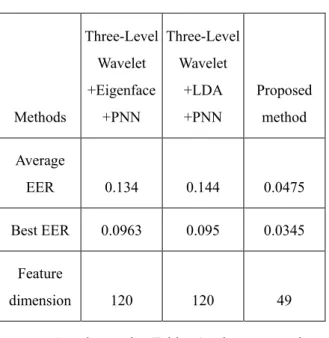
Table 1. Comparison of performance under different methods in IIS database
Methods Three-Level Wavelet +Eigenface +PNN Three-Level Wavelet +LDA +PNN Proposed method Average EER 0.134 0.144 0.0475 Best EER 0.0963 0.095 0.0345 Feature dimension 120 120 49
As shown in Table 1, the proposed method obtains the best recognition performance than the other methods. From the above results on the IIS databases, we conclude that the proposed method possesses good recognition performance.
6. Conclusions
In this paper, a novel WPNN is proposed. Firstly, the face features are extracted by the horizontal projection. Then, the dimension of resulting features is reduced by the WPNN. Finally, the PSO algorithm is applied to train the WPNN. Compared to the existing methods, the proposed method possesses two
advantages: better recognition rates and lower complexity. Experimental results show that the proposed method has good recognition performance. In future, it would be necessary to experiment on a larger face database in various environments to verify the proposed method more reliable.
7.ACKNOWLEDGEMENT
This research was partially supported by Institute for Information Industry, Tainan, Taiwan, R.O.C.
References
1. R.Chellappa, C.L.Wilson, and S.Sirohey, Human and machine recognition of faces: A survey, Proc. IEEE. 83, 705 (1995). 2. M.A.Turk and A.P.Pentland, Eigenfaces
for recognition, J.Cognitive Necuro Sci. 3, 71 (1991).
3. J. Lu, K. N. Plataniotis, and A. N. Venetsanopoulos, Face Recognition Using LDA-Based Algorithms, IEEE
Trans. Neural Networks. 14, 195 (2003).
4. B. Li, Y. Liu, When eigenfaces are combined with wavelets,
Knowledge-Based Systems. 15, 343
(2002).
5. J. T. Chien, and C. C. WU, Discriminant Waveletfaces and Neareast Feature Classifiers for Face Recognition, IEEE
Trans, Pattern Analysis and Machine Intelligence. 24, 1644 (2002).
6. C. H. CHEN and C. T. CHU, High Efficiency Feature Extraction Based on
1-D Wavelet Transform for Real-Time Face Recognition, WSEAS Trans.
INFORMATION SCIENCE & APPLICATIONS. 1, 411 (2004).
7. Q. Zhang and A. Benveniste, Wavelet Networks, IEEE Trans. Neural Net. 3, 889 (1992).
8. J. G.. Zheng, P. P. Song, Use of Immune Self-adaptation Wavelet for Data Mining,
Proc. of 1th Int’ Conf. on Machine Learning and Cybernetics. Beijing, China,
156 (2002).
9. V. Kruger and G.. Sommer, Affine Real-Time Face Tracking Using a Wavelet Network, ICCV’99 Workshop
Recognition, Analysis, and Tracking of Faces and Gestures in Real-Time Systems.
Corfu, Greece, 1999.
10. R. K. Galvao and T. Yoneyama, A Competitive Wavelet Network for Signal Clustering, IEEE Trans. Systems. Man
Cybernetics. 34, 1282 (2004).
11. D. F. Specht ,”Probabilistic Neural Network for Classification, Map, or Associative Memory”, Proceeding of the
IEEE International Conference on Neural Network. 1, 525 (1988).
12. S. Haykin, Neural networks: a
comprehensive foundation.1999.
13. C. S. Burrus, R. A. Gopinath, and H. T. Guo, Introduction to Wavelets and
Wavelet Transforms: A Primer. 1998.
14. J. C. Goswami and A. K. Chan,
Fundamentals of Wavelets. 1999.
15. J. Kennedy et al., Particle Swarm Optimization, Proc of IEEE Int. Conf.
Neural Networks. 4, 1942 (1995).
16. Y. Shi and R. C. Eberthart, A Modified Particle Swarm Optimizer, IEEE Int.
Conf. Evolutionary Computation. 69