
A Hierarchical Framework for Fine-Grained SIP-Based Location-Aware Integrated System
10
0
0
全文
(2) service anywhere anytime according to the position of communication, network quality, moving rate, and transfer rate. Integrate personal local area network, wireless local area network, motion communication access network and fixed access network into a heterogeneous multi-access network system, and this system will develop toward the intelligent network service after few years of evolvement. In such a highly concentrated network environment, it means that the importance of information service is to grow with each passing day. If we can provide the information to users according to the users’ location and the environment of network, the information that we provided will conform to the requirements of users and to avoid the information overload problem. One of the key requirements in the communication services at present is LBS (location base service), it is grow up at a high-speed. If we want to provide user the location-based service under the heterogeneous multi-access network environment, the key point is how to obtain users’ position information. For this reason, the target of research of this thesis is to bring up a workable framework base on the SIP that will accomplish to get position information under the environment of wired and wireless networks. No matter what users stay in what types of access networks, the framework can provide the management of system or ISP to obtain the position information of users’. According to the geography position information and the requirement of users to provide the related information or service.. 2. The progress development and the future of SIP Because of the prevalence of Internet, to utilize the Internet technology to transfer voice data and various multimedia data is to weed through the old to bring forth the new. Therefore, it should not be look down on using the Internet technology to transfer the voice data in order to substitute for the traditional telecommunications services. The VoIP protocols have been make by some different organization in international at present, such as H.323, MGCP, and SIP. In the protocols, H.323 is mad early and is ripe than other protocols in the market. But H.323 is to be designed aimed at the multimedia video meeting in the local area network at first, therefore, apply H.323 to the application of VoIP is not rather to suit at the view of technology. At the same time, the sub-protocol of H.323 is quite a few, the complexity of H.323 is rather high, therefore, IETF bring up the MGCP (Media gateway Control protocol) in Aug, 1999. To compare with H.323, the architecture of MGCP appear to be more simple than H.323. at the same time, MGCP has the higher expand ability in the function of voice transfer. Besides, IETF bring up SIP in Mar, 1999, is a really protocol that is to be make 2.
(3) aimed at the architecture of Internet. Accomplish the purpose to communication with tradition PSTN via gateway. SIP is one of the transfer control protocols that IETF bring up for the VoIP, it belong to the Application layer protocol in OSI seven-layer model. SIP can utilize the HTTP packages in existence when process the packet, for this reason, it is very suitable for the transfer architecture in the WAN. To make a long story short, SIP can to finish many functions that is not easy to be accomplish in PSTN. SIP was first developed within the Multiparty Multimedia Session Control (MMUSIC) working group, and the SIP working group will continue to maintain active communications with MMUSIC. This is particularly important since the main MIME type carried in SIP messages, the Session Description Protocol (SDP), specified in RFC 2327, is developed by MMUSIC and because MMUSIC is developing a successor to SDP which SIP will also use. The group will work very closely with the (proposed) SIPPING WG, which is expected to analyze the requirements for application of SIP to several different tasks, and with the SIMPLE WG, which is using SIP for messaging and presence. Now, SIP has been obtain the agreement of 3GPP(Third Generation Partnership Project)、3GPP (3rd Generation Partnership Project for cdma2000)、MWIF(Mobile Wireless Internet Forum), to become the stand protocol of All-IP Network Session Management in the future. At another side, the elasticity, ability of expand and the ability of supporting the mobility management is the main reason why we choosing the SIP to be the basis of development.. 3. The relationship between SIP and users’ location information Since SIP is a protocol to establish multimedia sessions, what relationship it is between SIP and to obtain user’s location information. In fact, we utilize the position of SIP server that in the SIP environment to be a method to estimate the position of users. That is, when users send SIP messages out, the messages will process by the SIP servers. The SIP server can obtain the information about users when processed the SIP messages. To integrate the users’ information and SIP Server’s geography position information, we can understand the position of users’. Just only expand the degree of level, the users’ position information will arrive at a exact degree and the position information of users will product the value to make a decision. For example, when users (caller) intend to establish communication with someone 3.
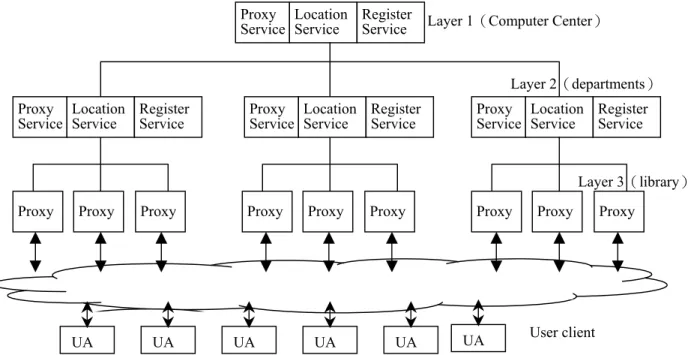
(4) (callee), caller will send out an INVITE SIP message. The proxy server will add a Record Router header into the INVITE SIP message when it processing the SIP message. It will record the related information belong to the Proxy Server into Record Router header. In the design of hierarchical framework, the SIP messages will be add into a Record Router header when messages pass through every proxy server. When the SIP Message send to the up layer Proxy Server, the system can get the message what is the bottom layer Proxy Server. And then, we can record the information of bottom layer proxy server and users’ account into the location server’s database, through the mapping with geography position database, we can get the users’ geography position information. As we have seen, it is a circumstance that users intending to establish a communication session. In another circumstance, users have been establishing communication sessions already or don’t intend to establish a communication session, users will must to register when moving into another network. At this time, the Registrar Server will use the same steps that be statement in front, to linking the users’ account with Registrar Server’s position information, and mapping with the geography position information database in order to get the users’ geography position information.. 4. Description of a hierarchical framework for fine-grained SIP-based location-aware integrated system The university campus is investigated in the present study, to work out a hierarchical framework for fine-grained SIP-based location-aware integrated system. The hierarchical framework is as shown in the figure1. The architecture of this system will be draw up in a hierarchical framework. To design it with hierarchical framework can take advantage of the convenience of management and loading balance. It set up the proxy server only in layer 3. The organization unit of manage domain of proxy server in layer 3 is a laboratory or an office. It is a thin proxy server in this layer, just only process the SIP request that issue in the domain where the proxy server manage. It contained the proxy server, location server and registrar server in the layer 2. The organization unit of manage domain of SIP server in layer 2 is a department of a university. We assume that the mobility of users will happen usually in the same department of a university. So that if users in the same department still, even users to move between difference offices or library, the registrar server in layer 2 charge the work for register still. This way can avoid that 4.
(5) the Register Server in layer 1 too work hard to exceed its load. As well as, the SIP communication in one department will don’t influence another department. First of all, all users must register at the Registrar Server in layer 1 and to obtain a SIP address. (We assume that SIP address is [email protected]). If a user stay in a laboratory or an office now, he will register at Registrar Server in layer 2, and get a temp SIP address from the layer 2 Registrar Server. (We assume that temp SIP address is a001%[email protected]). At the same time, the register information will be send to the Registrar Server that is situated in the layer 1, but the Registrar Server in layer 1 just only record the information about where department is user stay now, it is not be record that where library or office is user stay now. The advantage of this way is user just only register to the layer 2 Registrar Server when user moving in the laboratory that in the same department. (It is the circumstances that most possible happen.). Users just only to register to the layer 2 Registrar Server, this method can avoid the load too hard in the layer 1 Registrar Server or Location Server. When user away from original department and moving toward another department at the same university, will obtain a new IP Address from the foreign network and register to the layer 1 Registrar Server. The same as front, layer 1 Registrar Server just only record the information what department is user stay now, but don’t record the information about layer 3.. Proxy Location Register Service Service Service. Layer 1(Computer Center). Layer 2(departments) Proxy Location Register Service Service Service. Proxy Location Register Service Service Service. Proxy Location Register Service Service Service. Layer 3(library) Proxy. Proxy. UA. Proxy. UA. Proxy. UA. Proxy. UA. Proxy. UA. Proxy. UA. Proxy. User client. Figure 1. A Hierarchical Framework for Fine-Grained SIP-Based Location-Aware Integrated System 5. Proxy.
(6) There are proxy server, registrar server and location server in layer 2 and layer 3. The figure2 will illustrate the relationship between SIP servers.. Location Information. Registrar. 2 ) Store Location Service. UA 4 ) Query. 3 ) Invite Proxy. 5 ) Resp. 1 ) Register UA. 6 ) Invite. Figure 2. The Operation Model of SIP Component. We can spread the numbers of level in really circumstance under this hierarchical framework. The goal of spread the numbers of level is to downsize the manage domain, and so that can obtain a exact position information. In order to transfer SIP Address into geography position information, when the Registrar Server accept a REGISTER request, it will record not only Home SIP Address and temp SIP Address, but also create a mapping table in Location Server. The mapping table in location server can transfer the SIP address into the geography position information. The geography information will provide the usefully information to manager when make a decision that what message will sent to users.. 6.
(7) 14.) SIP/2.0 200 OK UA. Proxy 1.) Invite 2.) Invite Location service. 13.) SIP/2.0 200 OK. 3.) Query Proxy. Level 1. 4.) Resp 5.) Invite. 12.) SIP/2.0 200 OK. 6.) Query Location service. Proxy. Level 2. 7.) Resp 8.) Invite Proxy 9.) Invite. 11.) SIP/2.0 200 OK Level 3 10.) SIP/2.0 200 OK. UA. 15.) ACK. Figure 3. The Flow Char of SIP Communication 1. The communication in the difference University: Now we suggest, one user in another university send out an INVITE SIP Message to the user who is in our university. The flow char is description as figure 3. It include the flow path from SIP request message send out to the response is return to the caller. In this model, we can seen that when layer 1 proxy server query the layer 1 location server about the SIP INVITE message that send from the user who stay in another university, it obtain the information what department is the calee stay in only. The user’s location information can’t be get until the message send to the layer 2 proxy server. Although it must query much more once, but it is useful for reduce the numbers of record what in the layer 1 location server. 2. The communication in the same University but difference department Now we suggest, one user in the same university but difference department send out an INVITE SIP Message to the user who is in our university. The flow char is description as figure 4. It include the flow path from SIP request message send out to the response is return to the caller.. 7.
(8) 16.) SIP/2.0 200 OK Level 3 Proxy 2.) Invite. Location service. Location service. UA. 15.) SIP/2.0 200 OK. Proxy 3.) Invite. 1.) Invite. Level 2. 14.) SIP/2.0 200 OK. 4.) Query Proxy Level 1 5.) Resp 6.) Invite 13.) SIP/2.0 200 OK 7.) Query Proxy Level 2 8.) Resp 9.) Invite 12.) SIP/2.0 200 OK Proxy. Level 3. 11.) SIP/2.0 200 OK. 10.) Invite UA. 17.) ACK. Figure 4. The Flow Char of SIP Communication. Under the circumstances, system must take twice query action to database. The model at next discussion, will only once query action to database. 3. The communication in the same University and department Now we suggest, one user in the same university and same department send out an INVITE SIP Message to the user who is in our university. The flow char is description as figure 5. It include the flow path from SIP request message send out to the response is return to the caller.. 8.
(9) 10.) SIP/2.0 200 OK Level 3 Proxy 2.) Invite Location service. 1.) Invite. UA. 9.) SIP/2.0 200 OK. 3.) Query. Proxy Level 2 4.) Resp 5.) Invite 8.) SIP/2.0 200 OK Proxy 6.) Invite. Level 3. 7.) SIP/2.0 200 OK UA 11.) ACK. Figure 5. The Flow Char of SIP Communication. 5. The future work This paper is probe into the feasibility study that in a hierarchical framework for fine-grained SIP-based location-aware integrated system, the next step is how to implement. In the implement phase, we will use the oSIP to be a function library to develop the SIP application.. oSIP is an implementation of SIP. This library aims to provide multimedia and telecom software developers an easy and powerful interface to initiate and control SIP based sessions in their applications. The GNU oSIP library is written in C and get no dependencies except the standard C library. oSIP is thread safe and will generally be used in a multi-threaded application. Nevertheless, this is optional. oSIP is little in size and code and thus could be use to implement IP soft-phone as well as embedded SIP software. oSIP is not limited to endpoint agents, and can also be used to implement "SIP proxy". oSIP provide the function below: •. URL parser. •. SIP message parser. •. SDP message parser (limited). •. Two state machines and an transactional API for both UAS and UAC 9.
(10) •. SIP UDP layer. At first, we will establish an complete SIP environment, it include the User Agent, and each SIP Server. And then, will carry out the mechanic of a hierarchical framework for fine-grained SIP-based location-aware integrated system. This is a job that is so complex and huge. But we believe that, SIP is hopeful and it is worthy for us to spend time to study.. 參考文獻 [1] M. Handley, H. Schulzrinne, E. Schooler, J. Rosenberg,” SIP: Session Initiation Protocol”, Request for Comments: 2543,IETF,March 1999 [2] J. Rosenberg,H. Schulzrinne,G. Camarillo,A. Johnston,J. Peterson,R. Sparks,M. Handley,E. Schooler,” SIP: Session Initiation Protocol”, Internet Engineering Task Force INTERNET-DRAFT draft-ietf-sip-rfc2543bis-09., February 27, 2002 [3] Elin Wedlund,Henning Schulzrinne,”Mobility Support using SIP”,ACM/IEEE International Conference on Wireless and Multimedia,WOWMOM,Auguest 1999 [4] Henning Schulzrinne,Elin Wedlund,”Application- Layer Mobility Using SIP” MC2R [5] Josef Glasmann, Wolfgang Kellerer, Harald Müller,” Service Architectures in H.323 and SIP – A Comparison” [6]"Mobile IP", IEEE Communication Magazine, May 1997 [7]"Mobile Network Through Mobile IP", IEEE Internet Computing, Jan./Feb.1998 [8] R.Pandya,”Emerging mobile and personal communication system”,IEEE Communications Magazine, vol.33,pp.44-52,June 1995 [9] J.Rosenberg, H.Schulzrinne,” SIP: Locating SIP Servers”, February 21, 2002 [10] SIP Registration Schulzrinne draft-schulzrinne-sip-register-01.txt April 16, 2001. 10.
(11)
數據


+2

相關文件
1) Ensure that you have received a password from the Indicators Section. 2) Ensure that the system clock of the ESDA server is properly set up. 3) Ensure that the ESDA server
¾ Relocation, which modifies the object program so that it can be loaded at an address different from the location originally specified.. ¾ Linking, which combines two or
Note that if the server-side system allows conflicting transaction instances to commit in an order different from their serializability order, then each client-side system must apply
n Another important usage is when reserving network resources as part of a SIP session establishment... Integration of SIP Signaling and Resource
• BP can not correct the latent error neurons by adjusting their succeeding layers.. • AIR tree can trace the errors in a latent layer that near the front
* All rights reserved, Tei-Wei Kuo, National Taiwan University, 2005..
– Each listener may respond to a different kind of event or multiple listeners might may respond to event, or multiple listeners might may respond to
After the graph is constructed, we can realize that for all
