Pergamon
Prog. Polym. Sk., Vol. 22, 829-871, 1997
0
1997 Published by Else&x Science Ltd Printed in Great Britain. All rights reserved. 0079-6700/97 $32.00 PPI: SOO79-6700(97)00008-7THE APPLICATION
OF SIDE-CHAIN
LIQUID-CRYSTALLINE
POLYMERS
CHAIN-SHU HSU
Department of Applied Chemistry, National Chiao Tung University, Hsinchu, Taiwan, Republic of China
CONTENTS
1. Introduct ion2. Applicauon of side-chain LCPs in optical data storage
2.1. Side-chain LCPs containing azobenzene chromophores as reversible optical data storage materials
2.2. Side-chain LCPs containing spiropyran chromophores as reversible optical data storage materials
2.3. Conclusions
3. Application of side-chain LCPs in non-linear optics 3.1. Side-chain LC polymers
3.2. Ferroelectric side-chain LC polymers 3.3. Conclusions
4. Side-chain LCPs used as stationary phases for gas chromatography, supercritical-fluid chromatography and high-performance liquid chromatography
4.1. Introduction
4.2. Sidle-chain LCPs with a broad temperature ranges of cholesteric phase or chiral smectic C phase used as GC stationary phases
4.3. Sid’e-chain LC polysiloxanes containing crown ether moieties used as GC stationary phases
4.4. Application of side-chain LCPs as SFC stationary phases 4.5. Application of side-chain LCPs as HPLC stationary phases 4.6. Conclusion
5. The application of side-chain LCPs as separation membranes 6. The application of side-chain LCPs as solid polymer electrolytes 7. Miscellaneous aspects for application of side-chain LCPs
7.1. Application of side-chain LCPs in display technology
7.2. Applications of ferroelectric side-chain LCPs in displays, piezoelectric transducers and light modulators
7.3. Side-chain LC conducting polymers
7.4. Applications of side-chain LCPs with metallomesogens as organic ferromagnets 8. Conclusion and outlook
References 830 830 831 833 836 836 837 839 843 844 844 845 850 851 852 853 854 859 864 864 865 865 865 866 867
830 CHAIN-SHU HSU
1. INTRODUCTION
Side-chain liquid-crystalline polymers (LCPs), which represent a combination of liquid- crystalline behavior and polymeric properties, have been the subject of intensive research during the last decade. Systematic investigation of the synthesis of side-chain LCPs began only after Ringsdorf and co-worker proposed that a flexible spacer should be inserted between the polymeric backbones and mesogenic side groups to decouple the motions of the backbone and side groups in the liquid-crystalline state. On the basis of the spacer model, a large number of side-chain LCPs containing rod-like or disk-like mesogens were synthesized. Different smectic, chiral smectic, nematic and cholesteric mesophases are exhibited by these polymers that are based on different mesogenic groups and polymer backbones. Much information concerning the properties of side-chain LCPs under the influence of an external electric or magnetic field is also well documented. This field has been highly developed because of the potential applications of side-chain LCPs. So far, various potential appli- cations have been considered for the side-chain LCPs. Broadly speaking, applications fall into the following fields: optical data storage, non-linear optics, stationary phases for gas chromatography, supercritical-fluid chromatography and high-performance liquid chromato- graphy, solid polymer electrolytes, separation membranes and display materials.
Most of these fields were reviewed in 1989. ’ Therefore, we shall discuss only the recent progress in the applications of side-chain LCPs, in most of the cases based on the literature published since 1989.
2. APPLICATION OF SIDE-CHAIN LCPS IN OPTICAL DATA
STORAGE
The first example of a side-chain LCP as a reversible optical data storage material was demonstrated by Shibaev et al. in 1983.* The advantages of side-chain LCPs over low-molar-mass liquid crystals as image storage materials are as follows. (1) Because of the glass transition phenomenon (rs), segmental motion of the polymer chains can be frozen- in; thus it is expected that the stored image can be kept stable below Tg for a long time. (2) Good film-forming properties of the polymers allow cell-free performance of the image storage materials, which is evidently favorable from the applicational viewpoint. (3) Low fluidity of the polymers is favorable for the long-term stability of the stored image.
The study of side-chain LCPs in optical data storage was at an early stage when McArdle reviewed this field in 1989.’ Since then, a large number of side-chain LCPs to be used for optical data storage, have been reported in the literatures. Broadly speaking, the applications of side-chain LCPs in optical data storage fall into two classes: heat-mode recording and photo-mode recording. Shibaev et a1.2 and Coles and Simon3 reported the laser-addressed side-chain LCPs in heat-mode recording. McArdle reviewed most of this kind of heat-mode recording. Photo-mode recording was first reported by Wend&f et al. as “holographic” optical storage in 1987.4 In their system, composed of LCPs with side-chain photochromic azobenzene moieties, photoirradiation caused isomerization of the photochromic molecules, inducing “grating” in the LCP. The grating is produced by the change in the refractive index of the medium resulting from isomerization. The advantage of photo-mode recording over heat-mode recording lies in the superior resolution, fast writing speed and the possibility of multiplex recording in photo-mode recording. It is not intended to review all side-chain LCPs
THE APPLICATION OF SIDE-CHAIN LIQUID-CRYSTALLINE POLYMERS 831
RI-
O-
N 'Na - A1 - A2 , A tram CiS 00
R2 Fig. 1. C&tram isomerization of substituted azobenzene compounds.for optical (data storage here; rather, some representative examples of photo-mode recording are briefly (discussed.
2.1. Side&ain LCPs containing azobenzene chromophores as reversible optical data storage materials
It is well known that the azobenzene group can exist in two configurations: the trans or E form and the cis or Z form, as illustrated in Fig. 1. By irradiating with light of wavelength X1 and X2, the geometric configuration of the azo bond in azobenzene-based compounds can be reversibly switched from trans to cis. However, the cis state is thermodynamically unstable with respect to the tram state; therefore a thermal relaxation process occurs in the dark state, denoted in Fig. 1 as A.
Since Wendorff et al. first demonstrated reversible optical data storage properties in the azobenzene-containing side-chain LCP films in 19874 there has been a lot of interest in this area. ‘-15 A homopolymer containing a p-nitroazobenzene bound as side chain in a polyester through an oxygen atom and a spacer of six methylene units was used in Wendorff’s study (Fig. 2).
The writing process consists, in a first step, of orientation of the liquid-crystalline film by an external field, followed by irradiation with polarized laser light in the liquid-crystalline state or in the glassy state. This involves optically inducing a trans-cis conformational transition in the mesogenic side chains. The photogenerated cis form, owing to its non-mesogenic character, leads to a local change in the orientation distribution of the
LCP- 1 g 43 SA 94 n 104 i
Fig. 2. The chemical structure of liquid-crystalline polyesters (LCP-1) containing azoben- zene side groups, with transitions glassy to smectic A, nematic and isotropic as indicated
832 CHAIN-SHUHSU
Fig. 3. Center (A) and outer region (B) of Fresnel zone phase plate, stored by holographic techniques in a 7 pm film of the liquid-crystalline side-chain polymer LCP- 1.
liquid-crystalline matrix when the polymer is simultaneously heated locally. The pertur- bation generated in this way is much greater than it would be in an amorphous matrix. After the light is switched off, the perturbation is frozen-in and is retained, even if the azobenzene relaxes back to its tram form (see Fig. 3). To erase the stored information, the side-chain LCP is heated to a temperature above the clearing temperature, TN,, thereby orienting.
Side-chain LC copolymers with both photosensitive (azobenzene) and non-photosensitive side groups were also used in these studies. ‘Gus Copolymers of the structure shown in Fig. 4 were used by Anderle et al. l6 After irradiation by the polarized laser light, reorientation of the azobenzene moieties actually affects the neighboring non-photosensitive mesogenic groups, either below or above the glass transition temperature. This is due to the cooperative motion of the neighboring groups.
All these liquid-crystalline azobenzene-containing polymers have their glass transition temperature slightly higher than room temperature because of the requirement of flexibility
Fig. 4. Chemical structure of liquid-crystalline polyacrylates containi:! 4-cyanophenyl- benzoate and 4-cyanophenylazobenzene side groups.
THE APPLICATION OF SIDE-CHAIN LIQUID-CRYSTALLINE POLYMERS 833
6GN02
z
&“’
R
or heat
lk
Spiropyran
Merocyanine
Fig. 5. Photochromic reaction of the spiropyran chromophores.
so as to foim a mesophase. In principle, the higher the glass transition temperature of the polymer, the greater the stability of the writing at room temperature when this is well below the glass transition temperature.
Some amorphous azo polymers with high glass transition temperature have been synthe- sized and tested recently for reversible optical storage processes.27-30 High glass transition temperatures are obtained by using very short or no spacers between the main chain and the azo side groups. This results in a significant increase in the stability of the written material. It has thus been proved that liquid crystallinity is not a necessary condition for a material to exhibit reversible optical storage properties. Writing by using polarized laser light with wavelength equal to that of the absorbance of the azo group can be performed at room temperature in the glassy state. The birefringence can be monitored with a light beam whose wavelength is out of the region of absorbance of the azo polymer. The written information can be erased either by heating the polymer above its glass transition temperature or by irradiating with circularly polarized light.
2.2.
Side-chain LCPs containing spiropyran chromophores as reversible optical data
storage materials
Spiropyrans are the most important photochromic and thermochromic molecules. They can be converted to a merocyanine dye by irradiation with UV light or heating (Fig. 5). The back
LCP-2
Fig. 6. The chemical structure of liquid-crystalline polyacrylates (LCP-2) containing spironaphthoxazine.
834 CHAIN-SHU HSU
140
r
80 x 60I
I I I I I 0 10 20 30 40 50Fig. 7. Phase behavior of the spiropyran-containing polyacrylates (LCP-2) with n = 5. The composition of the polymers is given as mol% of spiropyran groups.35
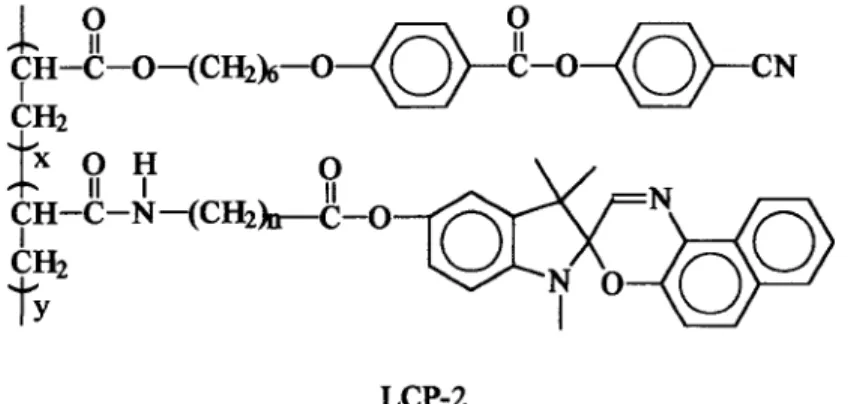
reaction occurs spontaneously or on irradiation by visible light. Side-chain LC polyacrylates and polysiloxanes containing mesogenic and spiropyran side groups were first prepared by Cebrera and Krongauz in 1987. 31-33 Since then, studies on optical data storage on the basis of these kinds of photochromic polymer have attracted much attention in the past few years. 34-38
An example of copolyacrylates containing 4-cyanophenyl benzoate and spiropyran side groups is given in Fig. 6. The obtained copolyacrylates reveal a nematic liquid-crystalline phase. The clearing temperatures decrease with increasing concentration of the spiropyran
4
(y&V) A> hvvis
J32 (red)
A=
B=
%F?f&No2
(SPIROPYRAN)
(MEROCYANINE) Fig. 8. Scheme for the conversion of the photochromic side groups.35THE APPLICATION OF SIDE-CHAIN LIQUID-CRYSTALLINE POLYMERS 835
groups in the macromolecule. In some cases more than 30 mol% of spiropyran groups could be incorporated and mesomorphic behavior could still be observed (Fig. 7).
Irradiation of the polymer films with UV light at temperatures below the glass transition leads to formation of the blue color characteristic of the isolated merocyanine dye molecule. Above the glass transition temperature merocyanine dimers are formed, which are red. The spiropyran form of the photochrome with characteristic yellow color can be restored by irradiation of blue or red films with visible light. The color changes of the films are shown in Fig. 8. The thermal back reaction leading to equilibrium between spiropyran and merocyanine forms of the photochrome proceeds in the mesophase with a much lower rate than in the iamorphous phase and is controlled by the viscosity of the polymer. In the liquid- crystalline glassy state the thermal reaction becomes extremely slow, or does not occur at all.
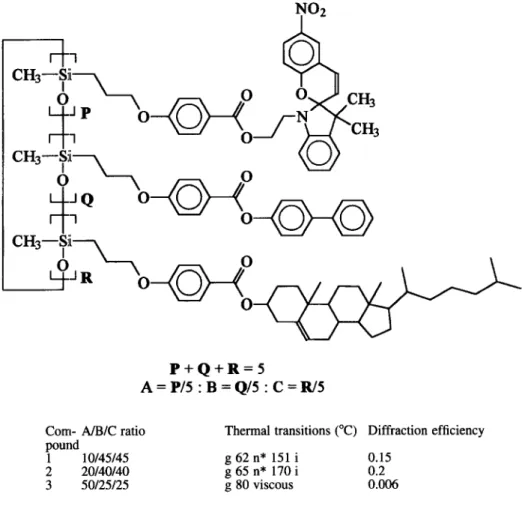
Natarajan et al. 39*40 recently reported the synthesis of a liquid-crystalline cyclic siloxane made up of photochromic spiropyran, biphenyl and cholesterol moieties. This siloxane formed a cholesteric film exhibiting selective reflection. These films were used to write,
P+Q+R=5
A=P/5:B=Q/5:C=R/5 Com- A/B/C ratio
pound
1 10/45/45 : 20/40/40 50125125
Thermal transitions (“C) Diffraction efficiency g62n* 151 i 0.15
g 65 80 n* viscous 170 i
g 0.2 0.006
Fig. 9. Structure and thermal transitions of liquid-crystalline siloxane materials containing biphenylbenzoate, cholesteryl benzoate and spiropyranbenzoate side groups.3g
836 CHAIN-SHU HSU
erase and rewrite holograms.39 Writing was achieved by UV laser light (358 nm), which led to opening of the closed spiropyran to the blue merocyanine form; heating to 60°C led to the disappearance of the blue color due to the formation of the closed form (Fig. 9).
2.3.
Conclusions
Side-chain LCPs are undoubtedly promising materials for erasable optical data storage application. Nematic and smectic side-chain LCPs can be used for heat-mode recording owing to their various states of order and orientation capability. One simple method of presenting information optically is to generate an optical scattering center in an optically clear liquid-crystalline layer. However, heat-mode recording has the disadvantages of slow response time and low resolution. Side-chain LCPs containing azobenzene, spiropyran and fulgide moieties in the side groups can be used for photo-mode recording. The photochromic effect of dye moieties is responsible for reversible optical data storage. Their outlets in erasible holographic optical storage look particularly interesting. Nevertheless, at present, no side-chain LCP optical data storage product is available commercially. Evidently, more work needs be done before this can be realized. In the author’s opinion, although further refinement in the synthesis of new materials with high purity and proper phase behavior is still required, more extensive studies on the processing and mechanical properties of these materials, coupled with a systematic investigation of the recording sensitivity, resolution and stability of the stored information for devices based on these materials, are even more important.
3. APPLICATION OF SIDE-CHAIN LCPS IN NON-LINEAR
OPTICS
Non-linear optical (NLO) effects have attracted considerable attention from both funda- mental and practical points of view. The major applications for non-linear optical effects include frequency conversion, light modulation, optical switching, optical logic, optical limiting and sensor protection.4’ All these applications require that the material have large optical non-linearities. Even though a number of inorganic crystals, such as KDP, KTP and LiNb03, are readily available for frequency-mixing applications, lack of good processability has kept them from being incorporated into integrated optical circuitry devices. In contrast, organic materials, in particular side-chain polymers, exhibit distinct advantages for applica- tions in electro-optical devices because of their large optical non-linearity, relatively high damage threshold and good film-forming properties.
One of the simplest non-linear optical effects is second harmonic generation (SHG), i.e. doubling the frequency of laser beams as they pass through organic materials. In order to obtain a useful material for SHG, one requires the use of molecules with a large, microscopic, second-order non-linear hyperpolarizability tensor, 0, organized in such a way that the resulting system has no center of symmetry, and an optimized constructive additivity of the molecular hyperpolarizability. It has been well established that molecules containing an electron donor and an electron acceptor attached to a r-conjugated system have a strong permanent dipole moment and present a large second-order non-linear hyperpolarizability. Since second-order (NLO) materials require a non-centrasymmetric structure, macroscopic organization of non-linear optical moieties in organic materials suitable for SHG applications
THE APPLICATION OF SIDE-CHAIN LIQUID-CRYSTALLINE POLYMERS 837
are currently obtained from single crystals, Langmuir-Blodgett multilayers and poled poly- meric films. Growth of a single organic crystal is difficult in a thin film and Langmuir- Blodgett films induce important losses by scattering. Poled polymers seem to be the best candidates Ito meet the requirements for integrated non-linear optics, since they are com- patible with semiconductor technology. Three classes of NLO polymers-i.e. amorphous polymers, side-chain liquid-crystalline polymers and ferroelectric side-chain polymers- have been investigated so far. In this section, the macroscopic second-order non-linear suceptibility, x (2), values of side-chain LC polymers and ferroelectric side-chain LC polymers are discussed.
3.1. Side-chain LC polymers
In 1982, Meredith et a1.42 demonstrated that a large second-order NLO coefficient can be obtained for a poled film consisting of a nematic side-chain LC polymetbacrylate doped (2% by weight) with the NLO dye 4-(dimethylamino)-4’-nitrostilbene (DANS). The SHG was considerably larger (100 times) than that which could be obtained with a 2% DANS-doped poly(methyl methacrylate) sample. However, two disadvantages are considered for dye- doped side-chain LCP systems. One is the limit solubility of the dye molecules in the LCP matrix; conlcentrations of up to a few percent only are possible. The other is the difficulty in keeping the orientation owing to the fairly low Tg ( < 50°C) of the LCP host.
For these reasons of stability and concentration of the dopant, many researchers have synthesized side-chain LC copolymers bearing the NLO-active dye as side groups.43-58 We describle some of these results reported after 1989.
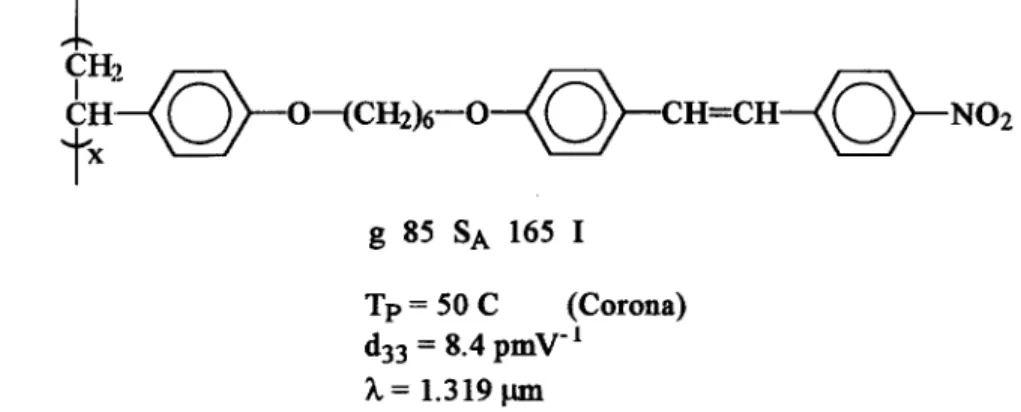
McCulloch and Bailey have reported the copolymers shown in Fig. 1OU and have mea- sured d33 of the order of 8 pm V-’ at 1.319 km with corona poling. Amano and co-work- ers 45,46 have found that x (2) values of side-chain LCPs are higher than for the corresponding amorphous polymers (see Fig. 11). Smith and Coles52 have reported the second- and third- order non-linear optical susceptibilities of 10 donor-acceptor substituted side-chain LCPs (see Table 1). Recently, Hsieh et al. succeeded in synthesizing some side-chain LCPs with tolane-baseld NLO-active groups (see Fig. 12) and have obtained better results.57,58 The measured d33 was of the order of 22 pm V-’ at 1.06 km with corona poling.
8 85 SA 165 I
Tp=50C
(Corona)
d33 =
8.4pmV-’
h= 1.319 fun
Fig. 10. A side-chain LC polystyrene synthesized for x(‘) measurement. Poling is made by corona at a temperature Tp = 50°CU
838 CHAIN-SHU HSU
fh
9
CH&
-C-O-(CH&-0
T
X I 1 , I l- 0 20 40 60 80 100mol ratio of dye moiety (%)
(B) 15 - G i..i 0
-2
IO- K Gi 0-x
S- 0 l 0 l o-’ ’ ’ ’ ’ ’ ’ ’ ’
0 20 40 60 80mol ratio of dye moiety (%)
100
Fig. 11. Thermal transitions (A) and variation of x’*’ values (B) versus the mole ratio of dye moiety in the side-chain LC copolymethacrylates. 46
THE APPLICATION OF SIDE-CHAIN LIQUID-CRYSTALLINE POLYMERS 839
-I-
YH2
R
clX3-c -C -0 -(C&)6-0 T Xg 47.7 n 78.6 I
Lax = 357 nm, T, = 60°C (Corona)
d33 = 22.6 pmV
-1Fig. 12. A side-chain LC polymethacrylate synthesized for x’*’ measurement. Poling is made by corona at a temperature T, = 60°C5*
3.2.
Ferroelectric side-chain LC polymersIt is well known the chiral smectic C (SC*) phase possesses a ferroelectric smectic layer59 but, owing ~to the helicoidal superstructure of the Sc* phase, no macroscopic ferroelectricity only helioelectricity occurs. Only an unwinding of this helicoidal structure yields a sample with a macrosopic spontaneous polarization exhibiting C2 point symmetry. The C2 symmetry implies that the untwisted Sc* phase can exhibit second-order non-linear properties. How- ever, the second-order NLO response of ferroelectric liquid crystals (FLCs) turned out to be rather small compared with that of standard NLO-active materials.60 This is only because of the molecular structure of the mesogens commonly used. They have no donor and acceptor groups oriented along the direction of the polar axis. More recently, higher non-linear sus- ceptibility on special molecular-designed FLCs were reported. 61-63
Fig. 13. Schematic representation of chiral smectic C* layers in the helix-unwound state. The inset shows the orientation of the achiral chromophores in the ferroelectric matrix.
CHAIN-SHUHSU
G
I Q‘l
z4
c
?
‘1
Y
0
I>
I 6 I -0 n6
i-
P
0=0 ”I
i f3-o
:
F G 30°C S 12S’C I G G 84°C N 113s”c I H G 30°C SA 145°C I I c 59°C S.4 110°C I J C 14”CS A 90°C N 107.5”C I , , ff+# 0 H-C- S-O-(CM,),-0 \ ,
-~]_(----cN
In
0.919 ’‘9
H-y-C-O-lCHI)‘- .0:-O--@a
?“I0 II n-c -C-0-(C&),-N \ I ,-~cH=C~-@‘I
a 0.081 0.503 1.89 + 0.47 0.47 2 0.12 53.4 + 8.0 10.01 + 1.5 1.30 2 0.33 0.23 + 0.06 0.55 k 0.14 0.13 5 0.03 4.6 2 0.7 0.6 f 0.1 0.25 2 0.06 0.06 2 0.0163
r
8
h 4.0 + 0.6 1.3 + 0.2 !s 8 F 2 2 16.1 2 2.4 3.2 ? 0.5 E zTable 1. Continued. Material and phase behavior K G 10°C M 90°C I Structure 1064 nm 1579 nm ~8 x lo9 (esu) J$’ x 10e9 (esu) xc3’ X lo-l3 (esu) xc3) X lo-l3 (esu) 0.853 - 3.5 k 0.5 2.1 2 0.3 L G ? S A 65°C N 100°C I - 35 k 5.0 21 k 3.0
THE APPLICATION OF SIDE-CHAIN LIQUID-CRYSTALLINE POLYMERS 843
x:y=80:20
g -14 SC* 68 S, 83 i
60 - 0 ,_..~.o~,l.:dA
I.,., 30 40 50 60 70 8( Temperature in “CFig. 14. Dependence of the second-order signal on temttrature for a ferroelectric side- chain LC copolysiloxane.
The NLCl effects of some ferroelectric side-chain LC polymers have also been demon- strated recently. 64-7o Zental and co-workers67 have reported on ferroelectric side-chain LC copolymers containing NLO-active chromophores (see Figs 13 and 14) which show consid- erably higher SHG activity than the homopolymer without chromophores. Finkelmann’s group has even demonstrated the mechanical-induced SHG in SC* elastomers.69*70
3.3. Conclusions
Side-chain LCPs have been proved to be a promising class of polymeric materials for non- linear optical applications. Most of the side-chain LC copolymers containing NLO chromo- phores in the side groups show much higher SHG values than that of KJIP. However, a
844 CHAIN-SHU HSU
critical stage in the processing of these polymers for use in non-linear optics is the director alignment of NLO chromophores in an electric field. Unfortunately, NLO chromphores having a strong permanent dipole moment tend to form anti-parallel correlations in the liquid-crystalline states. Therefore, the second-order NLO potential of side-chain LCPs is restricted by the poor degree of poled order which can be obtained. Some studies indicate that a significant increase in the subsceptibility values can be expected if a large poling field can be applied without damaging the material. In the author’s opinion, poling of these materials by a magnetic field could be a good selection in order to avoid this damage. 71 Furthermore, the side-chain LCPs possess a major disadvantage over inorganic crystals with respect to long-term NLO thermal stability. When the poling electric field is removed, the dipole orientation in the poled polymers tends to relax back to the thermodynamically more stable random structure through polymer-chain segmental motions and pendant rotations, leading to the decay of second-order NLO activity. Because of this, the electro-optic applications of poled polymers are greatly limited since practical devices applications require long-term stability of NLO activity at normal circuit working temperature, which ranges from 90°C to 125°C. For a side-chain LCP, it usually needs a flexible spacer in order to form a mesoph- ese. Owing to the plasticizer effect, the flexible spacer will decrease the T, of a side-chain LCP. Therefore most of the side-chain LCPs synthesized for NLO measurements show relatively low Tg ( < 50°C). In developing high Tg side-chain LCPs, two approaches can be considered. One approach is to use a more rigid polymer backbone for the side-chain LCP. The other approach, in the author’s opinion, is to use a double-end crosslinkable LC system7’ in order to from a crosslinked LC network with NLO-active groups.
4. SIDE-CHAIN LCPS USED AS STATIONARY PHASES FOR GAS
CHROMATOGRAPHY, SUPERCRITICAL-FLUID
CHROMATOGRAPHY AND HIGH-PERFORMANCE LIQUID
CHROMATOGRAPHY 4.1. Introduction
The use of liquid crystals as the stationary phase in gas chromatography (GC) was first reported by Kelker in 1963. This field has been extensively reviewed.73,74 Unlike conven- tional stationary phases that provide separation based on solute vapor pressure and/or differ- ent solubility arising from specific energetic interactions, liquid crystal stationary phases yield separation based upon differences in solute molecular shape. Although the properties exhibited by many monomeric liquid crystals are good from the point of view of GC require- ments, polymeric liquid crystals are attracting growing attention because they offer signifi- cant improvements in column efficiency, as well as thermal stability, over low-molar-mass liquid crystals. Among liquid crystal polymers, polysiloxanes are particularly useful as sta- tionary phases. Finkelmann et al. first used this type kind of polymer as GC stationary phases. 75 These polymers are referred to as mesomorphic polysiloxanes (MEPSIL). The applications of MEPSIL solvents as GC stationary phases have been extensively reviewed by Janini et al. 76 and by Witkiewicz. 77*78 A few examples of side-chain LC polyacrylates79-81 have also been reported as stationary phases for GC. After 1988, the quantity of publications concerning the applications of side-chain LCPs as GC stationary phase decreased remark- ably. On the other hand, more studies are aimed to the applications of side-chain LCPs in
THE APPLICATION OF SIDE-CHAIN LIQUID-CRYSTALLINE POLYMERS
845
supercriticall-fluid chromatography (SFC)82-84 and high-performance liquid chromatography (HPLC). *s-!)* Here, we do not intend to review all of them. The following sections will emphasize some representative examples of the recent progress in these fields.
4.2.
Side-chain LCPs with a broad temperature ranges of cholesteric phase or chiral
smectic C
phaseused as GC stationa~ phases
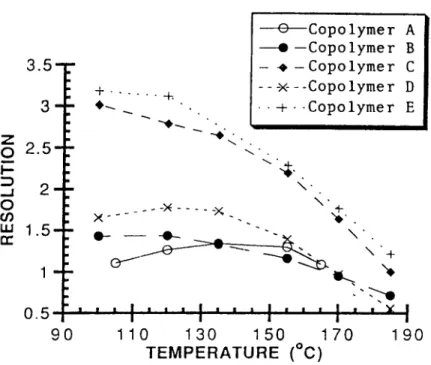
Many of the side-chain LCPs stationary phases tend to form nematic and smectic phases over a broad temperature ranges. Only a very few cholesteric or ferroelectric polymeric liquid crystals have been found that exhibit good properties as GC stationary phases. LC copoly- siloxanes containing cholesterol moieties in the side groups were prepared by Master et ~1.~~ Depending on the concentration of cholesteric moieties, the copolymers are able to form nematic, cholesteric and smectic phase, respectively (see Fig. 15). The copolymer with broad temperature range of cholesteric phase was found to offer better performance as stationary phase than those with nematic and smectic phases (Fig. 16).
A ferroelectric and a cholesteric side-chain LC polysiloxane which were used as GC stationary phase over a wide temperature range were reported by Lin and Hsu.” The che- mical structures and mesomorphic properties of both polysiloxanes, LCP-3 and LCP4, are presented in. Fig. 17. The capillary columns that were coated with polymers LCP-3 and LCP4
$
0CH&i-(C&)3-0
LO
lk
X43
PCH3-Si--@H&-O
+Y
Thermal transitions of LC copolysiloxanes
Copolymer XJY A o/100 B 25175 C 50150 D 75125 E 100/o Thermal transition (“C) K 55 n 175 i g 50 n* 210 i g 62 n* 230 i g 50 S > 230 dec g 72 S > 250 dec
846 CHAIN-SHU HSU
--+3-Copolymer
A -0-Copolymer
B3.5
4
-Copolymer
C
-x- --Copolymer D3
t
l.
. - . +. . . .5:
k
x--=-
_ ->c - - - - _x \.-.
4, .
g 1.5-r
t--a-
a
-_
1’.
_-a-====
--
\‘+
1 -r
r,
b
-‘>
0.5“
* ’ : I”
; “I
; ‘I’
: * ‘q
90
110
130
150
170
190
TEMPERATURE
(“C)
Fig. 16. Resolution versus temperature (“C) for anthracene and phenanthracene columns coated with stationary phases A-E.
are termed LC-1 and LC-2, respectively. Column LC-1 containing LCP-3 yields about 2100 plates/m, while LC-2 column containing LCP4 yields about 2340 plates/m (tripheny- lene, 230 “C). Both columns were found to provide satisfactory column efficiency (see chromatograms presented below).
G 16 &j 120 sc* 166 SA 244 I
s
iMeit‘
CH3-i-(CH2)6-0
7
-O-@-“++o-CH&2~
0
She3
LCP- 4 G 12 N* 319 IFig. 17. Chemical structures and phase transitions of side-chain LC polysiloxanes LCP-3 and LCP-4.
THE APPLICATION OF SIDE-CHAIN LIQUID-CRYSTALLINE POLYMERS 847 - 2-c !-BI - I I I 0 10 20 Time (min)
I-
O I-Cl 10 Time (min) 2-Br h -JL
17
I-Cl 20 0 IO -Cl - Time (min) 2-Br i 20Fig. 18. Chromatograms of l- and 2-chloronaphthalenes on (A) SE-54, (B) LC-1 and (C) LC-2. Temperature was programmed from 130°C to 200°C at 2Wmin.
The separations of two pairs of halogenated naphthalene isomers on SE-54, LC-1 and LC-2 columns are illustrated in Fig. 18. Both LC-1 and LC-2 columns show much better selectivity for the two pairs of halogenated naphthalene isomers than the SE-54 column.
The separations of some fatty acid methyl esters on LC- 1 and LC-2 columns are presented in Fig. 19(B) and Fig. 19(C). The order of elution is remarkable when compared with that generally observed with the OV-210 column [see Fig. 19(A)]. First, the cis and trans isomers are better resolved on both LC-1 and LC-2 columns. Second, the trcln~ isomers are retained longer than lthe corresponding cis isomers of the same carbon number, which is the reverse of that observed with the OV-210 column. Furthermore, the compounds are eluted in order of increasing c,arbon number and, for each group of compounds having the same carbon number, the elution time increases with increasing saturation.
The programed-temperature separation of two-, three-, four- and five-ringed polycyclic aromatic hydrocarbons (PAHs) with column LC-2 is presented in Fig. 20. More than 3 1 kinds of PAH compound, which are summarized in Table 2, have been eluted. The elution pattern of these solutes with mesomorphic polysiloxane is consistent with the degree of their rod-like geometry, the more rod-like being retained for longer. For example, phenanthrene (UB =
(4 (B 1 I 6 20 30 Time (mitt) Time (min) 6 I’ 0 10 20 Time (min) Fig. 19. Chromatograms of fatty methyl esters on (A) OV-210 (column temperature, 160°C; isothermal), (B) LC-1 and (C) LC-2. Temperature was programmed from 130°C to 200°C at 2Wmin for (B) and (C). Peaks: 1, myristic; 2, palmitelaidic; 3, palmitoleic; 4, palmitoleic; 5, elaidic; 6, oleic; 7, steric.
THE APPLICATION
OF SIDE-CHAIN
LIQUID-CRYSTALLINE
POLYMERS 849 4 I I I 0 10 20 16 8 2sI
26 I I I I I 30 40 so 60 70Fig. 20. Chromatograms of 31 kinds of PAH compound on LC-2. Temperature was
programmed from 110°C to 280°C at 3.5Wmin.
earlier than chrysene (UB = 1.72). Among o-, m- and p-terphenyls, o-terphenyl (LIB = 1 JO)
elutes first, followed by m-terphenyl (Z.&I = 1.47) and then p-terphenyl
(UB = 2.34).In conclusion, the side-chain liquid-crystalline poiysiloxanes with wide temperature range
of chiral srnecfic or cholesteric phases have been proved to be useful in separating many
classes of compound. The polymers obtained show very high thermal stability. Because the
separation is based on molecular shape, isomers that have very similar intrinsic properties can
be separated by these kinds of mesomorphic polymer stationary phase. Both prepared col-
umns show very high column efficiency for all four separation systems. The results may be
attributed to the twisted packing structure of chiral smectic or cholesteric mesophase exhib-
ited by the stationary phases.
8.50 CHAIJWHUHSU
Table 2. Peak assignments for PAH compounds and their identification methods
Peak no. Compound Molecular weight Identification method*
9 10 11 12 13 14 1.5 16 17 18 19 20 21 22 23 24 25 26 27 28 29 30 31 Naphthalene 2-Methylnaphthalene 1 -Methylnaphthalene Biphenyl Biphenylene Acenaphthylene Dibenzofuran 9-Methylene-9H-fluorene or 1,l ‘-( 1,2_ethynediyl)-bis benzene or 2,3-diphenyl-2-cyclopropen-l-one Same as 8 Fluorene o-Terphenyl 1 -Phenylnaphthalene Same as 8 Phenanthrene Anthracene 4H-Cyclopenta[defl phenanthrene 1 -Methylanthracene 2-Phenylnaphthalene m-Terphenyl Fluoranthene Acephenanthrylene Pyrene Benzo[c]phenanthrene p-Terphenyl 1 lH-Benzo[a]fluorene or 1 lH-benzo[b]fluorene
1,2’-Binaphthalene or I,1 ‘-binaphthalene or 9-(phenylmethylene)-9H-fluorene Benzo[ghi]fluoranthene Triphenylene or naphthacene Benzo[a]anthracene Chrysene 448” 1,2’-Binaphthalene or 1,l ‘-binaphthalene or 2,2’-binaphthalene 128 a, b 142
a,
b 142 a, b 154a,
b 152a, c
152a,
b 168 a 178 a 178 a 166 a, b 230 a, c 204 a, b 178 a 178 a, b 178 a, b 190 a 192 a 204 a, b 230 a, c 202 a, b 202 a, b 202 a, b 228 a 230 a, c 216 a 254 a 226a, c
228 a 228 a, b 228 a, b 254 a*Identification method: a, by sample mass spectra; b, by retention index and standard injected into GC; c, by retention index published in 57-59.
4.3. Side-chain
LC polysiloxanescontaining crown ether moieties used as GC stationary
phases
Side-chain LCPs containing crown ether moieties in the side groups have been prepared by Percec and Rodenhouse95 and Hsu et al.96v97 The application of crown-ether-containing side- chain LC polysiloxanes in GC stationary phases was presented by Fu et aZ.98*99 An example of separations of metbylnaphthalenes and dinitrotoluene with this kind of LCP stationary phase is shown in Fig. 2 1. The results demonstrate the superior selectivity of the crown ether for the separation of structural isomers of methylnaphthalene and dinitrotoluene.
THE APPLICATION OF SIDE-CHAIN LIQUID-CRYSTALLINE POLYMERS 851
Me3
1
?
CH3---Si-(CH2)11-0
-f-
n
S=?J
LCP-5
K 143 n 190
i(:A)
3 1 I 6 ? 4 6 5 Jj?L 0‘ 1 2 3 4 c 4 4 5 6 0 2 4 6 8 min. min.Fig. 21. (A) Chromatograms of substituted naphthalenes on LCP-5 columns at 160°C. Peaks: 1, naphthalene; 2, 2-methylnaphthalene; 3, 1-methylnaphthalene; 4, 2,6-dimethyl- naphtlhalene; 5, 1 ,5-dimethylnaphthalene. (B) Chromatograms of dinitrotoluene (DNT) isomers on LCP-5 columns at 180°C. Peaks: 1, 2,6-DNT; 2, 2,5-DNT; 3, 2,3-DNT; 4,
2,4-DNT; 5, 3,5-DNT; 6, 3,4-DNT.
4.4. Application of side-chain LCPs as SFC stationary phases
Side-chain LCP stationary phases in capillary columns have also been applied in super- critical-fluid chromatography.82-84 In the previous section, unsurpassed resolution of iso- meric PAHs has been demonstrated with GC by using side-chain LCPs as the stationary phase. However, the thermal instability of these phases precludes continuous operation at temperatures much higher than 280°C and therefore limits their use for analysis of high- molecular-weight PAHs. SFC has became a popular analytical tool not only for its ability to analyse thermal unstable and relatively high-molecular-weight compounds, but also because highly efficient and selective capillary columns can be used to achieve unique separation.
852 CHAIN-SHU HSU
$
CH&i-(CH
h-0
It
x
2w:-O+OCH3
P
CH3-Si--(CH&-0
t
Y -@-0~=3 6sin&j
x:y=45:5
g 100 s 305 I
Fig. 22. Chemical structure and phase transition of a side-chain LC polysiloxane.
Because the separation can be achieved at lower temperatures in SFC compared with GC, the resulting selectivity is usually higher. In 1988, Lee et al. used an LC polysiloxane (see Fig. 22) as an SFC stationary phase to separate petroleum hydrocarbons. It is found that the resolution of PAHs is greater in SFC than in GC with the same LCP stationary phase (see Fig. 23).
4.5. Application of side-chain LCPs as HPLC stationary phases
In contrast to the many publications concerning side-chain LCPs for GC, there have been few reports of their use as stationary phases in HPLC. *5,86 In HPLC, however, it was neces- sary for the liquid crystals to be chemically bonded to the solid support via a chemical reaction in order to achieve the stability required for a long column lifetime, which was adversely affected by solubility under the normal mobile phase solvent conditions.87-92
The concept of bonding a liquid crystal material to a solid support like silica via well- established organosilane chemistry has proved to be a viable method.87 An example of a successful bonding scheme is shown in Fig. 24. This method utilizes a standard approach in organosilane chemistry, involving the synthesis of a silanization reagent by reaction of dimethylchlorosilane with a terminal olefin compound.
The liquid crystal bonded phases have been evaluated by using cyclic aromatic hydro- carbon (PAHs) as the probe samples in reversed-phase HPLC.92 The results clearly indicate that these phases have better planarity and shape recognition than commercially available polymeric octadecylsilica (ODS) phases whose strong planarity and shape selectivity were found earlier.
The first example of side-chain LCPs used as stationary phase for HPLC was demonstrated by Klein and Springer in 1991 .85*86 A series of side-chain LC polyacrylates, containing 4- methoxyphenyl benzoate moieties as mesogenic units and aliphatic spacers containing two to six methylene units, were coated onto silica gels. These side-chain LCP modified silica gels served as stationary phases in HPLC. Steroid and dinitrobenzene isomers were used as
THE APPLICATION OF SIDE-CHAIN LIQUID-CRYSTALLINE POLYMERS
(A)
6.5 4.3!I
40 220r-
6 I 4 13 5lrll
853 2 1 250 “C 0.55 0.55 0.65 g/mLI---
-
0 15 25 min 0 15 34 minFig. 23. Chromatograms of six methylchrysenes on the same liquid-crystalline stationary phase in (A) GC (200 pm i.d. column) and (B) SFC (50 pm i.d. column). GC conditions: temperature programmed from 40°C to 200°C at lO”C/min, then at 4”CYmin to 240°C. SFC conditions: density programmed from 0.55 g/ml to 0.70 g/ml at 0.005 g/ml min after a 10 min isoconfertic period; temperature held at 100°C. Peak numbers represent the posi-
tion of methyl substitution on the chrysene structure.
sample sub,stances for testing the chromatographic properties of these stationary phases. The results demonstrated that, in analogy to gas chromatography, separations based on the me- sophase structure can be observed also in high-performance liquid chromatography.
4.6. Conclusion
Side-chain LCP stationary phases have been found to be useful in separating many classes of compounds. Because the basis of separation is molecular shape, isomers that have very similar intrinsic properties can be separated with this kind of stationary phase. The high selectivity makes the use of side-chain LCP stationary phases a suitable option for GC, SFC and HPLC. To date, many side-chain LCPs with wide temperature ranges of nematic and smectic phases have been proved to be useful as stationary phases. Side-chain LCPs with chlolesteric and chiral smectic C phases are also known, although to a much smaller extent. New side-chain LCPs are continuously becoming available and it is believed that the best of them are not yet to come. For instance, side-chain LCP with discotic phases have not so far
854 CHAIN-SHU HSU
I
7’
CH3-si-CH,
H
I
silica I pyridine
*a-!fi-O-/i-CH~-CH~-CH~-O-@-O$&OCH3
Fig. 24. Reaction scheme for the bonding of [4-(allyloxy)benzoyl-4-methoxyphenyl] to silica.
been tested as stationary phases. Since low-molar-mass discotic liquid crystals are useful, the discotic side-chain LCPs have the potential to become excellent stationary phases.
5. THE APPLICATION
OF SIDE-CHAIN
LCPS AS SEPARATION
MEMBRANES
Non-porous polymeric membranes are important for the separation of mixtures. For the practical application of non-porous membranes, it is desirable to have a high selectivity combined with a maximum permeability. Semicrystalline or glassy polymeric membranes often show good selectivity owing to their ordered or stiff structures, but low permeability. On the other hand, membranes in the liquid state exhibit high permeability but poor selec- tivity. The liquid-crystalline polymers are expected to have high chain mobility in the LC states. This provides an enhanced transport velocity of gas molecules through LC mem- branes. However, in the LC states the anisotropic LC structures reduce the amplitude of polymer-chain mobility compared with the isotropic state, which should lead to an enhanced selectivity between small and bulky gas molecules.
To date, investigations of transport properties of membranes in the LC state have been made by seveal research groups.98-“6 Kajiyama and co-workers9*-lo1 have studied gas transport properties through low-molar-mass liquid crystal/polymer composite membranes.
THE APPLICATION OF SIDE-CHAIN LIQUID-CRYSTALLINE POLYMERS
855
SiMe3
2
Cl+-Si-(CM&-O“r
n SiMe3LCP-6
15 n 75
iFig. 25. Chemical structure and phase transition of the side-chain LC polysiloxane LCP-6.
Paul and collegues 104-108 reported the gas permeation through main-chain LCP membranes. Loth and Euschen’@ investigated the transport behavior of salicylic acid through a liquid- crystalline side-chain elastomer membrane. Candia et al. ‘lo reported the transport behavior of dichloromethane through a smectic side-chain LCP. Finkelmann and co-workers’11-“3 have measured the transport behavior of hydrocarbon gases through side-chain LCP elastomer membranes,. Our group’t4-’ l6 has also studied the gas transport properties of side-chain LCPs/ porous polypropylene composite membranes. A representative example of gas permeation through a nematic side-chain LC polysiloxane-based membrane is presented below.
A side-chain LC polysiloxane containing 4-methoxyphenyl-4allyloxybenzoate side groups (Fig. 25) is used. The polymer exhibits a glassy-to-nematic transition at 15°C and a nematic-yo-isotropic transition at 75°C. During the measurements of gas permeation, two porous pokypropylene films were used as supporting layers to give the liquid-crystalline polymer membrane sufficient mechanical strength. This is necessary because the side-chain LCP will become a viscous liquid when it is heated to the liquid-crystalline and isotropic states. The permeation characteristics of the porous polypropylene film were measured, and it showed very high gas permeability with almost no selectivity for all gases used in this study. This result suggests that the permeation properties of the laminated membrane consisting of a side-chain LCP film and two porous polypropylene films were eventually controlled by the side-chain LCP film only.
The permeation results for five gases in the laminated side-chain LCP membrane at various temperatures are summarized in Table 3. For all five gases, the permeability increases as the temperature rises. Figure 26 shows the Arrhenius plots of the permeability
P
of five gases for the laminat~ed side-chain LCP membrane. A distinct jump ofP
was observed in the vicinity of the glass transition temperature of the side-chain LCP. For all five gases, the magnitude ofP
increases approximately five-fold when the temperature increases from 10°C (glassy state) to
Table 3. The temperature dependence of diffusion coefficients (D) and solubility coefficients (5) for Hr. Or, Nr, CH4 and CO2 in the laminated side-chain LCP membrane
T
CC)
'PH,DO2 42
DCH,
Dco,
SH* SO,
SN* SW
Go,
(cm*/s) x lo6 (cm3 (STP)/cm3 cmHg) x lo4
25 4.65 0.385 0.161 0.146 0.177 4.69 4.54 2.34 4.49 61.6
35 - 0.794 0.370 0.352 0.408 - 3.89 1.91 3.35 48.5
45 - 1.99 1.10 0.912 1.09 - 3.20 1.48 2.89 36.3
856 CHAIN-SHU HSU
A H2 cl co2 0 02
0 CH4 v N2
isotropic ! nematic i glassy
2.5 2.7 2.9 3.1 3.3 3.5 3.7 3
I/T x lo3(‘K-’ )
Fig. 26. Arrhenius plots of permeability P in units of cm3 (STP) cm/cm2 s cmHg for various gases in the laminated side-chain liquid-crystalline polysiloxane LCP-6 mem-
brane: Hz (A); CO* (0); 02 (0); CH4 (+) and N2 (V).
25°C (nematic liquid-crystalline state). This result may arise from the high segmental motion in the mesophase of the side-chain LCP. On the other hand, when the temperature increases from the nematic liquid-crystalline state of the side-chain LCP to its isotropic state, no abrupt jump of the permeability was observed. Table 4 summarizes the activation energies for permeation of the side-chain LCP obtained at three different states for five gases. As can be seen from the table, the activation energy for permeation shows the highest value when the side-chain LCP is in the liquid-crystalline state.
Figure 27 shows a plot of the separation factor, PoZ /PN2, versus PO, for the laminated side- chain LCP membrane. An increase in PO, on the abscissa corresponds to a rise of the temperature of measurement. In general, the magnitude of the separation factor decreases with increasing permeability. However, the opposite tendency was observed for the lami- nated side-chain LCP membrane when the temperature rises and the phase changes from its glassy state to its liquid-crystalline state: i.e. the separation factor increased. It seems without
THE APPLICATION OF SIDE-CHAIN LIQUID-CRYSTALLINE POLYMERS 857
Table 4. The temperature dependence of the permeability coefficients and separation factors, Po2/PN,
and P,-o,/PcH,, for Hz, 02, Nz, CH4 and CO* in the laminated side-chain LCP Thermal state of the T (“C) PH, PO2 PN, PCH, Pco* PO, IPCO,
side-chain LCP (cm3 (STF) cm/cm* s cmHg) x 10 10 PN, PC& Glassy 0 2.50 0.228 0.076 0.079 1.15 3.79 14.6 5 3.07 0.330 0.110 0.102 1.46 3.00 14.3 10 4.76 0.375 0.126 0.137 2.07 2.98 15.1 Nematic 25 21.8 1.75 0.380 0.655 11.1 4.60 16.9 35 33.7 3.06 0.706 1.18 19.8 4.33 16.8 45 55.4 6.37 1.63 2.64 39.6 3.90 15.0 60 96.5 18.6 4.95 7.42 74.2 3.75 10.0 Isotropic 75 132 46.8 15.6 21.8 110 3.00 5.04 82 182 62.7 22.4 30.4 152 2.80 5.00 90 230 87.1 31.5 39.0 200 2.76 5.13 5.0 4.5 4.0 3.0 2.5 25°C IO-‘” lo-’ PO, (cm3(STP)cm/cm2~seccmHg)
Fig. 27. Plot of the separation factor, Po,/PN2, versus the permeability of oxygen, PO2 in units of cm3 (STP) cm/cm* s cmHg, for the laminated side-chain liquid-crystalline poly-
858 CHAIN-SHU HSU
Table 5. Activation energies for permeation at three different states of the side-chain LCP Gas T < Ta (glassy) T, < T < TN1 (nematic) T > TN1 (isotropic)
HZ 02 N2 CH4 CO2
Ep , (kcal/mol) Ep2 (kcal/mol) Ep3 (kcal/mol)
1.43 8.35 8.00
7.48 13.43 9.91
7.83 14.50 11.77
8.51 13.70 9.86
8.85 10.89 9.85
doubt that this phenomenon of Po,/PN, increase with PO, is due to the ordered supermole- cular arrangement of the side-chain LCP. In detail, according to the structural principle, a side-chain LCP can be roughly separated into two different kinds of microphasic domain: one corresponding to the more or less coiled polymer backbone and the other corresponding to the anisotropically ordered mesogenic side groups. When the temperature is below T,, the seg-
mental motions of the mesogenic side groups are restricted and the frozen liquid-crystalline domains can be considered as barriers for the gases. Therefore, the gas permeation process is predominantly controlled by the amorphous main-chain domains. However, when the tem- perature rises above Tg, the segments of the main chains are free to move and the segmental motions of the side chains become larger. The gases permeate not only through the main- chain domains but also through the ordered mesogenic side-chain domains. The separation factor Po2/PN2 is mainly controlled by the mesogenic side-chain domains. And its value increases abruptly, because these domains have an ordered supermolecular arrangement.
It is well known that the permeation coefficient can be expressed as a function of the diffusion and the solubility coefficients. According to the time-lag method, the diffusion coefficients for all five gases through the laminated side-chain LCP membrane were esti- mated. The diffusion and solubility coefficients of the five gases, which were determined by the time-lag method in the nematic liquid-crystalline state of the side-chain LCP, are sum- marized in Table 5. Among the five gases, the high permeability of hydrogen is mainly attributed to its high diffusivity, while the high permeability of carbon dioxide is mainly attributed to its high solubility.
In order to understand the influence of the liquid-crystalline order on the gas permeation behavior in the laminated side-chain LCP, it is useful to compare the gas transport properties of this membrane with those of some common polymers (see Table 6). All the data listed in Table 6 were obtained at 25°C. At this particular temperature, the side-chain LCP presents a nematic mesophase. Although the polymer backbone of the side-chain LCP is polysiloxane and the side-chain LCP is supposed to have a very high segmental motion in the liquid- crystalline state, the laminated side-chain LCP membrane showed a fairly low permeation coefficient for oxygen. The permeability of oxygen for this membrane was much smaller than those for natural rubber and poly(dimethylsiloxane) and was slightly higher than that for high-density polyethylene. This membrane, however, shows the highest selectivity for oxy- gen and nitrogen as shown in Table 6. All these results could be due to the ordered super- molecular structure of the liquid-crystalline state exhibited by the side-chain LCP.
In conclusion, the permeation properties in the laminated side-chain LCP were found to depend strongly on the different states of the side-chain LCP. In the liquid-crystalline state of
THE APPLICATION OF SIDE-CHAIN LIQUID-CRYSTALLINE POLYMERS 859
Table 6. Comparison of gas transport properties at 25°C of the side-chain liquid-crystalline polysiloxane with those of some common polymers
Polymer* PO2 t Do,S so, 0 pO, lpN, Do, /DNz sO, bN2
LCP 1.75 0.385 4.54 4.60 2.39 1.93
NR 23.3 1.73 13.5 2.47 1.48 1.67
PDMS 605 - - 2.15 - -
HPDE 0.403 0.170 2.38 2.82 1.83 1.55
LDPE 2.88 0.460 6.29 2.97 1.44 2.07
*LCP = side-chain liquid-crystalline polysiloxane; NR = natural rubber; PDMS = poly(dimethylsi- loxane) (vulcanized, 10% filled); HDPE = polyethylene (density = 0.964); LDPE = polyethylene (density := 0.914).
tPermeability coefficient in lOWto cm3 (STP) cm/cm2 s cmHg. $Diffusion coefficient in 10” cm*/s.
Qolubility coefficient in lo4 cm3 (STP)/cm3.
the side-ch,ain LCP, the separation factors Po,/PN, and Pco,/PcH4 show the highest value, although the gas permeability is not the lowest. This could be due to the ordered super- molecular arrangement of the liquid-crystalline state of the side-chain LCP. The results demonstrate the possibility to achieve a highly permselective membrane simply based on a side-chain :LCP.
6.
THE APPLICATION
OF SIDE-CHAIN
LCPS AS SOLID
POLYMER
ELECTROLYTES
Solvent-free polymer electrolytes have attracted considerable attention because of their potential application in high-energy density batteries. The majority of polymer electrolyte systems reported to date have been largely based on poly(oxyethylene), incorporating an alkali metal salt. Only some studies have focused on the complexes formed by alkali metal salts and comb-like polymers containing oligo(oxyethylene) side chains. ‘18 Interest in these comb-like Ipolymers for the preparation of polymer electrolytes comes from the high seg- mental mobility of the side chains and the low glass transition temperature exhibited by these polymers, which results in high ionic conductivity of the polymeric electrolytes obtained. Hall
et al. ‘I9
and Smid and co-workers. “‘Jam reported on the conductivity of solid complexes of lithium salts and comb-like polysiloxanes with oligo(oxyetbylene) side groups.Side-chain LCPs with oligo(oxyethylene) spacers have been synthesized widely. The particular interest in this polymer system originates from the possibility of combining the complexing ability of the oligo(oxyethylene) side groups with the supramolecular arrange- ments as well as the high mobility provided by the mesophases of the LCPs. When this unique polymer system is combined with an inorganic salt it may lead to a complex with high ionic conductivity. Hsieh
et al. ‘*‘J*’
first investigated the ionic conductivity of solid polymeric electrolytes based on a side-chain LC polysiloxane (LCP-7). The chemical structure of LCP- 7, which contains oligo(oxyethylene) spacers and 6-cyano-2-naphthyl benzyl ether meso- gens, is shown in Fig. 28. The LCP-7 shows a Tg at 26°C followed by a liquid-crystalline phase, which undergoes isotropization at 87°C (see Fig. 29).860 CHAIN-SHU HSU
LCP-7
Fig. 28. Chemical structure of side-chain LC polysiloxane LCP-7.
-v-m__
yG$IH=P.97
J/g
1 I I 1 I
0 20 40 60 60 100 120
Temperature in 'YZ Fig. 29. Normalized DSC traces for pure side-chain liquid-crystalline polysiloxane LCP-7 (A) and LiSO$ZFJLCP-6 complexes with LiS03CF&MTH2CH2 mole ratios of l/20 (B),
THE APPLICATION OF SIDE-CHAIN LIQUID-CRYSTALLINE POLYMERS 861
-4
0 0.1 0.2 0.3 0.4 0.5 0.6 0.7 0.8 0.9 1.0
[LiSO,CF,]/[OCH,CH,]
Fig. 30. Logarithm of conductivity u versus LiSO$JF~OCH2CH2 mole ratio for side- chain liquid-crystalline polysiloxane LCP-7/LiS03CF3 complexes at 324 K.
(Ts) and the isotropization temperature (TJ of the LCP. The glass transition temperatures for LCP-5/LiS03CF3 complexes are nearly constant when the mole ratio of LiS03CF3 to oxy- ethylene units ([Li+]/[OCH2CH2]) is smaller than l/6. However, when [Li+]/[OCH$IH,] is higher than l/6, the Tg of the complexes increases gradually and the transition curves become broader. This suggests that complexation of the salts with the side chains of LCP-7 leads to side-chain stiffening or crosslinking when the salt content is sufficiently large. Ti and the isotropization enthalpy (AZY) of the complexes decrease with increasing amount of LiSO$Fs in the complexes. The reason is that the free liquid-crystalline domain decreases as the salt content increases. Curve G reveals that the free liquid-crystalline domain completely dis- appears when [LiSOsCFs]/[OCH&H2] of a complex is equal to 1.
Figure 30 presents the conductivities at 324 K for the complexes as a function of [Li+]/ [OCH2CH2] over the range from 0 to 1. The conductivity increases steadily with increasing the lithium concentration and no maximum peak is observed. This behavior is quite different from that presented by most of the amorphous polymeric electrolyte complexes. The reason could be that the polymer is in a liquid-crystalline state at this temperature and ionic con- duction does not proceed via a free-volume mechanism. Therefore, an increase in salt con- centration raises the number of charge carriers and increases the conductivity.
The conductivity plotted as logarithm of conductivity versus reciprocal temperature, for the complexes and pure LCP-7, is shown in Fig. 31. The conductivity of pure LCP-5 is basically constant in the temperature range between 237 K and 359 K. This demonstrates
862 CHAIN-SHU HSU
Temperature in K
333
293
253
353
313
273
233
I I 1 1 I I-7 -3
5
$ -4
b
-
0
0" -5
-
-6
-7
-8
-9
2,6 2,8 3,0 3,2 3,4 3.6 3.8 4.0 4.2 4,4
103*T-'/K-l
Fig. 3 1. Logarithm of conductivity u as a function of reciprocal absolute temperature, l/T, for side-chain liquid-crystalline polysiloxane LCP-7/LiS03CF3 complexes with Li- SOsCFs/0CH2CH2 mole ratio of l/l (0). l/2 (0), l/4 (m), l/6 (U), l/10 (A), l/20 (A)
and 2 (+).
that impurities have a negligible effect on the conductivities of LCPJ and the complexes. The maximum conductivity values are 4.8 x 10” S/cm at ambient temperature and 1.5 x lo4 S/cm at 359 K for the complex with [Li+]/[OCH2CH2] = l/l. The dependence of con- ductivity on temperature shows a very unusual behavior. Eventually, it can be discussed according to the different phases exhibited by the liquid-crystalline polymer. In the glassy and glass transition states the conductivity increases first with increasing temperature, reaches a maximum at about 263 K and then decreases with increasing temperature for the complexes with [Li+]/[OCH2CH2] 2 l/6.
The possible explanation is that the first increase of conductivity is due to the increase in polymer-chain motion as the temperature increases. When the temperature is further in- creased to approach the glass transition, the thermal energy becomes roughly comparable to the potential energy barriers to segment rotation and translation. With increasing tempera- ture, the segmental motions of the polymer become more and more large-scale. Therefore, the conductivity decreases during this transition region. In case of complexes with [Li+]/ [OCH2CH2] of l/10 and l/20, the conductivity is as low as for pure LCP4 and is constant
THE APPLICATION OF SIDE-CHAIN LIQUID-CRYSTALLINE POLYMERS 863
-7 .
-8 .
-2.8 2.9 3.0 3.1 3.2 3.3
103* T-‘/K-’ Fig. 32. Logarithm of conductivity u as a function of reciprocal absolute temperature, l/T, for complexes of side-chain liquid-crystalline polysiloxane LCP-7 with LiS03C!F3 (A), LiC104 (O), NaC104 (m), LiBr (0) and KC104 (0) with fixed mole ratio [metal ion]/
[OCH2CH21 = l/6.
in the glassy and glass transition states, because the salt content is too low. As the temperature is further increased, the side chains of the polymer begin to rearrange to form the liquid- crystalline structure. In the liquid-crystalline state, the dependence of conductivity on tem- perature shlows Arrhenius-type behavior for all complexes. Both high chain mobility and order in the structure of the polymer cause the conductivity to increase very rapidly.
The conductivities of complexes formed from the LCP4 with various kinds of alkali metal salts were also studied. Representative plots of the logarithm of conductivity versus recipro- cal temperature for complexes with fixed [M+]/[OCH2CH,] = l/6 are shown in Fig. 32 for LiSOsCFs, LiC104, LiBr, NaC104 and KC104 systems. As can be seen from Fig. 32, the conductivit:yT at a given temperature decreases in the order LiSOsCFs > LiC104 > NaC104 > LiBr > KC104. The results depict that the nature of the cation and anion exerts a significant effect on the conductivities of the complexes obtained. It also suggests that LiSOsCFs is most effectively ionized by the oxyethylene units of the polymer and thereby a greater number of charge carriers is available in the system.
In conclusion, side-chain LCPs with oligo(oxyethylene) spacers can dissolve metal ions and have been proved to be useful as solid polymer electrolytes. Although the weight fraction of the oxyethylene units in a side-chain LCP is rather low, the conductivity data for the complexes obtained are comparable with those reported for complexes based on other comb-like polymers containing oligo(oxyethylene) side groups. This is due to the