
中國醫藥大學機構典藏 China Medical University Repository, Taiwan:Item 310903500/23807
7
0
0
全文
(2) 180. Analgesic and Anti-inflammatory Activities of Hydrocotyle batrachium Hance. results from a series of in vitro tests, including the 2,2’-azinobis-(3-ethylbenzothiazoline)-6sulphonic acid (ABTS) radical monocation scavenging test, the ferric reducing antioxidant power (FRAP) method, 1,1-diphenyl-2picrylhydrazyl (DPPH) radical scavenging test and reducing power method, revealed that members of the genus Hydrocotyle displayed significant antioxidant activities. We also found that H. nepalensis Hook exhibited hepatoprotective and antioxidant effects in rats with carbon tetrachloride-induced liver damage. However, little information is available on the analgesic and anti-inflammatory effects of Hydrocotyle species. Therefore, we examined the effects of H. batrachium Hance on acetic acidand formalin-induced nociception in mice. We also evaluated the anti-inflammatory effects of H. batrachium Hance on paw edema induced by λcarrageenan (CARR). MATERIALS AND METHODS Material. H. batrachium Hance was collected from Taichung, Nantou, and Hsinchu counties in Taiwan in 2006. The plants were identified and authenticated by Dr. Chao-Lin Kuo, Associate professor and Chairman, Department of Chinese Medicine Recourses, China Medical University, Taichung, Taiwan. A voucher specimen (No. CMU20060824) was deposited in the Graduate Institute of Chinese Pharmaceutical Sciences, China Medical University, Taichung, Taiwan. Chemicals. Acetic acid and formalin were purchased from Merck (Darmstadt, Germany). λCarrageenan, indomethacin, rutin and quercetin were obtained from Sigma (St. Louis, MO, USA). Extraction. The dried whole herb (100 g) was boiled in distilled water (1000 mL) for 60 min. The extracts were filtered and collected three times. The decoction (about 1000 mL) was evaporated to 10 mL and dried in a vacuum at 50 C. The yield obtained was 26.37% (w/w) from the water extract of H. batrachium Hance.. Animals. Male ICR mice (about 18 g) were obtained from the BioLASCO Taiwan Co., Ltd. The animals were kept in plexiglass cages at a constant temperature of 22 1 C, relative humidity 55 5% on a 12 h dark-light cycle for at least 2 weeks before the experiment. They were given food and water ad libitum. All experimental procedures were performed according to the NIH Guide for the Care and Use of Laboratory Animals. All tests were conducted under the guidelines of the International Association for the Study of Pain [5]. Acetic acid-induced writhing response. After a 2-week adaptation period, the mice (25 to 28 g) were randomly assigned to five groups (n = 6), including a normal group, a positive control group, and three HBW-treated groups, respectively. All drugs were administered intraperitoneally. The normal control group received only 0.1 mL/10 g normal saline [6,7]. The positive control animals were pretreated with indomethacin (10 mg/kg, i.p.) [8] 30 min before 1% acetic acid (0.1 mL/10 g) administration. Mice in each of the HBW-treated groups were pretreated with 100, 500 or 1000 mg/kg HBW p.o. 60 min before acetic acid (0.1 mL/10 g) administration. Five minutes after the i.p. injection of 1% acetic acid, the number of writhings during the following 10-min period was counted. Formalin test. The antinociceptive activity of the drugs was determined using the formalin test as described by Dubuisson and Dennis [9]. The mice were randomly assigned to five groups (n = 6), including a normal, a positive control, and three HBW-treated groups. The normal control group received only normal saline. The animals were kept in a standard observation cage (30 cm 12 cm 13 cm) for 60 min before the test began. At the end of the one-hour acclimation period, 20 µL of 5% formalin was injected into the dorsal surface of the right hind-paw. The mice were then observed for 30 min and the amount of time spent licking the injected hind-paw was recorded. The first 5 min after formalin injection.
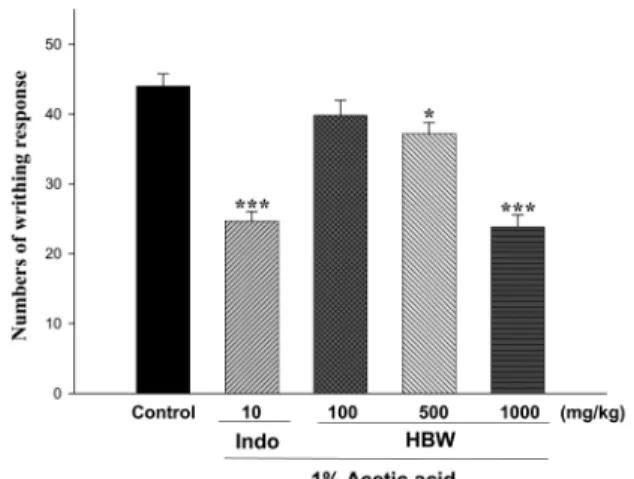
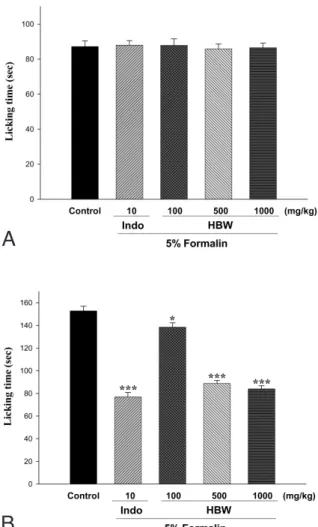
(3) Shyh-Shyun Huang, et al.. was referred to as the early phase, and the period from 20 min to 30 min after injection was referred to as the late phase. HBW (100, 500, 1000 mg/kg, p.o.) was administered to mice in the HBW groups 60 min before formalin injection. Indomethacin (10 mg/kg, i.p.) was administered to mice in the positive control group 30 min before formalin injection. The total time spent licking or biting the injured paw (pain behavior) was measured with a stopwatch. λ - C a r r a g e e n a n ( C A R R ) - i n d u c e d p aw edema. The anti-inflammatory activity of HBW was determined by the CARR-induced edema test [8,10]. Male ICR mice were randomly assigned to five groups (n = 6) and then fasted with free access to water for 24 hours before the experiment. Fifty microliters of a 1% suspension of CARR in saline, which had been prepared 30 min before each experiment, was injected into the plantar side of the right hind paws of the mice. After 60 min, HBW at doses of 100, 500 and 1000 mg/kg were administered orally, and after 90 min, indomethacin at the dose of 10 mg/kg was administered via an intraperitoneal route after the CARR treatment. Paw volume was measured prior to CARR injection and at 60, 120, 180, 240, 300 and 360 min intervals after the administration of the edematogenic agent using a plethysmometer (model 7159, Ugo Basile, Varese, Italy). The degree of swelling was evaluated according to the a-b value, where a is the volume of the right hind paw after CARR treatment and b is the volume of the right hind paw before CARR treatment. Indomethacin was used as a positive control compound [11].. 181. mobile phase B; the gradient elution was run with 30% solution B at 0 min, and 35% solution B at 30 min at a flow rate of 0.8 mL/min. The injection volume was 10 µL, and a wavelength of 254 nm was used for detection. Pure compounds, including rutin and quercetin, were also analyzed by HPLC under the same conditions. The retention time was used to identify the flavonoids in the samples. Statistical analysis. Data are expressed as mean S.E.M. Statistical evaluation was carried out by one-way or two-way analysis of variance (ANOVA), followed by Scheffe’s multiple range test. Statistical significance is expressed as *p < 0.05, **p < 0.01, ***p < 0.001. RESULTS. The cumulative amount of abdominal stretching correlated with the level of acetic acidinduced pain. HBW treatment (100, 500 and 1000 mg/kg) significantly (p < 0.001) inhibited the control writhes in a dose-dependent manner (Fig. 1). The inhibitory effect of HBW (1000 mg/kg) was similar to that of indomethacin (10 mg/kg) (p < 0.001). HBW (500 and 1000 mg/kg) significantly inhibited (p < 0.001) the formalin-induced pain in the late phase (Fig. 2B). The positive control. Analysis of rutin, quercetin and HBW by HPLC. Five milligrams of HBW was weighed and dissolved in 5 mL methanol. The solutions were filtered through 0.45 µm PVDF filters. The HPLC (Waters 2695 separations module; detector: Waters 996 photodiode array detector) analysis was carried out under the following conditions: a Waters XTerra RP 18 column (5 µm, 4.6 250 mm) was used with 0.05% phosphate buffer as mobile phase A, and acetonitrile was used as. Fig. 1. The effect of HBW on 1% acetic acid-induced writhing response in mice. HBW (100, 500, 1000 mg/kg, p.o.) for 60 min or indomethacin (10 mg/kg, i.p.) for 30 min. Data are presented as mean SEM (n = 6). *p < 0.05, ***p < 0.001 as compared with the control group. (One-way ANOVA followed by Scheffe’s test)..
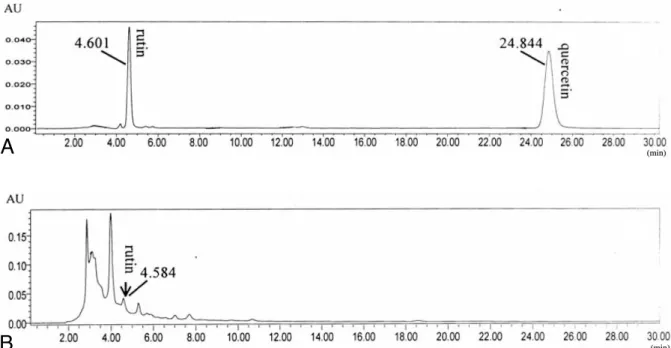
(4) 182. Analgesic and Anti-inflammatory Activities of Hydrocotyle batrachium Hance. indomethacin also significantly inhibited (p < 0.001) the formalin-induced pain in the late phase. Neither HBW nor indomethacin inhibited the formalin-induced pain in the early phase (Fig. 2A). As shown in Fig. 3, CARR induced paw edema. HBW (500, 1000 mg/kg) significantly inhibited (p < 0.001) the development of paw edema induced by CARR at 180, 240, 300 and 360 min after the CARR treatment. However, HBW (100 mg/kg) did not significantly inhibit the development of edema. Indometacin (10 mg/kg) significantly decreased the CARRinduced paw edema at 120 (p < 0.05), 180, 240, 300 and 360 min after the CARR treatment (p < 0.001). HBW was analyzed by HPLC. Its chromatogram is shown in Fig. 4. Both the standard (rutin) and HBW showed similar peaks at the retention time of 4.6 min. The other standard (quercetin) and HBW, however, did not show similar peaks at the same retention time. The chromatogram indicates that HBW contains the active ingredient rutin. The HPLC fingerprint of HBW could provide the chemical basis for future repetitive trials. DISCUSSION. The acetic writhing test is normally used to study the peripheral analgesic effects of drugs. Although this test is nonspecific (eg, anticholinergic, antihistaminic and other agents also show activity in the test), it is widely used for analgesic screening and involves local cholinergic and histaminic receptors [12]. In this study, we found that HBW exhibited an antinociceptive effect on acetic acid-induced writhing response. The formalin test is a valid and reliable model of nociception and is sensitive for testing various classes of analgesic drugs. The formalin test produces a distinct biphasic response and different analgesics might act differently in the early and late phases of this test. Therefore, the test can be used to clarify the possible antinociceptive mechanism of action of a proposed analgesic [13]. Central acting drugs such as opioids have been shown to exhibit inhibitory effects in both phases equally [12], whereas peripherally acting drugs such as aspirin,. A. B Fig. 2. The effects of HBW. A: Early phase (0 to 5 min). B: Late phase (20 to 30 min) of 5% formalin-induced inflammation in mice. Data are presented as mean SEM (n = 6). *p < 0.05, ***p < 0.001 as compared with the control group. (One-way ANOVA followed by Scheffe’s test).. Fig. 3. The effects of HBW and indomethacin on mice hind paw edema induced by λ-carrageenan. Data are presented as mean SEM (n = 6). *p < 0.05, ***p < 0.001 as compared with the control group. (One-way ANOVA followed by Scheffe’s test)..
(5) Shyh-Shyun Huang, et al.. 183. A. B Fig. 4. A: HPLC chromatograms of standards (rutin and quercetin). B: HPLC chromatograms of HBW. Instrument: Waters 996; Column: the Waters XTerra RP18 column, 5 µm, 4.6 250 mm; Mobile phase: 0.05% phosphate buffer and acetonitrile (the gradient elution); Flow rate: 0.8 mL/min; detection: 254 nm. Retention time: 4.601 (rutin), 24.844 (quercetin). Sample (10 mg/mL water); rutin and quercetin (0.1 mg/mL ethanol); Inj. vol. 10 µL.. indomethacin and dexamethasone have been reported to exhibit inhibitory effects only in the late phase. The late phase seems to represent an inflammatory response to pain that can be inhibited by anti-inflammatory drugs [14,15]. The inhibitory effect of HBW on the nociceptive response in the late phase of the formalin test suggests that the antinociceptive effect of HBW might be due to its peripheral action. The CARR test is highly sensitive to nonsteroidal anti-inflammatory drugs, and has long been accepted as a useful phlogistic tool for investigating new drug therapies [16]. The maximum degree of swelling of the CARRinjected paws occurred 240 min after injection. Statistical analysis revealed that HBW at doses of 500 and 1000 mg/kg significantly inhibited the development of edema at 180, 240, 300 and 360 min after treatment. Polyphenols have been reported to exhibit analgesic and ant-inflammatory effects [17,18]. The HPLC analysis showed that HBW contained rutin, but not quercetin. Rutin, a glycoside comprising the flavonol quercetin and the disaccharide rutinose, is widely distributed in the plant kingdom and shows remarkable antioxidant,. anti-inflammatory, and anticancer activities. It also has relaxing effects on smooth muscles [19]. Moreover, Galati et al showed that rutin was one of the components in the active anti-inflammatory methanol extract of Hypericum rumeliacum Boiss. subsp. apollinis (Boiss. & Heldr.) [20]. Rutin might be an important component in the analgesic and anti-inflammatory activities of the HBW. Studies of members of the genus Hydrocotyle resulted in isolation of trans-βfarnesene, α-terpinenes, and thymol methyl ether from H. sibthorpioides Lam. and H. maritime Honda [21], quercetin-3-O-galactoside from H. umbellata L. [22], monogalactosylmonoacylglycerol from H. ramiflora Maxim. [23], oleane and ursane type glycosides from H. ranunculoides Blume [24,25] and H. sibthorpioides [26], diacetylene from H. leucocephala Cham. and Schlecht. [4]. However, no chemical studies on H. batrachium Hance have been reported. Furthermore, only a few reports on the flavonoid compounds of the genus Hydrocotyle have been published. Therefore, further studies of the phytochemicals of the genus Hydrocotyle are needed..
(6) 184. Analgesic and Anti-inflammatory Activities of Hydrocotyle batrachium Hance. In conclusion, this study demonstrates that HBW possesses analgesic and anti-inflammatory activities. Further studies are necessary to elucidate the mechanisms of action. REFERENCES 1. Editorial Committee of the Flora of Taiwan, Second Edition. Flora of Taiwan (3). 2 nd edition. Taipei: Editorial Committee of the Flora of Taiwan, Second Edition.1993:1024. 2. Chang YS, Chen IS, Hsieh WC, et al. The catalogue st of medicinal plant resources in Taiwan, 1 edition. Taipei: the Committee on Chinese Medicine and Pharmacy, Department of Health, Executive Yuan, R.O.C. 2003:349. 3. Yu F, Yu F, McGuire PM, et al. Effects of Hydrocotyle sibthorpioides extract on transplanted tumors and immune function in mice. Phytomedicine 2007;14: 166-71. 4. Ramos F, Takaishi Y, Kawazoe K, et al. Immunosuppressive diacetylenes, ceramides and cerebrosides from Hydrocotyle leucocephala. Phytochemistry 2006;67:1143-50. 5. Zimmermann M. Ethical guidelines for investigations of experimental pain in conscious animals. Pain 1983;16:109-10. 6. Koster R, Anderson M, DeBeer EJ. Acetic acid for analgesic screening. Fed Proc 1959;18:418-20. 7. Taber RI, Greenhouse DD, Rendell JK, et al. Agonist and antagonist interactions of opioids on acetic acidinduced abdominal stretching in mice. J Pharmacol Exp Ther 1969;169:29-38. 8. Tunalier Z, Koçar M, Küpeli E, et al. Antioxidant, anti-inflammatory, anti-nociceptive activities and composition of Lythrum salicaria L. extracts. J Ethnopharmacol 2007;110:539-47. 9. Dubuisson D, Dennis SG. The formalin test: a quantitative study of the analgesic effects of morphine meperidine, and brain stem stimulation in rats and cats. Pain 1977;4:161-74. 10. Gepdiremen A, Mshvildadze V, Suleyman H, et al. Acute and chronic anti-inflammatory effects of Hedera colchica in rats. J Ethnopharmacol 2004;94: 191-5. 11. Chang HY, Peng WH, Sheu MJ, et al. Analgesic and anti-inflammatory activities of Phellinus merrillii. Mid Taiwan J Med 2007;12:76-82. 12. Shibata M, Ohkubo T, Takahashi H, et al. Modified formalin test: characteristic biphasic pain response. Pain 1989;38:347-52.. 13. Tjolsen A, Berge OG, Hunskaar S, et al. The formalin test: an evaluation of the method. Pain 1992;51:5-17. 14. Hunskaar S, Hole K. The formalin test in mice: dissociation between inflammatory and noninflammatory pain. Pain 1987;30:103-14. 15. Rosland JH, Tjolsen A, Maehle B, et al. The formalin test in mice: effect of formalin concentration. Pain 1990;42:235-42. 16. Just MJ, Recio MC, Giner RM, et al. Antiinflammatory activity of unusual lupine saponins from Bupleurum fruticescens. Planta Med 1998;64:404-7. 17. Chen TY, Shiao MS, Pan BS. Inhibition of 12- and 15lipoxygenase activities and protection of human and tilapia low density lipoprotein oxidation by I-TiaoGung (Glycine tomentella). Lipids 2005;40:1171-7. 18. dos Santos MD, Almeida MC, Lopes NP, et al. Evaluation of the anti-inflammatory, analgesic and antipyretic activities of the natural polyphenol chlorogenic acid. Biol Pharm Bull 2006;29:2236-40. 19. Liu CL, Chen YS, Yang JH, et al. Antioxidant activity of tartary (Fagopyrum tataricum (L.) Gaertn.) and common (Fagopyrum esculentum Moench) buckwheat sprouts. J Agric Food Chem 2008;56:173-8. 20.Galati EM, Contartese G, Miceli N, et al. Antiinflammatory and antioxidant activity of Hypericum rumeliacum Boiss. subsp. apollinis (Boiss. & Heldr.) Robson & Strid methanol extract. Phytother Res 2008;22:766-71. 21. Asakawa Y, Matzuda R, Takemoto T. Mono- and sesquiterpenoids from Hydrocotyle and Centella species. Phytochemistry 1982;21:2590-2. 22. Adams AA, Norris JA, Mabry TJ. A flavonoid from Hydrocotyle umbellata L. (Umbelliferae, Hydrocotyleae). Rev Latinoamer Quim 1998;20:67-8. 23.Kwon HC, Zee OP, Lee KR. Two new monogalactosylacylglycerols from Hydrocotyle ramiflora. Planta Medica 1998;64:477-9. 24.Della Greca M, Florentino A, Monaco P, et al. Polyoxigenated pleane triterpenes from Hydrocotyle ranunculoides. Phytochemistry 1994;35:201-4. 25. Della Greca M, Florentino A, Monaco P, et al. Oleane glycosides from Hydrocotyle ranunculoides. Phytochemistry 1994;36:1479-83. 26. Matsushita A, Sasaki Y, Warashina T, et al. Hydrocotylosides I-VII, new oleanane saponins from Hydrocotyle sibthorpioides. J Nat Prod 2004;67:3848..
(7) 185. 1. 1. 1. 2. 1. 3. 1 1. 2 3 4. 404. 91. 2008. 5. 7. 2008. 8. 15. 2008. 7. 24. 1,4.
(8)
數據
相關文件
臺大機構典藏NTUR (National Taiwan University 二 Repository, http://ntur.lib.ntu.edu.tw) 經驗與協助推 動臺灣學術機構典藏TAIR (Taiwan Academic Institutional Repository,
Wang, Solving pseudomonotone variational inequalities and pseudocon- vex optimization problems using the projection neural network, IEEE Transactions on Neural Networks 17
By correcting for the speed of individual test takers, it is possible to reveal systematic differences between the items in a test, which were modeled by item discrimination and
For a polytomous item measuring the first-order latent trait, the item response function can be the generalized partial credit model (Muraki, 1992), the partial credit model
volume suppressed mass: (TeV) 2 /M P ∼ 10 −4 eV → mm range can be experimentally tested for any number of extra dimensions - Light U(1) gauge bosons: no derivative couplings. =>
Define instead the imaginary.. potential, magnetic field, lattice…) Dirac-BdG Hamiltonian:. with small, and matrix
Later, though, people learned that Copernicus was in fact telling the
Estimated resident population by age and sex in statistical local areas, New South Wales, June 1990 (No. Canberra, Australian Capital
