maximum observed perpendicular coercivity was as high as 6000 Oe for the as-deposited Co–Tb amorphous films. A nearly magnetically isotropic amorphous Co–Tb film with in-plane coercivity of about 2080 Oe was obtained after annealing. © 1998 American Institute of Physics.
@S0021-8979~98!06618-3#
I. INTRODUCTION
Recently, the most important problem in recording me-dia technology is how to increase the recording density.1–3 Due to their high coercivity, CoCrM ~M5Ni, Ta, Pt! alloy thin films are the most widely used materials in longitudinal recording while CoCr films with columnar grains are used for perpendicular recording. For these crystalline films, the most significant problem is the noise that results at domain transition region from magnetic exchange coupling between the grains.4 Likewise, intergranular voids, stacking faults, crystallographic orientation, etc., all decrease magnetic performance.5 Practically, if we want to increase the areal recording density of the crystal film, the grain size of the film must be reduced.3 However, when the grain size is smaller than the single-domain size, the grains will become super-paramagnetic particles and the coercivity of the film will decrease rapidly due to thermal fluctuations. So, the recorded bit size is limited and correlated to the single-domain grain size.
Although the fabrication of single-domain nanocrystal particles might be achieved by various methods,6–9a Gauss-ian distribution of particle size may occur during the fabri-cation of thin films. It is difficult to obtain uniform single-domain particles. This distribution of grain size results in some of the particles being multidomain and some of the others will be superparamagnetic. Moreover, the location of and distance between the particles is uncontrollable.
In this article we suggest that the high coercivity amor-phous thin films may be one of the most promising candi-dates for ultrahigh density magnetic recording ~areal record-ing density.50 Gbits/in2! both in longitudinal recording and perpendicular recording.
Amorphous Co–Tb alloy thin films have excellent quali-ties of composition modulation and special perpendicular an-isotropy. They have been widely studied by many investigators.10–12 Amorphous thin films of TbFeCo have long been used as recording media in Magnetooptical~MO!
data storage.13–15 If the wavelength of the recording laser beam is small enough, the record spots in this amorphous film might be reduced to a uniformly isolated single-domain size with desired shape and smallest distance between neigh-boring recorded bits without grain boundary or crystallo-graphic orientation problems.
In this work, dc magnetron sputtering was used to pre-pare high coercivity amorphous Co–Tb thin films that might be used in ultrahigh density magnetic recording. The effects of composition, sputtering power, argon pressure, and an-nealing temperature on the perpendicular and in-plane mag-netic properties of the Co–Tb thin films were investigated. A nearly magnetically isotropic amorphous Co–Tb film with in-plane coercivity of about 2080 Oe was obtained after an-nealing. The maximum perpendicular coercivity was as high as 6000 Oe for the as-deposited amorphous films.
II. EXPERIMENT
Amorphous Co1002xTbx (x57 – 60) alloy thin films
were produced by dc magnetron sputtering. A mosaic target consisting of high purity cobalt disk~99.99%! overlaid with high purity terbium pieces~99.9%! was used. By varying the number of Tb pieces arrangement provides for a wide range of effective target compositions and therefore film composi-tions. The films were deposited onto glass substrates at room temperature.
Applied dc power source was working at controlled vari-ous powers and varivari-ous deposition rates. The base pressure was 531027Torr and after the high purity Ar gas was in-troduced, various sputtering pressures were investigated. 1000-Å-thick Co–Tb films were used in this study. To pro-tect the film from oxidation, the magnetic layer was sand-wiched between a SiNx layer and the glass substrate. The 500-Å-thick protective SiNx layer was sputtered from a Si
wafer target by dc magnetron reactive sputtering. The sput-tering pressure was 5 mTorr with a mixture of Ar and N2
gases.
The magnetic properties of the films were measured with a vibrating sample magnetometer ~VSM! at room
tempera-a!Electronic mail: [email protected]
3317
ture using a maximum applied field of 12 kOe. The micro-structure of the films was characterized by transmission elec-tron microscopy ~TEM!. The composition and homogeneity of the films were determined by energy disperse x-ray dif-fractometer ~EDX!. The thickness of the films were mea-sured by an astep.
III. RESULTS AND DISCUSSION
Here, we use different Co–Tb compositions, sputtering powers, argon pressures, and annealing temperatures to ex-amine the variation of the parallel and normal to the film plane magnetic properties.
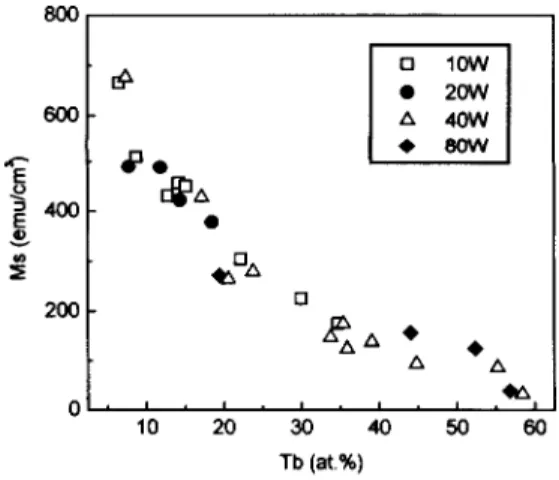
Figure 1 shows the relationship between the saturation magnetization Ms at room temperature of the as-deposited Co–Tb film at various sputtering powers as a function of the Tb content. The Ar pressure was 3 mTorr. It can be seen that the Ms value was almost independent of the sputtering power but decreases with increasing Tb content. At a Tb content of 7 at. %, the Ms value is 676 emu/cm3. When the Tb content of the film is increased to 58 at. %, the Ms decreases to 30 emu/cm3. This is due to that the amorphous Co–Tb alloy is sperimagnetic/ferrimagnetic,16 the magnetic moments of Co atoms are antiparallel to that of Tb atoms. The resulting mag-netization is the summation of Tb subnetwork magmag-netization and Co subnetwork magnetization. Due to the larger mag-netic moment of Co than that of Tb at room temperature, the resulting Ms value increases with increasing Co content. From Fig. 1, we can see that the compensation composition of the Co–Tb film at room temperature is about Co60Tb40. These as-deposited Co–Tb films all have an amorphous structure, as shown in Fig. 2. Figure 2~a! is the TEM photo-graph of the as-deposited Co64Tb36film. When examined in detail, a lemon peel-like microstructure is observed. The di-ameter of the lemon peel-like bumps is very small~about 60 Å!. The large area diffraction pattern of this lemon peel-like structure yields a broad halo and so the lattice spacing cannot be estimated, as shown in Fig. 2~b!. It is obvious that this film has an amorphous structure.
In Fig. 3, the Tb concentration in the Co–Tb films and the deposition rate of Co–Tb films are plotted versus the Ar
sputtering pressure ranging from 1 to 20 mTorr. We can see that the value of Tb content increased monotonically with the Ar pressure. The Tb content was 36 at. % in the film when the Ar pressure was 1 mTorr. It increased to 44 at. % as the Ar pressure increased to 20 mTorr. The deposition rate was about 4 Å/s when the Ar pressure was less than 5 mTorr. It decreased rapidly when the Ar pressure was higher than 5 mTorr. The deposition rate decreased to 2.3 Å/s at 10 mTorr then remained constant when the Ar pressure was higher than 10 mTorr. So, in the following we selected Ar pressures of 3 and 5 mTorr to examine the effect of the other sputter-ing parameters on the magnetic properties of the films.
Figure 4 shows the relationship between coercivity Hc and Tb content of the as-deposited films. The sputtering power was 40 W and Ar pressure was 3 mTorr. The in-plane coercivity Hci seems to be independent on the Tb content and is less than 400 Oe over the whole composition range. The perpendicular coercivity Hc' was also lower than 200
FIG. 1. Variation of saturation magnetization Ms at room temperature of the as-deposited amorphous Co–Tb film as a function of Tb content. The sput-tering power was varied from 10 to 80 W. The Ar pressure was 3 mTorr.
FIG. 2. TEM photo and diffraction pattern of the as-deposited Co64Tb36
film.~a! the TEM shows a lemon peel-like microstructure and ~b! the
dif-fraction pattern indicates an amorphous structure.
FIG. 3. The correlation between the Tb content of the film, deposition rate, and Ar pressure. The sputtering power was fixed at 40 W.
Oe when the Tb content was below 25 at. % and above 50 at. %. The maximum Hc'occurred in the composition range between Co65Tb35 and Co63Tb37. The Hc' was higher than 6000 Oe, when the Tb content was 36 at. %~i.e., Co64Tb36!. Its Ms value is about 130 emu/cm3, as shown in Fig. 1.
Figure 5 shows the relationship between the coercivity and the Tb content for the as-deposited Co–Tb films as the Ar pressure was increased to 5 mTorr. For these films, the in-plane coercivity Hciand perpendicular coercivity Hc' al-most have a similar variation over the entire composition range. When the Tb content is between 36 and 39 at. %, Hc' is higher than 1000 Oe. The maximum Hc'is about 4230 Oe and the maximum Hci is about 1770 Oe. The maximums both occur at 38 at. % Tb~i.e., Co62Tb38!. Comparing Fig. 4
with Fig. 5, we can see that Hc' and Hci vary with the change of Ar pressure. As the Ar pressure is increased from 3 to 5 mTorr the maximum Hc'of the film is decreased from 6000 to 4230 Oe. But Hci increases from 200 to 1770 Oe when the Tb content is 38 at. %. The magnetic anisotropy of the film changes from perpendicular to isotropic; this may be due to the variation of the microstructure caused by the in-crease in Ar pressure.17
In Fig. 6, the parallel and normal to the film plane squareness Mr/Ms of the as-deposited Co62Tb38 films are
plotted versus the Ar sputtering pressure in the range from 1 to 20 mTorr. As the Ar pressure increases from 3 to 5 mTorr we can see that the in-plane squareness increases from 0.02 to 0.61, but the perpendicular squareness decreases from 0.83 to 0.64. When the Ar pressure is higher than 5 mTorr, the in-plane and perpendicular squareness both decrease with increasing Ar pressure. The maximum perpendicular square-ness and minimum in-plane squaresquare-ness both occur at 3 mTorr of Ar pressure. This indicates that when the Ar pres-sure is 3 mTorr, the magnetic easy direction is normal to the film plane. This is the reason why we select Ar pressure as 3 mTorr to prepare perpendicular magnetic anisotropy films and Ar pressure is 5 mTorr for preparing magnetically iso-tropic Co–Tb films.
Figure 7 shows the coercivity and squareness of the Co62Tb38film as a function of annealing temperature Ta
be-tween 100 and 250 °C. The annealing time was 60 min. These films were deposited at a dc sputtering power of 40 W and Ar pressure of 5 mTorr. When Ta is higher than 250 °C, very small crystalline particles appear and the magnetic properties of the film decrease rapidly. This is consistent with the reported crystallization temperature of 255–300 °C16 for the evaporated amorphous Co–Tb films. Figure 7~a! shows the in-plane coercivity Hciand squareness Si. When Ta is increased from 100 to 180 °C, the Hcivalue remains nearly constant at about 1600 Oe and the Sistays at about 0.54. But, as Ta increased to greater than 180 °C, Hci and Siboth increase with increasing Ta. Hci increases from 1600 to 2080 Oe and Si increases from 0.54 to 0.8 as Ta increases from 180 to 250 °C. Figure 7~b! shows the perpen-dicular coercivity Hc' and squareness S'. When Ta is in-creased from 100 to 200 °C the Hc' value almost remains constant at about 4100 Oe and the S' value stays at about 0.77. As Ta is higher than 200 °C, Hc' decreases rapidly from 4100 Oe at Ta5200 °C to 2400 Oe at Ta5220 °C then
FIG. 4. The variation of coercivity with Tb content for the as-deposited Co–Tb films. The dash line is for the in-plane coercivity and solid line is for the perpendicular coercivity. The sputtering power was 40 W and the Ar pressure was 3 mTorr.
FIG. 5. The variation of coercivity with Tb content for the as-deposited Co–Tb films. Dash line is for the in-plane coercivity and solid line is for the perpendicular coercivity. The sputtering power was 40 W and the Ar pres-sure was 5 mTorr.
FIG. 6. Squareness Mr/Ms of as-deposited Co62Tb38film vs Ar sputtering
pressure. The sputtering power is 40 W. The solid line and the dash line represent the applied field H is normal and parallel to the film plane, respectively.
keeps constant when Ta is higher than 220 °C. But, S' in-creases from 0.75 to 0.82 as Ta inin-creases from 220 to 250 °C. After annealing, we can see that the magnetic anisot-ropy of the films is changed due to the stress release. The
Co62Tb38 films which were annealed between 220 and 250 °C almost have isotropic magnetic properties. These an-nealed Co62Tb38 films also have an amorphous structure, as
shown in Fig. 8. Figure 8~a! is the TEM photograph of the Co62Tb38 film after being annealed at 250 °C. It also has a
lemon peel-like microstructure. The diameter of these lemon peel-like bumps is about 37 Å which is smaller than that of Fig. 2~a!. The broad halo diffraction pattern, as shown in Fig. 8~b!, indicates that this film is also an amorphous structure. Figure 9~a! shows the M–H curves of the as-deposited Co62Tb38film. This film was deposited at dc power of 40 W
and Ar pressure of 5 mTorr. For this film, the in-plane coer-civity is 1770 Oe and the perpendicular coercoer-civity is 4230 Oe. The Ms value of this film is about 100 emu/cm3. Figure 9~b! shows the M–H curves of this film after it was annealed at 250 °C for 60 min. The M–H curves show that the film exhibits nearly isotropic magnetic properties. The in-plane coercivity is 2080 Oe and the perpendicular coercivity is 2460 Oe.
IV. CONCLUSIONS
The magnetic properties of sputtered amorphous Co1002xTbx alloy thin films have been studied over a wide
composition range, sputtering power, and argon pressure. An amorphous structure is still obtained, but with isotropic mag-netic properties for the Co62Tb38films annealed at 250 °C for
60 min in vacuum. The in-plane coercivity was about 2080
FIG. 8. TEM photo and diffraction pattern of the Co62Tb38film which was
annealed at 250 °C for 60 min,~a! is the TEM microstructure and ~b! is its
diffraction pattern.
FIG. 9. M–H loops measured along the directions of normal~'! and
par-allel~i! to the film plane of the Co62Tb38film.~a! As deposited, ~b! After
annealing in vacuum at 250 °C for 60 min. FIG. 7. Squareness and coercivity dependence on annealing temperature for
Co62Tb38films. The annealing time was 60 min,~a! is the in-plane
2E. Grochowski and D. A. Thompson, IEEE Trans. Magn. 30, 3797~1994!.
3D. N. Lambeth, E. M. T. Velu, G. H. Bellesis, L. L. Lee, and D. E.
Laughlin, J. Appl. Phys. 79, 4496~1996!.
4
J.-G. Zhu, IEEE Trans. Magn. 29, 195~1993!.
5
S. E. Mckinlay, N. Fussing, and R. Sinclair, IEEE Trans. Magn. 32, 3587
~1996!.
213~1986!.
15
T. Tokushima, N. Horiai, and T. Fujii, IEEE Trans. Magn. 25, 687~1989!.
16P. Hansen, in Handbook of Magnetic Materials, edited by K. H. J.
Bus-chow~Elsevier, New York, 1991!, Vol. 6, Chap. 4, p. 310.