行政院國家科學委員會專題研究計畫成果報告
超媒體文件運算結構之模式及資料庫設計研究
Designing a Model and Database for the Computing Str uctur e of
Hyper media Documents
計畫編號:NSC 88-2416-H004-037 執行期限:87 年 8 月 1 日至 88 年 7 月 31 日 主持人:余千智 國立政治大學資訊管理系 一、中文摘要 超 媒 體 文 件 組 成 之 文 件 架 構 (Document Architecture)含內容(content)、展 現 格 式 (presentational layout) 及 運 算 (computing)等三個結構單元。其中運算結 構之目的在定義及表現文件內容物件間的 交互運算關係,如:時間性及空間性互動 關係,試算表、統計分析或其他模式計算 關係等。目前以超文件標記語言 HTML 所 編輯的超媒體文件無法描述多媒體資料間 之時空及模式計算關係,對使用者互動式 介面效果的描述也有所不足。實際運算關 係 的 執 行 雖 可 由 劇 本 語 言 (scripting language),如 Java 等,所撰寫的程式來達 成,但仍缺乏結構性定義及動態組合展現 的功能。另現有研究文獻對超媒體文件運 算結構的探討多限於時空關係之表示,未 論及模式計算關係。對動態組合內容物件 及展現運算關係的資料庫設計問題,更未 見深入討論或具體成果。本研究的目的即 在提出一個超媒體文件運算結構的資料模 式表現及資料庫管理方法,以定義、儲存、 產出及展現超媒體文件的內容物件運算關 係。本研究將以物件導向方法設計超媒體 文件的運算環境及功能資料庫類別,並利 用 Java 語言建置結構性程式單元,能與 HTML 文件整合運作,以使超媒體文件組 織、瀏覽及運算結構的定義機制及操作環 境能趨於一致。 關鍵詞:超媒體文件,運算結構,物件導 向資料模式,多媒體資料庫 Abstr act
The document architecture of hypermedia documents contains content, presentational layout and computing structures. The goal of the computing structure is to define and represent the inter-object computational relationship among content objects, such as the temporal and spatial interactions, the spreadsheets, the statistical analysis or other model-based computational relationships. Currently, a hypermedia document edited by HTML(Hypertext Markup Language) can not provide descriptions for spatial-temporal or model-based computational relationships. It also lacks of the capability to describe the interfaces and effects constructs for handling user interactions. Although physical computations can be carried out by using scripting language like Java, there is still a need to have functions for supporting structural definition as well as dynamic composition and presentation. In the literature, most research works devoted to the discussions of spatial-temporal relationships. Few concentrated on model computations. Furthermore, no insightful discussions or
significant results have been proposed for dealing with the database design problems to support dynamic compositions and presentational computations for content objects. The goal of this project is to propose a conceptual data model and a multimedia database management approaches for representing and managing computing structure of hypermedia documents in order to facilitate the definition, storage, generation, and presentation of computational relationships among content objects. An object-oriented method will be used to design the database classes for computational environment and functions. Java will also be used to develop applets as the structural program constructs which can be integrated with HTML for easy implementation and operation purposes. In such a way, the definition mechanism and operation environment for document organization, browsing and computation can be unified. Keywords : Hypermedia Document, Computing Structure, Object-Oriented Data Model, Multimedia Database
二、緣由與目的 文件(Document)係指具有特定主題的 資訊組合及展現。文件依其組織與功能特 性考量,從內涵的資料型態與格式展現、 與其他文件間的參考鍵結關係、及可否成 為內含應用系統或運算程式之執行環境等 層面,大致可分為多媒體文件(Multimedia Document) 、 超 媒 體 文 件 (Hyperimedia Document) 、 及 複 合 式 文 件 (Compound Document) 等 三 類 [3,5,9,12,17,24,28,29,31, 38,39,48,54,66]。多媒體文件在內容及格式 上含有如文字、影像、圖形、動畫、聲音、 影片等之多媒體資料物件及展現介面。超 媒體文件為具有超鍵結(Hyperlink)關係之 多媒體文件,即文件內容之基本資訊、細 部資訊、相關資訊、資料物件等相互之間, 及與其他參考文件之全文或內容物件之 間,具有非線性組織及交互鍵結瀏覽的關 係。複合式文件即文件本身為應用系統與 軟體的運算執行環境,其內容資訊的產 生、取出或展現,可為內含或鍵結外部應 用系統及軟體的動態執行結果。 每一種應用類型及組成結構相類似的 文件,如備忘錄、電子郵件、電子書、技 術手冊、研究報告、電子雜誌等,均可定 義共通的文件型態(Document Type)。文件 架構(Document Architecture)則用於規範及 表現各種型態文件的基本屬性、操作功能 及文件主體中內容物件的邏輯組合、展現 格式與動態運算關係。因此,文件架構之 主體結構中又包含內容(Content)結構、格 式(Layout)結構與運算(Computing)結構等 三個結構性單元[5,9,24,41,48,64,76]。文件 主體中之內容結構又可下分文字資料結構 與非文字之多媒體資料結構兩部份。多媒 體資料含靜態的圖型、影像及動態的視 訊、音訊、動畫資料等,因此,非文字資 料結構下又包含多媒體資料的特徵結構及 時間、空間性資料結構等。格式或展現結 構主要在記錄字型、字體、間距、色調、 分欄、視窗、表格、區段、大小、位置、 流向、特殊效果等文件畫面及介面格式關 係。運算結構則可分為兩大類,即內容物 件間多維度時空互動之展現運算關係,以 及如文件內含試算表、模擬、統計分析、 規則推論程序等之模式或知識運算關係。 國際間不同標準團體所制訂及持續發 展中的文件參考模式及相關之製作語言與 交換格式等大多著重內容結構及格式結構 結構的表現,對運算結構均缺乏明確的定 義。文獻及實務中主要的文件相關國際標 準 有 : SGML/HyTime/SMSL 系 列 、 ODA/HyperODA 系 列 、 MHEG 、 HTML/ XML/SMIL 系 列 、 Java 、 VRML 、 OLE/ ActiveX 、 OpenDoc 、 MPEG 等 [2,5,6,9,13, 14,18,19,21,36,37,41,43,44,51,59,60,65,67, 68,69,70,71,78,79,83,97]。簡要說明如下: (一) SGML (Standard Generalized Markup Language) [5,37,83]
SGML 係 由 國 際 標 準 組 織 (International Standard Organization, ISO)所 制訂,主要語法由文字標記(tag)所組成,
用來標示文件內容結構的組合元件關係及 其圖文內容本體,可做為組織間電子文件 交換的依據。SGML文件的交換包含兩個部 份 : 一 是 文 件 型 態 定 義 (Document Type Definition,DTD),用來宣告特定文件型態 組 成 元 件 之 類 別 (element type) 、 屬 性 (attribute)及元件間的階層包含關係。另一 則是文件特例(Document Instance, DI),為 含有特定文件型態SGML結構化標記及本 文內容的文件檔案。SGML僅定義文件之內 容而未定義文件之展現格式,並未對陳列 結構作規範,因此要透過DSSSL (Document Style Semantics and Specification Language)[83]來指定,DSSSL利用體裁語 言(style language)定出SGML文件所需的 體裁形式,以及轉換語言(transformation language)用來在展示前調整SGML的結構 化文件。另一方面,SGML僅提供靜態的圖 文內容文件結構關係,並未擴展至多媒體 資料的空間、時間、測度、事件排程等動 態關係及超鍵結關係之定義。因此對超媒 體文件而言,SGML 標準並不完備。 ( 二 ) HyTime (Hypermedia/Time-Based Structure Language) [18,19,64] HyTime為SGML文件結構在多媒體資 料內容動態關係與超鍵結關係等方面的定 義擴充,HyTime將時間、空間、超鍵結等 相關的結構型式(Architectural Form, AF)加 入SGML的文件結構定義中,AF 可歸屬於 基礎(base)、定位(location address)、排程 (scheduling) 、 超 鍵 (hyperlinks) 、 測 度 (measurement)、及演出(rendition)等六類模 組。加入AF的SGML文件,可表現出多媒 體文件的時間與空間性質,也可使超媒體 文件在不同的平台上互相交換資料。相對 於 DTD , HyTime 以 HDTD(Hytime-conforming Document Type Definition)來定 義超媒體文件的結構組合與交互參考關 係。然而,HyTime對文件內容元件的循序 與同步關係雖有所界定,但對文件的格式 與展現行為、運算關係等仍未有進一步的 延伸。 ( 三 ) SMSL (Standard Hypermedia/ Multimedia Scripting Language) [79]
SMSL是SGML/HyTime超媒體文件結 構在內含劇本語言方面的延伸定義,由同 一ISO JTC1/SC18/WG8 超媒體語言特殊 工作群研擬中,其劇本程式可定義文件中 多 媒 體 物 件 的 行 為 (behaviors) 與 動 作 (actions) , 可 支 援 使 用 者 互 動 性 (user interactions)及傳統數值運算(computations) 的執行,屬多媒體文件運算結構的建置工 具。一份SMSL文件包含SGML/HyTime文 件 和 以 AF 方 式 加 入 其 中 的 劇 本 程 式 (scripts),透過不同機器平台上的劇本程式 執行器(runtime player),可解譯(interpret) 並 執 行 由 SMSL 所 產 生 的 跨 機 器 平 台 (machine-independent)劇本程式碼。SMSL 係以支援程式撰寫為主,標準及工具仍在 研訂中,如何達成文件運算關係之結構性 定義尚不明確。
(四) HTML (HyperText Markup Language) 及W3C相關標準 [6,14,21,30,67,78,79,97] HTML以SGML為基礎,加入一般性的 格式展現語意及超鍵標記,為全球資訊網 (WWW)應用文件製作所使用的標準化超 文件標記語言,由IETF(Internet Engineering Task Force)的HTML工作群(HTML-WG)所 持續擴充修訂中。HTML的語意標記中, Form、Link、Style、Table、Fig、Math、 Note等標記可用來建立互動式輸出入介面 及表現表格、插圖、數學方程式、註解等 格式,而透過Anchor超鍵標記,則可連結 存放不同地點、不同機器、不同型態的文 件及檔案。WWW 用戶(client)端的使用 者 , 透 過 HTML 瀏 覽 器 (browser) , 如 Netscape Navigator(Netscape) 或 Internet Explorer (Microsoft),及HTTP (Hypertext Transmission Protocol) 、 URL (Uniform Resource Locator)等協定,可自指定WWW 伺服器(server)下載並瀏覽HTML超媒體文 件。目前正在推廣中的XML(eXtendible
Markup Language)[6,7,8]則旨在延伸HTML 之功能,可讓使用者自訂文件型態,對內 容結構的描述有更大的彈性。 另外,由於HTML對文件展現結構的 支援仍極有限,各家瀏灠器所呈現的效果 不一,而各家瀏灠器自行針對展現效果所 擴充的HTML語法,更造成了文件展現標 記混雜的局面[67,70]。因此近來WWW協會 (W3C)針對超媒體文件在陳列方式上提出 了可支援相對絕對位置描述以及三維指定 的工作草案[21],而在格式方面則建議以串 接式的體裁紙(Cascading Style Sheet level 1,CSS1)[30],將體裁方式可儲存在另一 份體裁文件上,允許文件的作者與讀者加 入顏色字型等展現格式,可免除一再擴充 HTML用於展示的標記,同時也能對展現 格式作更精確的描述。此外,W3C亦推薦 兩 個 文 件 網 頁 的 展 現 設 定 語 言 : XHTML(eXtended Hypertxt Markup Language)及SMIL(Synchronized Multimedia Integration Language)[14,97]。XHTML可使 網頁外觀的設定,如圖形的位置、文字的 字體、邊限等更為容易。而SMIL則在強化 文件網頁展現中多媒體物件間相對關係的 控制,如音樂與動畫的同步關係設定等。 SMIL文件亦屬XML文件,發展目標以展現 物件的時間性行為、畫面規格、及媒體物 件超鏈結關係等的描述為主。 至於在WWW應用環境中可與HTML 文 件 配 合 的 現 有 劇 本 語 言 為 Java(Sun Microsystems),Java為一物件導向 (object-oriented) 、 分 散 式 (distributed) 、 解 譯 式 (interpreted)、架構中立(architecture neutral) 的可攜式(portable)、動態(dynamic)語言, 只要不同機器平台上的瀏覽器含有Java虛 擬機器(Virtual Machine),即可動態自伺服 器下載文件和必要的物件、物件處理器 (Object Content Handlers) 及 協 定 處 理 器 (Protocol Handlers)等,予以解譯、執行並 瀏覽互動式應用。另外在WWW環境中可
配合HTML超媒體文件處理三度空間動畫 (3-D animation) 模 擬 的 語 言 有 VRML(Virtual Reality Modeling Language) , 其 標 準 仍 由 VAG(VRML Architecture Group)持續修訂審議中[2]。綜 合來看,就文件運算關係之結構性定義而 言,則HTML仍未有具體方法。
(五) ODA (Office Document Architecture)/ HyperODA [5,9,40,41] 源自歐洲的文件結構標準ODA,由 ECMA所提出,是一個物件導向階層式的 辦公室多媒體文件結構。ODA文件定義除 基本檔案(profiles)外,可分為型態導向的一 般描述(generic description)與特例導向的特 定描述(specific description)兩部份,均含有 邏 輯 結 構 (logical structure) 及 格 式 結 構 (layout structure),可同時表現文件內容及 版面格式的組合與語意關係。ODIF(Office Document Interchange Format)是網路文件 傳輸的檔案交換格式標準協定。HyperODA 則擴充了ODA文件結構在時空性質與超鍵 結方面的定義,目的是補強ODA對於一份 文件的內容(尤其針對影像和聲音媒體) 彼此間在時間關係和非線性關係上的表 示。然而,就文件運算結構之定義而言, HyperODA所能支援的仍極為有限。 (六) MHEG (Multimedia-Hypermedia Expert Group) [13,65] MHEG 是由 ISO/IEC、SC2/WG12 形 成的一個專家工作群。MHEG之標準在制 訂通用的多媒體/超媒體物件類別(object classes), 以支 援跨 平 台主 從架 構的 分 散 式、交談式多媒體應用與服務系統。客戶 端應用系統之文件資料模式及交換格式可 含AVI、SGML/HyTime、及ODA/HyperODA 等。MHEG的物件類別包括基礎(basic)、內 容 (content) 、 投 影 (projector) 、 一 般 輸 入 (generic input)、時空組合(spatial-temporal composite)、及條件行動集(condition action set)等幾類,分別定義有關基本資料、資料 內涵、媒體播放、輸入介面、時間與空間 互動關係、條件與行動關係等方面之物 件。另外,研議中之新版MHEG定義亦包
含 劇 本 交 換 代 表 (Script Interchange Representation, SIR),此係與機器及作業系 統獨立的位元碼,其目的同一般劇本語 言。但從超媒體文件的組織及其運算結構 關係定義等層面來說,MHEG仍未包含具 體完整的規範。
(七)MPEG(Moving Pictures Expert Group) 系列[43,44,69] MHEG 為ISO/IEC、ISO/MPEG等專家 工作群所發展的影音資訊標準,其系列包 括已公佈的MPEG-1、MPEG-2、MPEG-4 v1,及研訂中的MPEG-4 v2及MPEG-7。 MPEG 標 準 的 目 標 在 處 理 影 音 資 訊 的 儲 存、檢索、傳送及內容描述。其中MPEG-4以位元層次的資料流(data streams)為對 象,可做多形式資料流的同步化處理,也 可 使 用 內 容 物 件 資 訊 (Object Content Information, OCI)資料流來附加彙總資料 (metadata)。MPEG-7則以描述多媒體內容 資訊的共通介面(common interface)為標準 化對象,以增加資料管理的彈性並加速資 料資源的全球化。MPEG-7標準元件中含影 音特徵的數量測度集:描述器(Descriptors, D) 、 描 述 器 間 的 關 係 結 構 : 描 述 綱 要 (Description Schemes, DS)、及描述定義語 言(Description Definition Language, DDL) 等,可描述的類別包括資料層面的媒介 (medium-based) 、 實 體 (physical) 、 知 覺 (perceptual)、錄製(transcriptive)等性質,以 及較上層的架構性(architectural)與註解性 (annotative)的描述等。MPEG-7中對運算特 徵的描述只限於上列實體的部份,如功率 (power)及頻率(frequency)等,仍缺乏深度的 及系統化的運算結構規劃。 上述各種多媒體文件結構模式多以支 援多媒體/超媒體應用之文件內容製作為目 標,缺乏文件運算結構之資料模式及資料 庫層面的延伸,不易涵蓋多媒體/超媒體資 訊系統層次的動態性文件組合、產出、展 現及運算需求[28,73]。因此,在能與內容 及格式結構整合的前提下,超媒體文件運 算結構的資料模式及資料庫設計方法與建 置技術仍有待進一步的探討及發展。另現 有研究文獻對超媒體文件運算結構的探討 多限於時空關係之表示,未論及模式計算 關係。對動態組合內容物件及展現運算關 係的資料庫設計問題,更未見深入討論或 具體成果[1,5,10,36,38,39,40,42,44,48,55,56, 57,58,75,76,81,84,85,86,89,92,93,95,96,97] 。綜此,本研究的目的即在提出一個超媒 體文件運算結構的模式表現及資料庫方 法,以定義、儲存、產出及展現超媒體文 件的內容物件運算關係。本研究將以物件 導向方法設計超媒體文件的運算環境及功 能資料庫類別,並以 WWW 為實驗環境, 利用 Java 語言建置結構性程式單元,能與 HTML 文件整合運作,以使超媒體文件組 織、瀏覽及運算結構的定義機制及操作環 境能趨於一致。 三、結果與討論 (一) 研究方法與步驟 為有效建立超媒體文件運算結構之資 料模式及資料庫,本計畫所採用之研究方 法與步驟列述如下: 1、採用整合性文獻整理與探討,整合分析 不同技術層面的相關文獻,以確認超媒 體文件內容物件之運算行為與互動關 係。運算行為關係包括如模式計算、規 則推論,以及在時空關係上內容物件的 互動展現等。模式計算關係指文件內容 物件間具有數學模式或決策模式之輸 入、處理及輸出關係,譬如試算表某一 個儲袸格(cell)的值隨前幾行儲袸格 的資料經一特定數學模式運算得來及 變動。規則推論關係則是文件內容物件 間具有知識規則的條件及結果推論關 係。時空運算展示行為關係係關於多媒 體文件內容物件間在時空互動關係上 的 運 算 行 為 以 及 動 態 展 示 效 果 的 處
理,如同步展現、繞轉運動、追趕超越 等。 2、採用物件導向資料模式方法,界定超媒 體文件運算結構之類別關係,賦予資 料、文件、知識、模式、程序等結構單 元 一 個 一 致 性 的 資 料 庫 模 式 表 現 方 法。類別(class)含屬性(attribute)及函式 (method)的描述。 3、採用多媒體資料庫方法,建立超媒體文 件之內容及運算物件資料庫結構,以支 援動態運算行為之物件存取、組合及展 現等管理作業功能。 4、採用現有的劇本語言 Java 進行運算結構 函 式 、 程 序 及 介 面 的 建 置 , 以 補 足 HTML 在運算行為關係上描述及執行 功能的不足。 5、採用主從(Client-Server)網路架構,規範 整體超媒體文件分散式作業環境,以達 成文件伺服器端運算結構定義及使用 者 工 作 站 端 運 算 行 為 展 現 之 運 作 功 能。 6、採用軟體整合方法,整合多媒體資料處 理、超媒體文件製作、資料庫管理、文 件標記及劇本語言等工具軟體,建立實 體超媒體文件應用原型系統,如觀光導 覽及諮詢系統,以測試整體效果。 (二) 超媒體文件運算結構之資料模式及資 料庫 整體多媒 體文件 架構的組 成已如 上 述,其層次關係如圖 1 所示,包含屬性結 構、功能結構與主體結構三大部份。屬性 結構含文件名稱、主題、作者、出版者、 版本、出版年份、關鍵詞等基本及相關資 料物件,功能結構含查詢、瀏覽、製作與 控制等功能及操作物件,主體結構則含文 件之內容、展現與運算結構。內容結構可 分成文字與非文字資料結構兩部份。文字 資料結構中下含如書籤、註解等之註記結 構,而非文字資料結構中則另包含時間/空 間性資料結構及多媒體資料物件內含之特 徵結構等。此外,文件內容結構亦建有可 提高內容搜尋效率之索引結構。格式結構 主要在記錄文件展現之畫面及介面陳列關 係。運算結構則可分為如內容物件間多維 度時空互動關係定義之展現運算結構,以 及如文件內含試算表、統計分析、知識推 論處理等之模式及知識運算結構。以下將 就兩類運算結構做進一步討論。 1、展現運算結構 多媒體文件展現格式的討論範圍可以 以使用者觀點(user view)、場景(scenario)、 畫面(screen/scene)、視窗(window)或頁(page) 為單位,呈現在同一個展現單位(如畫面) 中的多媒體文件內容物件具有相對於畫面 的時間、空間關係及物件相互間的時空性 互動關係。時空性展現及運算作業環境包 括時間座標軸、空間之X及Y座標軸、及時 間與空間測度單位等。而多媒體文件內容 物件的展現屬性,則包括時間性的起始時 間、展示或播放時間(即內容顯現的時間範 圍(duration))等,以及空間性的座標軸位置 (X軸座標、Y軸座標)及範圍(長、寬)等。內 容物件自身的一元關係有時間性的開始 (Start) 、 結 束 (End) 、 中 止 (Pause) 、 繼 續 (Resume)等,以及空間性的上移(Up)、下移 (Down)、左移 (Left)、右移 (Right)、 放 大 (Larger)、縮小(Smaller)等。 至於多媒體文件內容物件間的二元性 時空關係,以A、B二物件間的關係為例, 時間性的關係包括: (1)同始(Starts)(|-):A(|-)B表示A、B同時開 始, (2)相交(Overlaps)(>+):A(>+)B表示A交會 B,即A在B開始後結束前開始, (3)相接(Meets)(>=):A(>=)B表示A緊接B, 即A緊接B結束後開始, (4)相離(After)(>>):A(>>)B表示A隨B後, 即A隨B結束一段時間後開始, (5)相等(Equals)(==):A(==)B表示A、B同 步重合,即A、B同時開始及結束, (6)內含(During)(><):A(><)B表示A插入B 之間,即A在B開始後開始且結束前結 束, (7)同止(Finishes)(-|):A(-|)B表示A、B同時 結束等。
而A、B二物件間的時間性距離則可定為兩 物件開始時間的差。
空 間 性 的 關 係 就 X 或 Y 軸 而 言 則 包 括:
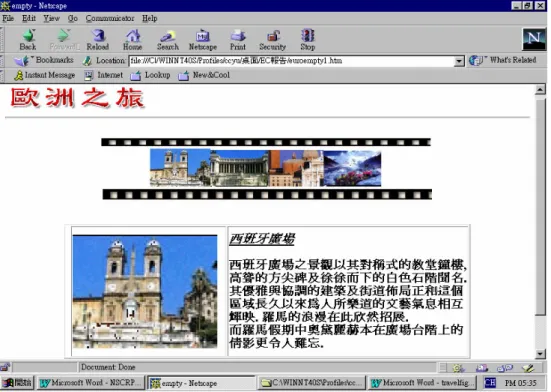
(1)同 界 (In with left/right or up/down adjacency)(|-、-|):A、B的某一座標軸(水 平或垂直)某一邊界(左、右或上、下)點 座標相同,A(X|-)B表示A、B的X軸左邊 界相同, (2)相交(Overlaps)(>+):A(X>+)B表示A、B X軸重疊,即A左邊界在B左邊界之右且 部份範圍重疊, (3)相接(Adjacency, or Meets)(>=):A(X>=)B 表示A、B X軸緊鄰,即A左邊界與B右 邊界接觸, (4)相離(Disjoint, or After)(>>):A(X>>)B表 示A、BX軸隔開,即A左邊界在B右邊界 之右且隔一段距離, (5)相等(Equals)(==):A(X==)B表示X軸上A 重合覆蓋B,即A、B在X軸上範圍及左、 右邊界相同, (6)內含(Within)(><):A(X><)B表示X軸上A 內含於B,即X軸上A範圍在B範圍左、 右邊界之內等。 而A、B二物件間的空間性距離則可定為兩 物件左上角座標在X及Y軸上位置的差。 展現運算結構的重點除上列時間、空 間性關係的描述外,亦著重在描述時間、 空間變動或相關事件(event)啟動下,多媒 體文件內容物件在展現過程中,展現單位 (如畫面)內之物件及相互之間有關時間、空 間數值變動的運算關係,包括位置(絕對、 相對)、範圍、方向、速度的變化等。運算 關係中又包括參數輸入、運算程序處理及 結果輸出等。圖2顯示展現運算結構的物件 導向資料模式,包括展現物件的一元關 係、二元關係、及運算關係等,以及各項 相關的運算子。 根據上述展現運算結構的物件導向資 料模式,即可使用物件導向資料庫管理系 統(OODBMS)或擴充關聯式資料庫管理系 統(ERDBMS)來建立可記錄展現運算關係 的資料庫。而其中運算關係的執行則可透 過應用發展語言如ASP(Active Server Page) 及文件劇本語言如Java或VB script等來處 理。執行多媒體文件內容展現時,只需依 展現運算關係之執行順序,取出資料、連 結媒體驅動及播放程式等,便可完整呈現 所定義之文件展現內容及流程。展現運算 關係的定義、修改及資料庫輸入,則可透 過設計並提供相關功能的系列使用者畫面 及介面來完成,方便於動態及自動化之展 現處理,使不必經常重新編輯、排版及儲 存整份文件內容及標記檔。 以圖3之影像走馬燈畫面為例,圖中所 含的內容物件及展現格式已定,包括:畫 面左上方歐洲之旅文字標題A,畫面中央走 馬燈區邊界橫條B和C、走馬燈區內四個縮 小圖片顯示物件D1-D4(共有O1-O8八張縮 小圖片但每個時間單位只輪流顯示相鄰四 張),畫面下半部與走馬燈區內最左邊圖片 D1同步呈現的同張且放大的圖片E、與放 大圖片同步且內容對應的文字說明F等。內 容物件間之展現運算關係如下: (1)時間性及空間性二元關係 B[(==),(X>+/dx),(Y>>/dy)]A, C[(==),(X==),(Y>>/dy)]B, Di[(==),(X></dx),(Y>>/dy)]B, i=1,..,4, Di[(==),(X>=),(Y==)]Di+1, i=1,..,3, E[(==),(X>+/dx),(Y>>/dy)]C, F[(==),(X>>/dx),(Y==)]E, (2)時空運算關係 Given d, r (d=走馬燈轉換速度, r=走馬燈 轉換方向, 0=由右至左, 1=由左至右) For n = 1 to N t(event) = nd (given d =走馬燈轉換速 度) k = n mod 8 (即 k = n/8之餘數) If k = 0 then k = 8 For m = 1 to 4 If r = 0 then Dm = Ok else D5-m = Ok k = k + 1 If k > 8 then k = k – 8
Continue If r = 0 then E = D1 else E = D4 Continue 上述關係一經建置存檔後,只要改變 展現運算關係的輸入設定,如走馬燈轉換 的速度、方向,或其他時間性、空間性的 屬性及二元關係等,即可重新依新的關係 設定展現畫面。 2、模式及知識運算結構 模式及知識運算結構的設計必須同時 考慮到模式管理及知識管理方面的課題。 (1)模式管理方面 就模式管理方面而言,模式的類別含一般 化問題解決(Problem solving)模式及特定應 用決策模式。一般化解題模式如多準則評 估模式(Multi-criteria evaluation model)、試 算表模式(Spreadsheet model)、模擬模式 (Simulation model)、迴歸分析(Regression analysis)及其他統計分析模式、線性規劃 (Linear programming)及其他最佳化數量規 劃模式等。特定應用決策模式則如產品及 服務計價模式、廣告績效評估模式、投資 組合模式、證券市場分析模式、信用評等 模式、拍賣及競標模式等等。每一種模式 都具有各自的模式型態、屬性及模式運算 關係。因此,模式運算結構包括模式屬性 結構及模式運算關係結構,而模式運算關 係結構中又包括模式輸入、模式輸出及模 式處理等結構。以線性規劃模式為例,其 模式輸入結構包括最佳化方式(最大化或 最小化)、決策變數(變數個數及名稱)、目 標函數(參數及關係)、限制條件及界限(限 制條件數、限制條件式參數及右邊項界限) 等;模式輸出結構包括最佳目標值及決策 變數值;模式處理結構則包括解題程序之 演 算 法 如 修 訂 單 體 法 (Revised Simplex method) 、 對 偶 單 體 法 (Dual-Simplex method) 、 及 內 點 趨 近 法 (Interior point approximation method, or projective scaling algorithm)等。 (2)知識管理方面 就知識管理方面而言,知識表現方法及表 現模式不同,知識推論的方法也不盡相 同 。 知 識 表 現 方 法 及 模 式 如 述 語 邏 輯 (Predicate logic)、框架(Frames)、語意網路 (Semantic networks) 、 及 規 則 基 底 (Rule-based)模式等。特定應用領域的專家知識組 成知識集,需確認知識表現模式之型態、 領域知識屬性及知識運算關係。因此,知 識運算結構包括知識屬性結構及知識運算 關係結構,而知識運算關係結構則又包括 知識輸入、知識輸出及知識處理等結構。 以規則基底模式為例,知識輸入結構包括 前提及事實之內容值或數據;知識輸出結 構包括推論結果值或數據;知識處理結構 則包括規則推論(Rule inferencing)演算法 如前推鏈結(Forward chaining)或後推鏈結 (Backward chaining)法等。 圖4顯示模式及知識運算結構的物件 導向資料模式,包括模式運算結構及知識 運算結構,次一層模式、知識相關之屬性 及運算關係結構,以及運算關係結構中之 輸入、輸出及處理結構等。 根據上述模式及知識運算結構的物件 導向資料模式,即可分別建立資料庫、模 式庫及知識庫來支援模式運算及知識運算 功能。而模式或知識運算關係的啟動與執 行則可透過幾種不同方式來達成:(a)共同 通路介面(Common Gateway Interface, CGI) 及外部模式或知識運算程式,(b)文件應用 發展語言及劇本語言內建之模式或知識運 算程式,(c)智慧型代理人及網路上之模式 或知識運算伺服器等。實際執行特定應用 之模式或知識運算時,只需依運算關係之 輸入、處理與輸出程序,輸入特定應用相 關資料,連結、驅動並執行對應之運算程 式,即可獲得並輸出運算之結果。使用者 可評估運算結果,必要時可修改輸入資 料,重複執行運算並比較結果。 以圖5之旅遊行程規劃決策支援功能 畫面為例,使用者可在選定旅遊區域後,
再輸入天數、價格、食宿等級、出發日期 及景點特色等評估項目的範圍與權重,並 指明符合度下限,便可透過旅遊行程資料 庫查詢及多準則評估模式的運算,輸出滿 足符合度限制的行程結果,供使用者進一 步鏈結並瀏覽旅行社及行程內容等細部資 料。其中,多準則評估模式各評估項目得 分的計算方法也可透使用者介面來設定及 修改,舉例如下: (a) 天數項目 某一行程的天數與使用者輸入的天數 範圍完全吻合,則該項得分100,否則g 上下每差一天扣減10分。 (b) 價格項目 某一行程的價格與使用者輸入的價格 範圍差距5000元內,則該項得100分, 否則每超過5000元級距扣減20分。 (c) 食宿等級項目 某一行程的食宿等級與使用者輸入者 相同或較高,則該項得100分,否則每 低一級扣減20分。 (d) 出發日期項目 某一行程的出發日期在使用者輸入的 日期範圍內,則該項得100分,否則前 後每超過3天遞減20分。 (e) 景點特色項目 某一行程的景點特色包含使用者輸入 的景點特色,則該項得100分,否則每 少列一個扣減的分數為: (100)/(使用者 輸入的景點特色個數)的整數。 最後每個行程的總分即為各評估項目 得分乘上該項目權數後的加總。只有總分 大於等於使用者符合度限制的行程資料才 會被納入輸出的推薦行程清單中。 四、計畫成果自評 本研究屬整合性技術與應用研究,在 技術發展及整合上,具有學術及實務的價 值與建置複雜度。本研究所提出之超媒體 文件之運算結構、資料模式、資料庫方法 等,透過實體環境上的原型系統發展,驗 證其可行性及績效。綜合而言,本研究計 畫所完成之工作項目及具體成果如下: 1、確定超媒體文件內容物件之運算行為及 分類並建立結構關係。 2、建立超媒體文件運算結構之物件導向資 料模式,能界定及表現運算結構之類別 關係。 3、建立超媒體文件內容及運算結構之多媒 體資料庫,以定義及存取超媒體文件之 內容及運算物件。 4、建立超媒體文件內容及運算結構之系統 作業環境,整合軟硬體及通訊網路,以 利系統開發及應用。 5、發展超媒體文件應用資訊系統原型--旅 遊服務資訊系統,以驗證運算結構之整 體模式、資料庫、作業流程、及實體環 境的可行性,並顯示其實用價值。 本研究計畫之成果整合並推展了以往 研究的架構與結果,為超媒體文件運算結 構之模式及資料庫的設計與應用提供了具 體可行的方法與流程,具有學術及實務應 用的價值。已達成原期望目標並有所延 伸,可整理成學術論文發表並推廣應用。 參與研究工作之人員,亦獲得各項研究工 作的深入及整合作業經驗。 參考文獻
[1] Allen, J., “Maintaining Knowledge about Temporal Intervals,” Commun. ACM, 26(11), November 1983, pp.832-843
[2] Andrea, L., David, R. and John, L., The VRML Source Book, John Wiley&Sons, Canada, 1996 [3] Barron, D., “Portable Documents: Problems and
(Partial) Solutions,” Electronic Publishing, 8(4), December 1995, pp.343-367
[4] Berra, P. B., et. al., “Architecture for Distributed Multimedia Database Systems,” Comput. Commun., 13(4), May 1990, pp.217-231
[5] Bormann, U. and Bormann, C., "Standards for Open Document Processing: Current State and Future Developments," Computer Networks and ISDN Systems, 21, 1991, pp. 149-163.
[6] Bosak, J., “Overview: XML, HTML and all that,” http://sunsite.unc.edu/pub/sun-info/standards/ reports/www6/overview.zip, April 1997
[7] Bray, T., Paoli, J., and Sperberg-McQueen, C., “Extensible Markup Language (XML),” http://www.w3.org/pub/WWW/TR/WD-xml.html,
August 1997.
[8] Brary, T. and DeRose, S., “Extensible Markup Language(XML): Part 2. Linking,” http://www. w3.org/pub/WWW/TR/WD-xml-link.html, July 1997.
[9] Brown, H. and Cole, F., “The Office Document Architecture and Hypermedia,” Hypermedia /Hypertext and Object-Oriented Databases, Chapman&Hall, 1991, pp.237-256.
[10] Bulterman, D. C. A., “Embedded Video in Hypermedia Documents: Supporting Integration and Adaptive Control,” ACM Trans. Info. Syst.,
13)4), Oct. 1995, pp. 440-470.
[11] Campbell, B. and Goodman, J., “HAM: A General Purpose Hypertext Abstract Machine,”
Commun. ACM, 31(7), July 1988, pp.856-861. [12] Christodoulakis, S., Theodoridou, M., Ho, F.,
Papa, M., and Pathria, A., "Multimedia Document Presentation, Information Extraction, and Document Formation in MINOS," ACM Trans. Off.Info.Syst., 4(4), Oct. 1986, pp. 345-383. [13] Colaitis, F., “Opening Up Multimedia Object
Exchange with MHEG,” IEEE Multimedia, Summer 1994, pp.80-84.
[14] Comerford, R., “The Internet,” IEEE Spectrum, Jan. 2000, pp.40-44.
[15] Conklin, J., “Hypertext: An Introduction and Survey,”IEEE Computer, 2(9), September 1987, pp.17-41.
[16] Courtiat, J. P., Diaz, M., De Oliveira, R. C., and Senac, P., “Formal Models for the Description of Timed Behaviors of Multimedia and Hypermedia Distributed Systems,” Comput. Commun., 19, 1996, pp. 1134-1150.
[17] De Bra, P., Houben, G. J., and Kornatzky, Y., “An Extensible Data Model for Hyperdocuments,” Proc. ACM Hypertext’92, December 1992, pp.222-231
[18] DeRose, S. and Durand, G., Making Hypermedia Work: A User’s Guide to HyTime, Kluwer Academic, Mass, 1994
[19] Erfle, R., “Specification of Temporal Constraints in Multimedia Documents Using HyTime,”
Electronic Publishing, 6(4), December 1993, pp.397-411
[20] Furht, B., "Multimedia Systems: An Overview,"
IEEE Multimedia,Spring 1994, pp. 47-59. [21] Furman, S. et al. and Isaacs, S. et al., “Positioning
HTML Elements with Cascading Style Sheets,” http://www.w3.org/pub/WWW/ TR/WD-positioning.html, January 1997
[22] Garzotto, F., Mainetti, L. and Paolini, P., “Hypermedia Design, Analysis, and Evaluation Issues,” Commun. ACM, 38(8), August 1995, pp.74-86.
[23] Garzotto, F., Paolini, P., and Schwabe, D., "HDM--A Model-Based Approach to Hypertext
Application Design," ACM Trans. Info. Syst., 11(1), Jan. 1993, pp. 1-26.
[24] Gaviotis, I. and Christodoulakis, D., "Architectural Requirements for Open Distributed Hypermedia," Info. and Soft. Tech., 37(4), 1995, pp. 245-251.
[25] Ghafoor, A., “Multimedia Database Management Systems,”ACM Comput. Surv., 27(4), December 1995, pp.593-598.
[26] Ginige, A., Lowe, D. B., and Robertson, J., "Hypermedia Authoring," IEEE Multimedia, Winter 1995, pp. 24-35.
[27] Golshani, F. and Dimitrova, M., “Retrivel and Delivery of Information in Multimedia Database Systems,” Info. and Soft. Tech., 36(4), 1994, pp.235-242.
[28] Grosky, W. I., "Multimedia Information Systems," IEEE Multimedia, Spring 1994, pp. 12-24.
[29] Haan, B., Kahn, P., Riley, V., Coombs, J. and Meyrowitz, N., “IRIS Hypermedia Services,”
Commun. ACM, 35(1), January 1992, pp.36-51 [30] Hakon, L. and Bert, B., “Cascading Style Sheets,
Level 1,” http://www.w3.org/pub/WWW/TR/ REC CSS1.html, December 1996
[31] Halasz, F., ‘Reflections on Notecards: Seven Issues for the Next Generation of Hypermedia Systems,“ Commun. ACM, 31(7), August 1988, pp.836-852
[32] Halasz, F. and Schwartz, M., “The Dexter Hypertext Reference Model,” Commun. ACM, 37(2), February 1994, pp.30-39
[33] Hall, W. and Davis, H., “Hypermedia Link Services and Their Application to Multimedia Information Management,” Inf. and Soft. Tech., 36(4), 1994, pp.197-202
[34] Hardman, L., Bulterman, D. and Rossum, G., “The Amsterdam Hypermedia Model: Adding Time and Context to the Dexter Model,”Commun. ACM, 37(2), February 1994, pp.50-62
[35] Hatzimanikatis, A., Gaviotis, I. and Christodoulakis, D., “Distributed Documents: An Architecture for Open Distributed Hypertext,”
Electronic Publishing, 7(1), March 1994, pp.35-48.
[36] Herman, I., Reynolds, G. J., and van Loo, J., “Premo: An Emerging Standard for Multimedia Presentation, Part I: Overview and Framework,”
IEEE Multimedia, Fall 1996, pp. 83-89.
[37] Herwijnen, E., Practical SGML, 2nd edi., Kluwer Academic Publishers, 1994.
[38] Hirzalla, N., Falchuk, B. and Karmouch, A., “A Temporal Model for Interactive Multimedia Scenarios,” IEEE Multimedia, Fall 1995, pp.24-31.
[39] Hirzalla, N..and Karmouch, A., “A data Model and a Query Language for Multimedia Documents Databases,”Multimedia Systems, 7, 1999,
pp.24-31.
[40] Huang, C. M. and Chu, Y. F., “An ODA-Like Multimedia Document System,”Soft.-Pract. and Exper., 26(10), Oct. 1996, pp. 1097-1126. [41] Hunter, R., Kaijser P. and Nielsen, F., “ODA: a
Document Architecture for Open Systems,”
Comput. Commun., 12(2), April 1989, pp.69-79 [42] Iino, M., Day, Y. and Ghafoor, A., “An
Object-Oriented Model for Spatio-Temporal Synchronization of Multimedia Information,”
Proc. IEEE International Conference Multimedia Computing and Systems, May 1994, pp.110-119. [43] ISO/MPEG N2728, Applications for MPEG-7,
MPEG Requirements Group, ISO, Geneva, March 1999, http://www.darmstadt.gmd.de/ mobile/MPEG7/Documents/N2728.html.
[44] ISO/MPEG N2729, MPEG-7 Context and Objectives, MPEG Requirements Group, ISO, Geneva, March 1999, http://www.darmstadt. gmd.de /mobile/MPEG7/Documents/N2729.html. [45] John, B. and Stephen, F., “Hypertext ???”,
Commun. ACM 31(7), July 1988, pp.816-819 [46] John, F., Multimedia Systems, ACM Press, New
York, 1994, pp.265-283
[47] Karmouch, A. and Emery, J., ‘A Playback Schedule Model for Multimedia Documents,,
IEEE Multimedia, Spring 1996, pp.50-61
[48] Khalfallah, H. and Karmouch, A., ‘An Architecture and a Data Model for Integrated Multimedia Documents and Presentational Applications,’Multimedia Syst. 3, 1995, pp.238-250.
[49] Kilov, H. and Cuthbert, L., "A Model for Document Management," Comput. Commun., 16(6), June 1995, pp. 408-417.
[50] Klas, W., Neuhold, E. and Schrefl, M., “Using an Object-Oriented Approach to Model Multimedia Data,” Comput. Commun., 13(4), May 1990, pp.204-216.
[51] Kretz, F. and Colaitis, F., "Standardizing Hypermedia Information Objects," IEEE Communications Magazine, May 1992, pp. 60-70.
[52] Lange, D., “An Object-Oriented Design Method for Hypermedia Information Systems,"
Proceedings of the 27th Annual Hawaii International Conference on System Sciences, 1994, pp. 366-375.
[53] Leggett, L. and Schnase, J., “Viewing Dexter with Open Eyes,” Commun. ACM, 37(2), February 1994, pp.77-86.
[54] Linthicum, D. S., "Creating Compound Document Standards," Open Computing, Jan. 1995, pp. 55-60.
[55] Little, T. D. C. and Ghafoor, A., “Synchronization and Storage Models for Multimedia Objects,”
IEEE J. Selected Areas in Commun., 8(3), April 1990, pp.413-427
[56] Little, T. D. C. and Ghafoor, A., “Spatio-Temporal Composition of Distributed Multimedia Objects for Value-Added Networks,” IEEE Computer, 24(10), October 1991, pp.42-50 [57] Little, T. D. C. and Ghafoor, A., “Interval-Based
Conceptual Models for Time-Dependent Multimedia Data,” IEEE Trans. on Knowledge and Data Engineering, 5(4), August 1993, pp.551-563.
[58] Macnee, C. A., Behrendt, W., Kalmus, J. R., Jeffery, K. G., and Wilson, M. D., “Presenting Dynamically Expandable Hypermedia,” Info. and Soft. Tech., 37(7), 1995, pp. 339-350.
[59] Martin B. and Man-Sze L., “Document Interchange Standards,” http://www2.echo.lu/oii/ en/docstand.html, July 1997
[60] Martin B. and Man-Sze L., “Multimedia/ Hypermedia Interchange Standards,” http:// www2.echo.lu /oii/en/moving.html, July 1997. [61] Masunaga, Y., "Design Issues of OMEGA: An
Object-Oriented Multimedia Database Management System," Journal of Information Processing, 14(1), 1991, pp. 60-74.
[62] Maurer, H., Scherbakov, N., Andrews, K., and Srinivasan, P., “Object-Oriented Modeling of Hyperstructure: Overcoming the Static Link Deficiency,”Info. and Soft. Techn., 36(6), 1994, pp. 315-322.
[63] McKie, S., "A New Era of Document Management," DBMS, June 1995, pp. 62-70. [64] Meghini, C., Rabitti, F., and Thanos, C.,
“Conceptual Modeling of Multimedia Documents,” IEEE Computer, October 1991, pp.23-29
[65] Meyer-Boudnik, T. and Effelsberg, W., “MHEG Explained,” IEEE Multimedia, Spring 1995, pp.26-38.
[66] Michalski, G. P., "The World of Documents,"
Byte, April 1991, pp. 159-170.
[67] Microsoft Corporation, “Dynamic HTML White Paper,” http://www.microsoft.com/workshop/ prog /aplatfrm/dynhtml.htm, February 1997. [68] Murata, M., “File Format for Documents
Containing Both Logical Structures and Layout Structures,” Electronic Publishing, 8(4), December 1995, pp.295-317.
[69] Nack, F. and Lindsay, A. T., “Everything You Wanted to Know About MPEG-7: Part 1,”IEEE Multimedia, 6(3), July-Sept. 1999, pp. 65-77. [70] Netscape Corporation, “Netscape Communicator/
Dynamic HTML,” http://form.netscape.com /comprod/products/communicator/features/Dynam ic_HTML.html
[71] Newcomb, S. R., Kipp, N. A., and Newcomb, V. T., “The HyTime: Hypermedia/Time-based Document Structure Language,”Commun. ACM, 34(11), November 1991, pp.67-83
Hypermedia,” Hypertext and Hypermedia, Academic Press, 1990, pp.1-14.
[73] O'Docherty, M. H. and Daskalakis, C. N., "Multimedia Information Systems-The Management and Semantic Retrieval of all Electronic Data Types," The Computer Journal,
34(3), 1991, pp. 225-238.
[74] Peterson, J., “Petri Nets”, ACM Comput. Surv., 9(3), September 1977, pp.225-252
[75] Pitkow, J. E. and Jones, R. K., “Supporting the Web: A Distributed Hyperlink Database System,”
Computer Networks and ISDN Systems, 28, 1996, pp.981-991
[76] Prabhakaran, B. and Raghavan, S., “Synchronization Models for Multimedia Presentation with User Participation,”Multimedia Syst., 2, 1994, pp.53-62.
[77] Quint, V., Roisin, C., and Vatton, I., "A Structured Authoring Environment for the World-Wide-Web," Computer Networks and ISDN Systems, 27(6), 1995, pp. 831-840.
[78] Raggett, D., “HTML 3.2 Reference Specification,” http://www.w3.org/pub/WWW/ TR/REC-html32.html, January 1997
[79] Rodriguez, A., Fisher, M. and Markey, B., “Scripting Languages Emerge in Standards Bodies,” IEEE Multimedia, Winter 1995, pp.88-92.
[80] Rosenberg, J., Cruz, G., and Judd, T., "Presenting Multimedia Documents Over a Digital Network,"
Comput. Commun., 15(6), 1992, pp. 377-380. [81] Schnase, J. L., Leggett, J. J., Hicks, D. L., and
Szado, R. L., “Semantic Data Modeling of Hypermedia Associations,” ACM Trans. Info. Syst., 11(1), Jan. 1993, pp. 27-50.
[82] Shelter, T., “Birth of the BLOB,”Byte, February 1990, pp.221-226.
[83] Spring, M. B., “Reference Model for Data Interchange Standards,” IEEE Computer, Aug. 1996, pp. 87-88.
[84] Stotts, P. and Furuta, R., “Petri-Net-Based Hypertext: Document Structure with Browsing Semantics,” ACM Trans. Inf. Syst. 7(1), January 1989, pp.3-29
[85] Steinmets, R., “Synchronization Properties in Multimedia Systems,” IEEE J. Selected Areas in Commun., 8(3), April 1990, pp.401-412.
[86] The CHOROCHRONOS Participants, “CHOROCHRONOS A Research Network for Spatiotemporal Database Systems,” SIGMOD Record, 28(3), Sept. 1999, pp. 12-21.
[87] Tompa, F., “A Data Model for Flexible Hypertext Databases Systems,”ACM Trans. Inf. Syst., 7(1), January 1989, pp.85-100
[88] Vaughan, T., “Chap1: What is Multimedia?”,
Multimedia: Making It Work, 2nd Edition, McGraw-Hill, 1994.
[89] Vazirgiannis, M. and Mourlas, C., "An Object-Oriented Model for Interactive Multimedia Presentation," The Computer Journal, 36(1), 1993, pp. 78-86.
[90] Vazirgiannis, M., Theodorodis, Y., and Sellis, T., “Spatio-Temporal Composition and Indexing for Large Multimedia Applications,” Multimedia Systems, 6, 1998, pp. 284-298.
[91] Vazirgiannis, M., Kostalas, I., and Sellis, T., “Specifying and Authoring Multimedia Scenarios,” IEEE Multimedia, 6(3), July-Sept. 1999, pp. 24-37.
[92] Wang, H. K. and Wu, J. L. C., “Object Model for Hypermedia Applications,” Comput. Commun., 18(7), July 1995, pp.475-485.
[93] Wiil, U. K., "Experiences with HyperBase: A Hypertext Database Supporting Collaborative Work," Sigmod Record, 22(4), Dec. 1993, pp. 19-25.
[94] Woelk, D., Kim, W., and Luther, W. "An Object-Oriented Approach to Multimedia Databases,"
Proceedings of the ACM-SIGMOD'86 Conference, Washington D. C., May 28-30, 1986, pp. 311-325.
[95] Wong, J., Kini, S., and Doobagunta, K., “Synchronization in Specification-Based Multimedia Presentations,” Soft.-Pract. and Exper., 26(1), Jan. 1996, pp. 71-81.
[96] Wong, J., Rao, S., and Ramaiah, N., “A Multimedia Presentation Toolkit for the World Wide Web,”Soft.-Pract. and Exper., 27(4), April 1997, pp. 425-446.
[97] W3C Recommendation, “Synchronized Multimedia Integration Language (SMIL) 1.0 Specification,” 1998, http://www.w3.org/TR/ REC-smil.html.
[98] Yoshitaka, A., Kishida, S., Hirakawa, M. and Ichikawa, T., “Knowledge-Assisted Content-Based Retrieval for Multimedia Databases,”IEEE Multimedia, Winter 1994, pp.12-21
[99] Yu, C. C., "Designing a Multimedia Database for Electronic Publication Systems," Journal of National ChengChi University, 67, Dec. 1993, pp. 743-764.
[100] Yu, C. C., "HESS: A Hypermedia Expert Support System for Intelligent Decision Making,"
Proceedings of the First Asia Pacific Decision Sciences Institute Conference, June 21-22, 1996, Hong Kong, Vol. 3, pp. 1201-1210.
[101] Yu, C. C., "Designing an Intelligent Multimedia Document Database for Digital Library Services,"
Proceedings of the Fourth International Symposium on Real-Time and Media Systems, September 11-12, 1998, Taipei, Taiwan, pp.1-17. [102] Yu, Chien-Chih, “A Multimedia Document
Model for Intelligent and User Support Content-Based Retrieval in Digital Libraries,”
Conference on Internet and Multimedia Systems and Applications, October 18-21, 1999, Nassau, Bahamas, pp. 53-57. [103] 余千智, "多媒體文件群組支援系統之整合性 架構與環境," 國立政治大學學報, 75, 1997年 10月, PP. 75-112. [104] 余千智, "數位圖書館之多媒體文件資料庫設 計與知識輔助內容基底查詢方法," 國科會研 究彙刊:人文及社會科學類, 1999年1月, PP. 42-66.
14 多媒體文件架構 文件主體結構 應用功能結構 文件屬性結構 內容結構 展現結構 運算結構 文字資料結構 非文字資料結構 展現運算結構 模式/知識運算結構 特徵結構 時間/空間資料結構 參考 組合 繼承 圖 1 多媒體文件結構之物件導向資料模式 索引結構 註記結構
15 內容結構 展現結構 一元關係 展現單位 物件關係 圖 2 展現運算結構之物件導向資料模式 展現運算結構 二元關係 時間性 運算關係 參數輸入 空間性 時間性 空間性 程序處理 結果輸出 上移 下移 左移 開始 結束 中止 繼續 右移 放大 縮小 同始 相交 相接 相離 相等 內含 同界 相交 相接 相離 相等 內含 同止 運算結構 參考 組合 繼承
16
17 圖 4 模式/知識運算結構之物件導向資料模式 內容結構 運算結構 運算關係 模式 / 知識 運算結構 模式屬性 推論關係 知識輸入 知識屬性 知識處理 知識輸出 展現結構 文字資料結構 模式運算結構 知識運算結構 模式輸入 模式處理 模式輸出 參考 組合 繼承
18